World

Euro hits two-year low as ECB holds fire

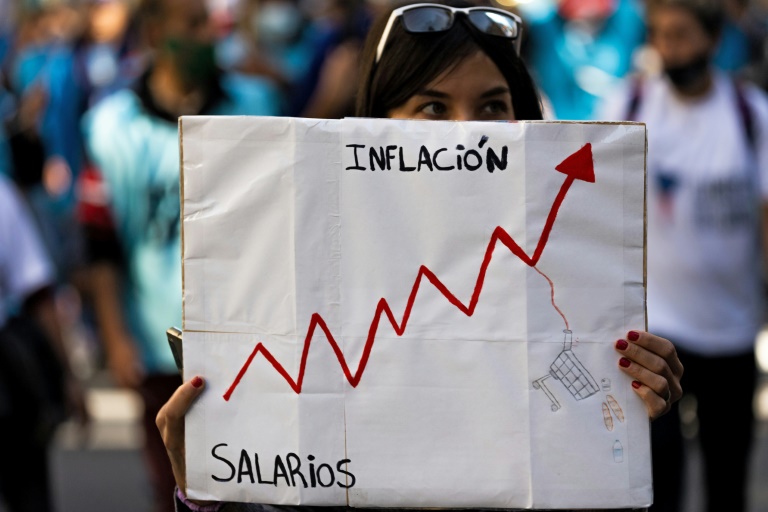
The euro slumped to a near two-year low on Thursday after the European Central Bank remained vague about when it will raise interest rates in the face of soaring inflation.

Meanwhile oil prices, whose recent surge has contributed to inflation around the globe reaching the highest levels in decades, came off the boil.

The ECB stood still in the face of record eurozone inflation, keeping its stimulus plans and rates unchanged, as the war in Ukraine cast a pall over the eurozone economy.

Meeting for the second time since the outbreak of the conflict, the bank’s 25-member governing council stuck to a plan that “should” see its bond-buying scheme come to an end in the third quarter.

An interest rate hike would follow “some time” after the stimulus programme comes to an end, and any increases “will be gradual”. 

The decision leaves the ECB further out of step with many of its peers. Central banks such as the Bank of England, US Federal Reserve and the Bank of Canada have already triggered their first interest rate rises in response to soaring inflation.

The euro took a knock after the ECB’s decision, slipping under $1.08 for the first time since May 2020, falling as low as $1.0758.

The ECB “continues to show little sign of looking to hike rates after leaving rates unchanged at their policy meeting today, while being even handed over the risks facing the eurozone economy,” said market analyst Michael Hewson at CMC Markets UK. 

The ECB’s provided a boost for eurozone stocks, however, which moved into positive territory and ended the day higher.

– Musk Twitter bid –

Wall Street was mixed, with another major bank reporting a big fall in profits and setting aside money due to Russia’s invasion of Ukraine.

Citigroup said its first quarter profits tumbled 46 percent to $4.3 billion, in a similar performance to JPMorgan Chase which reported Wednesday a sharp drop in profits and warned of downside risks from the Ukraine war and surging inflation.

Its shares nevertheless rose 2.1 percent in late morning trading.

Elsewhere on the corporate front, Tesla chief Elon Musk launched a hostile takeover bid for Twitter, offering to buy 100 percent of its stock and take it private, according to a stock exchange filing.

Musk offered $54.20 a share, but the company’s share price was up by around 0.4 percent to $46.03 in late morning trading.

The reaction “appears to suggest little enthusiasm on the part of investors” said Hewson at CMC Markets.

While this may indicate they believe Musk is not serious, Hewson said the share price would likely take a hit if he is rebuffed and dumps his holding. 

“Given the recent share price performance of Twitter they ought to be ripping his arm off, because it’s unlikely they will get a better offer from anybody else,” he said.   

Despite falling Thursday, both main oil contracts stayed firmly above the $100 per barrel mark, with fears swirling about global supply constraints over the invasion of Ukraine by Russia — a major producer of oil and gas.

– Key figures around 1530 GMT –

New York – Dow: UP 0.4 percent at 34,701.82 points

Frankfurt – DAX: UP 0.6 percent at 14,163.8 (close)

Paris – CAC 40: UP 0.7 percent at 6,589.35 (close)

London – FTSE 100: UP 0.5 percent at 7,616.38 (close)

EURO STOXX 50: UP 0.6 percent at 3,785.46

Tokyo – Nikkei 225: UP 1.2 percent at 27,172.00 (close)

Hong Kong – Hang Seng: UP 0.7 percent at 21,518.08 (close)

Shanghai – Composite: UP 1.2 percent at 3,225.64 (close)

Brent North Sea crude: DOWN 0.9 percent at $107.85 per barrel

West Texas Intermediate: DOWN 1.1 percent at $103.13 per barrel

Euro/dollar – DOWN at $1.0803 from $1.0894 at 2100 GMT

Pound/dollar – DOWN at $1.3060 from $1.3109

Euro/pound – DOWN at 82.72 pence from 83.03 pence

Dollar/yen – UP at 125.95 from 125.59
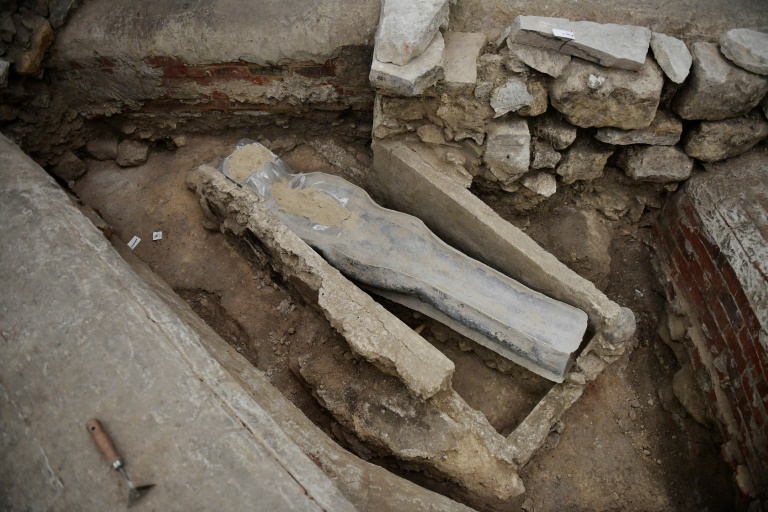
Mystery sarcophagus found in Notre-Dame to be opened

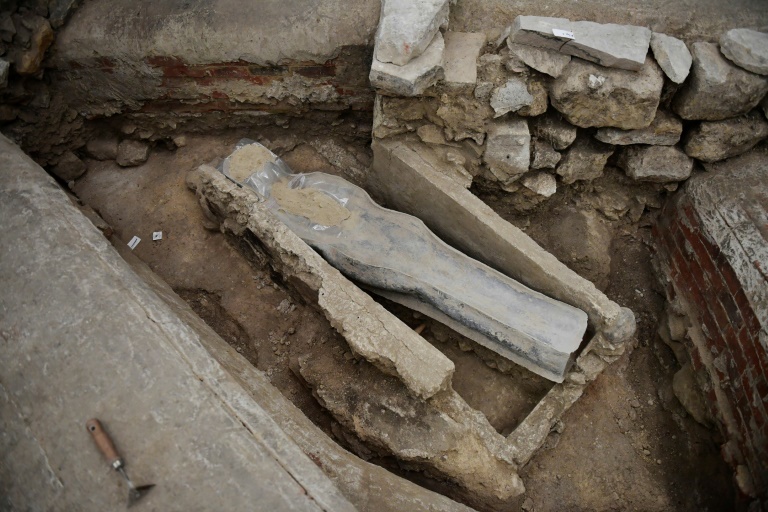
A mysterious leaden sarcophagus discovered in the bowels of Paris’ Notre-Dame cathedral after it was devastated by a fire will soon be opened and its secrets revealed, French archaeologists said Thursday.

The announcement came just a day before the third anniversary of the inferno that engulfed the 12th century Gothic landmark, which shocked the world and led to a massive reconstruction project.

During preparatory work to rebuild the church’s ancient spire last month, workers found the well-preserved sarcophagus buried 20 metres (65 feet) underground, lying among the brick pipes of a 19th century heating system.

But it is believed to be much older — possibly from the 14th century.

Scientists have already peeked into the sarcophagus using an endoscopic camera, revealing the upper part of a skeleton, a pillow of leaves, fabric and as-yet unidentified objects.

The sarcophagus was extracted from the cathedral on Tuesday, France’s INRAP national archaeological research institute said during a press conference.

It is currently being held in a secure location and will be sent “very soon” to the Institute of Forensic Medicine in the southwestern city of Toulouse. 

Forensic experts and scientists will then open the sarcophagus and study its contents, to identify the skeleton’s gender and former state of health, lead archaeologist Christophe Besnier said, adding that carbon dating technology could be used.

Noting that it was found under a mound of earth that had furniture from the 14th century, Besnier said “if it turns out that it is in fact a sarcophagus from the Middle Ages, we are dealing with an extremely rare burial practice”.

They also hope to determine the social rank of the deceased. Given the place and style of burial, they were presumably among the elite of their time.

However, INRAP head Dominique Garcia emphasised that the body will be examined “in compliance” with French laws regarding human remains.

“A human body is not an archaeological object,” he said. “As human remains, the civil code applies and archaeologists will study it as such.”

Once they are done studying the sarcophagus, it will be returned “not as an archaeological object but as an anthropological asset,” Garcia added.

And could Notre-Dame, this unknown person’s home for so many centuries, serve as their final resting place?

INRAP said the possibility of “re-internment” in the cathedral was being studied. 

Mystery sarcophagus found in Notre-Dame to be opened

A mysterious leaden sarcophagus discovered in the bowels of Paris’ Notre-Dame cathedral after it was devastated by a fire will soon be opened and its secrets revealed, French archaeologists said Thursday.

The announcement came just a day before the third anniversary of the inferno that engulfed the 12th century Gothic landmark, which shocked the world and led to a massive reconstruction project.

During preparatory work to rebuild the church’s ancient spire last month, workers found the well-preserved sarcophagus buried 20 metres (65 feet) underground, lying among the brick pipes of a 19th century heating system.

But it is believed to be much older — possibly from the 14th century.

Scientists have already peeked into the sarcophagus using an endoscopic camera, revealing the upper part of a skeleton, a pillow of leaves, fabric and as-yet unidentified objects.

The sarcophagus was extracted from the cathedral on Tuesday, France’s INRAP national archaeological research institute said during a press conference.

It is currently being held in a secure location and will be sent “very soon” to the Institute of Forensic Medicine in the southwestern city of Toulouse. 

Forensic experts and scientists will then open the sarcophagus and study its contents, to identify the skeleton’s gender and former state of health, lead archaeologist Christophe Besnier said, adding that carbon dating technology could be used.

Noting that it was found under a mound of earth that had furniture from the 14th century, Besnier said “if it turns out that it is in fact a sarcophagus from the Middle Ages, we are dealing with an extremely rare burial practice”.

They also hope to determine the social rank of the deceased. Given the place and style of burial, they were presumably among the elite of their time.

However, INRAP head Dominique Garcia emphasised that the body will be examined “in compliance” with French laws regarding human remains.

“A human body is not an archaeological object,” he said. “As human remains, the civil code applies and archaeologists will study it as such.”

Once they are done studying the sarcophagus, it will be returned “not as an archaeological object but as an anthropological asset,” Garcia added.

And could Notre-Dame, this unknown person’s home for so many centuries, serve as their final resting place?

INRAP said the possibility of “re-internment” in the cathedral was being studied. 

War in Ukraine: Latest developments

Here are the latest developments in the war in Ukraine:

– Russian flagship ‘seriously damaged’ but afloat –

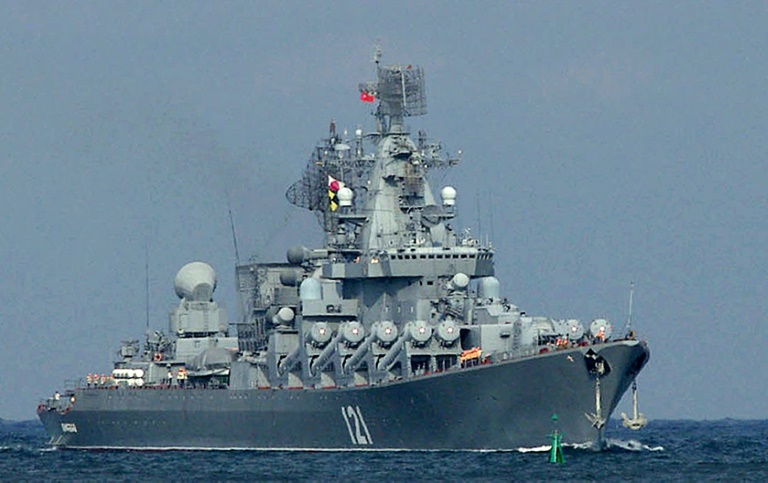
Ukraine claims its missiles struck the Russian navy’s Black Sea flagship, causing a fire that “seriously damaged” the vessel, according to Moscow. 

The Russian defence ministry says the warship, which has been used to launch missiles at Ukraine’s southern coast and interior, remains afloat.

The “Moskva” gained notoriety early in the war when it called on Ukrainian border troops defending the strategic Snake Island to surrender, only to be defiantly refused.

– Russia accuses Ukraine of attacks –

Kyiv rejects Moscow’s claim that it carried out attacks on Russian soil, accusing Moscow of staging “terror attacks” on its own territory to stir up “anti-Ukrainian hysteria” in the country.

Moscow claims Ukraine sent two helicopters across the border to bomb a town in Russia’s southern Bryansk region,

Russia, which had initially reported seven injured in shelling, said at least six residential buildings were damaged and that a toddler was among the injured in the purported helicopter attack.

Elsewhere, the governor of Russia’s Belgorod region claims the village of Spodaryushino, “came under shelling” from the Ukrainian side of the border, and that it and a nearby village had been evacuated as a precaution.

There was no way of immediately verifying the reports.

– Ukraine resumes evacuations –

Ukraine says it is reopening humanitarian corridors through nine routes in the country’s east and south, to facilitate the evacuation of civilians from war-scarred regions after a day-long pause that Kyiv attributed to Russian violations.

– Genocide debate –

Leaders on either side of the Atlantic diverge on whether to label Russia’s actions in Ukraine as “genocide”.

Canadian Prime Minister Justin Trudeau says US President Joe Biden, who has accused Russian President Vladimir Putin of genocide, was “right” in his choice of words.

But French President Emmanuel Macron, who is campaigning for re-election, said such “verbal escalations” were unhelpful, and German Chancellor Olaf Scholz steers clear of using the term. 

– $800 mn US aid package –

The United States unveils a major new package of aid to Ukraine, including equipment such as helicopters, howitzers and armoured personnel carriers.

The package includes equipment Washington had previously refused to provide to Kyiv for fear of escalating the conflict with nuclear-armed Russia.

– Kharkiv offensive continues –

Russia’s offensive on Ukraine’s second city of Kharkiv has claimed a further four lives, governor Oleg Synegubov says. The city near the Russian border has been on the eastern frontline since the start of the war and suffered massive destruction.

– Le Pen for NATO-Moscow rapprochement –

French far-right leader Marine Le Pen says she will back closer ties between NATO and Russia and pull Paris out of the alliance’s military command if elected president in an April 24 runoff with Emmanuel Macron.

Following accusations she is too close to President Vladimir Putin, Le Pen said a “strategic rapprochement” is required and questions need to be asked about the role of the alliance after the end of the Warsaw Pact.

– US warns China –

US Treasury Secretary Janet Yellen warns that China’s stance towards Russia and its invasion of Ukraine could affect countries’ willingness to collaborate and trade with Beijing.

– Prisoner swap –

Ukraine says 30 prisoners of war are being returned to the country as part of the most recent exchange of captives with Russia, following an order from President Volodymyr Zelensky.

It says in a statement on social media the swap involves five officers and 17 servicemen, along with eight civilians, including one woman.

– 4.7 million refugees –

More than 4.7 million Ukrainians have fled their country in the 50 days since Russia invaded, the United Nations says.

ECB sticks to the plan as inflation, Ukraine shake eurozone

The European Central Bank on Thursday stood still in the face of record inflation, keeping its stimulus plans and rates unchanged, as the war in Ukraine cast a pall over the eurozone economy.

Meeting for the second time since the outbreak of the conflict, the bank’s 25-member governing council stuck to a plan that “should” see its bond-buying scheme come to an end in the third quarter, it said. 

An interest rate hike would follow “some time” after the stimulus programme comes to an end — a delay the ECB’s President Christine Lagarde stressed could be “between a week and several months”.

Governors would “assess exactly the timing of the conclusion of our net asset purchases” at the bank’s next meeting in June with the help of new forecasts, Lagarde said.

The decision to stick to its plan leaves the ECB further out of step with many of its peers. 

Central banks such as the Bank of England, US Federal Reserve and the Bank of Canada have already triggered their first interest rate rises in response to soaring inflation.

Calls for the ECB to follow suit as soon as possible from within the governing council have grown stronger as price rises in the eurozone have taken off. 

Year-on-year inflation hit 7.5 percent in March, an all-time high for the currency bloc and well above the bank’s own two-percent target.

The surge owes a great deal to the take off in prices for energy, commodities and food as a result of Russia’s invasion of Ukraine. 

At the same time, high energy costs, added disruptions to supply chains and weaker confidence were “severely affecting” the eurozone economy, Lagarde said in a press conference.

The former French finance minister last week tested positive for Covid and had to dial into the press conference via video link.

– ‘Europe is different’ –

Lagarde conceded that the bank’s forecasts had been “wrong in the past”, as calls increased for the central banks to get out ahead of the inflation wave by raising interest rates.

Minutes from the last ECB meeting in March revealed that many members of the governing council wanted “immediate further steps”.

Central bankers use rate rises as a tool to try and tame inflation, but pulling the trigger too soon risks hurting economic growth.

Any hike would be the ECB’s first in over a decade and would lift rates from their current historic low levels.

The Frankfurt-based institution even set a negative deposit rate of minus 0.5 percent, meaning banks pay to park excess cash at the ECB.

The ECB’s straightforward reiteration of its stimulus planned showed a “somewhat strengthened” commitment to end its bond-buying scheme in the third quarter, said Carsten Brzeski, head of macro at ING bank.

But the status quo stance showed that “Europe is different and the ECB is different” to other countries and central banks, Brzeski said.

The ECB’s gradual plan would see it put an “end to the era of negative interest rates before the end of the year”, he predicted.

– Gas boycott –

Comparing the eurozone with the United States and the policies of the Fed was like “apples and oranges”, Lagarde said.

Just as the risks from the pandemic “have declined”, the European economy will “be more exposed and will suffer more consequences” from the war in Ukraine, she said.

The impact “will depend on how the conflict evolves, on the effect of current sanctions and on possible further measures,” Lagarde said.

Looming over the outlook was the possibility of a stop to supplies of Russian gas, which many eurozone countries rely on heavily to meet their energy needs.

“An abrupt boycott would have a significant impact,” Lagarde said.

While the ECB’s bond-buying stimulus is being phased out, the advent of a fresh crisis has some speculating about the possibility of the bank designing a new tool to contain the impact of the war.

Questioned on the subject, Lagarde simply said the ECB would stay flexible and act “promptly” if new risks emerged and some countries found it harder to finance their response.

Lebanon to demolish blast-hit silos despite victims' protest

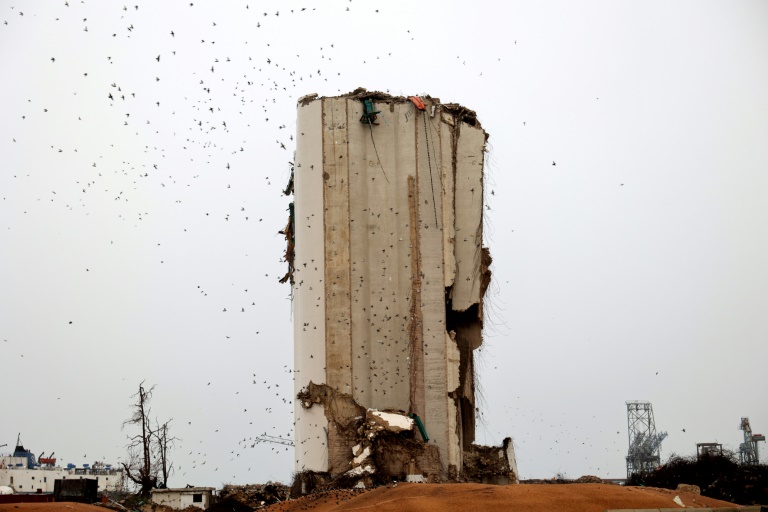
Lebanon on Thursday ordered the demolition of Beirut’s grain silos which are at risk of collapse following a devastating 2020 port explosion, prompting protests from relatives of blast victims who want the silos preserved.

“We tasked the Council for Development and Reconstruction with supervising the demolition process,” Information Minister Ziad Makari said after a cabinet meeting, without specifying a time frame.

Makari said the government’s decision was based on a report by Lebanon’s Khatib and Alami Engineering Company, which warned that the silos in the port of the capital Beirut could collapse within months.

“Repairing them will cost a lot,” Makari said.

Last year, Swiss company Amann Engineering also called for their demolition, saying the most damaged of the silos were tilting at a rate of two millimetres per day (0.08 inches).

Once boasting a capacity of more than 100,000 tonnes, an imposing 48 metre (157 foot) high remnant of the structure has become emblematic of the catastrophic August 4 port blast.

It killed more than 200 people and devastated entire neighbourhoods of the capital in 2020.

Still, the silos absorbed much of the blast’s impact, shielding large swaths of west Beirut from its ravaging effects.

Activists and relatives of blast victims have called for the grain storage facility to be preserved as a memorial site.

Following Thursday’s announcement, relatives of blast victims gathered near the silos to denounce plans for demolition. 

“We demand that the silos remain as a memorial monument that witnessed” one of history’s largest non-nuclear explosions, said a spokesperson for the families, arguing that damaged sections could be reinforced.

The silos should be preserved so that “people can reconcile with their pain,” he said.

To assuage potential anger over the decision, the cabinet on Thursday tasked the interior and culture ministries with erecting a monument commemorating victims of the explosion.

Authorities say the blast was caused by a shipment of ammonium nitrate fertiliser that caught fire after being impounded for years in haphazard conditions.

Investigations into the tragedy have been paused for months over what rights groups and relatives of the victims have decried as political interference.

Human Rights Watch last year accused top officials in government, parliament and the country’s security agencies of deadly negligence that led to the tragedy. 

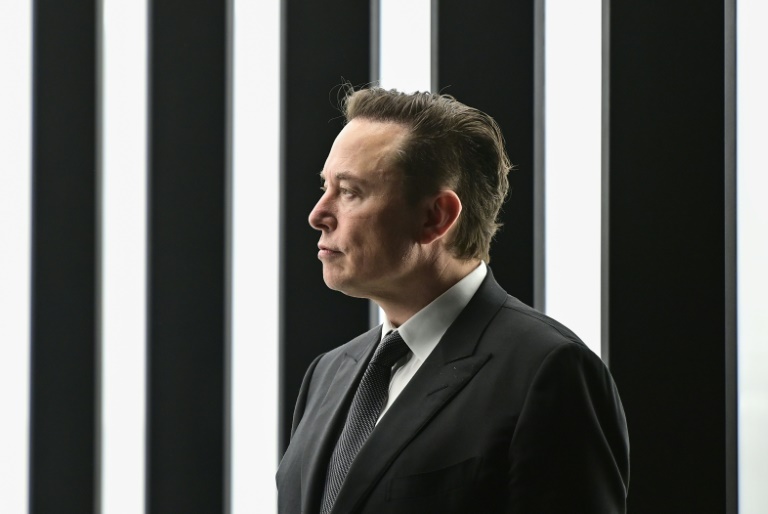
Elon Musk, tech visionary in the spotlight

Space conquest: check. Disrupt the auto industry: check. Take over Twitter? Why not. From eccentric entrepreneur to the world’s richest man, Elon Musk likes to dream big — and these days, he is everywhere you look.

Two decades after banking his first millions, the South-African born Musk last year became the world’s richest person — wresting the title from Amazon’s Jeff Bezos — following the meteoric rise of Tesla, his electric automaker founded in 2003.

The billionaire’s latest big splash: a bid announced Thursday to take over Twitter, capping a rollercoaster fortnight of announcements and counter-announcements — which Musk punctuated, characteristically, by gleefully firing tweets at the platform.

Just a week earlier, the 50-year-old was making headlines as Tesla cut the ribbon on a “gigafactory” the size of 100 soccer fields in Texas, where the firm is now based and Musk himself has relocated from California.

At the same time, his space transport firm SpaceX was breaking yet another boundary as a partner in a three-way venture to send the first fully private mission to the International Space Station.

Musk also makes news of a less flattering kind: Tesla has faced a series of lawsuits alleging discrimination and harassment against Black workers as well as sexual harassment.

In parallel with the whiplash-inducing stream of business news, Musk’s controversy-courting persona — with an unrestrained Twitter style and penchant for living by his own rules in the private sphere too — keeps the gossip press busy.

It recently emerged Musk had had a second child with his on-again off-again partner, the musician Grimes: a girl they named Exa Dark Sideræl Musk — although the parents will mostly call her Y.

He is even expected to make an appearance — in person or not — at the celebrity defamation trial pitting Johnny Depp against his ex-wife Amber Heard, who formerly dated Musk.

But one way or another, Musk has become one of the most ubiquitous figures of the era. So how did he get where he is today?

– To Mars… and beyond? –

Born in Pretoria, on June 28, 1971, the son of an engineer father and a Canadian-born model mother, Musk left South Africa in his late teens to attend Queen’s University in Ontario.

He transferred to the University of Pennsylvania after two years and earned bachelor’s degrees in physics and business.

After graduating from the prestigious Ivy League school, Musk abandoned plans to pursue further studies at Stanford University.

Instead, he dropped out and started Zip2, a company that made online publishing software for the media industry.

He banked his first millions before the age of 30 when he sold Zip2 to US computer maker Compaq for more than $300 million in 1999.

Musk’s next company, X.com, eventually merged with PayPal, the online payments firm bought by internet auction giant eBay for $1.5 billion in 2002.

After leaving PayPal, Musk embarked on a series of ever more ambitious ventures.

He founded SpaceX in 2002 — now serving as its chief executive officer and chief technology officer — and became the chairman of electric carmaker Tesla in 2004.

After some early crashes and near-misses, SpaceX perfected the art of landing booster engines on solid ground and ocean platforms, rendering them reusable, and late last year sent four tourists into space, on the first ever orbital mission with no professional astronauts on board.

Musk’s jokingly-named The Boring Company is touting an ultra-fast “Hyperloop” rail transport system that would transport people at near supersonic speeds.

And Musk has said he wants to make humans an “interplanetary species” by establishing a colony of people living on the Mars.

To this end, SpaceX is developing a prototype rocket, Starship, which it envisages carrying crew and cargo to the Moon, Mars and beyond — with Musk saying he feels “confident” of an orbital test this year.

Musk, who holds US, Canadian and South African citizenship, has been married and divorced three times — once to the Canadian author Justine Wilson and twice to actress Talulah Riley. He has seven children. An eighth child died in infancy.

Forbes estimates Musk’s current net worth at $265 billion.

In online classes, Ukrainians practise language as resistance

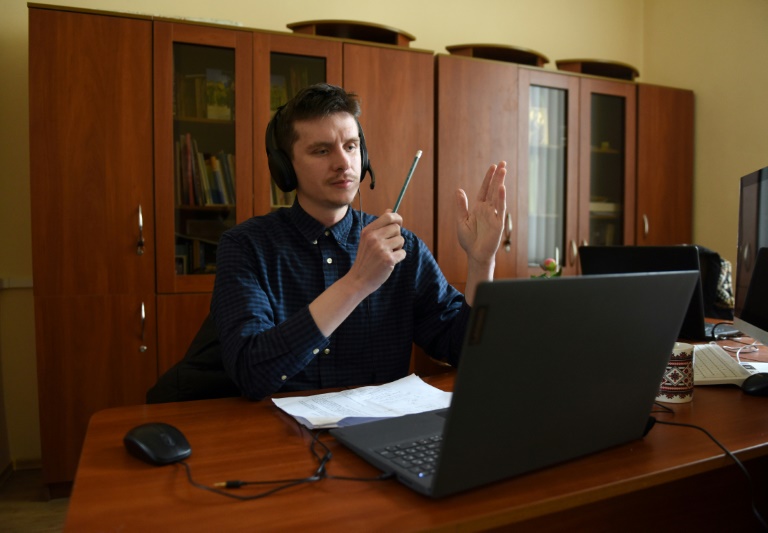
Ukrainian academic Nazar Danchyshyn may not have much fighting experience, but to help his country since the start of the war he has deployed his knowledge of language and poetry.

Twice a week, he flips open his laptop for online classes to help fellow countrymen in the former Soviet nation perfect their Ukrainian speaking skills.

“If we all speak Ukrainian in the future that would be a very powerful weapon against aggression,” the 30-year-old researcher and poet said.

A sizeable minority of Ukrainians speak Russian as their mother tongue, and many more are fluent, brought up under Moscow’s cultural influence, especially in the east and south of the country.

But in recent years, increasingly more people have decided to shift linguistic identity in rejection of Russia’s politics.

Since President Vladimir Putin invaded Ukraine in late February, under the pretext of “de-nazifying” its neighbour and protecting Russian speakers there, the trend has soared.

In the western city of Lviv, where the national language is predominant, a group of academics offers free lessons online to those wishing to brush up on their Ukrainian speaking skills.

Organisers say 1,000 people signed up in just three days, and they have so far only managed to find enough tutors for around 800.

Danchyshyn, who was also a guitar player in a band before the war, is one of those teachers.

“People remember that their grandparents and great-grandparents spoke Ukrainian, and then their families switched to Russian” under the Soviet Union, he said.

“Many wanted to return to their native language.”

– ‘I have my own country’ –

The war in Ukraine has killed thousands and displaced millions at home and abroad over the past seven weeks.

With mounting evidence of likely Russian war crimes, US President Joe Biden on Wednesday accused Moscow of “genocide”.

“It’s become clearer and clearer that Putin is just trying to wipe out the idea of even being able to be a Ukrainian,” the president said.

The conversation classes Danchyshyn gives are online, but organisers say the content is roughly inspired by language textbooks from the Lviv Polytechnic National University.

In their pages appear images of Ukraine’s national hero, 19th-century poet Taras Shevchenko, or modern role models such as Oksana Lyniv, a music conductor from Lviv.

Volodymyr Krasnopolsky, a 52-year-old Russian-speaking academic from the eastern city of Lugansk, is one of Danchyshyn’s students.

After pro-Moscow separatists seized control of Lugansk in 2014, he moved to the small eastern city of Rubizhne.

But the city was hit by a missile on February 24, and he and his daughter — a medic student — spent two weeks sheltering in a basement before they managed to flee westwards.

“There were people of different origins in the bomb shelter with us, but they all felt like Ukrainians,” he told AFP via text message.

“Learning Ukrainian is very important to me because I’m showing the aggressor that I’m a Russian-speaking Ukrainian from a Russian-speaking family, but I don’t need his protection. I have my own country,” he added.

“I believe that the Ukrainian nation is being formed today, regardless of people’s origin,” he said.

– ‘My bullets are words’ –

Yuliya, a school principal and maths teacher, said she had joined the course after the conflict forced her to escape bombardment on Ukraine’s second city Kharkiv near the Russian border.

“I plan to return home as soon as possible,” said the 51-year-old, who teaches in Ukrainian but speaks Russian in her daily life.

But “now is a good time for self-development.”

“I’m fluent in reading and writing in Ukrainian, but I struggle with speaking,” she explained, without giving her surname.

Under the grand ceiling of the Lviv polytechnic, passionate Ukrainian language advocate and one-time lawmaker Iryna Farion said initiating the free classes was part of “the constant struggle of Ukrainians for the right to be Ukrainian”.

Her eyes welled up as she recounted reports that Russians in the southern town of Melitopol had tried last month to force officials to switch the school curriculum to Russian.

“If we do not defend our language, Putin will come here, right into this very building,” she said.

As well as the online classes, she said she was planning to give Ukrainian lessons to the parents of displaced children enrolled at a local school to help them follow their homework.

“This is my frontline. My bullets are words,” she said.

UN says nine million in need of aid in South Sudan

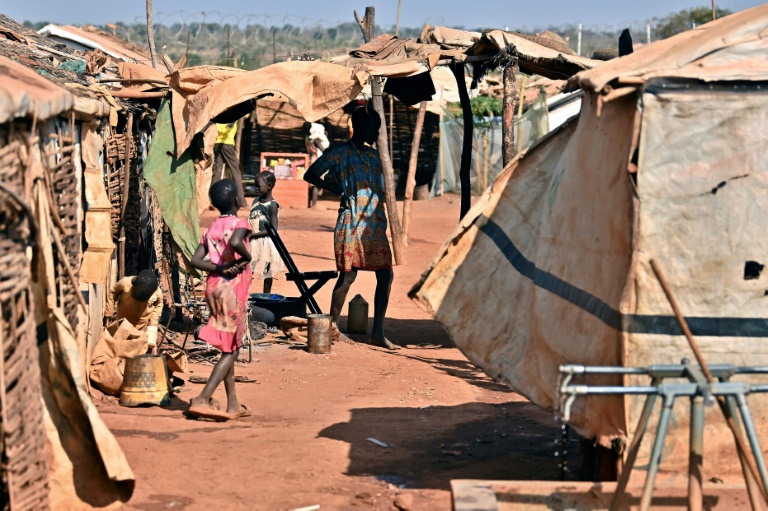
The UN’s envoy to South Sudan warned on Thursday that almost nine million people will be in need of aid this year as the fragile country grapples with a surge in violence between armed factions and a food crisis.

Clashes have flared anew in the world’s youngest nation despite a pledge by President Salva Kiir and his rival, Vice President Riek Machar, to silence their guns and strive towards implementing key provisions of a 2018 peace pact.

Nicholas Haysom, the head of the UN Mission in South Sudan (UNMISS), called on the leaders to step up efforts to quell the violence and urged the international community to channel in more assistance.

“This year two-thirds of the population or almost nine million people — 4.6 million of which are children — will need aid to survive,” Haysom told reporters in the capital Juba. 

“Food insecurity will be widespread. And that is worsening because of climate change, conflict and displacement.”

Haysom said he was “discouraged by the resurgence of sub-national violence,” highlighting the plight of thousands of people driven from their homes by fighting that erupted last week between pro-Kiir and pro-Machar forces in oil-rich Unity State.

The clashes in Leer County sent 14,000 people fleeing, according to the local authorities, while the UN also voiced alarm about reports of sexual violence, looting and destruction of property.

Traditionally a pro-Machar stronghold, Leer was an epicentre of a humanitarian crisis that emerged out of the 2013-2018 civil war, ravaged by violence as well as a famine.

South Sudan has been wracked by instability since independence in 2011 and is still struggling to draw a line under the war that claimed the lives of almost 400,000 people.

– Seeking ‘renewed momentum’ –

Haysom said the upsurge in fighting was increasing the number of people in need of aid and adding to woes from expected flooding in many areas in the coming months.

“Continued and sufficient funding is urgently needed to stop the worst from happening.”

Kiir and Machar earlier this month agreed on the creation of a unified armed forces command — a key component of the peace deal — and Haysom said he hoped it would open a window of opportunity to address the problems the country faces.

“With 10 months left in the transitional period, I am now strongly encouraging all parties to channel renewed momentum towards completing the remaining benchmarks of the peace agreement and to reach an agreement as to when the elections should be held,” Haysom said.

A two-year transition period laid down in the peace accord is due to end in February 2023, with elections due to be held 60 days beforehand.

“If you ask me if the country is ready for elections right now, I would say no… because the technical conditions have not been put in place,” he said, such as the creation of an election management body and an electoral law.

“They cannot be held if this violence is rampant throughout the country,” Haysom added, calling for a “greater level of commitment to peaceful coexistence across the country.”

Crises slowing economic growth worldwide: IMF chief

The war in Ukraine has undercut the global recovery, slowing expected economic growth in most countries in the world, IMF Managing Director Kristalina Georgieva said Thursday.

And beyond the humanitarian tragedy and economic crises, the war has exposed fractures in the international system at a time when global cooperation is the only solution, she said. 

The war hit as the world was struggling to recover from the ongoing impact of the Covid-19 pandemic, and has caused an acceleration of inflation that endangers the gains of the past two years.

“To put it simply: we are facing a crisis on top of a crisis,” Georgieva said in a speech ahead of the spring meetings of the IMF and World Bank.

“The economic consequences from the war spread fast and far, to neighbors and beyond, hitting hardest the world’s most vulnerable people,” she said.

Families already were struggling with higher energy and food prices and “the war has made this much worse.”

The IMF is due to release its updated economic forecasts on Tuesday, which Georgieva said will further downgrade the estimate for global growth that was cut to 4.4 percent in January.

“Since then, the outlook has deteriorated substantially, largely because of the war and its repercussions,” she said, and 143 countries will suffer downgrades.

While most will still achieve positive growth, the future is “extraordinarily uncertain,” and she warned of a deep divide between rich and poor countries.

– ‘Clear and present danger’ –

After a decade of low inflation, prices worldwide have surged amid strong demand for goods that outstripped supply as economies began to return to normal, but the Russian invasion of Ukraine in late February and the sanctions imposed on Moscow pushed fuel and food prices up sharply.

Ukraine and Russia are major grain producers, and Russia also is a key source of energy for Europe.

“The root cause of what we face today is the war and it is the war that must end,” Georgieva said in a discussion following her speech to the Carnegie Endowment for International Peace.

Inflation, which has hit a four-decade high the United States, “has become a clear and present danger,” she said, noting the trend will likely last longer than expected.

“This is a massive setback for the global recovery,” she said.

It also complicates policymaking: major central banks are raising interest rates to contain prices, but that increases borrowing costs for emerging markets and developing nations, which face high debt burdens.

“This is the most universally complex policy environment of our lifetime,” she said.

– ‘Fragmentation’ –

Ending the war and the pandemic are top priorities, but can only be addressed through international cooperation, said Georgieva, who warned of the growing “fragmentation of the world economy into geopolitical blocs.”

The IMF leader, who grew up in Cold War-era Bulgaria, lamented, “I have never thought that I would live to see another war in Europe of the magnitude of the tragedy that is happening in Ukraine.”

She noted that the end of the Cold War ushered in “a new era of rapidly increasing prosperity… because of an integrated global economy.”

Fractures in that system impair the ability to address the current crises and future challenges, but also could cause a “tectonic shift” that would reshape global supply chains.

“The threat to our collective prosperity from a breakdown in global cooperation cannot be overstated,” she said.

Close Bitnami banner
Bitnami