World

Death toll from Philippines landslides, floods hits 117

The death toll from landslides and flooding in the Philippines triggered by tropical storm Megi rose to 117 on Thursday, official figures showed, as more bodies were found in mud-caked villages.

Scores of people are still missing and feared dead after the strongest storm to strike the archipelago nation this year dumped heavy rain over several days, forcing tens of thousands into evacuation centres.

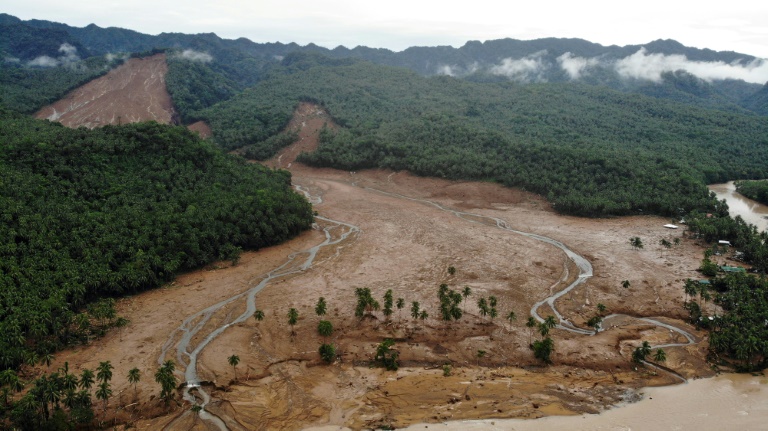
In the central province of Leyte — the worst affected by Megi — devastating landslides smashed farming and fishing communities, wiping out houses and transforming the landscape.

The disaster-prone region is regularly ravaged by storms — including a direct hit from Super Typhoon Haiyan in 2013 — with scientists warning they are becoming more powerful as the world gets warmer because of climate change.

Emergency personnel in Abuyog municipality have retrieved dozens of bodies from the coastal village of Pilar that was destroyed by a landslide on Tuesday.

At least 28 people were killed and around 150 are missing, Abuyog Mayor Lemuel Traya told AFP, adding there was little hope of finding anyone else alive.

Bad weather and thick mud had complicated retrieval efforts in Pilar where the ground was unstable. Searchers were also combing the coastline after some bodies were swept kilometres away by ocean currents.

“This will not end soon, it could go on for days,” Traya warned. 

Many of those who died had hiked up a mountain to avoid flash floods, villagers told AFP. 

“It sounded like a helicopter,” said Pilar councillor Anacleta Canuto, 44, describing the noise made by the landslide.

Canuto, her husband and their two children survived, but they lost at least nine relatives.

Pilar fisherman Santiago Dahonog, 38, said he rushed into the sea with two siblings and a nephew as the landslide hurtled towards them.

“We got out of the house, ran to the water and started swimming,” he told AFP. “I was the only survivor.” 

– Scores missing in Baybay –

Another 86 people were killed and dozens injured in vegetable, rice and coconut-growing villages around Baybay City at the weekend, local authorities said. At least 117 are still missing.

The hardest hit was Kantagnos where 32 people died and 103 have not been found. 

In the nearby village of Bunga, 17 people perished when a wave of sodden soil swept down a hill and slammed into the riverside community. Only a few rooftops are visible in the mud which has started to smell of rotting flesh. 

Three people also drowned on the main southern island of Mindanao, the national disaster agency said in its latest update.

Another three deaths previously reported in the central province of Negros Oriental were dropped from the tally after they were found to be unrelated to the storm. 

Megi struck at the beginning of Holy Week, one of the most important holidays in the mainly Catholic country when thousands travel to visit relatives.

It came four months after a super typhoon devastated swathes of the country, killing more than 400 and leaving hundreds of thousands homeless.

The Philippines — ranked among the most vulnerable nations to the impacts of climate change — is hit by an average of 20 storms every year.

Judge slashes Tesla's damages to ex-employee in racism case

A San Francisco judge on Wednesday slashed the $137 million in damages Tesla was told to pay a former employee in a racial discrimination case down to $15 million but upheld the verdict.

In his ruling, US District Court Judge William Orrick said “the weight of the evidence amply supports the jury’s liability findings” but the damages ordered were “excessive,” citing constitutional limitations on punitive damages set by the Supreme Court.

Tesla was ordered in October to pay Black former employee Owen Diaz $137 million in damages for turning a blind eye to racism the man encountered at the firm’s Silicon Valley auto plant.

Rejecting Tesla’s request for a retrial, Orrick said “Tesla’s indifference to Diaz’s complaints is striking.”

He said the evidence presented to the jurors was “disturbing.”

“The jury heard that the Tesla factory was saturated with racism. Diaz faced frequent racial abuse, including the N-word and other slurs,” the judge wrote.

“His supervisors, and Tesla’s broader management structure, did little or nothing to respond. 

“And supervisors even joined in on the abuse, one going so far as to threaten Diaz and draw a racist caricature near his workstation.”

The original award comprised $130 million in punitive damages and $6.9 million for emotional distress, which Orrick cut to $13.5 million in punitive damages and $1.5 million for emotional harm, “the maximum amount supportable by proof.”

Hired through a staffing agency, Diaz had worked as an elevator operator between June 2015 and July 2016 at the Fremont plant, where he was subjected to racist abuse and a hostile work environment, according to the court filing.

In his lawsuit filed in 2017, Diaz said African-American employees at the factory, where his son also worked, were regularly subjected to racist epithets and derogatory imagery.

Diaz also said that, despite complaints to supervisors, Tesla took no action over the regular racist abuse.

Following the October verdict, Tesla released a blog post by human resources vice president Valerie Capers Workman, which downplayed the allegations of racist abuse in the lawsuit but acknowledged that at the time Diaz worked there, Tesla “was not perfect.”

Workman said Tesla had responded to Diaz’s complaints, firing two contractors and suspending a third.

In February, the California Department of Fair Employment and Housing, which enforces the state’s civil rights laws, sued Tesla over discrimination and harassment against Black workers at the same factory, which the complaint called a “racially segregated workplace.”

The agency said it had received hundreds of complaints from workers at the Fremont plant.

Asian markets rise but inflation, Ukraine fears linger

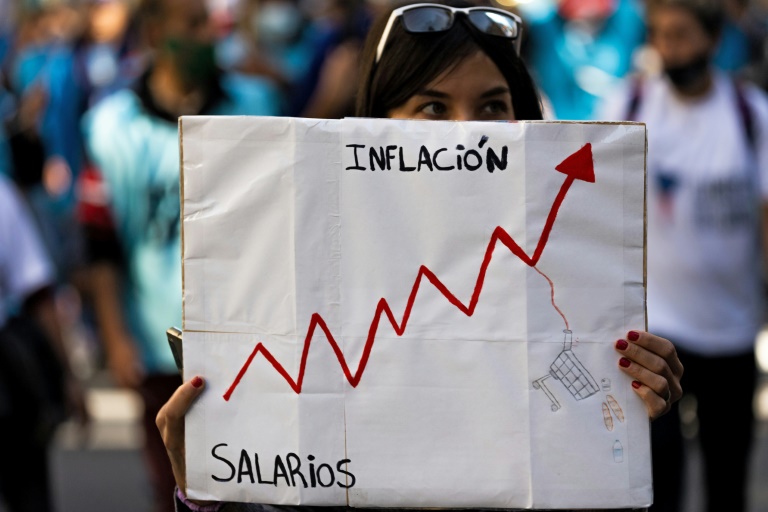
Asian stock markets rose Thursday after a recovery on Wall Street, but investors remained cautious about the ongoing impact of skyrocketing inflation and the war in Ukraine.

Prices were already soaring in major economies when Russia’s invasion of Ukraine sent shockwaves through the global energy, food and commodity markets.

Despite lingering concerns about the US Federal Reserve’s next moves to contain prices, Wall Street enjoyed a buoyant session — especially the tech-rich Nasdaq, which surged 2.0 percent.

Asia was in a similar mood Thursday as Tokyo closed 1.2 percent higher. Hong Kong and Shanghai were also in positive territory.

Sydney rose 0.6 percent as Australia posted its lowest unemployment rate — a smidge under four percent — in 48 years.

Seoul was flat, meanwhile, as South Korea’s central bank raised its key interest rate to the highest level since August 2019 to tame rising inflation.

Analysts had warned overnight that the uncertainty was far from over.

“With a thicker fog of war starting to roll in and engulf the global markets again, it is another worrying setup amid the widespread bearish sentiment out there,” Stephen Innes of SPI Asset Management said in a note.

– ‘Countervailing forces’ –

Data this week from the United States — the world’s biggest economy — and Britain showed inflation at levels not seen in decades.

The grim outlook was reflected in the latest earnings report from JP Morgan Chase, the largest American bank by assets.

“There’s this very strong underlying economy,” its chief executive Jamie Dimon said.

But he pointed to “countervailing forces”, including rising interest rates, inflation and the war in Ukraine.

“And those things are going to collide at one point, probably sometime next year,” he said in a conference call with reporters.

“I’m not predicting a recession… But is it possible? Absolutely.”

Analysts said, however, that markets had welcomed an indication that US inflation may be approaching its peak.

Eyes are also on the European Central Bank as its policy makers meet Thursday, with the outlook for the eurozone economy still murky.

Both main oil contracts stayed above the $100 per barrel mark, with fears swirling about global supply constraints over the invasion of Ukraine by Russia — a major producer of oil and gas.

“The oil complex is heavily fixated on the short-term,” Vandana Hari of Singapore-based Vanda Insights told Bloomberg News.

“The prospect of an EU ban on Russian oil will keep the market on edge as long as Ukraine festers.”

– Key figures around 0630 GMT –

Tokyo – Nikkei 225: UP 1.2 percent at 27,172.00 (close)

Hong Kong – Hang Seng: UP 0.9 percent at 21,555.85

Shanghai – Composite: UP 1.5 percent at 3,233.78

Euro/dollar: UP at 1.0915 from $1.0894 at 2100 GMT

Pound/dollar: UP at $1.3138 from $1.3109

Euro/pound: UP at 83.08 pence from 83.03 pence

Dollar/yen: DOWN at 125.41 from 125.59

Oil – Brent: DOWN 0.6 percent at 108.17 per barrel

Oil – WTI: DOWN 1.0 percent at 103.21 per barrel

New York – Dow: UP 1.0 percent at 34,564.59 (close)

London – FTSE 100: UP 0.1 percent at 7,580.80 (close)

— Bloomberg News contributed to this story —

Russian flagship 'seriously damaged' as Moscow threatens to strike Kyiv

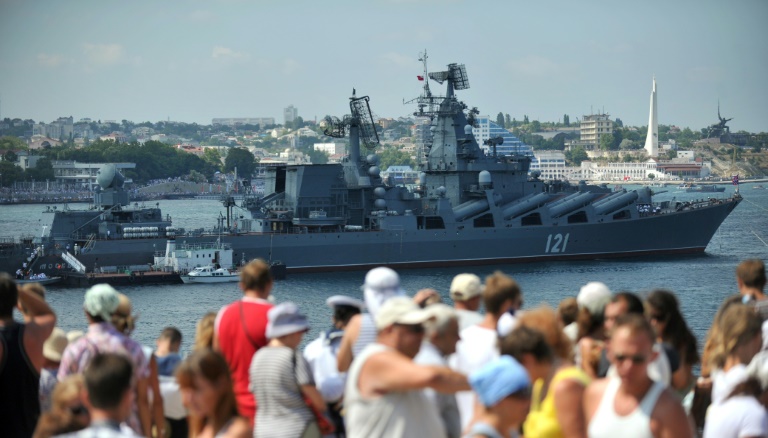
Russia’s Black Sea flagship involved in the naval assault on Ukraine has been “seriously damaged” by an explosion, state media reported Thursday, as Moscow threatened to strike Kyiv’s command centres.

With the war entering its seventh week, US President Joe Biden announced an $800-million military aid package for Ukraine that included helicopters and armoured personnel carriers.

And international prosecutors said the conflict has turned Ukraine into a “crime scene”, suggesting that those responsible could one day face prosecution.

It was unclear what caused the explosion on the Moskva missile cruiser, with both sides giving conflicting reports.

Russia’s defence ministry was quoted as saying the damage was caused by ammunition detonating “as a result of a fire”, adding that the cause of the blaze was being investigated. 

But a spokesman for the Odessa military administration, Sergey Bratchuk, said on Telegram that “according to available data, the cause of the ‘serious damage’ was ‘Neptune’ domestic cruise missiles”. 

The governor of Odessa also said Ukrainian forces had hit the vessel with missile strikes, while presidential advisor Oleksiy Arestovych said “we don’t understand what happened”.

Moscow’s Black Sea fleet is blockading Mariupol and off the coast of Odessa, and its ships have been used to bombard coastal cities.

The Moskva gained notoriety early in the war when it called on Ukrainian border troops defending the strategic Snake Island to surrender, only to be defiantly refused.

It was previously deployed in the Syria conflict where it served as naval protection for the Russian forces’ Hmeimim airbase. 

The crew had been evacuated, the Russian defence ministry told state media, but “the ship was seriously damaged”.

Having initially expected to swiftly overcome its neighbour, Russia has faced fierce resistance and now even reprisals in its own territory — leading Moscow Wednesday to threaten to strike command centres in Kyiv if Ukraine continues to launch attacks on Russian soil.

The warning sparked alarm in Kyiv, which had been experiencing some respite after Russian forces withdrew from the region after failing to secure the capital. 

It had been believed that Moscow was refocusing its war aims to the south and east of the country, with Ukrainian authorities warning of bloody new clashes to come in the eastern Donbas region. 

The aid package unveiled Wednesday by the United States includes armoured personnel carriers and helicopters, as well as some equipment Washington had previously refused to send to Ukraine for fear of escalating the conflict with nuclear-armed Russia.

The Pentagon said it was looking to provide Ukraine with weapons that would “give them a little more range and distance,” as the country prepares for an escalation of violence. 

– No electricity, no water –

More than 40,000 people have left the country in the past 24 hours in a desperate attempt to flee the expected offensive, the United Nations said Wednesday.

This brings those displaced abroad to 4.6 million since the conflict began.

The anticipated Russian onslaught is an apparent attempt to create an unbroken corridor from occupied Crimea to Donbas, where Russian-backed separatists control the Donetsk and Lugansk regions.

Part of that push involves taking the key southern port of Mariupol, which Ukrainian forces have struggled to hold and where President Volodymyr Zelensky estimates “tens of thousands” of civilians have died.

Russia’s defence ministry said Wednesday more than 1,000 Ukrainian soldiers had surrendered in the city, as air strikes targeted the huge Azovstal iron and steel works.

Also in the crosshairs is Severodonetsk — the last easterly city still held by Ukrainian forces — where residents have endured heavy shelling as they pledge not to flee.

About 400 civilians have been buried there since the war began, according to the Ukrainian governor of the Lugansk region Sergiy Gaiday, with locals now grimly awaiting the Russian attack. 

“There’s no electricity, no water,” resident Maria, who lives with her husband and mother-in-law, told AFP. “But I prefer to stay here, at home. If we leave, where will we go?”

“The bombings? It’s like this all the time,” Maria said as explosions thundered in the distance.

– ‘Our citizens are murdered’ –

In areas that Russian forces have withdrawn from, officials and residents are piecing together the extent of the devastation left behind. 

The Hague-based International Criminal Court, which deals with rights abuses, has dispatched investigators to Ukraine and told reporters the country had become a “crime scene.”

“We’re here because we have reasonable grounds to believe that crimes within the jurisdiction of the court are being committed,” the ICC’s chief prosecutor Karim Khan said on a visit to Bucha, a town now synonymous with scores of atrocities alleged to have been committed by Russian troops. 

Officials in Bucha say more than 400 people were found dead there, with 25 rapes reported.

In nearby Gostomel, up to 400 people are unaccounted for, said regional prosecutor Andiy Tkach. 

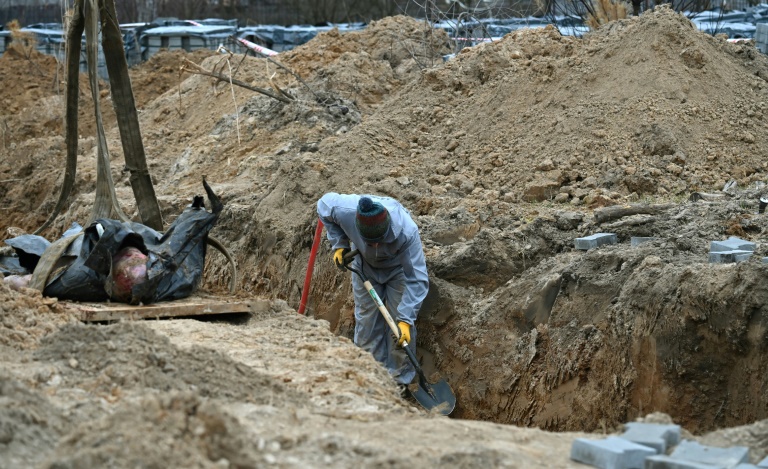
AFP witnessed dozens of body bags filling a refrigerated lorry trailer, as two others awaited more corpses. 

“Our citizens are murdered and we must bury every person in the right way,” said Igor Karpishen, loading the truck.

Ukrainian authorities say Russian troops continue to kill civilians in areas they still occupy. 

On Wednesday Ukrainian prosecutors accused soldiers of shooting six men and one woman in a home in the occupied southern village of Pravdyne the day before. 

Another four civilians were killed in Russian strikes on the second city of Kharkiv on Wednesday, local authorities said.

These and other alleged atrocities have led Biden to accuse President Vladimir Putin of genocide — a claim dismissed as “unacceptable” by the Kremlin.

Canadian Prime Minister Justin Trudeau backed Biden but France and Germany declined to follow suit, drawing the ire of Zelensky, who denounced French leader Emmanuel Macron’s stance as “very painful for us”. 

burs-oho/reb/je

North Korea's tests stir nuclear debate in South

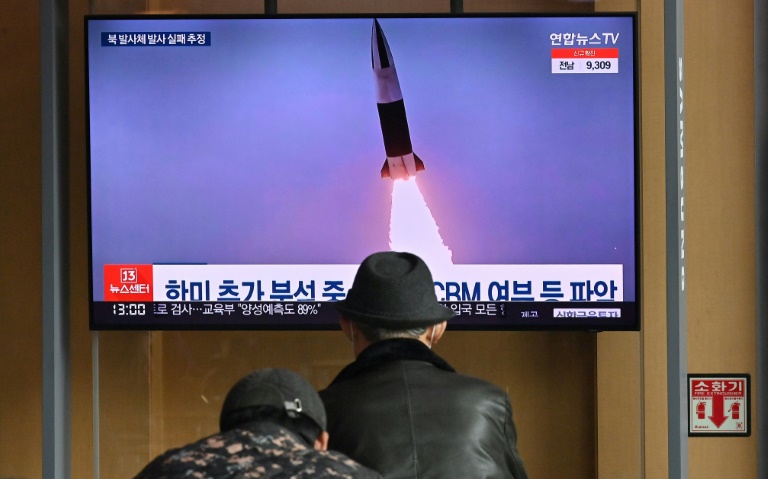
After firing its largest-ever missile, North Korea is preparing to conduct a nuclear test, officials and analysts say, reviving a longstanding debate south of the border: should Seoul have nukes too?

Pyongyang has conducted a blitz of sanctions-busting weapons tests this year, including launching an intercontinental ballistic missile (ICBM) at full range for the first time since 2017.

It was a dramatic return to long-range testing after a years-long pause while leader Kim Jong Un embarked on a round of failed diplomacy with then-US president Donald Trump in 2018.

Renewed North Korean sabre-rattling, coupled with the Russian invasion of Ukraine, has shifted the public mood in South Korea — with growing demand for their own deterrent.

“Discussions on South Korea possibly pursuing its own nuclear capability have been circulating,” said Soo Kim of the RAND Corporation.

“The nuclear option is likely to remain on the discussion table for Seoul’s decision-makers. But this, of course, will have implications and reach beyond the Korean Peninsula.”

The discussion on whether South Korea should pursue nuclear armaments extends beyond official circles, with a majority of citizens also appearing to support such a move.

Seventy-one percent of South Koreans now favour the country getting nuclear weapons, according to a research paper published in February by the US-based Carnegie Endowment and the Chicago Council on Global Affairs.

– Nuclear test expected –

North Korea has tested nuclear weapons six times since 2006 and touted the success of its last and most powerful one in 2017 — a hydrogen bomb with an estimated yield of 250 kilotons.

As North Korea’s ICBMs are still in development there is a “high risk of failure” each time, said Cha Du-hyeogn, a researcher at Seoul’s Asan Institute for Policy Studies. 

Last month, a North Korean missile exploded in the skies above Pyongyang.

“That cramps Pyongyang’s style,” said Cha, adding a nuclear test is less risky.

Another test is likely soon, South Korean officials and the top US envoy on North Korea say, as part of the celebrations for the 110th anniversary of the birth of founding leader Kim Il Sung on Friday.

Satellite imagery shows signs of new activity at a tunnel at the Punggye-ri testing site, which North Korea said was demolished in 2018 ahead of a Trump-Kim summit. 

The Vienna-based Open Nuclear Network says it has spotted signs of excavation and increased activity, indicating North Korea may be preparing it for a nuclear weapon test.

– South Korean nukes –

Seoul ran a covert nuclear programme in the 1970s, ending it up in return for security guarantees from the United States.

America stations 28,500 troops in South Korea to protect against its nuclear-armed neighbour, and has recently ramped up military displays, sending an aircraft carrier close by this week for the first time since 2017.

Many commentators see “too clear” parallels with Ukraine’s fate: Kyiv gave up its large stock of USSR-era nukes, over which it never had operational control, in return for security guarantees.

“An actual war that we couldn’t even imagine broke out and has heightened the importance of self-defence,” said Park Won-gon, a professor of North Korean Studies at Seoul’s Ewha University.

For its seventh nuclear test, North Korea will likely seek to miniaturise nuclear warheads to mount on its ICBMs aiming “to reach a point where no one can deny it is a de facto nuclear power,” he said.

– Nuclear proliferation –

On the campaign trail, South Korea’s hawkish new President-elect Yoon Suk-yeol opposed the idea, saying that “strengthening US extended deterrence would be the answer”.

This could involve asking the United States to deploy tactical nuclear weapons to South Korea — something analysts say US President Joe Biden has not shown much interest in.

This would be “far less politically complicating, economically costly, and regionally destabilising than nuclear proliferation”, said Leif-Eric Easley, a professor at Ewha University.

But for many South Koreans, a US security guarantee is no longer enough.

While 56 percent of South Koreans support allowing the United States’ nuclear weapons in the country, the polled group “overwhelmingly” preferred an independent arsenal over the US deployment option, according to the February research paper.

“At this point, certainly judging by public opinion in South Korea, it doesn’t feel like it’s enough to know that your friend has a button that they can press,” said Scott Snyder, senior fellow at the US-based Council on Foreign Relations.

Fleeing war, Ukraine's orphans face trafficking threat

Left in care homes and now threatened by war, thousands of already vulnerable Ukrainian refugees are at risk of being trafficked as they are uprooted by fighting across the country.

Some have come under Russian fire in their care homes. Others fled amid the sound of explosions and gunfire. Many remain unaccounted for, lost in the chaos of Ukraine’s sprawling and often disorganised social service system. 

“There was a big problem of forced labour in the orphanages before the war (and) trafficking for the sex industry,” said Eric Rosenthal, director of Disability Rights International (DRI) in Washington. 

Now there is an even greater danger “of children being targeted, children being left behind, children being abandoned”.

There are more than 100,000 children in orphanages, boarding schools, or homes for the disabled in Ukraine, the highest number in all of Europe, according to the UN refugee agency, UNHCR. 

Many are considered so-called social orphans — their parents or other relatives are alive but unable to care for them in the country, one of Europe’s poorest. 

Since Russia’s invasion of Ukraine on February 24, at least 8,000 minors in care have been taken abroad or relocated within Ukraine, according to official data. 

About 31,000 have been returned to their parents, and officials estimate that at least 2,500 others are trapped in active fighting zones and need to be evacuated. 

Getting them out is no easy task. 

– Narrow escape –

In late March, as war reached the city of Nizhyn northeast of Kyiv, Marieta knew she had to act quickly. 

She ran a care home for children whose families were too poor to care for them or were struggling with substance abuse. While some families came to collect their kids, seven of them between the ages of five and 14 were left behind. 

“The children could hear the gunfire and explosions. It was terrifying for them,” she told AFP, declining to give her last name. 

The kids were loaded onto a bus with the curtains drawn, ferried to a centre near the Slovak border nearly 1,000 kilometres (620 miles) away. 

“Luckily, the children didn’t see the destroyed houses and dead people,” Marieta said.

“Three days after we left, the Russians moved in on Nizhyn. If we’d left it any longer, we’d have been trapped.”

Elsewhere, in Vorzel, northwest of Kyiv, a care home for infants under the age of four came under shelling the day after the Russians invaded.

“Fortunately, children and staff were not inside,” said Halyna Postoliuk, country director for Hope and Homes for Children Ukraine.

It wasn’t until March 9 that it was deemed safe enough to evacuate the 55 infants and 26 staff from the centre — first to Kyiv, then to western Ukraine — after a humanitarian corridor was eventually agreed. 

– Shelter for sex –

Fears are now mounting that those lucky enough to escape death in Ukraine could be preyed on by traffickers, a long-running threat for children in the country’s sprawling and often dysfunctional care network established under the Soviet Union.

It’s a threat heightened by the conflict. 

“When the war started, children were living in quite isolated, closed environments, and the big problem is that there is no proper regular monitoring of this huge system,” said Postoliuk.

DRI’s Rosenthal said that even before the war, Ukraine was “an extremely dangerous place for children who are separated from their families”, in a care system that is “disorganised… with little oversight”.

The fear is that children could slip through the cracks and fall into the hands of traffickers, he said. 

Some kids have already been transferred to orphanages in Romania and Moldova, where there is “a big trafficking problem”, he said.

The UN’s International Organization for Migration has already warned refugees fleeing the country to beware of traffickers eager to take advantage of the chaotic exodus. 

And in March, Ukraine imposed new rules for the evacuation and monitoring of orphans, but NGOs say more still needs to be done. 

Thomas Hackl, from Caritas Romania, said his team at the Romania border recently stopped a suspected trafficker trying to take two young Ukrainian girls to Italy.  

“Traffickers mingle with the population, offering transport. There were many signs that led us not to trust this man, he insisted too much, he wanted to take them to a specific place.”

The charity also said people arriving in Poland had told them they had been offered “shelter in return for sex”.

– ‘No training’ – 

Colleen Holt Thompson fears the worst for children who have been lost in the chaos of war. 

When the conflict broke out, the 55-year-old American who volunteers for a US adoption network travelled to Lviv in western Ukraine from the US state of Kentucky to help with international evacuations.

“There are many thousands of kids right now who are in hotels with people with them… in little camps and in families’ homes that have never been checked,” said Thompson, who has six adopted children from Ukraine.

“We don’t know if these people are safe, there is no training,” she told AFP from Lviv. 

She now fears for an 18-year-old girl who she’s been trying to adopt for years, who was recently moved from Donetsk in the east to an orphanage in Lviv and could be taken to Austria. 

Many kids who have managed to escape fighting in Ukraine are now experiencing trauma, not eating or sleeping properly or showing signs of psychological and emotional regression, according to some experts. 

Others like Marieta are grateful to have got her children to safety — for now. 

Asked what would happen if Russian forces closed in on their new refuge, she replied: “It’s better not to think about it.”

Russian flagship 'seriously damaged' as Moscow threatens to strike Kyiv

Russia’s Black Sea flagship leading the naval assault on Ukraine has been “seriously damaged” by an explosion, state media reported Thursday, as Moscow threatened to strike Kyiv’s command centres.

With the war entering its seventh week, US President Joe Biden announced an $800-million military aid package for Ukraine that included helicopters and armoured personnel carriers.

And international prosecutors said the conflict has turned Ukraine into a “crime scene”, suggesting that those responsible could one day face prosecution.

The damage to the Moskva missile cruiser was caused by ammunition detonating “as a result of a fire”, the Russian defence ministry was quoted as saying, adding that the cause of the blaze was being investigated. 

The governor of Odessa said Ukrainian forces had hit the vessel with missile strikes, while presidential advisor Oleksiy Arestovych said “we don’t understand what happened”.

Moscow’s Black Sea fleet is blockading Mariupol and off the coast of Odessa, and its ships have been used to bombard coastal cities.

The Moskva gained notoriety early in the war when it called on Ukrainian border troops defending the strategic Snake Island to surrender, only to be defiantly refused.

It was previously deployed in the Syria conflict where it served as naval protection for the Russian forces’ Hmeimim airbase. 

The crew had been evacuated, the Russian defence ministry told state media, but “the ship was seriously damaged”.

Having initially expected to swiftly overcome its neighbour, Russia has faced fierce resistance and now even reprisals in its own territory — leading Moscow Wednesday to threaten to strike command centres in Kyiv if Ukraine continues to launch attacks on Russian soil.

The warning sparked alarm in Kyiv, which had been experiencing some respite after Russian forces withdrew from the region after failing to secure the capital. 

It had been believed that Moscow was refocusing its war aims to the south and east of the country, with Ukrainian authorities warning of bloody new clashes to come in the eastern Donbas region. 

The aid package unveiled Wednesday by the United States includes armoured personnel carriers and helicopters, as well as some equipment Washington had previously refused to send to Ukraine for fear of escalating the conflict with nuclear-armed Russia.

The Pentagon said it was looking to provide Ukraine with weapons that would “give them a little more range and distance,” as the country prepares for an escalation of violence. 

– No electricity, no water –

More than 40,000 people have left the country in the past 24 hours in a desperate attempt to flee the expected offensive, the United Nations said Wednesday.

This brings those displaced abroad to 4.6 million since the conflict began.

The anticipated Russian onslaught is an apparent attempt to create an unbroken corridor from occupied Crimea to Donbas, where Russian-backed separatists control the Donetsk and Lugansk regions.

Part of that push involves taking the key southern port of Mariupol, which Ukrainian forces have struggled to hold and where President Volodymyr Zelensky estimates “tens of thousands” of civilians have died.

Russia’s defence ministry said Wednesday more than 1,000 Ukrainian soldiers had surrendered in the city, as air strikes targeted the huge Azovstal iron and steel works.

Also in the crosshairs is Severodonetsk — the last easterly city still held by Ukrainian forces — where residents have endured heavy shelling as they pledge not to flee.

About 400 civilians have been buried there since the war began, according to the Ukrainian governor of the Lugansk region Sergiy Gaiday, with locals now grimly awaiting the Russian attack. 

“There’s no electricity, no water,” resident Maria, who lives with her husband and mother-in-law, told AFP. “But I prefer to stay here, at home. If we leave, where will we go?”

“The bombings? It’s like this all the time,” Maria said as explosions thundered in the distance.

– ‘Our citizens are murdered’ –

In areas that Russian forces have withdrawn from, officials and residents are piecing together the extent of the devastation left behind. 

The Hague-based International Criminal Court, which deals with rights abuses, has dispatched investigators to Ukraine and told reporters the country had become a “crime scene.”

“We’re here because we have reasonable grounds to believe that crimes within the jurisdiction of the court are being committed,” the ICC’s chief prosecutor Karim Khan said on a visit to Bucha, a town now synonymous with scores of atrocities alleged to have been committed by Russian troops. 

Officials in Bucha say more than 400 people were found dead there, with 25 rapes reported.

In nearby Gostomel, up to 400 people are unaccounted for, said regional prosecutor Andiy Tkach. 

AFP witnessed dozens of body bags filling a refrigerated lorry trailer, as two others awaited more corpses. 

“Our citizens are murdered and we must bury every person in the right way,” said Igor Karpishen, loading the truck.

Ukrainian authorities say Russian troops continue to kill civilians in areas they still occupy. 

On Wednesday Ukrainian prosecutors accused soldiers of shooting six men and one woman in a home in the occupied southern village of Pravdyne the day before. 

Another four civilians were killed in Russian strikes on second city Kharkiv on Wednesday, local authorities said.

These and other alleged atrocities have led Biden to accuse President Vladimir Putin of genocide — a claim dismissed as “unacceptable” by the Kremlin.

Canadian Prime Minister Justin Trudeau backed Biden but France and Germany declined to follow suit, drawing the ire of Zelensky, who denounced French leader Emmanuel Macron’s stance as “very painful for us”. 

burs-oho/reb

War in Ukraine: Latest developments

Here are the latest developments in the war in Ukraine:

– Russian flagship ‘seriously damaged’ –

The Russian navy’s Black Sea flagship is “seriously damaged” by an ammunition explosion, state media says. A Ukrainian government official claims the vessel was hit by the country’s missiles.

The “Moskva” gained notoriety early in the war when it called on Ukrainian border troops defending the strategic Snake Island to surrender, only to be defiantly refused.

– US unveils $800 mn new aid to Ukraine –

The United States unveils a major new package of aid to Ukraine, including equipment such as helicopters, howitzers and armored personnel carriers.

The package includes equipment Washington had previously refused to provide to Kyiv for fear of escalating the conflict with nuclear-armed Russia.

– Ukraine a ‘crime scene’ –

“Ukraine is a crime scene,” the International Criminal Court’s chief prosecutor says on a visit to the town of Bucha west of Kyiv, one of several towns where Russia is accused of massacring civilians.

Prosecutor Karim Khan says there are “reasonable grounds to believe that crimes within the jurisdiction of the court are being committed”. The ICC investigates allegations of war crimes, crimes against humanity, genocide and aggression.

– Russia committing ‘genocide’: Biden –

US President Joe Biden accuses Russian forces for the first time of committing genocide in Ukraine.

“It’s become clearer and clearer that (President Vladimir) Putin is just trying to wipe out the idea of even being able to be a Ukrainian,” he tells reporters.

– Biden assures Zelensky of support –

President Joe Biden has called Ukrainian counterpart Volodymyr Zelensky to assure him of “ongoing US support” for Kyiv, the White House says.

Zelensky tweets they discussed an “additional package of defensive and possible macro-financial aid” worth hundreds of millions of dollars.

– Russia threatens Kyiv –

The Russian military threatens to strike Ukraine’s command centres in Kyiv as “we are seeing Ukrainian troops’ attempts to carry out sabotage and strike Russian territory,” Moscow’s defence ministry says.

“If such cases continue, the Russian armed forces will strike decision-making centres, including in Kyiv,” the ministry states.

– Le Pen for NATO-Moscow rapprochement –

French far-right leader Marine Le Pen says she will back closer ties between NATO and Russia and pull Paris out of the alliance’s military command if elected president in an April 24 runoff with Emmanuel Macron.

Following accusations she is too close to Vladimir Putin, Le Pen said a “strategic rapprochement” is needed and questions need to be asked about the role of the alliance after the end of the Warsaw Pact.

– Mariupol troops surrender: Moscow –  

Russia says more than 1,000 Ukrainian soldiers have surrendered in the besieged southeastern city of Mariupol after a ferocious six-week battle for the strategic port.

Ukraine has yet to confirm the report.

– Ceasefire seems impossible: UN –

UN Secretary-General Antonio Guterres says a “global ceasefire doesn’t seem possible”, indicating the UN is still waiting for answers from Russia to concrete proposals for evacuating civilians and delivering aid.

“That was our appeal for humanitarian reasons, but it doesn’t seem possible,” said Guterres.

– Polish, Baltic leaders to Kyiv –

The leaders of Poland, Estonia, Latvia and Lithuania travel to Kyiv together by train to show support for Ukrainian President Volodymyr Zelensky.

German President Frank-Walter Steinmeier says he had planned to join them but was told by Kyiv he was “not wanted”, with a top aide to Zelensky saying Kyiv wants German Chancellor Olaf Scholz to visit instead.

– Separatists sanctioned –

Britain says it and the European Union plan to impose sanctions on 178 pro-Russian separatists in eastern Ukraine. 

Separatist forces have been fronting the fight against Ukrainian marines in Mariupol.

– US warns China –

US Treasury Secretary Janet Yellen warns that China’s stance towards Russia and its invasion of Ukraine could affect countries’ willingness to collaborate and trade with Beijing.

– 1,500 Russian soldiers in morgues – 

An official in the central Ukrainian city of Dnipro says the remains of more than 1,500 Russian soldiers are being kept in its morgues.

Dnipro deputy mayor Mikhail Lysenko tells reporters he hopes “Russian mothers will be able to come and pick up their sons”.

– Finnish NATO decision ‘within weeks’ –

Finnish Prime Minister Sanna Marin says the country, which has been non-aligned since the end of the Cold War, will decide whether to apply for NATO membership “within weeks”.

Russia’s invasion of Ukraine has also relaunched a debate over NATO membership in neighbouring Sweden.

Prayers but no peace talks: Chad rivals bide time in Qatar

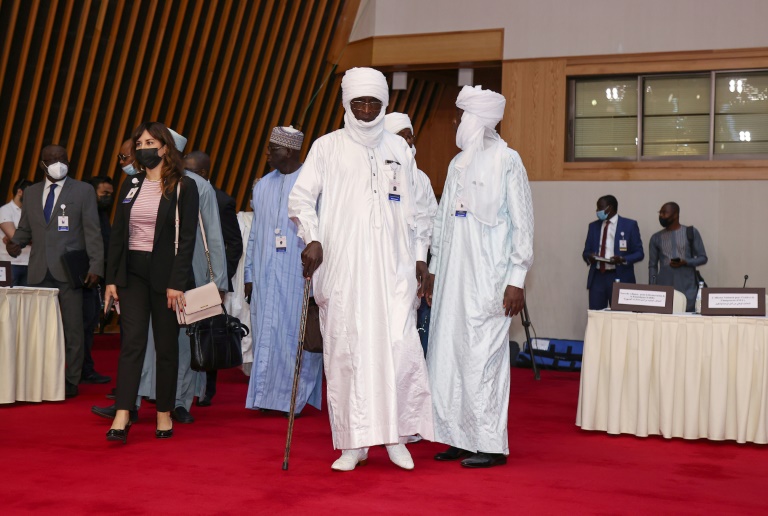
In the month since Chadian rebels and envoys of the military government started peace talks in Qatar, the two sides have prayed together most days but refused to face each other across the negotiating table.

With more than 250 opposition and government officials staying in two luxury hotels, the Gulf state is picking up a mounting bill for its mediation in the Central African nation.

The transitional military council’s foreign minister Mahamat Zene Cherif has been seen in a Doha mosque next to members of the Front for Change and Concord in Chad (FACT), which Chad’s long-time leader Idriss Deby Itno was killed in battle against one year ago.

“There is no personal issue. This is about the management of the country,” said FACT spokesman Issa Ahmet, who takes part in the prayers.

Deby’s army general son, Mahamat Idriss Deby Itno, seized power promising to hold a national dialogue in May and elections by the end of 2022. 

The Doha talks began on March 13 to prepare for the dialogue, but many diplomats increasingly doubt the deadlines will be met.

Cherif said the rival sides were waiting in a “cordial” atmosphere. “We have exchanges. We discuss our problems,” he told AFP. The minister was optimistic that there would be an accord in Doha so that the national talks can go ahead.

“I cannot say who will sign it but the dialogue will go ahead,” he added.

– Long wait –

During long hours in their hotel rooms, the rival groups wait to see a plan to get discussions started that is being drawn up by Qatar’s mediation envoy Mutlaq bin Majed Al Qahtani, a veteran of several tough assignments including getting the United States and Taliban to talk in Doha.

The opposition, already overloaded with more than 50 groups, varies between outright rebels based in isolated camps to unarmed political activists. Personal and political rivalries have made Qahtani’s job more difficult.

“The differences between the movements — military and more classical political — mean that it is difficult to reconcile the different views,” said Benjamin Auge, an Africa specialist with the French Institute of International Relations.

But all refuse to speak directly with the government. And many representatives told AFP they want guarantees for their safety if they return to N’Djamena for the national dialogue.

They are also demanding that Deby promise that he will not stand in the new elections.

Qahtani has sought to reduce the number of participants while preparing a summary of their disparate demands. There is no indication when a report will be ready.

The government and opposition say they will wait. But the African Union, United Nations and other states in Africa are anxiously looking for progress. 

“Chad is a key country that touches zones and countries already in a situation of fragility,” said Auge, highlighting internal conflict and battles against militants in neighbouring Nigeria, Libya and Sudan.

France, the former colonial power, and the United States are closely watching events.

Robert Menendez, chair of the US Senate Foreign Relations Committee, has criticised the US administration’s refusal to label Deby’s takeover as a coup.

Menendez said in a letter to the administration that Deby’s “failure” to rule himself out of the elections — as has occurred during transitions elsewhere in Africa — could “severely damage efforts to transition to democracy and civilian rule not only in Chad but also in Mali, Guinea, Burkina Faso, and Sudan”.

The Chadian groups in Doha face an uncertain wait. “The national dialogue could be pushed back,” said Auge. “For the moment, the Chad authorities are sticking to the date so that they do not poison the talks in Doha, that are already difficult.”

ECB wrestles with record inflation and war risk

European Central Bank policymakers meet on Thursday faced with the challenge of threading a response between record-high inflation figures and weak growth due to the war in Ukraine.

The bank’s 25-member governing council gathers for the second time since Russia launched its invasion at the end of February, with the outlook for the eurozone economy still murky.

At its meeting in March, the ECB sped up the wind-down of its bond-buying programme, raising the possibility of a complete stop as soon as July. 

A move towards interest rate rises would follow “some time” after that — a time frame which could be a “week after” or “months later”, according to ECB President Christine Lagarde.

But calls for the ECB to act faster have grown louder as prices have continued to spiral, with the war in Ukraine sending the costs for energy, commodities and food upwards.

Inflation in the eurozone hit 7.5 percent in March, an all-time high for the currency bloc and well above the central bank’s own two-percent target.

Meanwhile, surging prices for oil and gas, as well as the added disruption for supply chains, threaten to drag on the economy. 

The high degree of uncertainty means the ECB will likely tread carefully. Thursday’s meeting would not produce an “Easter egg”, said Holger Schmieding, economist at Berenberg Bank. 

“Expect a lively debate but no major decision yet.”

– ‘Further steps’ –

Observers will be listening closely to Lagarde’s press conference at 1230 GMT for clues as to how the ECB might respond next. 

Among the things they will be listening for are “a further hint that the ECB may raise rates later this year”, Schmieding said, a policy pushed for by more “hawkish” governing council members.

Joachim Nagel, the head of Germany’s traditionally conservative central bank, has cautioned against “acting too late”.

Any hike would be the ECB’s first in over a decade and would lift rates from their current historic low levels.

The Frankfurt-based institution even set a negative deposit rate of minus 0.5 percent, meaning banks pay to park excess cash at the ECB.

Central bankers use interest rate rises as a tool to tame inflation, but pulling the trigger too soon risks hurting economic growth.

Minutes from the last ECB meeting revealed that many members of the governing council wanted “immediate further steps” to tackle inflation despite the darkening economic picture.

The Bank of England, the US Federal Reserve and the Bank of Canada have already moved on rate hikes, leaving the ECB looking out of step.

Carsten Brzeski, head of macro at ING bank, said he saw the ECB’s rates exiting negative territory “at the latest around the turn of the year”.

– Old predictions –

The ECB’s prediction that inflation would even out at 5.1 percent over the course of 2022 was “already outdated”, Brzeski said.

The persistence of high energy costs and the potential for new sanctions that could further limit supplies from Russia could drive the monthly figure into “double-digit” territory. 

Soaring energy prices would also saddle businesses and consumers with higher bills and “weigh on economic activity in the coming months”, Brzeski said.

Over recent years, the ECB has hoovered up billions of euros in government and corporate bonds each month to stoke the economy and keep credit flowing in the 19-nation currency club.

While the stimulus is being phased out, the advent of a fresh crisis has some speculating about the possibility of the ECB designing a new tool to contain the impact of the war.

The “geostrategic” programme would counter the risk of borrowing costs rising for certain countries in the eurozone that would make it harder for them to finance their response to the war, said Eric Dor, a director at the IESEG business school.

Signalling a willingness to use the new tool could be “sufficient” to keep costs low, Dor said, though it was probably “too early” for it to be launched.

Close Bitnami banner
Bitnami