World

Asia markets open lower ahead of key US data

Most Asian markets opened lower Tuesday, after a weak lead from Wall Street and with eyes on key US inflation data later in the day.

Tokyo was down more than one percent, while Hong Kong dipped slightly into the red.

There were small gains in Taipei and Jakarta.

This followed a weak lead Monday from Wall Street and Europe, with sentiment souring on flat UK economic growth and expectations for another strong US inflation report, which will likely bring aggressive US interest rate hikes.

The US S&P 500 fell 1.7 percent in the first trading day of the holiday-shortened week.

The government is set to release the US consumer price index for March on Tuesday, after inflation rose 7.9 percent over the 12 months to February, the biggest increase in 40 years.

Calling it the “Putin price hike” in reference to the economic ramifications of Russia’s invasion of Ukraine, White House Press Secretary Jen Psaki told reporters: “We expect March headline inflation to be extraordinarily elevated.”

Economists are expecting annual US inflation to spike to nearly 8.5 percent, which would be the highest since late 1981.

“What we’re faced with this year is stagflation,” Kathryn Rooney Vera, head of global macro research at Bulltick LLC, told Bloomberg Television. “It’s a very complicated environment that the Fed has found itself in” and the market is pricing in potentially 50 basis points of hikes at each of the next two policy meetings, she added.

“Risk assets are starting to respond to the relentless rise in yields with US equities falling sharply overnight as the US 10-year yield hit 2.79 percent, its highest in three years,” said Tapas Strickland of National Australia Bank in a note.

All those concerns were weighing on the Tokyo market, Okasan Online Securities said in a note.

“Investors will then likely refrain from making major moves ahead of the release of the March US consumer prices data later in the day. The market will likely lose a sense of clear direction” until the data’s release, the brokerage said.

Hong Kong’s modest gains were fuelled by tech shares after China’s approval of the first batch of new video game licences since July. That step may ease some of the worst concerns about Beijing’s gaming-sector curbs.

Oil steadied, with Brent crude back just over $100 a barrel, after a tumble that erased most of the commodity’s gains sparked by Russia’s war in Ukraine. China’s coronavirus outbreaks and mobility curbs are imperilling demand.

– Key figures around 0230 GMT –

Tokyo – Nikkei 225: DOWN 1.37 percent at 26,454.87 (break)

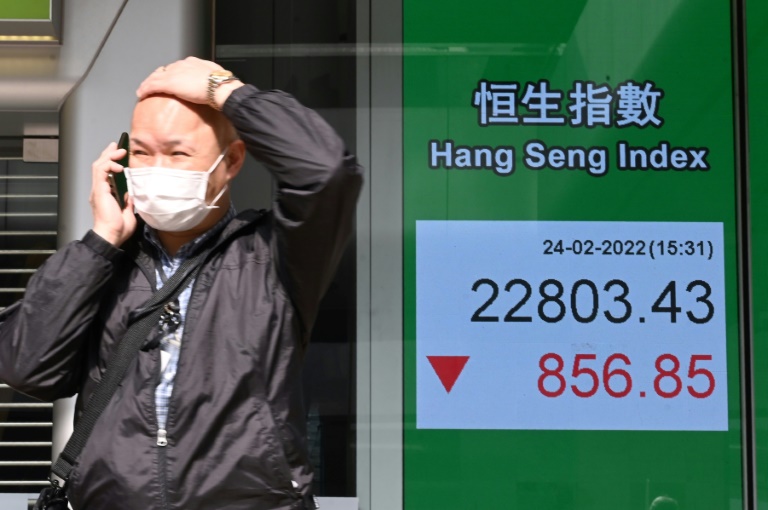
Hong Kong – Hang Seng Index: DOWN 0.09 percent at 21,188.38

Shanghai – Composite: UP 0.03 percent at 3,168.00

Brent North Sea crude: UP 1.81 percent at $100.26 per barrel

West Texas Intermediate: UP 1.94 percent at $96.12 per barrel

Euro/dollar: DOWN at $1.0871 from $1.0882

Pound/dollar: DOWN at $1.3021 from $1.3029

Euro/pound: FLAT at 83.49 pence

Dollar/yen: UP at 125.40 yen from 125.37 yen

New York – Dow: DOWN 1.19 percent at 34,308.08 (close)

London – FTSE 100: DOWN 0.67 percent at 7,618.31 (close)

— Bloomberg News contributed to this report —

US orders non-essential staff to leave Shanghai as virus surges

The United States announced Tuesday it had ordered all non-essential employees at its Shanghai consulate to leave, while voicing concerns for the safety of Americans in China as the government enforces hard lockdowns to contain Covid-19.

China has stuck tightly to a policy of “zero Covid”, aiming to eliminate infections through rigid lockdowns, mass testing and travel restrictions.

But the policy has come under strain since March as more than 100,000 cases in Shanghai have led to a lockdown of the city’s 25 million inhabitants, sparking widespread public outcry over food shortages and an inflexible policy of sending anyone who tests positive to quarantine centres.

The US State Department “ordered the departure due to the ongoing Covid-19 outbreak”, a spokesperson from its Beijing embassy said in a statement.

American diplomats have also raised “concerns about the safety and welfare of US citizens with People’s Republic of China officials,” the statement added. 

China’s largest city reported more than 23,000 new coronavirus infections on Tuesday.

Most of its residents remain under strict lockdown, although some who live in neighbourhoods deemed a low virus risk have been allowed outside their homes, sparking scenes of jubilation shared on Chinese social media.

The US embassy said last week it would permit non-essential employees to leave its Shanghai consulate due to the case surge, warning citizens in China they may face “arbitrary enforcement” of virus curbs. 

The State Department is now ordering employees to leave, as “it is best for our employees and their families to be reduced in number and our operations to be scaled down as we deal with the changing circumstances on the ground,” the spokesperson said in the statement.

China has hit back against US complaints about the Shanghai lockdown, with Chinese foreign ministry spokesman Zhao Lijian on Saturday slamming the United States’ “groundless accusations” and insisting that China’s policy was “scientific and effective.”

Authorities have readied tens of thousands of new beds in more than 100 makeshift hospitals as part of a policy of isolating every person who tests positive for the virus — whether or not they show any symptoms.

Locals have begun to chafe at lockdown restrictions, with many taking to social media to vent anger at food shortages and heavy-handed controls — including the recent killing of a pet corgi by a health worker.

An unpopular policy of separating infected children from their virus-free parents — now softened — also triggered a rare show of public anger last week.

But officials are not budging on their zero-tolerance approach. 

City health official Wu Qianyu said during a Sunday press conference the city “would not relax in the slightest”.

Major online delivery platforms said they would bolster food stocks and draft thousands of drivers to strengthen the supply of basic goods.

Meta tests sale of virtual goods in metaverse

Meta, the parent company of Facebook and Instagram, will give content creators the opportunity to sell virtual items to users in Horizon Worlds, its main platform in the metaverse, the company said Monday. 

“For example, someone could make and sell attachable accessories for a fashion world or offer paid access to a new part of a world,” the Californian tech group said in a press release.

The metaverse, touted by Meta and other companies as the future of the internet, consists of a set of parallel “universes” accessed primarily through augmented and virtual reality platforms. 

It already exists in a basic way in the form of video games such as Minecraft, Fortnite and Roblox and social platforms such as Horizon Worlds, and VRChat, where people come together not only to play, but also to interact and participate in events. 

Meta, whose income is overwhelmingly dependent on large-scale targeted advertising, has made it its mission to make a major contribution to the emergence of the metaverse, and is staking out its place in the next battle for the public’s attention. 

To that end, the social networking giant is seeking to attract content creators who are likely in turn to attract more new users. 

It had already set up a $10 million fund for creators on Horizon in October, where more than 10,000 different “worlds” already exist, according to the company.

“While we’re launching this today as a test with a handful of creators to get their feedback, these types of tools are steps toward our long-term vision for the metaverse where creators can earn a living and people can purchase digital goods, services, and experiences,” Meta said.

The company also plans to test bonuses for creators who achieve certain goals — such as “building worlds that attract the most time spent.” 

These bonuses will not be “subject to fees and will be paid to creators in full,” Meta said, unlike revenue from virtual items, which is subject to a commission. 

Horizon Worlds has more than 300,000 users in the United States and Canada, according to an article by the specialized site The Verge published in February.

Pregnancy trap for workers in controversial Japan scheme

When Vanessa, a worker with Japan’s “technical intern” programme, told her supervisors she was pregnant, she says they first suggested an abortion and then pressured her to quit.

It’s an example, activists say, of the abuses faced by vulnerable workers in a controversial programme that helps Japan meet its labour needs.

The programme, which had around 275,000 workers from countries including China and Vietnam last year, is supposed to give participants specialised experience that will be of use in their home country.

It’s a valuable source of labour given Japan’s ageing population and small pool of migrant workers, but the scheme has been dogged by allegations of discrimination and physical abuse.

And female technical interns can face particular pressure around pregnancy.

Vanessa, who asked to be identified by her first name only, was working in a care home in southern Japan’s Fukuoka when she discovered she was pregnant, and hoped to return to work after the birth. 

Instead, the 25-year-old Filipina says bosses pushed her and her partner for an abortion despite terminations being both taboo and a crime in her deeply Catholic homeland.

“I thought, ‘how dare (they),'”. “Having an abortion is a mother’s choice, not someone else’s,” she told AFP. 

When she refused to have an abortion, her supervisors forced her to quit.

Japan’s health ministry says 637 technical interns quit because of pregnancy or childbirth between 2017 and 2020, including 47 who said they wished to continue the programme.

But advocates say that is likely the “tip of the iceberg”, and no statistics capture how many others have been pressured to avoid or end pregnancies.

– Interchangeable, cheap labour –

“Most technical interns are of reproductive age… but the idea of them getting pregnant during their stay in Japan is often considered out of the question,” said Masako Tanaka, a Sophia University professor who studies the reproductive rights of migrant women.

Technical interns are covered by Japanese laws banning harassment or discrimination based on pregnancy.

But “maternity harassment” remains a problem for Japanese women, and foreign technical interns are often even more vulnerable. 

Reports of pregnancy-based discrimination in 2019 prompted Japan’s immigration agency to remind employers about the rights of interns.

“We understand that it’s entirely possible that technical interns, as human beings, get pregnant and give birth, and they shouldn’t suffer detrimental treatment for that,” an immigration agency official told AFP.  

Hiroki Ishiguro, a lawyer who has represented technical interns, says employers often consider them interchangeable cheap labour. 

“For some employers, it’s easier to just send them back home and have them replaced with entirely new trainees, rather than go through these extra burdens (to accommodate pregnancy),” he told AFP. 

Now back in the Philippines, Vanessa says she was told her pregnancy would give fellow Filipina trainees a bad reputation. 

They said “because of my situation… the ‘value’ of Filipino trainees will decrease,” she recalled. 

– ‘I’m sorry you two’ –

Financial pressures, including debt from recruitment fees and the needs of family, also weigh on interns like Le Thi Thuy Linh, a Vietnamese worker on a farm in southern Japan’s Kumamoto who found out she was pregnant in July 2020.

She feared her family back home would be “destroyed financially” if she was deported over the pregnancy, said Ishiguro, who is representing Linh.

She hid the pregnancy from her employer and sought a termination.

But abortion pills are not approved in Japan, where surgical terminations typically cost upwards of 100,000 yen ($815), and some interns fear clinics could reveal the procedure to their employers.

That leaves some women seeking unauthorised abortion pills — a “very risky act that could see them charged with foeticide,” Tanaka said.

Linh took abortion pills that she got over the internet soon after she discovered her pregnancy in July, but to no avail.

Her employer began to suspect the pregnancy, though Linh denied it, and warned her of “difficulties” if she gave birth and raised a child, Ishiguro said.

In November, she gave birth prematurely, alone and at home, to stillborn twin boys.

Exhausted, she wrapped them in a towel and placed them in a cardboard box in her room, tucking a note inside: “I’m sorry you two.”

She sought help the following day from a doctor, who reported her to authorities. In January, she received a three-month suspended sentence for having “abandoned” her babies’ bodies. She is appealing.

Vanessa’s story ended differently — she gave birth to her son in the Philippines, but still hopes to return to Japan.

“I want to prove that it’s possible for a pregnant trainee to give birth in her country and go back to Japan to finish her contract,” she said.

Philippine volunteers in door-to-door blitz for top Marcos Jr rival

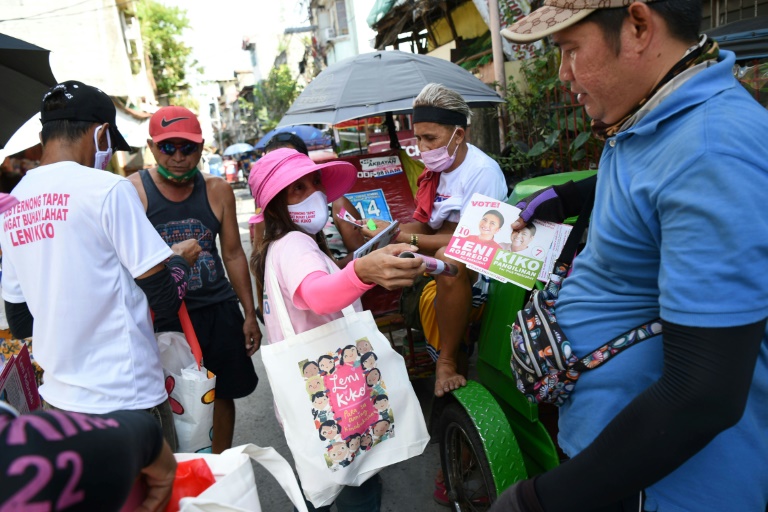
Clutching pink flyers and face masks, diehard supporters of Philippine presidential hopeful Leni Robredo are going door to door across the archipelago nation in an against-the-odds bid to win over voters.

Nearly two million volunteers are involved in a grassroots movement for Robredo, the incumbent vice president, as she battles to close the gap with frontrunner Ferdinand Marcos Junior before the May 9 polls. 

Voter surveys show the son of the country’s former dictator heading towards a landslide victory, the endgame of a decades-long, well-funded effort to return the powerful clan to the presidential palace they fled 36 years ago.

But there are signs Robredo’s pink-coloured campaign is finding traction, with huge rally turnouts, endorsements from pop stars and Catholic priests, and a bump in a recent poll raising hopes among her fervent fans.

“I’m really craving for change, for decency in the highest position,” said Rocelle Mendoza, 29, who uses her own money to print Robredo T-shirts and aprons that she gives away at markets in the capital Manila.

“We are aware that we have to climb a mountain. And I think it’s also why we’re no longer hesitating to spend.”

Some analysts have likened the feverish support for Robredo to the people-driven movement for former president Corazon Aquino in the 1986 snap election campaign that led to the ousting of Ferdinand Marcos Senior. 

Robredo, a widow and former congresswoman, made a last-minute decision to enter the presidential race in October after Marcos Jr declared his candidacy.

That set up a rematch with her rival in the 2016 vice presidential contest that she narrowly won. 

A volunteer-driven campaign mushroomed across the country, putting the mild-mannered Robredo in second place in the polls. 

But the chances of beating Marcos Jr again appear slim. 

Relentless attacks from President Rodrigo Duterte and a nasty misinformation campaign on social media have undermined Robredo’s popularity and eroded her support among local officials, who are key to garnering votes.

The latest poll by Pulse Asia Research shows her gaining ground, but Marcos Jr still leads by 32 percentage points.

“It remains a relatively tall mountain for Robredo to climb and is still Marcos’s race to lose,” said Eurasia Group analyst Peter Mumford. 

– ‘We won’t stop’ –

Marcos Jr has been bolstered by an alliance with first daughter and vice presidential favourite Sara Duterte, the backing of powerful political clans, and a massive social media campaign portraying his family in a positive light.

But Robredo’s loyal followers are undeterred, dipping into their own pockets to support the former lawyer for farmers and battered women in an election they see as critical for the country’s future. 

After six years of authoritarian firebrand Duterte and his deadly drug war, Robredo volunteers say they are scared of a Marcos Jr presidency, pointing to the human rights abuses committed during his father’s 20-year rule. 

“I’m afraid there will be a repeat of martial law. The videos I see about torture and rape, it’s scary,” said Sheilla Oledan, 31, as she door-knocked in suburban Manila.

So far, nearly two million volunteers have signed up to campaign for Robredo on social media and on the ground, said Georgina Hernandez Yang, joint leader of a group set up by the Robredo camp to coordinate volunteer efforts.

They belong to groups representing diverse interests and ages, such as “Seniors for Leni”, “Doctors for Leni”, and “Youth Vote for Leni”.

Talking to people face-to-face was the best way to “break out of our echo chambers” on social media, said Yang.

“There’s a lot of fake news and disinformation that we’re able to clarify and correct.”

But changing minds is not easy. 

In suburban Manila, supporters hand out pink flyers and face masks to residents and street vendors, striking up conversations to explain Robredo’s platform. 

Some people wave them away while others listen to their spiel. Occasionally, they are heckled or harassed. 

“Someone asked us to kiss them first before they will listen. It’s very offensive,” complained Marielle Chico, 26.

After speaking to a Robredo volunteer, rice and egg vendor George Tolentino said he was still undecided. 

“I will study first their agenda,” the 55-year-old said. 

As election day looms, volunteers like Mendoza are determined to continue campaigning. 

“It all comes down to May 9,” she said defiantly.

“We won’t stop.” 

'Why not us?': Latinos stuck at Mexico border as Ukrainians enter US

Thousands of Latino refugees arrive in the Mexican city of Tijuana each year, dreaming of one day crossing the border that separates them from the United States. 

But as Ukrainians who fled Russia’s invasion have recently begun to cross the same frontier with little delay, many Latinos stuck waiting for months are wondering why they are not being treated the same.

“Why are we — neighbors of the United States — not given the same opportunity to seek asylum? We came here fleeing almost the same thing,” said L., a 44-year-old Mexican man.

Because of the war raging in their homeland, Ukrainians have been granted special humanitarian permission to enter the United States. Washington said last month it would take in up to 100,000 refugees.

Thousands of Ukrainians have since flown to Tijuana to cross the land border to the United States — easier than getting the visa required to fly direct.

Volunteers in Tijuana and the neighboring US town of San Ysidro say that, on average, new Ukrainian arrivals wait just two or three days before crossing, using an entrance available only to them.

“I think we all deserve a chance,” L.’s wife said, with tears welling up in her eyes.

The couple fled their central Mexican hometown of Irapuato with their three children, carrying only a change of clothes, after suspected cartel members torched their home and the bakery where they made their living. 

Staring down at the floor and nervously clutching a piece of paper in her trembling hands, the woman spoke to AFP hesitantly, declining to give her name for fear of something happening to her or her family.

“We came here not by choice but out of necessity — we have endured a lot of violence,” she said.

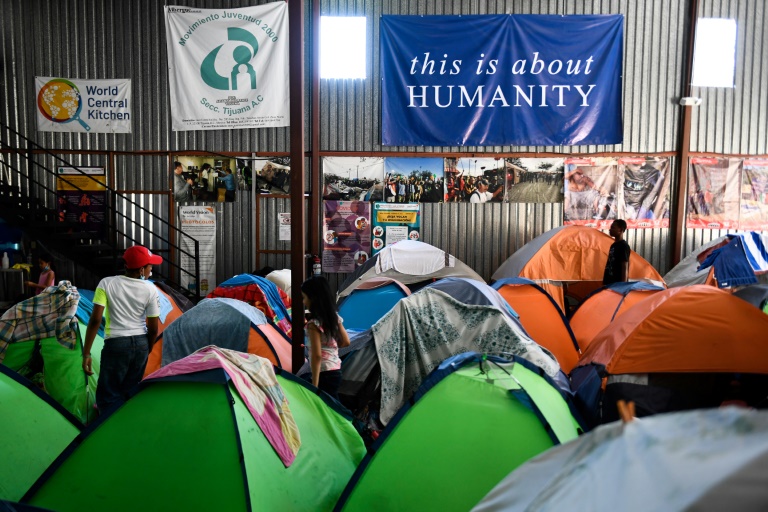
“We want to give them a better life,” she added, pointing to her children, who are living in one of several tents at the Movimiento Juventud 2000 shelter.

The family are just three blocks from Unidad Deportiva Benito Juarez, which has become the staging post for thousands of Ukrainians.

“Why don’t they give us a chance?” she asked.

– ‘Almost a war’ –

The contrast between the two shelters could hardly be more stark.

At Movimiento Juventud 2000, the atmosphere is heavy with frustration and sadness, while at Benito Juarez, relief and hope abound.

Volunteers at the Ukrainian shelter have created a database to keep up with the rapid turnover of asylum seekers.

By Saturday afternoon, more than 2,600 Ukrainians had registered. 

At Movimiento Juventud 2000, some families have been waiting as long as six months for a change in border restrictions that would allow them to apply for asylum.

R., who also did not want to give her full name, is from Honduras, and has five children aged between one and nine. She said they were forced to leave their city eight years ago when her journalist husband was attacked.

They fled to Guatemala, where her husband received medical treatment. But they realized they could not remain when one of the doctors who treated him was murdered.

Another attempt to rebuild their lives in Mexico was scuppered when a flood destroyed their new home, and so the family headed to the US border, encouraged by the election of Democratic President Joe Biden.

“We have been applying for asylum since we lived in Guatemala, but a long time has passed and we are still waiting,” she said, sitting on a plastic bucket next to the tent in which the whole family has slept for months.

The youngest of her babies learnt to walk between tents.

Like the Ukrainians, “we also came fleeing,” she said.

“It’s different, but it’s almost a war with the gangs… we can’t go back.”

– ‘Suffered’ –

Thanks to donations from both sides of the border, Ukrainian volunteers installed a children’s play area at their shelter.

Toys, crayons and books are available, with a new crate of plastic yellow ducks arriving Saturday.

Nearby, young Haitian, Mexican and Central American children do not have any dedicated space and few materials, although they are entertained a couple of times each week by UNICEF workers and individual volunteers.

Teacher Nelly Cantu, who is part of that effort, says she was approached about helping at the Ukrainian shelter, but decided to stay put.

“Besides the language barrier, I preferred to stay here because the children need me. They have suffered a lot, and have less support. This is also a war,” she said.

Some 125 people, mainly from Haiti and Central America, live in the shelter staffed by six people, said its director Jose Maria Garcia.

“We try to explain to them that they have to be patient,” Garcia said.

Man, woman or… X: US rolls out gender-neutral passports

It’s just a small box to tick on an application form, but a huge breakthrough for D. Ojeda, a non-binary person who on Monday became one of the first Americans to apply for a gender-neutral passport.

“Even with my family, they still don’t get it,” said Ojeda, a 34-year-old activist who goes by D. and uses the pronouns “they, them.” “So at least I have the government to say who I am as a person.”

The option to receive a passport with an “X” gender designation, which was made available Monday by US President Joe Biden’s administration, was hailed as a blessing for an estimated 1.2 million Americans whose gender identity falls outside the categories of man or woman.

It came at a time when Republican lawmakers across the country have been passing legislation that critics say curtails LGBTQ rights and was likely to further fuel tensions around gender issues in a deeply divided nation.

At their home in the Washington suburb of Alexandria, Ojeda began to fill out the long online passport application form, putting down their first and last name, then choosing from three options for gender: M for male, F for female and X for people who don’t identify as either. They chose the latter.

They also ticked the box for “gender change,” to reflect the difference from their previous passport, which identified them as female. They didn’t have to provide any medical documentation for the change.

“I think that’s incredible,” said Ojeda, who works as an organizer at the National Center for Transgender Equality (NCTE) and holds a doctorate degree in psychology. 

“What makes it difficult for trans people is just how hard it is to get anything changed,” such as legal documentation, said Ojeda.

When Ojeda and their NCTE colleagues learned of the new passport option, they “started crying at each other,” Ojeda added, seated at their desk in a blue sweater, with a thin beard and with their hair pulled back.

– See me as ‘who I am’ –

The State Department announced in October that it had issued the first American passport with the X designation for gender after a long legal battle waged by a person from Colorado who is intersex.

But it was only on March 31, the International Day of Transgender Visibility, that the State Department announced it was extending that right to all Americans, as well as adopting other measures on the federal level meant to simplify administrative hurdles for transgender and non-binary people.

A few other countries have similar policies. Australia began issuing X-gender passports in 2011, with New Zealand, Canada, Germany and Argentina joining the roster since then, as well as, Pakistan and Nepal.

Ojeda already boasts a driver’s license from their home state of Virginia, where their gender is marked as X. Ojeda said the procedure was simple: they received an appointment, filled out the application and the X box was already there.

“I was really happy about that because it was the first time I see myself and I in an identification form,” Ojeda said. 

Things, however, get more complicated with travel. Ojeda says they are often called “Ma’am,” which is upsetting.

Born in Peru, Ojeda cannot wait to visit their relatives there, now that they have a new passport, which is required for international travel.

Though they are still struggling to get their family to accept them.

“You know, they don’t say the name that I want,” said Ojeda, who was given a different first name at birth.

“When I pretended to be a woman, and I tried really hard, there was something that always bothered me,” said Ojeda.

Now, they added, “I can turn around and say, ‘well in my ID the government sees me as who I am, and maybe you need to start seeing me as who I am.'”

“It feels like the world is safer.”

Italy freezes villa of Russian F1 driver and father

Italian authorities said Monday they have frozen a 100-million-euro ($109 million) Sardinia villa linked to Russian motor racing driver Nikita Mazepin and his oligarch father Dmitry.

The financial police imposed a freezing order on the Rocky Ram villa in Porto Cervo, on the spectacular Costa Smeralda coast on the northeast of the Italian island, a government official said.

Nikita Mazepin, 23, was sacked by the Haas Formula One team last month after Russia’s invasion of Ukraine.

Days later, he was added to a list of Russians sanctioned by the European Union, alongside his father, Dmitry Mazepin, the owner and chief executive of chemical giant Uralchem.

Italy has blocked hundreds of millions of euros of property, notably villas and luxury yachts, linked to Russian oligarchs sanctioned following Moscow’s invasion of its neighbour.

Climate change drove extreme rain in southeast Africa storms: study

A string of deadly storms pummelled Madagascar, Malawi and Mozambique with more intense rainfall because of climate change, new research found Monday. 

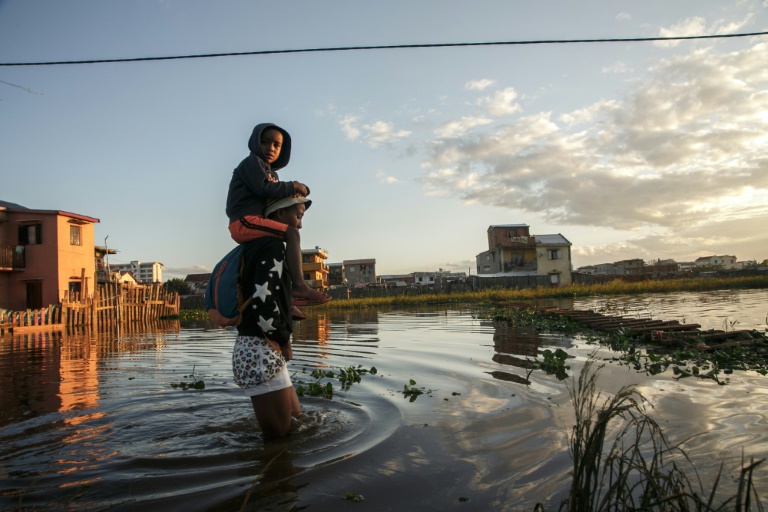
Three tropical cyclones and two tropical storms hit Southeast Africa in just six weeks in the first months of this year, causing widespread flooding. 

More than a million people were affected and at least 230 people died.

The analysis was carried out by the World Weather Attribution (WWA) network of scientists, which has pioneered ways to speedily link extreme weather events to climate change.

They said that it was climate change that had made the heavy rains brought by the back-to-back storms both heavier and more likely.

“Again we are seeing how the people with the least responsibility for climate change are bearing the brunt of the impacts,” said WWA co-founder Friederike Otto, of the Grantham Institute at Imperial College London.  

After Tropical Storm Ana smashed into the region in January, Tropical Cyclone Batsirai hit Madagascar in early February, followed in quick succession by Tropical Storm Dumako and Tropical Cyclones Emnati and Gombe.

WWA scientists used weather observations and computer simulations to compare rainfall patterns under today’s climate to that of the pre-industrial area, before global warming.

They focused on two of the wettest periods — during storm Ana in Malawi and Mozambique and during cyclone Batsirai in Madagascar. 

“In both cases, the results show that rainfall associated with the storms was made more intense by climate change and that episodes of extreme rainfall such as these have become more frequent,” WWA said in a report of their findings.

That tallies with overall climate research showing that global warming can increase the frequency and intensity of rainfall.  

– Data plea –

But the scientists were not able to determine exactly how much climate change influenced the extreme events because of a shortage of high quality historical rainfall records for the region.

This is a particular concern in poorer nations, which are also especially vulnerable to the impacts of climate change. 

“Strengthening scientific resources in Africa and other parts of the global South is key to help us better understand extreme weather events fueled by climate change, to prepare vulnerable people and infrastructure to better cope with them,” said Izidine Pinto, of the University of Cape Town and the Red Cross Red Crescent Climate Centre. 

WWA said that of 23 weather stations in the affected area in Mozambique, only four had relatively complete records going back to 1981. 

In Madagascar and Malawi there were no weather stations with suitable data.

Madagascar, one of the poorest countries in the world, has also been ravaged by drought in its southern region, leading to malnutrition and pockets of famine. 

In December, the WWA said global warming had played only a minimal role in that crisis, contradicting a UN description of the situation as a “climate change famine”. 

Gas tank graveyard has Mexico City residents up in arms

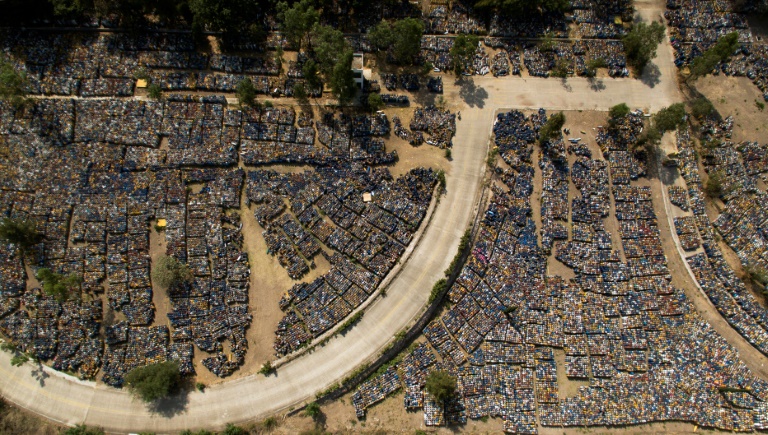
Thousands of disused gas cylinders sit outside under the sun at a former refinery in Mexico City, producing a foul smell that neighbors say has made their lives a nightmare.

Almost every night, Cesar Rivera and his wife leave their apartment because the odor becomes too much, the 37-year-old web programmer told AFP.

“The smell is so strong at night — so unbearable — that it’s like the stove isn’t turned off properly,” he said.

The couple also fear that the liquefied petroleum gas seeping from the cylinders — which are used by many households in Mexico City — will cause an explosion or make them sick.

“The building administration has asked us not to smoke or use the stove burners when the smell’s stronger. It has completely changed our lives,” said Rivera.

“It’s a time bomb,” he added.

Aerial images taken by AFP show what looks like a huge graveyard in the west of the capital, surrounded by residential districts.

But instead of human remains the disused refinery of state-owned oil giant Pemex has become the resting place of thousands of old multicolored gas cylinders.

Rivera said that he and his wife had suffered due to the smell for eight months, but only discovered in January what the source was.

– ‘Vomiting, headaches –

LP gas, made up mainly of butane and propane, is odorless so producers add mercaptan to give it a nauseating smell that allows it to be detected.

Although “the gases produced by its combustion are not toxic or carcinogenic” a leak can cause a build-up that “can be explosive and can suffocate people in small spaces,” Mexico’s National Commission for the Efficient Use of Energy says on its website.

The tanks were stored at the old refinery by the state firm Gas Bienestar, which was created in 2021 to expand competition in the sector, after exchanging old or damaged cylinders free of charge for new ones.

In January, the Mexico City authorities said in a statement that Pemex was in the process of removing them.

Contacted by AFP, the company said it was unable to give an interview about the matter.

Mexican civil protection authorities did not respond to a request for information about the risks posed by the cylinders.

According to Ricardo Torres, an expert at the National Autonomous University of Mexico, LP contributes to the formation of ozone, which at ground level is a harmful pollutant for people and the environment.

Firefighters at a nearby station said they receive daily reports of gas leaks, when in fact the odor comes from the disused tanks.

“We’ve gone to the former refinery, but they don’t see us,” says station chief Cesar Suarez.

Juan Macias, who runs a carpentry workshop next door to the old refinery, said that he now closes the windows in the afternoon despite the stifling heat.

“We feel like vomiting and have really bad headaches,” he said.

“The authorities say there’s nothing to worry about,” the 44-year-old added.

“But everyone here thinks there’s some danger, so we always take care not to light anything when it smells a lot for fear of an explosion,” he said.

Close Bitnami banner
Bitnami