World

Ukraine braces for fall of Mariupol, Russian assault on east

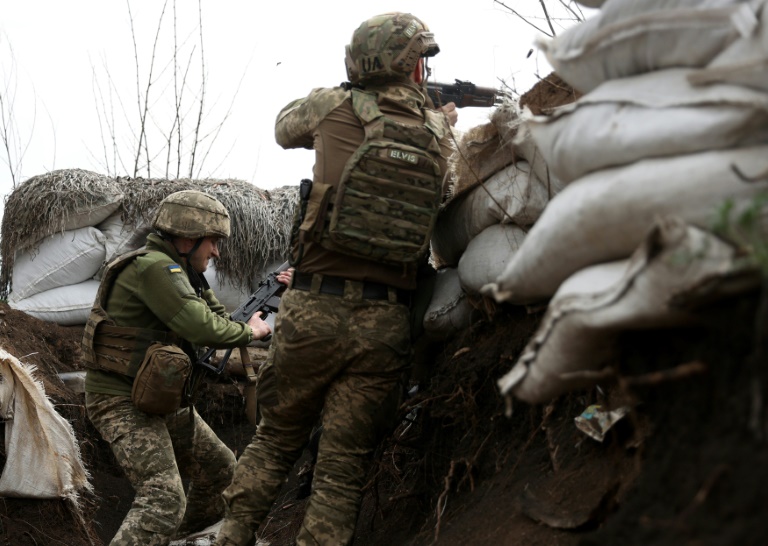
Ukraine braced Monday for what could be the imminent fall of Mariupol to Russia as President Volodymyr Zelensky said he believed “tens of thousands” of people had died in Moscow’s assault on the strategic port.

With the war grinding toward its seventh week, Ukrainian forces said they were also bolstering their positions in the east ahead of an anticipated massive Russian onslaught. 

Austria’s chancellor meanwhile became the first European leader to visit Moscow since the Russian invasion, saying he raised alleged war crimes in devastated areas around Kyiv that had been under Russian occupation.

Ukrainian authorities say over 1,200 bodies have been found in the area so far and that they are weighing cases against “500 suspects”, including President Vladimir Putin and other top Russian officials.

Seven bodies were found Monday under the rubble of two multi-storey buildings in Borodianka, Kyiv region, the state emergency service said in Telegram, bringing the total to 19.

French investigators arrived in Ukraine to help probe suspected Russian atrocities in the area, as the European Union earmarked 2.5 million euros ($2.7 million) to the International Criminal Court for future Ukraine cases.

Russia is believed to be trying to connect occupied Crimea and Moscow-backed separatist territories Donetsk and Lugansk in Donbas and has laid siege to Mariupol, once a city of more than 400,000 people.

“Today will probably be the last battle, as the ammunition is running out,” the 36th marine brigade of the Ukrainian armed forces said on Facebook. 

“It’s death for some of us, and captivity for the rest,” it added, saying it had been “pushed back” and “surrounded” by the Russian army.

A pro-Russia rebel leader, Denis Pushilin, said separatist forces had already taken control of the city’s port, in comments reported by the RIA Novosti news agency.

Speaking to South Korea’s National Assembly by video link in an appeal for military assistance, Zelensky said Russia had “completely destroyed” the city and “burned it to ashes”.

“At least tens of thousands of Mariupol citizens must have been killed,” he said.

Russian forces are also turning their focus to the Donbas region in the east, where Zelensky said Russian troops were preparing “even larger operations”.

“They can use even more missiles against us… But we are preparing for their actions. We will answer,” Zelensky said.

Lugansk governor Sergiy Gaiday warned that the region could suffer as badly as Mariupol.

– ‘War on civilians’ –

Over the weekend, further strikes hampered evacuations in and around Kharkiv in the northeast, killing 11 people including a seven-year-old child, regional governor Oleg Synegubov said.

“The Russian army continues to wage war on civilians due to a lack of victories at the front,” he said on Telegram.

In Dnipro, an industrial city of around one million inhabitants, Russian missiles rained down on the local airport, nearly obliterating the facility, local authorities said.

Gaiday said a missile strike on a railway station in the city of Kramatorsk on Friday, which killed 57 people, had left many afraid to flee.

He again urged people to leave the region, with five humanitarian corridors agreed for Monday.

“You are alive because a Russian shell has not yet hit your house or basement — evacuate, buses are waiting, our military routes are as secure as possible,” he wrote on Telegram.

Russia has denied carrying out the strike.

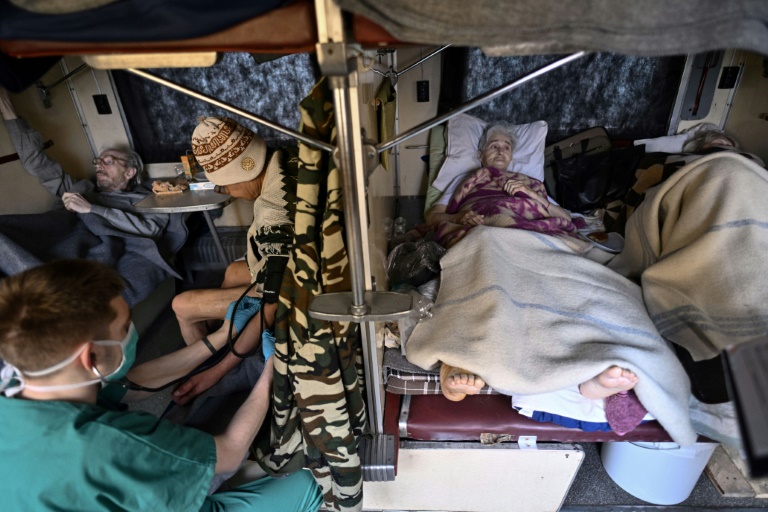
Over the weekend, nearly 50 wounded and elderly patients were transported from the east in a hospital train by medical charity Doctors Without Borders (MSF), the first such evacuation since the Kramatorsk attack.

Electrician Evhen Perepelytsia was rescued after he lost his leg in shelling in his hometown of Hirske.

“We hope that the worst is over — that after what I’ve been through, it will be better,” said the 30-year-old after arriving in the western city of Lviv.

– EU talks sanctions –

On the diplomatic front, EU foreign ministers were meeting Monday to discuss a sixth round of sanctions, with concerns that divisions over a ban on Russian gas and oil imports could blunt their impact.

Austrian Chancellor Karl Nehammer said his meeting with Putin was not “a visit of friendship,” adding that he “mentioned the serious war crimes in Bucha and other locations”.

US President Joe Biden meanwhile will hold virtual talks on Monday with Indian Prime Minister Narendra Modi, just weeks after saying New Delhi had been “shaky” in its response to the invasion.

A US spokeswoman said the two leaders would consult on ways to offset the “destabilising impact (of the war) on global food supply and commodity markets”.

Russia was responsible for an escalating global food crisis because of its bombing of wheat stocks and preventing ships from carrying grain abroad, the EU’s top diplomat Josep Borrell said Monday.

The World Bank warned Sunday that Ukraine’s economy would collapse by 45 percent this year — far worse than it predicted even a month ago — while Russia would see an 11-percent decline in GDP.

The World Trade Organization meanwhile cautioned that the war could almost halve global trade growth this year.

– ‘Prevent one massacre’ –

Despite Kyiv’s allegations of Russian atrocities, Ukraine’s Foreign Minister Dmytro Kuleba on Sunday told NBC’s “Meet the Press” he was still open to negotiating with Moscow.

“If sitting down with the Russians will help me to prevent at least one massacre like in Bucha, or at least another attack like in Kramatorsk, I have to take that opportunity,” he said.

Bucha — where authorities say hundreds were killed, some with their hands bound — has become a byword for the brutality allegedly inflicted under Russian occupation. 

More than 4.5 million Ukrainian refugees have now fled their country, the United Nations refugee agency said — 90 percent of them women and children.

At least 183 children have died and 342 were injured in Ukraine in 46 days of the Russian invasion, the prosecutor general’s office said on Telegram.

burs-dlc-gw/jj
Sharif elected new Pakistan PM after Khan ouster

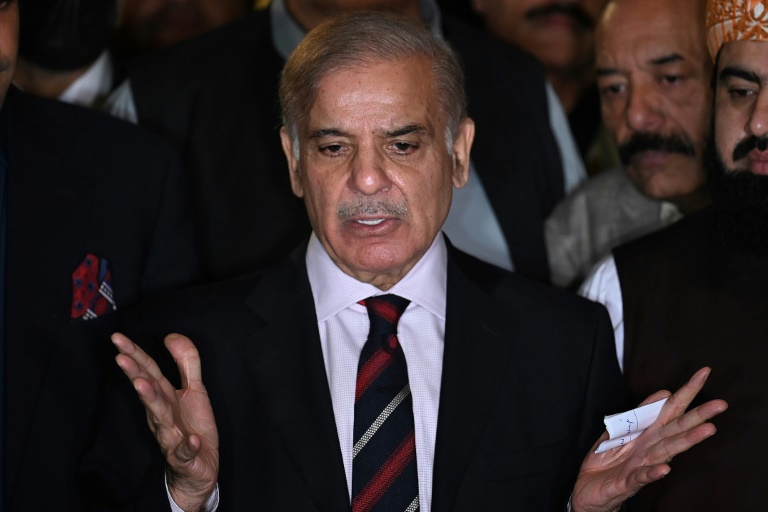
Pakistan lawmakers on Monday elected Shehbaz Sharif as the country’s new prime minister following the weekend ouster of Imran Khan, who resigned his national assembly seat — along with most of his party members — ahead of the vote.

Khan was dismissed Sunday after losing a no-confidence vote, paving the way for an unlikely alliance that faces the same issues which bedevilled the cricket star-turned-politician — a weak economy, rising militancy, and soured relations with the West.

Sharif immediately announced a raft of populist measures, including a new minimum wage of 25,000 rupees (around $135), pay rises for civil servants, and development projects in rural areas.

He also said he wanted better relations with neighbour India, but a solution needed to be found for Kashmir — the contested Himalayan territory at the heart of decades of their conflict. 

For his part, Indian Prime Minister Narendra Modi congratulated Sharif on his election, and called for “peace and stability in a region free of terror.”

Sharif, leader of the centrist Pakistan Muslim League-N (PML-N), was the only candidate for premier after Khan loyalist Shah Mahmood Qureshi, the former foreign minister, withdrew and resigned his seat.

“It’s a victory of righteousness, and evil has been defeated,” Sharif said in his maiden speech as premier, suggesting no end to what has been a bitter political battle.

His first task will be to form a cabinet that will also draw heavily from the centre-left Pakistan Peoples Party (PPP), as well as find space for the smaller conservative Jamiat-ulema-e-Islam-F (JUI-F) group.

– Bitter rivals –

The PPP and PML-N are dynastic parties that have dominated Pakistani politics for decades — usually as bitter rivals — and their relations are sure to fray in the lead-up to the next election, which must be held by October 2023.

“History knows there is no ideological convergence among them,” Qureshi said before storming out.

The coalition must tackle soaring inflation, a feeble rupee and crippling debt, while militancy is also on the rise — with Pakistan’s Taliban emboldened by the return to power last year of the hardline Islamist group in neighbouring Afghanistan.

“The situation is very bad, but I am sure that we will change it with the blessing of Allah and with hard work,” said Sharif.

The new premier may also rethink Pakistan’s global alignment, which drifted away from Washington under Khan and closer to Russia and China — a vital economic partner.

“On the foreign policy front we have to face a lot of debacles. Our strategic partners left us,” he said.

Pakistan’s stock exchange gained over three percent Monday on the hope of more stability, while the rupee also strengthened.

Sharif is the younger brother of disgraced three-time prime minister Nawaz Sharif, and Pakistan media are already speculating the latter may soon return from exile in Britain.

The elder Sharif was dismissed in 2017 and later jailed for 10 years by an accountability court on graft charges after revelations from the Panama Papers, but was released to seek medical treatment abroad.

The younger Sharif is also mired in graft proceedings. In 2019, the National Accountability Bureau seized nearly two dozen properties belonging to him and his son Hamza, accusing them of money laundering.

He was arrested and detained in September 2020, but released six months later on bail for a trial which is still pending.

– Conspiracy theory –

Khan tried everything to stay in power after losing his majority in parliament — including dissolving the assembly and calling a fresh election.

But the Supreme Court deemed all his actions illegal and ordered them to reconvene and vote.

Khan insists he has been the victim of a “regime change” conspiracy involving Washington and his opponents, and has vowed to take his fight to the streets in the hope of forcing an early election.

Sharif promised an investigation into Khan’s allegations.

“If an iota of evidence is provided against us, I will immediately resign,” he told parliament.

The mass PTI resignations signal that Khan intends to make good a threat to disrupt the new administration and take his fight to the streets, and he called again for mass protests across the country.

“Whether his agitation ability has grown or shrunk in last few weeks remains to be seen,” said analyst Mosharaf Zaidi.

Sony, Lego to put $2 bn into Epic Games metaverse effort

Japanese giant Sony and Lego’s Danish parent firm announced Monday a $2 billion investment in US gaming powerhouse Epic Games for its work toward joining the metaverse vision for the internet’s future.

Scores of tech firms have been rushing to invest in building the metaverse, a loose term covering the growing eco-system of interactive online worlds, games and 3D meeting places that are already attracting millions of users.

In the form of video games like Epic’s hit Fortnite, the precursors of the metaverse already exist in a minimalist way, with people coming together not only to play, but also to interact and participate in events. 

The $2 billion (1.84 billion euros) in funding is aimed at advancing Epic’s “vision to build the metaverse and support its continued growth,” the three firms said in a joint statement.

Sony, already a shareholder in Epic Games, and Kirkbi, Lego’s parent firm, are each investing $1 billion, the firms said. 

“All three companies highly value both creators and players, and aim to create new social entertainment exploring the connection between digital and physical worlds,” they added. 

The investment brings Epic Games’ valuation to $31.5 billion, the US game studio said. 

With 350 million users worldwide, its Fortnite game is free to download, but generates billions in revenue with the purchase by players of additional items for their characters, including clothing. 

The game has quickly become a global phenomenon, to the point that some games are now followed live by millions of viewers. 

French Greens face crisis after failed presidential bid

France’s Greens were facing a financial and political crisis on Monday after a deeply disappointing presidential election saw their candidate finish sixth and struggle to put climate change on the national agenda

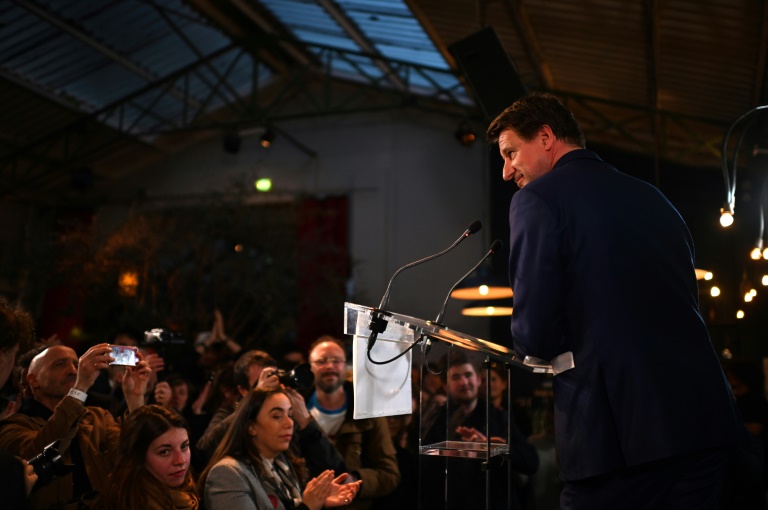
Yannick Jadot from the Europe Ecology-The Greens party (EELV) was eliminated in Sunday’s first round with a score of around 4.6 percent, following a campaign that never gathered momentum.

Under French campaign financing rules, only candidates who score above 5.0 percent have their expenses reimbursed by the state, leaving the Greens with a huge hole in their accounts.

“The situation is critical and the fact that we came below the bar of five percent puts us in a very, very difficult situation,” national secretary Julien Bayou told France Inter radio on Monday.

He appealed for donations from those who backed the party, as well as others “who would have liked to vote for Yannick Jadot and perhaps voted for another candidate.”

“We need this support to be able to continue to ensure the ecology movement lives on,” Bayou added.

President Emmanuel Macron finished top in Sunday’s vote on around 27.6 percent followed by far-right leader Marine Le Pen on 23.4 percent, with the pair set to contest a run-off vote scheduled for April 24.

EELV was not the only party appealing for financial help on Monday, with the once-mighty right-wing Republicans also facing a 7.0-million-euro ($7.6 million) hole in their finances after their candidate, Valerie Pecresse, scored just under 5.0 percent on Sunday.

The performance from Jadot, a former Greenpeace executive, spelled bitter disappointment for his party which was hoping to build on successes in local elections last year which saw them sweep major cities from Lyon to Bordeaux. 

Germany’s historically more powerful Green party entered government after elections last year and controls several ministries and key posts in the cabinet, including the foreign minister role. 

– ‘Enormous disappointment’ –

Adding to tensions, the office of the EELV in the western city of Nantes was attacked during election night by individuals who threw projectiles at the windows and daubed the word “traitors” on the door.

Jadot after the election urged supporters to vote for Macron against Le Pen in the run-off and had also refused to give way in the campaign to allow hard-left candidate Jean-Luc Melenchon a better chance of making the final round.

Jadot scored slightly better than the last ecologist candidate to stand — Eva Joly with 2.3 percent in 2012 — but less well than Noel Mamere in 2002 who secured 5.25 percent despite the stakes for the planet being much higher in 2022.

In a concession speech on Sunday night, Jadot said his programme sought to respond to the challenges posed by climate change, as well as growing economic inequalities in France.

“It’s an understatement to say that these vital challenges — vital for our country, vital for us and our children — were largely ignored in a campaign that was confiscated,” he said.

The Covid-19 pandemic overshadowed the start of campaigning before Russia’s invasion of Ukraine changed the dynamic completely, making foreign policy and the rocketing cost of living key issues for voters.

Jadot was also eclipsed by Melenchon, who put a big emphasis on the environment during his campaign.

Remi Lefebvre, a French political scientist at the University of Lille in northern France, told AFP before the vote that the Greens had been “the enormous disappointment of this campaign.”

“The problem with the greens is its social base,” he explained. “They can’t reach working-class people because the greens are not seen as reassuring.”

Low-income families often see their pitch as boiling down to “they’re going to ask us to tighten our belts even more”, Lefebvre said, while the educated, urban middle classes tended to vote for Macron.

Jadot, calling on his 1.5 million voters on Sunday to back Macron in the second round to bar the far-right from power, pointed out his differences with the president.

He said the vote “is not approval for your responsibility in the fracturing of the country due to your inaction on the climate, your social failures, conformism and democratic contempt.”

Russian town buries soldier born under Putin, killed in Ukraine

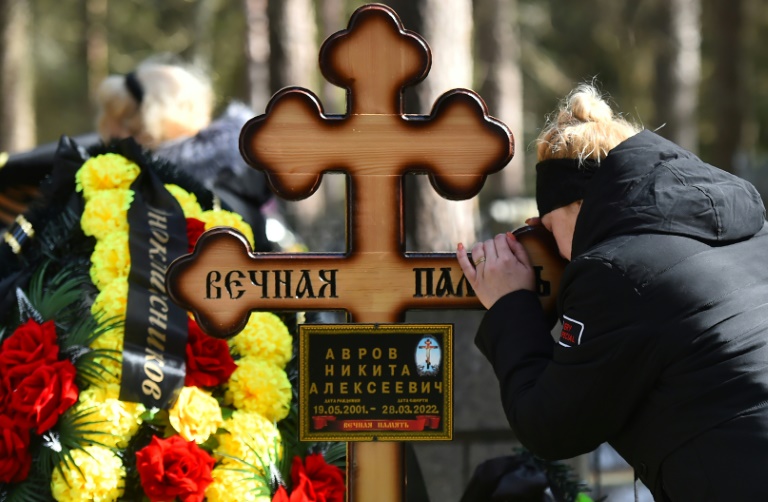
A baby-faced 20-year-old, Nikita Avrov was killed in Ukraine while serving as a gunner on a Russian tank.

At his funeral on Tuesday, those giving eulogies leave no room for doubt: the private died for a good cause, for his Russian fatherland.

In front of his family’s house in the small town of Luga, 150 kilometres (93 miles) south of Saint Petersburg, Avrov’s casket is briefly put on display, surrounded by funeral wreaths, while the flag of his motorised infantry division flies alongside.

Around 60 people file past to pay their final respects to a soldier who was born after Russian President Vladimir Putin took power in 2000.

Mourners also hold a ceremony at a war memorial where an Eternal Flame burns beside monuments to Soviet soldiers killed in World War II and Afghanistan.

Five fur-hatted soldiers and their commanding officer carry the coffin to the cemetery to the mournful sound of a brass band and fire their guns into the air.

In this town of 30,000 people, there is little sense of the bloody military operation in neighbouring Ukraine, launched by Russian troops on February 24, to fierce resistance from Ukrainian forces depicted by Moscow as hordes of neo-Nazis.

Some cars bear stickers with the letter Z, which has come to symbolise patriotic backing for the Russian operation.

According to the local authorities, Avrov was a gunner: loading the weapons of an assault tank.

He died in late March in Izyum, a small town in eastern Ukraine that was taken by Russian troops, strategically located between the cities of Kharkiv and Slavyansk.

– ‘Forces of evil’ –

Whether officials, military or clergy, those who speak at the memorial ceremony frame his death as a patriotic sacrifice.

“Fighting neo-Nazis and nationalists in Ukraine, he died for our motherland, for peace for each of us,” says Alexei Golubev, a municipal official, as the dead man posthumously receives a bravery medal.

“When Russia shows weakness, some impure people try to bring it to its knees… But they won’t manage it!”, says Sergei Nikitin, a colonel.

His speech echoes Moscow’s official rhetoric: that the West took advantage of Russia’s weakness after the breakup of the USSR and brought Ukraine under its sway.

In a nearby Russian Orthodox church, a priest makes similar patriotic points.

“Nikita wasn’t afraid of the forces of evil. He defended us so that we could have peaceful skies,” says Father Nikolai, as some 200 people gather to listen to the eulogy.

Standing outside are two former classmates of Avrov, who give their names as Sergei and Anton.

“Nikita was a soldier and died in combat. That’s a heroic deed,” says Sergei.

“We have to defend our country. It’s true that it’s the best ones who die,” adds Anton.

– ‘No justification’ –

A mournful mood about such deaths prevails among women present.

The exact numbers of Russian troops killed in Ukraine are not known, while a Kremlin spokesman last week acknowledged they are “significant”. Russia last gave a figure of 1,351 deaths, on March 25.

“It’s very painful; it’s very scary when they die so young,” says Anna Korolyova, a 59-year-old neighbour, carrying two carnations.

Russians choose their words carefully, since they face potential jail terms if they are found guilty of making “fake” statements about the military’s activities in Ukraine.

At the cemetery, another woman, 48-year-old Svetlana, who prefers not to give her surname, expresses bemusement.

“It’s terrifying to even imagine what the mother feels. You wouldn’t wish that on your enemy. What grief. What are these horrors happening, that mothers are losing children? This can have no justification,” she says.

Israel army launches new raids around flashpoint W.Bank city

Israeli forces launched a third day of operations Monday around the flashpoint West Bank city of Jenin following heavy gun battles in recent days and overnight arrests, the army said.

Tensions have soared since a spree of attacks in Israel left 14 people dead in the past three weeks, with Prime Minister Naftali Bennett warning the Jewish state is now “on the offensive”.

The Israeli army said 14 Palestinians were arrested early Monday, a day after four Palestinians were killed in separate incidents in the occupied territory, sparking criticism from international observers.

An additional 13 army battalions were now operating in the West Bank, said a military source, speaking on condition of anonymity.

In Jenin, thousands of mourners flooded the streets, many carrying Palestinian flags or rifles, for the funeral of Mohamed Zakarneh, 17, who according to the Wafa news agency died of gunshot wounds overnight.

“The resistance is in direct confrontation with the occupation and any minute we must expect a total clash,” said Ziad al-Nakhala, secretary general of the militant Islamic Jihad movement, in a statement.

“Jenin must not be isolated, no matter the cost.”

The Israeli army said it operated nearby Monday, in Burqa and Qallil in the northern West Bank, as well as in Al-Aroub and Hebron in the south. 

“Violent riots were instigated by dozens of Palestinians” near Nablus, the army said, while the Palestine Red Crescent said 24 Palestinians were wounded in the Nablus area overnight. 

Jenin, as well as Bethlehem in the southern West Bank, declared general strikes, shuttering shops, offices and official institutions.

“We will beat this terror wave with our powerful security forces,” Israeli Defence Minister Benny Gantz said Monday.

“There is the risk of escalation into a wider campaign in Gaza or some events in Lebanon,” he said.

– Weeks of violence –

Tensions have surged during the Muslim holy month of Ramadan, nearly a year after violence flared in the Hamas-ruled Gaza Strip, leading to 11 days of war.

A total of 14 people in Israel have been killed in four attacks since March 22, including a shooting spree in Bnei Brak, an Orthodox Jewish city in greater Tel Aviv, carried out by a Palestinian from Jenin.

Over the same period, at least 14 Palestinians have been killed, including assailants, according to a count by AFP. 

Two of them were women shot dead on Sunday. Maha Zaatari stabbed and lightly wounded an officer in Hebron before she was killed. Ghada Sabatien was unarmed but failed to heed soldiers’ warnings to stop near Bethlehem, the army said.

The British Consulate General in Jerusalem on Monday sent condolences to her family and wrote that “a swift, thorough investigation” into her death was needed. 

The Israeli military source said 30 Palestinian suspects were apprehended in the past few days, and 16 attacks against Israeli targets foiled.

Islamic Jihad has been growing in strength and capability both in Gaza and the West Bank, and especially in Jenin, according to the Israeli military source. 

The source also said that Israeli forces are operating in Jenin partially because the Palestinian Authority — which has a security coordination agreement with Israel — has failed in conducting its own activities in the area.

– Wrong turn –

Israeli troops were targeting relatives of Raad Hazem, the 28-year-old Jenin man who last Thursday killed three Israeli civilians and wounded more than a dozen at a Tel Aviv bar before he was shot dead following a manhunt.

The Israeli army demanded the father hand himself in, ahead of the planned demolition of the family home. It said it had engaged in an exchange of gunfire involving the assailant’s family members on Sunday — the clash in which 17-year-old Zakarneh was killed.

Another Palestinian from the Bethlehem area was shot dead Sunday after hurling a Molotov cocktail at an Israeli vehicle, the army told AFP.

In another incident overnight, two Israelis were shot and wounded after entering Nablus, where the previous night Joseph’s tomb, a religious site, had been vandalised by Palestinians.

“A group of Israeli civilians entered into the city after breaking through an unmanned military checkpoint,” said an army statement.

Shortly after, it said, the two Israeli men emerged at another checkpoint “with gunshot wounds”.

One of the men involved told public broadcaster Kan they had gone to inspect Joseph’s tomb.

“We were done and heading back to Jerusalem but then we took a wrong turn,” and were shot at by a “terrorist”, he said.

Embattled Sri Lanka PM appeals for 'patience' from protesters

Sri Lanka’s Prime Minister Mahinda Rajapaksa pleaded for “patience” Monday as thousands continued to take to the streets to protest his family’s rule, with public anger at a fever pitch over the country’s crippling economic crisis.

Sri Lanka’s 22 million residents have seen weeks of power blackouts and severe shortages of food, fuel and even life-saving medicine in the country’s worst downturn since independence in 1948.

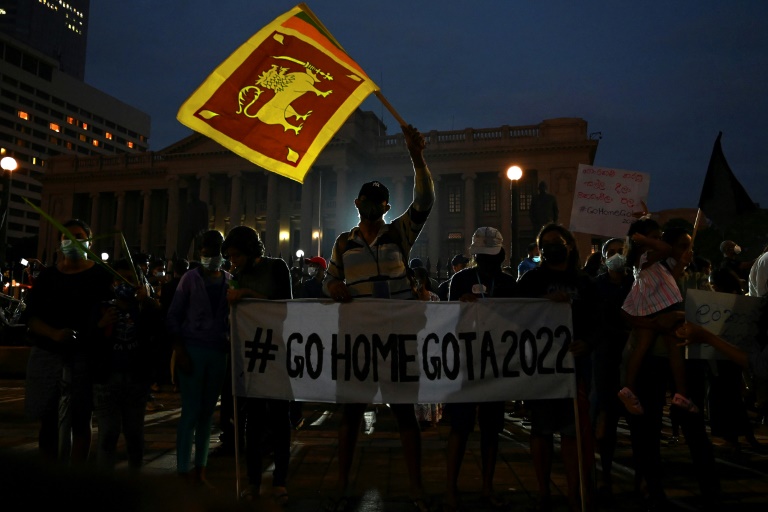
Protesters have rallied daily since Saturday against President Gotabaya Rajapaksa — Mahinda’s younger brother — in Colombo and across the island nation, chanting “Gota go home” and calling for his government’s removal.

In his first address since the crisis, Mahinda — the patriarch of the powerful Rajapaksa family omnipresent in Sri Lanka’s politics for two decades — said he needed more time to pull the nation out of the deep end.

“Even if we can’t stop this crisis in two or three days, we will solve it as soon as possible,” Rajapaksa said in his televised address. 

“Every minute you protest on the streets, we lose an opportunity to earn dollars for the country,” he said.

“Please remember that the country needs your patience at this critical moment.”

Pressure on the powerful Rajapaksa family has intensified in recent days, with the country’s vital business community also withdrawing support for them over the weekend. 

Mahinda did not directly address the growing calls for him and Gotabaya to step down, but he defended his administration by saying that opposition parties had rejected their offer to form a unity government.

“We invited all other parties to come forward and take up the challenge, but they did not, so we will do it on our own,” he said, also blaming Sri Lanka’s ballooning foreign debt on the pandemic.

While the coronavirus-spurred restrictions and stoppages have torpedoed Sri Lanka’s vital tourism-driven economy, experts say the crisis was exacerbated by government mismanagement, years of accumulated borrowing and ill-advised tax cuts.

The government is preparing for bailout negotiations with the International Monetary Fund this week, with finance ministry officials saying that sovereign bond-holders and other creditors may have to take a haircut.

Sri Lanka expects $3 billion from the IMF to support the island’s balance of payments in the next three years.

French bank Societe Generale to sell Russia unit to oligarch

French banking group Societe Generale said on Monday it was ceasing activities in Russia and selling its Rosbank unit to an investment firm founded by an oligarch close to the Kremlin.

The exit will cost the firm 3.1 billion euros ($3.4 billion).

Hundreds of foreign companies, from financial firms to fast-food restaurants, have pulled out of Russia since the February 24 invasion of Ukraine.

But French firms, which are the biggest foreign employers in Russia, have been among the slowest to withdraw, prompting Ukrainian President Volodymyr Zelensky to urge them to leave during an address to the French parliament on March 23.

Societe Generale is heavily involved in Russia, with exposure of 18.6 billion euros. Of that, 15.4 billion euros was linked to Rosbank, a heavyweight in the Russian banking sector, in which Societe General is the main shareholder.

Shares in Societe Generale ended the day 5.0 percent higher.

“Societe Generale ceases its banking and insurance activities in Russia,” the firm said in a statement.

It also announced “the signing of a sale and purchase agreement to sell its entire stake in Rosbank and the Group’s Russian insurance subsidiaries” to Interros Capital, an investment firm founded by one of Russia’s richest oligarchs, Vladimir Potanin.

Potanin, who is close to President Vladimir Putin, is also the co-owner of Russian mining giant Norilsk Nickel.

“With this agreement, concluded after several weeks of intensive work, the group would exit in an effective and orderly manner from Russia, ensuring continuity for its employees and clients,” Societe Generale said.

The bank said it expected the deal to be completed in the coming weeks and that it was subject to approval from regulators.

The bank said it would write off some two billion euros of the net book value of the divested activities and take a further 1.1-billion-euro non-cash hit.

“One could criticise the decision to sell to this type of buyer but on the other hand there weren’t many people queuing up to buy,” an expert who declined to be identified told AFP.

He said the conditions under which the sale had taken place had been “very complicated” and “limited to candidates already in situ”.

Societe Generale had held talks with other prospective buyers, a source close to the bank told AFP.

– ‘Great resistance’ –

In a separate statement, Interros said that “the conditions for the deal have been approved by the government commission on control over foreign investment in the Russia Federation”.

“Interros intends to do the maximum efforts to develop Rosbank,” Potanin said in his company’s statement.

“The main objective is to maintain the stability of Rosbank, as well as create new opportunities for its clients and partners,” he said.

In a statement, Rosbank said it was “certain” that the firm would maintain its stability thanks to its “expertise” and reliance on “international expertise”.

The Russian bank said it built “great resistance” to economic turmoil due to its “well-thought-out risk policy” as well as its balanced loan portfolio and diversified liquidity base.

Meanwhile, Societe Generale’s auto leasing subsidiary, ALD, said it would not enter into new commercial transactions in Russia, Kazakhstan and Belarus.

Since Zelensky’s speech to the French parliament, auto giant Renault suspended operations at its Moscow factory and hinted that it might divest its majority stake in domestic car giant AvtoVAZ, while French sports retailer Decathlon halted sales at its stores in Russia.

Another major French company singled out by Zelensky, supermarket chain Auchan, has decided to stay, citing the “human” cost of leaving.

The Western exodus followed the invasion and a slew of Western sanctions on Russia, including the freezing of $300 billion of the country’s foreign currency reserves abroad.

Russia has since faced the risk of defaulting on its debt.

War in Ukraine: Latest developments

Here are the latest developments in the war in Ukraine:

– ‘Last battle’ for Mariupol –

Ukrainian forces say they are preparing for a “last battle” for the besieged southern city of Mariupol because their ammunition is running out.

“It’s death for some of us, and captivity for the rest,” the 36th marine brigade of the Ukrainian armed forces says on Facebook, saying it had been “pushed back” and “surrounded” by the Russian army.

Pro-Russia rebels says they already control Mariupol’s port.

Ukrainian President Volodymyr Zelensky says he believes “tens of thousands” of people in the city have been killed.

– Austrian leader meets Putin –

Austrian Chancellor Karl Nehammer meets President Vladimir Putin in Moscow after talks with Ukrainian President Volodymyr Zelensky in Kyiv.

The first European leader to meet Putin since the start of the Russian invasion, Nehammer said it was not “a visit of friendship,” and called their conversation “direct, open and hard”.

“I mentioned the serious war crimes… and stressed that all those responsible have to be brought to justice,” he said, telling Putin of the “urgent” need for humanitarian corridors “to bring water and food into besieged towns and (to) remove women, children and the injured”.

– Over 1,200 bodies found –

Ukraine says it has discovered 1,222 bodies in Bucha and other towns around the capital Kyiv from which the Russian army has retreated. 

French police officers and forensic doctors arrive in Ukraine to help investigate the discovery of scores of bodies in civilian clothing scattered in Bucha and other towns around Kyiv after Russia’s withdrawal from the region.

– Ukraine still open to talks –

Despite the allegations of atrocities, Ukraine’s Foreign Minister Dmytro Kuleba says he is still open to negotiating with Moscow.

“If sitting down with the Russians will help me to prevent at least one massacre like in Bucha, or at least another attack like in Kramatorsk, I have to take that opportunity,” he tells US broadcaster NBC.

– Societe Generale leaves Russia –

Societe Generale says it is ceasing its activities in Russia and selling its majority stake in Rosbank to an investment firm founded by an oligarch close to the Kremlin.

France’s third-largest bank estimates that pulling out of Russia will cost it 3.1 billion euros ($3.4 billion).

Swedish telecom giant Ericsson also says that it is suspending all of its Russian operations for the foreseeable future.

– Sweden debates NATO membership –

Sweden’s ruling party kicks off an internal debate on whether Stockholm, which is officially non-aligned militarily, should apply for NATO membership.

Public support for NATO membership has almost doubled since Russia’s invasion of Ukraine.

– Biden, Modi discuss Ukraine –

US President Joe Biden and Indian Prime Minister Narendra Modi hold a virtual summit, weeks after saying New Delhi has been “shaky” in its response to the invasion of Ukraine.

– Sixth round of EU sanctions –

EU foreign ministers meet to discuss a sixth round of sanctions on Moscow.

EU members are divided on whether to impose the sanctions that would hurt Russia the most, a boycott of its oil and gas exports, but diplomats acknowledge there are discussions about the measures.

– Ukraine economy collapses –

The World Bank predicts that the war will cause Ukraine’s economy to contract by 45.1 percent this year.

– More than 4.5 million flee – 

More than 4.5 million Ukrainian refugees have now fled their country, the United Nations refugee agency says.

Ninety percent of those who have left are women and children.

24 dead in Philippines landslides, flooding

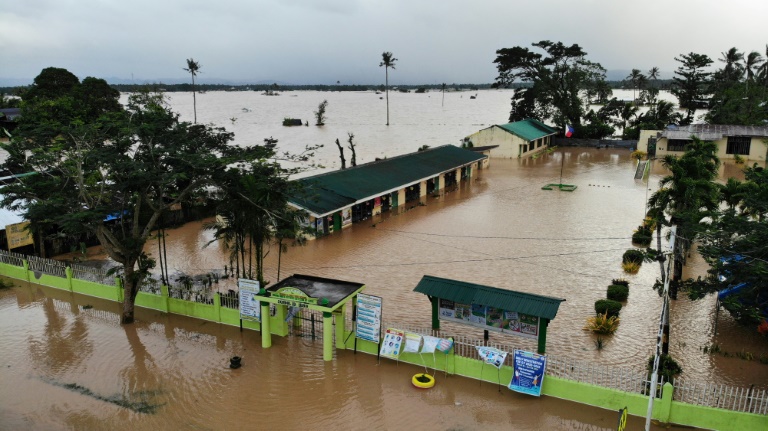
At least 24 people have been killed in landslides and flooding across central and southern Philippines, authorities said Monday, after tropical storm Megi dumped heavy rain and disrupted travel ahead of the Easter holidays.

More than 13,000 people fled to emergency shelters as the storm pounded the region Sunday, the national disaster agency said, flooding houses, inundating fields, cutting off roads and knocking out power.

The central province of Leyte was among the hardest hit, with landslides leaving 21 people dead in four villages, Baybay City disaster officer Rhyse Austero told AFP. 

Leyte’s death toll adds to another three people killed on the main southern island of Mindanao, the national disaster agency said. 

Photos posted on Facebook and verified by AFP show several houses buried in mud up to the rooftops in Bunga, one of the affected villages in Leyte.

“Yesterday the rain was so hard, it was non-stop for more than 24 hours,” resident Hannah Cala Vitangcol told AFP. 

The 26-year-old teacher fled with her family to a hotel Monday after waking to find nearby homes had been covered in an avalanche of mud.

“I was crying because I know the people buried there and I was also scared because there were mountains behind our house,” she said.

Baybay City council member Mark Unlu-cay posted photos on Facebook showing survivors from another village, Kantagnos, being treated in hospital.

“It seems like the entire community… was badly hit by the landslide and the riverflow,” he said.

Unlu-cay said he feared the death toll could rise after receiving reports that other villages had also been inundated by the waves of earth and mud.

Philippine Coast Guard and police personnel rescued people from their homes in the flooded town of Abuyog, carrying residents onto orange stretchers laid on floating boats. 

– First major storm in 2022 –

Tropical storm Megi — known in the Philippines by its local name Agaton — is the first major storm to hit the disaster-prone country this year. 

Whipping up seas, it forced dozens of ports to suspend operations and stranded nearly 6,000 people at the start of one of the busiest travel periods of the year.

The Philippines re-opened to fully vaccinated tourists from most countries in February after lifting most Covid-19 restrictions, and Easter is a popular holiday for domestic tourists.

The storm comes four months after a super typhoon devastated swathes of the archipelago nation, killing more than 400 people and leaving hundreds of thousands homeless.

Rai, the strongest typhoon to hit the Philippines last year, intensified faster than expected, officials said previously. 

Scientists have long warned that typhoons are strengthening more rapidly as the world becomes warmer because of human-driven climate change.

The Philippines — ranked among the most vulnerable nations to its impacts — is hit by an average of 20 storms every year.

In 2013, Typhoon Haiyan was the strongest storm ever to have made landfall, leaving over 7,300 people dead or missing. 

Close Bitnami banner
Bitnami