World

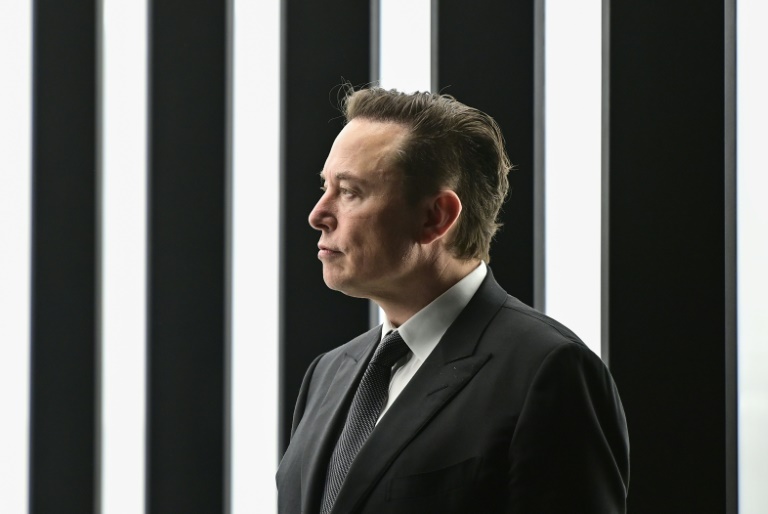
Twitter employees to meet with new board member Musk

Twitter plans to hold a meeting for employees concerned about Tesla Chief Executive Elon Musk’s influence on the company’s board, a Twitter spokesperson said Friday.

The Twitter official did not disclose the timeframe or format for the meeting.

The social media company named Musk to the board on Tuesday after the outspoken and polarizing executive disclosed he had acquired a more than nine percent stake in the company, making him Twitter’s largest shareholder.

In announcing the appointment, Twitter Chief Executive Parag Agrawal said he was “excited” to name Musk, calling him “a passionate believer and intense critic of the service which is exactly what we need.”

Musk said he looked forward to soon making “significant improvements to Twitter.” 

The Tesla chief began polling his followers on whether to add an “edit” button the service, a long-discussed tweak.

But Musk is a break-the-mold figure in American business. On Thursday, he tweeted a photo of himself smoking marijuana on a Joe Rogan podcast in 2018, with the caption, “Twitter’s next board meeting is gonna be lit.”

His antics often raise eyebrows and occasionally draw condemnation, as when Jewish groups blasted his tweet comparing Canadian leader Justin Trudeau to Adolf Hitler over Covid-19 vaccine mandates. Musk later deleted the tweet without apologizing.

The appointment has sparked misgivings among some employees, according to a Washington Post report.

Workers at the California-based social media company cited worries about Musk’s statements on transgender issues and his reputation as a difficult and driven leader, according to statements on Slack reviewed by the Post.

His arrival has cheered some Wall Street analysts, who have been frustrated by Twitter’s difficulty in meaningfully monetizing its business.

But skeptics have pointed out that Musk has bullied critics in the investment community and fired or penalized workers who have spoken out or tried to unionize. 

A California agency has sued Tesla, alleging discrimination and harassment against Black workers. The electric carmaker has rejected the charges, saying it opposes discrimination.

President's attacks heap pressure on Mexico's embattled media

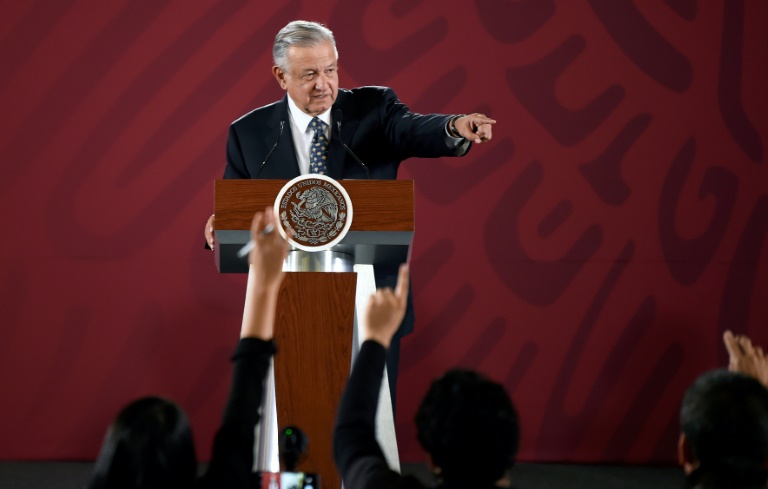
Mexico’s president has stepped up his attacks on a number of media outlets in one of the world’s most dangerous countries for journalists, branding them “mercenaries” who defend vested interests.

Andres Manuel Lopez Obrador, a left-wing populist who faces a midterm recall referendum on Sunday, often uses his weekday press conferences to lash out at newspapers, prominent journalists and industry leaders.

“They’re aligned with a conservative bloc. The goal is to hurt us,” the president said in February after news articles questioned how his son’s mansion in Houston fit in with his own pro-austerity agenda.

“It’s very important to know that the media — not all — are the defenders of interest groups, of people who did not pay taxes, who were in charge of economic policy,” he added.

Prominent Mexican journalist Carmen Aristegui sees such criticism as “a direct attack by the president” against media figures like her.

“We are neither for nor against his government. The goal is to inform,” added Aristegui, famous for hard-hitting reports on government corruption.

For Juan Pardinas, the director of the Reforma daily newspaper, part of the problem is that Lopez Obrador’s attacks against the press are so frequent.

The president “has mentioned the newspaper more than 300 times in his morning conferences,” Pardinas told AFP.

Reforma has been a harsh critic of major presidential projects, such as Lopez Obrador’s tourist railroad in the Yucatan Peninsula and controversial energy reforms, as it was during other governments.

In February, the president accused Reforma of acting “at the service of the mafia of power, which has done a lot of harm to Mexico.”

Such an attack “puts at risk not only my colleagues from the Reforma group but the entire journalistic profession,” Pardinas said.

Media workers in Mexico already face myriad dangers.

Eight journalists have been killed in the Latin American country since the start of 2022, according to Reporters Without Borders (RSF).

Around 150 journalists have been murdered in Mexico since 2000, and only a fraction of the crimes have resulted in convictions, the media watchdog says.

Such killings doubled during the first three years of Lopez Obrador’s term, which began in December 2018 — to 30, compared with 15 in the same timeframe under his predecessor Enrique Pena Nieto, according to media rights group Article 19.

Usually the victims are reporters working for local media in states plagued by drug cartel-related violence rather than those at the national press in the capital singled out by the president.

– ‘Who’s who of lies’ –

In March, the European Parliament angered Lopez Obrador with a resolution urging his government to protect journalists and accusing him of using “populist rhetoric” to denigrate and intimidate the press.

Lopez Obrador accused EU lawmakers of supporting his opponents’ “coup” attempt “like sheep.”

On social networks, the president and his allies are sometimes the targets of disinformation about issues such as Mexico City Mayor Claudia Sheinbaum’s nationality or the first lady’s qualifications — rumors debunked by AFP.

The presidency now has its own fact-checking service. Every Wednesday, part of his news conference is dedicated to highlighting the “lies” attributed to journalists or political opponents. 

The segment, known as the “Who’s who of lies,” amounts to “direct attacks on people and their reputation,” historian Ana Maria Serna told AFP. 

“I don’t remember a presidency fighting directly with journalists (before now). In the past, other forms of censorship were used,” she added.

“There was a lot of advertising bought by the federal government. It was a form of control. Another was direct payment to journalists,” Serna said.

Lopez Obrador, a vocal critic of corruption, this week announced a support fund for journalists without social security, lamenting the fact that many of them “end up with nothing.”

'Bodies everywhere': Rockets strike Ukraine evacuation hub

The attack on the train station in Kramatorsk came mid-morning, when hundreds were gathered, waiting for evacuation out of east Ukraine as they had done at the same time for the last several days. 

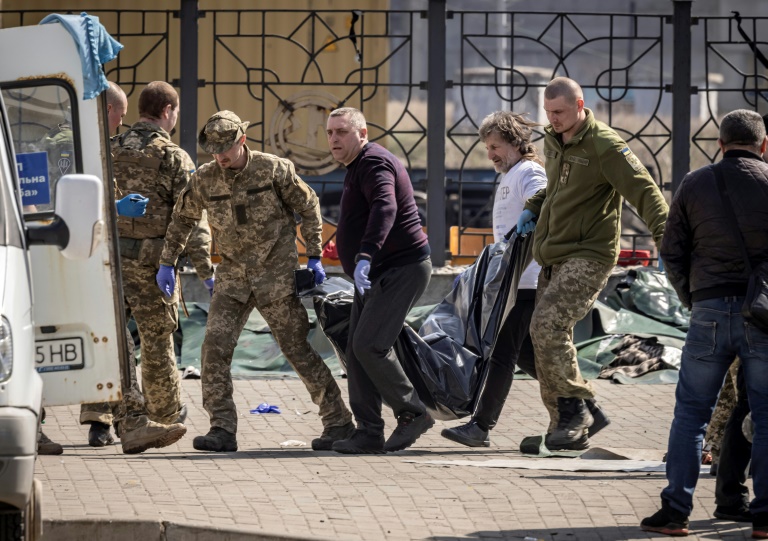
Body parts, packed bags and stuffed animals were flung across the floor after two rockets struck the busy hub on Friday, killing at least 39 people.

“I was in the station. I heard like a double explosion. I rushed to the wall for protection,” said Natalia, searching for her passport among the abandoned belongings.

“I saw people covered in blood coming into the station and bodies everywhere on the ground. I don’t know if they were just injured or dead,” she told AFP.

Around 30 bodies, all dressed in civilian clothing, were grouped together and placed under plastic sheets next to a kiosk daubed yellow and blue — the colours of Ukraine’s flag — outside the station, where blood pooled on the ground.

On the station platform, a walking stick lay next to a lump of flesh. Further along, a toy rabbit soaked red.

The toll from the strikes rose throughout the morning with Ukraine’s SBU security service saying least 39 people had been killed, including at least four children.

Kramatorsk had been hit by Russian strikes earlier this week but had been otherwise spared the destruction witnessed by other eastern Ukraine cities since Russia’s invasion.

– ‘Looking for my husband’ –

Moscow denied involvement in Friday’s strike and accused Kyiv of carrying out the attack deliberately.

Ukrainian authorities had warned this week that time was running out to flee westwards in advance of an anticipated Russian attack.

Rescue workers and men in camouflage carried bodies onto a truck to be ferried away. Some of the bags were light and needed no more than two men to be carried.

Prosecutors in the Donetsk region said in a statement that at the time of the attack there were approximately 4,000 civilians at the station, mostly women and children.

Earlier in the morning, AFP saw dozens of people — women, children and the elderly — throng the station desperate to escape the feared Russian advance on eastern Ukraine.

After the attack, a sneaker with the foot still inside was visible under a bench, where the people hoping to be evacuated had been waiting.

A policeman moved between the debris, picking up phones and putting them in a box, one of them ringing out incessantly.

“I’m looking for my husband. He was here. I can’t reach him,” sobbed a woman in a red turtle neck. Shaking, she hesitated to get closer to the bodies, holding her phone to her ear.

– ‘For our children’ –

The head of Ukraine’s railway company, Alexander Kamyshin had said earlier that at least 100 were injured by two rockets hitting the station.

“This is a deliberate attack on the passenger infrastructure of the railway and the residents of Kramatorsk,” Kamyshin said.

A soldier at one of the three hospitals in the city told AFP that around 50 wounded had arrived from the scene.

“Many of them will die because they have lost a lot of blood, and we don’t have enough blood,” he said.

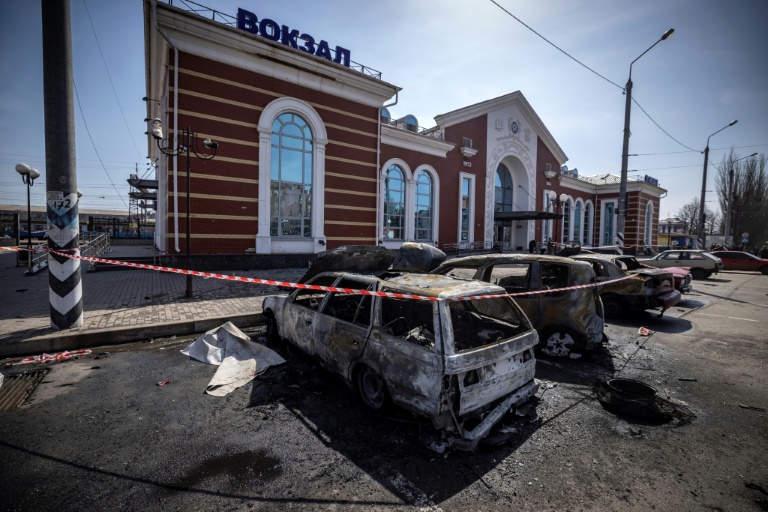
Outside the station, four burnt-out cars could be seen next to the military-green remains of a rocket, cordoned off.

“It’s a Tochka missile, a fragmentation bomb,” a policeman on the scene told AFP. “It explodes in several places over an area the size of a football pitch.”

The missile was tagged with white spray paint with the words “for our children” in Russian, a recurring expression used by pro-Russian separatists in reference to their losses since the start of the first Donbas war in 2014.

Asia, Europe stocks climb, Wall Street pauses

Asian and European equities rallied Friday on clarity over rising US interest rates, while the euro hit a one-month dollar low before France’s presidential election.

Meanwhile US stocks opened narrowly mixed after ending Thursday higher.

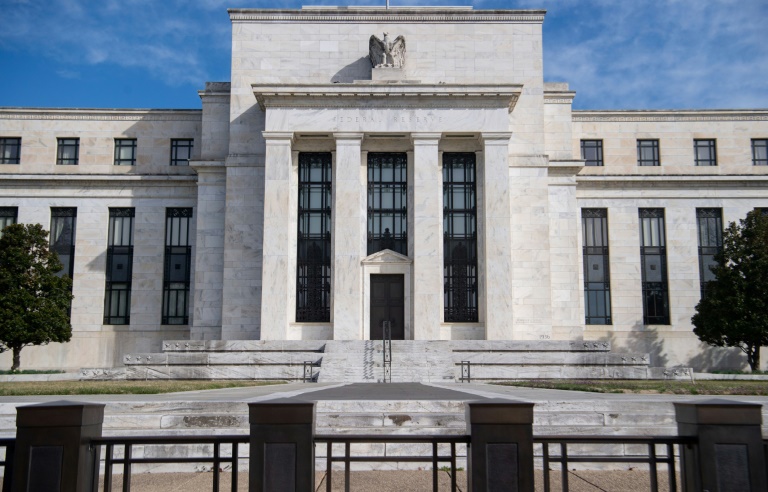
The trading caps a tough week dominated by the US Federal Reserve’s hawkish tone in minutes from its March monetary policy gathering, which sent the dollar climbing against its main rivals.

The euro sank to $1.0839 before of Sunday’s first round French presidential vote, with the unit dented also by European officials’ reticence to move as aggressively as the Fed on tackling soaring inflation.

Oil prices steadied as traders mulled the recent release of nations’ strategic reserves to combat recent Ukraine war-driven turmoil over Russian crude supplies. 

– Strong US finish –

Equity investors took their cue “from a strong finish to a turbulent trading session on Wall Street overnight”, said AJ Bell investment director Russ Mould.

“Commodities firms and financial stocks, the latter boosted by expectations of faster rate hikes, helped lead the charge higher.”

Commodity prices have been boosted in recent weeks because Ukraine and Russia are key producers of raw materials.

Financial firms were given a shot in the arm on Friday as investors became more willing to take risks. 

“The fortunes of financial stocks have been closely aligned with risk appetite over the last couple of months and we’re continuing to see that now,” said OANDA analyst Craig Erlam.

“If the economy can weather the storm, they could be in a strong position given how higher interest rates are generally beneficial for them.”

The Fed has made clear it intends to act more decisively to rein in 40-year-high inflation by ramping up borrowing costs and offloading bond holdings.

Markets have come under huge pressure this year as the end of ultra-cheap central bank cash, a Covid-fuelled slowdown in China’s economic activity, the war in Ukraine and soaring inflation come together in a perfect storm.

However, so far this year the London FTSE 100 index has won more than three percent in value, boosted by heavyweight commodity and oil companies whose share prices have benefitted from soaring prices of raw materials.

In contrast, Frankfurt’s DAX has shed in excess of 10 percent and the Paris CAC 40 has lost eight percent, hit also by energy security concerns as a result of EU nations’ reliance on gas supplies from sanctions-hit Russia.

– Key figures around 1330 GMT –

London – FTSE 100: UP 1.0 percent at 7,625.68 points

Frankfurt – DAX: UP 0.8 percent at 14,195.51

Paris – CAC 40: UP 0.6 percent at 6,500.87

EURO STOXX 50: UP 0.8 percent at 3,833.52

New York – Dow: UP less than 0.1 percent at 34,613.39

Tokyo – Nikkei 225: UP 0.4 percent at 26,985.80 (close)

Hong Kong – Hang Seng Index: UP 0.3 percent at 21,872.01 (close)

Shanghai – Composite: UP 0.5 percent at 3,251.85 (close)

Euro/dollar: DOWN at $1.0840 from $1.0879 late Thursday

Pound/dollar: DOWN at $1.3006 from $1.3075

Euro/pound: UP at 83.37 pence from 83.20 pence

Dollar/yen: UP at 124.62 yen from 123.95 yen

Brent North Sea crude: UNCHANGED at $100.58 per barrel

West Texas Intermediate: UP 0.2 percent at $96.26 per barrel

burs-rl/lth

Crisis-hit Sri Lanka hikes rates as protests spiral

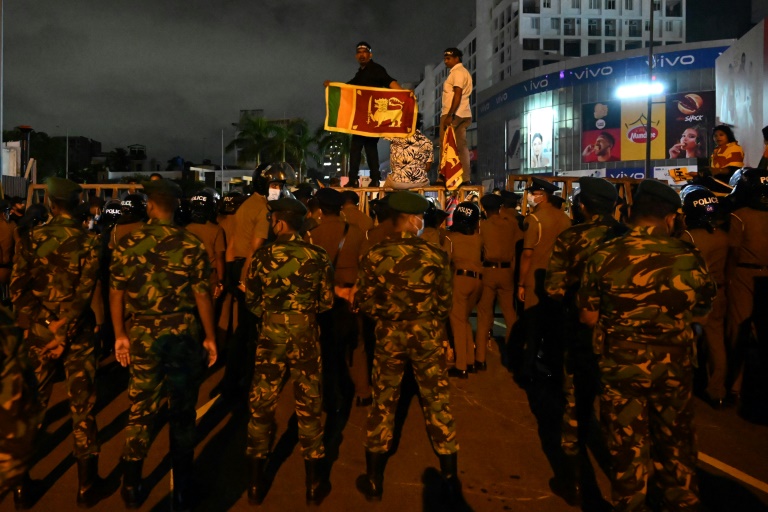
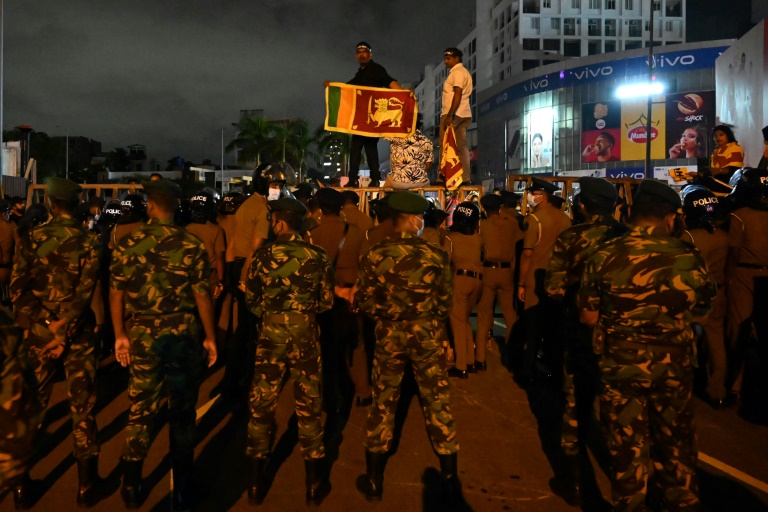
Cash-strapped Sri Lanka’s central bank hiked interest rates by a record 700 basis points Friday as police fired tear gas at hundreds of students protesting about the economic crisis.

Severe shortages of food, fuel and electricity have led to widespread anti-government demonstrations with calls for President Gotabaya Rajapaksa to resign.

The latest protests saw students try to march to the national parliament on Friday.

Elsewhere demonstrators nationwide carried placards demanding Rajapaksa step down over the country’s worst economic crisis since independence in 1948.

Buddhists monks, who had largely led Rajapaksa’s election bid in November 2019, were also seen joining demonstrations in the capital Colombo.

The Central Bank of Sri Lanka said its benchmark lending rate had been raised to 14.5 percent to “stabilise the exchange rate” after the rupee tumbled over 35 percent in a month.

The rate for deposits was also increased by seven percentage points to 13.5 percent as reports said Sri Lanka’s rupee was the worst performing currency in the world, edging out the Russian ruble.

The bank said the shock-treatment rate hike was due to its belief that the embattled island’s inflation, which is already at record levels, could get worse.

The Colombo Consumer Price Index rose 18.7 percent in March while food inflation stood at more than 25 percent, but private analysts placed inflation at over 50 percent in the month.

International rating agencies have downgraded Sri Lanka as fears grow that it could default on its $51 billion external debt after foreign reserves fell below $2 billion at the end of March.

This week Rajapaksa appointed a panel of experts to organise a restructuring of foreign debt.

His government is preparing for bailout negotiations with the International Monetary Fund, and finance ministry officials told AFP the panel will prepare a programme for sovereign bond holders and other creditors to take a haircut.

“What Sri Lanka is keen to do is avoid a hard default,” a source from the ministry who requested anonymity told AFP. 

“It will be a negotiated restructuring of the debt with the help of the IMF.”

Meetings with the IMF are set to begin by next week but finance minister Basil Rajapaksa — the president’s brother — resigned on Sunday night along with nearly the entire cabinet. 

The country is still without a replacement, with his successor quitting after just one day in office.

Public anger is at fever pitch, and thousands of people were expected to take part on Saturday in what likely will be the biggest protest since the crisis began.

Recent days have seen civil servants and schoolchildren join in demonstrations largely organised through social media.

In an apparent bid to head off more protests, the government on Thursday declared extra public holidays for next week to coincide with the traditional Sinhalese and Tamil New Year.

Opposition parties have rejected an overture from the president to form a unity administration and instead joined calls for him to step down.

The shortages of essentials have been caused by a wide-ranging import ban as Sri Lanka seeks to conserve its meagre foreign currency reserves to pay its debts.

In recent years the vital tourism sector has also been hit hard by Islamist bomb attacks in 2019 and the coronavirus pandemic, which dried up remittances from Sri Lankans abroad.

Economists say the crisis has been exacerbated by government mismanagement, years of accumulated borrowing and ill-advised tax cuts.

Crisis-hit Sri Lanka hikes rates as protests spiral

Cash-strapped Sri Lanka’s central bank hiked interest rates by a record 700 basis points Friday as police fired tear gas at hundreds of students protesting about the economic crisis.

Severe shortages of food, fuel and electricity have led to widespread anti-government demonstrations with calls for President Gotabaya Rajapaksa to resign.

The latest protests saw students try to march to the national parliament on Friday.

Elsewhere demonstrators nationwide carried placards demanding Rajapaksa step down over the country’s worst economic crisis since independence in 1948.

Buddhists monks, who had largely led Rajapaksa’s election bid in November 2019, were also seen joining demonstrations in the capital Colombo.

The Central Bank of Sri Lanka said its benchmark lending rate had been raised to 14.5 percent to “stabilise the exchange rate” after the rupee tumbled over 35 percent in a month.

The rate for deposits was also increased by seven percentage points to 13.5 percent as reports said Sri Lanka’s rupee was the worst performing currency in the world, edging out the Russian ruble.

The bank said the shock-treatment rate hike was due to its belief that the embattled island’s inflation, which is already at record levels, could get worse.

The Colombo Consumer Price Index rose 18.7 percent in March while food inflation stood at more than 25 percent, but private analysts placed inflation at over 50 percent in the month.

International rating agencies have downgraded Sri Lanka as fears grow that it could default on its $51 billion external debt after foreign reserves fell below $2 billion at the end of March.

This week Rajapaksa appointed a panel of experts to organise a restructuring of foreign debt.

His government is preparing for bailout negotiations with the International Monetary Fund, and finance ministry officials told AFP the panel will prepare a programme for sovereign bond holders and other creditors to take a haircut.

“What Sri Lanka is keen to do is avoid a hard default,” a source from the ministry who requested anonymity told AFP. 

“It will be a negotiated restructuring of the debt with the help of the IMF.”

Meetings with the IMF are set to begin by next week but finance minister Basil Rajapaksa — the president’s brother — resigned on Sunday night along with nearly the entire cabinet. 

The country is still without a replacement, with his successor quitting after just one day in office.

Public anger is at fever pitch, and thousands of people were expected to take part on Saturday in what likely will be the biggest protest since the crisis began.

Recent days have seen civil servants and schoolchildren join in demonstrations largely organised through social media.

In an apparent bid to head off more protests, the government on Thursday declared extra public holidays for next week to coincide with the traditional Sinhalese and Tamil New Year.

Opposition parties have rejected an overture from the president to form a unity administration and instead joined calls for him to step down.

The shortages of essentials have been caused by a wide-ranging import ban as Sri Lanka seeks to conserve its meagre foreign currency reserves to pay its debts.

In recent years the vital tourism sector has also been hit hard by Islamist bomb attacks in 2019 and the coronavirus pandemic, which dried up remittances from Sri Lankans abroad.

Economists say the crisis has been exacerbated by government mismanagement, years of accumulated borrowing and ill-advised tax cuts.

Bucha residents return to scene of civilian killings

Hanna Predko fled Bucha on the first day of Russia’s invasion. With her three children, Hanna left as soon as the first bombs began to fall.

Her mother, Natalia Predko, 69, joined Hanna on March 11, slipping out in a civilian evacuation operation while the town was under Russian occupation.

Fighting around the town never ceased completely and, at the end of March, Russian troops pulled out.

Dozens of civilian corpses were found after their exit, a number of them with their hands tied behind their back.

“We’re all very happy that our forces have chased the bastards away,” Hanna said, as she and her mother returned to the suburban town near the capital Kyiv on Thursday.

“Now, everyone knows this place, sadly for an enormous cost,” the 31-year-old said, pulling up outside the town hall with her mother in her car, the boot full of food to share with locals.

Perched on the arm of a cherry-picker, a local official raised the Ukrainian flag above the municipal building for the first time since the occupation by Moscow’s forces.

 – Spring weather –

“I am very very happy to have come back and to see our national flag after the liberation of our town by the army of Ukraine. Glory to Ukraine!” said Natalia, as she watched the blue and yellow standard flapping in the wind.

She is pleased, too, to have found her husband safe and sound after leaving him behind because he had refused to leave his home.

“We’re planning to stay here,” Hanna said when asked where they will live from now on. 

“Lots of my friends live abroad, we were invited and there were possibilities to leave. But we decided to come back, even if the town is in ruins,” she said.

In a small square in front of the town hall, volunteers handed out food.

Dozens of residents lined up, mostly older people, dressed for mid-winter despite the gentle spring temperatures. They trotted away slowly, pulling a trolley or swinging plastic bags full of supplies.

With the sun out, Boris Byguik decided to take his bike to inspect his son’s house.

Byguik, 63, whose son is a policeman and was away when the occupation began, is currently based in the nearby town of Vorzel.

“The curfew ended today. I decided to come and fix my son’s gate, since the neighbours said it was broken. The Russians stole everything in the house, broke the doors and the windows,” he says.

“I was scared to go inside because there could be traps. You can’t rule anything out from these ‘fascists’ — we saw them!” said the retired police officer.

 – ‘They looted everything’  –

Russian soldiers came to Vorzel, too, and stayed there a month.

Byguik recalled how the son of their neighbour was killed one night, “because Russians equipped with a thermal camera fired grenades from a drone on anyone that stepped outside”.

A week ago, when the Russian troops withdrew “they took with them anything they could carry. They looted everything, their armoured vehicles were brimming with stolen possessions”, he said, getting back on his bike.

He left before a convoy of United Nations 4x4s pulled up in front of the town hall. 

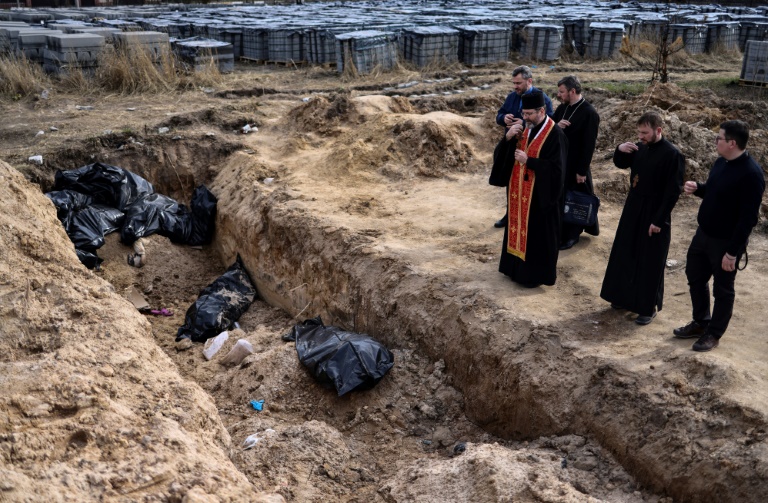
In front of a mass grave dug by the Ukrainians, where some of the bodies are still only half-buried, the British diplomat listened to a local official’s account of how civilians were killed in Bucha.

“The world is already deeply shocked” by the events in Bucha, Griffiths said, adding that “the next step is conducting investigations”.

By the mass grave, in the shadow of a white church with two golden domes, archbishop Svyatoslav Shevchuk, the head of the Greek Catholic church in Ukraine, said a prayer.

“We have seen the genocide of the Ukrainian people here,” he told AFP.

“We pray because the most important judge is almighty God, but justice must be done here, too. If we do not condemn a crime like this, it will be repeated.”

From coal to ports, Western sanctions target Russian economy

From a coal embargo to new restrictions on investments and European ports closed to Russian ships, the list of Western sanctions imposed on Russia’s economy since it invaded Ukraine keeps getting longer.

Here is an overview: 

– Energy –

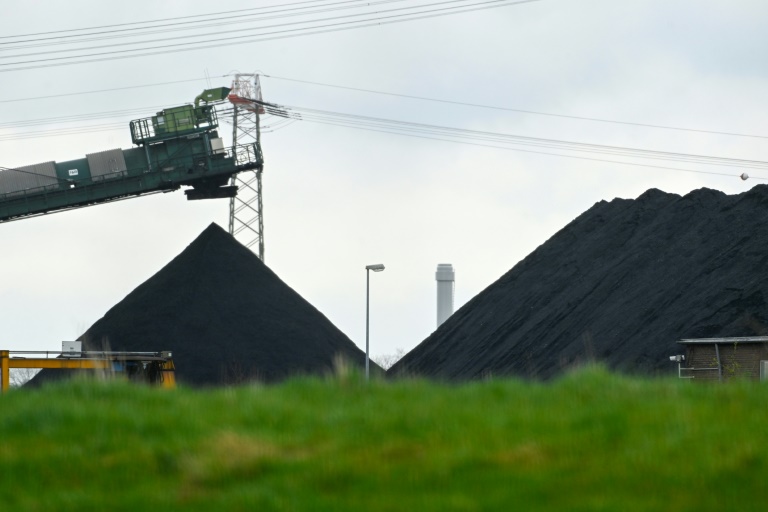
The European Union decided Thursday to forgo from August purchases of Russian coal, which accounts for about 45 percent of its total imports.

EU nations have already announced their intention to cut their imports of Russian gas by two thirds by the end of the year, as well as ban European companies from making new investments in the sector critical for the Russian economy.

In another highly symbolic decision, Germany has suspended the entry into service of the Nord Stream 2 pipeline which was due to have allowed a significant increase in imports.

But the bloc has been reluctant to impose a ban on Russian gas and oil so far, as member states such as Germany are heavily dependent on Moscow’s fossil fuel exports.

The United States and Canada have imposed their own embargoes of Russian oil and gas.

Britain plans to end imports of Russian coal by the end of the year, as it has already pledged to do for Russian crude oil and petroleum products.

– Transportation – 

The EU announced Thursday it is closing its ports to Russian ships. Russian truckers are also banned from operating in the bloc.

EU and NATO members have blocked their airspace to Russian aircraft and many Western airlines have halted flights to Russia.

The wider aerospace industry is concerned as the export of aircraft, parts and equipment has been banned, as has maintenance work on Russian-registered Airbus and Boeing aircraft. Western insurers cannot provide coverage.

– Trade –

The fifth EU sanctions package adopted Thursday includes a 10-billion-euro ($10.9 billion) ban on exports to Russia, including high-tech goods.

The list of Russian products banned from the EU is also being extended to include certain “critical raw materials and equipment” worth an estimated 5.5 billion euros a year to stop the financing of Moscow’s war effort in Ukraine.

Shortly before the EU adopted its latest sanctions package, US lawmakers voted to revoke most favoured nation status for Russia and its ally Belarus, which will result on goods from them facing high US import tariffs. Imports of Russian seafood, vodka and diamonds have been banned outright. 

The United States on Wednesday also banned any new investment in Russia, and Britain has as well.

– Financial sector –

The US Treasury has blocked Russia from using dollars held in US banks to make payments on its foreign debt, forcing Moscow to settle in rubles which sets up a likely default.

The White House also declared “full blocking” sanctions on Russia’s largest public and private financial institutions, Sberbank and Alfa Bank.

The United States, EU and Britain have frozen foreign currency held by the Russian central bank and banned all transactions with the institution.

Most Russian banks were earlier cut from the SWIFT messaging system, which allows banks to communicate rapidly and securely about transactions.

US credit card giants Visa, Mastercard and American Express have blocked Russian banks from their payment networks.

– Key individuals –

Hundreds of Russian individuals have been hit by US and EU sanctions, including the adult daughters of Russian President Vladimir Putin.

The EU added 18 Russian entities and 200 people to its black list on Thursday alone.

Putin and his Belarusian counterpart Alexander Lukashenko have been sanctioned, as has Igor Sechin, the head of Russian oil firm Rosneft.

Britain has sanctioned 82 Russian oligarchs with 172 billion pounds (200 billion euros, $220 billion) in assets, and 18 banks with 940 billion pounds in assets.

War in Ukraine: Latest developments

Here are the latest developments in the war in Ukraine:

– 39 killed at train station – 

At least 39 people are killed, including four children, in a rocket attack on a train station in the eastern Ukrainian city of Kramatorsk that is being used for civilian evacuations, according to Ukraine’s SBU security service.

AFP journalists on the scene see the bodies of at least 30 people grouped and lying under plastic sheets next to the station.

Ukrainian President Volodymyr Zelensky describes Russia as an “evil with no limits” after the attack, in which he says 300 were injured. The European Union says the attack is “horrifying”.

Russia’s defence ministry accuses Kyiv of carrying out the attack, saying in a statement it wanted to use fleeing residents “as a ‘human shield’ to defend the positions of Ukraine’s Armed Forces.”

– Eastern evacuation – 

The attack comes as civilians in eastern Ukraine struggle to evacuate, after officials tell them they have a “last chance” to avoid a major Russian offensive expected in the Donbas region.

Russia has redeployed its troops towards the east and south, aiming to create a land link between occupied Crimea and the Moscow-backed separatist statelets of Donetsk and Lugansk in Donbas.

– EU chief to Kyiv –

European Commission President Ursula von der Leyen says that she is en route to the Ukrainian capital Kyiv, along with the bloc’s diplomatic chief Josep Borrell.

They are to meet with President Zelensky.

– Borodianka ‘horrific’ –

The destruction left by Russian troops in the town of Borodianka outside of Kyiv is “much more horrific” than the situation uncovered in the nearby town of Bucha, Zelensky says.

Ukraine’s prosecutor general says 26 bodies have been recovered from underneath two destroyed apartment buildings there. 

– New sanctions –

The European Union approves an embargo on Russian coal — the first time the bloc has targeted the energy sector — and the closing of its ports to Russian vessels. It also says it has frozen nearly 29.5 billion euros in Russian and  Belarusian assets so far.

The Group of Seven industrialised nations agrees to a ban on new investments in key sectors and fresh export restrictions, as well as the phasing out of Russian coal.

Britain announces sanctions on the daughters of Russian President Vladimir Putin and Foreign Minister Sergei Lavrov.

– UN rights body suspension –

The UN General Assembly votes to suspend Russia from the UN Human Rights Council as punishment for the invasion of Ukraine.

It is only the second ever suspension of a country from the council, after Libya in 2011.

– Record food prices –

World food prices hit an all-time high in March as Russia’s invasion of breadbasket Ukraine has disrupted wheat and coarse grain exports, the UN’s Food and Agriculture Organization says.

The FAO’s food price index surged by 12.6 percent between February and March, “making a giant leap to a new highest level since its inception in 1990”, the FAO says.

– Zelensky urges gas ban, arms –

Zelensky urges the West to impose “Molotov cocktail” sanctions on Moscow, including a ban on Russian gas, and appeals for more weapons as he addresses Finnish MPs.

He scolds “those who are making us wait, wait for the things that we need badly, wait for the means of protecting our lives.”

– Ukraine controls border region –

Ukrainian forces are in control of the northeast region of Sumy along the border with Russia, governor Dmytro Zhyvytsky says on social media.

He warns: “the region is not safe. There are many areas that have been mined and are still not cleared.”

39 killed in train station strike as civilians flee east Ukraine

A rocket attack on a train station in the eastern Ukrainian city of Kramatorsk killed dozens on Friday as civilians raced to leave the Donbas region in the crosshairs of the Russian army.

Thirty-nine people were killed, including four children, Ukraine’s SBU security service said, in one of the deadliest strikes of the six-week-old war.

President Volodymyr Zelensky reported 300 were injured, saying the strike showed “evil with no limits”.

AFP journalists on the scene saw the bodies of at least 30 people grouped and lying under plastic sheets next to the station, before being loaded onto a military truck.

Blood was pooling on the ground and packed bags were strewn outside the building in the immediate aftermath of the attack.

The remains of a large rocket with the words “for our children” in Russian was lying just adjacent to the main building.

“I’m looking for my husband. He was here. I can’t reach him,” a woman told AFP, sobbing and holding her phone to her ear.

Another woman in a state of shock said: “I was in the station. I heard like a double explosion. I rushed to the wall for protection.

“Then I saw people covered in blood entering the station and bodies everywhere on the ground.”

Suitcases, stuffed animals and bags were scattered around the station and across the platform, interspersed with human remains.

The Russian defence ministry said suggestions it had carried out the attack were “absolutely untrue”.

The bombing came as European Commission President Ursula von der Leyen and EU foreign policy chief Josep Borrell headed to Kyiv on Friday in a sign of solidarity with Ukraine.

More than a month into President Vladimir Putin’s invasion of Ukraine, Moscow has shifted its focus to eastern and southern parts of the country after stiff resistance torpedoed its plans of an easy capture of the capital Kyiv.

Instead, Russian troops appear to be aiming to create a long-sought land link between occupied Crimea and the Moscow-backed separatist statelets of Donetsk and Lugansk in Donbas.

Heavy shelling has already begun to lay waste to towns in the region, and officials have begged civilians to flee, but the intensity of fighting is impeding evacuations.

In Donetsk, the head of the regional military administration, Pavlo Kyrylenko, said three evacuation trains had been temporarily blocked after a Russian airstrike on an overpass by a station.

But officials continued to press civilians to leave where possible.

“There is no secret — the battle for Donbas will be decisive. What we have already experienced, all this horror, it can multiply,” warned governor of the Lugansk region, Sergiy Gaiday.

“Leave! The next few days are the last chances. Buses will be waiting for you in the morning,” he added.

– ‘More horrific’ –

Meanwhile, near the capital Kyiv, residents and Ukrainian officials returning after a Russian withdrawal from the area were trying to piece together the scale of the devastation.

Violence in the town of Bucha, where authorities say hundreds were killed — including some found with their hands bound — has become a byword for allegations of brutality inflicted under Russian occupation.

But Zelensky warned worse was being uncovered.

“They have started sorting through the ruins in Borodianka,” northwest of Kyiv, he said in his nightly address.

“It’s much more horrific there. There are even more victims of Russian occupiers.”

Violence in the area has caused massive destruction, levelling and damaging many buildings, and bodies are only now being retrieved.

Ukraine’s Prosecutor General Iryna Venediktova said on Thursday that 26 bodies had been recovered from two destroyed apartment buildings so far.

“Only the civilian population was targeted. There is no military site here,” she said, describing evidence of war crimes “at every turn”.

Fresh allegations emerged from other areas too, with villagers in Obukhovychi, northwest of Kyiv, telling AFP they were used as human shields.

– ‘Help us now’ –

Moscow has denied targeting civilians in areas under its control but growing evidence of atrocities has galvanised Ukraine’s allies to pile on more pressure.

On Thursday, the EU approved an embargo on Russian coal and the closure of its ports to Russian vessels as part of a “very substantial” new round of sanctions that also includes an export ban and new measures against Russian banks.

In addition, it backed a proposal to boost its funding of arms supplies to Ukraine by 500 million euros ($544 million), taking it to a total of 1.5 billion euros.

In a show of support, the EU’s von der Leyen and Borrell also headed to Kyiv on Friday for talks with Zelensky.

En route to Kyiv, Borrell told journalists the EU would supply 7.5 million euros to train Ukrainian prosecutors to investigate war crimes, which Russia is accused of committing in the country.

And the Group of Seven industrialised nations agreed to more sanctions, including a ban on new investments in key sectors and fresh export restrictions, as well as the phasing out of Russian coal.

At the United Nations, 93 of the General Assembly’s 193 members voted to suspend Russia from the body’s human rights council over its actions in Ukraine.

Russia blasted the move as “illegal and politically motivated”, while US President Joe Biden said it confirmed Moscow as an “international pariah”.

“Russia’s lies are no match for the undeniable evidence of what is happening in Ukraine,” Biden said, calling Russia’s actions in the country “an outrage to our common humanity”.

Ukraine has welcomed new measures on Moscow, as well as the UN suspension, but it continues to push for more support.

“Ukraine needs weapons that will allow us to win on the battlefield and this will be the strongest sanction,” Zelensky said in his address, echoing calls from his foreign minister, who earlier asked NATO for heavy weaponry, including air defence systems, artillery, armoured vehicles and jets.

“Either you help us now — and I’m speaking about days, not weeks — or your help will come too late and many people will die, many civilians will lose their homes, many villages will be destroyed,” Foreign Minister Dmytro Kuleba said after meeting NATO foreign ministers in Brussels.

burs-sah-sea/dt/gil

Close Bitnami banner