World

Putin's daughters, sanctioned by US, hidden from public eye

Little is known publicly about Russian President Vladimir Putin’s daughters, sanctioned on Wednesday by the US government over Moscow’s “atrocities in Ukraine.”

The US Treasury identified the daughters as Katerina Tikhonova, “a tech executive whose work supports … the Russian defense industry” and Maria Vorontsova, who leads state-funded genetics research programs “personally overseen by Putin.”

A senior US official said Washington believes “Putin’s assets are hidden with family members.”

According to Putin’s official biography on the Kremlin’s web site, his daughter Maria was born in 1985 before the family moved to Dresden, where Putin served as a KGB agent. 

A second daughter, Katerina was born the next year in Dresden. The only known photo of the women shows them as little girls, with bows in blond braids.

In rare remarks over the years, Putin has disclosed that his daughters received their university education in Russia, speak several European languages and live in Russia. Putin also has grandchildren. 

Not much is known officially beyond that, as the Kremlin has kept Putin’s family life firmly out of public sight.

According to Russian media reports, Vorontsova is an endocrinologist who is involved in a large medical research company focused on cancer treatment with ties to the government.

Russian media have identified Tikhonova as a mathematician who heads a science and technology foundation affiliated with Russia’s leading state university.

Tikhonova is also a professional acrobatic rock and roll dancer, who has taken part in prestigious international competitions, according to those reports. 

Videos from those tournaments show Tikhonova, wearing glistering fitted costumes stepping onto her partner’s hands and being catapulted into the air for flips and somersaults.

During a press conference in 2019, Putin declined to directly answer a question about his daughters’ growing business clout and their ties to the government, never actually acknowledging that Vorontsova and Tikhonova were his children and referring to them as simply “women.”

“I am proud of them. They continue to study and they work,” Putin said during another press conference several years earlier.

“They are not involved in any business activity and they are not involved in politics. They are not trying to push their way anywhere,” he added.

In an interview in 2020, Putin said he doesn’t want to share any information about his family because of “security concerns.”

He did disclose that he has grandchildren, but wouldn’t say how many.

“I have grandkids, I am happy. They are very good, so sweet. I really enjoy spending time with them.”

Fox caught at US Capitol had rabies: city health authority

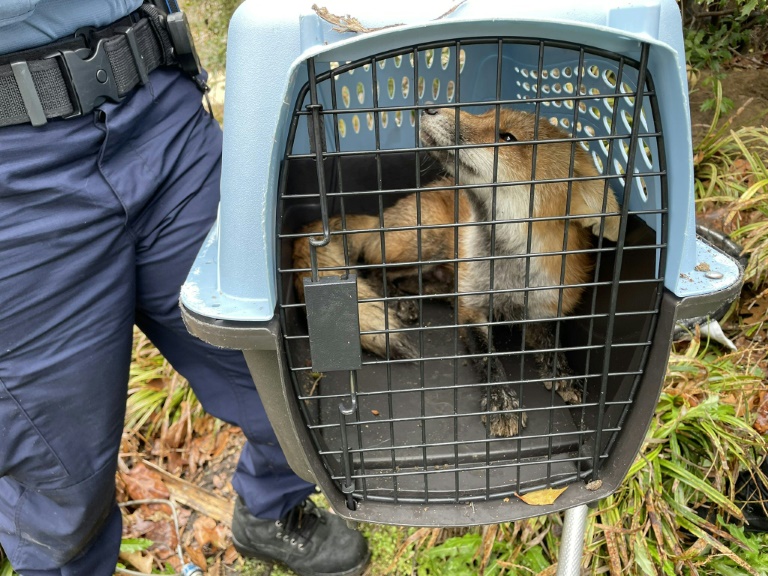
A fox that was put down after biting at least nine people including a congressman at the US Capitol has tested positive for rabies, public health officials said Wednesday.

DC Health in Washington told AFP that laboratory analysis of tissue samples had “confirmed the fox tested positive for the rabies virus.”

There are just one to three cases of human rabies per year in the United States, according to the Centers for Disease Control and Prevention, and the most common method of transmission is a bite that punctures the skin.

Of 25 cases from 2009 to 2019, seven were acquired abroad. Most were caused by bats, with dogs and racoons — but no foxes — also among the culprits. All except two of the infections proved fatal.

A few thousand animals test positive each year and 30,000 to 60,000 people receive post-exposure treatment.

Human deaths have been declining since the 1970s, however, thanks to public health and outreach programs as well as medical advances.

“DC Health is contacting all human victims who were bitten by the fox,” the agency said.

The animal was “humanely euthanized so that rabies testing may be done” after it was identified as being responsible for nine confirmed bites at the Capitol on Monday and Tuesday. 

No other foxes were found at the complex near downtown Washington, according to DC Health, but it added that more sightings should be expected as the species is known to prowl the entire urban area.

Before the episode took a dark turn, the fox’s hijinks had lit up social media, spawning a satirical Twitter account, a glut of questionable puns and a parody online store offering t-shirts bearing the legend: “I survived the Capitol Fox 2022.”

One of the animal’s victims was congressman Ami Bera, a Democrat from Sacramento, California, who shared an image of a bite mark in his suit and revealed the attack left him needing multiple precautionary shots for tetanus and rabies.

The fox also attacked a political reporter, biting her ankle from behind, as well as at least seven other members of the public.

Red Cross evacuee convoy arrives from Russian-held city

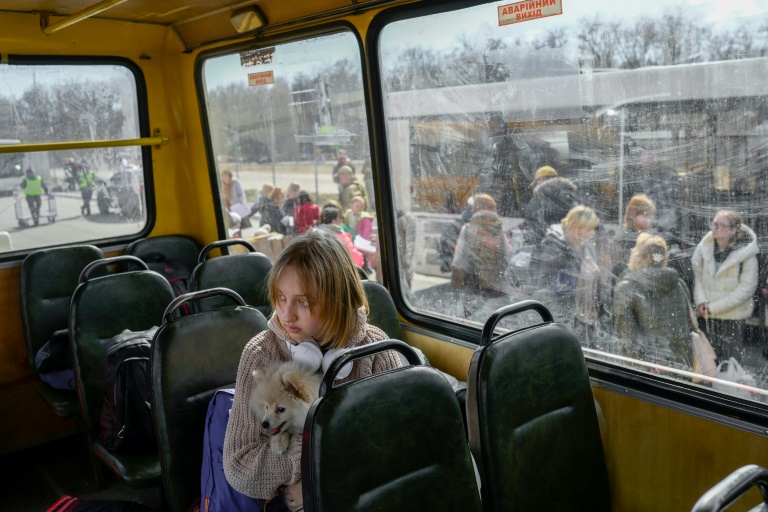
A Red Cross convoy arrived in the southern Ukrainian city of Zaporizhzhia on Wednesday after failing to reach the besieged port city of Mariupol, an AFP journalist on the scene reported.

Accompanied by the International Committee of the Red Cross (ICRC), seven buses and at least 40 private cars arrived in the city carrying hundreds of evacuees from Russian-occupied areas, in what was the first successful international evacuation six weeks into the war.

The ICRC said most of the people arriving were in fact from Mariupol, which is still held by Ukrainian forces, but had been evacuated from the nearby Russian-held city of Berdiansk.

“These people have really gone through the worst,” ICRC spokesperson Lucile Marbeau told AFP.

“We’ve been hearing people saying how they had to walk out of Mariupol. There in Mariupol there is still no food, no water, no electricity.”

Marbeau explained that there was “barely any connection” for residents to be able to call their families or try and find a way out.

The ICRC said in a social media post that more than 500 evacuees in total were brought to Zaporizhzhia.

Passengers said it took around 26 hours to travel to Zaporizhzhia through multiple checkpoints. They said men were taken from the buses and in many cases stripped of their clothes as Russian troops inspected them for military tattoos or skin marks that suggested they had been carrying a gun. 

On arrival, stressed and also relieved, one man collapsed with an alcohol-induced fit, while a woman from Mariupol hugged ICRC representatives and thanked them for bringing her and her family to safety. 

“There is a huge intensity of feeling when people are able to leave a dire situation, but also when you know they have had to leave people behind,” said Marbeau. “We met a 14-year-old girl who travelled out alone while her parents stayed.”

“There was very serious shelling. That’s why we were delayed,” said one of the evacuees, Iryna Nikolaienko, explaining that she had been able to make her way out during a pause in the fighting.

“The Mariupol that I knew and loved, it does not exist anymore,” she said.

“I understood that I was leaving forever, that I would never come back to my city and I would never see it again.”

On Monday, the Red Cross said that the team it had dispatched several days earlier to help evacuate civilians from Mariupol was being held by police in Russian-controlled territory.

The organisation said on Twitter Wednesday that it had attempted for five days to reach the city, which has been under sustained Russian bombardment since Moscow invaded in late February.

“But security conditions made it impossible,” it said. 

“Thousands are still trapped in the city. They urgently need a safe passage out, and aid to come in,” it added.

Russian forces late last month struck a Red Cross facility in the city, home to half a million people before the war, where officials have warned of a humanitarian disaster.

An estimated 120,000 people are still in Mariupol and Ukrainian President Volodymyr Zelensky said Wednesday he believes Russia is trying to hide the evidence of “thousands” of people killed there and thousands more wounded.

Ukrainian human rights official Lyudmila Denisova said on Telegram on Wednesday, citing witness testimony, that Russian forces have brought mobile crematoria and other heavy equipment to clear debris in the city.

Repeated attempts to evacuate Mariupol residents have collapsed, though some have made the dangerous dash to freedom from the city alone.

Mariupol’s mayor earlier this week estimated that some 90 percent of the city had been completely destroyed as a result of the war.

The ICRC declined to comment on whether the aid they had been carrying was able to reach Mariupol. 

A number of civilians fleeing occupied areas and humanitarian volunteers who have spoken with AFP in Zaporizhzhia over the last several weeks claimed that they have first-hand knowledge of Russian troops looting aid.  

Turkey fishermen fear mines in Black Sea

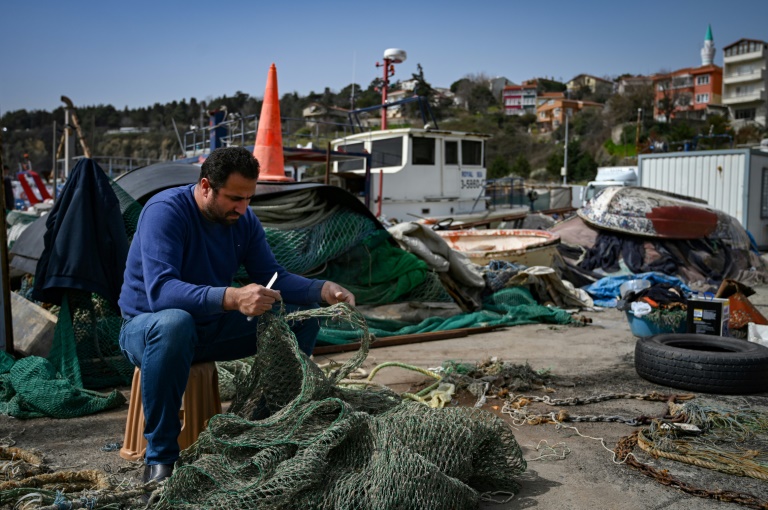
Turkish fisherman Sahin Afsut fears the worst: hitting a mine and “disappearing underwater in the blink of an eye”. 

Like many fishermen in Rumelifeneri, a village set on the rocks of the Bosphorus in northern Istanbul, Afsut and his team remain in port since the discovery of a drifting mine last month in the Black Sea. 

Fears grew after a second mine was found on March 28, which could have come from Ukraine where Russia launched an invasion in February.

A third stray mine was found Wednesday in the Black Sea off the town of Kefken in northwestern Turkey. 

Turkish authorities fear an accident and believe the mines became unmoored from the Ukrainian coast during storms. 

“If you hit (a mine), you’re finished,” says Afsut, wearing a grey cap in front of his small trawler from which he usually catches whiting, red mullet and anchovies. 

He did not see the first mine two kilometres (1.2 miles) offshore, first discovered by a local fisherman but several others described the scene.

“It was large, like half a barrel. We watched from above there, the (special Turkish navy) units neutralised it,” says 55-year-old Ahmet Tarlaci who has been a fisherman for 43 years.

– ’90 percent stopped’ –

The Turkish navy warned five days before the first was found on March 26 of the risk of mines coming from Ukrainian waters. 

But “the mines arrived quickly, even the Turkish armed forces were surprised,” Tarlaci says. 

The Russian defence ministry last week said 420 mines — 370 mines of them in the Black Sea — were placed by Ukraine to protect its coast but around 10 had broken off. 

Kyiv dismissed Moscow’s version of events, accusing the Russian navy of letting the mines wander to discredit Ukraine. 

At Rumelifeneri port, where around 100 boats, from small fishing boats to 40-metre (131-foot) trawler boats were waiting Friday, “90 percent of people that we know have stopped” going out to sea, says fisherman Sefki Deniz, 42. 

Turkish officials have banned fishing at night, and with the price of diesel reaching spectacular heights, many fishermen decided to end the fishing season three weeks ahead of time.

“We already have financial losses, there shouldn’t be any human losses,” says Deniz, wearing plastic boots and a blue fleece. 

The fisherman regrets the little information provided by officials who say they cannot reveal how many mines there are, where they came from or how dangerous they may be. 

“For the time being, (the mines) are not a problem, but we won’t let our guard down,” Turkish President Recep Tayyip Erdogan said Friday. 

“They speak now of 10 mines and what if the others wander off? The Black Sea is not a large sea, it’s like a lake,” says Deniz, despite 24-hour searches by minehunters in the area.

– ‘Never found their bodies’ – 

“Across from us, there is Ukraine, Russia: if the wind blows violently from the north, it’s only a question of time” before the mines arrive in Turkey’s waters, fears fishing captain Saban Ucar, 32. 

The 30-40 metre (98-foot to 131-foot) fishing boats “have radars, sonars… but the 9-10 metre boats only have binoculars,” he says from a building overlooking the port.

Ucar was not born at the time, but the memory is still vivid in the village of two accidents in the 1980s caused by mines dating back to World War II.

“There was one that exploded at the port in 1983, five people from the village died. And in 1989, it happened at sea while lifting a net, the mine exploded and so did the boat: four people died. 

“We never found their bodies,” says Deniz, one of the veterans at the port.

The fisherman now fears a mine will be able to make its way to the Bosphorus Strait used by 38,500 ships last year.

The strait, which crosses Istanbul, is in some places less than 700 metres (2,296 feet) wide. 

“At sea, the risk (of an accident) is 10 percent,” Deniz says, adding: “In the Bosphorus, it’s 100 percent.” 

Turkey fishermen fear mines in Black Sea

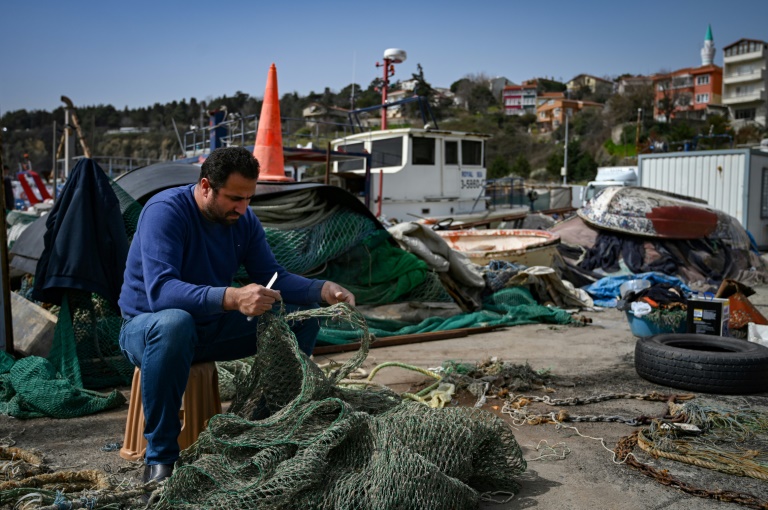
Turkish fisherman Sahin Afsut fears the worst: hitting a mine and “disappearing underwater in the blink of an eye”. 

Like many fishermen in Rumelifeneri, a village set on the rocks of the Bosphorus in northern Istanbul, Afsut and his team remain in port since the discovery of a drifting mine last month in the Black Sea. 

Fears grew after a second mine was found on March 28, which could have come from Ukraine where Russia launched an invasion in February.

A third stray mine was found Wednesday in the Black Sea off the town of Kefken in northwestern Turkey. 

Turkish authorities fear an accident and believe the mines became unmoored from the Ukrainian coast during storms. 

“If you hit (a mine), you’re finished,” says Afsut, wearing a grey cap in front of his small trawler from which he usually catches whiting, red mullet and anchovies. 

He did not see the first mine two kilometres (1.2 miles) offshore, first discovered by a local fisherman but several others described the scene.

“It was large, like half a barrel. We watched from above there, the (special Turkish navy) units neutralised it,” says 55-year-old Ahmet Tarlaci who has been a fisherman for 43 years.

– ’90 percent stopped’ –

The Turkish navy warned five days before the first was found on March 26 of the risk of mines coming from Ukrainian waters. 

But “the mines arrived quickly, even the Turkish armed forces were surprised,” Tarlaci says. 

The Russian defence ministry last week said 420 mines — 370 mines of them in the Black Sea — were placed by Ukraine to protect its coast but around 10 had broken off. 

Kyiv dismissed Moscow’s version of events, accusing the Russian navy of letting the mines wander to discredit Ukraine. 

At Rumelifeneri port, where around 100 boats, from small fishing boats to 40-metre (131-foot) trawler boats were waiting Friday, “90 percent of people that we know have stopped” going out to sea, says fisherman Sefki Deniz, 42. 

Turkish officials have banned fishing at night, and with the price of diesel reaching spectacular heights, many fishermen decided to end the fishing season three weeks ahead of time.

“We already have financial losses, there shouldn’t be any human losses,” says Deniz, wearing plastic boots and a blue fleece. 

The fisherman regrets the little information provided by officials who say they cannot reveal how many mines there are, where they came from or how dangerous they may be. 

“For the time being, (the mines) are not a problem, but we won’t let our guard down,” Turkish President Recep Tayyip Erdogan said Friday. 

“They speak now of 10 mines and what if the others wander off? The Black Sea is not a large sea, it’s like a lake,” says Deniz, despite 24-hour searches by minehunters in the area.

– ‘Never found their bodies’ – 

“Across from us, there is Ukraine, Russia: if the wind blows violently from the north, it’s only a question of time” before the mines arrive in Turkey’s waters, fears fishing captain Saban Ucar, 32. 

The 30-40 metre (98-foot to 131-foot) fishing boats “have radars, sonars… but the 9-10 metre boats only have binoculars,” he says from a building overlooking the port.

Ucar was not born at the time, but the memory is still vivid in the village of two accidents in the 1980s caused by mines dating back to World War II.

“There was one that exploded at the port in 1983, five people from the village died. And in 1989, it happened at sea while lifting a net, the mine exploded and so did the boat: four people died. 

“We never found their bodies,” says Deniz, one of the veterans at the port.

The fisherman now fears a mine will be able to make its way to the Bosphorus Strait used by 38,500 ships last year.

The strait, which crosses Istanbul, is in some places less than 700 metres (2,296 feet) wide. 

“At sea, the risk (of an accident) is 10 percent,” Deniz says, adding: “In the Bosphorus, it’s 100 percent.” 

Canada approves controversial Bay du Nord offshore oil project

Canada’s environment minister approved Wednesday a controversial offshore oil project expected to see 300 million barrels of oil extracted over 30 years — and to set back efforts to curb climate change.

In a statement, Steven Guilbeault said Norwegian firm Equinor’s proposed development of oil discoveries in the Flemish Pass Basin, some 500 kilometers (310 miles) east of St. Johns, Newfoundland, passed an environmental assessment.

That four-year review, the minister said, determined that the Bay du Nord project “is not likely to cause significant adverse environmental effects when mitigation measures are taken into account.”

“The project is therefore allowed to proceed with strict measures to protect the environment,” he said.

Canada is the world’s fourth largest oil producer.

The Bay du Nord project, which split Prime Minister Justin Trudeau’s Liberals and was widely seen as a test of the government’s resolve in tackling climate change and curtailing oil output, is expected to generate an estimated Can$3.5 billion in government revenue.

For Newfoundland province, which has the highest unemployment rate in the country, it also represents a much needed economic boost.

Ottawa set 137 binding conditions on the project, including incorporating reduced greenhouse gas emissions in its design, protecting fish habitat and air quality — which Guilbeault said represent “some of the strongest environmental conditions ever” applied in Canada.

But environmental groups immediately panned the decision, citing UN warnings to stop tapping new oil sources or risk irreversible and catastrophic climate impacts.

“Approving Bay du Nord is another leap towards an unlivable future,” Environmental Defence’s Julia Levin said in a statement. “The decision is tantamount to denying that climate change is real and threatens our very existence.”

– ‘Burning the planet’ –

Greenpeace Canada climate campaigner Patrick Bonin said fossil fuels need to be phased out as quickly as possible, and that the approval of Bay du Nord “only worsens the climate crisis and the global reliance on fossil fuels that are burning the planet.”

Even the New Democratic Party, a small leftist faction that recently agreed to prop up Trudeau’s minority government, accused the Liberals of caving to “their corporate buddies from the oil and gas sector instead of listening to climate scientists.”

“Under the Liberals we have the worst record of any G7 country when it comes to emissions reductions, and we are the only country who has increased emissions every single year,” the NDP said in a statement.

“With the approval of the Bay du Nord project, it’s difficult to imagine this record will improve,” it said.

The decision on the project had twice been delayed, after the Trudeau government last year enhanced its Paris Agreement target to reduce carbon emissions by 40-45 percent from 2005 levels by 2030.

Guilbeault, a former eco-warrior picked by Trudeau to guide Canada’s climate policy, said the floating oil rig’s emissions are expected to produce five times less emissions than the average Canadian oil project and incorporate new technologies.

He said it fits within Ottawa’s climate strategy and “is an example of how Canada can chart a path forward on producing energy at the lowest possible emissions intensity while looking to a net-zero future.”

In an interview with public broadcaster CBC, Guilbeault touted the stringent emissions controls imposed on Bay du Nord while adding: “The world still needs oil.”

Canada approves controversial Bay du Nord offshore oil project

Canada’s environment minister approved Wednesday a controversial offshore oil project expected to see 300 million barrels of oil extracted over 30 years — and to set back efforts to curb climate change.

In a statement, Steven Guilbeault said Norwegian firm Equinor’s proposed development of oil discoveries in the Flemish Pass Basin, some 500 kilometers (310 miles) east of St. Johns, Newfoundland, passed an environmental assessment.

That four-year review, the minister said, determined that the Bay du Nord project “is not likely to cause significant adverse environmental effects when mitigation measures are taken into account.”

“The project is therefore allowed to proceed with strict measures to protect the environment,” he said.

Canada is the world’s fourth largest oil producer.

The Bay du Nord project, which split Prime Minister Justin Trudeau’s Liberals and was widely seen as a test of the government’s resolve in tackling climate change and curtailing oil output, is expected to generate an estimated Can$3.5 billion in government revenue.

For Newfoundland province, which has the highest unemployment rate in the country, it also represents a much needed economic boost.

Ottawa set 137 binding conditions on the project, including incorporating reduced greenhouse gas emissions in its design, protecting fish habitat and air quality — which Guilbeault said represent “some of the strongest environmental conditions ever” applied in Canada.

But environmental groups immediately panned the decision, citing UN warnings to stop tapping new oil sources or risk irreversible and catastrophic climate impacts.

“Approving Bay du Nord is another leap towards an unlivable future,” Environmental Defence’s Julia Levin said in a statement. “The decision is tantamount to denying that climate change is real and threatens our very existence.”

– ‘Burning the planet’ –

Greenpeace Canada climate campaigner Patrick Bonin said fossil fuels need to be phased out as quickly as possible, and that the approval of Bay du Nord “only worsens the climate crisis and the global reliance on fossil fuels that are burning the planet.”

Even the New Democratic Party, a small leftist faction that recently agreed to prop up Trudeau’s minority government, accused the Liberals of caving to “their corporate buddies from the oil and gas sector instead of listening to climate scientists.”

“Under the Liberals we have the worst record of any G7 country when it comes to emissions reductions, and we are the only country who has increased emissions every single year,” the NDP said in a statement.

“With the approval of the Bay du Nord project, it’s difficult to imagine this record will improve,” it said.

The decision on the project had twice been delayed, after the Trudeau government last year enhanced its Paris Agreement target to reduce carbon emissions by 40-45 percent from 2005 levels by 2030.

Guilbeault, a former eco-warrior picked by Trudeau to guide Canada’s climate policy, said the floating oil rig’s emissions are expected to produce five times less emissions than the average Canadian oil project and incorporate new technologies.

He said it fits within Ottawa’s climate strategy and “is an example of how Canada can chart a path forward on producing energy at the lowest possible emissions intensity while looking to a net-zero future.”

In an interview with public broadcaster CBC, Guilbeault touted the stringent emissions controls imposed on Bay du Nord while adding: “The world still needs oil.”

West ramps up sanctions as Russia threatens Ukraine's east

The United States and Britain announced new sanctions against Russia Wednesday after Ukraine said hundreds of civilians were found dead around its capital, as Kyiv warned residents in the east to get out “now” ahead of a feared assault.

The White House unveiled measures targeting Russia’s top banks and two daughters of President Vladimir Putin, while Britain sanctioned two banks — and vowed to eliminate all Russian oil and gas imports by year-end.

Their actions followed an international outcry as Ukraine said its forces found hundreds of civilians dead around Kyiv, including the town of Bucha, after the pullout of Russian troops.

“They burned families. Families. Yesterday we found again a new family: father, mother, two children. Little, little children, two. One was a little hand, you know,” Ukraine President Volodymyr Zelensky said Wednesday.

In Washington, US President Joe Biden joined in describing the horrors in Bucha.

“Civilians executed in cold blood, bodies dumped into mass graves, the sense of brutality and inhumanity left for all the world to see, unapologetically,” Biden said.

“There’s nothing less happening than major war crimes,” he added, urging the world to hold the killers accountable.

The Kremlin denies responsibility and has claimed Kyiv staged civilian deaths — with Putin on Wednesday accusing Ukrainian authorities of “crude and cynical provocations” in Bucha.

The Russian withdrawal from areas around Kyiv and the north is part of a shift towards Ukraine’s southeast, in a bid to create a land bridge between occupied Crimea and Moscow-backed separatist statelets in the Donbas region.

Ukraine Deputy Prime Minister Iryna Vereshchuk on Wednesday warned residents in the eastern Kharkiv, Lugansk and Donetsk regions to leave immediately ahead of a feared Russian attack.

“It has to be done now because later people will be under fire and face the threat of death,” she wrote on Telegram.

The threat was already very real in the industrial city of Severodonetsk, the easternmost city held by Ukrainian forces, where shells and rockets were landing at regular intervals on Wednesday.

“We have nowhere to go, it’s been like this for days,” one of them, 38-year-old Volodymyr, told AFP standing opposite a burning building.

Elsewhere, preparations for the feared attack were hard under way, such as on a two-lane highway through the rolling eastern plains connecting Kharkiv and Donetsk.

Trench positions were being dug, and the road was littered with anti-tank obstacles. Nearby water reservoirs had been opened and bridges were being destroyed, all in an effort to slow any Russian advance.

“We’re waiting for them!” said a lieutenant tasked with reinforcing the positions, giving a thumbs up.

– ‘Leaving forever’ –

Thousands of people have been killed and more than 11 million displaced since Russia invaded Ukraine on February 24.

In Bucha, where Ukrainian officials blame Russian forces for carrying out a “massacre,” residents were desperate to know the fate of their loved ones.

But Tetiana Ustymenko knows the conclusion to her story. Her son and his two friends were gunned down in the street, and she buried them in the garden of the family home. 

“How can I live now?” she said.

Meanwhile efforts to evacuate civilians continued Wednesday, with a Red Cross convoy arriving in the southern city of Zaporzhzhia.

It was carrying hundreds of evacuees from Russian-occupied areas, but had failed to reach the besieged port of Mariupol. 

One of the evacuees, Iryna Nikolaienko, told how she had been able to make her way out of Mariupol during a pause in the fighting.

“The Mariupol that I knew and loved, it does not exist anymore,” she said.

“I understood that I was leaving forever.”

– EU ‘indecisiveness’ –

Western powers have already pummelled Russia with debilitating economic sanctions, which forced Moscow on Wednesday to make foreign debt payments on dollar-denominated bonds in rubles, raising the prospect of a potential default.

Washington’s new sanctions targeted Maria Vorontsova and Katerina Tikhonova, two adult daughters of Putin, plus the wife and daughter of Foreign Minister Sergei Lavrov and members of Russia’s Security Council.

The White House also declared “full blocking” sanctions on Russia’s largest public and private financial institutions, Sberbank and Alfa Bank, and said all new US investment in Russia was now prohibited.

Britain meanwhile froze the overseas assets of both Sberbank and Credit Bank of Moscow. 

The EU is also poised to implement a fifth round of sanctions cutting off Russian coal imports — and European Council chief Charles Michel said that “sooner or later”, it must also impose oil and gas sanctions.

And rich countries will tap an additional 120 million barrels of oil from emergency reserves in a bid to calm crude prices that have soared following the invasion.

But addressing the Irish parliament Wednesday, Ukraine’s Zelensky condemned the “indecisiveness” of European nations dependent on Russian energy.

In other moves to isolate Moscow, the US and Britain have pressed to have Russia excluded from the UN Human Rights Council, with a vote in the General Assembly scheduled for Thursday.

But US Secretary of State Antony Blinken admitted there was little anyone could do about Russia’s position on the UN Security Council, where it has a veto.

“There’s a pretty fundamental problem there,” he said, a day after Zelensky called for Russia to be expelled from the council.

– ‘Unbelievable’ morale –

Peace talks between the sides have so far gone nowhere.

Moscow says it is “ready” to continue — however NATO chief Jens Stoltenberg said there was no sign Putin had dropped “his ambition to control the whole of Ukraine”.

Spirits are high yet in Kyiv, however, said American veteran Steven Straub, who has been training with the national guard in the capital.

Straub, 73, fought during the Vietnam war, and said Ukraine was “much different.”

“What surprised me here is the morale… It’s unbelievable,” he told AFP. 

burs-st/mlm

West ramps up sanctions as Russia threatens Ukraine's east

The United States and Britain announced new sanctions against Russia Wednesday after Ukraine said hundreds of civilians were found dead around its capital, as Kyiv warned residents in the east to get out “now” ahead of a feared assault.

The White House unveiled measures targeting Russia’s top banks and two daughters of President Vladimir Putin, while Britain sanctioned two banks — and vowed to eliminate all Russian oil and gas imports by year-end.

Their actions followed an international outcry as Ukraine said its forces found hundreds of civilians dead around Kyiv, including the town of Bucha, after the pullout of Russian troops.

“They burned families. Families. Yesterday we found again a new family: father, mother, two children. Little, little children, two. One was a little hand, you know,” Ukraine President Volodymyr Zelensky said Wednesday.

In Washington, US President Joe Biden joined in describing the horrors in Bucha.

“Civilians executed in cold blood, bodies dumped into mass graves, the sense of brutality and inhumanity left for all the world to see, unapologetically,” Biden said.

“There’s nothing less happening than major war crimes,” he added, urging the world to hold the killers accountable.

The Kremlin denies responsibility and has claimed Kyiv staged civilian deaths — with Putin on Wednesday accusing Ukrainian authorities of “crude and cynical provocations” in Bucha.

The Russian withdrawal from areas around Kyiv and the north is part of a shift towards Ukraine’s southeast, in a bid to create a land bridge between occupied Crimea and Moscow-backed separatist statelets in the Donbas region.

Ukraine Deputy Prime Minister Iryna Vereshchuk on Wednesday warned residents in the eastern Kharkiv, Lugansk and Donetsk regions to leave immediately ahead of a feared Russian attack.

“It has to be done now because later people will be under fire and face the threat of death,” she wrote on Telegram.

The threat was already very real in the industrial city of Severodonetsk, the easternmost city held by Ukrainian forces, where shells and rockets were landing at regular intervals on Wednesday.

“We have nowhere to go, it’s been like this for days,” one of them, 38-year-old Volodymyr, told AFP standing opposite a burning building.

Elsewhere, preparations for the feared attack were hard under way, such as on a two-lane highway through the rolling eastern plains connecting Kharkiv and Donetsk.

Trench positions were being dug, and the road was littered with anti-tank obstacles. Nearby water reservoirs had been opened and bridges were being destroyed, all in an effort to slow any Russian advance.

“We’re waiting for them!” said a lieutenant tasked with reinforcing the positions, giving a thumbs up.

– ‘Leaving forever’ –

Thousands of people have been killed and more than 11 million displaced since Russia invaded Ukraine on February 24.

In Bucha, where Ukrainian officials blame Russian forces for carrying out a “massacre,” residents were desperate to know the fate of their loved ones.

But Tetiana Ustymenko knows the conclusion to her story. Her son and his two friends were gunned down in the street, and she buried them in the garden of the family home. 

“How can I live now?” she said.

Meanwhile efforts to evacuate civilians continued Wednesday, with a Red Cross convoy arriving in the southern city of Zaporzhzhia.

It was carrying hundreds of evacuees from Russian-occupied areas, but had failed to reach the besieged port of Mariupol. 

One of the evacuees, Iryna Nikolaienko, told how she had been able to make her way out of Mariupol during a pause in the fighting.

“The Mariupol that I knew and loved, it does not exist anymore,” she said.

“I understood that I was leaving forever.”

– EU ‘indecisiveness’ –

Western powers have already pummelled Russia with debilitating economic sanctions, which forced Moscow on Wednesday to make foreign debt payments on dollar-denominated bonds in rubles, raising the prospect of a potential default.

Washington’s new sanctions targeted Maria Vorontsova and Katerina Tikhonova, two adult daughters of Putin, plus the wife and daughter of Foreign Minister Sergei Lavrov and members of Russia’s Security Council.

The White House also declared “full blocking” sanctions on Russia’s largest public and private financial institutions, Sberbank and Alfa Bank, and said all new US investment in Russia was now prohibited.

Britain meanwhile froze the overseas assets of both Sberbank and Credit Bank of Moscow. 

The EU is also poised to implement a fifth round of sanctions cutting off Russian coal imports — and European Council chief Charles Michel said that “sooner or later”, it must also impose oil and gas sanctions.

And rich countries will tap an additional 120 million barrels of oil from emergency reserves in a bid to calm crude prices that have soared following the invasion.

But addressing the Irish parliament Wednesday, Ukraine’s Zelensky condemned the “indecisiveness” of European nations dependent on Russian energy.

In other moves to isolate Moscow, the US and Britain have pressed to have Russia excluded from the UN Human Rights Council, with a vote in the General Assembly scheduled for Thursday.

But US Secretary of State Antony Blinken admitted there was little anyone could do about Russia’s position on the UN Security Council, where it has a veto.

“There’s a pretty fundamental problem there,” he said, a day after Zelensky called for Russia to be expelled from the council.

– ‘Unbelievable’ morale –

Peace talks between the sides have so far gone nowhere.

Moscow says it is “ready” to continue — however NATO chief Jens Stoltenberg said there was no sign Putin had dropped “his ambition to control the whole of Ukraine”.

Spirits are high yet in Kyiv, however, said American veteran Steven Straub, who has been training with the national guard in the capital.

Straub, 73, fought during the Vietnam war, and said Ukraine was “much different.”

“What surprised me here is the morale… It’s unbelievable,” he told AFP. 

burs-st/mlm
IS captives were forced to sing 'Hotel Osama': French hostage

A French journalist held by the Islamic State in Syria testified Wednesday that he and other hostages were forced by their captors to sing a depraved parody of the Eagles song “Hotel California” called “Hotel Osama.”

“It was terrifying for us, a joke for them,” Nicolas Henin said at the trial of El Shafee Elsheikh, a 33-year-old former British national.

Elsheikh is accused of involvement in the murders of American journalists James Foley and Steven Sotloff and aid workers Kayla Mueller and Peter Kassig.

Henin is one of several former hostages who have testified at the trial in federal court of the alleged member of the notorious IS kidnap-and-murder cell known as the “Beatles.”

Henin said the words to “Hotel Osama” included the original lyrics from “Hotel California” about checking in but never leaving, but with a twist.

“If you try, you’ll die Mr. Bigley style,” the lyrics went, a reference to British engineer Kenneth Bigley, who was beheaded in 2004 by Jordanian Abu Musab Zarqawi, head of the Al-Qaeda terror network in Iraq.

Henin said he was captured in June 2013 on his fifth reporting trip to Syria.

He was held alone for two days in a bathroom but managed to escape by breaking bars on the windows with a broom.

After running the whole night, he arrived at a village at dawn and spoke to two men in pyjamas.

“Unfortunately they were IS fighters,” he said.

Returned to captivity, he was beaten and taken outside and “hung in the air for a couple of hours” with his hands and feet chained together.

– ‘They were terrified’ –

Henin was later placed with other hostages including Frenchman Pierre Torres and Danish photographer Daniel Rye Ottenson.

British aid worker David Haines and Italian relief worker Federico Motka arrived later.

After being taken to another prison, three guards arrived one day speaking with British accents.

Haines and Motka told the other hostages they were the “Beatles,” Henin said, using the nickname given to the jihadist jailers because of their British accents.

“They were terrified,” he said of Haines and Motka. “Shaking.”

They were later joined by Sotloff, Foley, John Cantlie, a British journalist captured with Foley, Toni Neukirch, a German citizen, and five Doctors Without Borders (MSF) workers.

He said the Beatles would come around once or twice a week, “sometimes for a round of beatings.”

After his release in April 2014, Henin provided the authorities with information that was used in a rescue attempt.

“I spent a long time with agencies, describing the location, giving details to the person in charge of preparing the raid,” Henin said.

The US-led rescue mission was launched on July 4, 2014 but the hostages had been taken elsewhere just days earlier.

“They had been moved prior to the operation,” said Robert Daniel Story, an FBI special agent who was involved in preparations for the raid and took the witness stand after Henin.

“We were very disappointed,” Story said.

The “Beatles” held at least 27 foreign hostages in Syria between 2012 and 2015.

A number of European journalists and aid workers were released after ransoms were paid but the Americans — Foley, Sotloff and Kassig — were killed and videos of their murders released by IS for propaganda purposes.

Mueller was reportedly handed over to IS leader Abu Bakr al-Baghdadi, who allegedly raped her repeatedly before killing her.

Elsheikh and another former British national, Alexanda Amon Kotey, were captured in January 2018 by a Kurdish militia in Syria.

They were turned over to US forces in Iraq and flown to Virginia in 2020 to face charges of hostage-taking, conspiracy to murder US citizens and supporting a foreign terrorist organization.

Kotey pleaded guilty in September 2021 and is facing life in prison.

“Beatles” executioner Mohamed Emwazi was killed by a US drone in Syria in 2015, while the fourth member of the cell, Aine Davis, is imprisoned in Turkey after being convicted of terrorism.

Elsheikh has denied the charges, and his lawyers claim his arrest is a case of mistaken identity.

Close Bitnami banner
Bitnami