World

In tragic Bucha, people search for the missing

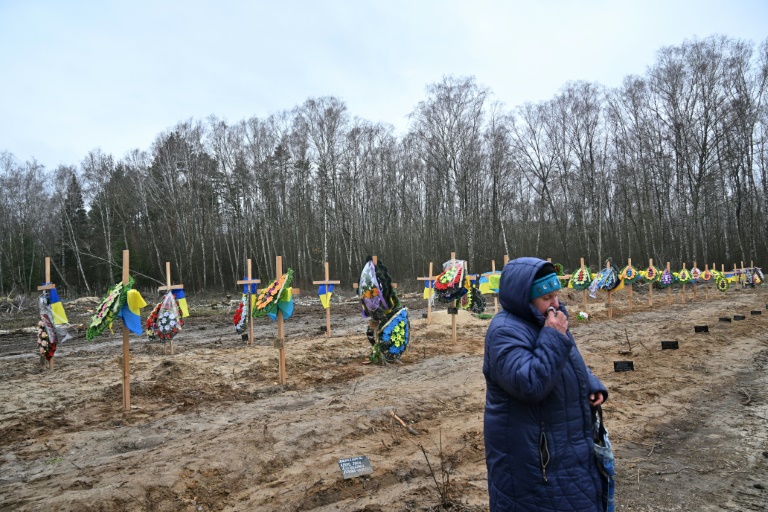
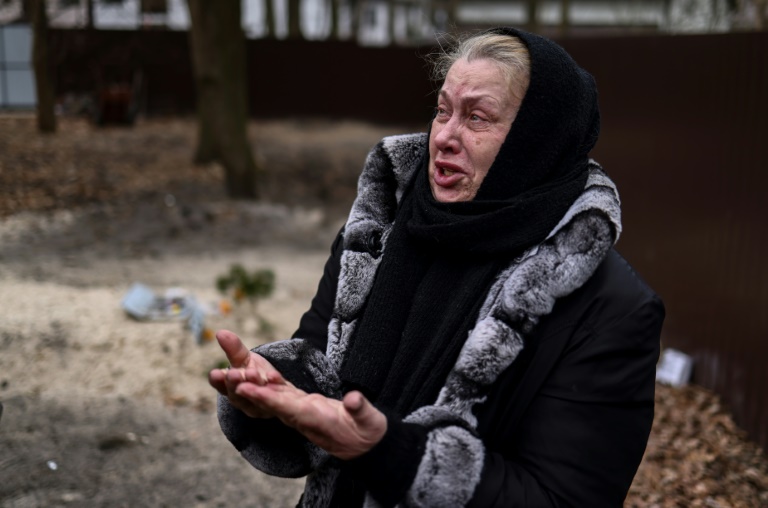
As Bucha emerges from the horror of the Russian occupation, townspeople are desperate to know the fate of loved ones. Some know how their story ends. Others still wait to find out, hoping against hope it will not end in tragedy.

Tetiana Ustymenko knows the conclusion to her story. Her son and his two friends were gunned down in the street outside and she buried them in the garden of the family home. 

Oleh Onyshchenko is searching for two family members. He arrives on a windswept plain where 50 body bags are laid out on the ground.

His relatives are burnt beyond recognition, he thinks, though a wedding ring may prove a clue to end the mystery of their final moments.

Oleksandr Kovtun still has hope. His son is missing but perhaps, he reasons, the Russians abducted them as they retreated.

Bucha — a commuter town on Kyiv’s doorstep — was occupied by Russian forces in the early days of the invasion.

The horrors left behind after their withdrawal last week are slowly being uncovered.

– Garden burial – 

There is a black sash draped across one door on Kyiv-Myrotska Street. Out front a car riddled with gunfire has a pool of clotted blood in the passenger seat. There are three bodies in the back garden.

Ustymenko, 65, says she put her son Serhii and his friends Nastia and Maksym here on March 4.

Serhii, 25, offered to evacuate her but she was reluctant — it was too dangerous. Without her knowledge he came anyway.

“I heard shooting but I was sure he wasn’t there,” she said. 

“Then the phone turned on. I said, ‘Son, son?’, and a neighbour told me a car was shot in front of him. He said my son is gone.”

Maksym was shot in the forehead by a sniper through the windscreen, she said. Nastia was shot in the legs. Serhii was shot in the back.

They lay in the open for three days before Tetiana’s husband Valerii washed and dressed the bodies and dug a simple grave with the neighbours’ help.

It is at the bottom of the garden past daffodils. There is one mound in the sandy earth, but each body is marked by a sprig of conifer. On top is the metal blade of a broken snow shovel. 

The year before last Serhii snapped it, prompting a squabble with his mother. “I put this here to say ‘Forgive me son’,” she said. “I want him to forgive me for arguing with him for nothing.”

“How can I live now?”

– Searching body bags – 

Onyshchenko arrives to inspect the bodies of Bucha’s war dead at the cemetery. There are around 50, some stacked on top of each other, others lie side by side on the ground in crumpled black body bags.

A gaggle of police officers is poring over paperwork, writing preliminary reports to identify the corpses.

Every few minutes they unzip a new bag. In one, a woman’s arms lie tangled across her lifeless face. In another, rigor mortis gives the impression of a man standing to attention.

Some contain only body parts, scorched and severed.

Onyshchenko, 49, hangs back. In his pocket are photocopies of the ID card of his sister-in-law Tamila, and the birth certificate of her 14-year-old daughter Anna.

They left Bucha in a borrowed car but the owner later saw a video of it ablaze in the street.

He has come to look for distinctive jewellery, to identify what remains of the mother and daughter.

A police officer tucks a handwritten note into one gaping body bag. “Bucha, man, approximately 30-years-old,” it reads. “Eyes open. Bodily injuries on the left side of the abdomen, on the neck and hands.”

“A month ago no-one could imagine something like this was possible,” says Onyshchenko.

– Continuing hope – 

Kovtun’s 19-year-old son Oleksii is missing. “He went into the city and did not come back.”

The 58-year-old now clings to the hope he might have been taken by the Russians.

Another young man from their street is rumoured to have been taken captive in Russia. Maybe this was the fate of his boy too.

“My son knew him,” he says. “There’s no other hope for us.”

On Saturday the bodies of 20 people dressed in civilian clothing were found strewn along a single Bucha street. 

On Sunday a city official said 57 civilians had been buried in a mass grave by their neighbours.

The register of the dead grows day by day.

“We asked around about him, talked with a woman who deals with such cases,” said Kovtun. 

“We hope he is not on those lists.”

World stock markets beat retreat with all eyes on Fed

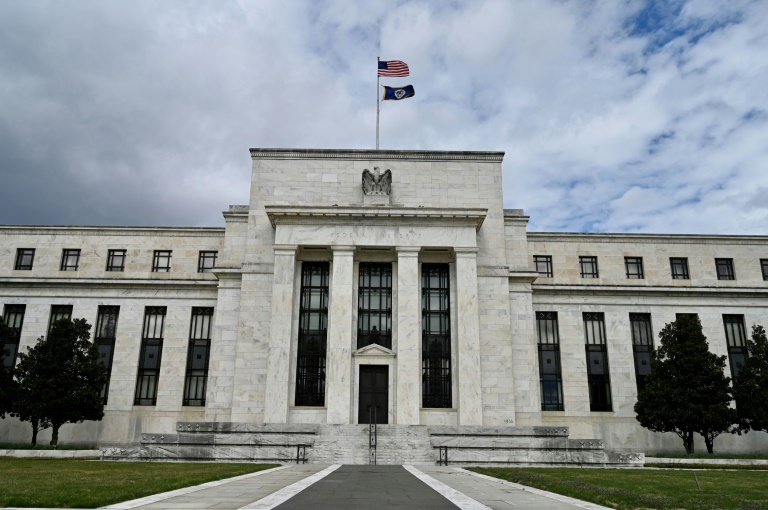
Global equities sank Wednesday and oil prices retreated as Federal Reserve meeting minutes added to expectations for aggressive central bank monetary tightening.

Several US Federal Reserve officials supported raising interest rates by half a percentage point in the future to combat inflation, according to minutes of the central bank’s meeting last month.

Officials also discussed lowering their bond holdings by a total of $95 million per month as soon as the upcoming May 3-4 meeting, according to the minutes.

The disclosures added to a stream of hawkish commentary from Fed officials, exacerbating worries that the central bank’s efforts to rein in prices could harm economic growth.

“The markets remain unnerved by the economic implications of a highly aggressive Fed and a potential policy mistake,” Charles Schwab investment bank said in a note.

Wall Street tumbled for a second straight session, with the S&P 500 losing one percent and large tech equities like Amazon, Facebook parent Meta and Microsoft all shedding more than three percent.

Earlier, Asian and European bourses retreated, while the euro hit a one-month low. 

“Investor confidence might have improved from the low point in early March when the Ukraine war was unfolding,” said AJ Bell investment director Russ Mould. 

“However, there remain significant headwinds for equities and the latest trouble spot is what the Federal Reserve might do to curb inflation.”

Worries about a potential slowing of the economy due to higher interest rates also weighed on oil prices, which dropped more than five percent.

Analysts also pointed to an announcement from the International Energy Agency outlining plans to release crude stockpiles after Russia’s invasion of Ukraine destabilized oil markets.

Data from the US Energy Information Administration also showed a surprise build in crude inventories.

“It seems that the concerns are a little bit of weakness in demand short term, which is raising concerns of some demand destruction, along with the Federal Reserve minutes today,” said Phil Flynn, analyst at the Price Futures Group.

The retreat in crude prices came as Democrats in the US Congress pressed CEOs from ExxonMobil, Chevron and other oil giants on the reasons for spiking gasoline prices.

Oil executives rejected suggestions they had withheld supply to drive up prices and said they are in the process of increasing investments in response to higher commodity prices.

– Key figures around 2100 GMT –

New York – Dow: DOWN 0.4 percent at 34,496.51 (close)

New York – S&P 500: DOWN 1.0 percent at 4,481.15 (close)

New York – Nasdaq: DOWN 2.2 percent at 13,888.82 (close)

London – FTSE 100: DOWN 0.3 percent at 7,587.70 points (close)

Frankfurt – DAX: DOWN 1.9 percent at 14,151.69 (close) 

Paris – CAC 40: DOWN 2.2 percent at 6,498.83 (close) 

EURO STOXX 50: DOWN 2.4 percent at 3,824.69 (close)

Tokyo – Nikkei 225: DOWN 1.6 percent at 27,350.30 (close)

Hong Kong – Hang Seng Index: DOWN 1.9 percent at 22,080.52 (close)

Shanghai – Composite: FLAT at 3,283.43 (close)

Brent North Sea crude: DOWN 5.2 percent at $101.07 per barrel

West Texas Intermediate: DOWN 5.6 percent at $96.23 per barrel

Euro/dollar: DOWN at $1.0900 from $1.0905 late Tuesday

Pound/dollar: DOWN at $1.3071 from $1.3074

Euro/pound: DOWN at 83.38 pence from 83.41 pence

Dollar/yen: UP at 123.79 yen from 123.60 yen

burs-jmb/cs

Tear gas fired at Sudan protest 3 years after anti-Bashir sit-in

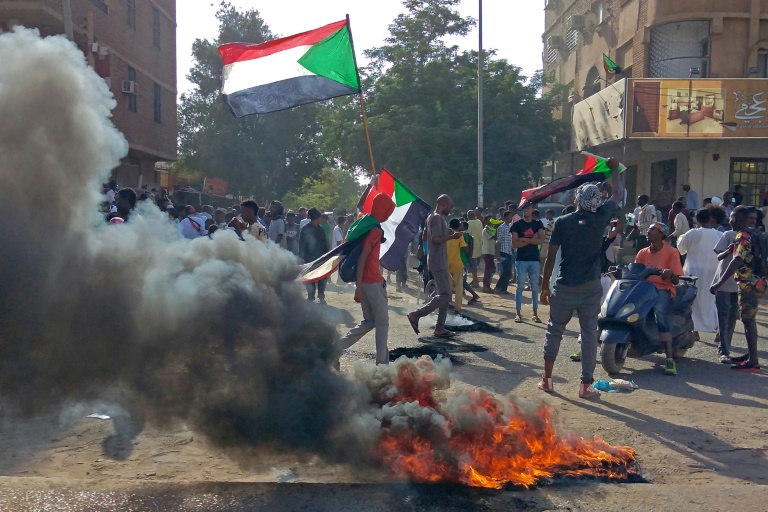
Thousands protested across Sudan against military rule on the anniversary Wednesday of previous popular uprisings, most recently against autocrat Omar al-Bashir three years ago. 

Security forces fired tear gas at demonstrators in the capital Khartoum, its twin city of Omdurman, and in Wad Madani to the south, witnesses and AFP correspondents said. 

They also “stormed Al-Jawda hospital and fired tear gas inside, scaring patients and health workers and causing suffocation among some of them”, said the independent Central Committee of Sudan Doctors. 

Sudan has grappled with an October 25 coup led by army chief Abdel Fattah al-Burhan that has derailed a political transition period and hammered the economy of one of the world’s poorest countries.

Pro-democracy activists had warned online of a people power “earthquake of April 6” — a momentous day in Sudan’s history that was key in bringing down earlier strongmen.

In 1985, the day saw the ouster of president Jaafar Nimeiri following a popular uprising. In 2019 it marked the start of a mass sit-in outside army headquarters, after months of protests, against Bashir’s three decades in power.

“It is an important day… so we expect many to take to the streets despite the heat and Ramadan,” the Muslim holy month when the faithful observe a daytime fast, said one Khartoum protester, Badwi Bashir.

“We just want to bring down the coup (leadership) and end the prospect of any future coups.”

At dusk, volunteers were seen distributing water, juice, dates and other food as protesters sat to break their fast in Khartoum and neighbouring cities, AFP correspondents said.

– ‘No to military rule’ –

Sudan’s latest putsch has “set fire to all aspects of life, turning our country into an arena of crises,” said the civilian alliance Forces of Freedom and Change, or FFC.

Security forces had earlier sealed off key bridges and deployed around the presidential palace and army headquarters.

In Omdurman, protesters broke through barbed wire blockades and marched through streets leading to the parliament building, according to an AFP correspondent. 

Protesters marched in the eastern state of Gedaref with banners that read “No to military rule” and “Away with the government of hunger”, said one witness, Ahmed Salah. 

Demonstrations were also held in several cities across the Darfur region, the central state of North Kordofan and the Red Sea city of Port Sudan, according to witnesses. 

Five days after the start of the 2019 sit-in, generals bowed to the pressure on the streets to remove Bashir. 

But the protesters stayed on to press for civilian rule, only to be dispersed in a crackdown in June that year by men in military fatigues that claimed 128 lives according to medics.

Sudan’s civilian and military leaders later agreed on a transition of power, which promised greater international engagement for the country as well as foreign aid and investment.

But last October’s coup upended those plans, leading to the current wave of protests. At least 93 people have been killed and hundreds wounded in the crackdown since, medics say.

– Partnership ‘failed’ –

“We have to defeat the coup,” FFC spokesman Jaafar Hassan said last week. 

“We have tried a partnership with the military, and it failed, ending in this coup, and we shouldn’t do this again.”

Burhan said last Saturday he would only “hand over power to an honest, elected authority, accepted by the all the Sudanese people”.

The United States on Wednesday warned against “the use of any violence” and demanded Sudanese authorities “keep their word and hold accountable those responsible for abuses.”

Since the coup, Sudan’s already ailing economy has suffered severe blows, as Western donors cut crucial aid pending the restoration of a transition to civilian rule.

Prices of food, fuel and basic commodities have soared and crime has spiked. Violence has intensified in remote areas, particularly the restive Darfur region, the UN says.

Burhan last week threatened to expel UN special representative Volker Perthes, accusing him of “interference” in the country’s affairs after Perthes warned of the deepening crisis in Sudan during a UN Security Council briefing.

Israel's Bennett loses majority after MP quits coalition

A key member of Israeli Prime Minister Naftali Bennett’s Yamina party said Wednesday she was quitting his coalition government, in a surprise move that leaves him without a parliamentary majority.

Idit Silman’s announcement left Bennett’s coalition, an alliance of parties ranging from the Jewish right and Israeli doves to an Arab Muslim party, with 60 seats — the same as the opposition.

Although Silman’s defection does not mean the fall of the coalition, it raises the spectre of a potential return to office by veteran leader Benjamin Netanyahu, less than a year after he lost the premiership to Bennett. 

“I tried the path of unity. I worked a lot for this coalition,” Silman, a religious conservative who served as coalition chairperson, said in a statement.

“Sadly, I cannot take part in harming the Jewish identity of Israel.”

On Monday, Silman had lashed out at Health Minister Nitzan Horowitz, after he instructed hospitals to allow leavened bread products onto their premises during the upcoming Passover holiday, in line with a recent supreme court ruling reversing years of prohibition.

Jewish tradition bars leavened bread from the public domain during Passover.

“I am ending my membership of the coalition and will try to continue to talk my friends into returning home and forming a right-wing government,” Silman said.

“I know I’m not the only one who feels this way.”

– ‘Dangerous instability’ –

Bennett met with leaders of the coalition parties following the announcement.

“All of them want to continue with the government,” he said.

“The alternative is more elections,” he added, warning this could spell “dangerous instability for Israel”.

The most important thing now is to “stabilise” the alliance, Bennett said, accusing Netanyahu supporters of pushing Silman to quit by launching “verbal attacks” against her.

Bennett’s coalition may continue ruling with 60 seats, although with difficulty in passing new legislation.

If another member of the coalition defects, however, the Knesset could hold a vote of no confidence and lead Israel back to the polls for a fifth parliamentary election in four years.

Political analyst Dahlia Scheindlin told AFP that if Silman “is the first person to really prepare to bring down the government, she is doing it from the place of conviction”.

“She is religious, and I think we all underestimate the power of theology,” said Scheindlin. 

In a formal resignation letter, Silman said: “We must admit that we tried. It’s time to recalculate and try to form a national, Jewish, Zionist government.”

– ‘Limp government’ –

Following the announcement, Silman was embraced by the same right-wing politicians who had relentlessly attacked her since she followed Bennett into the governing coalition last year, reneging on campaign promises.

“Idit, you’re proof that what guides you is the concern for the Jewish identity of Israel, the concern for the land of Israel, and I welcome you back home to the national camp,” opposition leader Netanyahu said in a video recording.

“I call on whoever was elected with the votes of the national camp to join Idit and come back home, you’ll be received with all due honour and open arms,” he added.

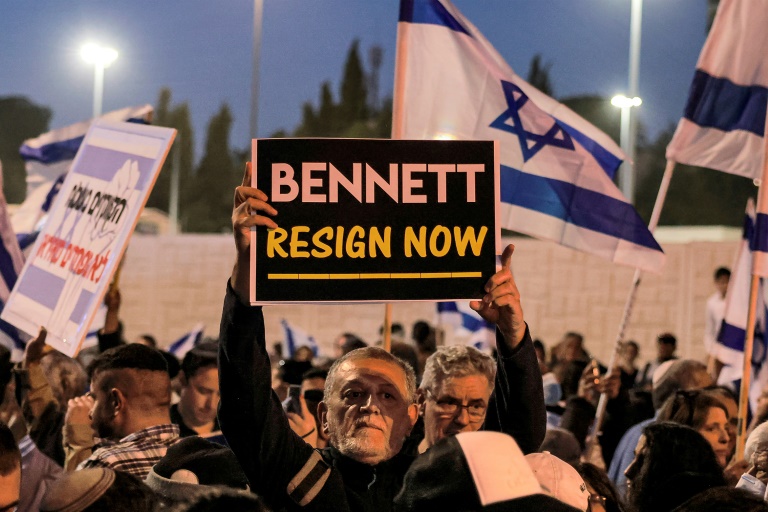
Thousands of Netanyahu supporters gathered Wednesday evening in Jerusalem, shouting “Bennett, out” and demanding an end to the coalition government, AFP journalists said.

“Tonight, we say to the government one thing: leave,” Netanyahu told the crowd. 

Israel’s longest-serving prime minister — in office from 1996 to 1999 and again from 2009 until June — Netanyahu had pledged to play the role of spoiler against Bennett’s government, which brought an end to his hold on power.

At a special session of the Knesset, he said: “There is a weak and limp government in Israel today. Its days are numbered.”  

The Knesset is in recess and will reconvene on May 8 for legislative work. 

“I won’t name any names, but there will be more defectors,” Miki Zohar of Netanyahu’s Likud party told Kan public radio.

“We’re in talks with more than two lawmakers who are considering coming to us,” Zohar added.

To form a coalition of his own without new elections, Netanyahu would need the support of at least 61 lawmakers.

Currently he falls well short, and does not command the support of all 60 opposition MPs.

The six lawmakers of the Arab-led Joint List are fierce opponents of the former premier.

Bezalel Smotrich of the Religious Zionism party, once a political partner of Bennett, predicted the ruling coalition would not survive Silman’s defection.

“This is the beginning of the end of the left-wing, non-Zionist government of Bennett and the Islamist Movement,” he wrote on Twitter.

DR Congo Pygmies attacked in wildlife park: rights group

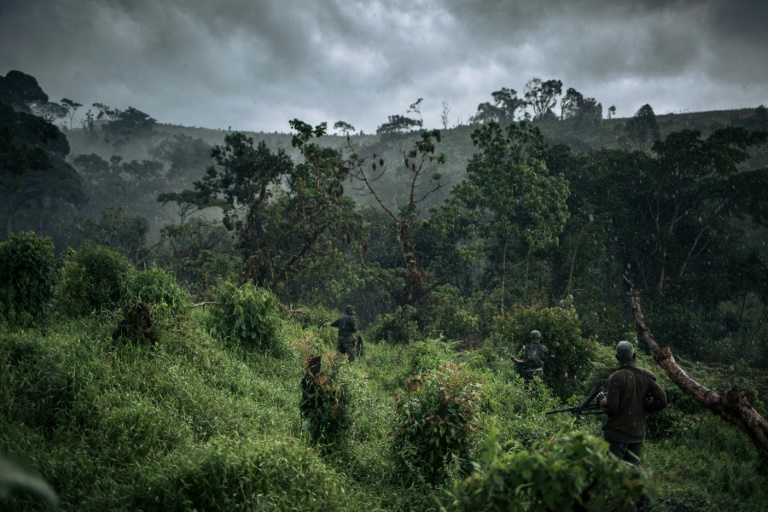
Troops and rangers in the Kahuzi-Biega National Park in eastern Democratic Republic of Congo have carried out attacks on indigenous Pygmies living in the famed wildlife haven, a rights watchdog said on Wednesday.

Violence broke out in 2018 between park rangers and members of the Batwa community, who are accused of illegally settling in the reserve, cutting down trees to make charcoal and opening fire on rangers, killing and wounding a number of them.

The British watchdog Minority Rights Group (MRG), in a report on Wednesday, alleged that soldiers and Kahuzi-Biega guards carried out attacks against the Pygmies living in the park. 

“The attacks were well-planned, targeted civilian populations,” the group said.

“The research team obtained direct evidence of the deaths of at least 20 individual Batwa community members in connection with this three-year campaign of forced expulsion,” it added.

“The research team obtained direct evidence that 15 Batwa women were forcibly group-raped by park guards and soldiers during the July and November-December 2021 operations,” the watchdog said.

The 6,000-square-kilometre (2,300-square-mile) reserve lies close to the Rwandan border near Bukavu, in one of the most troubled areas of the vast country.

– Legal limbo –

Dominated by the extinct volcanoes of Kahuzi and Biega, the park’s tropical forests are a redoubt for one of the last populations of eastern lowland gorillas, made up of about 250 primates, according to its website.

Since the 1990s, the haven has been listed by UNESCO as a World Heritage site in danger because of the presence of armed groups and settlers, poaching and deforestation.

A number of Pygmies charge that their land was confiscated when the national park was expanded and want to recover what they say is theirs.

The MRG report, based on on-site investigation and dozens of witnesses, said the park rangers received financial and technical support at the time from the governments of Germany and the United States, as well as international conservation organizations such as the Wildlife Conservation Society (WCS).

WCS said in a statement it condemned violence like that alleged and called for an independent investigation into the claims of abuses in the Kahuzi-Biega National Park.

“If the allegations are true, these were illegal and horrific military attacks on DRC’s own citizens. WCS has never played a role in supporting or facilitating such heinous acts,” it said. 

An investigation has recently been launched by the park’s overseers, the Congolese Institute for the Conservation of Nature (ICCN), to probe alleged violations.

The panel has been in Bukavu since April 4 and will travel to the scene of the alleged crimes, Georges Muzibaziba, who heads the ICCN’s human rights section.

There is a lack of legal clarity between DR Congo’s laws that protect the national park and those guaranteeing the rights of the Pygmy populations. 

On April 7, 2021, a bill to protect and promote the rights of indigenous people was adopted by the DR Congo parliament.

It guarantees among other things recognition of the rights to land and natural resources of the indigenous Pygmy people to possess, occupy and use traditionally.

The Senate has been reviewing the bill for the last year.

Good times: Luxury watchmakers face soaring demand

Times have been so good for luxury watchmakers that they are running behind demand, forcing some to delay the release of new collections and others to invest more in production capacity.

After the pandemic severely hit the global economy in 2020, the sector enjoyed a spectacular recovery last year and started 2022 with a bang, though Russia’s war in Ukraine created new uncertainties.

Watches were the best performing business for French luxury group Hermes, with sales soaring by 73 percent last year.

“We had an extraordinary year in the watches business,” Hermes vice president Guillaume de Seynes told AFP at Watches and Wonders in Geneva this week, one of the industry’s biggest annual showcases.

“We can feel a very strong dynamic for watchmaking everywhere in the world,” he said, adding that there was hot demand for a men’s watch model last year.

“We could have even sold more if we had been able to make more,” de Seynes said, noting that watchmakers face a “demand phenomenon that exceeds production capacity.”

His priority for 2022 is to invest in production. 

– Solid year –

The Oris brand also had “a very strong year”, said its chief executive, Rolf Studer.

Oris watches range between 1,800 and 7,200 Swiss francs ($1,928 and $7,710 or 1,767 euros and 7,064 euros).

The company had to delay the launch of a new collection in the higher price range because it did not produce enough watch movements — their internal mechanisms — in its workshops.

The watch was supposed to come out last summer but it is only launching now.

“We planned too conservatively,” Studer said.

“So we decided to keep the movements for the watches that were already out instead of launching new models and not be able to supply existing models already on the market,” he added.

Swiss watch exports rebounded last year, rising by 31.2 percent after a 21.8-percent contraction in 2020, when countries closed borders and went into strict Covid lockdowns.

Exports have not only exceeded pre-pandemic levels, they beat their 2014 record, too.

They went up by almost 16 percent in the first two months of this year, according to industry data, though the recovery has been seen only in watches worth more than 3,000 Swiss francs.

– Wait list –

The sector is now bracing for the fallout from the war in Ukraine and sanctions on Russia, which has a sizeable rich client base.

But the industry can rely on long wait lists for higher-end timepieces.

“Since we didn’t have enough watches for other markets, we will sell those that won’t be delivered to Russia elsewhere,” Edouard Meylan, CEO of H. Moser & Cie., told AFP.

All of his 2022 production is already pre-sold to retailers and partly pre-paid by final customers.

H. Moser only makes 2,000 watches per year at an average price of 45,000 Swiss francs. The watchmaker is even rejecting orders for timepieces that require a more than two-year wait.

“There’s uncertainty that can be created in other markets, particularly financial markets,” Meylan said.

“But we would have to have a big crash for an independent brand like ours to be affected,” he added.

'Amazon, here we come': Biden cheers US union drive

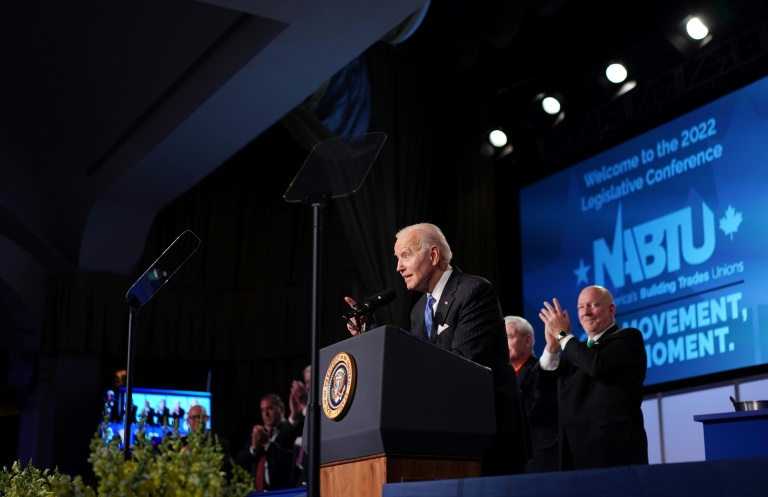
President Joe Biden sang praises for organized labor once again Wednesday, hailing last week’s triumph by union backers at Amazon as a sign of what is possible throughout the United States.

“That’s what unions are about in my view, by providing dignity and respect for people who” work hard, the US president said during a speech to a construction workers union.

The Democratic president, a self-professed “union guy,” alluded to his White House task force on union organizing to “make sure the choice to join a union belongs to workers alone,” Biden said.

“By the way: Amazon, here we come!”

The remarks came after Friday’s landmark ballot in which workers at a New York warehouse voted to establish the first  US union at Amazon.

Many US Fed officials support future half-point increase: minutes

At their March policy meeting, several US Federal Reserve officials supported raising interest rates by half a percentage point in the future to combat inflation, minutes released Wednesday said.

“Many participants noted that one or more 50 basis point increases in the target range could be appropriate at future meetings, particularly if inflation pressures remained elevated or intensified,” according to minutes from the Federal Open Market Committee’s (FOMC) March 15-16 gathering.

Fed officials at that meeting decided to raise interest rates by a quarter percentage point, their first increase since slashing the rate to zero when Covid-19 broke out two years ago.

The central bank is under pressure to curb inflation, which has climbed to levels not seen since the 1980s in the United States, without tightening conditions so much they damage the economy’s recovery.

A half percentage point rate increase would represent a more forceful response to the inflation wave, and the minutes said many participants at last month’s meeting “would have preferred a 50 basis point increase in the target range for the federal funds rate.”

“A number of these participants indicated, however, that, in light of greater near-term uncertainty associated with Russia’s invasion of Ukraine, they judged that a 25 basis point increase would be appropriate at this meeting,” the minutes said.

Officials also believed “that the committee’s previous communications had already contributed to a tightening of financial conditions, as evident in the notable increase in longer-term interest rates over recent months,” according to the minutes.

Meeting participants wanted to “expeditiously” move towards neutral monetary policy — a term indicating a balance between restriction and accommodation for the economy — but “depending on economic and financial developments, a move to a tighter policy stance could be warranted.”

Fed Chair Jerome Powell and other central bank leaders have signaled they will soon take further action to tighten policy by beginning the process of reducing the Fed’s stockpile of trillions of dollars in bonds and other securities, many of which were accumulated during the pandemic to support the economy.

The minutes said officials believe it is appropriate to begin the process of balance sheet runoff “at a coming meeting, possibly as soon as” the upcoming May 3-4 meeting.

Officials were leaning towards reducing their holdings by $60 billion per month for US Treasury securities and $35 billion for mortgage-backed securities, and phasing in the reductions over three months, the minutes said.

War in Ukraine: Latest developments

Here are the latest developments in the war in Ukraine:

– Leave ‘now’, residents in east Ukraine told –

Ukraine tells residents in the country’s east to evacuate “now” or “risk death” ahead of a feared Russian onslaught on the Donbas region, which Moscow has declared its top prize.

Deputy prime minister Iryna Vereshchuk writes on Telegram that the governors of the Lugansk and Donetsk regions, part of the Donbas, and the nearby city of Kharkiv “are doing everything to ensure that the evacuations take place in an organised manner.”

– Bucha killings ‘war crimes’: Biden – 

US President Joe Biden has denounced the killing of Ukrainian civilians in the town of Bucha allegedly by Russian troops as “war crimes.”

“Civilians executed in cold blood, bodies dumped into mass graves, the sense of brutality and inhumanity left for all the world to see, unapologetically. There’s nothing less happening than major war crimes,” he said, urging the world to hold the killers accountable.

– Putin speaks on Bucha –

Russian President Vladimir Putin accuses Ukrainian authorities of being behind “crude and cynical provocations”, after they said hundreds of civilians were found dead in the town of Bucha when Russian troops withdrew.

– Denials ‘not tenable’ –

The Berlin government says that satellite images from last month provided strong rebuttal of Russian denials of involvement in civilian deaths in Bucha.

“Russian declarations” that images of civilian deaths “were posed scenes or that they were not responsible for the murders are in our view not tenable”, government spokesman Steffen Hebestreit says.

– Putin daughters sanctioned –

The United States announces sanctions on two daughters of Putin, saying family members are known to hide the Russian president’s wealth.

It also declared “full blocking” sanctions on Russia’s largest public and private financial institutions, Sberbank and Alfa Bank, and says all new US investments in Russia are now prohibited.

The EU is also looking to add Putin’s daughters to its sanctions blacklist, European diplomats tell AFP.

– More UK sanctions –

Britain has slapped new sanctions on Russia, targeting two banks and eliminating all Russian oil and coal imports by the end of the year.

The latest UK measures also outlaw all new British investment into Russia.

– Four said killed in Donetsk –

Russian strikes have killed four people and wounded four others near a humanitarian distribution point in the east Ukraine region of Donetsk, the regional governor said.

– ‘Long’ war ahead –

NATO chief Jens Stoltenberg says there is no sign Putin has dropped “his ambition to control the whole of Ukraine”.

– Orban invites Putin, Zelensky –

Hungarian Prime Minister Viktor Orban, one of Putin’s rare allies in Europe, says he has urged the Russian leader to declare an immediate ceasefire in Ukraine.

He also invites the leaders of France, Germany and Ukraine to meet Putin in Budapest.

– UN rights body suspension –

The UN General Assembly will vote Thursday on suspending Russia from the UN Human Rights Council as punishment for invading Ukraine, the assembly presidency says.

A day earlier Ukrainian President Volodymyr Zelensky had also called for Russia to be expelled from the UN Security Council “so it cannot block decisions about its own aggression, its own war.”

– Dollar debt paid in rubles –

Russia says it had made payments on dollar-denominated foreign debt in rubles, adding to fears the country is headed for a sovereign default.

The finance ministry says it was forced to make the $649.2-million payment in rubles after an intermediary bank refused to execute the payment but did not say whether the payment was accepted.

– ‘Not far short of genocide’: Johnson –

British Prime Minister Boris Johnson says the alleged massacre in Bucha “doesn’t look far short of genocide to me” and that Britain will also step up sanctions on Russia.

US President Joe Biden has branded Putin a war criminal.

– Pope slams ‘horrendous cruelties’ –

Pope Francis says during his weekly audience the “recent news about the war in Ukraine, instead of bringing relief and hope, instead attests to new atrocities, such as the Bucha massacre.”

– Red Cross convoy –

A Red Cross convoy arrives in the southern Ukrainian town of Zaporizhzhia after failing to reach the besieged port city of Mariupol, an AFP journalist reports.

Seven buses with around 300 people onboard accompanied by the International Committee of the Red Cross and at least 40 private cars arrive in the southern town.

burs-cb-cdw/gw

Lots of low- and no-cost ways to halt global warming

Not only do we have the tools to slash emissions and curb global warming by 2030, but half of available carbon-cutting options are cost-free or very cheap, UN climate experts say.

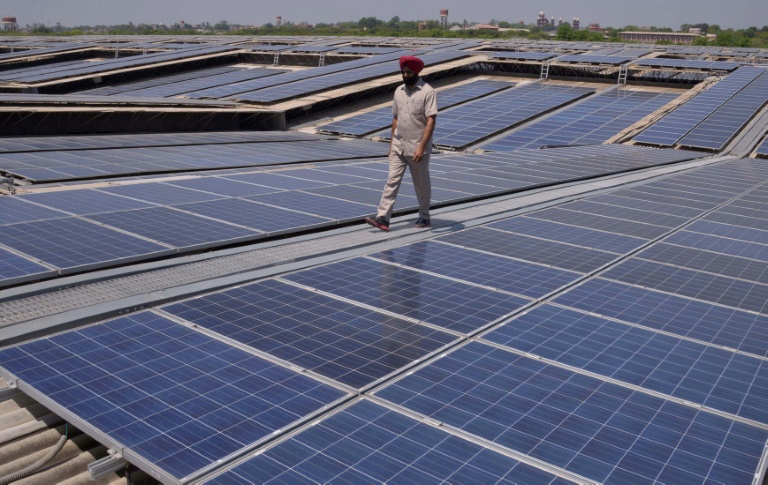
There is no silver bullet, but a mosaic of actions — from ramping up solar and wind technology, to economy-wide energy efficiencies — were identified by the UN’s Intergovernmental Panel on Climate Change (IPCC) as low hanging fruit. 

The IPCC said humanity has less than three years to halt the rise of planet-warming carbon emissions, and less than a decade to slash them by 43 percent from 2019 levels to give us a shot at capping global warming at 1.5 degrees Celsius.      

But current policies support continued fossil fuel use and are taking the world in the wrong direction, the IPCC said, in a flagship report on how to avoid catastrophic warming, published on Monday.

Despite the tight timeline, the IPCC said the existing carbon-cutting potential across sectors “is sufficient to reduce global greenhouse gas emissions to half of the current level or less”. 

While this requires taking action across a wide range of options, the report said that measures that are low-cost “make up more than half of this potential and are available for all sectors”. 

“The market benefits of some options exceed their costs,” it added.

– Wind and solar – 

In 2019, total emissions were 59 billion tonnes, or gigatonnes, of CO2 or its equivalent in other greenhouse gases. 

The range of options identified would enable a reduction in emissions of 31 to 44 gigatonnes by 2030. 

There are four key areas where the total potential for carbon reduction is highest between now and the end of the decade — solar and wind energy, reductions in deforestation, and restoration of forests and other ecosystems. 

Of those, solar and wind are also among the cheapest options available thanks to the steep drop in the unit costs of these technologies — down 85 and 55 percent respectively between 2010 and 2019, according to the report. 

This “demonstrates that with the right policy incentives and economic frameworks, climate change mitigation can be financed at scale and relatively quickly,” said Michael Wilkins, head of the Centre For Climate Finance And Investment at Imperial College Business School. 

More investment in solar could see an emissions reduction of between two and seven gigatonnes of CO2 equivalent by 2030. Wind energy could save between 2.1 and 5.6 gigatonnes. 

Most of that potential, according to the report, would have essentially negative lifetime costs because they are cheaper than fossil fuel alternatives. 

The reduction of methane emissions in the production of fossil energies is also mostly low cost.

Other energy generation options have a lower overall potential, with a higher cost, such as nuclear power and hydroelectricity.

– Food and forests –

Protecting and restoring natural habitats is the second most significant area for reducing CO2 emissions.  

Forests are crucial for absorbing CO2 generated by human activities, and the IPCC found that limiting deforestation and the destruction of grasslands could reduce net emissions between three and almost eight gigatonnes, largely at a low cost. 

Restoring these types of ecosystems would save one to five gigatonnes. But action in this category would be at the more expensive end of the range considered by the IPCC. 

Shifting to “sustainable” diets and reducing waste food could save more than two gigatonnes, the IPCC said, but it did not give a cost estimate because of wide global variability and a lack of data. 

– ‘Fair balance’ –

The transport sector is notable for the fact that no single option has a particularly large potential to reduce emissions.  

But almost all of the potential measures — switching to public transport and bicycles, fuel efficiency in road vehicles, shipping and aviation — are associated with negative costs. 

In the construction sector, reduction in energy demand and efficiencies in things like lighting are seen as the lowest cost options, albeit with limited potential. 

The construction of new highly energy efficient buildings have the greatest potential (between less than one and more than two gigatonnes), although costs are towards the higher end.

In industry, meanwhile, most of the options — beyond improving energy efficiency and cutting other greenhouse gas emissions — are associated with higher costs. 

But the sector still has significant potential for reducing emissions, in particular the switch to less carbon-intensive energy sources.

“The costs of climate protection are economically absolutely feasible when examined on a global scale and over generations,” said Elmar Kriegler, of the Potsdam Institute for Climate Impact Research, who was one of the IPCC authors. 

But, he said, costs vary significantly from region to region, with developing countries facing a relatively higher price tag to move away from fossil fuels.   

“That is why a fair balance is crucial, not only within individual countries but also internationally. Because one thing is clear: The benefits of climate protection clearly exceed its costs,” he added.

Close Bitnami banner
Bitnami