World

Putin says Russia's interests 'non-negotiable' amid Ukraine crisis

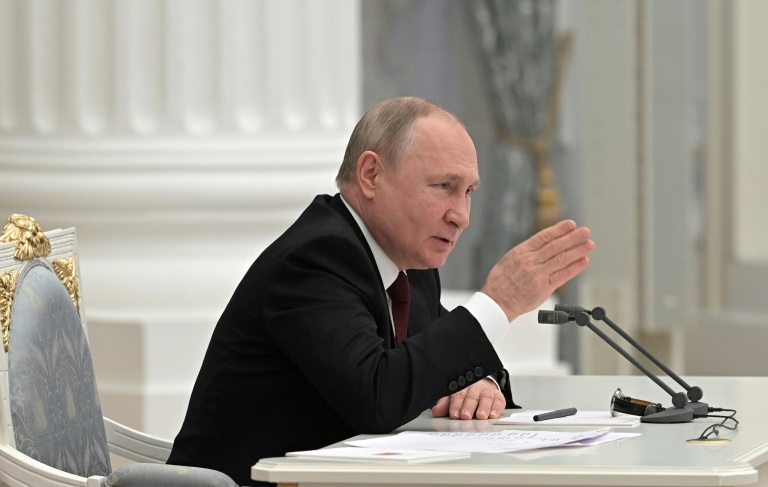
Russian President Vladimir Putin said Wednesday the country’s interests were non-negotiable, as Moscow massed more than 150,000 troops on the borders with Ukraine and the West punished Russia with new sanctions.

In a video address to mark the Defender of the Fatherland Day, a public holiday in the country, Putin congratulated the Russian military and praised the battle-readiness of the army after he signalled plans to send troops to Ukraine.

“Our country is always open for direct and honest dialogue, for the search for diplomatic solutions to the most complex problems,” Putin said.

But he added: “The interests of Russia, the security of our citizens, are non-negotiable for us.”

Putin spoke after parliament’s upper house, the Federation Council, on Tuesday evening gave him unanimous approval to deploy “peacekeepers” to two breakaway Ukrainian regions now recognised by Moscow as independent, and potentially into other parts of Ukraine. 

On Tuesday night, Russia said it had established diplomatic relations “at the level of embassies” with the separatist-controlled regions, which broke away from Kyiv in 2014 in a conflict that cost 14,000 lives.

Moscow also said it would soon evacuate diplomatic personnel from Ukraine to “protect their lives.”

Speaking to journalists Tuesday evening, Putin set out a number of stringent conditions if the West wanted to de-escalate the crisis, saying pro-Western Ukraine should drop its NATO membership ambitions and maintain neutrality.

US President Joe Biden on Tuesday announced tough new sanctions against Russia for “beginning” an invasion of Ukraine, but said there was still time to avoid war.

Japan and Australia followed suit early Wednesday with their own stringent penalties for Moscow and individuals connected with the aggression against Ukraine, with Australian Prime Minister Scott Morrison targeting members of Russia’s security council for “behaving like thugs and bullies.”

Biden announced what he called the “first tranche” of sanctions, including steps to starve Russia of financing and target financial institutions and the country’s “elites”.

But he left the door open to a final effort at diplomacy to avert a full-scale Russian invasion.

“There’s no question that Russia is the aggressor, so we’re clear-eyed about the challenges we’re facing,” the president said.

Biden’s address followed a wave of sanctions announced by Britain and the European Union, after Putin recognised the self-declared Donetsk and Lugansk separatist regions this week.

Germany also announced it was halting certification of the Nord Stream 2 gas pipeline from Russia.

Moscow said the sanctions regime would backfire.

The US-led sanctions will “hurt the global financial and energy markets,” Anatoly Antonov, Russia’s ambassador to the United States, said in a Facebook post, adding that ordinary Americans will “feel the full consequences of rising prices”.

– ‘Rejection of diplomacy’ –

Putin’s plans remained unclear Wednesday, but Western officials have been warning for weeks he has been preparing an all-out invasion of Ukraine, a move that could spark a catastrophic war in Europe. 

The Biden administration signalled it no longer believes Russia is serious about avoiding conflict, with Secretary of State Antony Blinken cancelling a meeting with Russian Foreign Minister Sergei Lavrov scheduled for Thursday.

Speaking to reporters on Tuesday, Putin said that Moscow had recognised the independence of Ukraine’s separatist regions within their administrative borders, including territory controlled by Kyiv. 

He added that Western-brokered peace agreements on Ukraine’s conflict no longer existed and stressed that the deployment of Russian troops would “depend on the specific situation… on the ground.”

“The best solution… would be if the current Kyiv authorities themselves refused to join NATO and maintained neutrality,” Putin said.

NATO chief Jens Stoltenberg said the alliance had “every indication” that Moscow “continues to plan for a full-scale attack on Ukraine.”

Kyiv showed no sign of backing down, with Ukrainian Foreign Minister Dmytro Kuleba meeting Biden to appeal for more military aid.

Russia’s recognition move prompted an emphatic condemnation from United Nations chief Antonio Guterres, who called it “a death blow to the Minsk Agreements endorsed by the (UN) Security Council.”

– ‘Further military aggression’ –

Biden said Washington would continue to supply “defensive” weapons to Ukraine and deploy more US troops to reinforce NATO allies in Eastern Europe.

Kyiv recalled its top diplomat from Moscow as President Volodymyr Zelensky warned that Putin’s recognition of the breakaway regions heralded “further military aggression” against Ukraine.

French Foreign Minister Jean-Yves Le Drian said EU foreign ministers “unanimously agreed on an initial sanctions package,” as he also cancelled a meeting with his Russian counterpart.

Britain slapped sanctions on five Russian banks and three billionaires, and Canada followed suit with similar measures. 
Baidoa: Crossroads of despair in drought-ravaged Somalia

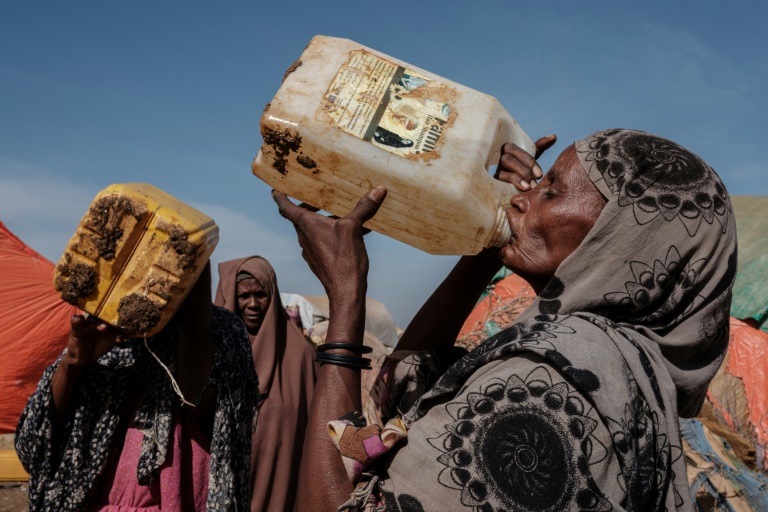
Under the blazing sun, Salado Adan Mohamed puts the finishing touches to her makeshift shelter, cobbled together from branches and fragments of discarded cloth. 

She has just arrived in the southwestern Somali city of Baidoa, the last refuge for people fleeing the worst drought in the country in a decade.

Along with her three children, the 26-year-old mother walked for five days “without eating” to make the 70-kilometre (43-mile) trek from her village to Baidoa.

She settled in Muuri, one of 500 camps for displaced people in the city, where aqals — traditional dome-shaped huts — have been hastily built in recent weeks. 

Desperate, hungry and thirsty, more and more people are flocking to Baidoa from rural areas of southern Somalia, one of the regions hardest hit by the drought that is engulfing the Horn of Africa. 

According to the UN’s World Food Programme, nearly 13 million people, mostly farmers and herders, are going hungry in the region: 5.7 million in Ethiopia, 2.8 million in Kenya and 4.3 million in Somalia — a quarter of the country’s population. 

In Somalia, the UN’s humanitarian agency OCHA said this month that the number of people who have left their homes in search of water, food and pasture has doubled to more than 554,000. 

– ‘We have nothing left’ –

Mohamed says she and her husband saw their crops devoured by swarms of locusts that have ravaged many parts of East Africa in recent years. 

Within just a few months, what little they had left was wiped out when the rains failed for a third straight time since the end of 2020.

“We had three camels which died during the drought season, 10 goats — we ate some, others died and the rest were sold — and all five cattle perished because of the lack of water and pasture,” she says.

“We have nothing left.” 

With her husband and children, Mohammed started out from her home village for Baidoa, the last hope for many in the stricken region. 

But her husband, who has tuberculosis, did not make it all the way. Too weak to continue, he turned back. She has not heard from him since. 

The countryside around Baidoa is under the control of the Al-Qaeda linked Al-Shabaab Islamist group, which held the city itself for several years at the height of the insurgency before being driven out in early 2012 by Somali-led forces.

But the persistent insecurity means almost no aid can be sent out of the city. 

Even in Muuri, Mohamed says she struggles to provide even one meal a day for her children. 

“Sometimes we get something to eat, sometimes not… If there’s not enough, I sacrifice for my children,” she says, a weary look on her face. 

– Spectre of 2011 –

Humanitarian organisations have been ringing alarm bells on the deteriorating situation in the Horn of Africa for weeks, with fears of a repeat of the 2011 famine in Somalia that cost the lives of 260,000 people. 

Insufficient rainfall since late 2020 has come as a fatal blow to populations already suffering from locust invasions between 2019 and 2021 and the Covid-19 pandemic. 

“We had our usual reserves of sorghum, but we have eaten through them in the last three years. They are now finished,” says Ibrahim Mohamed Hassan, a blind 60-year-old who walked about 60 kilometres with his family to Garas Goof camp in Baidoa. 

He says 30 of the 50 families in his home village have fled.

“The others will follow,” he predicts, adjusting his sunglasses which are held together with a rubber band.

– Malnutrition and disease –

Over the past decade, Baidoa — which lies about 250 kilometres northeast of the capital Mogadishu — has become accustomed to large population influxes. 

At least 60 percent of its population — now estimated to be between 700,000 and 800,000 — are displaced and the number of informal settlements has exploded from 77 in 2016 to 572 now. 

But at the medical centre in Tawkal 2 Dinsoor camp, the scale of the current influx is worrying. 

“Before, we used to receive about 1,000 internally displaced people, or even less, per month. Today, we host about 2,000 to 3,000,” says the centre’s supervisor Hassan Ali Amin.

He says he has observed cases of malnutrition and diarrhoea among children, as well as measles and pneumonia among weakened adults.

“If the situation continues to worsen, we expect to receive thousands, hundreds of thousands of people,” adds Mohamednur Mohamed Abdirahman, field director of the British charity Save The Children in Baidoa. 

– ‘Sad and skinny’ – 

Abdulle Kalar Maaney says he does not want to imagine the worst-case scenario: a fourth season of poor rainfall. 

He says he is “very hopeful” that the rains will return in March and that he will be able to return to his home village. 

He arrived in Muuri with his wife and 10 children having lost his last precious possessions: his donkey and his cart. 

He was counting on the beast to earn some money after they arrived in Baidoa, but the donkey died during the 90-kilometre journey to the city and he abandoned the cart.

“I never thought I would end up like this,” sighs the slender 48-year-old, clad in an oversized shirt.

“I was big and strong when I had my cattle,” he says. “I’ve become sad and skinny since the drought killed them all off.” 

Taiwan condemns Russia over Ukraine

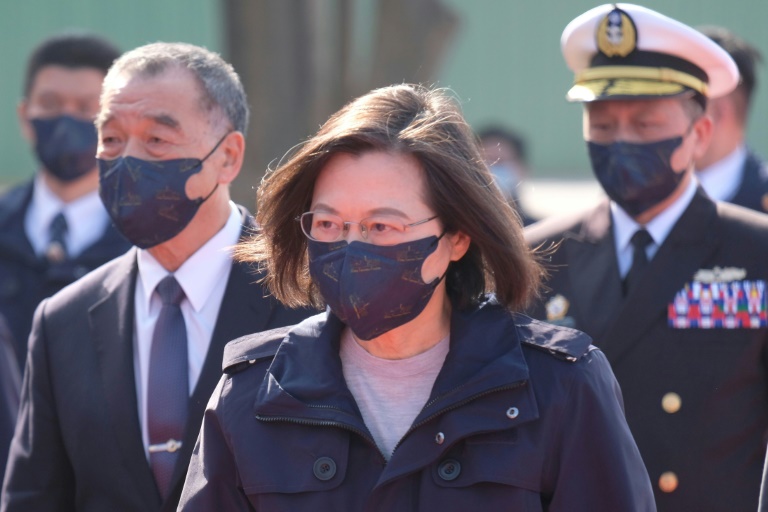
Taiwan’s president on Wednesday condemned Russia for ordering troops into rebel-held regions in Ukraine, and claimed the crisis was being used to hurt morale on the island, which has long been under the threat of a Chinese invasion.

Self-ruled democratic Taiwan has watched the Ukraine situation closely, as China claims sovereignty over the island and has vowed to seize it one day — by force if necessary.

Beijing has ramped up military, diplomatic and economic pressure on Taiwan since President Tsai Ing-wen came to power in 2016, as she rejects the stance that the island is Chinese territory.

“Our government condemns Russia’s violation of Ukraine’s sovereignty… and urges all parties to continue to resolve the disputes through peaceful and rational means,” Tsai said.

She described Taiwan and Ukraine as “fundamentally different in terms of geostrategy, geographical environment, and the importance of international supply chains,” referring to the island’s status as a major plank in the global economy, especially semiconductors.

“However, in the face of external forces attempting to manipulate the situation in Ukraine and affect the morale in Taiwan’s society, all government units must be more vigilant against cognitive warfare.”

Taiwan’s defence ministry said last year that China has launched a disinformation campaign aimed at seizing the island “without a fight”.

Tsai on Wednesday also told national security and military units to remain vigilant and step up surveillance of military activities around Taiwan.

The final quarter of 2021 saw a massive spike in incursions by Chinese warplanes into Taiwan’s air defence identification zone.

Last year, Taiwan recorded 969 such incursions, according to a database compiled by AFP — more than double the roughly 380 in 2020.

Beijing has trod a cautious line on Ukraine but also offered growing support to Russian President Vladimir Putin.

The two powers signed a joint statement this month, agreeing on multiple foreign policy goals including no further expansion of NATO and that Taiwan is an “inalienable part of China”.

Chinese officials have also repeatedly sided with Russia in blaming the West for the tensions over Ukraine, accusing them of a “Cold War mentality” while describing Moscow’s security concerns as “reasonable”.

World must brace for more extreme wildfires: UN

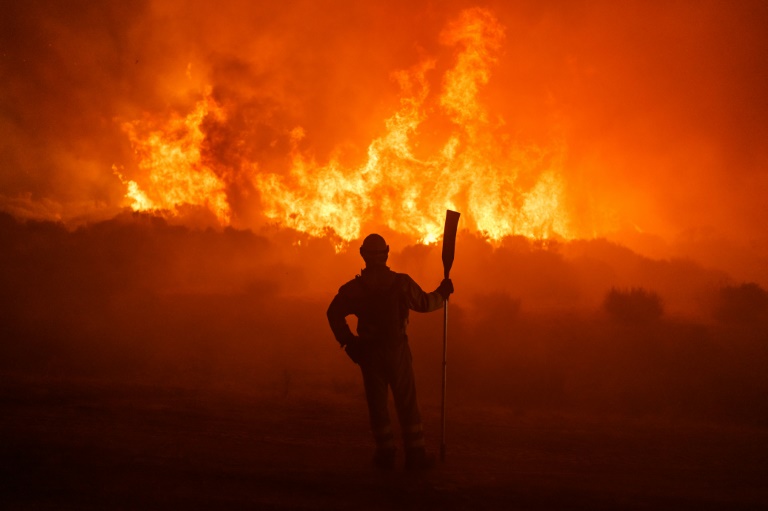
The number of major wildfires worldwide will rise sharply in coming decades due to global warming, and governments are ill-prepared for the death and destruction such mega-blazes trail in their wake, the UN warned Wednesday.

Even the most ambitious efforts to curb greenhouse gas emissions will not prevent a dramatic surge in the frequency of extreme fire conditions, a report commissioned by the UN Environment Programme (UNEP) concluded.

“By the end of the century, the probability of wildfire events similar to Australia’s 2019–2020 Black Summer or the huge Arctic fires in 2020 occurring in a given year is likely to increase by 31–57 percent,” it said.

The heating of the planet is turning landscapes into tinderboxes, and more extreme weather means stronger, hotter and drier winds to fan the flames.

Such wildfires are burning where they have always occurred, and are flaring up in unexpected places such as drying peatlands and thawing permafrost.

“Fires are not good things,” said co-author Peter, an expert in forest fire management at the UN’s Food and Agriculture Organization (FAO).

“The impacts on people — socially, health-wise, psychologically — are phenomenal and long-term,” he told journalists in a briefing.

Large wildfires, which can rage uncontrolled for days or weeks, cause respiratory and heart problems, especially for the elderly and very young. 

A recent study in The Lancet concluded that exposure to wildfire smoke results, on average, in more than 30,000 deaths each year across 43 nations for which data was available.

Economic damages in the United States — one of the few countries to calculate such costs — have varied between $71 to $348 billion (63 to 307 billion euros) in recent years, according to an assessment cited in the report.

– Zombie fires –

Major blazes can also be devastating for wildlife, pushing some endangered species closer to the brink of extinction.

Nearly three billion mammals, reptiles, birds and frogs were killed or harmed, for example, by Australia’s devastating 2019-20 bushfires, scientists have calculated.

Wildfires are made worse by climate change.

Heatwaves, drought conditions and reduced soil moisture amplified by global warming have contributed to unprecedented fires in the western United States, Australia and the Mediterranean basin just in the last three years.

Even the Arctic — previously all but immune to fires — has seen a dramatic increase in blazes, including so-called “zombie fires” that smoulder underground throughout winter before bursting into flames anew.

But wildfires also accelerate climate change, feeding a vicious cycle of more fires and rising temperatures.

Last year, forests going up in flames emitted more than 2.5 billion tonnes of planet-warming CO2 in July and August alone, equivalent to India’s annual emissions from all sources, the European Union’s Copernicus Atmosphere Monitoring Service (CAMS) reported.

Compiled by 50 top experts, the report called for a rethink on how to tackle the problem.

“Current government responses to wildfires are often putting money in the wrong places,” investing in managing fires once they start rather than prevention and risk reduction, said UN Environment chief Inger Andersen.

“We have to minimise the risk of extreme wildfires by being prepared.”

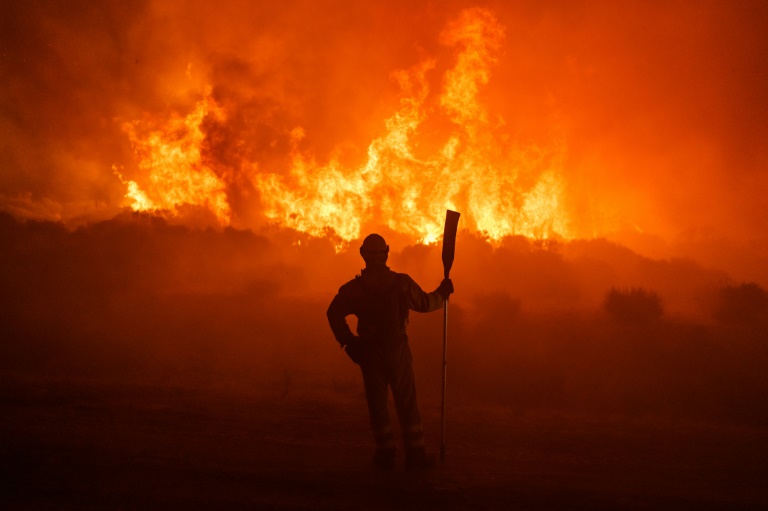
World must brace for more extreme wildfires: UN

The number of major wildfires worldwide will rise sharply in coming decades due to global warming, and governments are ill-prepared for the death and destruction such mega-blazes trail in their wake, the UN warned Wednesday.

Even the most ambitious efforts to curb greenhouse gas emissions will not prevent a dramatic surge in the frequency of extreme fire conditions, a report commissioned by the UN Environment Programme (UNEP) concluded.

“By the end of the century, the probability of wildfire events similar to Australia’s 2019–2020 Black Summer or the huge Arctic fires in 2020 occurring in a given year is likely to increase by 31–57 percent,” it said.

The heating of the planet is turning landscapes into tinderboxes, and more extreme weather means stronger, hotter and drier winds to fan the flames.

Such wildfires are burning where they have always occurred, and are flaring up in unexpected places such as drying peatlands and thawing permafrost.

“Fires are not good things,” said co-author Peter, an expert in forest fire management at the UN’s Food and Agriculture Organization (FAO).

“The impacts on people — socially, health-wise, psychologically — are phenomenal and long-term,” he told journalists in a briefing.

Large wildfires, which can rage uncontrolled for days or weeks, cause respiratory and heart problems, especially for the elderly and very young. 

A recent study in The Lancet concluded that exposure to wildfire smoke results, on average, in more than 30,000 deaths each year across 43 nations for which data was available.

Economic damages in the United States — one of the few countries to calculate such costs — have varied between $71 to $348 billion (63 to 307 billion euros) in recent years, according to an assessment cited in the report.

– Zombie fires –

Major blazes can also be devastating for wildlife, pushing some endangered species closer to the brink of extinction.

Nearly three billion mammals, reptiles, birds and frogs were killed or harmed, for example, by Australia’s devastating 2019-20 bushfires, scientists have calculated.

Wildfires are made worse by climate change.

Heatwaves, drought conditions and reduced soil moisture amplified by global warming have contributed to unprecedented fires in the western United States, Australia and the Mediterranean basin just in the last three years.

Even the Arctic — previously all but immune to fires — has seen a dramatic increase in blazes, including so-called “zombie fires” that smoulder underground throughout winter before bursting into flames anew.

But wildfires also accelerate climate change, feeding a vicious cycle of more fires and rising temperatures.

Last year, forests going up in flames emitted more than 2.5 billion tonnes of planet-warming CO2 in July and August alone, equivalent to India’s annual emissions from all sources, the European Union’s Copernicus Atmosphere Monitoring Service (CAMS) reported.

Compiled by 50 top experts, the report called for a rethink on how to tackle the problem.

“Current government responses to wildfires are often putting money in the wrong places,” investing in managing fires once they start rather than prevention and risk reduction, said UN Environment chief Inger Andersen.

“We have to minimise the risk of extreme wildfires by being prepared.”

Brazil's Bolsonaro turns to Telegram as vote nears

Like millions of Brazilians, @mara, a fervent fan of far-right President Jair Bolsonaro, has turned to the messaging app Telegram as the country heads toward a deeply divisive election: “There’s no censorship here,” she says.

Similar to the 2018 election that brought Bolsonaro to power, this October’s edition is shaping up as an all-out war on social media, with disinformation as a powerful weapon.

Bolsonaro, who has had various posts blocked on Facebook, Twitter and YouTube for violating their rules on misinformation, is eagerly encouraging his base to follow him on Telegram as the vote nears.

Founded by Russian-born tech entrepreneur Pavel Durov in 2013, Telegram is a crypted messaging app with virtually no restrictions on what users can say in messages.

That has won it fans in Bolsonaro’s camp, where other social media companies face accusations of censoring right-wing views.

It has also earned it scrutiny from the Brazilian authorities, notably the Superior Electoral Tribunal, which has tried in vain to get Telegram to cooperate in fighting disinformation in the run-up to the elections.

“Here, you can express your opinions freely,” said @mara, a 60-year-old teacher who asked her real name not be used.

The pressure on Telegram, she said, is “RI-DI-CU-LOUS.”

“That’s a DICTATORSHIP, it only happens in countries governed by dictators,” she told AFP via the app, which has been hugely successful in Brazil, downloaded on 53 percent of all cell phones.

Bolsonaro is facing an uphill battle to win reelection, currently trailing leftist ex-president Luiz Inacio Lula da Silva in polls.

Like his political role model, former US president Donald Trump, Bolsonaro is adept at rallying his base on social media, where the Brazilian leader has more than 45 million followers in all.

He faces a series of investigations for spreading false information on social networks, notably over his repeated claims of rampant fraud in Brazil’s electronic voting system, for which he has provided no evidence.

Bolsonaro has more than one million followers on Telegram, not including numerous fan groups with names like “Reelect Bolsonaro 2022.”

Lula, for his part, has just 47,000.

– ‘Cowardly’ –

Dubai-based Telegram proudly explains on its website that its chat data and encryption keys are deliberately spread around the world, in what is known as “distributed infrastructure.”

“Thanks to this structure, we can ensure that no single government or block of like-minded countries can intrude on people’s privacy and freedom of expression,” it says.

Its refusal to block content some consider dangerous has sometimes gotten it in trouble, including suspensions in several countries.

And its largely unmoderated platform, which allows groups of up to 200,000 members, is a potential viral breeding ground for false information.

Earlier this month, the Superior Electoral Tribunal signed an agreement with eight leading social networks to combat disinformation during the elections, including Twitter, TikTok, Facebook, WhatsApp, Instagram and YouTube.

Telegram was notably absent.

The court’s president, Luis Roberto Barroso, wrote to Telegram headquarters in December, asking for a meeting and warning that the app was rife with “conspiracy theories and false information about (Brazil’s) electoral system.”

He went on to threaten Brazil would suspend Telegram, “plain and simple.”

Bolsonaro said any such move would be “cowardly.”

– Specter of US Capitol riot –

Brazilian prosecutors are also investigating Telegram on allegations of spreading disinformation and hate speech.

“It’s a platform designed to dodge the law. Messages are stored on multiple servers, each in a different jurisdiction,” said Pablo Ortellado, a digital communications expert at the University of Sao Paulo.

Bolsonaro’s repeated allegations against the electronic voting system used in Brazil since 1996 are raising fears he will reject the election result if he loses, like Trump.

The specter of the January 6, 2021 attack on the US Capitol by Trump supporters — who were riled up in part on social media — looms large in Brazil.

“The fear is that if Telegram can’t be brought under Brazilian electoral legislation, false allegations of vote fraud can’t be regulated or contained,” Ortellado told AFP.

If Brazil does block Telegram, @mara has a back-up plan: she has already signed up for other apps, including Trump’s new Truth Social, which started rolling out Sunday.

“WE WILL NEVER GIVE UP,” she said.

Two Venezuela military officers killed in helicopter crash

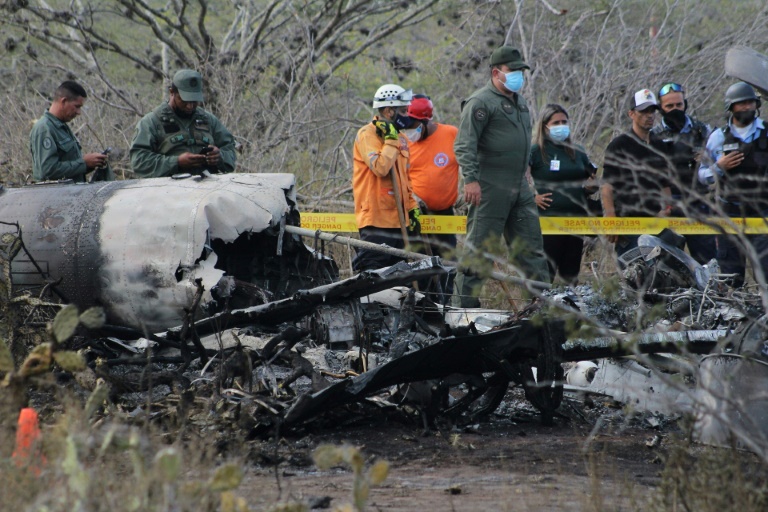
Two Venezuelan military personnel were killed and two others injured Tuesday when a Russian-made helicopter crashed in the South American nation, President Nicolas Maduro said.

“Today we have had a sad and regrettable accident in the state of Lara, with an Mi-17 helicopter with two fatalities and two pilots who are fighting for their lives,” Maduro said during a meeting with ministers broadcast on state television.

It was unclear why the chopper went down, and Maduro has ordered an investigation. 

The aircraft burst into flames when it crashed, and the injured pilot and co-pilot were pulled to safety by local residents and laborers.

The Venezuelan army said in a statement that the crash occurred during “a supply mission to border protection bases.”

Hong Kong parents decry child separations during virus surge

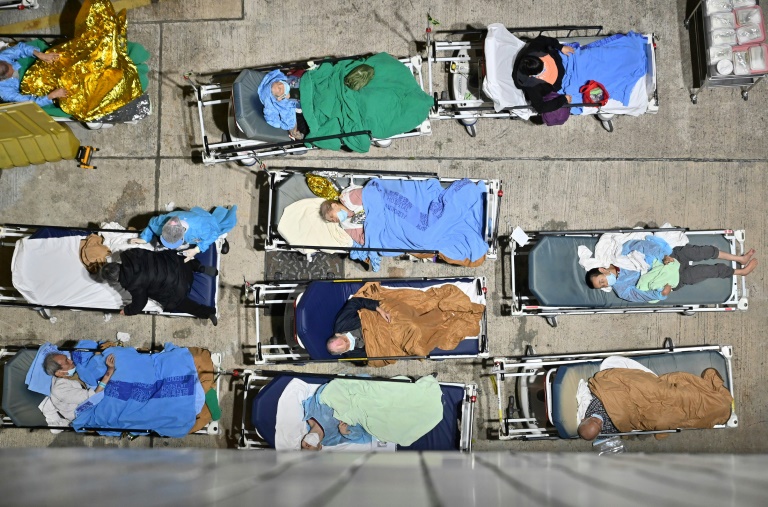
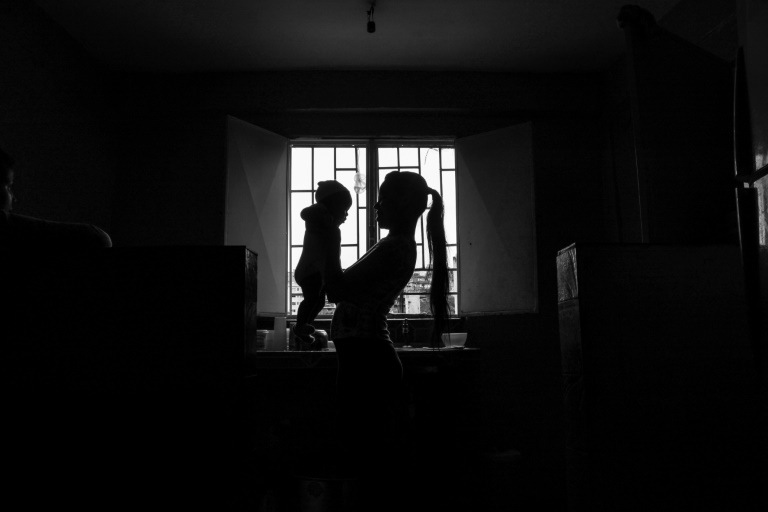
Hong Kong parents are being separated from children and babies who test positive for the coronavirus, compounding public anger over the financial hub’s lack of readiness for a major outbreak now sweeping the city.

The densely populated metropolis is in the throes of its worst-ever Covid wave, registering thousands of cases every day as hospitals and isolation units run out of space.

A strict China-style zero-Covid policy kept the virus mostly at bay the last two years at the expense of marooning the city internationally. 

But when the highly contagious Omicron variant eventually broke through earlier this year, authorities were caught flat-footed. 

Hong Kong has been ordered by China to stick to its zero-Covid policy and aim to isolate anyone who tests positive even though the number of daily cases has soared far beyond capacity.

Some parents have complained of being unable to accompany children in hospital while others have flocked to social media to voice fears of separation if they seek treatment for themselves or sick young ones.

The revelation has sparked dismay, including among health professionals. 

“If a child requires hospitalisation due to Covid, it should be made possible for one parent to stay in the same room unless the child’s condition is very serious,” Siddharth Sridhar, a microbiologist at the University of Hong Kong, wrote on Twitter.

“In times like these, staying rational and compassionate is more important than ever.”

– ‘I’ll sleep on the floor’ –

Laura, a 32-year-old British-born permanent resident, told AFP her daughter Ava tested positive after she was admitted to hospital on Sunday night with a fever and laboured breathing.

Ava is now stable in the intensive care unit and will soon be moved to an isolation ward but she will have to recover without her parents for at least seven days.

“I’ve said I’ll sleep in the corridor, on the floor, anywhere,” she said, fighting back tears.

Laura and her husband Nick managed to share a quick video call with Ava on Tuesday.

“It was devastating,” Laura recalled, asking to use just her first name. 

“She’s 11 months, she’s aware of her surroundings, separation anxiety is at an all-time high at this age, she was inconsolable, just crying ‘Mamma, Mamma’.”

Online parent groups have filled with angst, fear and confusion this week. 

Kunj Gandhi, the administrator of a popular Facebook support group for people going through quarantine, wrote that many hospitals had stopped letting parents stay with children as wards filled beyond capacity. 

“Many (parents) tried to fight or rationalise it but in the end had to make the heartbreaking decision of leaving their child in hospital so the child could get the treatment he/she needs,” she wrote. 

On a 17,000-strong mostly Cantonese-speaking Facebook group for mothers looking for coronavirus treatment, many said they had sick children but feared going to hospital.

“My son is two and a half years old and has been feverish since early Monday morning,” one member called Shan Hor wrote. “I don’t know what to do. I am so scared.”

Others wrote that calls to the health department and government advice lines went unanswered.

Lau Ka-hin, an official from Hong Kong’s Hospital Authority, confirmed that children were being separated. 

“We tried our best to arrange the children and the parents who are confirmed Covid positive to be in the same hospital so that the parents can take care of the children,” he told reporters on Tuesday. 

“But there are many, many cases and many children are infected. It takes time for our staff to arrange the suitable place for them.”

– Schools disrupted –

Hong Kong authorities are facing rising anger over the lack of preparations to deal with a surge of cases despite two years of hard-fought breathing room earned through zero-Covid.

Usually uncritical newspapers such as Oriental Daily have published multiple editorials this week castigating city leaders, an outspokenness that is increasingly rare in Hong Kong as authorities crack down on dissent following 2019’s democracy protests.

The strict, often changing social distancing measures have been punishing for businesses and especially grim for parents with schooling disrupted for the last two years.

On Tuesday, Hong Kong leader Carrie Lam announced the summer holidays would be immediately brought forward to make school buildings available for three rounds of compulsory citywide Covid tests in March.

Figures this week showed departures from the city have reached their highest since the pandemic and political crackdown began. 

But even then leaving Hong Kong is not easy with very few international flights. 

Some health experts are worried Hong Kong’s harsh isolation rules may in fact fuel the spread of the virus. 

“My real fear now is parents delaying treatment due to fear of separation,” David Owens, a local doctor, wrote on Twitter this week.

UN slams 'aggressive' formula milk marketing

The United Nations slammed baby formula makers Wednesday for “unethical” marketing strategies, accusing them of aggressively targeting expecting parents and health workers and putting shareholder interests before children’s health.

It is widely recognised that breastfeeding carries huge health benefits.

But countries’ failure to crack down on the marketing of breast milk substitutes means far too many children are still being reared on formula, the World Health Organization and the UN children’s agency Unicef warned, in a new report.

It found that the $55-billion formula milk industry systematically deploys aggressive marketing strategies, spending up to $5 billion a year to sway parents’ decisions on how to feed their infants.

“This report shows very clearly that formula milk marketing remains unacceptably pervasive, misleading and aggressive,” WHO chief Tedros Adhanom Ghebreyesus said in a statement.

Unicef chief Catherine Russell called for “robust policies, legislation and investments in breastfeeding to ensure that women are protected from unethical marketing practices”.

Experts have long extolled the health benefits of breastfeeding, saying that breast-fed children are healthier, perform better on intelligence tests and are less likely to be overweight or suffer from diabetes later in life.

Women who breastfeed also have a reduced risk of breast and ovarian cancer, research shows.

– ‘Marketing is everywhere’ –

But despite the known benefits, only 44 percent of babies under the age of six months are exclusively breastfed, as recommended by the WHO and Unicef.

And while global breastfeeding rates have increased little in the past two decades, the sale of formula milk has more than doubled over the same period, Wednesday’s report said.

Lead report author Nigel Rollins, of the WHO’s maternal, newborn, child and adolescent health division, blamed the industry’s aggressive marketing practices.

“We see marketing everywhere,” he told AFP, pointing to targeted digital messaging, promotional gifts to new parents, and even efforts to turn health professionals into a “conduit for messages about formula”.

The report, which surveyed 8,500 parents and pregnant women and 300 health workers across eight countries in various regions of the world, found that more than half of parents and pregnant women said they had been targeted with formula marketing.

In Britain, 84 percent of all women surveyed said they had been exposed to such marketing, while a full 97 percent in China had, “increasing their likelihood of choosing formula feeding,” the UN agencies said.

– Pseudoscience –

Rollins pointed to how companies use pseudoscience to suggest that breast milk is not enough on its own or that formula does a better job of helping babies to sleep through the night.   

“Children or babies crying, not sleeping, are very worrisome to parents, and the industry uses those moments to say our product is the solution for your problem,” he said.

Wednesday’s report voiced particular concern about marketing targeting of health care professionals with free samples, promotional gifts, research grants, and paid conferences.

Over a third of the women surveyed said a health worker had recommended a specific brand of formula to them, it found.

Rollins stressed the goal was not to clear store shelves of formula, acknowledging that breast feeding is not an option for all parents.

But he insisted far more needed to be done to ensure adherence to an international code of conduct adopted by the World Health Assembly back in 1981, demanding that formula not be marketed or distributed in a way that interferes with the promotion of breastfeeding.

Wednesday’s report did not name specific companies, painting the problem as an industry-wide issue.

Nestle, the world’s biggest formula maker, meanwhile insisted to AFP that it was “highly compliant with the WHO Code”.

The Switzerland-based company pointed out that it was “voluntarily stopping promoting formula for infants 0-6 months across the world by year end”, including in the United States, Canada and Japan, countries that have no regulation on the issue.

Nestle said it supported “the adoption of laws on marketing of infant formula in all countries”, adding that it was “ready to work with WHO, Unicef and others to make this happen”.

One dead, 10 feared missing in Australia floods

One person was found dead in a submerged car and 10 others were reportedly missing on Wednesday after heavy rain caused flash flooding in eastern Australia and set off a string of emergency warnings up and down the Pacific coast. 

The body of the drowned 60-year-old was found early Wednesday in the state of Queensland, premier Annastacia Palaszczuk told parliament, describing the incident as a “tragedy”.

Almost half a meter (1.5 feet) of rain has fallen on some parts of her state in the last 24 hours, causing multiple road closures and transport chaos.

Emergency services received more than a hundred calls for help and swift water rescue crews have been despatched to assist dozens of stranded residents.

Emergency services have received more than a hundred calls for help and swift water rescue crews have been despatched to rescue dozens of stranded residents.

“This has the potential to be a significant rainfall event for south-east Queensland,” Palaszczuk said.

A freight train overturned near the town of Gympie, although the driver was said to have minor injuries.

Local media quoted Sunshine Coast Police District Superintendent Craig Hawkins as saying 10 people were also missing.

Fifteen Queensland dams are at capacity and more rain is expected in the coming days.

“Locally intense rainfall is possible and since many catchments are now saturated there is an increased risk of dangerous and life-threatening flash flooding over the coming days,” said Palaszczuk.

Police warned motorists to avoid driving through flooded roads and to stay at home.

“Flash flooding is occurring on roads and bridges – Re-consider your need to travel today,” police told residents.

Heavy rain has also pelted the state of New South Wales, where parts of Sydney were briefly submerged Tuesday.

After several years of drought and climate-worsened bushfires, Australia’s east is wrapping up an extraordinarily wet antipodean summer, thanks to a La Nina weather pattern.

La Nina increases the chances of tropical cyclones off Australia’s Pacific coast and brings above-average rainfall, according to the country’s Bureau of Meteorology. 

Close Bitnami banner
Bitnami