World

North Korea marks ex-leader's birthday with snowy celebration

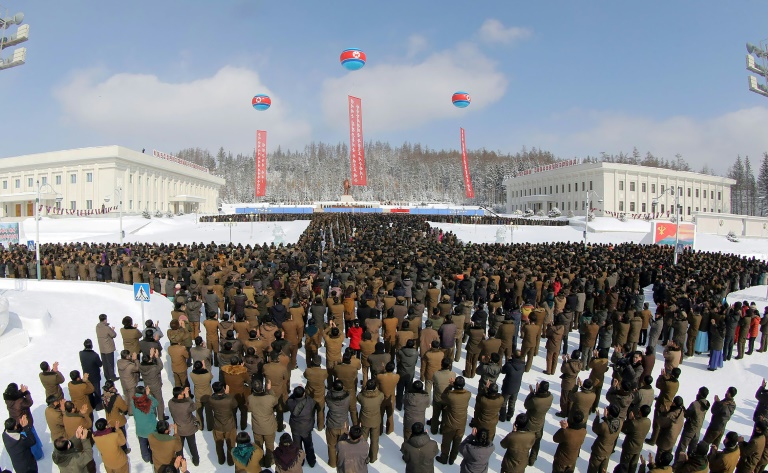
North Korea marked the 80th birthday of leader Kim Jong Un’s late father with a mass outdoor meeting in sub-zero temperatures, state media reported Wednesday, but no missiles or military parade.

Kim was joined by top officials in celebrating the “Day of the Shining Star” in snowy Samjiyon, a city near Mt Paektu, where official narratives say Kim Jong Il was born in a secret guerilla camp on February 16. 

The North Korean calendar is peppered with anniversaries related to the nation’s official history, in particular to Kim’s father and his grandfather Kim Il Sung, the country’s founding leader.

The occasions are celebrated with flower shows, mass dances and laudatory tributes in state media, in what analysts say is a means to instil loyalty to the leadership.

Kim Il Sung’s April 15 birthday is called the Day of the Sun.

Photos and video in North Korean state media Wednesday showed participants gathered before a giant statue of Kim Jong Il to celebrate what the official KCNA news agency called “the great auspicious holiday of the nation”.

The crowd was said to have burst into “stormy cheers” at the sight of leader Kim Jong Un, who has called Samjiyon — located along the Chinese border in Ryanggang province — the “home of our revolution”.

Kim has poured huge resources into the area’s redevelopment in recent years, with the vast project including new apartments, hotels and a ski resort.

This year’s anniversary has been closely watched as it comes amid fresh tensions on the peninsula. Some observers had anticipated a military parade by the North to showcase its new weapons.

Pyongyang carried out an unprecedented seven weapons tests in January, including of its most powerful missile since 2017, when leader Kim Jong Un baited then-US president Donald Trump with a spate of provocative launches.

It has also warned it could abandon its self-imposed moratorium and resume testing intercontinental ballistic missiles or nuclear weapons.

But Pyongyang appears to have paused testing during the Beijing Winter Olympics, possibly out of deference to key ally China, analysts have said.

Experts say Pyongyang could use its next key anniversary — the 110th birthday of Kim Il Sung on April 15 — to carry out a major weapons test.

18 dead in storms near Brazil's Rio de Janeiro: firefighters

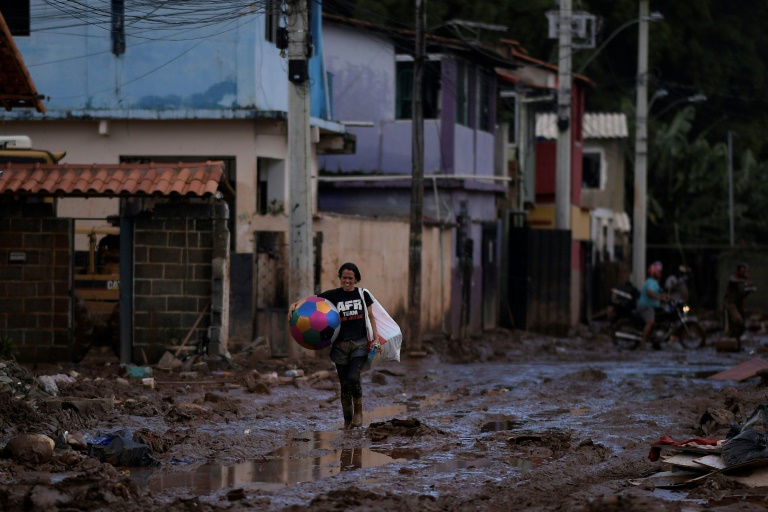
Landslides and flooding triggered by heavy rainfall killed at least 18 people Tuesday in a tourist town in the hills above Rio de Janeiro, Brazilian firefighters said.

“So far, 18 deaths caused by landslides and floods have been confirmed” in recent hours, the Rio de Janeiro Fire Department said in a statement.

It said more than 180 firefighters and other rescue workers were at the scene in the picturesque hill town of Petropolis where Brazil’s last emperor Pedro II is buried, 68 kilometers (42 miles) north of the city of Rio.

City hall declared a “state of disaster” as images spread on social media of destroyed houses and cars swept away by floodwater.

Many shops were completely inundated by the rising waters which gushed down the streets of the historic city center. 

Some parts of Petropolis received up to 260 millimeters (10 inches) of water in less than six hours, more than was expected for the whole month of February, according to the meteorological agency MetSul. 

The heaviest downpour had passed but more moderate rainfall was expected to continue for several hours, authorities said.

President Jair Bolsonaro, on an official trip to Russia, said on Twitter that he was keeping abreast of “the tragedy” and asked his ministers to provide “immediate aid to the victims.”

Earlier this month, floods and landslides caused by torrential rain killed at least 28 people in the southeast of the country, mostly in Sao Paulo state and the region north of Rio.

In January 2011, more than 900 people died in the mountainous region of Rio due to heavy rains that caused flooding and landslides in a large area including Petropolis and neighboring cities Nova Friburgo and Teresopolis.

At new fraud trial, Navalny vows to fight on against Kremlin

Imprisoned Kremlin critic Alexei Navalny said he would keep challenging Russia’s leadership during the opening of a new fraud trial that could extend his jail term by more than a decade.

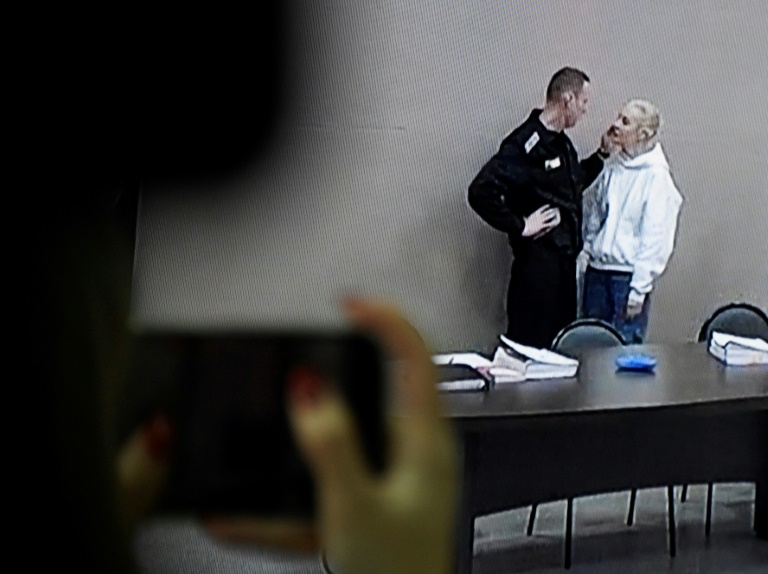
Navalny appeared at the beginning of the hearing Tuesday via video link wearing a prison uniform and flanked by guards at the makeshift court inside his penal colony, smiling and embracing his wife.

US Secretary of State Antony Blinken said he was “troubled by dubious new charges” against Navalny and called for his release.

“Navalny and his associates are targeted for their work to shine a light on official corruption,” Blinken tweeted.

“This time, he goes to trial in a penal colony, out of public view. Russian authorities should release Aleksei Navalny and end their harassment and prosecution of his supporters.”

German Chancellor Olaf Scholz earlier said the new case was “incompatible” with the rule of law, speaking during a press conference with Russian leader Vladimir Putin in Moscow.

The 45-year-old opposition leader has already been behind bars for a year, after surviving a poison attack he and Washington blame on the Kremlin.

He is serving out a two-and-a-half year sentence on old embezzlement charges, but the fresh charges could see his time behind bars significantly extended.

“You’re going to increase my term indefinitely. What can we do about it?” Navalny said during the court hearing.

“The activities of people are more important than the fate of one individual. I’m not afraid.”

The new case was launched in December 2020, when Navalny was recovering in Germany after he was attacked with Soviet-designed poison. The Russian authorities have repeatedly denied any involvement.

– ‘Illegal persecution’ –

Rights groups have criticised authorities for holding the closed-door hearing inside the maximum-security prison in Pokrov, 100 kilometres (60 miles) east of Moscow.

Investigators accuse Navalny of stealing for personal use more than $4.7 million in donations that were given to his political organisations. The charges carry a maximum penalty of 10 years in prison.

A prosecutor during the trial accused Navalny and his allies of “misleading citizens” with the “deliberate” aim of stealing funds.

Navalny grew a wide following among liberal-leaning Russians with videos exposing the corruption among the elite. Many of the investigations gained millions of views online.

Navalny’s allies decried the trial as a sham and his lawyer said it came as part of Kremlin efforts to remove him from political life.

“We believe the persecution of Navalny is illegal, is distinctly political in nature, and aimed at discrediting and removing him from political activity,” lawyer Olga Mikhailova said.

– ‘Incompatible’ with rule of law – 

The start of the trial comes during a week of intensive talks between Russia and the West over Ukraine, with Scholz the latest leader in Moscow for talks with Putin.

The German chancellor condemned legal proceedings against Navalny, following appeals earlier from the opposition leader’s allies to raise his case with Putin. 

“My position on the Navalny case is very clear: his judgement is incompatible with the principles of the rule of law and I have expressed this view on many occasions,” Scholz said.

Navalny was treated by doctors in Berlin and Germany blamed his near-fatal poisoning on the Kremlin. Former chancellor Angela Merkel used her final visit to Moscow last year to ask Putin to free Navalny.

On the eve of the hearing Amnesty International criticised the “sham trial, attended by prison guards rather than the media”.

“It’s obvious that the Russian authorities intend to ensure that Navalny doesn’t leave prison any time soon,” it said on Monday.

In separate charges, Navalny also faces up to six months in prison if convicted of contempt of court.

Navalny’s poisoning and arrest sparked widespread condemnation abroad as well as sanctions from Western capitals.

After his arrest, Navalny’s political organisations across the country were declared “extremist” and shuttered, while many key aides fled Russia fearing prosecution. 

Russian army, Putin's favoured foreign policy tool

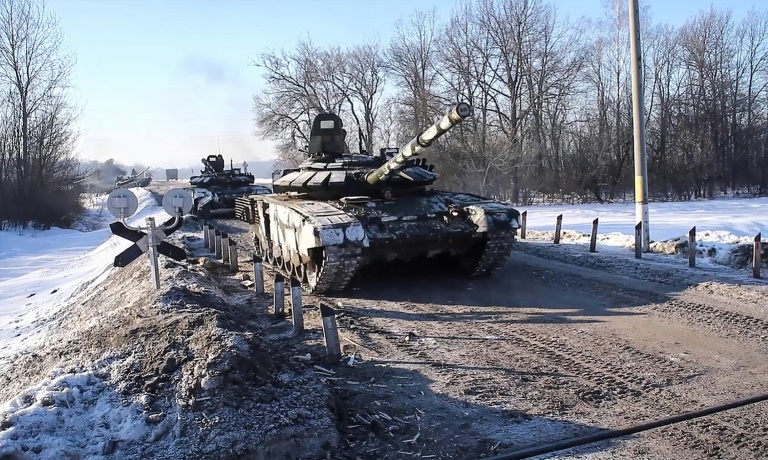
Whether they have been camped out on Ukraine’s borders or moving tanks across the vast country, Russia’s battle-hardened troops have made the world listen to Vladimir Putin, who wants to redefine European security.

President Putin has made reviving the army one of the top priorities of his 20-year rule.

After years of post-Soviet neglect, the armed forces received new aircraft, tanks and missiles, opened new bases in the Arctic and resumed Cold War-style strategic bomber patrols.

Today, experts say, the modernised Russian army has become a key tool of Putin’s foreign policy.

Dmitri Trenin, director of the Carnegie Moscow Center, says Putin thinks big.

“The Ukraine crisis has demonstrated, for the first time since the end of the Cold War, Russia’s readiness to use military force to prevent further expansion of the Western alliance into former Soviet territory,” he said.

“The geopolitical retreat that Russia began three decades ago has ended.”

For months Russia has been moving troops towards the border with pro-Western Ukraine, prompting Western capitals to warn a Russian attack was imminent and start pulling personnel out of the country.

Amid Russia’s latest show of force the United States relocated its embassy in Kyiv to the western Ukrainian city of Lviv, citing a “dramatic acceleration” in the build-up of Russian troops.

On Tuesday, Russia announced that some of the troops were returning home following the planned conclusion of exercises but other military drills were ongoing.

– Battlefield triumphs –

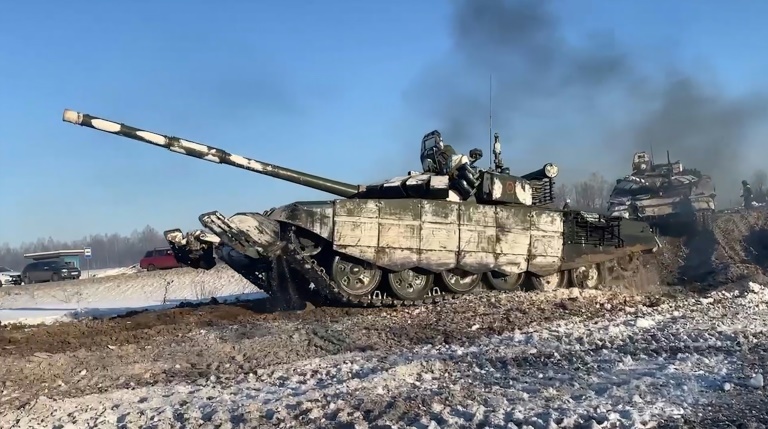
For months, social networks have been flooded with images of Russian tanks parked in the snow near the Ukrainian border or trains transporting multiple rocket launchers and other materiel.

On the EU doorstep, Russia has flexed its muscles in Belarus, during joint drills that involved sophisticated weapons systems such as S-400 surface-to-air missiles and Pantsir air defence systems.

Russia last month also announced a series of naval exercises in the Atlantic Ocean, the Arctic Ocean, the Pacific Ocean, the Mediterranean and elsewhere.

With roughly one million active-duty military personnel and state-of-the-art weapons, the Russian army is one of the largest and most powerful in the world.

Moscow has the world’s second-largest arsenal of nuclear weapons and a huge cache of ballistic missiles.

Putin has also boasted of developing a number of “invincible” weapons that can surpass existing systems, including the Sarmat intercontinental missiles and Burevestnik cruise missiles.

In recent years the Kremlin strongman has scored a number of battlefield — and foreign policy — triumphs that helped boost his popularity despite economic malaise at home.

In January, Russia swiftly sent troops to the Central Asian nation of Kazakhstan to back a Kremlin-friendly regime in what was touted as a peace-keeping operation amid deadly unrest.

In 2015, Russia charged into Syria with an air campaign that turned the tide of a complex conflict in favour of the Damascus regime.

The intervention helped President Bashar al-Assad reclaim swathes of territory his forces had lost to Islamists and Western-backed opposition groups. Syria has also proved a valuable training ground for the Russian military.

A year earlier, Russian special forces helped the Kremlin seize Crimea from Ukraine in a largely bloodless military operation.

In 2008, Russian troops routed the Georgian military in five days of fighting. 

– ‘Good tool’ – 

“The army is a good tool of influence,” Vasily Kashin, a military analyst at Moscow’s Higher School of Economics, told AFP.

“From a military point of view, any concentration of troops requires a response,” he added.

But analysts also point out that apart from the show of force, the Kremlin has few other powerful levers to assert its influence on the international arena.

The West has repeatedly accused Moscow of using its vast energy resources as a geopolitical tool, but observers say Russia cannot afford to deprive itself of the major source of hard-currency income.

Russia’s military modernisation has also come at the expense of key economic diversification efforts and major infrastructure and social projects.

However impressive, the Russian army cannot compete with the American war machine, and if war breaks out there will be no winners.

“Hypothetically, the Russian army would be capable of countering NATO forces in Europe for some time, but in general, in terms of conventional weapons, the United States has a very significant superiority over Russia,” said Kashin. 

“Any direct military clash with NATO in Europe will lead to an uncontrollable escalation and the spillover into a nuclear war.”

Ukraine's comedian-turned-president stars in crisis

He was the comic from Ukrainian TV who implausibly became president.

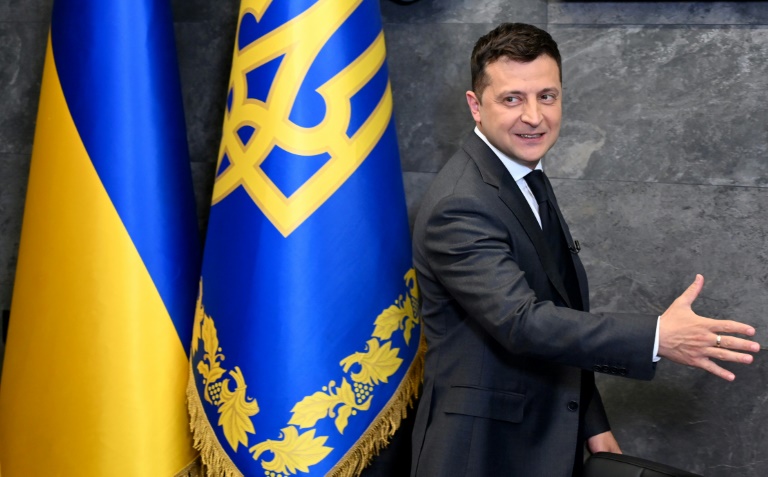
But Volodymyr Zelensky could be having the last laugh as Russia begins pulling back forces from Ukraine’s frontiers without staging an attack — just as he had told Washington they would.

The fresh-faced 44-year-old became president of Ukraine in time to witness the gravest standoff between the Kremlin and Western powers since the end of the Cold War more than three decades ago.

He watched Russia surround his country with more than 100,000 soldiers and Washington warn in increasingly shrill tones that a war was “imminent” and could begin “any day”.

Zelensky took it all in and did what he knew best: he told his nation of more than 40 million people to relax and plan a party.

“What should we do? Only one thing — keep calm,” he said last month.

“We will celebrate Easter in April. And then in May, the same as always — the sun, holidays, barbeques,” he said. “And before long, it’s summer.”

Then he declared February 16 — the day some US officials picked as a possible start for President Vladimir Putin’s assault — a national “unity day” holiday on which people should come out with flags and balloons.

– ‘Not that bad’ –

Zelensky ran for president seemingly as a joke in 2019.

He catapulted to fame by playing a foul-mouthed school teacher on TV who became president after one of his students filmed his profane rant against corruption and posted it online.

The evening comedy show became a huge hit just as the country was gripped by cataclysmic change.

Ukraine’s 2014 pro-EU revolution ousted a Kremlin-backed leader and brought in a new team that had to grapple with a spiralling conflict in the east and an economy teetering toward collapse.

Ukrainians watched the president on the comedy show make crude jokes to his wife and pedal to work with a startled look of panic.

It captured the zeitgeist — and made Zelensky a small fortune.

He defeated Petro Poroshenko — an incumbent mired by crises on all sides — in a runoff by winning more than 70 percent of the vote.

But some Ukrainians braced for the worst. His critics compared him unfavourably to celebrity politicians such as Italy’s Silvio Berlusconi and then US president Donald Trump.

His early decision to fill his team with members of his Kvartal 95 TV production company did little to build public confidence.

Zelensky’s initial media appearances with other world leaders looked stilted. 

“I think our international partners have a fairly difficult time dealing with him. He is not on their level,” said Ukrainian political analyst Mykola Davydyuk.

“They are playing at a very high level that he cannot reach — and cannot understand.”

But some Western diplomats appear taken by his charm.

“He hasn’t done that bad, to be honest,” one diplomat said.

“He has an impossible job. He is stuck, under pressure from both the Russians and the Americans,” the diplomat said.

“He has shown composure.”

– Defining moment –

The standoff with Russia over Ukraine’s dream of joining NATO — aspirationally written into the constitution but unlikely to happen in the coming decades — could well define Zelensky’s presidency for the coming years.

He came to power attempting to open lines of communication with Putin that could finally resolve the bloody separatist conflict after claiming more than 14,000 lives.

The two held a Parisian summit a few months after Zelensky’s election that Putin hailed as an “important step”.

But Zelensky read from a different script at his own post-summit media event.

“My counterparts have said it is a very good result for a first meeting. But I will be honest — it is very little,” he said.

Relations between the two men have been deteriorating ever since.

Putin has accused Zelensky’s government of “discriminating” against Russian-speakers and reneging on past promises for settling the eastern conflict.

Zelensky’s offer of a three-way summit with Putin and US President Joe Biden fell on deaf ears in Moscow last month.

But some analysts think Zelensky’s stature has grown in the past few weeks.

“If Russia doesn’t escalate and reduces its posture near Ukraine, it will likely be a little embarrassing for the US intelligence community, but it will also bolster Zelensky’s position,” the Foreign Policy Research Institute’s senior fellow Rob Lee said.

“He didn’t back down and NATO defence support increased.”

EU court to deliver key rule-of-law judgement

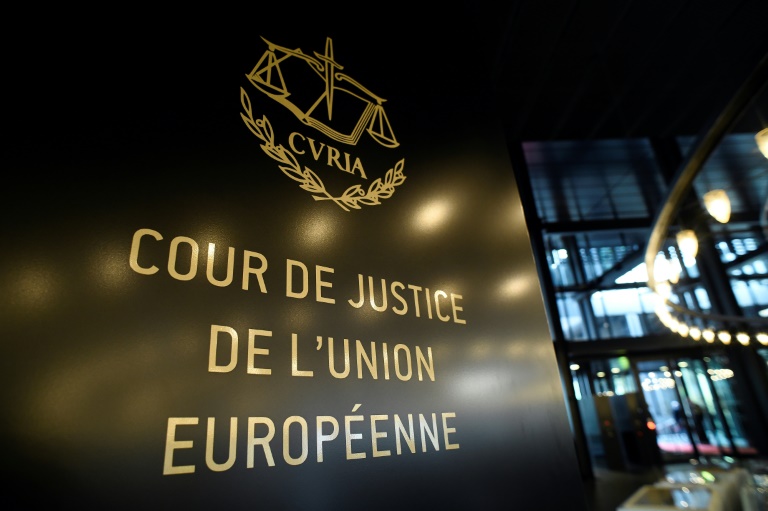
The EU’s highest court will rule Wednesday on whether European Union funds can be slashed for member states flouting democratic standards, a case with major implications for Poland and Hungary.

Both EU countries — which Brussels says are backsliding on rule of law — launched the legal challenge being heard by the European Court of Justice (ECJ). They want the so-called “conditionality mechanism” to be invalidated.

But in December the court’s advisor, the advocate general, concluded that the Polish-Hungarian challenge should be rejected, arguing that the conditionality mechanism was compatible with the EU’s treaties.

Should the judges decide the same, it would open the door to the European Commission cutting their funding.

The European Parliament, which approves the EU’s multi-year budgets, has for months called for the commission to do just that, stressing that the conditionality instrument has been available since the beginning of last year.

It has even launched its own legal action, accusing the commission of inaction.

But the EU executive, wary of being wrong-footed by court rulings and aware it needs a qualified majority of member states to approve the mechanism’s use, has been determined to build a cast-iron case, step-by-step.

In November, it sent formal letters to Warsaw and Budapest setting out what it sees as the democratic shortfalls.

For Poland, it criticises judicial reforms it believes undermine judges’ independence and a refusal to accept the primacy of EU law over Polish law.

For Hungary, it is about public procurement, conflict of interests and corruption.

– Live broadcast –

In a sign of how anticipated Wednesday’s judgment is, the court will for the first time broadcast its ruling live.

That decision will then be debated in the European Parliament, where EU budget commissioner Johannes Hahn will stand in for commission chief Ursula von der Leyen, who pulled out to focus on the military crisis over Ukraine.

If the ECJ confirms the right to cut money on these grounds, “we expect the European Commission to start putting the mechanism into action right away”, said the head of the conservative EPP bloc in the parliament, Manfred Weber.

Poland’s Constitutional Court is due to issue its own conclusions on the EU conditionality mechanism on Thursday. The court is considered to be close to the ruling Law and Justice party that continues to defy Brussels.

If the ECJ ruling goes against Poland and Hungary, it is expected that both countries will throw up more legal challenges to try to overturn it.

The conditionality mechanism was created in 2020, after a summit at the height of the coronavirus pandemic that agreed common borrowing to build an 800-billion-euro ($900 billion) pile of grants and loans for EU countries to recover.

Budget hawks, including Austria and the Netherlands, demanded the conditionality mechanism to put guard rails around the spending of taxpayers’ money.

Ukraine marks 'Day of Unity' as US warns Russia may yet attack

A defiant Ukrainian leader urged citizens to celebrate a “Day of Unity” on Wednesday, as Washington warned once again that Russia remains poised to launch a devastating assault.

President Volodymyr Zelensky chose the date for what he hoped would be a patriotic outpouring after US reports suggested Russian forces could attack as early as February 16.

An intense diplomatic campaign is underway to head off the crisis triggered when Russia deployed more than 100,000 troops on Ukraine’s borders, backed with fleet reinforcements and powerful artillery and missile systems.

On Tuesday, there were hopes for a breakthrough as President Vladimir Putin met Germany’s Chancellor Olaf Scholz to explore a route to a negotiated solution and Moscow said it had begun to pull back some forces.

But US President Joe Biden — who has ordered Washington’s embassy in Kyiv closed and urged Americans to leave Ukraine — demanded that Russia prove its good intentions with a verifiable withdrawal.

“Analysts indicate that they remain very much in a threatening position,” Biden said, in an address on the crisis. “The United States is prepared no matter what happens. We are ready with diplomacy,” he said.

“And we are ready to respond decisively to Russian attack on Ukraine, which is still very much a possibility,” he said, warning of “powerful sanctions”.

– ‘Cautious optimism’ –

Earlier, in the first announced withdrawal from among the troops Russia massed on the Ukrainian border, the defence ministry in Moscow said some soldiers were returning to bases at the end of planned exercises.

Western leaders have accused Moscow of positioning the troops in advance of a possible invasion of pro-Western Ukraine, warning that any attack would be met with severe economic sanctions.

After meeting Scholz in Moscow, Putin said Russia “of course” did not want war, and was willing to look for solutions with the West.

“We are ready to work further together. We are ready to go down the negotiations track,” Putin told a joint press conference with Scholz.

In response, Scholz said: “That we are now hearing that some troops are being withdrawn is in any case a good sign.”

“For Europeans, it is clear that lasting security cannot be achieved against Russia but only with Russia.”

Moscow released few details about the troop withdrawal. 

In Brussels, NATO chief Jens Stoltenberg said while there was not yet “any sign of de-escalation on the ground” there were “grounds for cautious optimism”.

The crisis — the worst between Russia and the West since the Cold War ended — reached a peak this week, with US officials warning of a full-scale invasion — perhaps on Wednesday.

Zelensky reacted with sarcasm to the warning, and declared Wednesday a “Day of Unity”.

“Serious external and internal challenges have arisen, which require responsibility, confidence and concrete actions from me and each of us,” he said.

“But our state today is stronger than ever,” he vowed.

– ‘Dirty tricks’?  –

On Tuesday, Ukraine said the websites of the country’s defence ministry and armed forces as well as two banks had been hit by a cyberattack that could have Russian origins.

“It cannot be excluded that the aggressor is resorting to dirty tricks,” Ukraine’s communications watchdog said, in reference to Russia.

In a separate move likely to anger Kyiv, Russian lawmakers on Tuesday voted to urge Putin to recognise two breakaway regions in eastern Ukraine as “sovereign and independent states”.

This would allow Russia to abandon the Minsk agreements peace plan for eastern Ukraine and potentially move in Russian troops — giving Putin a strong hand to play in any future negotiations with Kyiv.

The European Union “strongly” condemned such a move, saying it would violate the Minsk agreements that Moscow had signed up to.

Russia has repeatedly blamed the Ukraine crisis on the West, saying the United States and western Europe are ignoring Russia’s legitimate security concerns.

The Kremlin insists NATO must give assurances that Ukraine will never be admitted as a member and the alliance roll back its presence in several eastern European and ex-Soviet countries. 

Russia already controls the Crimean Peninsula that it seized from Ukraine in 2014 and supports separatist forces who have taken control of parts of eastern Ukraine, in a conflict that has claimed more than 14,000 lives.

The Brazil resort town disappearing into the sea

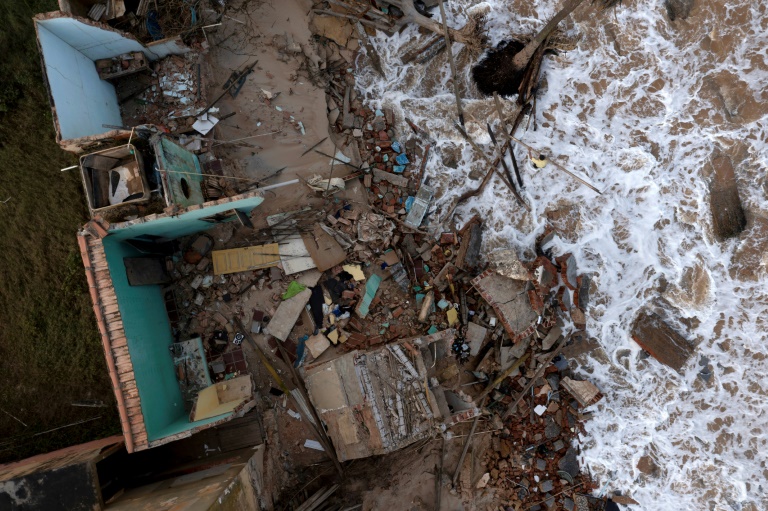
Vultures roam the sand in the Brazilian resort town of Atafona amid the ruins of the latest houses destroyed by the sea, whose relentless rise has turned the local coastline into an apocalyptic landscape.

The Atlantic Ocean advances an average of six meters (nearly 20 feet) a year in this small town north of Rio de Janeiro, which has long been prone to extreme erosion — now exacerbated by climate change.

The sea has already submerged more than 500 houses, turning the once idyllic coastline into an underwater graveyard of wrecked structures.

One of the next to lose his home will be Joao Waked Peixoto.

Walking through the jumbled rubble of what was once his neighbors’ house, he looks at what is left: a fragment of a blue-painted room strewn with tattered magazines, a bicycle and other remnants of life.

“When will we have to leave? That’s an unknown,” he says.

“The sea advanced three or four meters in 15 days. Our wall might not last until next week.”

Waked Peixoto’s grandfather built the house as a vacation home, a beachfront getaway with large rooms and a garden.

During the coronavirus pandemic, Waked Peixoto and his family moved in full-time.

But it now looks inevitable the house will be swallowed by the sea.

“It will be a shame to lose this house, because it holds so many memories of my whole family,” he says.

– Extreme erosion –

Atafona, a town of some 6,000 people, has long suffered from extreme erosion. It is part of the four percent of coastlines worldwide that lose five meters or more every year.

The problem is being exacerbated by global warming, which is causing sea levels to rise and making currents and weather patterns more extreme, says geologist Eduardo Bulhoes of Fluminense Federal University.

But Atafona has had a “chronic problem” for decades, he says.

The Paraiba do Sul river, whose mouth is in Atafona, has shrunk because of mining, agriculture and other activities that drain it upstream.

“In the last 40 years, that has drastically reduced the river’s volume, meaning it transports less sand to Atafona,” says Bulhoes.

With less sand, the town’s beaches have stopped regenerating naturally, ceding ground to the sea.

Construction on the coast has only made the problem worse, by stripping away sand dunes and vegetation, the beaches’ natural defenses.

The result has been disastrous for the tourism and fishing industries.

“Large boats can’t come through the river delta anymore… and the money disappeared along with them,” says Elialdo Bastos Meirelles, head of a local fishermen’s community of some 600 people.

“The river is dead.”

– ‘Abandoned’ –

Local authorities have studied several plans to curb the erosion, including building dikes to reduce the force of the ocean’s waves and hauling sand from the river delta to the beach.

Bulhoes, the geologist, proposed the latter, which is modeled on similar initiatives in the Netherlands, Spain and the United States.

But the projects exist only on paper so far.

The county under-secretary for the environment, Alex Ramos, told AFP no one had yet come up with a definitive solution, and that any plan would have to gain environmental regulators’ approval first.

In the meantime, the county has launched a social assistance program that pays 1,200 reais ($230) a month to more than 40 families who lost their homes to erosion.

But critics accuse the local government of a lack of political will.

“We keep hearing promises,” says Veronica Vieira, head of neighborhood association SOS Atafona.

“But this town has been abandoned. It’s an apocalypse. It makes you want to cry.”

'Hold the line': Canada truckers dig in despite new police powers

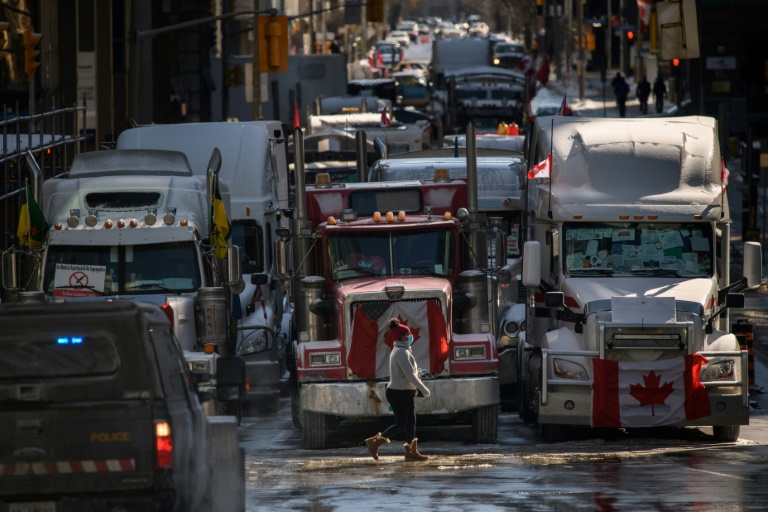
Trucker-led protesters occupying the Canadian capital showed no sign of backing down Tuesday, despite a newly invoked state of emergency granting wide new powers to end their weeks-long protest over Covid rules.

A day after Prime Minister Justin Trudeau invoked the Emergencies Act, the truckers appeared undeterred — if anything hardening their stance to move their big rigs into positions tougher to dislodge, with signs that read: “Hold the line.”

“Truckers are not going anywhere,” said one protester who gave his name only as Tyler, sitting at the wheel of his truck parked outside parliament.

Trudeau’s move marks only the second time in Canadian history such emergency powers have been invoked in peacetime.

Authorities have until now proven unable to end the trucker movement, which has paralyzed the Canadian capital Ottawa for more than two weeks, snarling border trade with the United States and spawning copycat protests abroad.

Facing intense criticism over the failure to dislodge the protesters, Ottawa police chief Peter Sloly abruptly resigned on Tuesday.

Sloly had said repeatedly that he lacked the resources to remove the demonstrators safely, but in a parting statement said authorities were “now better positioned to end this occupation.”

The so-called “Freedom Convoy” started with truckers protesting against mandatory Covid vaccines to cross the US border, but its demands have since grown to include an end to all pandemic health rules and, for many, a wider anti-establishment agenda.

In the latest move to soften the tough restrictions, federal officials announced Tuesday an easing of Covid-19 checks and rules for vaccinated travelers arriving at its borders, including no longer requiring PCR tests.

“These changes are possible not only because we have passed the peak of Omicron,” Health Minister Jean-Yves Duclos said, but because Canadians are following public health guidance “to protect themselves, their families and their communities.”

Quebec, meanwhile, joined several other provinces in announcing it would no longer require proof of Covid jabs to shop, dine in restaurants and for other indoor activities, starting next month — noting a drop in hospitalizations.

– ‘Overthrow the government’ –

At a news conference, Public Safety Minister Marco Mendicino noted “significant progress” in bringing an end to border crossing demonstrations that he said were carried out by “a very small organized group that is driven by an ideology to overthrow the government.”

Police over the weekend cleared demonstrators from the Ambassador Bridge connecting Windsor, Ontario and Detroit in the US state of Michigan — arresting 46 people and seizing 37 vehicles.

And on Tuesday, protesters departed a border checkpoint in Alberta, while a crossing in Manitoba was expected to reopen Wednesday, according to federal police.

A day earlier, police had swooped in and arrested about a dozen protesters with rifles, handguns, body armor and ammunition at the border between Coutts, Alberta and Sweet Grass, Montana.

“The group was said to have a willingness to use force against the police if any attempts were made to disrupt the blockade,” the Royal Canadian Mounted Police had said in a statement.

Mendicino said the arrests in Coutts “should be a cautionary tale about what it is that we are precisely dealing with here.”

– Pushback to measures –

The Emergencies Act, formerly known as the War Measures Act, was previously used by Trudeau’s father, former prime minister Pierre Trudeau, during the October Crisis of 1970.

It saw troops sent to Quebec to restore order after the kidnappings by militant separatists of a British trade attache and a Quebec minister, Pierre Laporte, who was found strangled to death in the trunk of a car.

Justin Trudeau said the military would not be deployed at this time.

Rather, said officials, the law would be used to strengthen police powers to arrest protesters, seize their trucks and freeze their bank accounts, and even compel tow truck companies to help clear blockades.

Cryptocurrency exchanges and crowdfunding sites — used by the truckers to raise millions of dollars in Canada and the United States — must also now report large and suspicious transactions to a money laundering and terrorism financing watchdog.

Justice Minister David Lametti told reporters Tuesday, “We’re trying to break the financing, particularly foreign financing” of the convoy and its use of “heavy rigs to disrupt the Canadian economy and put people in a state of insecurity.”

Several provincial premiers denounced the use of the emergency measures, while the Canadian Civil Liberties Association accused Ottawa of not having met the threshold for invoking the act.

Trudeau’s minority Liberal government, however, has enough support to push through approval of the measures when parliament weighs in to decide whether to extend their use beyond one week.

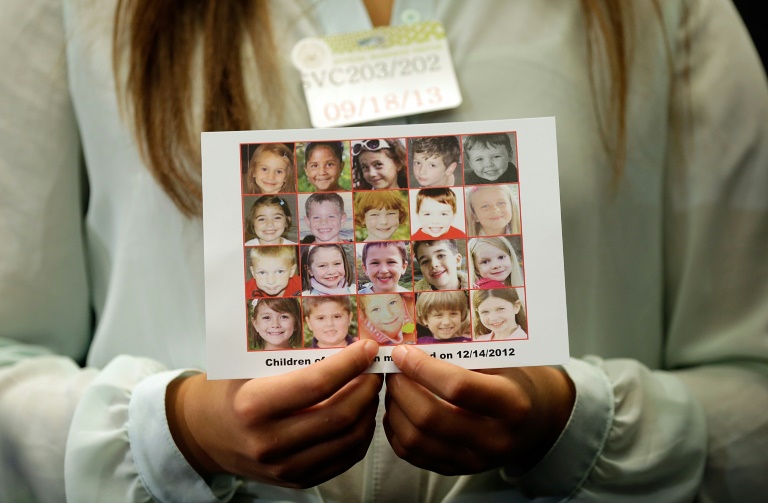
Sandy Hook families settle with gunmaker for $73 mn over school massacre

Families of nine victims of the Sandy Hook school shooting have reached a $73 million settlement with US gunmaker Remington, in a landmark deal for a country traumatized by campus massacres.

Lawyers for the plaintiffs said the settlement marks the first time a gun maker has been held liable for a mass shooting in the United States.

Twenty-six children and teachers were shot dead in 2012 at the elementary school in Newtown, Connecticut by Adam Lanza, a 20-year-old with known developmental disabilities.

The killings — the second-deadliest school massacre in US history — stunned Americans, with many thinking they would mark a watershed moment that would lead lawmakers to tighten gun control.

A “settlement agreement has been executed between the parties,” a notice from lawyers for the families said Tuesday.

Calling the move “historic,” US President Joe Biden said it begins “the necessary work of holding gun manufacturers accountable.”

Manufacturers and dealers must either change their business models or “bear the financial cost of their complicity,” he said in a statement.

Lanza’s mother, a gun enthusiast, had bought him an AR-15-style Bushmaster XM15-E2S semi-automatic rifle more than two years before the shooting. 

Lanza murdered his mother before attacking the school, and killed himself afterward.

The lawsuit alleged that Remington and the other two defendants are culpable because they knowingly marketed a military grade weapon that is “grossly unsuited” for civilian use yet had become the gun most used in mass shootings.

An AR-15 was also used to kill 58 people at a mass shooting in Las Vegas in 2017, and 17 at a school in Parkland, Florida in 2018. 

Remington, the oldest gunmaker in the United States and which has since filed for bankruptcy, had denied the allegations.

The plaintiffs alleged that the gun was marketed immorally and unscrupulously and sold on its war-fighting capabilities to civilians.

Marketing, they charged, popularized the AR-15 in combat and mass shooting-type situations through the type of violent video games that Lanza was known to play.

They specifically cited Remington’s marketing of high-capacity magazines, which have only combat utility, for use with the gun.

The gun “was used not by a highly trained soldier but by a deeply troubled kid, not on a battlefield abroad but in an elementary school at home, and not to preserve freedom, but to eviscerate them,” Joshua Koskoff, a lawyer for the Sandy Hook families, told a press conference Tuesday.

Christopher Boehning, another lawyer for the plaintiffs, told AFP the settlement “sends a strong warning signal to other gun manufacturers regarding their role in these unthinkable tragedies.”

AFP has sought comment from Remington.

– Popular in mass shootings –

The United States leads the world in mass shootings by civilians, with many schools undergoing live shooter drills as a matter of routine.

But the grief and trauma of Lanza’s rampage was underscored by the youth of his victims. He killed 20 six- and seven-year-olds along with six staff members.

Nearly four years later, the shooting was still so visceral that it moved then-president Barack Obama to tears during a speech on gun control. 

Hopes that revulsion ignited by the massacre would finally prompt Congress to follow through on wildly popular demands for greater restrictions on weapons, however, fell flat.

Instead, the powerful gun lobby has repeatedly stamped out any efforts to further change the famed Second Amendment to the country’s constitution, which allows for the right to bear arms.

But the settlement deal between the Sandy Hook families and Remington could help pave the way for further accountability in such massacres.

The US Congress passed a law in 2005 that explicitly immunized gunmakers when their products are used in crimes.

But the Connecticut Supreme Court said that Remington could still be sued on the grounds that its marketing violated Connecticut’s unfair trade practice laws.

“The gun manufacturers knew that they were advertising a dangerous product and they exploited these dangers,” Matthew Soto, brother of first grade teacher Vicki Soto, who was among the victims, said at Tuesday’s press conference.

Nicole Hockley, the mother of victim Dylan, six, told the press conference that her family had moved from Britain “because of our belief in the American dream.”

But that “turned into the American nightmare, where for too many the right to bear arms is a higher priority than the right to life.”

Close Bitnami banner
Bitnami