World

Indonesia adds Google Pixel phones to ban list with iPhone 16

Indonesia has banned the sale of Google Pixel phones over the tech giant’s failure to meet investment regulations, its industry ministry said, days after blocking sales of Apple’s iPhone 16.Jakarta is seeking to boost investment from foreign tech companies with restrictive measures that require their phones to be 40 percent sourced from parts in Indonesia.”We …

Indonesia adds Google Pixel phones to ban list with iPhone 16 Read More »

India’s capital chokes in smog after firework ban flouted

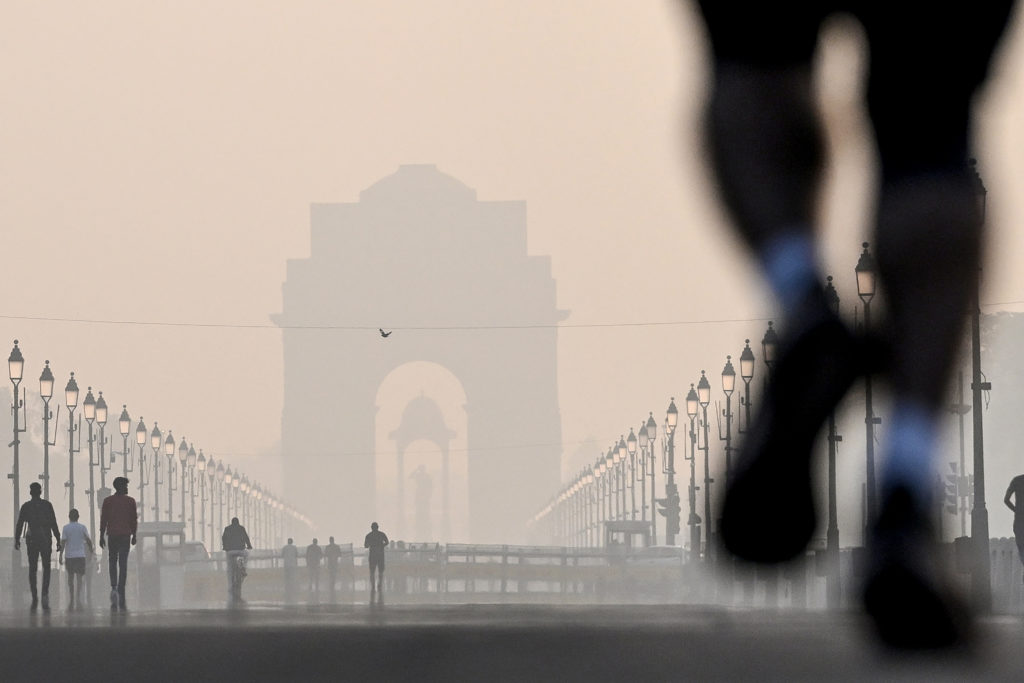
India’s capital New Delhi was wreathed in poisonous smog Friday, with air pollution worsening after a fireworks ban was widely flouted for raucous celebrations for the Hindu festival of lights, Diwali.New Delhi’s traffic-clogged streets are home to more than 30 million people, and the city is regularly ranked as one of the most polluted urban …

India’s capital chokes in smog after firework ban flouted Read More »

Climate shifts and urbanisation drive Nepal dengue surge

Nepal is fighting a surge in dengue cases, a potentially deadly disease once unheard of in the country’s high-altitude Himalayan regions, as climate change and urbanisation nurture fever-bringing mosquitoes in new zones.Only a single case of dengue was recorded in Nepal in 2004. Two decades later, thousands of cases are being reported across the country.Once …

Climate shifts and urbanisation drive Nepal dengue surge Read More »

‘Waiting in vain’: year on from pledge, world clings to fossil fuels

One year after world leaders issued the landmark call for a global move away from fossil fuels, nations are failing to turn that promise into action, say climate diplomats, campaigners and policy experts.Countries are being urged not to lose sight of that historic agreement ahead of November’s COP29 climate negotiations, where fossil fuels are not …

‘Waiting in vain’: year on from pledge, world clings to fossil fuels Read More »

Stock markets fall, yen rallies after BoJ policy move

Markets fell Tuesday and the yen rallied after Japan announced a surprise tweak to its ultra-loose monetary policy, just as traders were fretting that central bank efforts to tame inflation will tip economies into recession.

Sentiment was also being weighed down by a spike in Covid infections in China as officials roll back many of the strict containment measures that have been in place for almost three years.

A so-called Santa rally appears to be eluding investors, with the mood dampened by last week’s warnings from the Federal Reserve and European Central Bank that they will likely push interest rates higher than expected next year.

The remarks dealt a blow to a short rally across equities that had been fuelled by data showing inflation coming down.

Adding to the selling pressure were comments from former New York Fed chief William Dudley, who told Bloomberg Television that any sign of optimism in markets could make monetary policymakers tighten even more.

Tokyo sank more than two percent after the Bank of Japan adjusted its parameters for controlling bond yields, in a shift away from its long-running dovish stance of keeping rates ultra-low to boost the struggling economy.

Inflation in Japan has risen sharply this year, with the consumer price index in October at 3.6 percent, the highest in four decades, though bank boss Haruhiko Kuroda and other officials have said that would be temporary, citing a lack of strong demand and wage rises.

The move sent the yen to 132.30 per dollar, its strongest level since August.

The Japanese unit has been hobbled this year by the BoJ’s determination to stick to its loose monetary policy — hitting a 32-year low of around 150 to the dollar in October — even as the Fed ramped up borrowing costs. 

– No Santa rally –

“This was bound to happen with inflation rising in Japan, it’s just happened sooner than many thought,” Amir Anvarzadeh, of Asymmetric Advisors, said. “It could spark money flowing back into Japan.”

Hong Kong, Shanghai, Sydney, Seoul, Singapore, Wellington, Taipei, Mumbai, Jakarta and Bangkok were also in the red.

London, Paris and Frankfurt all sank at the open.

“Those who were in the camp of a year-end rally are now second-guessing their investment thesis,” said JC O’Hara of MKM Partners.

“The markets may have placed a little too much faith in Santa Claus and the rally he typically brings.”

With few catalysts to drive trade, investors are winding down for the Christmas break, though they are keeping a close eye on developments in China, which is suffering a sharp jump in Covid cases.

Officials in recent weeks have started to move away from their rigid zero-Covid policy of lockdowns and mass testing following widespread protests.

And while the shift has been welcomed as a much-needed boost to the world’s number-two economy, there is growing anxiety about the immediate impact on businesses and the healthcare system.

“A massive China reopening bounce is giving way to a reality check as investors come to grips with numerous zero-Covid offramp economic and medical issues that China is simply unprepared to handle,” said SPI Asset Management’s Stephen Innes.

“Especially if the predicted 10 million-plus daily Covid cases hit the healthcare system later this month.”

Still, the expected pick-up in demand from the China reopening continues to support commodity prices, with both main oil contracts up more than one percent, extending Monday’s gains.

The impact of Covid and weaknesses in the country’s vast property sector led the World Bank on Tuesday to slash its China growth forecasts to 2.7 percent this year, from 4.3 percent predicted in June. It also revised its forecast for next year from 8.1 percent down to 4.3 percent. 

– Key figures around 0820 GMT –

Tokyo – Nikkei 225: DOWN 2.5 percent at 26,568.03 (close)

Hong Kong – Hang Seng Index: DOWN 1.3 percent at 19,094.80 (close)

Shanghai – Composite: DOWN 1.1 percent at 3,073.77 (close)

London – FTSE 100: DOWN 0.7 percent at 7,312.94

Dollar/yen: DOWN at 132.39 yen from 136.95 yen on Monday

Euro/dollar: UP at $1.0623 from $1.0610 

Pound/dollar: DOWN at $1.2146 from $1.2148

Euro/pound: DOWN at 87.44 pence from 87.31 pence

West Texas Intermediate: DOWN 0.2 percent at $75.07 per barrel

Brent North Sea crude: DOWN 0.3 percent at $79.58 per barrel

New York – Dow: DOWN 0.5 percent at 32,757.54 (close)

Japan central bank tweaks monetary policy, yen strengthens

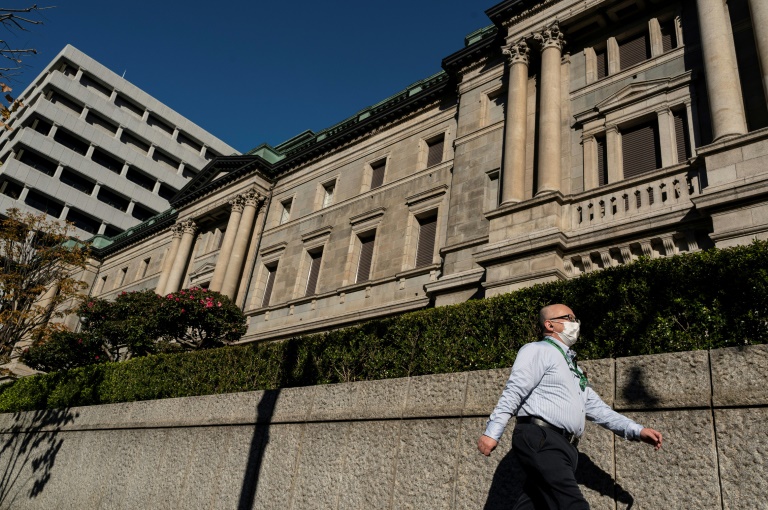
Japan’s central bank tweaked its longstanding monetary easing programme on Tuesday, in a surprise move that saw the yen strengthen quickly against the dollar and prompted falls on Tokyo bourses.

The change marks a rare shift of gears for the dovish central bank, which has largely left its policy intact even as counterparts in other major economies hike rates to tackle inflation.

After a two-day policy meeting, the bank said it would widen the band in which it would allow rates for 10-year Japan government bonds to move, saying it would “improve market functioning”.

“The Bank will expand the range of 10-year JGB yield fluctuations from the target level: from between around plus and minus 0.25 percentage points to between around plus and minus 0.5 percentage points,” it said in a statement.

The move saw the yen strengthen rapidly against the dollar, with the greenback falling from a daily high of 137 yen to 133 yen within minutes of the decision.

The announcement came during the morning break in Tokyo trade, but the key Nikkei 225 index plunged as it reopened, falling as much as three percent before recovering slightly.

Few had anticipated the shift, with all 47 of the economists surveyed by Bloomberg ahead of the decision saying they expected no change in policy.

The bank left the rest of its longstanding loose monetary programme intact, including its years-old inflation target of two percent.

Governor Haruhiko Kuroda, whose term ends next spring, has for years struggled to steer the world’s third largest economy towards sustained two percent inflation, seen as necessary for growth.

Prices in Japan have risen sharply this year, with the consumer price index in October at 3.6 percent, the highest in four decades.

But Kuroda and the central bank consider the increases temporary, citing a lack of strong demand and wage rises.

Speaking to reporters on Tuesday afternoon, Kuroda insisted the shift “is not the first step of an exit strategy”.

“Once the price stability target draws closer, the monetary policy board will discuss strategies toward the exit and will make information public accordingly,” he said.

– ‘A sense of policy flexibility’ –

Still, the BoJ has come under pressure to move away from its ultra-loose policy as central banks in other major economies hike interest rates to tackle inflation.

The resulting differential has seen the yen nosedive about 20 percent against the dollar this year.

Hideo Kumano, chief economist at Dai-ichi Life Group, said the decision showed the bank recognised its existing policy was no longer tenable.

“It has been unrealistic to try to cap the long-term yield with the fixed-rate bond-buying operations at 0.25 percent,” he told AFP.

“It seems to me that the bank wanted to create a little bit of a sense of policy flexibility or room for policy choices and pass the baton to the next governor,” he added.

Kuroda’s term ends in April, and over the weekend reports suggested Japan’s government could work with his successor to move away from the longstanding two-percent price target.

The bank’s decision Tuesday sent shockwaves through Asian markets, with stocks falling on regional bourses as investors digested the news.

“In reality, the long-term rate will become 0.5 percent. It will reduce the rate gap between Japan and the US,” said Kumano.

But Kuroda was at pains to insist “this is not a rate hike”.

Saisuke Sakai, chief economist of Mizuho Research & Technologies, said the move would help address the weaker yen caused by the growing gulf between US and Japanese central bank policy.

But “unlike rate hikes by the Fed and European central banks aimed at cooling down overheated economies… this is aimed chiefly at stabilising market function,” he told AFP.

“Japan’s economy has not recovered to the pre-pandemic level yet, in contrast to the US economy,” he noted.

Kim's sister defends North Korea's spy satellite capabilities

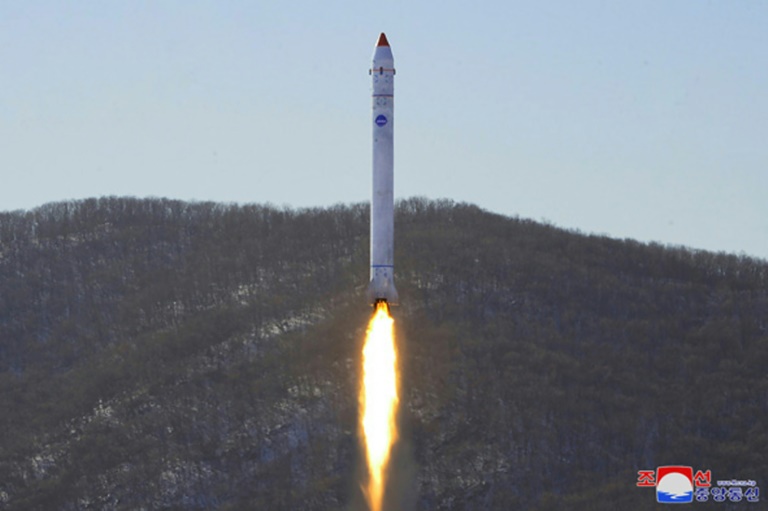
North Korea has developed advanced technologies to take images from space using a spy satellite, the powerful sister of leader Kim Jong Un insisted Tuesday, after experts mocked black-and-white pictures supposedly taken from space in a weekend launch.

Kim Yo Jong’s defence of North Korea’s satellite capabilities comes after the isolated country said it conducted an “important final-stage” test for the development of a reconnaissance satellite.

But experts in Seoul quickly raised doubts, saying the quality of the photos — presumably taken from the satellite — was too poor. 

In a lengthy, vitriolic statement carried by the official Korean Central News Agency, Kim said it was “too inappropriate and careless” to evaluate Pyongyang’s satellite development progress and capability based on the two images.

She insisted a camera installed on the satellite had the “reliability of ground control including attitude control and shooting control command in a suitable space flight environment”. 

Kim also said the satellite’s data transmission devices and encryption processing technology were reliable. 

“We carried out a necessary test and reported the significant and satisfying result, which was not lacking,” she said. 

The development of a military reconnaissance satellite was one of Pyongyang’s key defence projects outlined by her elder brother Kim Jong Un last year.

North Korea is under biting international sanctions for its nuclear weapons programmes, but peaceful satellite launches are not subject to the same level of restrictions.

But analysts say developing such a satellite would provide North Korea with cover for testing banned intercontinental ballistic missiles (ICBM), as they share much of the same technology.

Earlier this year, Pyongyang carried out two launches, claiming it was testing components for a reconnaissance satellite, which the United States and South Korea said likely involved components of its new Hwasong-17 intercontinental ballistic missile (ICBMs). 

The younger Kim rebuked claims that the North’s satellite launches were thinly disguised firings of banned ICBMs. 

“If we develop ICBMs, we will fire ICBMs, and not test long-range rockets disguised as satellites,” she said.

Kim also dismissed analysts doubting that the North has the advanced technology needed for the rocket to survive re-entry into the Earth’s atmosphere, saying she would explain it in “an easy-to-understand manner” to their naysayers. 

“If the atmospheric re-entry technology was insufficient, it would not be possible to receive remote data from the pilot combat unit until the moment of impact,” she said.

– Air drill –

The weekend’s launch comes after a year of unprecedented weapons tests by North Korea, including the launch of its most advanced intercontinental ballistic missile the month before.

The United States and South Korea have warned for months that Pyongyang is preparing to conduct its seventh nuclear test.

The two countries held a joint air drill on Tuesday, and deployed a US B-52H strategic bomber to the Korean peninsula, the South Korean Joint Chiefs of Staff said in a statement.

The long-range heavy bomber was part of an exercise that included the US and South Korea’s most advanced jets — including the F-22 and the F-35 stealth fighters. 

Experts say North Korea is particularly sensitive about US-South Korean joint air drills, as its air force is one of the weakest links in its military, lacking high-tech jets and properly trained pilots. 

Close Bitnami banner
Bitnami