World

As protests wane, family of Peru's ousted leader offered asylum in Mexico

Mexico has offered asylum to the graft-accused family of Peru’s ex-president Pedro Castillo, his successor announced, as protests prompted by the leftist leader’s ouster appeared to be waning.

Embattled Castillo was abruptly removed from power and arrested this month after seeking to dissolve Congress and rule by decree.

His ouster drew criticism from leftist Latin American allies including Mexico, as well as from thousands of supporters who took to the streets to demand his release.

On Sunday, Dina Boluarte who took Castillo’s place, said Mexico had offered to take in her predecessor’s wife and children. 

“A few days ago, the foreign minister (of Peru, Ana Cecilia Gervasi) informed me that the Mexican state had given political asylum” to Castillo’s family, Boluarte told the Panorama TV program.

Boluarte, who was Castillo’s vice president until his ouster, did not specify whether the family members — Castillo’s wife, two children and sister-in-law — have left the country.

Castillo’s wife, Lilia Paredes, stands accused by prosecutors of criminal conspiracy and money laundering as part of an alleged graft network headed by her husband.

The “criminal organization” Castillo stands accused of running is alleged to have handed out public contracts in exchange for kickbacks.

Paredes’ sister Yenifer is also accused in the alleged plot.

– Tourists stuck –

Castillo, a rural former school teacher and union leader, unexpectedly took power from Peru’s traditional political elite in elections last year.

He immediately came under fire from his political rivals and soon also found himself in the cross-hairs of prosecutors investigating graft claims.

His term saw three prime ministers and seven interior ministers come and go in just over a year.

Opinion polls have shown massive public disapproval of Castillo’s management of the country, but thousands nevertheless spilled into the streets when he was ousted by the very Congress he had sought to dissolve, and then arrested.

A subsequent security clampdown, which has seen the deployment of armed soldiers amid a state of emergency, has left 20 protesters dead.

Castillo is being held in pre-trial detention on charges of rebellion and conspiracy. 

Mexico’s President Andres Manuel Lopez Obrador and the fellow leftist leaders of Bolivia, Argentina and Colombia have all expressed support for Castillo.

Demonstrations in recent weeks — which have included roadblocks and airport disruptions — called for Boluarte’s resignation and for elections scheduled for 2026 to be brought forward to next year.

Operations at the airport of Arequipa, Peru’s second busiest, resumed Monday after a week of closure due to protests that saw the runway obstructed with stones, sticks and burning tires.

The airport disruption stranded hundreds of tourists, including at the Inca citadel of Machu Picchu.

On Monday, neighbor Chile said a chartered plane would evacuate tourists from Cusco, near the World Heritage Site, to Lima.

burs/mlr/tjj

Dutch PM apologises for 250 years of slavery

Dutch Prime Minister Mark Rutte on Monday officially apologised for 250 years of the Netherlands’ involvement in slavery, calling it a “crime against humanity”.

The apology comes almost 150 years after the end of slavery in the European country’s overseas colonies, which included Suriname and islands like Curacao and Aruba in the Caribbean and Indonesia in the East.

In the first of the former Dutch colonies to react, Aruba’s Prime Minister Evelyn Wever-Croes accepted the apology, but others like the island of Sint Maarten said it would not.

“Today on behalf of the Dutch government, I apologise for the past actions of the Dutch state,” Rutte said in a speech, repeating the apology in English, Papiamento and Sranan Tongo, languages spoken on the Caribbean islands and in Suriname.

“The Dutch State of the Netherlands… bears responsibility for the great suffering inflicted on enslaved people and their descendants,” Rutte told an audience at the National Archives in The Hague.

“We, living in the here and now, can only recognise and condemn slavery in the clearest terms as a crime against humanity,” he added.

Dutch ministers have travelled to seven former colonies in South America and the Caribbean for the event.

Dutch Deputy Prime Minister Sigrid Kaag said on an official visit to Suriname last week that a “process” would begin leading up to “another incredibly important moment on July 1 next year”.

Descendants of Dutch slavery will then celebrate 150 years of liberation from slavery in an annual celebration called “Keti Koti” (Breaking the Chains) in Suriname.

But the plan has caused controversy, with groups and some of the affected countries criticising the move as rushed, and saying the lack of consultation by the Netherlands smacked of a colonial attitude.

Some are also demanding compensation.

Rutte in his speech on Monday said that choosing the right moment was a “complicated matter”. 

“There is not one right time for everyone, not one right word for everyone, not one right place for everyone,” he said.

– ‘Golden’ Age? –

The Dutch funded their “Golden Age” of empire and culture in the 16th and 17th centuries by shipping around 600,000 Africans as part of the slave trade, mostly to South America and the Caribbean.

At the height of its colonial empire, the United Provinces known today as the Netherlands possessed colonies like Suriname, the Caribbean island of Curacao, South Africa and Indonesia, where the Dutch East India Company was based in the 17th century.

In recent years, the Netherlands has been grappling with the fact that its Rembrandt and Vermeer-filled museums and historic towns were largely built on the back of that brutality.

Spurred by the Black Lives Matter movement in the United States, it has also raised questions about racism in Dutch society.

Pressure has been growing at home with the cities of Amsterdam, Rotterdam, The Hague and Utrecht formally apologising for the slave trade.

Rutte had long resisted, previously saying the period of slavery was too far back and that an apology would ignite tensions in a country where the far right remains strong.

He has now changed tack, but that has not pleased everyone.

– ‘A first step’ –

Sint Maarten’s Prime Minister Silveria Jacobs told Dutch media on Saturday the island would not accept a Dutch apology if made on Monday.

“Let me be clear that we won’t accept an apology until our advisory committee has discussed it and we as a country discussed it,” she said.

But on Aruba, Wever-Croes told the ANP news agency the island accepted the apology, but stressed “it is a first step.”

On Monday, Dutch cabinet ministers would be in Suriname, Bonaire, Sint Maarten, Aruba, Curacao, Saba and St. Eustatius to “discuss the cabinet response and its significance on location with those present” after the Rutte speech, the government said.

Slavery was formally abolished in Suriname and other Dutch-held lands on July 1, 1863, but the practice only really ended in 1873 after a 10-year “transition” period.

Slavery commemoration groups say any apology should come on the 150th anniversary of that date, in 2023, instead of the “arbitrary” date of December 19 this year.

En garde! Wasps use penis spikes to ward off predators

An accidental sting has helped Japanese scientists prove some male wasps have a rather unusual predator defence weapon: penis spikes.

While wasps are known for their prickly attacks, only females have a real sting in their tails. Their male counterparts generally evade predators by mimicking the fairer sex.

Scientists had theorised that some male wasps might have other defence mechanisms, including perhaps deploying their genital spikes.

“However, the evidence was lacking,” explained Shinji Sugiura, an ecologist at Japan’s Kobe University.

Sugiura studies animal anti-predator defences but it was only by chance that he investigated the unusual male wasp mechanism, after his graduate student and co-author reported being stung by a mason wasp.

“I tried to be stung after hearing her experience,” Sugiura told AFP.

“Because I had believed male wasps as harmless, I was very surprised to experience the pain.”

Female wasps sting via an ovipositor, a tube-like protrusion that deposits eggs but can also deliver a venomous riposte.

Male wasps lack the organ but are equipped with two large spikes that sit either side of their penis.

To test the effectiveness of this defence, Sugiura’s team offered up male mason wasps to two different kinds of frogs to see how the spikes were deployed.

“Male wasps were frequently observed to pierce the mouth or other parts of frogs with their genitalia while being attacked,” Sugiura reported in research published Tuesday in the Current Biology journal.

The attacks are documented in a video that shows an unfortunate frog trying repeatedly to chomp down on a wasp, before using its front feet to pull the stinging insect out of its mouth.

Pond frogs happily ate all the males, as well as stinging females, but over a third of tree frogs rejected the male wasps after being stung.

When the experiment was repeated with the genital spikes removed from the wasps, the tree frogs no longer held back and ate them without hesitation.

“The difference was statistically significant. Even a small difference of survival could cause the evolution of anti-predator devices in insects,” Sugiura said.

There has been little research on insect genitalia outside of its role in reproduction, according to Sugiura, though the wasp defence mechanism is not entirely without precedent.

Previous research has found, for example, that some species of hawkmoth use their genitalia to emit ultrasound that jams bat sonar.

Sugiura is no stranger to uncovering some of the weirdest ways animals evade their predators.

He has documented how some beetles can escape after being swallowed, by following the digestive tract to its logical conclusion and escaping from the anus.

And he has shown that other insects can make any unfortunate toad that has eaten them vomit them back up.

He now hopes to expand his current research to determine whether other wasp families have the same genital spike defence mechanism.

Global 'peace pact' signed to protect nature

Countries reached a historic deal on Monday to reverse decades of environmental destruction threatening the world’s species and ecosystems, in what the UN chief hailed as “a peace pact with nature.”

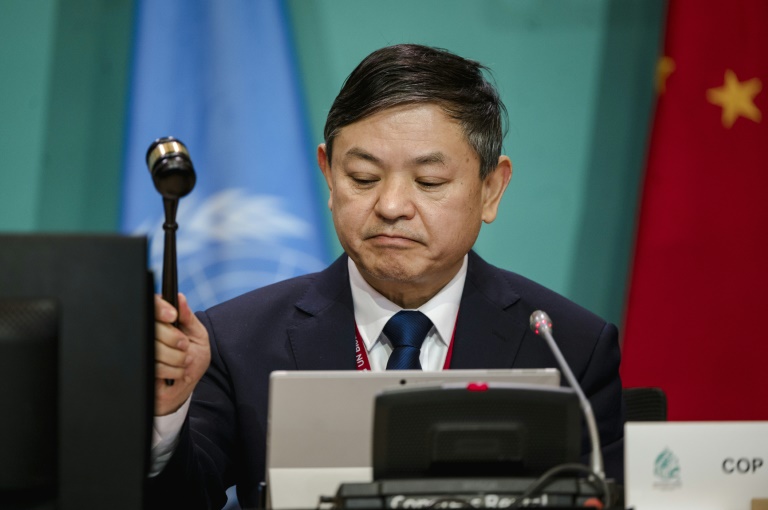
After the marathon COP 15 biodiversity summit in Montreal ran into the small hours, chair Chinese Environment Minister Huang Runqiu, declared the deal adopted and banged his gavel, sparking loud applause.

“We are finally starting to forge a peace pact with nature,” UN Secretary-General Antonio Guterres said, hailing the accord.

EU chief Ursula von der Leyen said the deal was a “foundation for global action on biodiversity, complementing the Paris Agreement for Climate.”

After four years of fraught negotiations, more than 190 other states rallied behind the Chinese-brokered accord aimed at saving Earth’s lands, oceans and species from pollution, degradation and the climate crisis.

“We have in our hands a package which I think can guide us all to work together to hold and reverse biodiversity loss, to put biodiversity on the path of recovery for the benefit of all people in the world,” Huang told the assembly.

He overruled an objection from the Democratic Republic of Congo, which had refused to back the text, demanding greater funding for developing countries.

– Biggest conservation deal ever –

The deal pledges to secure 30 percent of the planet as a protected zone by 2030, stump up $30 billion in yearly conservation aid for the developing world and halt human-caused extinctions of threatened species.

Environmentalists have compared it to the landmark plan to limit global warming to 1.5C under the Paris agreement, though some warned that it did not go far enough.

Brian O’Donnell of the Campaign for Nature called it “the largest land and ocean conservation commitment in history.”

“The international community has come together for a landmark global biodiversity agreement that provides some hope that the crisis facing nature is starting to get the attention it deserves,” he said.

“Moose, sea turtles, parrots, rhinos, rare ferns and ancient trees, butterflies, rays, and dolphins are among the million species that will see a significantly improved outlook for their survival and abundance if this agreement is implemented effectively.”

The CEO of campaign group Avaaz, Bert Wander, cautioned: “It’s a significant step forward in the fight to protect life on Earth, but on its own it won’t be enough. Governments should listen to what science is saying and rapidly scale up ambition to protect half the Earth by 2030.”

– Indigenous rights –

The text pledges to safeguard the rights of Indigenous people as stewards of their lands, a key demand of campaigners.

But observers noted it pulled punches in other areas — for example, only encouraging businesses to report their biodiversity impacts rather than mandating them to do so.

The 23 targets in the accord also include saving hundreds of billions of dollars by cutting environmentally destructive farming subsidies, reducing the risk from pesticides and tackling invasive species.

– Funding fight –

At times, the talks looked at risk of collapsing as countries squabbled over money.

How much the rich countries will send to the developing world, home to most of the planet’s biodiversity, was the biggest sticking point.

Developing countries had been seeking the creation of a new, bigger fund for aid from the Global North. But the draft text instead suggested a compromise: creating a fund under the existing Global Environment Facility (GEF).

That concern was echoed by the Democratic Republic of Congo, home to the Congo Basin, a rich haven of biodiversity.

Current financial flows for nature to the developing world are estimated at around $10 billion per year.

A DRC delegate spoke up in the plenary to demand annual funding rise to $100 billion — but Huang passed the accord, angering DRC’s allies.

The United States is not a signatory to the biodiversity convention due to resistance from Republican senators.

US President Joe Biden supports the deal and launched his own “30 by 30” plan domestically, while the United States pays into the GEF to assist developing countries.

Sweden blocks extradition of journalist sought by Erdogan

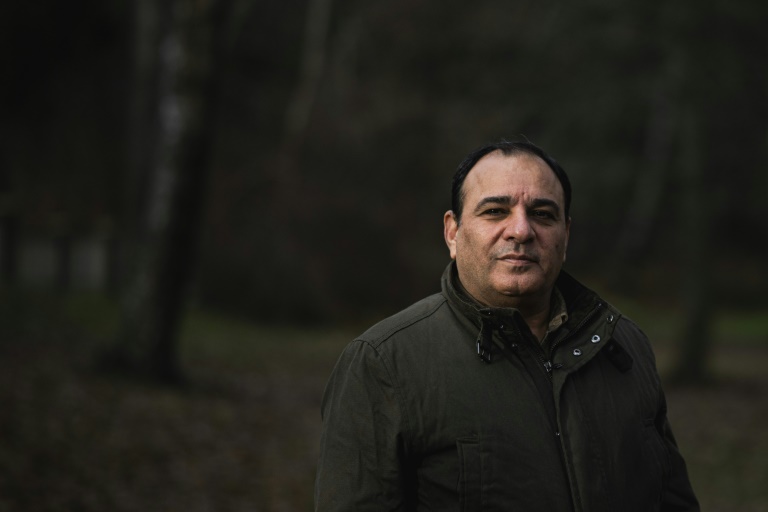
Sweden’s Supreme Court on Monday blocked the extradition of exiled Turkish journalist Bulent Kenes, a key demand by Ankara to ratify Stockholm’s NATO membership.

There were “several hindrances” to sending back the former editor-in-chief of the Zaman daily, who Turkey accuses of being involved in a 2016 attempt to topple President Recep Tayyip Erdogan, the court said.

Some of the accusations against Kenes are not crimes in Sweden, which along with the political nature of the case and his refugee status, made extradition impossible, the court added.

“There is also a risk of persecution based on this person’s political beliefs. An extradition can thusly not take place,” judge Petter Asp said in a statement.

As a result, “the government… is not able to grant the extradition request.”

Sweden’s foreign ministry’s press office underscored the point.

“If the Supreme Court declares that there are hindrances to an extradition in an individual case the government has to deny the extradition request,” the ministry said. 

“We can’t speculate on any potential effects on the NATO accession. Sweden’s government has to follow Swedish and international law in extradition affairs, which is also laid out in the trilateral agreement,” it added.

Kenes is the only person Erdogan has identified by name among dozens of people Ankara wants extradited in exchange for approving Sweden’s NATO membership.

Following decades — or in Sweden’s case centuries — of staying out of a military alliance, the two countries made the historic decision to apply to join NATO after Russia invaded Ukraine.

The bid needs unanimous approval from all NATO members.

Apart from Hungary, which is due to ratify Sweden’s and Finland’s membership in early 2023, Turkey is the only country to threaten to prevent the two countries from joining NATO.

Turkey, which has accused Sweden especially of providing a safe haven for outlawed Kurdish groups it deems “terrorists,” has held back on ratifying their NATO applications despite reaching an agreement with Sweden and Finland in June.

Ankara says it expects Stockholm in particular to take tougher action on several issues, including the extradition of criminals.

– Growing list –

Swedish Prime Minister Ulf Kristersson travelled to Turkey in November to meet Erdogan to discuss the issues.

When pressed about “terrorists” he wants extradited from Sweden during a joint press conference, Erdogan only named Kenes as one on the list.

Stockholm has repeatedly stressed that its judiciary is independent and has the final say in extraditions.

In early December, Sweden extradited to Turkey a convicted member of the outlawed Kurdistan Workers’ Party (PKK), who had fled to Sweden in 2015 but had his asylum request denied.

Kenes, who now works for the Stockholm Center for Freedom — an association founded by other Turkish dissidents in exile — told AFP Monday that he was “happy” but not surprised by the court’s opinion.

“It is not an unexpected decision. I have always repeated that I had 100 percent trust in the Swedish legal system and judicial system because Sweden has rule of law,” Kenes said, while stressing that the allegations against him were “fabricated by the Erdogan regime.”

He insisted he committed “neither political crime nor violent crime.

“I’m not a coup maker, I am not a terrorist,” he added.

“I am just a journalist. I am just a person doing his journalism in the framework of defending human rights,” Kenes said.

Ankara has over time increased the number of people it wants extradited: first 33, then 45, then 73, in unofficial lists published by media close to the Turkish government.

Speaking to AFP in November, Kenes said he believed he was singled out by Erdogan “because he has known me for decades” due to his long career as a journalist, and because it was the first name he came up with off the top of his head.

Planet spiralling into star may offer glimpse into Earth's end

For the first time astronomers have identified a planet that is spiralling towards a cataclysmic collision with its ageing sun, potentially offering a glimpse into how Earth could end one day.

In a new study published on Monday, a team of mostly US-based researchers said they hope the doomed exoplanet Kepler-1658b can help shed light on how worlds die as their stars get older.

Kepler-1658b, which is 2,600 light years from Earth, is known as a “hot Jupiter” planet.

While similar in size to Jupiter, the planet orbits its host star an eighth of the distance between our Sun and Mercury, making it far hotter than the gas giant in our own Solar System.

Kepler-1658b’s orbit around its host star takes less than three days — and it is getting shorter by around 131 milliseconds a year, according to the study published in The Astrophysical Journal Letters.

“If it continues spiralling towards its star at the observed rate, the planet will collide with its star in less than three million years,” said Shreyas Vissapragada, a postdoc at the Harvard–Smithsonian Center for Astrophysics and the study’s lead author.

“This is the first time we’ve observed direct evidence for a planet spiralling towards its evolved star,” he told AFP. 

An evolved star has entered the “subgiant” phase of the stellar life cycle, when it starts expanding and becoming brighter.

Kepler-1658b’s orbit is being shortened by the tides, in a similar process to how Earth’s oceans rise and fall every day.

This gravitational push-and-pull can work both ways — for example the Moon is very slowly spiralling away from Earth.

– Earth’s ‘ultimate adios’? –

So could Earth be heading towards a similar doom?

“Death-by-star is a fate thought to await many worlds and could be the Earth’s ultimate adios billions of years from now as our Sun grows older,” the Center for Astrophysics said in a statement.

Vissapragada said that “in five billion years or so, the Sun will evolve into a red giant star”. 

While the tidally-driven processes seen on Kepler-1658b “will drive the decay of the Earth’s orbit towards the Sun,” that effect could be counter-balanced by the Sun losing mass, he said.

“The ultimate fate of the Earth is somewhat unclear,” he added.

Kepler-1658b was the first exoplanet ever observed by the Kepler space telescope, which launched in 2009. However it took nearly a decade of work before the planet’s existence was confirmed in 2019, the Center for Astrophysics said.

Over 13 years, astronomers were able to observe the slow but steady change in the planet’s orbit as it crossed the face of its host star.

One “big surprise” was that the planet itself is quite bright, Vissapragada said. 

Previously it had been thought this was because it is a particularly reflective planet, he said. 

But now the researchers believe the planet itself is far hotter than anticipated, possibly due to the same forces that are driving it towards its star.

Planet spiralling into star may offer glimpse into Earth's end

For the first time astronomers have identified a planet that is spiralling towards a cataclysmic collision with its ageing sun, potentially offering a glimpse into how Earth could end one day.

In a new study published on Monday, a team of mostly US-based researchers said they hope the doomed exoplanet Kepler-1658b can help shed light on how worlds die as their stars get older.

Kepler-1658b, which is 2,600 light years from Earth, is known as a “hot Jupiter” planet.

While similar in size to Jupiter, the planet orbits its host star an eighth of the distance between our Sun and Mercury, making it far hotter than the gas giant in our own Solar System.

Kepler-1658b’s orbit around its host star takes less than three days — and it is getting shorter by around 131 milliseconds a year, according to the study published in The Astrophysical Journal Letters.

“If it continues spiralling towards its star at the observed rate, the planet will collide with its star in less than three million years,” said Shreyas Vissapragada, a postdoc at the Harvard–Smithsonian Center for Astrophysics and the study’s lead author.

“This is the first time we’ve observed direct evidence for a planet spiralling towards its evolved star,” he told AFP. 

An evolved star has entered the “subgiant” phase of the stellar life cycle, when it starts expanding and becoming brighter.

Kepler-1658b’s orbit is being shortened by the tides, in a similar process to how Earth’s oceans rise and fall every day.

This gravitational push-and-pull can work both ways — for example the Moon is very slowly spiralling away from Earth.

– Earth’s ‘ultimate adios’? –

So could Earth be heading towards a similar doom?

“Death-by-star is a fate thought to await many worlds and could be the Earth’s ultimate adios billions of years from now as our Sun grows older,” the Center for Astrophysics said in a statement.

Vissapragada said that “in five billion years or so, the Sun will evolve into a red giant star”. 

While the tidally-driven processes seen on Kepler-1658b “will drive the decay of the Earth’s orbit towards the Sun,” that effect could be counter-balanced by the Sun losing mass, he said.

“The ultimate fate of the Earth is somewhat unclear,” he added.

Kepler-1658b was the first exoplanet ever observed by the Kepler space telescope, which launched in 2009. However it took nearly a decade of work before the planet’s existence was confirmed in 2019, the Center for Astrophysics said.

Over 13 years, astronomers were able to observe the slow but steady change in the planet’s orbit as it crossed the face of its host star.

One “big surprise” was that the planet itself is quite bright, Vissapragada said. 

Previously it had been thought this was because it is a particularly reflective planet, he said. 

But now the researchers believe the planet itself is far hotter than anticipated, possibly due to the same forces that are driving it towards its star.

FTX chief Bankman-Fried could accept extradition from Bahamas

Cryptocurrency tycoon Samuel Bankman-Fried arrived at Bahamas magistrate court Monday where he could move to accept extradition to the United States to face charges over the multibillion-dollar collapse of his FTX group.

Bahamas television showed Bankman-Fried, once the wunderkind of the global digital currency world, arriving at the court in Nassau under heavy security after leaving a local jail, where he has been held since his arrest one week ago.

Local and US media reported that he is mulling reversing his decision last week to fight extradition and accept to be sent to the United States for trial.

His hearing is scheduled to begin around 11:00 am (1600 GMT), local media reported.

Last week the US Justice Department and the Securities and Exchange Commission (SEC) filed criminal and civil charges against the one-time crypto billionaire and media star, alleging that he cheated investors in FTX and misused funds that belonged to FTX customers.

FTX’s spectacular rise from 2019 to become a leading player in the virtual currency industry based in the Bahamas ended dramatically in November when the company and its sister trading firm Alameda Research collapsed into insolvency. 

Bankman-Fried was arrested at his Nassau apartment one week ago at the request of federal prosecutors in New York.

He was charged in the United States with eight counts including conspiracy, wire fraud, money laundering and election finance violations.

Separately the SEC accused him of violating securities laws.

Belarus strongman urges unity with Moscow in 'difficult times'

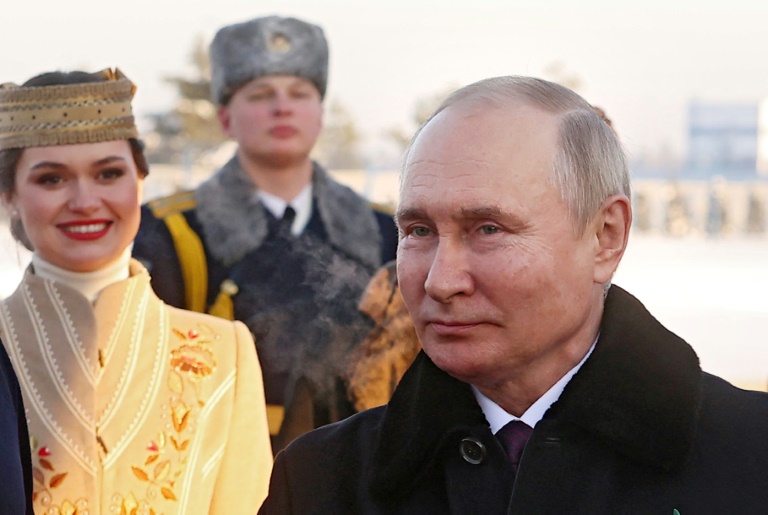
Belarus strongman Alexander Lukashenko urged closer military cooperation with Russia on Monday during a rare visit from President Vladimir Putin, who launched his invasion of Ukraine from his neighbour’s territory.

Putin landed in Minsk with his defence and foreign minister in tow, hours after Russian forces launched a swarm of attack drones at critical infrastructure in Kyiv, which provoked emergency blackouts in a dozen regions.

“Difficult times require us to have political will and to focus on getting results on all topics of the bilateral agenda,” Lukashenko told Putin.

“The main issues lately have been defence and security issues,” he added.

The Kremlin has for years sought to deepen integration with Belarus, which relies on Moscow for cheap oil and loans, but Lukashenko had resisted outright unification with Russia despite being a key ally.

Speculation mounted ahead of the Russian leader’s visit that he would pressure Lukashenko to send troops to Ukraine to fight alongside the Russians after Moscow suffered a string of defeats in nearly 10 months of fighting.

Kremlin spokesman Dmitry Peskov, however, dismissed the reports “as totally stupid, groundless fabrications.”

– ‘Open for dialogue’ –

“Russia and Belarus are open for dialogue with other states, including European ones. I hope that soon they will listen to the voice of reason,” Lukashenko said.

Putin told his Belarusian ally that he hoped to deepen economic ties between the countries during the visit and praised Belarus as “our ally in the truest sense of the word”.

The drone attacks over Ukraine, which wounded three people near Kyiv, came as Russia said it shot down several US-made missiles over its airspace near Ukraine.

“I first heard the air raid siren… I thought there is going to be a drone attack. For the first time, it scared me,” Natalia Dobrovolska, a 68-year-old resident of Kyiv, told AFP.

She described hearing multiple explosions before power shut off in her building in western Kyiv. Officials said Russia had dispatched 35 attack drones nationwide, including 23 over Kyiv.

Ukraine said it downed 30 of the aerial weapons, including Iranian-made “Shaheds”, which have pummelled the capital in recent weeks.

Mayor Vitali Klitschko said critical infrastructure facilities were “damaged” while regional authorities said nine homes had been scarred by the attacks.

Energy operator Ukrenergo announced that emergency electricity outages were scheduled in the capital and nearly a dozen regions.

– Belarus border a ‘priority’ –

Ukraine has experienced frequent and deadly aerial attacks in the 10 months since Russia invaded in late February.

After a series of battlefield setbacks and territory lost this summer and autumn, Moscow stepped up its aerial campaign to target the country’s energy grid.

With winter setting in, missile and drone attacks have plunged cities around the country into darkness, and severed water and heat supplies to millions of Ukrainians.

Speaking to the leaders of several NATO countries via video link on Monday, President Volodymyr Zelensky urged Ukraine’s allies to supply its military with more weapons.

“Russian aggression can and must fail. And our task now is to accelerate it,” he told the leaders assembled in Riga.

He said in a late-night address Sunday that some nine million people had their electricity restored after Russia’s previous missile barrage last week.

Ukraine has an estimated population of 40 million.

Before Putin’s visit, Ukraine’s leader also described the situation on Ukraine’s border with Russia and Belarus as a “constant priority”. 

“We are preparing for all possible defence scenarios,” Zelensky said.

Lukashenko, who has been in power since 1994, is a long-time Kremlin ally and allowed Russian troops to attack Ukraine from his country on February 24.

– Russian-Belarusian military drills –

Hours before Putin touched down in Minsk, Russia announced its forces were running military drills with Belarusian forces.

The defence ministry released footage of drills in Belarus, showing soldiers conducting tank manoeuvres, and practising artillery and sniper fire at a snow-dusted training ground.

“From the morning until the evening twilight — there is not a single second of silence at the training grounds of Belarus,” the ministry said.

It did not say where the drills were taking place or how long they would last.

In October, Belarus announced the formation of a joint regional force with Moscow with several thousand Russian servicemen arriving in the ex-Soviet country, fuelling concerns Minsk could also send troops to Ukraine.

On Monday, Governor Vyacheslav Gladkov said Ukrainian strikes left around 14,000 people without power in a district of southern Russia’s Belgorod region.

Jailed Pakistan Taliban take hostages after seizing police station

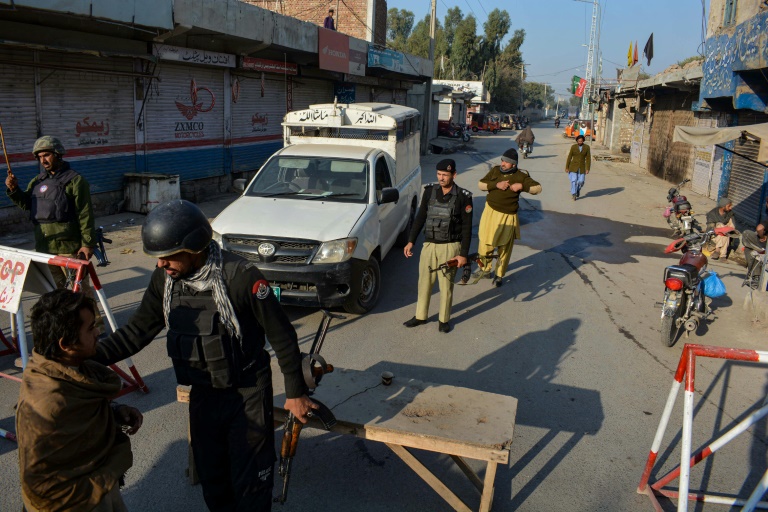
More than 30 Pakistan Taliban militants were holding several officers hostage on Monday after breaking free from custody and seizing a police station, officials said.

Members of the Tehreek–e-Taliban Pakistan (TTP) group — separate from the Afghan Taliban but with a similar hardline Islamist ideology — overpowered their jailers on Sunday and snatched weapons.

The militants, held on suspicion of terrorism, are demanding safe passage to Afghanistan, Muhammad Ali Saif, a spokesman for the provincial Khyber Pakhtunkhwa government, said in a statement late Sunday. 

A senior government official in Bannu, where the incident unfolded near the border with Afghanistan and Pakistan’s formerly self-governed tribal areas, said hostages were still being held after a failed operation to free them. 

“During the interrogation, some of them snatched guns from the policemen and later took the entire staff hostage,” he told AFP on Monday, speaking on condition of anonymity. 

“They want us to provide them safe passage via a ground route or by air. They want to take all the hostages with them and to release them later on the Afghan border or inside Afghanistan.”

Pakistani officials have asked the government in Kabul to help with the release of hostages, he added.

A second government official told AFP that “practically no progress” had been made by Monday evening. 

The TTP claimed responsibility for the incident and demanded authorities provide safe passage to border areas.

“Otherwise, the entire responsibility of the situation will be on the military,” the TTP said in a statement.

A video posted to social media, which the government official confirmed to be from the scene, showed a group of armed men, with one threatening to kill all the hostages.

He said they had at least eight hostages, including police and military staff.

The TTP emerged in 2007 and carried out a horrific wave of violence in Pakistan, with violence reducing after a military operation that began in 2014. 

Attacks are on the rise again since the Afghan Taliban seized control of Kabul last year, however, with most targeting security forces.

A shaky months-long ceasefire between the TTP and Islamabad ended last month.

In 2012 and 2013, dozens of heavily armed Taliban fighters freed more than 600 prisoners, including hardcore militants, during two sophisticated overnight attacks on a jail in Bannu. 

Close Bitnami banner
Bitnami