World

German gas giant's shareholders back nationalisation

Shareholders of troubled German gas giant Uniper on Monday approved the company’s nationalisation after it was pushed to the brink of collapse following Russia’s invasion of Ukraine. 

After Moscow sent its forces into Ukraine in February, crucial Russian gas supplies to Germany were drastically slashed in suspected retaliation for Western sanctions. 

Starved of Russian deliveries, Uniper was left facing bankruptcy, prompting the German government to announce it would nationalise the firm over fears its failure could send shockwaves through Europe’s top economy.

Shareholders backed the deal “by a large majority” in a vote at an extraordinary general meeting, Uniper said in a statement. 

The vote was seen as a formality after the majority shareholder, Finnish state-owned energy company Fortum, agreed to the measures in September. 

The European Commission still needs to agree to the nationalisation under state aid laws. Uniper, Germany’s biggest gas importer, said this approval is expected “in the near future”.

Ahead of the vote, company CEO Klaus-Dieter Maubach said that “by stabilising the company, the federal government recognises the central role that Uniper plays for the security of supply in Germany and Europe”. 

Earlier Monday, the German government and Uniper concluded a framework agreement related to the rescue package. 

Berlin had initially agreed to an eight-billion-euro ($8.5 billion) cash injection for Uniper, but the debt-laden company said last month the government would need to spend an additional 25 billion euros.

Uniper has reported a 40-billion-euro net loss for the first nine months of the year, one of the biggest losses in German corporate history.

The government will finance the rescue out of a 200-billion-euro fund designed to cushion the impact of the energy crisis on households and businesses.

With Russian supplies slashed, Uniper has been forced to pay high prices on the open market. 

And while costs have come down since the summer, they remain elevated. 

“We are still in a situation where we have to buy gas on the (spot) markets, where the prices have reached a level that is — in general — higher than the purchase price of our customers,” Holger Kreetz, Uniper’s chief operating officer for asset management, told AFP.

“We are still in a tight situation,” he said, adding this would remain the case until existing long-term contracts expire.

Uniper is seeking damages at an international tribunal from Gazprom over what it claims is the Russian energy giant’s failure to deliver contractually agreed gas supplies. 

Gazprom has said it does not recognise the legitimacy of the claims. 
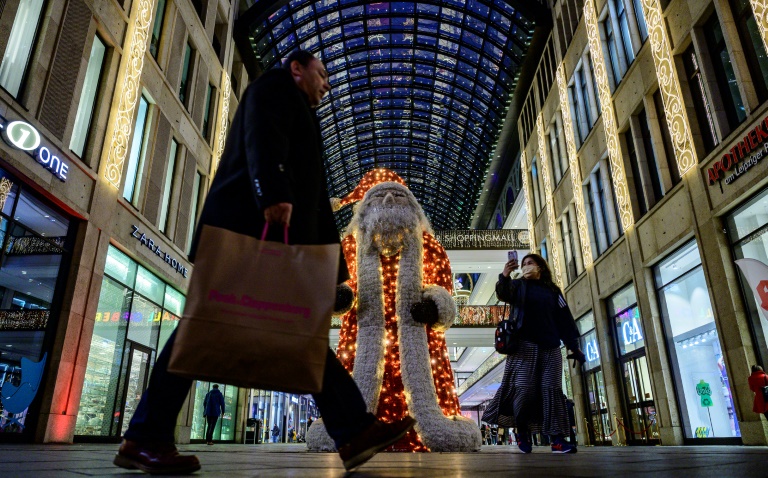
European stocks attempt pre-Christmas rebound

European equities rose Monday in light pre-Christmas trade, rebounding gently from last week’s losses that followed bumper interest rate hikes, but Wall Street and Asian markets failed to get into the festive mood.

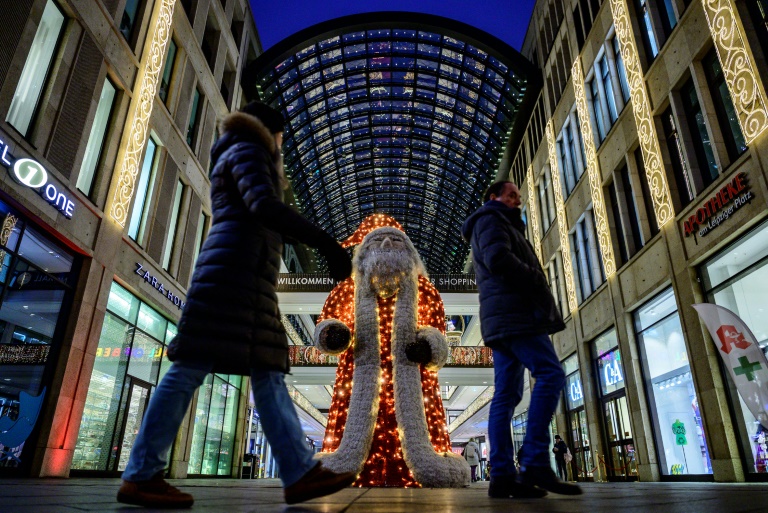
Equity markets often experience a so-called Santa rally, when prices rise during the low-level holiday trading.

“Everyone, it seems, is waiting to see if Santa is going to come around, which leaves the market stuck between feelings of hope and angst,” said market analyst Patrick O’Hare at Briefing.com.

“Accordingly, there isn’t much happening at the broad market level this morning,” he added.

The blue-chip Dow opened marginally lower, with the broader S&P 500 and tech-heavy Nasdaq Composite were flat.

Meanwhile in Europe, London rose 0.6 percent in afternoon trading, while Frankfurt and Paris both added 0.5 percent.

“Markets are grinding higher as some traders are optimistic about valuations which seem to them somewhat attractive,” AvaTrade analyst Naeem Aslam told AFP.

“We really don’t have much volume in markets as traders are away for holidays,” he added.

“Overall I think it’s going to be pretty subdued trading, given the lack of significant data to react to,” noted analyst Susannah Streeter at stockbroker Hargreaves Lansdown.

Asian indices, however, fell on lingering concern over a possible global recession caused by moves to fight inflation from top central banks.

Equities took a turn south last week after monetary policymakers around the world signalled that while price rises appeared to be stabilising, more work would be needed to get them under control.

All three main indexes on Wall Street ended sharply lower Friday after the Federal Reserve warned it would continue tightening monetary policy into 2023.

That was followed by similar warnings from the European Central Bank and Bank of England, while data suggested economies were feeling the pinch, dealing a blow to sentiment heading into the Christmas break.

“With no shortage of economic headwinds, investors struggle to find something cheerful about this holiday week after the two most dominant central banks cast a pall over the proceedings,” said SPI Asset Management’s Stephen Innes.

The US sell-off fed through to Asia, where Tokyo shed more than one percent, while Hong Kong, Shanghai, Taipei, Manila, Bangkok, Jakarta and Wellington were in negative territory, but Singapore and Mumbai edged up.

Adding to the downbeat mood was a spike in Covid-19 cases in China following the country’s reopening after almost three years of strict containment measures.

While the move is expected to boost the world’s number two economy, there is a worry that businesses and China’s health system will be hit in the near term.

Still, Beijing flagged a number of measures aimed at kickstarting growth next year, including support for the beleaguered property sector.

An expected pick-up in Chinese demand helped propel oil prices higher.

– Key figures around 1430 GMT –

London – FTSE 100: UP 0.6 percent at 7,374.60 points

Frankfurt – DAX: UP 0.5 percent at 13,960.89

Paris – CAC 40: UP 0.5 percent at 6,482.31

EURO STOXX 50: UP 0.4 percent at 3,819.75

New York – Dow: DOWN less than 0.1 percent at 32,894.27

Tokyo – Nikkei 225: DOWN 1.1 percent at 27,237.64 (close)

Hong Kong – Hang Seng Index: DOWN 0.5 percent at 19,352.81 (close)

Shanghai – Composite: DOWN 1.9 percent at 3,107.11 (close)

Euro/dollar: UP at $1.0610 from $1.0586 on Friday

Pound/dollar: UP at $1.2187 from $1.2148

Euro/pound: DOWN at 87.09 pence from 87.14 pence

Dollar/yen: DOWN at 136.59 yen from 136.60 yen

West Texas Intermediate: UP 1.9 percent at $75.72 per barrel

Brent North Sea crude: UP 1.7 percent at $80.35 per barrel

burs/cw

Timeline: Twitter mayhem since Musk takeover

Since buying Twitter, Elon Musk has made radical changes that have sparked fears for the future of the platform, from firing half the staff to restoring ex-president Donald Trump’s account and temporarily suspending those of several journalists.

After Twitter users voted on Monday to oust Musk, AFP looks back at a rollercoaster two months at the Silicon Valley giant.

– Enter Elon –

Musk, the world’s second-richest richest man and CEO of Tesla and SpaceX, buys Twitter in late October for $44 billion after months of on-off negotiations.

“Let the good times roll,” he tweets after the deal is sealed on October 28. He becomes the sole director of the company after dissolving its corporate board.

– ‘Content moderation council’ –

In one of his first moves, the self-declared free speech absolutist announces he will form a “content moderation council”, in a nod to concerns that Twitter could become a free-for-all platform for disinformation and hate speech.

– Monthly charge –

On November 1, Musk announces the site will charge $8 per month to verify the accounts of celebrities and companies — a service that used to be free. But the November 6 launch of the Twitter Blue subscription plan goes awry. Musk is forced to suspend the move after an embarrassing rash of fake accounts alarm advertisers.

– Brands step back –

Top global companies, including General Mills and Volkswagen, suspend their advertising on Twitter on November 3 as they monitor the new direction the company will take.

– Massive layoffs –

On November 4, half of Twitter’s 7,500-strong staff are made redundant, sending shockwaves through Silicon Valley.

Musk tweets that “unfortunately there is no choice when the company is losing over $4M/day”.

– Regulator’s ‘concern’-

The chaos draws a rare warning on November 10 from the Federal Trade Commission (FTC), the US authority that oversees consumer safety.

“We are tracking recent developments at Twitter with deep concern,” says an FTC spokesperson.

– Ultimatum to staff –

Musk delivers an ultimatum to Twitter staff on November 16, asking them to choose between being “extremely hardcore” and working long hours, or losing their jobs. He gives them a day to decide.

Large numbers of staff quit.

– Trump reinstated –

Musk reinstates the account of banned former president Donald Trump after conducting a poll of users, a narrow majority of whom support the move. 

A few days later he announces an “amnesty” for all banned Twitter accounts.

– Covid controversy  –

In late November, Twitter says it is no longer enforcing a policy of combatting Covid-19 disinformation. Musk had fiercely opposed Covid restrictions.

– Kanye suspended –

Musk revises his promises of unfettered free speech after rapper Kanye West tweets a picture that appears to show a swastika interlaced with a Star of David. His account is suspended for “incitement to violence”.

– Twitter Blue take two –

In mid-December Musk relaunches Twitter Blue. This time, Twitter conducts a review of the account before giving it the coveted blue check mark.

– Journalists suspended, then reinstated –

On December 15, Twitter suspends the accounts of more than a half-dozen journalists, including reporters from CNN, The New York Times, and The Washington Post.

Musk accuses them of endangering his family through their reporting on Twitter’s shutdown of an account that tracked flights of his private jet. 

The EU threatens to sanction the company.

On December 17 some of the accounts are reactivated.  

– Vote to oust Musk –

On December 19, Twitter users vote by 57.5 percent to oust Musk as CEO in a poll he organized and promised to honour.

Musk has not yet responded.

S.Africa's ruling ANC re-elects Ramaphosa as party chief

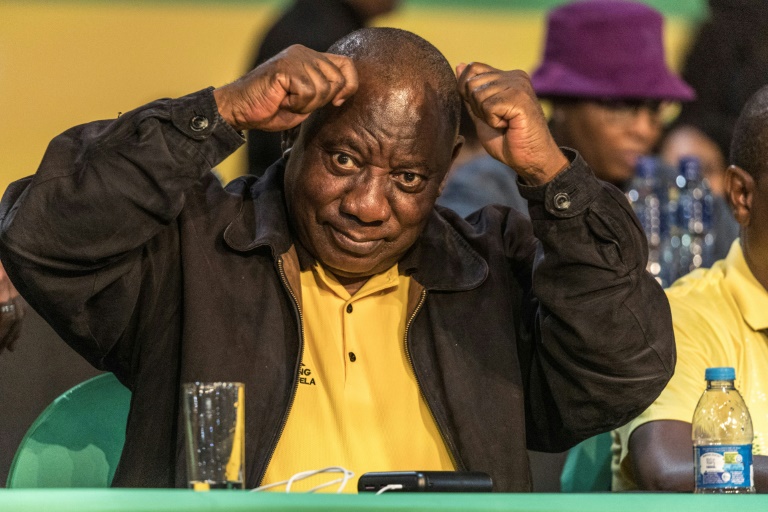
South Africa’s ruling ANC party on Monday re-elected President Cyril Ramaphosa as its leader for a second five-year term, despite a brewing scandal over a huge cash theft at his farm.

Ramaphosa garnered 2,476 votes for the post of party president against 1,897 for former health minister Zweli Mkhize, the African National Congress’ elections chief, Kgalema Motlanthe, announced.

“It’s a good outcome not only for the governing party… it’s a good outcome for the country,” Ramaphosa’s spokesman Vincent Magwenya told reporters.

“The president is quite energised,” he added.

Ramaphosa’s comfortable victory opens the way for him to a second term as South African president if the ANC win the next general elections, due in 2024. 

Under the constitution, the head of state is chosen by parliament.

More than 4,300 delegates, gathered at a conference near Johannesburg, cast their ballots on Sunday to appoint top officials, including party president, deputy president, chair and secretary general, 

The party’s former treasurer, Paul Mashatile, emerged as deputy president.

Most of the delegates erupted in celebration, standing on chairs, chanting and clapping hands when the results were announced. 

Ramaphosa’s opponent Mkhize, walked up to the stage and took off his cap to congratulate Ramaphosa. The pair hugged and shook hands.

– Burglary scandal –

Ramaphosa, 70, won the contest despite being mired in accusations that he concealed the burglary of a huge amount of cash at his upmarket cattle farm.

As the nation’s vice president, he ascended to the ANC’s top job in December 2017 as his boss Jacob Zuma battled a mounting corruption scandal.

The following February, Zuma was forced out by the ANC.

Ramaphosa took office vowing to weed out endemic corruption and renew the party.

But his clean-hands image has been dented by the burglary scandal.

He won a reprieve ahead of the conference when the ANC used its majority in parliament to block a possible impeachment inquiry. But a police investigation is still ongoing. 

The scandal is likely to accelerate a decline in support for the party ahead of the next elections and could still cost Ramaphosa the presidency, said Aleix Montana, Africa analyst at risk intelligence firm Verisk Maplecroft. 

“A second term for Ramaphosa is not set in stone,” he said. 

Sipho Mthembu, 41, chairman of an ANC branch in Gauteng, South Africa’s most populous province, told AFP he was “very disappointed” by the election outcome. 

“We all know that under Ramaphosa a lot of wrong things have happened and the image of the ANC has been compromised,” said Mthembu.

Ramaphosa’s rival Mkhize, 66, is also facing graft allegations that he denies.

– ANC crisis –

The ANC has a storied history, renowned throughout the world for its decades-long struggle, led by Nelson Mandela, against apartheid.

It has governed the country since the advent of democracy in 1994. 

But it has been battered by graft, cronyism, internal rifts and a moribund economy.

An organisational report presented at the conference showed that party membership had dropped by a third over the past five years. 

The rand strengthened slightly against the dollar after Ramaphosa’s victory was announced.

His success provides “a semblance of stability and continuity” favoured by investor, said political analyst Pearl Mncube. 

Yet, his long-running plans to overhaul the ANC are likely to meet resistance among the party’s newly-elected leaders, commentators said.

He “has regained the presidency of the ANC but it may be a Pyrrhic victory, because the top seven is even more unfriendly to him,” Richard Calland, a law professor and political analyst, told AFP.

“He will need to be bolder and show greater courage.” 

But an “ecstatic” Home Affairs Minister Aaron Motsoaledi, told AFP “that is the best team the ANC can ever have”.

Three women, including new national treasurer Gwen Ramokgopa, were elected to top roles, the largest number ever.

“That is progress,” said ANC spokesman Pule Mabe.

Putin arrives in Belarus after drone attack batters Kyiv

Russian President Vladimir Putin on Monday arrived for a rare visit to neighbouring Belarus, which Moscow used to launch its invasion of Ukraine nearly 10 months ago, for talks with close ally and strongman leader Alexander Lukashenko.

His arrival on an icy runway in Minsk came hours after Russian forces launched a swarm of attack drones at critical infrastructure in Kyiv, which provoked emergency blackouts in a dozen regions.

The Kremlin has for years sought to deepen integration with Belarus, which relies on Moscow for cheap oil and loans, but Lukashenko had resisted outright unification with Russia despite being a key ally in the war. 

Speculation was mounting ahead of the Russian leader’s visit that he would pressure Lukashenko to send his troops to Ukraine alongside Russia’s military after a series of defeats for Moscow in nearly 10 months of fighting.

Kremlin spokesman Dmitry Peskov however described the reports “as  totally stupid, groundless fabrications.”

The drone attacks, which left three injured near Kyiv, came as Russia said it had shot down several US-made missiles over its airspace near Ukraine.

“I first heard the air raid siren howling from the street… I thought there is going to be a drone attack. For the first time, it scared me,” Natalia Dobrovolska, a 68-year-old resident of Kyiv, told AFP.

She described hearing multiple explosions before power shut off in her building in western Kyiv. Officials said Russia had dispatched 35 attack drones nationwide, including 23 over Kyiv.

Ukraine said it had downed 30 of the aerial weapons, including Iranian-made “Shaheds”, which have pummelled the capital in recent weeks.

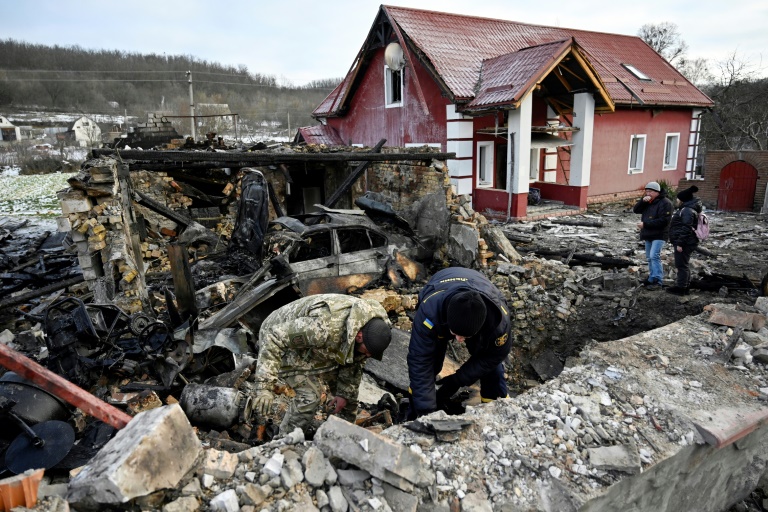
Mayor Vitali Klitschko said critical infrastructure facilities were “damaged” while regional authorities said nine homes had been scarred by the attacks.

Energy operator Ukrenergo meanwhile announced that emergency electricity outages were scheduled in the capital and nearly a dozen regions.

At the same time, Moscow said its air defence systems had shot down four US-made missiles over Belgorod, a Russian region bordering Ukraine, in one of its first such claims in nearly 10 months of fighting.

– Belarus border a ‘priority’ –

“Four American ‘HARM’ anti-radar missiles were shot down in the airspace over the Belgorod region,” the defence ministry said on social media.

Ukraine has experienced frequent and deadly aerial attacks in the 10 months since Russia invaded in late February.

After a series of battlefield setbacks and lost territory this summer and autumn, Moscow stepped up its aerial campaign to target the country’s energy grid.

With winter setting in, missile and drone attacks have plunged cities around the country into darkness, and severed water and heat supplies to millions of Ukrainians.

After a major Russian assault aiming more than 70 missiles on cities last Friday, the national electricity operator was forced to impose emergency rolling blackouts as it raced to repair the battered energy grid.

Speaking to the leaders of several NATO countries via videolink after the drone attacks Monday, President Volodymyr Zelensky urged Ukraine’s allies to supply its military with more weapons.

“Russian aggression can and must fail. And our task now is to accelerate it,” he told the leader assembled in Riga.

He said in a late night address Sunday that  some nine million people had their electricity restored after Russia’s latest missile barrage last week.

Ukraine has an estimated population of 40 million.

Ahead of Putin’s visit, Ukraine’s leader also described the situation on Ukraine’s border with Russia and Belarus as a “constant priority”. 

“We are preparing for all possible defence scenarios,” Zelensky said, adding that he had recently discussed border regions with military commanders.

Lukashenko, who has been in power since 1994, is a long-time Kremlin ally and allowed Russian troops to attack Ukraine from his country on February 24.

– Russian-Belarusian military drills –

Russian Foreign Minister Sergei Lavrov was already in Minsk on Monday alongside Defence Minister Sergei Shoigu.

Hours before Putin touched down in Minsk, Russia announced its forces were running military drills with Belarusian forces.

The defence ministry released footage of drills in Belarus, showing soldiers conducting tank manoeuvres, and practising artillery and sniper fire at a snow-dusted training ground.

“From the morning until the evening twilight — there is not a single second of silence at the training grounds of Belarus,” the ministry said.

It did not say where the drills were taking place or how long they will last.

In October, Belarus announced the formation of a joint regional force with Moscow with several thousand Russian servicemen arriving in the ex-Soviet country, fuelling concerns Minsk could also send troops to Ukraine.

In fighting that has spilled over into Russian regions bordering Ukraine, one person was killed, and others were wounded Sunday in Belgorod following attacks that the local authorities blamed on Kyiv.

Governor Vyacheslav Gladkov said Monday that Ukrainian strikes left around 14,000 people without power in a district of the Belgorod region.

German business morale up again as prospects brighten

German business confidence improved for a third straight month in December, a key survey showed Monday, the latest sign a downturn in Europe’s top economy may be milder than feared.

The Ifo institute’s monthly confidence barometer, based on a survey of about 9,000 companies, reached 88.6 points, up from a reading of 86.4 points in November. 

Earlier in the year, the gauge declined for months after Russia’s invasion of Ukraine, and subsequent reduction in gas exports, sent inflation soaring and triggered warnings of recession for next year.

But a massive government fund to cap prices and efforts to diversify the country’s energy supplies have eased the immediate sense of crisis. 

“Sentiment in the German economy has brightened considerably,” Ifo president Clemens Fuest said.

“German business is entering the holiday season with a sense of hope.”

ING bank economist Carsten Brzeski said the reading shows that “hope has returned”.

“Hope that the economy might even avoid a winter recession or at least hope that it will only be a mild one.”

But he cautioned “the downsides still outweigh the upsides”, noting that gas reserves were dropping fast due to cold weather, as well as warning signs there could be a weakening of global trade. 

After months flashing red, leading indicators have started giving more optimistic readings in recent weeks. 

Last week, Ifo said the looming recession will be milder than expected, with economic output shrinking 0.1 percent in 2023, revising its previous prediction of a 0.3 percent contraction.

And another influential institute, IfW Kiel, even predicted that the economy would dodge recession due to the government relief measures. 

In its autumn forecast, the German government said the economy would contract 0.4 percent next year.

Meta 'breached EU antitrust rules' on Facebook ads

US online giant Meta appears to have “breached EU antitrust rules” in the online classified section of its Facebook social network, the European Commission said Monday in a preliminary finding.

“The Commission takes issue with Meta tying its online classified ads service, Facebook Marketplace, to its personal social network, Facebook,” it said in a statement.

“The Commission is also concerned that Meta is imposing unfair trading conditions on Facebook Marketplace’s competitors for its own benefit.”

The commission, the regulator for the 27-nation European Union, has had several run-ins with Meta and other Big Tech companies over their practices.

Its policy arsenal has been beefed up this year with two new pieces of EU legislation, the Digital Services Act and the Digital Markets Act, that carry massive financial penalties in the event of infringement. 

Those acts will come fully into force through 2023 and 2024.

Monday’s announcement was about “suspected violations” of EU antitrust rules and gives Meta a chance to respond to the commission’s formal Statement of Objections.

Those concerns focus on the way Meta gives Facebook users automatic access to Facebook Marketplace “whether they want it or not”.

That link may unfairly disadvantage Facebook Marketplace competitors, the commission said.

The concerns also home in on unfair trading practices on competing online classified ads services which advertise on Facebook or Instagram, both of which are part of Meta.

The commission said it was worried that the user terms on those platforms could allow Meta to use ads-related data from competitors to boost Facebook Marketplace.

If the EU’s concerns stand, and enough evidence of infringement is produced, Meta could face a fine of up to 10 percent of its total global annual turnover.

Meta’s worldwide revenue for the 12 months ending September 30 was $118 billion.

The commission could also prohibit the infringing behaviour.

Meta 'breached EU antitrust rules' on Facebook ads

US online giant Meta appears to have “breached EU antitrust rules” in the online classified section of its Facebook social network, the European Commission said Monday in a preliminary finding.

“The Commission takes issue with Meta tying its online classified ads service, Facebook Marketplace, to its personal social network, Facebook,” it said in a statement.

“The Commission is also concerned that Meta is imposing unfair trading conditions on Facebook Marketplace’s competitors for its own benefit.”

The commission, the regulator for the 27-nation European Union, has had several run-ins with Meta and other Big Tech companies over their practices.

Its policy arsenal has been beefed up this year with two new pieces of EU legislation, the Digital Services Act and the Digital Markets Act, that carry massive financial penalties in the event of infringement. 

Those acts will come fully into force through 2023 and 2024.

Monday’s announcement was about “suspected violations” of EU antitrust rules and gives Meta a chance to respond to the commission’s formal Statement of Objections.

Those concerns focus on the way Meta gives Facebook users automatic access to Facebook Marketplace “whether they want it or not”.

That link may unfairly disadvantage Facebook Marketplace competitors, the commission said.

The concerns also home in on unfair trading practices on competing online classified ads services which advertise on Facebook or Instagram, both of which are part of Meta.

The commission said it was worried that the user terms on those platforms could allow Meta to use ads-related data from competitors to boost Facebook Marketplace.

If the EU’s concerns stand, and enough evidence of infringement is produced, Meta could face a fine of up to 10 percent of its total global annual turnover.

Meta’s worldwide revenue for the 12 months ending September 30 was $118 billion.

The commission could also prohibit the infringing behaviour.

Italy partly bows to EU over card payments

Italy’s new hard-right government has abandoned plans to allow merchants to refuse card payments under 60 euros ($64), following pressure from the European Union.

Economy Minister Giancarlo Giorgetti confirmed the U-turn as he set out amendments to the 2023 budget late on Sunday.

The European Commission last week approved the general direction of far-right Prime Minister Giorgia Meloni’s first budget, but warned moves to boost the use of cash risked efforts to fight tax evasion.

“We must find solutions that are compatible with the recommendations and reference standards, also at the European level,” Giorgetti told a parliamentary commission.

The government had proposed merchants be allowed to refuse card payments for transactions worth less than 60 euros without incurring penalties, alongside measures to raise the maximum for cash payments in shops from 2,000 to 5,000 euros, which also drew criticism from Brussels.

The plan to raise the ceiling on cash payments will go ahead.

The European Commission had previously recommended that Italy fight tax evasion by strengthening e-payments and limiting the thresholds for cash payments.

The application of sanctions on merchants who refused card payments was also one of the goals agreed under an EU post-pandemic recovery plan, from which Italy stands to receive almost 200 billion euros in grants and loans by 2026.

The Bank of Italy has also criticised cash payments as aiding tax evasion, which costs Italy about 100 billion euros per year.

Another measure criticised by Brussels, a tax amnesty on debts of up to 1,000 euros from the period 2000 to 2015, has been postponed for three months, under the latest budget draft.

UK judges rule Rwanda deportation plan lawful

Judges in London on Monday ruled that the UK government’s controversial plan to deport migrants to Rwanda was lawful, after a legal challenge by migrants and campaigners.

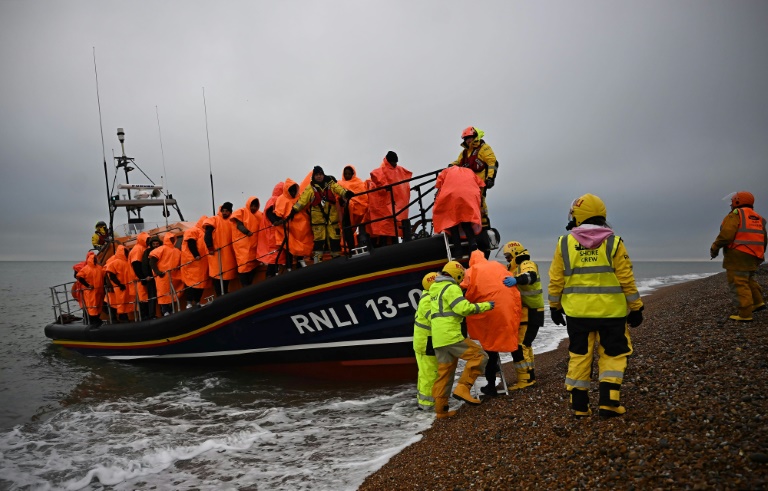
Former prime minister Boris Johnson brought in the proposal to try to tackle record numbers of migrants crossing the Channel from northern France by small boats.

But it triggered a wave of protests from rights groups and charities, and last-gasp legal challenges successfully blocked the first deportation flights in June.

Several individuals who arrived in small boats and organisations supporting migrants brought a case at the High Court in London for a judicial review of the policy, claiming it is unlawful.

Lawyers for the parties argued that the policy was unlawful on multiple grounds, including the assessment of Rwanda as a safe third country.

The judges acknowledged that the issue had stirred public debate but said its only remit was “to ensure that the law is properly understood and observed, and that the rights guaranteed by parliament are respected”. 

“The court has concluded that it is lawful for the government to make arrangements for relocating asylum-seekers to Rwanda and for their asylum claims to be determined in Rwanda rather than in the United Kingdom,” they said in a summary.

“The relocation of asylum-seekers to Rwanda is consistent with the (UN) Refugee Convention and with the statutory and other legal obligations on the government including the obligations imposed by the Human Rights Act 1998.”

The judges however said interior minister Suella Braverman had not properly considered the circumstances of the eight claimants in the case and referred their cases back to her.

– ‘Morally reprehensible’ – 

Tackling asylum claims has become a political headache for the ruling Conservative government in London, despite its promise to “take back control” of the country’s borders after Britain’s Brexit departure from the European Union.

More than 43,000 migrants have crossed the Channel this year in small boats, heaping pressure on social services to accommodate them while their asylum claims are processed.

Johnson’s short-lived successor Liz Truss and the incumbent Rishi Sunak have backed the Rwanda deal, which aims to send anyone deemed to have entered the UK illegally since January 1 to the African nation.

Sunak and Braverman have both said urgent action is needed to prevent further tragedies in the Channel. Four people died last week when their boat capsized in freezing waters.

Both welcomed the ruling. “We have always maintained that this policy is lawful and today the court has upheld this,” Braverman said, insisting it will help those relocated to “build new lives”.

Sunak’s official spokesman told reporters the government would “look to push ahead with this as soon as possible”, although an appeal is likely.

The Rwandan government called the ruling a “positive step” towards solving the global migration crisis.

Monday’s ruling involved asylum-seekers from Syria, Iran and Iraq, migrant support groups Care4Calais and Detention Action, plus the PCS union whose members would have to implement the removals.

James Wilson from Detention Action said the body was “very disappointed by the outcome today” but would “regroup and consider next steps”.

Paul O’Connor of the PCS said the policy remained “morally reprehensible” despite the ruling and an appeal may be “seriously” considered to block deportations.

Brexit hardliner Braverman suggested in an interview published on Saturday that the European Convention on Human Rights and the UN refugee convention were ill-suited to dealing with modern migration.

Such agreements had been struck in the aftermath of World War II and were “designed for a world where travel was not cheap, numbers were much lower, flows of people were much smaller”, she told The Times.

Close Bitnami banner
Bitnami