World

Amid protests, Peru's new leader swears in cabinet

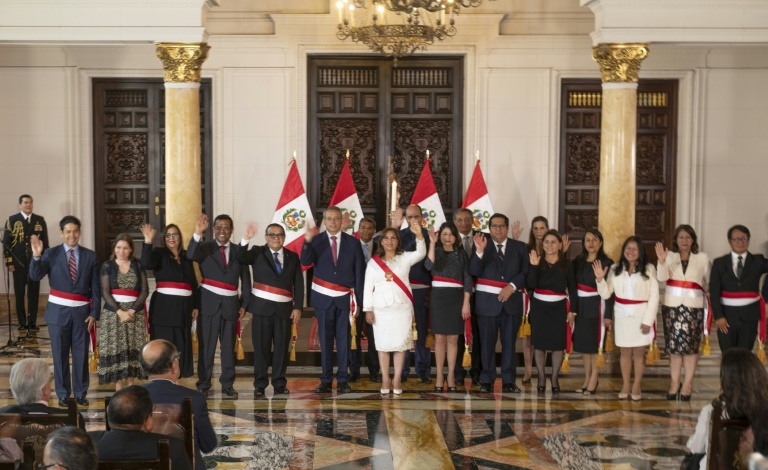
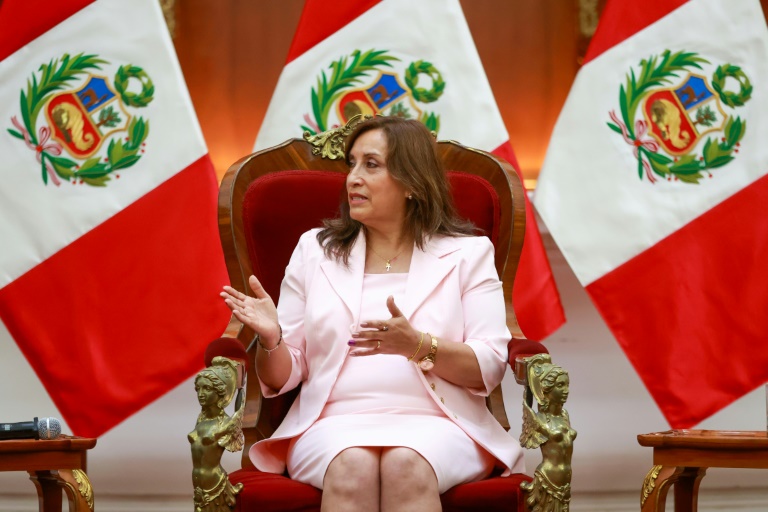
Peru’s new leader Dina Boluarte unveiled a new cabinet Saturday as street protests pressed on seeking new elections after Pedro Castillo’s removal as president.

Boluarte, Peru’s first woman president and who was vice president under Castillo in his leftist government, oversaw a ceremony in which 19 ministers — eight of them are women — took the oath of office at the presidential palace.

The new cabinet comprises people seen as technicians who are politically independent rather than partisan. Her new chief of staff is a former prosecutor who specialized in corruption cases.

A big protest seeking new elections and protesting the ouster of Castillo was planned in Lima in the evening — but only after Saturday’s World Cup semifinal matches.

Boluarte, a 60-year-old lawyer, has said she will serve out Castillo’s term through July 2026 but on Friday she did rule out holding an early presidential vote. 

This is a key demand of street protesters who have been blocking roads and burning tires across this country with a record of political upheaval and instability.

Boluarte was hastily sworn in as Peru’s first woman president on Wednesday hours after Castillo, who faced a series of corruption probes into himself and his family, was ousted in an impeachment vote by congress. 

– ‘A usurper’ –

Castillo had tried to head off that vote — the third against him since he took office 18 months ago — by trying to dissolve the legislature and announcing he would rule by decree. But lawmakers voted to fire him anyway.

The prosecution accuses the left-wing rural teacher of rebellion and conspiracy, and a high court ordered him held for seven days in preliminary detention.

Castillo was taken into custody by his own security people Wednesday after his failed decree as he headed to the embassy of Mexico to seek political asylum. On Thursday, he was placed in preventive detention.

The charges against Castillo carry a jail term of between 10 and 20 years.

Boluarte had been negotiating for three days with conservative parties that dominate congress. Her leftist allies have refused to take part after the ouster and arrest of Castillo.

Her stated decision to serve out his term until July 2026 has run into headwinds.

The demands of protesters for new elections stem from fierce rejection of congress. A poll released in November said 86 percent of those questioned disapprove of the legislature.

“Dina Boluarte does not represent us because she is a usurper. We did not elect her,” said Maria Tolentino, a homemaker who took part in protests Friday in Lima.

Police have cancelled vacation and personal leave to deal with the unrest.

Prosecutors are questioning Castillo’s former ministers as part of the probe into the rebellion charges. 

Many roads remained blocked in the south of the country, where Castillo enjoys wide support, including the Pan-American Highway, leaving dozens of buses and cargo trucks stranded.

Hundreds of people marched through the streets of the capital Lima on Friday for the second day, demanding Castillo’s release. On Thursday, police fired tear gas and clashed with hundreds of his supporters.

Students, workers and left-wing political parties have announced a protest in Lima on Saturday beginning at 2100 GMT (4:00 pm local), after the end of the day’s FIFA World Cup quarter-final matches in Qatar.
Ukrainian, Russian Nobel Peace winners slam Putin's 'insane' war

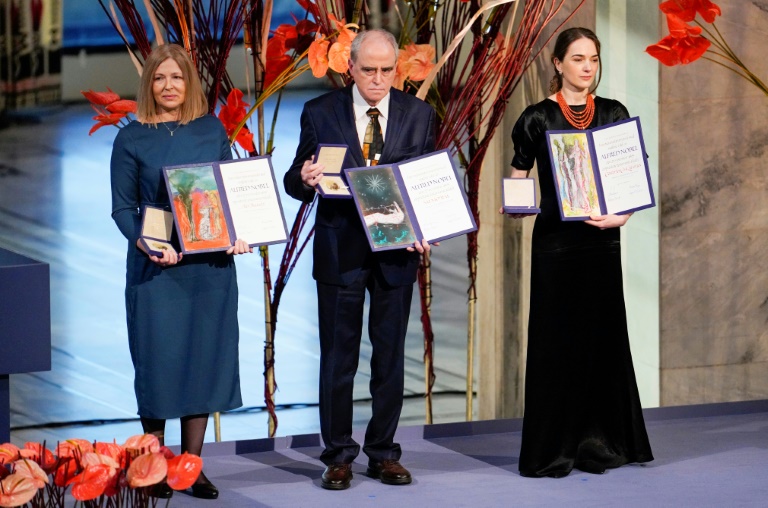
A trio from the three nations at the centre of the war in Ukraine accepted their Nobel Peace Prize on Saturday, calling for an unabated fight against Russian leader Vladimir Putin’s “insane and criminal” invasion.

Jailed Belarusian rights advocate Ales Bialiatski, Russian organisation Memorial and Ukraine’s Center for Civil Liberties (CCL) were honoured by the Nobel committee for their struggle for “human rights, democracy and peaceful co-existence” in the face of authoritarianism.

“The people of Ukraine want peace more than anyone else in the world,” the head of the CCL, Oleksandra Matviichuk, said. “But peace cannot be reached by a country under attack laying down its arms.”

Founded in 2007, the CCL has documented war crimes allegedly committed by Russian troops in Ukraine.

These include shelling residential buildings, churches, schools and hospitals, bombing evacuation corridors, the forced displacement of people, and torture.

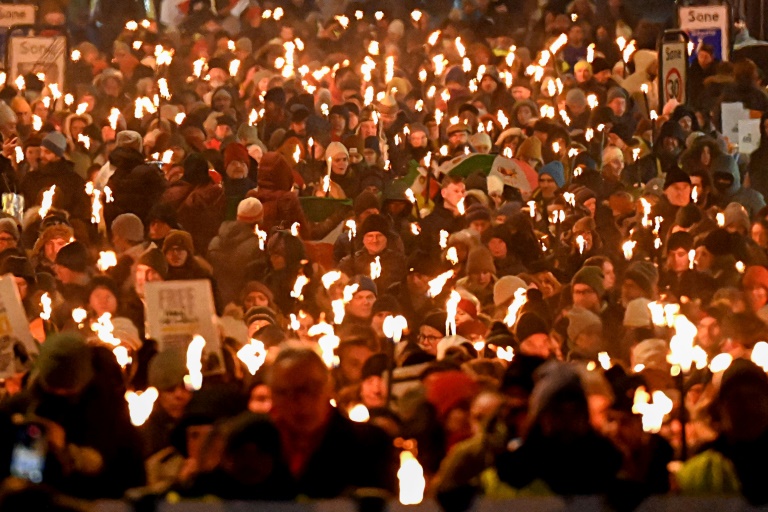
Due to the Russian bombing of Ukraine’s energy infrastructure, Matviichuk had to write her Nobel acceptance speech by candlelight, she told AFP.

In the nine months since the start of the Russian invasion, the CCL has documented more than 27,000 cases of alleged war crimes, which she said were “only the tip of the iceberg”.

“War turns people into numbers. We have to reclaim the names of all victims of war crimes,” she said in her speech, her voice overcome with emotion.

Ukrainian President Volodymyr Zelensky congratulated Matviichuk, the CCL “and all human rights defenders”, noting that the ceremony took place on International Human Rights Day.

– Putin’s ‘imperial ambitions’ –

In Oslo’s City Hall decorated with red Siberian flowers, Matviichuk reiterated her appeal for an international tribunal to judge Putin, his ally Belarusian President Alexander Lukashenko and “other war criminals”.

Her Russian co-laureate Yan Rachinsky, the chairman of human rights organisation Memorial, meanwhile denounced Russia’s “imperial ambitions” inherited from the ex-Soviet Union “that still thrive today”.

Putin and his “ideological servants” have hijacked the anti-fascist struggle “for their own political interests”, he said.

Now, “resistance to Russia is called ‘fascism'”, and has become “the ideological justification for the insane and criminal war of aggression against Ukraine”, he said, using harsh language considering the stiff penalties Moscow imposes on those who publicly criticise the invasion.

Founded in 1989, Memorial has for decades shed light on crimes committed by Joseph Stalin’s totalitarian regime, worked to preserve the memory of the victims, and documented human rights violations in Russia.

Amid crackdowns on the opposition and media, Russia’s Supreme Court ordered Memorial dissolved at the end of 2021.

It then ordered a raid of its Moscow offices on October 7 — the very day it was announced as co-winner of this year’s Peace Prize.

“Today, the number of political prisoners in Russia is more than the total number in all of the Soviet Union at the beginning of the period of perestroika in the 1980s,” Rachinsky said, referring to a Soviet era term for the policy of restructuring or reforming the economic and political system. 

– ‘International of dictatorships’ –

The third Nobel laureate, Ales Bialiatski, founder of rights group Viasna, has been detained in Belarus since July 2021 pending trial following Minsk’s crackdown on large-scale protests against the regime.

The 60-year-old was not authorised to transmit an acceptance speech for the Nobel ceremony.

Instead, his wife Natalia Pinchuk, who accepted the award on his behalf, shared some of his thoughts, recorded earlier, including a call to fight against “the international of dictatorships”.

In Ukraine, Russia is trying to establish “a dependent dictatorship”, he said, quoted by his wife.

“The same as today’s Belarus, where the voice of the oppressed people is ignored and disregarded”, he said, citing “Russian military bases, huge economic dependence, (and) cultural and linguistic russification”.

“Goodness and truth must be able to protect themselves,” he said.

Later Saturday, a separate awards ceremony in Stockholm honoured the winners of the other Nobel prizes in the fields of medicine, physics, chemistry, literature and economics.

Among the laureates was Annie Ernaux of France, who won the literature prize, former US central bank chief Ben Bernanke who won the economics prize, and Barry Sharpless of the US, who won the chemistry prize for the second time. 

Also in attendance were the laureates from 2020 and 2021, when the Stockholm festivities were cancelled due to the Covid-19 pandemic.

A lavish banquet was held later in the evening at Stockholm City Hall for some 1,500 guests, including the Norwegian royal family.

Amid protests, Peru's new leader asked to quickly form cabinet

The head of Peru’s legislature called Saturday on the country’s new leader Dina Boluarte to appoint a new cabinet urgently amid continuing street protests following the removal of Pedro Castillo as president.

Boluarte, who served as vice president under Castillo, has promised to form a government on Saturday, but also did not rule out holding an early presidential vote — a key demand of street protesters who have been blocking roads and burning tires across this country with a record of political upheaval and instability.

“The president of the republic must make prompt decisions, such as on her cabinet … to get out of certain difficulties and generate confidence and calm,” House speaker Jose Williams said on RPP radio.

He added: “I ask people to calm down. Look at things positively.”

Boluarte was hastily sworn in as Peru’s first woman president on Wednesday just hours after Castillo, who faced a series of corruption probes into himself and his family, was ousted in an impeachment vote by congress. 

Castillo had tried to head off that vote — the third against him since he took office 18 months ago — by trying to dissolve the legislature and announcing he would rule by decree. But lawmakers voted to fire him anyway.

The prosecution accuses the left-wing rural teacher of rebellion and conspiracy, and a high court ordered him held for seven days in preliminary detention.

The charges against Castillo carry a jail term of between 10 and 20 years.

Many roads remained blocked in the south of the country, where Castillo enjoys wide support, including the Pan-American Highway that links Peru and Chile, leaving dozens of buses and cargo trucks stranded.

Hundreds of people marched through the streets of the capital Lima on Friday for the second day, demanding Castillo’s release. On Thursday, police fired tear gas and clashed with hundreds of his supporters.

Students, workers and left-wing political parties have announced a protest in Lima on Saturday beginning at 2100 GMT (4:00 pm local), after the end of the day’s FIFA World Cup quarter-final matches in Qatar.
EU parliament arrests spark calls for tighter controls over MEPs

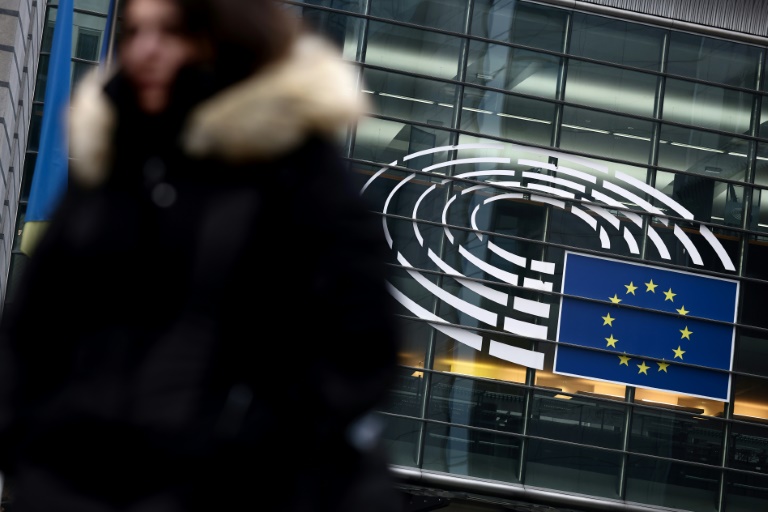
The arrest of a European Parliament vice-president and four others linked to a corruption probe implicating World Cup hosts Qatar sparked calls Saturday for the bloc’s MPs to be held to higher standards.

“This is not an isolated incident,” said anti-corruption campaigning group Transparency International.

“While this may be the most egregious case of alleged corruption the European Parliament has seen in many years, it is not an isolated incident,” said a statement from its director Michiel van Hulten.

“Over many decades, the Parliament has allowed a culture of impunity to develop, with a combination of lax financial rules and controls and a complete lack of independent (or indeed any) ethics oversight. 

“In many ways it has become a law unto itself,” added van Hulten, urging “root and branch” reform.

“Every serious attempt to improve accountability is blocked by the Parliament’s ruling Bureau, with the acquiescence of a majority of MEPs,” he added.

Left-wing French MEP Manon Aubry condemned Qatar’s “aggressive lobbying” and demanded a parliamentary debate on the Gulf state.

Police arrested Greek socialist MEP Eva Kaili on Friday hours after the four others had been detained for questioning. At least three were either Italian citizens or originally came from Italy, a source close to the case told AFP.

Kaili, 44, is the partner of one of the four, Francesco Giorgi, a parliamentary assistant with the European Parliament’s Socialists and Democrats group, said the source.

Former Italian MEP Pier-Antonio Panzeri, who served as a socialist in the parliament between 2004 and 2019, was also reportedly arrested. 

All five were still being questioned Saturday, said a spokesman for Belgium’s federal prosecutor’s office.

– Corruption, money laundering –

The investigation concerns “corruption” and “money laundering”, the prosecutor said .

In Rome, press agencies reported Panzeri’s wife and daughter had been arrested in Italy.

The arrests came after a series of raids in Brussels which Belgian prosecutors said turned up 600,000 euros ($630,000) in cash.

Police also seized computers and mobile phones in the investigation into a Gulf state suspected of influencing the decisions of the European Parliament through cash payments or gifts to top figures in the EU assembly.

Belgian daily L’Echo reported Saturday that “several bags full of (money) notes” had been found at Kaili’s Brussels home, which police decided to search after her father was caught carrying a large amount of cash in a suitcase.

While prosecutors did not name the country under investigation, a legal source close to the case confirmed to AFP Belgian press reports that it was Qatar.

In Athens, the president of the Greek socialists (PASOK) Nikos Androulakis announced on Twitter that Kaili had been expelled from the party.

“There is pressure within the party for Kaili to leave her seat at the European parliament,” a member of the party told AFP.

“For the moment, she does not wish to give up her seat as she knows it would imply losing her parliamentary immunity,” a second source said.

– Parliamentary immunity –

Kaili is a former television presenter and one of the European Parliament’s 14 vice presidents. In November, just prior to the World Cup, she met Qatar’s Labour Minister Ali bin Samikh Al Marri.

In a video statement posted on Twitter by the Qatar News Agency, she said: “I believe the World Cup for Arabs has been a great tool for… political transformation and reforms”.

The parliament “recognised and respected” Qatar’s progress in labour reforms, she added.

She made similar comments during a speech at the assembly later in November, accusing some MEPs of “bullying” Qatar and accusing them of corruption.

A Qatari government official told AFP: “We are not aware of any details of an investigation. Any claims of misconduct by the State of Qatar are gravely misinformed.”

The country “operates in full compliance with international laws and regulations”, he added.

Panzeri, 67, currently heads a Brussels-based human rights organisation called Fight Impunity.

The secretary general of the International Trade Union Confederation, Italian Luca Visentini, was also among those reportedly arrested. The ITUC said it was “aware” of the media reports.

World Cup host Qatar has striven to improve its image in the face of criticism over its record on worker protections and human rights. 

Interviewed by AFP on Monday, Visentini had welcomed progress made by Qatar on worker rights, but insisted “pressure” needed to be maintained once the football is over.

Migrant workers make up more than 2.5 million of Qatar’s 2.9 million population.

Doha has implemented reforms to its migrant labour system, but critics insist more work needs to be done to secure a long-term impact. 

Ukrainian, Russian Nobel Peace winners slam Putin's 'insane' war

A trio from the three nations at the centre of the war in Ukraine accepted their Nobel Peace Prize on Saturday, calling for an unabated fight against Russian leader Vladimir Putin’s “insane and criminal” invasion.

Jailed Belarusian rights advocate Ales Bialiatski, Russian organisation Memorial and Ukraine’s Center for Civil Liberties (CCL) were honoured by the Nobel committee for their struggle for “human rights, democracy and peaceful co-existence” in the face of authoritarianism.

“The people of Ukraine want peace more than anyone else in the world. But peace cannot be reached by a country under attack laying down its arms,” the head of the CCL, Oleksandra Matviichuk, said.

Founded in 2007, the CCL has documented war crimes allegedly committed by Russian troops in Ukraine.

These include shelling residential buildings, churches, schools and hospitals, bombing evacuation corridors, the forced displacement of people, and torture.

Due to the Russian bombing of Ukraine’s energy infrastructure, Matviichuk had to write her Nobel acceptance speech by candlelight, she told AFP in an interview just hours before the ceremony.

In the nine months since the start of the Russian invasion, the CCL has documented more than 27,000 cases of alleged war crimes, which she said were “only the tip of the iceberg”.

“War turns people into numbers. We have to reclaim the names of all victims of war crimes,” she said in her speech, her voice overcome with emotion.

– Putin’s ‘imperial ambitions’ –

In Oslo’s City Hall decorated with red Siberian flowers, Matviichuk reiterated her appeal for an international tribunal to judge Putin, his ally Belarusian President Alexander Lukashenko and “other war criminals”.

Her Russian co-laureate Yan Rachinsky, the chairman of human rights organisation Memorial, meanwhile denounced Russia’s “imperial ambitions” inherited from the ex-Soviet Union “that still thrive today”.

Putin and his “ideological servants” have hijacked the anti-fascist struggle “for their own political interests”, he said.

Now, “resistance to Russia is called ‘fascism'”, and has become “the ideological justification for the insane and criminal war of aggression against Ukraine”, he said, using harsh language considering the stiff penalties Moscow imposes on those who publicly criticise the invasion.

Founded in 1989, Memorial has for decades shed light on crimes committed by Joseph Stalin’s totalitarian regime, worked to preserve the memory of the victims, and documented human rights violations in Russia.

Amid crackdowns on the opposition and media, Russia’s Supreme Court ordered Memorial dissolved at the end of 2021.

It then ordered a raid of its Moscow offices on October 7 — the very day it was announced as co-winner of this year’s Peace Prize.

“Today, the number of political prisoners in Russia is more than the total number in all of the Soviet Union at the beginning of the period of perestroika in the 1980s,” Rachinsky said, referring to a Soviet era term for the policy of restructuring or reforming the economic and political system. 

– ‘International of dictatorships’ –

The third Nobel laureate, Ales Bialiatski, founder of rights group Viasna, has been detained since July 2021 pending trial following Minsk’s crackdown on large-scale protests against the regime.

The 60-year-old was not authorised to transmit an acceptance speech for the Nobel ceremony.

Instead, his wife Natalia Pinchuk, who accepted the award on his behalf, shared some of his thoughts, recorded earlier, including a call to fight against “the international of dictatorships”.

In Ukraine, Russia is trying to establish “a dependent dictatorship”, he said, quoted by his wife.

“The same as today’s Belarus, where the voice of the oppressed people is ignored and disregarded”, he said, citing “Russian military bases, huge economic dependence, (and) cultural and linguistic russification”.

“Goodness and truth must be able to protect themselves,” he said.

Later Saturday, a separate awards ceremony in Stockholm honoured the winners of the other Nobel prizes in the fields of medicine, physics, chemistry, literature and economics.

Among the laureates was Annie Ernaux of France, who won the literature prize, former US central bank chief Ben Bernanke who won the economics prize, and Barry Sharpless of the US, who won the chemistry prize for the second time. 

Also in attendance were the laureates from 2020 and 2021, when the Stockholm festivities were cancelled due to the Covid-19 pandemic.

A lavish banquet was to be held later in the evening at Stockholm City Hall for some 1,500 guests, including the royal family.

Arms dealer Bout praises Putin, backs Ukraine assault

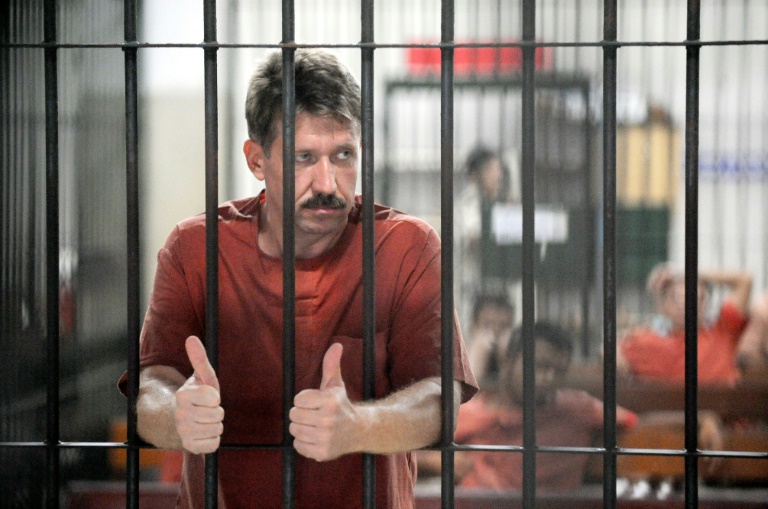
Viktor Bout, a notorious arms dealer dubbed the “Merchant of Death”, praised Russian President Vladimir Putin and backed Moscow’s assault on Ukraine.

On Thursday, Bout, who was serving a 25-year sentence in a US prison, was exchanged in Abu Dhabi for American basketball star Brittney Griner.

Speaking to the Kremlin-backed RT channel in an interview released on Saturday, Bout said he kept a portrait of Putin in his prison cell in the United States.

“I am proud that I am a Russian person, and our president is Putin,” the former Soviet air force pilot said in the 40-minute interview.

“I know that we will win,” he added, saying he was enjoying snow and “the air of freedom” upon his return to Russia.

Bout was interviewed by Maria Butina, who herself served a short prison stint in the United States for illegally acting as a foreign agent for Russia.

Bout, 55, said he “fully” supported Russia’s military offensive in Ukraine and would have volunteered to go to the front if he had the “opportunity and necessary skills”.

“Why did we not do it earlier?” he said, referring to Putin’s decision to launch an offensive against Ukraine in February.

Bout said he had become one of the first victims of the West, noting he had been under sanctions for more than 20 years.

“Everything that happened to me is happening to our country now,” he said.

Butina, who now serves as a member of the Russian parliament’s lower house, said during the interview that US authorities had thrown Bout in prison “because he is Russian”.

Bout, who crossed paths with Griner during their exchange on the tarmac in Abu Dhabi, said he had wished her luck.

“You have to wish everyone luck,” he added.

– ‘Lost interest in food’ –

Bout, who was accused of arming rebels in some of the world’s bloodiest conflicts, was arrested in Thailand in a US sting operation in 2008, extradited to the United States and sentenced in 2012 to 25 years in prison.

His notoriety inspired the Hollywood film “Lord of War”, starring Nicolas Cage, in which the anti-hero escaped justice.

He said in the interview that he read a lot of books in prison and forced himself to laugh at the beginning of the day to keep his spirits up.

He complained about the quality of food in US prisons, saying he missed the taste of garlic and wood strawberries.

“At some point I’ve lost interest in food,” he said.

“I have lost a lot of weight.”

EU parliament graft arrests spark calls for tighter controls over MPs

The arrest of a European Parliament vice-president and four others linked to a corruption probe implicating World Cup hosts Qatar sparked calls Saturday for the bloc’s MPs to be held to higher standards.

“This is not an isolated incident,” said anti-corruption campaigner Transparency International.

“While this may be the most egregious case of alleged corruption the European Parliament has seen in many years, it is not an isolated incident,” said Transparency director Michiel van Hulten.

“Over many decades, the Parliament has allowed a culture of impunity to develop, with a combination of lax financial rules and controls and a complete lack of independent (or indeed any) ethics oversight. 

“In many ways it has become a law unto itself,” added van Hulten, urging “root and branch” reform.

“Every serious attempt to improve accountability is blocked by the Parliament’s ruling Bureau, with the acquiescence of a majority of MEPs,” he added.

Checks on the institution are “defective”, tweeted Alberto Alemano of the College of Europe in Bruges.

Police arrested Greek socialist MEP Eva Kaili on Friday hours after the four others had been detained for questioning. At least three were either Italian citizens or originally came from Italy, a source close to the case told AFP.

Kaili, 44, is the partner of one of the four, Francesco Giorgi, a parliamentary assistant with the European Parliament’s Socialists and Democrats group, said the source.

Former MEP Italy’s Pier-Antonio Panzeri, who served as a socialist in the parliament between 2004 and 2019, was also reportedly arrested. 

All five were still being questioned Saturday, said a spokesman for Belgium’s federal prosecutor’s office.

– Corruption, money laundering –

The investigation concerns “corruption” and “money laundering”, the prosecutor said .

In Rome, press agencies reported Panzeri’s wife and daughter had been arrested in Italy.

The arrests came after a series of raids in Brussels which Belgian prosecutors said turned up 600,000 euros ($630,000) in cash.

Computers and mobile phones were also seized in the investigation into an unnamed Gulf state suspected of influencing the decisions of the European parliament through cash payments or gifts to top figures in the EU assembly.

Belgian daily L’Echo reported Saturday that “several bags full of (money) notes” were found at Kaili’s Brussels home which police decided to search after her father was caught carrying a large amount of cash in a suitcase.

A legal source close to the case confirmed to AFP Belgian press reports the country concerned was Qatar, seemingly trying to defend its tarnished reputation over human rights abuses.

In Athens, the president of the Greek socialists (PASOK) Nikos Androulakis announced on Twitter that Kaili had been expelled from the party.

“There is pressure within the party for Kaili to leave her seat at the European parliament,” a member of the party told AFP.

– Parliamentary immunity –

“For the moment, she does not wish to give up her seat as she knows it would imply losing her parliamentary immunity,” a second source said.

Kaili, a former television presenter and currently one of the European Parliament’s 14 vice presidents. In November, just prior to the World Cup, she met Qatar’s Labour Minister Ali bin Samikh Al Marri.

In a video statement posted on Twitter by the Qatar News Agency she said: “I believe the World Cup for Arabs has been a great tool for… political transformation and reforms…”.

The parliament “recognised and respected” Qatar’s progress in labour reforms, she added.

She made similar comments during a speech at the assembly later in November, accusing some MEPs of “bullying” Qatar and accusing them of corruption.

Panzeri, 67, currently heads a Brussels-based human rights organisation called Fight Impunity. 

The secretary general of the International Trade Union Confederation, Italian Luca Visentini, was also among those reportedly arrested. The ITUC said it was “aware” of the media reports. 

World Cup host Qatar has striven to improve its image in the face of criticism over its record on worker protections and human rights. 

Interviewed by AFP on Monday, Visentini had welcomed progress made by Qatar on worker rights, but insisted “pressure” needed to be maintained once the football is over.

Migrant workers make up more than 2.5 million of Qatar’s 2.9 million population and labour conditions have been strongly criticised — particularly in the lead-up to the World Cup.

Doha has implemented reforms to its migrant labour system, but critics insist more work needs to be done to secure a long-term impact. 

Ukrainian, Russian Nobel Peace winners slam Putin's 'insane' war

A trio from the three nations at the centre of the war in Ukraine accepted their Nobel Peace Prize on Saturday, calling for the fight to continue unabated against Russian leader Vladimir Putin’s “insane and criminal” invasion.

Jailed Belarusian rights advocate Ales Bialiatski, Russian organisation Memorial and Ukraine’s Center for Civil Liberties (CCL) were honoured by the Nobel committee for their struggle for “human rights, democracy and peaceful co-existence” in the face of authoritarianism.

The world’s most prestigious prize for peace efforts has in no way weakened the trio’s resolve to stand up and fight.

“The people of Ukraine want peace more than anyone else in the world. But peace cannot be reached by a country under attack laying down its arms,” the head of the CCL, Oleksandra Matviichuk, said.

Founded in 2007, the CCL has documented war crimes allegedly committed by Russian troops in Ukraine, including shelling of residential buildings, churches, schools and hospitals, bombings of evacuation corridors, forced displacement of people, and torture.

Due to Russian bombing of Ukraine’s energy infrastructure, Matviichuk had to write her Nobel acceptance speech by candlelight, she told AFP in an interview just hours before the ceremony.

In the nine months since the start of the Russian invasion, the CCL has documented more than 27,000 cases of alleged war crimes, which she said were “only the tip of the iceberg”.

“War turns people into numbers. We have to reclaim the names of all victims of war crimes,” she said in her speech, her voice overcome with emotion.

– Putin’s ‘imperial ambitions’ –

In Oslo’s City Hall decorated with red Siberian flowers, Matviichuk reiterated her appeal for an international tribunal to judge Putin, his ally Belarusian President Alexander Lukashenko and “other war criminals”.

Her Russian co-laureate Yan Rachinsky, the chairman of human rights organisation Memorial, meanwhile denounced Russia’s “imperial ambitions” inherited from the ex-Soviet Union “that still thrive today”.

Putin and his “ideological servants” have hijacked the anti-fascist struggle “for their own political interests”, he said.

Now, “resistance to Russia is called ‘fascism'”, and has become “the ideological justification for the insane and criminal war of aggression against Ukraine”, he said, using harsh language considering the stiff penalties Moscow imposes on those who publicly criticise the invasion.

Founded in 1989, Memorial has for decades shed light on crimes committed by Joseph Stalin’s totalitarian regime, worked to preserve the memory of the victims, and documented human rights violations in Russia.

Amid crackdowns on the opposition and media, Russia’s Supreme Court ordered Memorial dissolved at the end of 2021, and ordered a raid of its Moscow offices on October 7 — the very day it was announced as co-winner of this year’s Peace Prize.

“Today, the number of political prisoners in Russia is more than the total number in all of the Soviet Union at the beginning of the period of perestroika in the 1980s,” Rachinsky said.

– ‘International of dictatorships’ –

The third Nobel laureate, Ales Bialiatski, founder of rights group Viasna, has been detained since July 2021 pending trial following Minsk’s crackdown on large-scale protests against the regime.

The 60-year-old was not authorised to transmit an acceptance speech for the Nobel ceremony.

Instead, his wife Natalia Pinchuk, who accepted the award on his behalf, shared some of his thoughts, recorded earlier, including a call to fight against “the international of dictatorships”.

In Ukraine, Russia is trying to establish “a dependent dictatorship”, he said, quoted by his wife.

“The same as today’s Belarus, where the voice of the oppressed people is ignored and disregarded”, he said, citing “Russian military bases, huge economic dependence, (and) cultural and linguistic russification”.

“Goodness and truth must be able to protect themselves,” he said.

Later Saturday, a separate awards ceremony was to take place in Stockholm honouring the winners of the other Nobel prizes in the fields of medicine, physics, chemistry, literature and economics.

That will be followed by a lavish banquet at Stockholm City Hall for some 1,500 guests, including the royal family.

Also in attendance will be the laureates from 2020 and 2021, when the Stockholm festivities were cancelled due to the Covid-19 pandemic.

This year’s laureates will receive a gold medal, diploma and cheque for 10 million Swedish kronor ($970,000).

Thailand hits 10 million visitors in 2022 as tourism recovers

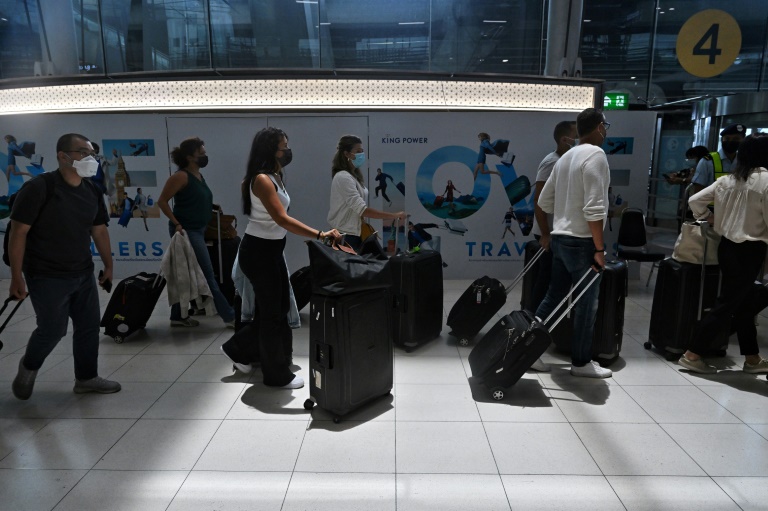
Thailand celebrated the arrival of its 10 millionth international visitor of 2022 on Saturday, according to the tourism authority, as the kingdom consolidated the recovery of its Covid-battered travel sector.

Thailand welcomed some 40 million people in 2019, but then the pandemic hit and travel was decimated as nations tightened border controls to contain the coronavirus.

With those restrictions easing worldwide Thailand’s travel numbers have begun a slow recovery and the government expects to generate nearly $16 billion in tourism revenue this year.

Traditional dancers and drummers at Bangkok’s Suvarnabhumi International Airport on Saturday welcomed passengers arriving on a Saudi Arabian Airlines flight that authorities believe clocked the 10-million milestone.

“The sky is open,” Thai Prime Minister Prayut Chan-O-Cha said in a speech at the airport.

“We would like to build confidence that Thailand is still one of the (top) tourist destinations of people around the world.”

Finance minister Arkhom Termpittayapaisith said this week that visitor numbers were expected to grow next year too.

Government figures suggest Thailand would welcome roughly 23 million tourists in 2023, while some analysts believe a full recovery in tourist numbers could happen in 2024.

Thai hotel owners and restauranteurs have breathed a sigh of relief as business has slowly picked up.

Marisa Sukosol, president of the Thai Hotels Association, welcomed the 10 million travellers milestone “after two years and a half of pain”.

“I think next year we will see continuous momentum of growth,” she said, pointing to the return of tourists from Russia and across the Asia-Pacific region.

But she cautioned against over-optimism — economic stagnation as well as lingering pandemic threats continue to impact the tourism sector.

While Thailand has benefited from the loosening of travel restrictions by other nations, its tourism industry has also been affected by the global economic slowdown and persistent inflation.

Recovery in the tourism sector is also heavily dependent on China relaxing international travel rules, Thai officials have said.

China was previously the biggest source of foreign tourists for Thailand. 

UK charity suspends work after royal race row

The UK charity at the centre of a royal racism controversy says it has suspended work supporting black survivors of domestic abuse, after a torrent of toxic hate.

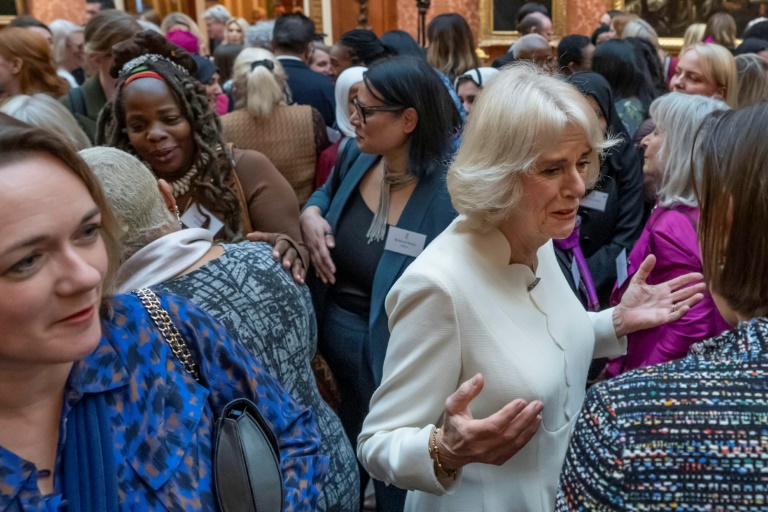
Sistah Space founder Ngozi Fulani, who is British, was asked repeatedly at a Buckingham Palace reception on November 29 where she was “really” from. 

Since revealing the exchange with Lady Susan Hussey, 83, a godmother to Prince William, Fulani has been targeted by what she called “horrific” racist insults online.

In a statement late Friday, she said that as a result, Sistah Space had been “forced to temporarily cease” many of its operations to protect clients and staff.

“We are overwhelmed by the amount of support and encouragement and look forward to fully reinstating our services as soon as safely possible,” Fulani added. 

Hussey resigned from her role as a palace courtier after the row, and Prince William condemned his godmother’s interrogation of Fulani as “unacceptable”.

But it revived attacks on the royal family in the days before William’s estranged younger brother Harry and wife Meghan aired new accusations of racial bias in a Netflix documentary this week.

Close Bitnami banner
Bitnami