World

Lima's streets tense as Peru leader hints at early elections

Peru’s new president Dina Boluarte has said she will form a new government Saturday, even as demonstrators pressed on Lima streets for ex-president Pedro Castillo to be freed after an alleged failed coup bid.

Boluarte told journalists that if the situation “warrants it,” the government will consult with Congress on holding an early presidential vote.

She urged those “who are coming out in protest … to calm down.”

Demonstrations continued on Friday, with protesters blocking roads with rocks, logs, and burning tires as they called for early elections.

The roadblocks interrupted traffic along the southern Pan-American Highway that links Peru and Chile.

Two days after the failure of his coup attempt, Castillo is sharing a detention center with former president Alberto Fujimori at a police base in Lima.

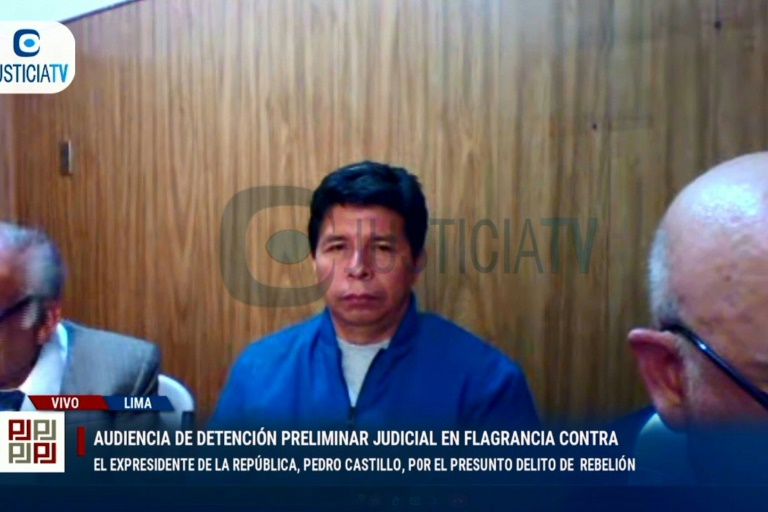
The prosecution accuses this left-wing rural teacher of rebellion and conspiracy, and a high court ordered him into seven days in preliminary detention.

On the streets, meanwhile, the demonstrations continue for the second day and fuel uncertainty about the possibility that Boluarte can conclude her term in 2026, as she herself announced upon taking office.

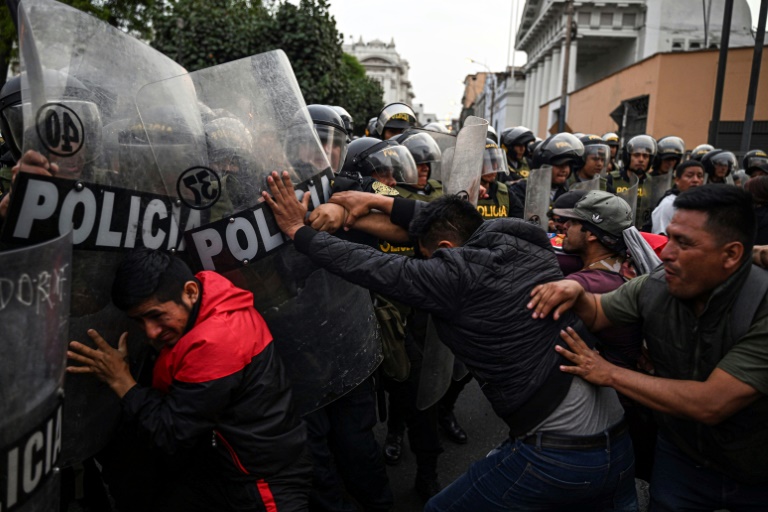
Hundreds of demonstrators marched through the colonial center of the capital, demanding Castillo’s release. 

“I voted for Castillo, this Congress does not represent us, we want Castillo freed,” Maribel Quispe told AFP, in the march that left the central Plaza San Martin, and included the Prosecutor’s Office on its route to Congress.

“We want them to close this corrupt Congress and free Castillo. He made the decision to close Congress because they wouldn’t let him work,” marcher Sara Medina said.

Several dozen riot police officers closed the avenues that lead to the legislature to prevent the protest from passing through. 

The demonstrators burned banners with the image of President Boluarte, shouting “coup leader!”

Earlier Friday, Castillo’s former chief of staff said that the Peruvian ex-president “could have been induced” by drugs to dissolve Congress and does not remember delivering the national address that led to his downfall.

Congress was supposed to debate Castillo’s impeachment on Wednesday on corruption charges, but the president preempted them by announcing in a televised speech that he was dissolving the assembly and would rule by decree.

“There are indications that the president was forced to read the message of dissolution, and whoever wrote the text did so in order to provide an argument for his removal,” ex-aide Guido Bellido said on Twitter.

Bellido, who visited his former boss at the Lima police base where he is held while under investigation for rebellion and conspiracy, also questioned Castillo’s mental condition. 

“The psychological state of P. Castillo when reading the message to the nation shows that he was not in control of his faculties. This suggests that he could have been induced. A toxicological test is urgently needed,” he said.

The former rural school teacher won a shock electoral victory over Peru’s traditional elites in June 2021.

The charges against him carry a jail term of between 10 and 20 years.

Boluarte, who served as vice president under Castillo, was hastily sworn in as Peru’s first woman president just hours after the impeachment.

However, doubt is mounting over her ability to hold onto the job until the end of her mandate in 2026 in a country prone to political instability that is now on its sixth president in six years.
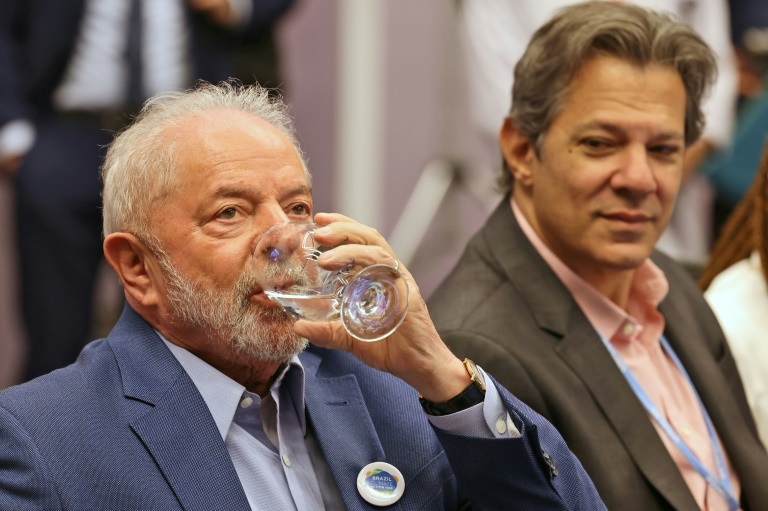
Brazil's Lula appoints former mayor as finance minister

Brazil’s president-elect Luiz Inacio Lula da Silva on Friday named former Sao Paulo mayor Fernando Haddad, viewed unfavorably by many in the business community, as his finance minister.

Lula da Silva, who narrowly defeated incumbent Jair Bolsonaro in October elections, unveiled ministers in the key posts of foreign affairs, justice, defense, and chief of staff.

However, all eyes were on his pick for finance minister, with markets nervous over the incoming government’s commitment to fiscal discipline and the inflation-hit economy in fragile recovery.

“(I chose) comrade Fernando Haddad as Minister of Finance,” Lula said during a press conference in the capital Brasilia.

Haddad, 59, who served as education minister from 2005 to 2012, succeeds powerful liberal economy minister Paulo Guedes, an ally of far-right President Jair Bolsonaro.

After Lula’s new government takes office following his January 1 inauguration, the economy ministry will be dissolved and transformed into finance, industry and planning agencies.

When Haddad’s name started circulating for the role, markets reacted with unease, viewing him as too much on the left and fearing he would jeopardize the budgetary balance.

“He represents the heterodox economic policy” that Lula’s Workers’ Party (PT) defends, said Antonio Madeira of the MCM consultancy firm.

Madeira said that with Haddad in the finance ministry, he expects “an increase in spending” and “a more assertive state giving a significant role to public companies.”

Despite some of the reluctance towards Haddad, the Sao Paulo Stock Exchange’s Ibovespa index was up Friday by 0.5% after the names of the future ministers were announced.

Haddad said that in 2023 he will prioritize tax reform, a new fiscal framework, as well as “recover the international agreements that are stopped,” such as Mercosur-European Union.

Lula also tapped Mauro Vieira as foreign minister. 

Vieira is a 71-year-old career diplomat who has already served as foreign minister as well as ambassador to Argentina, the United States and the United Nations.

He is currently serving as ambassador to Croatia, which on Friday knocked Brazil out of the World Cup.

For the justice ministry, Lula appointed Flavio Dino, a former governor of the northeastern state of Maranhao.

Rui Costa, governor of the province of Bahia, was named to a ministry that falls between the roles of prime minister and chief of staff.

Jose Mucio Monteiro, a civilian, was named defense minister.

After appointing five white men to the key ministries, Lula promised that “in time, you will see more women than men here… as well as a number of Afro-Brazilians.”

“We will try and form a government in the image of Brazilian society.”

Lula, a former union leader who already served two terms as president between 2003 and 2010, said that he would announce the names of more ministers next week and he has “not yet decided the total number of ministers” he would have in his government.

One of the most highly anticipated posts is that of the environmental minister, who will play a crucial role as Brazil seeks to tackle deforestation in the Amazon.

Brazil's Lula appoints former mayor as finance minister

Brazil’s president-elect Luiz Inacio Lula da Silva on Friday named former Sao Paulo mayor Fernando Haddad, viewed unfavorably by many in the business community, as his finance minister.

Lula da Silva, who narrowly defeated incumbent Jair Bolsonaro in October elections, unveiled ministers in the key posts of foreign affairs, justice, defense, and chief of staff.

However, all eyes were on his pick for finance minister, with markets nervous over the incoming government’s commitment to fiscal discipline and the inflation-hit economy in fragile recovery.

“(I chose) comrade Fernando Haddad as Minister of Finance,” Lula said during a press conference in the capital Brasilia.

Haddad, 59, who served as education minister from 2005 to 2012, succeeds powerful liberal economy minister Paulo Guedes, an ally of far-right President Jair Bolsonaro.

After Lula’s new government takes office following his January 1 inauguration, the economy ministry will be dissolved and transformed into finance, industry and planning agencies.

When Haddad’s name started circulating for the role, markets reacted with unease, viewing him as too much on the left and fearing he would jeopardize the budgetary balance.

“He represents the heterodox economic policy” that Lula’s Workers’ Party (PT) defends, said Antonio Madeira of the MCM consultancy firm.

Madeira said that with Haddad in the finance ministry, he expects “an increase in spending” and “a more assertive state giving a significant role to public companies.”

Despite some of the reluctance towards Haddad, the Sao Paulo Stock Exchange’s Ibovespa index was up Friday by 0.5% after the names of the future ministers were announced.

Haddad said that in 2023 he will prioritize tax reform, a new fiscal framework, as well as “recover the international agreements that are stopped,” such as Mercosur-European Union.

Lula also tapped Mauro Vieira as foreign minister. 

Vieira is a 71-year-old career diplomat who has already served as foreign minister as well as ambassador to Argentina, the United States and the United Nations.

He is currently serving as ambassador to Croatia, which on Friday knocked Brazil out of the World Cup.

For the justice ministry, Lula appointed Flavio Dino, a former governor of the northeastern state of Maranhao.

Rui Costa, governor of the province of Bahia, was named to a ministry that falls between the roles of prime minister and chief of staff.

Jose Mucio Monteiro, a civilian, was named defense minister.

After appointing five white men to the key ministries, Lula promised that “in time, you will see more women than men here… as well as a number of Afro-Brazilians.”

“We will try and form a government in the image of Brazilian society.”

Lula, a former union leader who already served two terms as president between 2003 and 2010, said that he would announce the names of more ministers next week and he has “not yet decided the total number of ministers” he would have in his government.

One of the most highly anticipated posts is that of the environmental minister, who will play a crucial role as Brazil seeks to tackle deforestation in the Amazon.

Bootleg album of jailed R&B star R. Kelly surfaces on Spotify and Apple Music: media

A previously unreleased album by disgraced US R&B singer R. Kelly, who is serving a 30-year sentence for sex offenses, dropped Friday on the Spotify and Apple Music platforms, a recording that the music press described as a bootleg. 

The release of the album, called “I Admit It,” was first reported by the celebrity entertainment site TMZ. It featured 13 tracks, including the 19-minute title song, which had been published on SoundCloud in 2018 before Kelly was convicted of sex crimes against teenage girls and producing child pornography. 

Spotify did not respond to an AFP request for comment and a few hours after the initial reports by TMZ and the Hollywood Reporter, the disc was no longer available on either music platform. 

Questioned by Variety, a representative for Sony Music, which owns Kelly’s musical rights, said the album had been briefly and unofficially made public, which, according to Variety, meant it had been a bootleg copy. 

A lawyer for Kelly, Jennifer Bonjean, told Variety the singer and his entourage were not behind this release and that her client “is having intellectual property stolen from him.” 

The singer, known worldwide for his hit “I Believe I Can Fly” and who sold 75 million records, was found guilty in September 2021 in a New York court of having masterminded a “system” of sexual exploitation of young women for three decades, including teenage girls. 

For these sexual crimes, the federal court in Brooklyn sentenced him to 30 years in prison. 

Last September, a court in Chicago, Illinois, found him guilty of production of child pornography and embezzlement from a minor. 

He could face a sentence of 10 to 90 years in prison, according to federal prosecutors in Illinois. 

The lawsuits against Kelly were seen as a major milestone in the #MeToo movement, as the majority of plaintiffs in the case were Black women. 

For decades, Kelly’s stellar career had been dogged by rumors and suspicions of sexual violence. He had long managed to silence them with financial agreements that included confidentiality clauses.

US basketball star Griner back home after Russia prisoner swap

American basketball star Brittney Griner was taken to a US Army base in Texas for a medical checkup on Friday after being released from a Russian prison in exchange for a notorious arms dealer known as the “Merchant of Death.”

Griner, who was arrested in Russia in February on drug charges, arrived overnight in San Antonio from Abu Dhabi, where the prisoner swap took place, and did not make any public statements.

Robert Whetstone, a spokesman for the Brooke Army Medical Center at Joint Base San Antonio-Fort Sam Houston, said the 32-year-old Griner, who is from Texas, was taken to the facility “as is standard protocol.”

“The US government is focused on ensuring that Brittney Griner and her family’s well-being are prioritized and that all assistance available be offered in an appropriate manner,” Whetstone said.

White House national security spokesman John Kirby told NBC that Griner was in “very good spirits when she got off the plane and appeared to be obviously in good health.”

Kirby said she would be given “all the access she needs to health care workers just to make sure that she is OK.”

Griner was exchanged in Abu Dhabi on Thursday for Viktor Bout, a 55-year-old Russian national who was serving a 25-year sentence in a US prison.

In footage released by Russian state media, Griner, shorn of her distinctive dreadlocks, and a relaxed and animated Bout crossed paths on the airport tarmac and headed towards the planes that would take them home.

Griner, a two-time Olympic gold medalist, WNBA champion and LGBTQ trailblazer, was arrested at a Moscow airport against a backdrop of soaring tensions over Ukraine.

– Putin says ‘compromises’ found –

Griner was accused of possessing vape cartridges with a small quantity of cannabis oil and sentenced in August to nine years in prison.

Bout, who was accused of arming rebels in some of the world’s bloodiest conflicts, was detained in a US sting operation in Thailand in 2008, sent to the United States and sentenced in 2012 to 25 years behind bars.

Bout told Kremlin-run media on Friday that Western countries were seeking to “destroy” Russia.

“The West believes that they did not finish us off in 1990, when the Soviet Union began to disintegrate,” Bout told state-run channel RT. “They think that they can just destroy us again and divide Russia.”

While Griner’s family and friends celebrated her release, another American held in Russia, former US Marine Paul Whelan, detained since 2018 and accused of spying, expressed disappointment he was not part of the swap.

The Griner family expressed solidarity with Whelan, saying in a statement: “We pray for Paul and for the swift and safe return of all wrongfully-detained Americans.” 

Russia President Vladimir Putin said Friday that other prisoner swaps with Washington were possible.

“This is the result of negotiations and the search for compromises,” Putin said. “In this case, compromises were found and we aren’t refusing to continue this work in the future.”

– ‘Joy and relief’ –

President Joe Biden announced Griner’s release on Thursday flanked by her wife, Cherelle Griner, and thanked the UAE for helping “facilitate” it.

WNBA commissioner Cathy Engelbert said there was a “collective wave of joy and relief” in the women’s professional league where Griner has been a star for a decade with the Phoenix Mercury.

At the time of her arrest, Griner had been playing for a professional team in Russia, as a number of WNBA players do in the off-season.

She pleaded guilty to the charges against her, but said she did not intend to break the law or use the banned substance in Russia.

Griner testified that she had permission from a US doctor to use medicinal cannabis to relieve pain from her many injuries.

The use of medical marijuana is not allowed in Russia.

The 2005 film “Lord of War” starring Nicolas Cage was based in part on Bout’s arms trafficking exploits, and he has been the subject of several books and TV shows.

Speaking to MSNBC, Kirby acknowledged concerns Bout could return to criminal activity.

“We’re going to make sure now that he’s a free man that we’re looking after our national security interests and we’re as vigilant as we can be,” he said.

Stock markets mixed on renewed US Fed rate fears

Global stocks had a mixed showing Friday, with hotter-than-expected US wholesale prices renewing concerns that the Federal Reserve will push on with aggressive policies against inflation.

Investors have been poring over economic data as they try to anticipate if the US central bank will shift to a softer approach to interest rate hikes at a regular meeting next week.

While inflation has shown signs of easing, government data released Friday showed that producer prices still remained elevated, sending key US indices into the red.

Meanwhile, markets welcomed China’s easing of its zero-Covid restrictions, which have hammered the world’s second biggest economy.

China’s consumer inflation slowed further in November as well, falling below two percent and giving authorities room to unveil fresh stimulus measures.

Hong Kong shares closed sharply higher Friday, building on big gains for the week while Chinese mainland markets were also higher.

European markets also ended the day higher.

Wall Street stocks finished lower, with the S&P 500 and Nasdaq Composite Index both shedding 0.7 percent, while the Dow Jones Industrial Average fell 0.9 percent.

This came after the producer price index — a gauge of inflation — rose by 0.3 percent in November, more than analysts expected.

“Wall Street had a somewhat mixed day of economic data,” said Edward Moya of the OANDA trading platform.

“A hot PPI report was then countered by a University of Michigan report that showed inflation expectations are coming down quickly,” he added in a note.

For now, markets are keeping a close eye on consumer price data due next week, which in turn could have a bearing on the Fed’s monetary policy path.

The Fed has raised rates by 0.75 percentage points in each of its last four meetings, but is widely expected to slow the pace after central bankers gather next week.

However, investors are concerned that a strong jobs market and other data might convince the Fed to tighten monetary policy longer than hoped.

The European Central Bank and the Bank of England also have rate decisions due next week after hiking their rates sharply this year.

“The hotter-than-expected PPI print called into question the ‘peak inflation’ narrative, although traders know that it is too late for the Fed to change its mind about a 50 (basis points) hike next week,” said Fawad Razaqzada, market analyst at Forex.com and City Index.

Elsewhere, oil prices jumped by more than one percent as Russian President Vladimir Putin threatened to cut production after Western nations imposed a $60 price cap on Russian crude.

“Today’s modest rebound however doesn’t change the fact that oil prices are now well below the levels they were at the time of the Russian invasion of Ukraine,” noted market analyst Michael Hewson at CMC Markets.

– Key figures around 2130 GMT –

New York – Dow: DOWN 0.9 percent at 33,476.46 (close)

New York – S&P 500: DOWN 0.7 percent at 3,934.38 (close)

New York – Nasdaq: DOWN 0.7 percent at 11,004.61 (close)

EURO STOXX 50: UP 0.5 percent at 3,942.62 (close)

London – FTSE 100: UP less than 0.1 percent at 7,476.63 (close)

Frankfurt – DAX: UP 0.7 percent at 14,370.72 (close)

Paris – CAC 40: UP 0.5 percent at 6,677.64 (close)

Tokyo – Nikkei 225: UP 1.2 percent at 27,901.01 (close)

Hong Kong – Hang Seng Index: UP 2.3 percent at 19,900.87 (close)

Shanghai – Composite: UP 0.3 percent at 3,206.95 (close)

Euro/dollar: DOWN at $1.0534 from $1.0560 on Thursday

Dollar/yen: DOWN at 136.57 yen from 136.61 yen

Pound/dollar: UP at $1.2262 from $1.2239

Euro/pound: DOWN at 85.90 pence from 86.24 pence

Brent North Sea crude: DOWN 0.1 percent at $76.10 per barrel

West Texas Intermediate: DOWN 0.6 percent at $71.02 per barrel

US and Russia again make deal but broader diplomacy on ice

The United States and Russia again showed they can do business with their second prisoner exchange this year but, despite some suggestions by Moscow, few expect broader diplomacy over the Ukraine war.

Working-level US and Russian diplomats met Friday, a day after the swap, in Istanbul but a US official said they discussed a “narrow set of bilateral issues” and not the Ukraine war.

In a scene whose choreography if not personalities were reminiscent of the Cold War, basketball star Brittney Griner, arrested on minor drug charges, walked on the tarmac in Abu Dhabi on Thursday to a plane that took her back to the United States.

Walking in the other direction was Viktor Bout, an arms dealer arrested in a 2008 US sting operation in Thailand, who triumphantly returned home and declared that the West wants to “destroy” Russia.

Still in prison was Paul Whelan, an American accused by Russia of espionage. The former Marine’s detention sparked criticism of President Joe Biden by his Republican rivals, although the administration insisted it was still working to free him.

The Biden administration said that Russia did not budge. But President Vladimir Putin one day later dangled the possibility, saying that further swaps were “possible” with the United States, sparking speculation on which Russians he seeks to free.

“This is the result of negotiations and the search for compromises,” Putin told reporters on a visit to Kyrgyzstan.

He also said on Ukraine that “ultimately, in the end, an agreement will have to be reached” in Ukraine — which he invaded in February, prompting a furious defense backed by Western weapons that has driven back Russian forces.

– ‘Nothing more’ –

The United States and Russia arranged the prisoner exchange through quiet back channels with assistance from the United Arab Emirates.

In April, the two countries carried out a similar deal, swapping Trevor Reed, a former Marine who got into a drunken brawl, for drug-smuggling pilot Konstantin Yaroshenko, with the two swapped in Istanbul.

Turkey, the scene of Friday’s closed-door talks, and the United Arab Emirates both have complicated alliances with the United States and have balked at efforts to isolate Moscow, serving as hubs for Russian expatriates. 

Secretary of State Antony Blinken had proposed the prisoner swap involving Griner to his counterpart, Russian Foreign Minister Sergei Lavrov, in a July telephone call, their only known direct conversation since the war.

Blinken said after Griner’s release that the United States was also willing to work with Russia on narrow issues such as arms control but that the swap indicated no wider diplomatic opening.

“This is about getting unjustly detained Americans back to their families,” Blinken told CBS News. 

“That was the focus. It’s nothing more. It’s also nothing less.”

Western diplomats privately say it is crucial not to let back-channel diplomacy play into the hands of Putin by making Russia an issue of the United States versus Russia.

Russia alleges it faced a threat from Ukraine’s NATO aspirations. The United States insists that any peace initiative is up to Ukraine, the country that was invaded, and that it will not negotiate over Kyiv’s head.

Will Pomeranz, director of the Wilson Center’s Kennan Institute, said the swap was purely focused on the desires to free prisoners.

“I don’t think this will have any impact really on US-Russia relations. They are in such a terrible, terrible state and I don’t think this really changes the dynamic,” he said.

US sounds alarm over 'harmful' Iran-Russia military partnership

The United States on Friday expressed alarm over a “full-scale defense partnership” between Moscow and Tehran, describing it as “harmful” to Ukraine, Iran’s neighbors and the world.

Iran stands accused by Western powers of supplying drones to Russia — which rejected the US allegations — as Moscow batters Ukraine’s energy infrastructure in search of an advantage in the bloody conflict.

Washington has previously condemned Iran-Russia security cooperation, but on Friday described an extensive relationship involving equipment such as helicopters and fighter jets as well as drones, with the latter items resulting in new US sanctions.

“Russia is seeking to collaborate with Iran in areas like weapons development, training,” White House national security spokesman John Kirby told reporters.

Moscow “is offering Iran an unprecedented level of military and technical support — that is transforming their relationship into a fully fledged defense partnership,” he said.

“We have also seen reports that Moscow and Tehran are considering the establishment of a joint production line for lethal drones in Russia. We urge Iran to reverse course (and) not to take these steps.”

Moscow’s UN envoy Vassily Nebenzia pushed back later in the day, telling a Security Council meeting that “the military industrial complex in Russia can work perfectly fine and doesn’t need anyone’s assistance.”

The drone allegations, he said, were “already refuted” multiple times before.

Earlier, Kirby announced that the United States would sanction three Russian-based entities active in “the acquisition and use of Iranian drones.”

The sanctions target the Russian Aerospace Forces, the 924th State Center for Unmanned Aviation, and the Command of the Military Transport Aviation.

“The United States will continue to use every tool at our disposal to disrupt these transfers and impose consequences on those engaged in this activity,” Secretary of State Antony Blinken said in a statement on the sanctions.

Last month, Tehran admitted it had sent drones to Russia, but insisted they were supplied before the invasion of Ukraine.

– ‘Sordid deals’ –

Kirby said the United States is also concerned that Russia “intends to provide Iran with advanced military components,” including helicopters and air defense systems.

Iranian pilots have reportedly been learning to fly advanced Sukhoi Su-35 warplanes in Russia, and Tehran may receive the aircraft within the next year, which would “significantly strengthen Iran’s air force relative to its regional neighbors,” Kirby said.

The United States also believes that Iran is considering the sale of “hundreds of ballistic missiles” to Russia, he said.

Britain’s Foreign Secretary James Cleverly took aim Friday at the “sordid deals” between Moscow and Tehran, saying in a statement that Iran had sent drones to Russia in exchange for “military and technical support” from Moscow.

This “will increase the risk it poses to our partners in the Middle East and to international security,” Cleverly said, vowing that “the UK will continue to expose this desperate alliance and hold both countries to account.”

Kirby on Friday announced a new $275 million aid package to help boost Ukraine’s air defenses, against Russian drones in particular.

He said the aid “will soon be on its way to provide Ukraine with new capabilities to boost its air defenses and counter the threats that Ukraine is facing from drones.”

The Pentagon released details on the package, saying it includes counter-drone equipment, as well as ammunition for Himars precision rocket systems, 80,000 155mm artillery rounds, some 150 generators, and other equipment.

The United States has previously said that generators were being provided to Kyiv to help Ukraine with its electricity needs amid repeated Russian strikes on energy infrastructure.

The latest package — which is made up of equipment taken from existing US stocks — brings Washington’s military assistance to Ukraine since Russia’s February 24 invasion to more than $19.3 billion.

Belgium makes EU parliament arrests in Qatar corruption probe

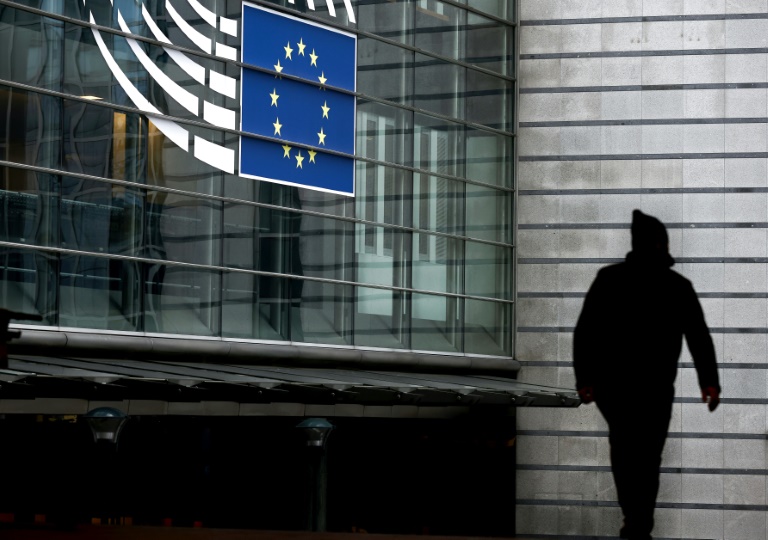
Belgian police arrested a European Parliament vice-president and four others in connection with an investigation into corruption implicating World Cup hosts Qatar, the prosecutors office said Friday.

Officers arrested Greek socialist MEP Eva Kaili hours after four other suspects had been detained for questioning. All four were either Italian citizens or originally came from Italy, a source close to the case told AFP.

Kaili is the partner of one of the four, a parliamentary assistant with the European Parliament’s Socialists and Democrats group, said the source.

Following reports of Kaili’s arrest, the president of the Greek socialists (PASOK) Nikos Androulakis announced on Twitter that she had been expelled from the party.

A statement issued earlier by Belgian prosecutors mentioned a Gulf country in connection with an investigation into corruption and money laundering, but did not name it. And while it said a former MEP was among those arrested, it did not identify him.

But Belgian press reports said the country concerned was Qatar, and named the former MEP as Italy’s Pier-Antonio Panzeri, who served as a socialist in the parliament between 2004 and 2019.

— 600,000 euros seized —

Belgium’s federal prosecutor announced the earlier arrests after a series of raids at 16 addresses raids in the capital Brussels. 

“Today’s searches have enabled investigators to recover about 600,000 euros in cash,” the prosecutors said in a statement. 

“Computer equipment and mobile phones were also seized. These elements will be analysed as part of the investigations.”

Investigators “suspected a Gulf country (of influencing) the economic and political decisions of the European parliament”, the statement added.

It alleged this was done “by paying large sums of money or offering large gifts to” influential figures in the European parliament.

A source close to the case confirmed press reports that the investigation was into suspected attempts by Qatar to corrupt an Italian Socialist former MEP, who Belgian outlets Le Soir and Knack named as Panzeri.

– ‘Recognised and respected’ –

Kaili, 44, is a former television presenter and currently one of the European Parliament’s 14 vice presidents. In November, shortly before the World Cup started, she met Qatar’s Labour Minister Ali bin Samikh Al Marri.

In a video statement posted on Twitter by the Qatar News Agency she said: “I believe the World Cup for Arabs has been a great tool for… political transformation and reforms…”.

The European Parliament “recognised and respected” Qatar’s progress in labour reforms, she added.

She made similar comments during a speech at the European Parliament later in November, accusing some MEPs of “bullying” Qatar and accusing them of corruption.

Panzeri, 67, currently heads a Brussels-based human rights organisation called Fight Impunity. 

According to the reports, the secretary general of the International Trade Union Confederation (ITUC), Italian Luca Visentini, was also among those arrested. The ITUC said it was “aware” of the media reports, but had no further comment to make at present. 

– Corruption accusations –

The alleged bribery comes as World Cup host Qatar has made a major push to improve its image in the face of criticism over its record on worker protections and human rights. 

Interviewed by AFP on Monday, Visentini welcomed progress made by Qatar on worker rights, but insisted “pressure” needed to be maintained once the football tournament finishes.

Migrant workers make up more than 2.5 million of Qatar’s 2.9 million population and labour conditions have been strongly criticised — particularly in the lead-up to the World Cup.

Doha has implemented reforms to its migrant labour system, but critics insist more work needs to be done to make sure the changes have an impact. 

Qatar’s World Cup has also been dogged by accusations of corruption surrounding the FIFA members’ vote to award the tournament to the energy-rich Gulf state.

Belgium’s France Soir newspaper pointed out that Friday’s police raids came on the United Nations-designated International Anti-Corruption Day.

Peru's ousted president may have been drugged: ex-aide

Pedro Castillo’s former chief of staff said Friday that the Peruvian ex-president “could have been induced” by drugs to dissolve Congress and does not remember delivering the national address that led to his downfall.

Congress was supposed to debate Castillo’s impeachment on Wednesday on corruption charges, but the president preempted them by announcing in a televised speech that he was dissolving the assembly and would rule by decree.

“There are indications that the president was forced to read the message of dissolution, and whoever wrote the text did so in order to provide an argument for his removal,” ex-aide Guido Bellido said on Twitter.

Bellido, who visited his former boss at the Lima police base where he is held while being investigated for rebellion and conspiracy, also questioned Castillo’s mental condition. 

“The psychological state of P. Castillo when reading the message to the nation shows that he was not in control of his faculties, this suggests that he could have been induced, a toxicological test is urgently needed,” he said.

Bellido, who was Castillo’s first chief of staff in 2021, posted a photo of Castillo in detention, with the message “Be strong, President, the people will free you.”

The suggestion that Castillo acted under the influence of drugs was also put forward by Guillermo Olivera, one of his lawyers. 

“When the former president read that message written by others, a few minutes before they had given him a drink, allegedly water, and that after drinking the water he felt stunned,” Olivera told reporters from the detention center.

“Everyone has seen that he was reading shakily, and I would hypothesize even further, that he was also a little sedated.”

Peru was plunged into political crisis this week when leftist Castillo — facing a third impeachment bid — tried to dissolve Congress.

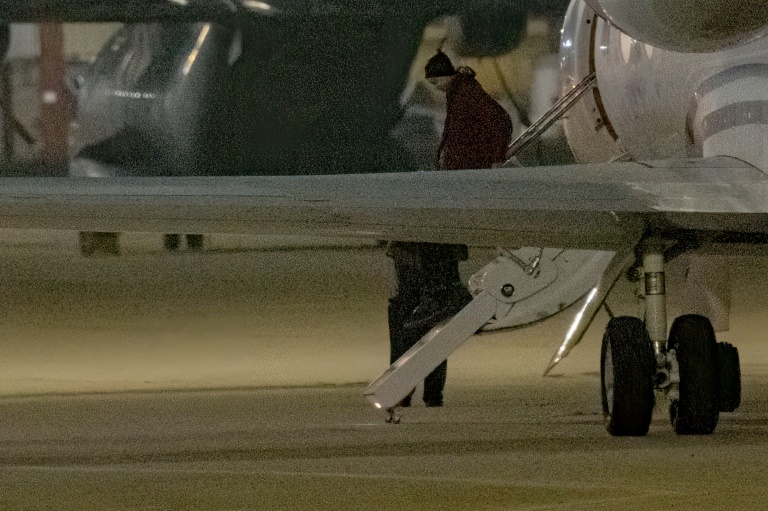
Lawmakers quickly gathered to vote him out of office, and Castillo was arrested on his way to the embassy of Mexico, which had agreed to give him asylum.

The former rural school teacher, who won a shock election victory over Peru’s traditional elites in June 2021, is being held in provisional detention for seven days.

Close Bitnami banner
Bitnami