World

China's Xi to hold Arab summits on Saudi trip

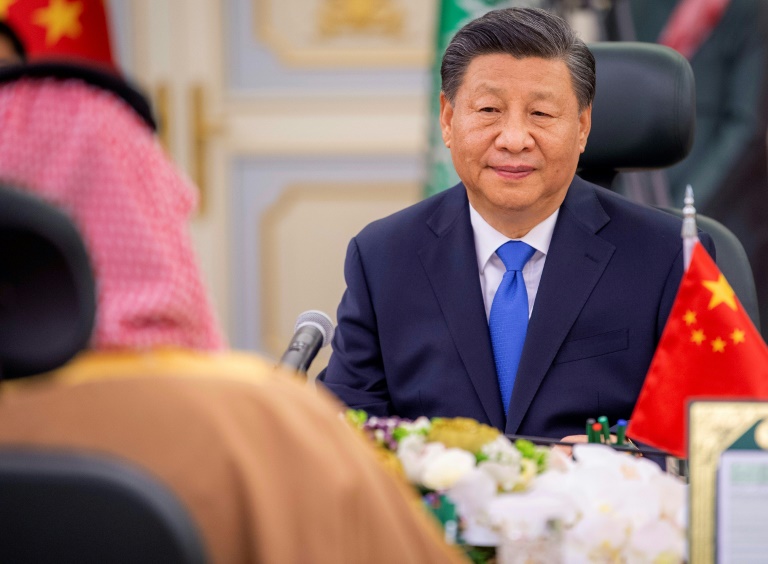
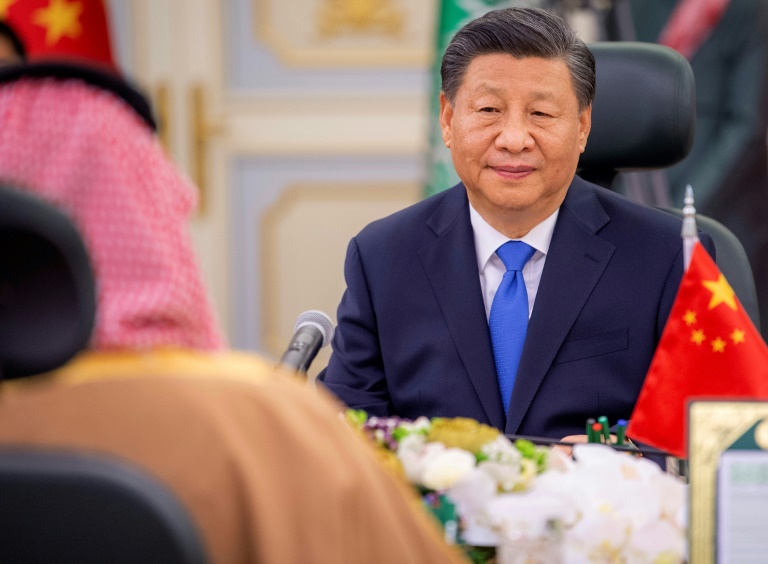
Chinese President Xi Jinping will meet Arab leaders at summits in Riyadh on Friday after striking a series of agreements with Saudi Arabia, strengthening ties as the top oil exporter quarrels with Washington.

The leader of the world’s second biggest economy will sit down with regional rulers on the third and final day of his trip, only his third journey outside China since the coronavirus pandemic began.

After talks with King Salman and his 37-year-old son Crown Prince Mohammed bin Salman, the de facto ruler, the two sides stressed “the importance of stability” in oil markets — a point of friction with the United States, which has urged the Saudis to raise production.

In a joint statement, they also spoke of “focusing on emissions rather than sources” in tackling climate change, the approach championed by the resource-rich Gulf monarchies. 

Forty-six agreements and memorandums of understanding were announced on everything from housing to Chinese language teaching. Both sides are seeking economic and strategic benefits by deepening cooperation.

However, few details were released despite a Saudi state media report on Thursday that about $30 billion in deals would be signed during Xi’s visit.

The two sides “stressed the importance of continuing joint action in all fields, deepening relations within the framework of the comprehensive strategic partnership between the two countries, and reaching new and promising horizons”, the statement said.

Xi’s visit comes at a time of tension between Saudi Arabia and the United States, its long-time partner and security guarantor, over oil production, human rights issues and regional security.

It follows US President Joe Biden’s trip to Jeddah in July, before mid-term elections, when he failed to persuade the Saudis to pump more oil to calm prices.

– ‘Prestige’ trade deals –

On Friday, Xi is to hold talks with the six-country, resource-rich Gulf Cooperation Council and attend a broader China-Arab summit.

The Gulf countries, strategic partners of Washington, are bolstering ties with China as part of an eastward turn that involves diversifying their fossil fuel-reliant economies.

At the same time China, hit hard by its Covid lockdowns, is trying to revive its economy and widen its sphere of influence, notably through its Belt and Road Initiative which provides funding for infrastructure projects around the world.

Officials have provided few details about Friday’s agenda, but one potential area is a China-GCC free trade agreement that has been under discussion for nearly two decades. 

“China will want to draw the lengthy negotiations to a close, as FTAs with major trading blocs is a matter of prestige for Beijing,” said Robert Mogielnicki of the Arab Gulf States Institute in Washington.

“It’s not as simple for the GCC states, which seem to be more invested in advancing bilateral ties and are engaged in varying degrees of regional economic competition with their neighbouring member states.” 

A breakthrough on the trade pact could help Saudi Arabia, the Middle East’s biggest economy, diversify its economy in line with the Vision 2030 reform agenda championed by Prince Mohammed. 

Yet Mogielnicki said the significance of the announcements made during Xi’s trip would only be clear if the projects become reality.

“When it comes to China’s bilateral relations with the Gulf and broader Middle East, one must remember that signing MoUs and making investment pledges is much easier than actually committing capital,” he said. 

Xi’s trip has already earned a rebuke from the White House, which warned of “the influence that China is trying to grow around the world”. Washington called Beijing’s objectives “not conducive to preserving the international rules-based order”.
Global economic chiefs laud China's 'decisive' zero-Covid reversal

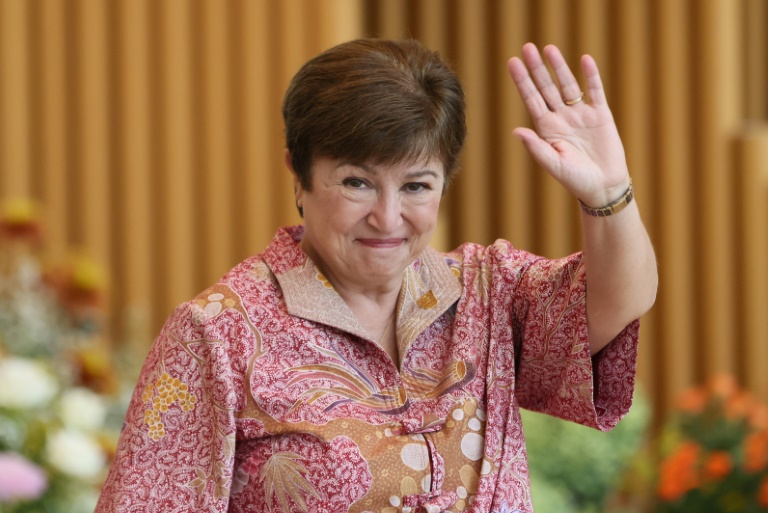
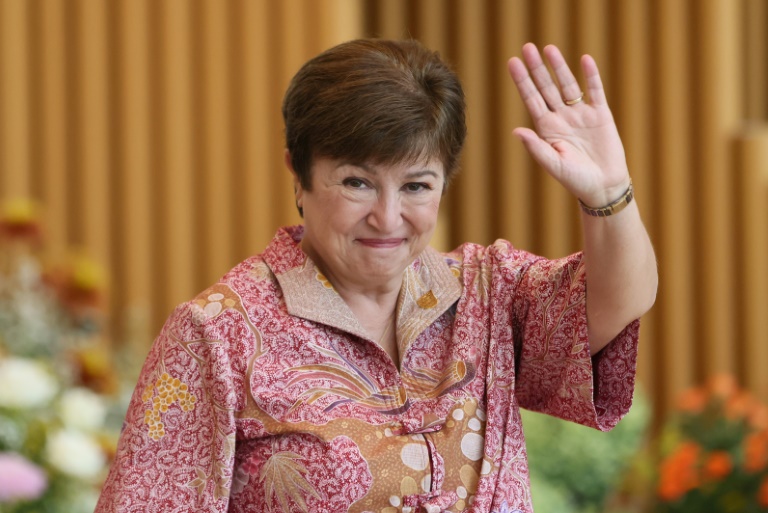
Global economic leaders on Friday hailed China’s move away from its hardline zero-Covid policy, with the IMF chief saying the “decisive actions” would help revive growth both in the country and globally.

The relaxation would help to shore up a world economy struggling with the impact of the pandemic and Russia’s invasion of Ukraine, the head of the World Trade Organization said after the conference in the eastern city of Huangshan, hosted by outgoing Chinese Premier Li Keqiang. 

Beijing on Wednesday announced a loosening of its zero-tolerance approach to coronavirus outbreaks, ending large-scale lockdowns and allowing some positive cases to isolate at home following widespread protests against the restrictions.

The decision indicated that the world’s second-largest economy is finally shifting towards living with Covid after years of grinding curbs stifled growth.

“We welcome very much the decisive actions taken by the Chinese authorities… to recalibrate the Covid policies so as to create a better impetus for the revival of growth in China,” Kristalina Georgieva said at a press briefing with the heads of other major economic institutions.

The effort to boost vaccination rates and anti-viral treatments “is very good for the Chinese people, but also important for Asia and the rest of the world”, Georgieva added.

“China’s performance matters (not just) to China — it matters to the world economy as well.”

The global economy has been rocked this year, with Russia’s brutal invasion of Ukraine adding to a stuttering post-pandemic recovery and a cost of living crisis in many countries.

The retreat from zero-Covid “will help remove one set of uncertainties” in a world reeling from the impacts of the pandemic, the war in Ukraine and climate change, said WTO Director-General Ngozi Okonjo-Iweala, at the same briefing.

Secretary-General of the Organisation for Economic Co-operation and Development, Mathias Cormann, said the “adjustments will support the strength of the recovery both in China and globally”.

Beijing’s step back from zero-Covid has so far helped to prop up global stock markets fearful of a looming recession in the United States, but analysts have warned that China’s route to a full reopening remains bumpy.

– Further relaxations –

Long criticised for disrupting business operations and global supply chains, the zero-Covid policy has acted as a constraint on China’s economy, with analysts expecting Beijing to miss its stated annual growth target of 5.5 percent.

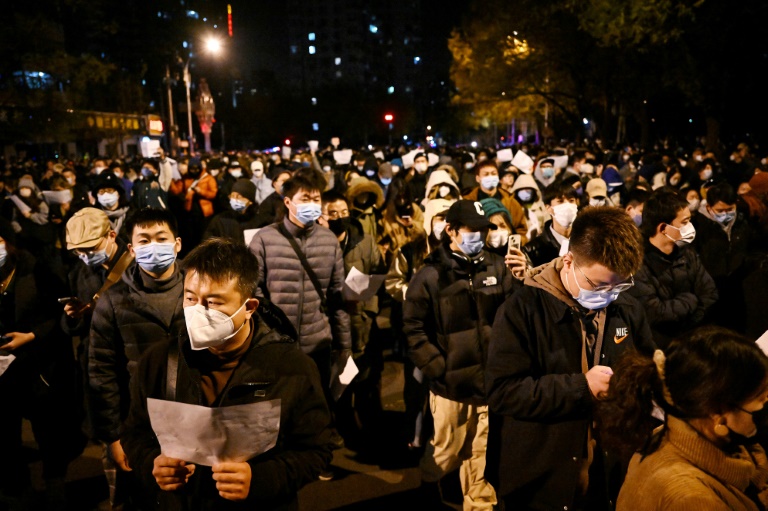
Public frustration with snap lockdowns and mass testing boiled over last month as protesters took to the streets in cities around the country, with some calling for greater political freedoms in China’s most widespread demonstrations since 1989.

On Friday, China rolled back more restrictions, with the culture and tourism ministry announcing that visitors will no longer be required to show “health codes” when entering a range of different venues.

A spokesperson for the National Health Commission said at a press briefing on Friday that hospitals must not refuse care to coronavirus-positive patients, state broadcaster CCTV reported.

The move marks a further pivot away from China’s longstanding strategy of isolating all those who test positive and treating them in specialist state-run facilities.

Demand for home treatments and personal protective gear has surged amid concerns over large-scale outbreaks, even though official statistics have reported a decline in new cases in recent days.

China’s market regulator said Friday that it would crack down on price gouging after the retail price of a traditional flu treatment as much as quadrupled in the first few days of December.

Global economic chiefs laud China's 'decisive' zero-Covid reversal

Global economic leaders on Friday hailed China’s move away from its hardline zero-Covid policy, with the IMF chief saying the “decisive actions” would help revive growth both in the country and globally.

The relaxation would help to shore up a world economy struggling with the impact of the pandemic and Russia’s invasion of Ukraine, the head of the World Trade Organization said after the conference in the eastern city of Huangshan, hosted by outgoing Chinese Premier Li Keqiang. 

Beijing on Wednesday announced a loosening of its zero-tolerance approach to coronavirus outbreaks, ending large-scale lockdowns and allowing some positive cases to isolate at home following widespread protests against the restrictions.

The decision indicated that the world’s second-largest economy is finally shifting towards living with Covid after years of grinding curbs stifled growth.

“We welcome very much the decisive actions taken by the Chinese authorities… to recalibrate the Covid policies so as to create a better impetus for the revival of growth in China,” Kristalina Georgieva said at a press briefing with the heads of other major economic institutions.

The effort to boost vaccination rates and anti-viral treatments “is very good for the Chinese people, but also important for Asia and the rest of the world”, Georgieva added.

“China’s performance matters (not just) to China — it matters to the world economy as well.”

The global economy has been rocked this year, with Russia’s brutal invasion of Ukraine adding to a stuttering post-pandemic recovery and a cost of living crisis in many countries.

The retreat from zero-Covid “will help remove one set of uncertainties” in a world reeling from the impacts of the pandemic, the war in Ukraine and climate change, said WTO Director-General Ngozi Okonjo-Iweala, at the same briefing.

Secretary-General of the Organisation for Economic Co-operation and Development, Mathias Cormann, said the “adjustments will support the strength of the recovery both in China and globally”.

Beijing’s step back from zero-Covid has so far helped to prop up global stock markets fearful of a looming recession in the United States, but analysts have warned that China’s route to a full reopening remains bumpy.

– Further relaxations –

Long criticised for disrupting business operations and global supply chains, the zero-Covid policy has acted as a constraint on China’s economy, with analysts expecting Beijing to miss its stated annual growth target of 5.5 percent.

Public frustration with snap lockdowns and mass testing boiled over last month as protesters took to the streets in cities around the country, with some calling for greater political freedoms in China’s most widespread demonstrations since 1989.

On Friday, China rolled back more restrictions, with the culture and tourism ministry announcing that visitors will no longer be required to show “health codes” when entering a range of different venues.

A spokesperson for the National Health Commission said at a press briefing on Friday that hospitals must not refuse care to coronavirus-positive patients, state broadcaster CCTV reported.

The move marks a further pivot away from China’s longstanding strategy of isolating all those who test positive and treating them in specialist state-run facilities.

Demand for home treatments and personal protective gear has surged amid concerns over large-scale outbreaks, even though official statistics have reported a decline in new cases in recent days.

China’s market regulator said Friday that it would crack down on price gouging after the retail price of a traditional flu treatment as much as quadrupled in the first few days of December.

Equity markets boosted by China hopes, eyes now on US inflation

Stock markets rose Friday and the dollar dipped as traders continue to weigh concerns about rising interest rates and a possible recession against optimism over China’s economic reopening.

With few Thursday catalysts to work with, traders were setting their sights on the release of two key US inflation reports — on Friday and Monday — and the Federal Reserve’s final policy meeting of the year.

In light of data signalling that almost a year of interest rate hikes was beginning to impact prices, the US central bank is widely expected to announce a 50 basis point lift at the gathering, compared with the previous four straight 75-point increases.

But there remains some concern that the world’s top economy remains resilient and the jobs market too strong, meaning the Fed might have to keep tightening monetary policy longer than had been hoped.

That uncertainty has weighed on US markets, which have endured a tough December so far, and analysts warned of further pain.

“We think the worst is yet to come,” Gary Schlossberg, at Wells Fargo Investment Institute, told Bloomberg Television.

“We’re looking for a moderate recession next year, which means a moderate decline in corporate profits is our target for the year.”

The mood was slightly better in Asia, particularly Hong Kong, where investor sentiment has been buoyed by China’s decision to shift away from its nearly three-year zero-Covid strategy of lockdowns and mass testing that has battered the economy.

After widespread protests across the country, leaders have decided to loosen their grip, fanning excitement that growth will pick up as activity returns to normal.

A pledge to help the embattled property sector, which accounts for a huge part of the economy, was also providing a lift.

World economic leaders on Friday hailed Beijing’s move away from its hardline policy, with International Monetary Fund boss Kristalina Georgieva saying the “decisive actions” would help revive growth both in the country and globally.

– ‘Positive on China’ –

“The process will likely be gradual and bumpy over the year ahead, due to low immunisation of the population and unpreparedness of the health system to deal with a possible further surge in cases,” Silvia Dall’Angelo, at Federated Hermes, said in a note.

“Reopening should gain traction in the second half of next year. At that stage, the Chinese recovery will likely accelerate, as the removal of restrictions will allow fiscal and monetary stimulus to be effective.”

And JPMorgan strategist Marko Kolanovic added that he “remains positive on China, due to favourable monetary conditions as well as an eventual full reopening and end of Covid”.

Hong Kong rose more than two percent, while there were also positive performances in Tokyo, Shanghai, Sydney, Seoul, Singapore, Taipei, Bangkok, Mumbai and Manila.

London, Paris and Frankfurt opened with gains.

And the dollar dropped against most peers, having surged to record or multi-decade highs earlier this year owing to the Fed’s hawkish tilt and its use as a safe-haven hedge against volatility.

However, SPI Asset Management’s Stephen Innes warned that “with the who’s who of Wall Street advising clients to expect a market downswing in 2023, I doubt many investors are getting too excited about the move” higher in equities.

Oil prices rose after another big drop, with both main contracts down more than 10 percent this week as expectations for a recession in the United States and elsewhere weighed on demand expectations.

– Key figures around 0820 GMT –

Tokyo – Nikkei 225: UP 1.2 percent at 27,901.01 (close)

Hong Kong – Hang Seng Index: UP 2.3 percent at 19,900.87 (close)

Shanghai – Composite: UP 0.3 percent at 3,206.95 (close)

London – FTSE 100: UP 0.3 percent at 7,496.00

Euro/dollar: UP at $1.0570 from $1.0560 on Thursday

Dollar/yen: DOWN at 136.34 yen from 136.61 yen

Pound/dollar: UP at $1.2253 from $1.2239

Euro/pound: UP at 86.25 pence from 86.24 pence

West Texas Intermediate: UP 0.4 percent at $71.75 per barrel

Brent North Sea crude: UP 0.4 percent at $76.43 per barrel

New York – Dow: UP 0.6 percent at 33,781.48 (close)

Griner heads home after release from Russia in prisoner swap

American basketball star Brittney Griner was headed back to the United States on Friday after being released from a Russian prison in exchange for an arms dealer known as the “Merchant of Death.”

Griner, 32, who was arrested in Russia in February on drug charges, and Viktor Bout, 55, who was serving a 25-year sentence in a US prison, were exchanged at an airport in Abu Dhabi.

In footage released by Russian state media, Griner, shorn of her distinctive dreadlocks, and a relaxed and animated Bout could be seen crossing paths on the airport tarmac and heading towards the planes that would take them home.

President Joe Biden announced Griner’s release early Thursday in an address to the nation at the White House. “She is safe. She is on a plane. She is on her way home,” he said.

The president said he had spoken to her and she was in “good spirits” after suffering “needless trauma.”

Griner, a two-time Olympic gold medalist, WNBA champion and LGBT trailblazer, was arrested at a Moscow airport nine months ago against a backdrop of soaring tensions over Ukraine.

She was accused of possession of vape cartridges with a small quantity of cannabis oil and sentenced in August to nine years in prison.

Bout, who was accused of arming rebels in some of the world’s bloodiest conflicts, was detained in a US sting operation in Thailand in 2008, extradited to the United States and sentenced in 2012 to 25 years behind bars.

He landed in Russia Thursday, state television said. “Don’t worry, everything is OK, I love you very much,” he told his mother Raisa.

While Griner’s family and friends celebrated her release, another American held in Russia, Paul Whelan, a former US Marine detained since 2018 and accused of spying, was not part of Thursday’s exchange and he told CNN he was “greatly disappointed.”

“I don’t understand why I’m still sitting here,” Whelan told the US television network in a phone call from the Russian penal colony where he is imprisoned.

Biden pledged to obtain Whelan’s freedom, saying “we will never give up.”

“Sadly, for totally illegitimate reasons, Russia is treating Paul’s case different than Brittney’s,” he said.

As for Griner’s release, Biden said “this is a day we’ve worked toward for a long time. It took painstaking and intense negotiations.”

– ‘Family is whole’ –

Biden made the announcement flanked by Griner’s wife, Cherelle Griner, Vice President Kamala Harris and Secretary of State Antony Blinken.

“I’m just standing here, overwhelmed with emotions,” Cherelle Griner said.

She acknowledged Whelan’s fate, saying: “Today my family is whole, but as you all are aware there’s so many other families who are not whole.”

In a statement late Thursday, the Griner family thanked President Biden and his administration again, and said they “pray for Paul and for the swift and safe return of all wrongfully-detained Americans.”

“We ask that you respect our privacy as we embark on this road to healing,” they added. 

WNBA commissioner Cathy Engelbert said there was a “collective wave of joy and relief” in the women’s professional league where the 6’9″ (2.06 meter) Griner has been a star for a decade with the Phoenix Mercury.

NBA team The Phoenix Suns said the news of her release “put a smile on everybody’s face” on Thursday.

Biden thanked the United Arab Emirates for helping “facilitate” Griner’s release and the UAE issued a joint statement with Saudi Arabia saying it was the result of “mediation efforts” by leaders of the two Arab nations.

White House Press Secretary Karine Jean-Pierre said, however, there was “no mediation involved” and “the only countries that negotiated this deal were the United States and Russia.”

– ‘Rescue our compatriot’ –

At the time of her arrest, Griner had been playing for a professional team in Russia, as a number of WNBA players do in the off-season.

She pleaded guilty to the charges against her, but said she did not intend to break the law or use the banned substance in Russia.

Griner testified that she had permission from a US doctor to use medicinal cannabis to relieve pain from her many injuries.

The use of medical marijuana is not allowed in Russia.

The Russian foreign ministry said it had been negotiating with Washington to secure Bout’s release “for a long time” and that initially the United States had “refused dialogue” on including him in any swap.

“Nevertheless, the Russian Federation continued to actively work to rescue our compatriot,” it said. “The Russian citizen has been returned to his homeland.”

The 2005 film “Lord of War” starring Nicolas Cage was based in part on Bout’s arms trafficking exploits and he has been the subject of several books and TV shows.

Russia’s ambassador to the United States, Anatoly Antonov, told Bout in a video message that he was aware that the arms dealer had been subjected to “powerful physical and moral pressure” while in prison, Russian news agency TASS reported.

“And you endured it with dignity,” the ambassador added, saying Moscow was “genuinely delighted by the fact that Russia’s efforts for your release have eventually succeeded.”

Asked about Bout’s release, a senior US defense official said “there is a concern that he would return to doing the same kind of work that he’s done in the past.”

The art teacher who showed the world China's protests

Just a few months ago, he was an ordinary Chinese art teacher who posted his personal thoughts and paintings online.

When demonstrations erupted against Beijing’s hardline zero-Covid policy, the 30-year-old known on Twitter as “Teacher Li” became the go-to source for videos, some of them real-time.

With images or talk of protest wiped out on Chinese social networks by government censors, thousands of people turned to Li, who lives in Italy, to make their voices heard.

“I never expected it,” said Li, who asked AFP not to reveal his full name because of threats against him.

Following three years of widespread lockdowns, mass testing, travel restrictions, and forced isolation for Covid cases and contacts, discontent against Beijing’s measures finally boiled over last month.

The demonstrations that flared up nationwide on the weekend of November 26 to 27 were the most widespread since pro-democracy rallies in 1989.   

Angry protesters demanded answers after a fire in the northwestern city of Urumqi killed 10 people, with virus curbs blamed for hampering rescue efforts.

In some demonstrations, rage against the restrictions gave rise to calls for President Xi Jinping to resign.

From the living room of his non-descript apartment where he has a workstation comprising a colourful keyboard and a curved screen, Li became a one-man newsroom marshalling a flurry of citizen journalists on the ground.

His followers, who leapt from 150,000 on November 23 to 830,000 now, sent him footage or information that he in turn transmitted to the world via his Twitter account.

China’s “Great Firewall” makes it impossible for most internet users to access Twitter, Facebook and other international platforms.

Living in a city in Italy which he asked AFP not to name, Li used his Twitter account to become the link between the protesters and the world.

With rallies flaring up across China, including Beijing and Shanghai, Li said he was receiving about 30 to 40 contributions every second, and “it wasn’t possible to keep up”.

“For our generation or for Twitter users, this is something that is happening for the first time in 30 years, so many people are excited and emotional,” he said.

The bespectacled painter spent the whole day in front of his screen, skipping meals to sift through the unending stream of contributions.

On November 27, he published 399 posts.

His Twitter feed provided a valuable glimpse of the extraordinary developments on the ground, particularly as journalists in China were hampered themselves by Covid travel restrictions.

Li said he felt no choice but to react.

“When you see people on the streets, you see them holding up white paper, shouting slogans, you don’t have time to consider, all you can do is do your bit to record what they are doing,” he said.

“The more you record, the more it acts as an additional layer of protection for them because then people around the world see it. 

“You don’t think about consequences for yourself because in reality people are themselves facing more direct threats than you.”

China’s vast security apparatus moved swiftly against the protesters, deploying a heavy police presence while boosting online censorship and surveillance.

But on Wednesday the government also announced a nationwide rolling back of the harshest zero-Covid restrictions, a rare apparent concession to the public’s frustration.

– ‘Small account’ –

Li moved to Italy a few years ago to further his studies in art. 

To his students and video contributors, he is known as Teacher Li.

On Twitter, his name is “Teacher Li is not your teacher” — and his profile picture is a drawing of one of the four cats that share his home with him.

In his apartment, his easel stands unused as running his Twitter account has taken over his waking hours. For days on end, he stays in, taking breaks only to feed his cats and himself.

Used to sharing his personal thoughts or art online, Li began venturing into social issues — which, like politics, can be sensitive topics in China.

Earlier this year, after writing about the case of a trafficking victim found chained by her neck in a shack, his account on China’s social network Weibo was blocked for 180 days.

Undeterred, Li set up a total of 52 new accounts, all of which were shut down, the quickest in 10 minutes.

He refused to give up, saying: “It’s my right to speak out.”

“I have already given in by a lot, I’m not criticising the government… but I’m still being deprived of my right to speak. So blasting through 52 accounts became a form of performance art for me,” he said.

Finally at the end of April, he shifted to Twitter.

His followers on Weibo numbered around 90,000 at the time, he said, adding that he “was a small account but even such a voice wasn’t permitted”.

– Trust and threats –

Some followed Li to Twitter, and when videos of violent protests at China’s largest iPhone factory started circulating on November 23, he posted videos recorded by people at the scene.

That was followed by footage of demonstrations in Urumqi after the fire, and elsewhere over the weekend.

Li transmitted videos sent by contributors, accompanied by a brief text on what was being depicted, where it was happening and when.

He believes that letting the images speak for themselves helped him gain people’s confidence.

“People in China are very afraid that their opinion will be misused by what are described as external forces. They fear that it will be exaggerated and publicised and turned into a rumour. But I don’t do that,” he said.

Li acknowledged there have been occasions where he had to remove posts that contained wrong information.

“But people are indulgent with me, because they know I’m working alone,” he said.

A breaking event would bring simultaneous contributions from different sources, he said, allowing him to ascertain its veracity. 

As he publishes what Chinese state media ignores, Li has drawn scrutiny — no longer just from online censors.

Detractors have accused him of defaming or humiliating his country or of being a government informer gathering details about protestors.

There have also been threats offline. 

“The police came to my home (in China). I know that my family is being affected. I am being affected online. This is very immense pressure,” he said.

– ‘Worth it’ –

But he said he won’t give up. 

“This account is now very important — it’s a window for people within China to know what’s going on in their own country, and it is also a window for Chinese abroad and foreigners to understand China… So I must persevere.”

For now, Li believes his actions and those of his contributors have borne fruit.

“On whether it’s worth it, it is. Because this has changed the situation in China –- from zero-Covid to a changing attitude.

“And the population is realising that they can reasonably express their requests. This is very meaningful. 

“In view of the future and happiness of thousands or tens of thousands of families, my little self is not important.” 

The art teacher who showed the world China's protests

Just a few months ago, he was an ordinary Chinese art teacher who posted his personal thoughts and paintings online.

When demonstrations erupted against Beijing’s hardline zero-Covid policy, the 30-year-old known on Twitter as “Teacher Li” became the go-to source for videos, some of them real-time.

With images or talk of protest wiped out on Chinese social networks by government censors, thousands of people turned to Li, who lives in Italy, to make their voices heard.

“I never expected it,” said Li, who asked AFP not to reveal his full name because of threats against him.

Following three years of widespread lockdowns, mass testing, travel restrictions, and forced isolation for Covid cases and contacts, discontent against Beijing’s measures finally boiled over last month.

The demonstrations that flared up nationwide on the weekend of November 26 to 27 were the most widespread since pro-democracy rallies in 1989.   

Angry protesters demanded answers after a fire in the northwestern city of Urumqi killed 10 people, with virus curbs blamed for hampering rescue efforts.

In some demonstrations, rage against the restrictions gave rise to calls for President Xi Jinping to resign.

From the living room of his non-descript apartment where he has a workstation comprising a colourful keyboard and a curved screen, Li became a one-man newsroom marshalling a flurry of citizen journalists on the ground.

His followers, who leapt from 150,000 on November 23 to 830,000 now, sent him footage or information that he in turn transmitted to the world via his Twitter account.

China’s “Great Firewall” makes it impossible for most internet users to access Twitter, Facebook and other international platforms.

Living in a city in Italy which he asked AFP not to name, Li used his Twitter account to become the link between the protesters and the world.

With rallies flaring up across China, including Beijing and Shanghai, Li said he was receiving about 30 to 40 contributions every second, and “it wasn’t possible to keep up”.

“For our generation or for Twitter users, this is something that is happening for the first time in 30 years, so many people are excited and emotional,” he said.

The bespectacled painter spent the whole day in front of his screen, skipping meals to sift through the unending stream of contributions.

On November 27, he published 399 posts.

His Twitter feed provided a valuable glimpse of the extraordinary developments on the ground, particularly as journalists in China were hampered themselves by Covid travel restrictions.

Li said he felt no choice but to react.

“When you see people on the streets, you see them holding up white paper, shouting slogans, you don’t have time to consider, all you can do is do your bit to record what they are doing,” he said.

“The more you record, the more it acts as an additional layer of protection for them because then people around the world see it. 

“You don’t think about consequences for yourself because in reality people are themselves facing more direct threats than you.”

China’s vast security apparatus moved swiftly against the protesters, deploying a heavy police presence while boosting online censorship and surveillance.

But on Wednesday the government also announced a nationwide rolling back of the harshest zero-Covid restrictions, a rare apparent concession to the public’s frustration.

– ‘Small account’ –

Li moved to Italy a few years ago to further his studies in art. 

To his students and video contributors, he is known as Teacher Li.

On Twitter, his name is “Teacher Li is not your teacher” — and his profile picture is a drawing of one of the four cats that share his home with him.

In his apartment, his easel stands unused as running his Twitter account has taken over his waking hours. For days on end, he stays in, taking breaks only to feed his cats and himself.

Used to sharing his personal thoughts or art online, Li began venturing into social issues — which, like politics, can be sensitive topics in China.

Earlier this year, after writing about the case of a trafficking victim found chained by her neck in a shack, his account on China’s social network Weibo was blocked for 180 days.

Undeterred, Li set up a total of 52 new accounts, all of which were shut down, the quickest in 10 minutes.

He refused to give up, saying: “It’s my right to speak out.”

“I have already given in by a lot, I’m not criticising the government… but I’m still being deprived of my right to speak. So blasting through 52 accounts became a form of performance art for me,” he said.

Finally at the end of April, he shifted to Twitter.

His followers on Weibo numbered around 90,000 at the time, he said, adding that he “was a small account but even such a voice wasn’t permitted”.

– Trust and threats –

Some followed Li to Twitter, and when videos of violent protests at China’s largest iPhone factory started circulating on November 23, he posted videos recorded by people at the scene.

That was followed by footage of demonstrations in Urumqi after the fire, and elsewhere over the weekend.

Li transmitted videos sent by contributors, accompanied by a brief text on what was being depicted, where it was happening and when.

He believes that letting the images speak for themselves helped him gain people’s confidence.

“People in China are very afraid that their opinion will be misused by what are described as external forces. They fear that it will be exaggerated and publicised and turned into a rumour. But I don’t do that,” he said.

Li acknowledged there have been occasions where he had to remove posts that contained wrong information.

“But people are indulgent with me, because they know I’m working alone,” he said.

A breaking event would bring simultaneous contributions from different sources, he said, allowing him to ascertain its veracity. 

As he publishes what Chinese state media ignores, Li has drawn scrutiny — no longer just from online censors.

Detractors have accused him of defaming or humiliating his country or of being a government informer gathering details about protestors.

There have also been threats offline. 

“The police came to my home (in China). I know that my family is being affected. I am being affected online. This is very immense pressure,” he said.

– ‘Worth it’ –

But he said he won’t give up. 

“This account is now very important — it’s a window for people within China to know what’s going on in their own country, and it is also a window for Chinese abroad and foreigners to understand China… So I must persevere.”

For now, Li believes his actions and those of his contributors have borne fruit.

“On whether it’s worth it, it is. Because this has changed the situation in China –- from zero-Covid to a changing attitude.

“And the population is realising that they can reasonably express their requests. This is very meaningful. 

“In view of the future and happiness of thousands or tens of thousands of families, my little self is not important.” 

Barcelona-Marseille pipeline: an ambitious but risky project

A planned underwater hydrogen pipeline connecting Barcelona and Marseille is a risky project, but one that is key for the European Union’s energy independence.

Here’s what we know about the joint initiative by Madrid, Lisbon and Paris, which will be discussed on Friday on the sidelines of a summit of southern European Union nations in Spain:

– What is it? –

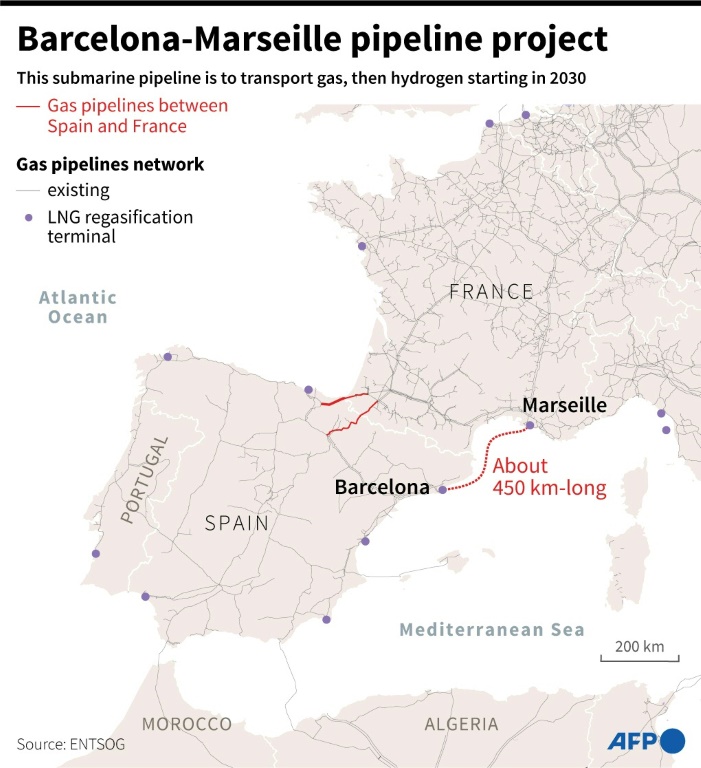
Dubbed “H2Med” or “BarMar” (from Barcelona and Marseille), the pipeline will transport green hydrogen, between Spain, France and the rest of Europe.

Green hydrogen is made from water via electrolysis and with renewable energy.

Announced at an EU summit in October, the pipeline offers an alternative to the defunct 2003 MidCat pipeline project.

Intended to carry gas across the Pyrenees from Spain to France, it was eventually abandoned over profitability issues and objections from Paris and environmentalists.

– What are its goals? –

The pipeline aims to boost the decarbonisation of European industry, giving it access to clean energy on a large scale, which Spain and Portugal hope to produce.

The two neighbours aim to become world leaders in green hydrogen thanks to their numerous wind and solar power farms.

France, Portugal and Spain initially said in October the pipeline aimed to reduce Europe’s dependence on Russian energy by improving gas interconnections between the Iberian Peninsula and its neighbours.

Spain and Portugal account for 40 percent of Europe’s capacity to turn liquefied natural gas (LNG) that arrives in tankers back into gas form, but they are poorly connected to the rest of Europe.

But since the three nations want EU funds to mainly cover the project, the pipeline will need to be dedicated to hydrogen, Madrid and Paris have stressed.

– Why Barcelona and Marseille? –

According to the project’s backers, it is “the most direct and efficient way of linking the peninsula with central Europe”.

Barcelona is an energy hub in Spain, and according to Jose Ignacio Linares, a professor at Madrid’s Pontificia Comillas University, it “has one of the largest re-gasification plants in Europe”.

Marseille is also a key point in the French network and a gateway to the Rhone Valley, northern Italy and Germany — industrial regions that could become big consumers of green hydrogen.

– What route will it take? –

The route has not yet been decided, but “the most logical” option would be to run close to the shore to avoid deep waters, Linares told AFP.

If that’s the case, H2Med would extend some 450 kilometres (280 miles).

– When will it be ready? –

French Energy Minister Agnes Pannier-Runacher told Spain’s El Pais daily the pipeline could come online in 2030, while her Spanish counterpart Teresa Ribera said it could enter service in “five, six or seven years”.

– How much will it cost? –

The cost of the project has not been revealed. But the European Hydrogen Backbone (EHB), that groups European energy pipeline operators, estimates a two-billion-euro ($2.1-billion) price tag.

– What are the obstacles? –

“An offshore hydrogen pipeline at this depth and distance has never been done before,” said Gonzalo Escribano, an energy expert at Madrid’s Real Instituto Elcano think tank. 

The innovative project faces certain technical challenges. 

One of the main problems is that hydrogen is made up of small molecules which can escape through the joints and cause corrosion, said Linares, an engineer by training.

But such problems could be overcome by “installing a membrane inside (the pipeline), a kind of plastic that prevents the hydrogen from escaping,” he said.

– What’s the outlook? –

The biggest risk is its economic viability, experts say.

“It is not clear when the green hydrogen market is going to take off and whether Spain will be in a position to produce enough to export it,” said Escribano.

But Linares said its construction would take so long “that we can’t afford to wait”. 

“If we do, we’ll end up with a huge volume of hydrogen that we won’t be able to export.”

China's Xi meets Arab leaders on 'milestone' Saudi trip

Chinese President Xi Jinping will meet Arab leaders in the Saudi capital on Friday for summits he has described as “milestone events” at a time of economic uncertainty and geopolitical realignment.

The meetings come on the third and final day of Xi’s first visit to Saudi Arabia since 2016 and only his third overseas trip since the coronavirus pandemic began. 

On Thursday, he met with King Salman and Saudi Arabia’s de facto ruler, Crown Prince Mohammed bin Salman, announcing deals on everything from hydrogen energy to housing, although few details were released. 

Friday’s agenda was expected to include a summit with the six-member Gulf Cooperation Council as well as a broader China-Arab summit.

Egyptian President Abdel Fattah al-Sisi and Tunisian President Kais Saied were among the heads of state who arrived on Thursday, with leaders from Qatar, Lebanon, Iraq and elsewhere also planning to attend. 

“China looks forward to working with Saudi Arabia and Arab countries to make the two summits milestone events in the history of China-Arab relations and China-GCC relations,” Xi said on Thursday in remarks carried by Chinese state broadcaster CCTV.

The Gulf countries, strategic partners of Washington, are bolstering ties with China as part of an eastward turn that involves diversifying their fossil fuel-reliant economies.

Meanwhile China is trying to widen its sphere of influence, notably through its Belt and Road Initiative, in which it is providing funding for infrastructure projects around the world.

– ‘Prestige’ trade deals –

Officials have provided few details about Friday’s agenda, but one potential area of focus is a China-GCC free trade agreement that has been under discussion for nearly two decades. 

“China will want to draw the lengthy negotiations to a close, as FTAs with major trading blocs is a matter of prestige for Beijing,” said Robert Mogielnicki of the Arab Gulf States Institute in Washington. 

“It’s not as simple for the GCC states, which seem to be more invested in advancing bilateral ties and are engaged in varying degrees of regional economic competition with their neighbouring member states.” 

A breakthrough on the trade deal could help Saudi Arabia, the world’s biggest oil exporter and the Middle East’s biggest economy, diversify its economy in line with the Vision 2030 reform agenda championed by Prince Mohammed. 

Saudi state media have said that bilateral deals worth about $30 billion were expected to be signed during the visit. 

Yet Mogielnicki said the significance of any announcements would only be clear if they went beyond pledges.

“When it comes to China’s bilateral relations with the Gulf and broader Middle East, one must remember that signing MoUs (memoranda of understanding) and making investment pledges is much easier than actually committing capital,” he said. 

Xi’s Middle East trip has already earned a rebuke from the White House, which on Wednesday warned of “the influence that China is trying to grow around the world”, calling its objectives “not conducive to preserving the international rules-based order”.
China's Xi meets Arab leaders on 'milestone' Saudi trip

Chinese President Xi Jinping will meet Arab leaders in the Saudi capital on Friday for summits he has described as “milestone events” at a time of economic uncertainty and geopolitical realignment.

The meetings come on the third and final day of Xi’s first visit to Saudi Arabia since 2016 and only his third overseas trip since the coronavirus pandemic began. 

On Thursday, he met with King Salman and Saudi Arabia’s de facto ruler, Crown Prince Mohammed bin Salman, announcing deals on everything from hydrogen energy to housing, although few details were released. 

Friday’s agenda was expected to include a summit with the six-member Gulf Cooperation Council as well as a broader China-Arab summit.

Egyptian President Abdel Fattah al-Sisi and Tunisian President Kais Saied were among the heads of state who arrived on Thursday, with leaders from Qatar, Lebanon, Iraq and elsewhere also planning to attend. 

“China looks forward to working with Saudi Arabia and Arab countries to make the two summits milestone events in the history of China-Arab relations and China-GCC relations,” Xi said on Thursday in remarks carried by Chinese state broadcaster CCTV.

The Gulf countries, strategic partners of Washington, are bolstering ties with China as part of an eastward turn that involves diversifying their fossil fuel-reliant economies.

Meanwhile China is trying to widen its sphere of influence, notably through its Belt and Road Initiative, in which it is providing funding for infrastructure projects around the world.

– ‘Prestige’ trade deals –

Officials have provided few details about Friday’s agenda, but one potential area of focus is a China-GCC free trade agreement that has been under discussion for nearly two decades. 

“China will want to draw the lengthy negotiations to a close, as FTAs with major trading blocs is a matter of prestige for Beijing,” said Robert Mogielnicki of the Arab Gulf States Institute in Washington. 

“It’s not as simple for the GCC states, which seem to be more invested in advancing bilateral ties and are engaged in varying degrees of regional economic competition with their neighbouring member states.” 

A breakthrough on the trade deal could help Saudi Arabia, the world’s biggest oil exporter and the Middle East’s biggest economy, diversify its economy in line with the Vision 2030 reform agenda championed by Prince Mohammed. 

Saudi state media have said that bilateral deals worth about $30 billion were expected to be signed during the visit. 

Yet Mogielnicki said the significance of any announcements would only be clear if they went beyond pledges.

“When it comes to China’s bilateral relations with the Gulf and broader Middle East, one must remember that signing MoUs (memoranda of understanding) and making investment pledges is much easier than actually committing capital,” he said. 

Xi’s Middle East trip has already earned a rebuke from the White House, which on Wednesday warned of “the influence that China is trying to grow around the world”, calling its objectives “not conducive to preserving the international rules-based order”.

Close Bitnami banner
Bitnami