World

India's Bishnoi community, the original eco-warriors

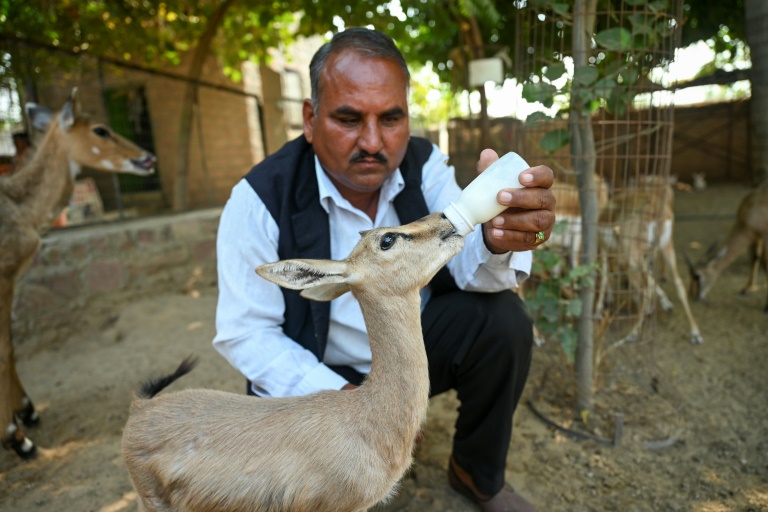
Surrounded by deer and antelopes, Ghevar Ram caressed an injured fawn at a rescue centre run by India’s Bishnoi community, who have been fighting to protect the environment for more than 500 years.

Ram, a member of the Hindu sect, has devoted his life to animals, bringing those in distress to the centre and taking care of them until they are fit enough to be released back into the wild.

“I treat animals like my own children. This is what we are taught since our childhood,” Ram, 45, told AFP as he bottle-fed the fawn ahead of the UN Biodiversity Conference in Montreal next week.

The Bishnois are India’s original eco-warriors, willing to sacrifice themselves to protect animals and trees.

The sect, established in the 15th century by Guru Jambheshwar and which now claims about 1.5 million members, believes in the sanctity of all life, shunning meat and avoiding felling living trees.

Spread mostly in hamlets across Rajasthan, the community draws inspiration from Amrita Devi, a Bishnoi woman killed in 1730 while trying to protect a khejari — now the state tree.

According to legend, a local king in the desert state sent his men to cut wood to fuel cement lime kilns to build his palace.

Devi rushed out of her home in a Bishnoi village to block them, clasping a tree trunk to protect it.

“Despite her pleas, the men did not stop. She then hugged a tree, but the king’s men showed no mercy and chopped down the tree along with her head,” said Sukhdev Godara, a retired schoolteacher, his eyes glistening with emotion.

Her last words were recorded as: “A chopped head is cheaper than a felled tree.”

Other Bishnoi villagers — beginning with Devi’s three daughters — followed suit, hugging the trees as they were decapitated.

In all, 363 Bishnoi men, women, and children were killed, their sacrifice now commemorated with a monument in the village inscribed with each of their names and topped with a statue of Amrita Devi.

– ‘In harmony with nature’ –

The martyr is now a hero for the likes of Sita Devi, who fuels her cooking fire with cow dung cakes rather than firewood to feed her strictly vegetarian family.

A mother of seven, she also once breastfed an orphaned antelope fawn.

“I was working in the fields when I saw a fawn being attacked by feral dogs. I rescued the fawn and brought it home,” she said, dressed in a traditional long pink skirt and sparkling gold jewellery.

“I fed the fawn my own milk, and once he regained strength, I released it in the wild,” she recalled with pride.

Although a subsect of Hinduism, the Bishnoi do not cremate their dead because that would mean cutting down trees to fuel the fire.

“Our guru taught us to bury our dead instead,” said schoolteacher Godara.

Bishnoi men are mostly farmers and patrol the land to make sure no animal is harmed or hunted down.

Advocate Rampal Bhawad co-founded the Bishnoi Tiger Force, an environmental campaign group and anti-poaching vigilante organisation, after Bollywood superstar Salman Khan shot dead two black bucks while filming a movie in Rajasthan in 1998.

The community followed the case assiduously for 20 years until Khan was sentenced to five years in jail by a local court for violating the Wildlife Protection Act.

The penalty was later suspended on appeal, but not before Khan had spent several days in prison.

“We file police complaints and pursue cases till the guilty are punished,” Bhawad told AFP. 

In a world fighting the insidious effects of climate change, he said, “we should plant more and more trees.

“We should live in harmony with nature and be kind towards all living beings.”
India's Bishnoi community, the original eco-warriors

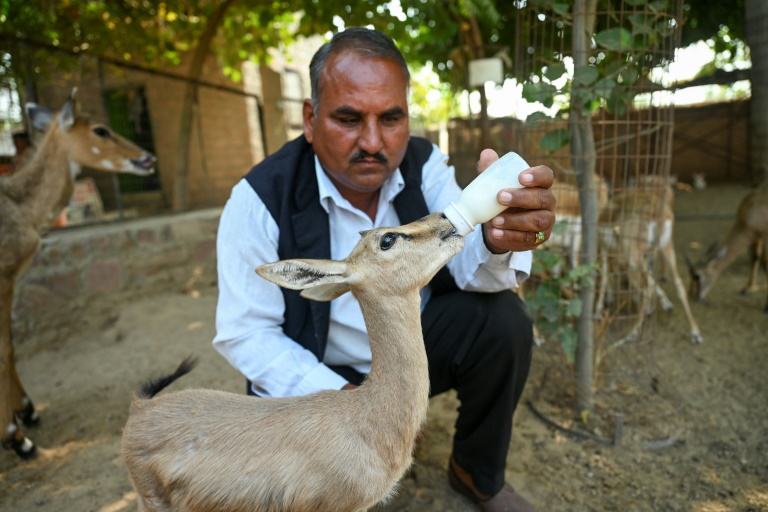
Surrounded by deer and antelopes, Ghevar Ram caressed an injured fawn at a rescue centre run by India’s Bishnoi community, who have been fighting to protect the environment for more than 500 years.

Ram, a member of the Hindu sect, has devoted his life to animals, bringing those in distress to the centre and taking care of them until they are fit enough to be released back into the wild.

“I treat animals like my own children. This is what we are taught since our childhood,” Ram, 45, told AFP as he bottle-fed the fawn ahead of the UN Biodiversity Conference in Montreal next week.

The Bishnois are India’s original eco-warriors, willing to sacrifice themselves to protect animals and trees.

The sect, established in the 15th century by Guru Jambheshwar and which now claims about 1.5 million members, believes in the sanctity of all life, shunning meat and avoiding felling living trees.

Spread mostly in hamlets across Rajasthan, the community draws inspiration from Amrita Devi, a Bishnoi woman killed in 1730 while trying to protect a khejari — now the state tree.

According to legend, a local king in the desert state sent his men to cut wood to fuel cement lime kilns to build his palace.

Devi rushed out of her home in a Bishnoi village to block them, clasping a tree trunk to protect it.

“Despite her pleas, the men did not stop. She then hugged a tree, but the king’s men showed no mercy and chopped down the tree along with her head,” said Sukhdev Godara, a retired schoolteacher, his eyes glistening with emotion.

Her last words were recorded as: “A chopped head is cheaper than a felled tree.”

Other Bishnoi villagers — beginning with Devi’s three daughters — followed suit, hugging the trees as they were decapitated.

In all, 363 Bishnoi men, women, and children were killed, their sacrifice now commemorated with a monument in the village inscribed with each of their names and topped with a statue of Amrita Devi.

– ‘In harmony with nature’ –

The martyr is now a hero for the likes of Sita Devi, who fuels her cooking fire with cow dung cakes rather than firewood to feed her strictly vegetarian family.

A mother of seven, she also once breastfed an orphaned antelope fawn.

“I was working in the fields when I saw a fawn being attacked by feral dogs. I rescued the fawn and brought it home,” she said, dressed in a traditional long pink skirt and sparkling gold jewellery.

“I fed the fawn my own milk, and once he regained strength, I released it in the wild,” she recalled with pride.

Although a subsect of Hinduism, the Bishnoi do not cremate their dead because that would mean cutting down trees to fuel the fire.

“Our guru taught us to bury our dead instead,” said schoolteacher Godara.

Bishnoi men are mostly farmers and patrol the land to make sure no animal is harmed or hunted down.

Advocate Rampal Bhawad co-founded the Bishnoi Tiger Force, an environmental campaign group and anti-poaching vigilante organisation, after Bollywood superstar Salman Khan shot dead two black bucks while filming a movie in Rajasthan in 1998.

The community followed the case assiduously for 20 years until Khan was sentenced to five years in jail by a local court for violating the Wildlife Protection Act.

The penalty was later suspended on appeal, but not before Khan had spent several days in prison.

“We file police complaints and pursue cases till the guilty are punished,” Bhawad told AFP. 

In a world fighting the insidious effects of climate change, he said, “we should plant more and more trees.

“We should live in harmony with nature and be kind towards all living beings.”

Hackers dump Australian health data online, declare 'case closed'

The hackers leaking stolen Australian health records to the dark web on Thursday appeared to end their extortion attempt by dumping a final batch of data online and declaring:”Case closed.”

In November the hackers demanded health insurer Medibank pay US$9.7 million to keep the records off the internet — or one dollar for each of the company’s impacted customers, which included Prime Minister Anthony Albanese.

Medibank refused to pay at the urging of the federal government, which at the height of the crisis considered making it illegal for hacked companies to hand over ransoms.

On Thursday morning the hackers said they had posted the last of the data online, deliberately coinciding with International Computer Security Day.

“Happy Cyber Security Day,” they wrote. 

“Added folder full. Case closed.” 

The first batches of stolen data started appearing on a dark web forum on November 9, in curated posts highlighting medical records about drug addiction, pregnancy terminations and sexually transmitted infections. 

Medibank on Thursday said the latest post was “incomplete and hard to understand” — an indication the hackers may have lost interest after a ransom was taken off the table.  

“While our investigation continues there are currently no signs that financial or banking data has been taken,” Medibank said in a statement.  

Australian Federal Police Commissioner Reece Kershaw said in November the hackers were believed to be a group of “loosely affiliated cyber criminals” who were based in Russia. 

Cybersecurity analysts have suggested they could be linked to Russian hacker group REvil. 

Australian government ministers have variously dubbed the hackers “scumbags”, “scummy criminals”, and “rolled gold mongrels”.

Ukraine embassy guard in Madrid 'lightly' injured by letter bomb

A security guard at Ukraine’s embassy in Madrid was lightly injured Wednesday while opening a letter bomb addressed to the Ukrainian ambassador, prompting Kyiv to boost security at its embassies.

The letter, which arrived by regular post, exploded in the early afternoon as the guard opened it in the embassy garden, said the central government’s representative in Madrid, Mercedes Gonzalez.

The guard was discharged from hospital later Wednesday and returned to work, Ukraine’s ambassador to Spain, Serhii Pohoreltsev, said.

In an interview with Spanish state television, Pohoreltsev appeared to blame Russia: “We are well aware of the terrorist methods of the aggressor country,” he said.

“Russia’s methods and attacks require us to be ready for any kind of incident, provocation or attack,” he added.

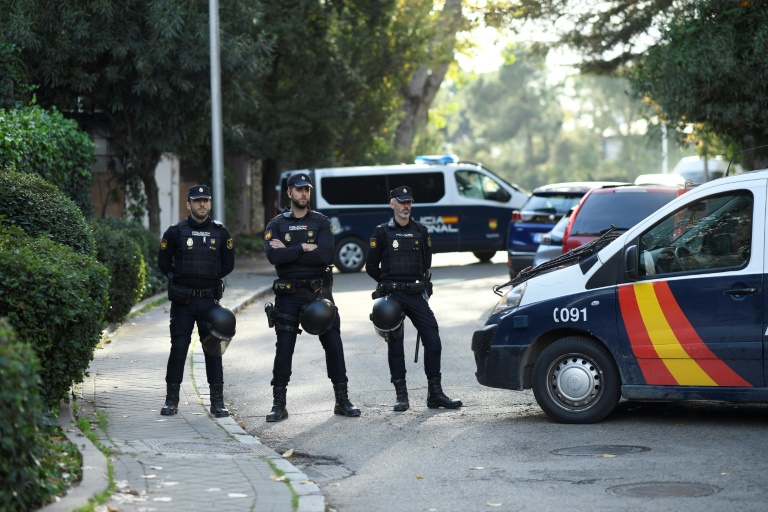
Spain’s National Police force were informed of an explosion at the embassy at around 1:00 pm (1200 GMT), a police source said.

The source said the guard was “lightly” injured and “went himself to a hospital” for treatment.

Police have opened an investigation “which includes the participation of forensic police”, the source said, without giving further details.

Police put a security cordon around the embassy, which is in a leafy residential area in northern Madrid.

A man who lives in front of the embassy, who asked not to be identified, told AFP he had heard the explosion. 

“I thought it was gunshot. It was not too loud,” he said.

– Second ‘suspicious’ package –

Ukrainian Foreign Minister Dmytro Kuleba ordered the strengthening of security at all Ukrainian embassies, Ukraine’s foreign ministry spokesperson Oleg Nikolenko said on social media after the letter bomb went off.

Spain’s Foreign Minister Jose Manuel Albares spoke with the ambassador over the phone “to ask about the well-being of the Ukrainian worker who was injured,” the Spanish foreign ministry said in a statement.

Albares also contacted Kuleba by phone to express his “support and solidarity”, it added.

Later in the evening, a second “suspicious postal shipment” was intercepted at the headquarters of military equipment firm Instalaza in the northeastern city of Zaragoza, the interior ministry said.

Experts carried out a “controlled explosion” of the mailed item.

“Investigators are analysing the exploded device and checking if there are any links between this event and what happened this morning at the Ukrainian embassy in Madrid,” it added.

Bankman-Fried apologizes, says didn't 'try to commit fraud'

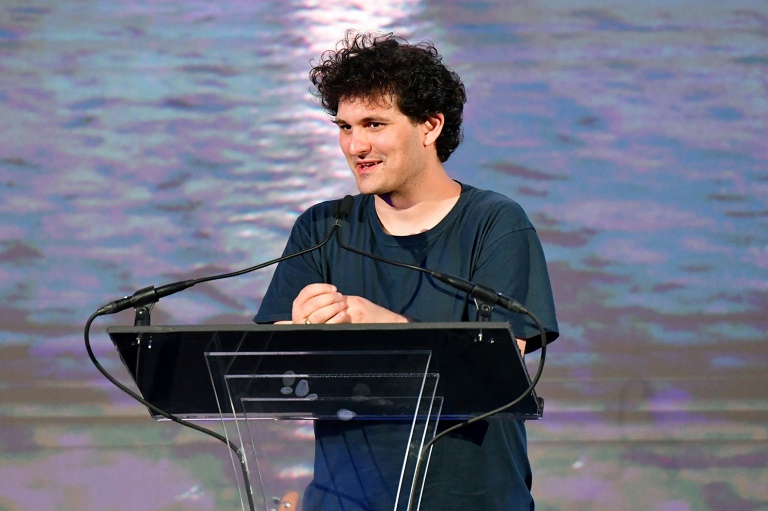
Former FTX Chief Executive Sam Bankman-Fried apologized Wednesday for a “lot of mistakes” in the abrupt collapse of the cryptocurrency firm and said he did not knowingly behave fraudulently.

“I didn’t ever try to commit fraud on anyone,” Bankman-Fried told the Dealbook conference hosted by CNBC and The New York Times.

“I’m deeply sorry about what happened,” Bankman-Fried said. “Clearly I made a lot of mistakes or things I would be able to give anything to be able to do over again.”

Bankman-Fried, appearing by video from the Bahamas and donning his trademark t-shirt, said he was “shocked” by many of the details that have surfaced amid the cryptocurrency platform’s collapse, depicting the problems as stemming from lax oversight and corporate controls rather than an intent to defraud. 

On November 11, Bankman-Fried resigned as FTX filed for bankruptcy protection while facing a large financing shortfall and a deluge of withdrawals from panicked customers. The firm at its peak had been worth some $32 billion.

At the time, FTX had taken some $10 billion in customer funds without authorization, according to the Wall Street Journal.

Much attention has focused on the relationship between FTX and Alameda Research, an affiliated trading firm. 

Bankman-Fried acknowledged an “embarrassing” lack of attention to conflicts of interest between the two firms, but insisted that he was not abreast of the details on Alameda and did not run Alameda.

– Thought no ‘existential’ risk –

Among the revelations, the digital currency news site CoinDesk reported on November 2 that Alameda’s balance sheet was heavily built on FTT — a token created by FTX and not based on an asset with independent value. 

The value of FTT plunged in early November as both Alameda and FTX cratered and has not recovered.

Bankman-Fried said that he was also surprised at the scale of Alameda’s positions on FTX that were troubled and which ultimately stressed the firm.

“I didn’t think it was existential for FTX,” Bankman-Fried said of Alameda’s financial stress, adding that he thought the problem would “end up having some small impact on FTX, but not a significant one, not one that hurt customers at all.”

Bankman-Fried said he didn’t knowingly “comingle” funds between the two firms.

FTX’s newly installed CEO John J. Ray has lambasted his predecessors in a November 17 filing in bankruptcy court.

“Never in my career have I seen such a complete failure of corporate controls and such a complete absence of trustworthy financial information as occurred here,” Ray said in the filing. 

“From compromised systems integrity and faulty regulatory oversight abroad, to the concentration of control in the hands of a very small group of inexperienced, unsophisticated and potentially compromised individuals, this situation is unprecedented,” he said.

Bankman-Fried on Wednesday said he was not aware that he was the subject of a criminal probe, adding that he rejected his lawyer’s advice to stay silent now.

“I have a duty to explain what happened,” he said. “And I think I have a duty … if there is anything I can do to try and help customers out here.”

Bankman-Fried suggested US investors in FTX could recover their losses, but did not explain how this might happen.

Macron blasts Biden subsidies at start of US state visit

France’s President Emmanuel Macron fired a volley at his American hosts on the first day of a rare state visit to Washington, telling lawmakers Wednesday that US industrial subsidies are “super aggressive” against French competitors.

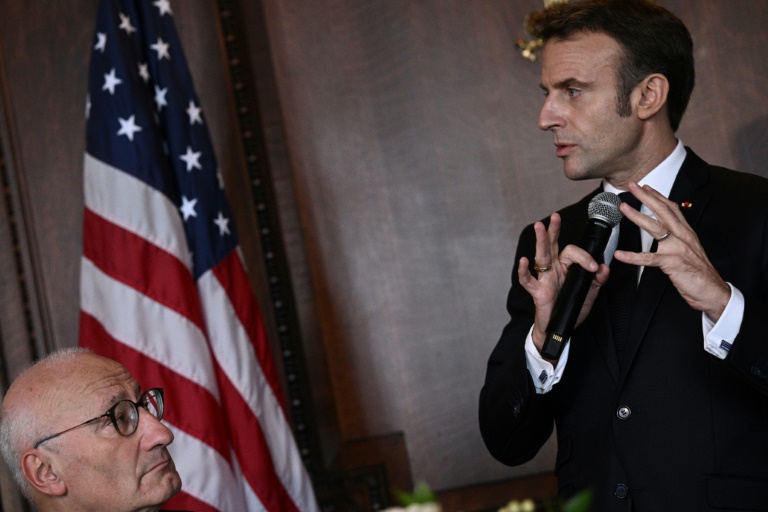
“This is super aggressive for our business people,” an AFP reporter heard Macron tell members of Congress and business leaders, who had invited him to lunch ahead of the main part of the state visit on Thursday, when the French leader will spend most of the day with President Joe Biden.

Macron was referring to Biden’s signature policy called the Inflation Reduction Act, which is set to pour billions of dollars into environmentally friendly industries — with strong backing for US-based manufacturers.

The White House touts the IRA legislation as a groundbreaking effort to reignite US manufacturing and promote renewable technologies, but European Union governments are crying foul, threatening to launch a trade war by subsidizing their own green economy sector.

Macron’s blunt assessment, saying he just wanted “to be respected as a good friend,” tore some of the veneer off a carefully choreographed state visit intended to celebrate historic US-French ties — and also tackle the trickier parts of the US-EU transatlantic alliance.

“I don’t want to become a market to sell American products because I have exactly the same products as you,” said Macron, stressing that France had its own middle class in need of employment.

“And the consequence of the IRA is that you will perhaps fix your issue but you will increase my problem. I’m sorry to be so straightforward,” he said.

The White House responded by insisting that the state visit is about the two presidents’ “warm relationship.”

US advances in the clean energy economy will help Europeans too, Press Secretary Karine Jean-Pierre said. The IRA “presents significant opportunities for European firms as well as benefits to EU energy security. This is not a zero sum game.”

In a speech later at the French embassy, Macron insisted on the subsidies issue and said they could become a real sticking point in US relations with Europe.

While voicing support for the environmental goals of the IRA, Macron said, “These are choices that will split the West.”

Still, Macron said US-French ties remain solid, calling on both countries to heed “the bonds that history has forged between us, an alliance stronger than anything.” 

– Frenchman on the Moon? –

Earlier, Macron joined Vice President Kamala Harris at NASA headquarters in Washington to discuss cooperation in space — and to propose the first Frenchman on the Moon.

Macron highlighted the American lunar program Artemis, whose first uncrewed test mission launched in mid-November with participation of the European Space Agency (ESA), and said “we are very keen” to join.

“It’s very important for us, as long as you can propose a French leader to fly to the Moon quite rapidly,” he told Harris, in a nod to French astronaut Thomas Pesquet, who also attended the NASA visit.

Macron’s busy schedule, which included a working lunch to discuss biodiversity and clean energy, and a visit to the historic Arlington National Cemetery, illustrated the ambitions set for the trip — the first formal state visit by a foreign leader to Washington since Biden took office nearly two years ago.

The core of the visit will be Thursday, including a White House military honor guard, Oval Office talks with Biden, a joint press conference and a banquet where Grammy-award-winning American musician Jon Batiste will perform.

The White House showed off the menu for the big dinner, which will start with butter poached Maine lobster, paired with caviar, “delicata squash raviolo” and tarragon sauce.

The main course features beef and triple cooked butter potatoes, before heading into the cheese course of award winning US brands, and finally orange chiffon cake, roasted pears with citrus sauce, and creme fraiche ice cream.

Washing all that down will be three different American wines.

– EU-US tensions –

Trade tensions, however, are only part of the uncomfortable flip side to the red carpet occasion.

Another gripe in Europe is the high cost of US liquid natural gas exports — which have surged to help compensate for canceled Russian deliveries.

There is also divergence on how to deal with the rise of superpower China. 

The question — with Washington pursuing a more hawkish tone and EU powers trying to find a middle ground — is unlikely to see much progress.

Macron blasts Biden subsidies at start of US state visit

France’s President Emmanuel Macron fired a volley at his American hosts on the first day of a rare state visit to Washington, telling lawmakers Wednesday that US industrial subsidies are “super aggressive” against French competitors.

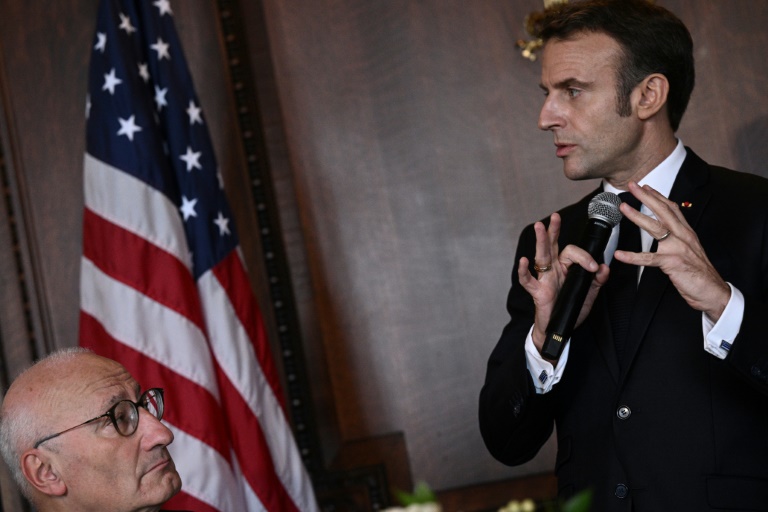
“This is super aggressive for our business people,” an AFP reporter heard Macron tell members of Congress and business leaders, who had invited him to lunch ahead of the main part of the state visit on Thursday, when the French leader will spend most of the day with President Joe Biden.

Macron was referring to Biden’s signature policy called the Inflation Reduction Act, which is set to pour billions of dollars into environmentally friendly industries — with strong backing for US-based manufacturers.

The White House touts the IRA legislation as a groundbreaking effort to reignite US manufacturing and promote renewable technologies, but European Union governments are crying foul, threatening to launch a trade war by subsidizing their own green economy sector.

Macron’s blunt assessment, saying he just wanted “to be respected as a good friend,” tore some of the veneer off a carefully choreographed state visit intended to celebrate historic US-French ties — and also tackle the trickier parts of the US-EU transatlantic alliance.

“I don’t want to become a market to sell American products because I have exactly the same products as you,” said Macron, stressing that France had its own middle class in need of employment.

“And the consequence of the IRA is that you will perhaps fix your issue but you will increase my problem. I’m sorry to be so straightforward,” he said.

The White House responded by insisting that the state visit is about the two presidents’ “warm relationship.”

US advances in the clean energy economy will help Europeans too, Press Secretary Karine Jean-Pierre said. The IRA “presents significant opportunities for European firms as well as benefits to EU energy security. This is not a zero sum game.”

In a speech later at the French embassy, Macron insisted on the subsidies issue and said they could become a real sticking point in US relations with Europe.

While voicing support for the environmental goals of the IRA, Macron said, “These are choices that will split the West.”

Still, Macron said US-French ties remain solid, calling on both countries to heed “the bonds that history has forged between us, an alliance stronger than anything.” 

– Frenchman on the Moon? –

Earlier, Macron joined Vice President Kamala Harris at NASA headquarters in Washington to discuss cooperation in space — and to propose the first Frenchman on the Moon.

Macron highlighted the American lunar program Artemis, whose first uncrewed test mission launched in mid-November with participation of the European Space Agency (ESA), and said “we are very keen” to join.

“It’s very important for us, as long as you can propose a French leader to fly to the Moon quite rapidly,” he told Harris, in a nod to French astronaut Thomas Pesquet, who also attended the NASA visit.

Macron’s busy schedule, which included a working lunch to discuss biodiversity and clean energy, and a visit to the historic Arlington National Cemetery, illustrated the ambitions set for the trip — the first formal state visit by a foreign leader to Washington since Biden took office nearly two years ago.

The core of the visit will be Thursday, including a White House military honor guard, Oval Office talks with Biden, a joint press conference and a banquet where Grammy-award-winning American musician Jon Batiste will perform.

The White House showed off the menu for the big dinner, which will start with butter poached Maine lobster, paired with caviar, “delicata squash raviolo” and tarragon sauce.

The main course features beef and triple cooked butter potatoes, before heading into the cheese course of award winning US brands, and finally orange chiffon cake, roasted pears with citrus sauce, and creme fraiche ice cream.

Washing all that down will be three different American wines.

– EU-US tensions –

Trade tensions, however, are only part of the uncomfortable flip side to the red carpet occasion.

Another gripe in Europe is the high cost of US liquid natural gas exports — which have surged to help compensate for canceled Russian deliveries.

There is also divergence on how to deal with the rise of superpower China. 

The question — with Washington pursuing a more hawkish tone and EU powers trying to find a middle ground — is unlikely to see much progress.

Two dead, dozens missing as landslide wipes out Brazil highway

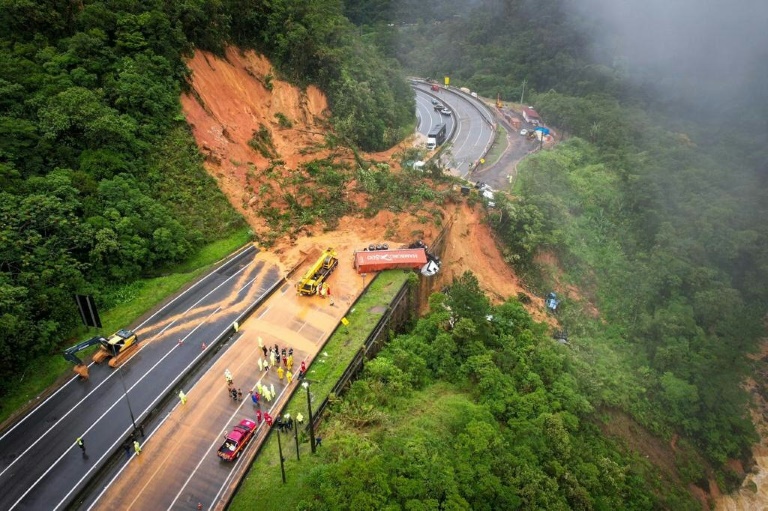
At least two people were killed and dozens more are missing after a landslide ripped across a section of highway in southern Brazil, sweeping some 20 cars and trucks along with it, authorities said Wednesday.

The torrent of mud came rushing down a steep hillside Monday after days of heavy rain in the state of Parana, hitting highway BR 367, officials said.

“It’s hard to know the exact number of victims. A vehicle could have one to five people inside. We’re working with an estimate of 30 to 50 people missing,” local emergency response chief Manoel Vasco told a news conference.

Aerial images released by the emergency services showed a massive smear of mud that swept away everything in its path — including a chunk of highway and the vehicles on it.

Rescue workers said the bad weather and remote location were complicating the search effort.

They are using drones with heat-detecting cameras in hopes of finding survivors.

“Fifty-four firefighters have been working non-stop for more than 35 hours,” the Parana state security authority said in a statement later Wednesday, noting as well concerns over further landslides.  

Two bodies have been found so far, and six survivors have been located, including the mayor of the coastal town of Guaratuba, the nearest city.

“It was horrible. The mountain just fell on top of us. It swept away every last car. We’re only alive by the grace of God,” the mayor, Roberto Justus, said in a video posted on social media.

Brazil is frequently hit by deadly landslides.

The national weather service INMET has issued heavy rain warnings for multiple states. 

At least one other person died Wednesday after a section of road was washed out, sweeping away the victim’s car, in the northeastern state of Segipe, Brazilian media reported.

In February, more than 200 people were killed in a series of landslides in the picturesque southeastern tourist town of Petropolis.

Two dead, dozens missing as landslide wipes out Brazil highway

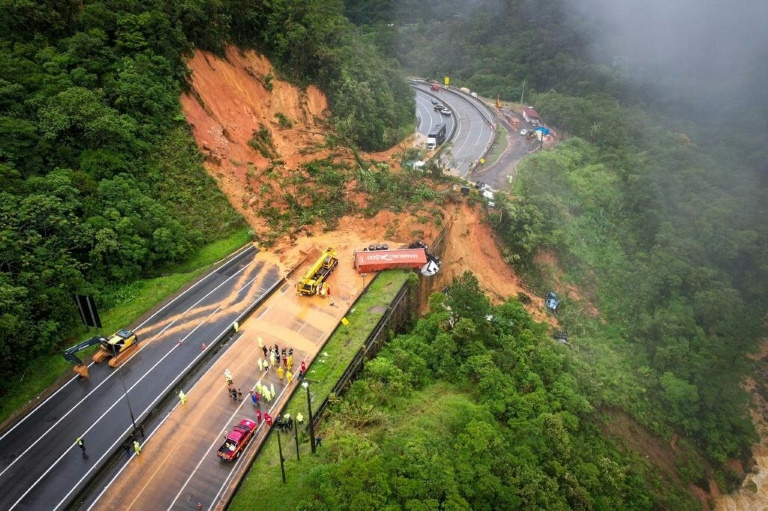
At least two people were killed and dozens more are missing after a landslide ripped across a section of highway in southern Brazil, sweeping some 20 cars and trucks along with it, authorities said Wednesday.

The torrent of mud came rushing down a steep hillside Monday after days of heavy rain in the state of Parana, hitting highway BR 367, officials said.

“It’s hard to know the exact number of victims. A vehicle could have one to five people inside. We’re working with an estimate of 30 to 50 people missing,” local emergency response chief Manoel Vasco told a news conference.

Aerial images released by the emergency services showed a massive smear of mud that swept away everything in its path — including a chunk of highway and the vehicles on it.

Rescue workers said the bad weather and remote location were complicating the search effort.

They are using drones with heat-detecting cameras in hopes of finding survivors.

“Fifty-four firefighters have been working non-stop for more than 35 hours,” the Parana state security authority said in a statement later Wednesday, noting as well concerns over further landslides.  

Two bodies have been found so far, and six survivors have been located, including the mayor of the coastal town of Guaratuba, the nearest city.

“It was horrible. The mountain just fell on top of us. It swept away every last car. We’re only alive by the grace of God,” the mayor, Roberto Justus, said in a video posted on social media.

Brazil is frequently hit by deadly landslides.

The national weather service INMET has issued heavy rain warnings for multiple states. 

At least one other person died Wednesday after a section of road was washed out, sweeping away the victim’s car, in the northeastern state of Segipe, Brazilian media reported.

In February, more than 200 people were killed in a series of landslides in the picturesque southeastern tourist town of Petropolis.

US House approves bill to avert freight rail strike

Lawmakers in the US House of Representatives voted Wednesday to prevent a potentially catastrophic freight rail strike, stepping in to break an impasse between workers and executives during a critical pre-holiday period.

The bill, passed with a solid bipartisan majority, effectively forces hold-out unions to accept a September deal on increased wages, which a majority of unions had already agreed to.

The bill must now go to the Senate, where leaders of both parties have suggested they will move quickly to head off a disruption of the US rail system right before Christmas.

Congress is empowered under a 1926 law to resolve disputes between railroads and labor unions, as part of its power to regulate commerce.

President Joe Biden praised the bipartisan vote to avert a shutdown that “would devastate our economy and families everywhere,” but said the measure must pass swiftly.

“Without more action, supply chain disruptions will begin,” Biden said on Twitter. “The Senate must urgently send a bill to my desk.”

White House Press Secretary Karine Jean-Pierre told a press briefing that Biden expects the bill to reach him by next weekend.

The Biden administration had taken a hands-on approach to the long-running deadlock over a contract between organized labor and railroads, with cabinet secretaries in September participating in all-night negotiations alongside union leaders and rail executives.

After that marathon session, leaders from the two sides announced a tentative agreement.

Since that time, members of eight of the 12 rail unions approved the deal, while four voted it down.

The agreement includes a 24 percent pay increase for workers. But critics in organized labor have slammed a lack of guaranteed paid sick leave, an omission that has been seen as evidence of “unchecked corporate greed,” as one leading union put it.

In a win for organized labor, the House also backed a measure to add mandated paid sick time to the agreement, addressing the major sticking point identified by unions. 

The sick-leave measure passed on a tighter, mostly party-line vote, leaving its fate in the Senate more uncertain.

– Test for ‘Union Joe’ –

The failure of the agreement to win universal approval among the unions set the stage for a potential strike on December 9, putting the White House in an awkward spot.

Biden, who has been dubbed “Union Joe” for his strong affinity for organized labor, called on Monday for Congress to act.

His call was endorsed by numerous business groups and resonated with leading congressional Republicans, including Representative Sam Graves of Missouri, who called the prospect of a strike a “catastrophic economic disaster.”

The House voted 290-137 in favor of the resolution to enact the agreement, with 79 Republicans joining most Democrats in backing the measure.

Since Monday, at least two of the four unions that voted down the agreement have publicly criticized Biden’s stance.

The Brotherhood of Maintenance of Way Employees (BMWED), part of the Teamsters union, said it was “deeply disappointed” by the president’s action, while the Brotherhood of Railroad Signalmen also expressed disappointment as it encouraged the Biden administration “to stick to its pro-worker roots” and insist that guaranteed paid sick leave be included in the deal.

But both unions coalesced around a separate resolution championed by House Democrat Donald Payne Jr. to add seven days of paid sick leave to the agreement.

Payne, in proposing the measure, described it as “about fairness” in light of the sacrifices made by rail workers and other essential workers during the pandemic.

“Without paid sick time, railroad workers are forced to make a choice between their health, or the health of their families, and their paychecks,” Payne said.

But Graves said the existing agreement was “more than fair for rail workers.” 

Graves noted that Biden had hailed the September agreement, but “it’s now clear that the administration cannot close their own deal,” he said in urging colleagues to vote against the measure adding paid sick leave.

In the end, the resolution still passed on a largely party-line, 221-207, with all 218 Democrats present voting in support, along with three Republicans.

Close Bitnami banner
Bitnami