World

Nurses join other striking UK staff in two December walkouts

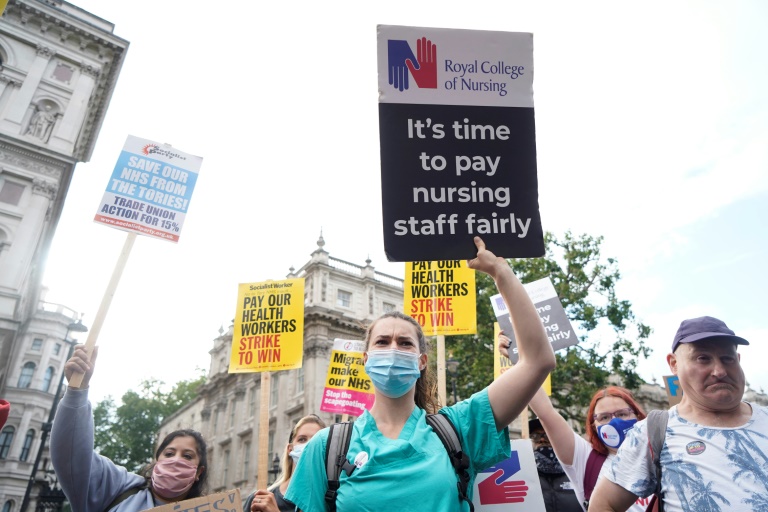
Nurses across most of Britain will next month hold the first strikes in their union’s 106-year history, joining a host of other UK workers taking industrial action over pay.

Staff in England, Wales and Northern Ireland — but not Scotland — will walk out on December 15 and 20, after the Royal College of Nursing (RCN) union said the government had turned down an offer of negotiations.

It will be the latest industrial action in Britain, where decades-high inflation and a cost-of-living crisis has prompted staff in various sectors to demand pay rises to keep up with spiralling prices.

The nurses’ strike will be sandwiched between the first of a series of two-day walkouts by national railway workers, while postal service employees will stage fresh stoppages in the run-up to Christmas.

Numerous other public and private sector staff, from lawyers to airport ground personnel, have also held strikes this year.

“Nursing staff have had enough of being taken for granted, enough of low pay and unsafe staffing levels, enough of not being able to give our patients the care they deserve,” said RCN head Pat Cullen.

The union, which wants a pay rise significantly above inflation, announced earlier this month that a ballot of its more than 300,000 members had found a majority in favour of strikes.

“Ministers have had more than two weeks since we confirmed that our members felt such injustice that they would strike for the first time,” Cullen said, adding that an offer of formal negotiations was declined.

“They have the power and the means to stop this by opening serious talks that address our dispute.”

The RCN will next week announce which particular arms of Britain’s sprawling state-funded National Health Service (NHS) will be affected by the walkouts.

– ‘Challenging times ‘ –

Amid the waves of industrial action, British inflation has continued its recent surge, reaching a 41-year high of 11.1 percent in October on soaring energy and food bills.

Bosses in the NHS said in September that nurses were skipping meals to feed and clothe their children and struggling to afford rising transport costs.

One in four hospitals had set up foodbanks to support staff, according to NHS Providers, which represents hospital groups in England.

The government says it has accepted independent pay recommendations, and given over one million NHS workers a pay rise of at least £1,400 ($1,590) this year. 

That follows on from a three-percent increase last year when public sector pay was frozen.

But the RCN says this leaves experienced nurses worse off by 20 percent in real terms due to successive below-inflation awards since 2010.

In Scotland, the union has paused announcing strike action after the devolved government in Edinburgh, which has responsibility for health policy, reopened pay talks.

UK health minister Steve Barclay said he was “hugely grateful for the hard work and dedication” of nurses and regretted the strikes.

The NHS has “tried and tested plans” to minimise disruption and ensure emergency services continue to operate, he added.

“These are challenging times for everyone and the economic circumstances mean the RCN’s demands, which on current figures are a 19.2 percent pay rise, costing £10 billion a year, are not affordable,” he said.

The RCN has questioned the UK government’s economic rationale, noting it spends billions of pounds on agency staff to plug workforce gaps.

It points to independent research it commissioned indicating that the finance ministry would recoup 81 percent of the initial outlay of a significant pay rise through higher tax receipts and savings on future recruitment and retention costs.

In the last year, 25,000 nursing staff left the Nursing and Midwifery Council (NMC) register, it said. 

Other UK health unions are also balloting workers for industrial action, while ambulance staff in Scotland are due to walk out on Monday.

Meanwhile, across the wider economy, numerous sectors look set to continue their strikes into the new year.
Nurses join other striking UK staff in two December walkouts

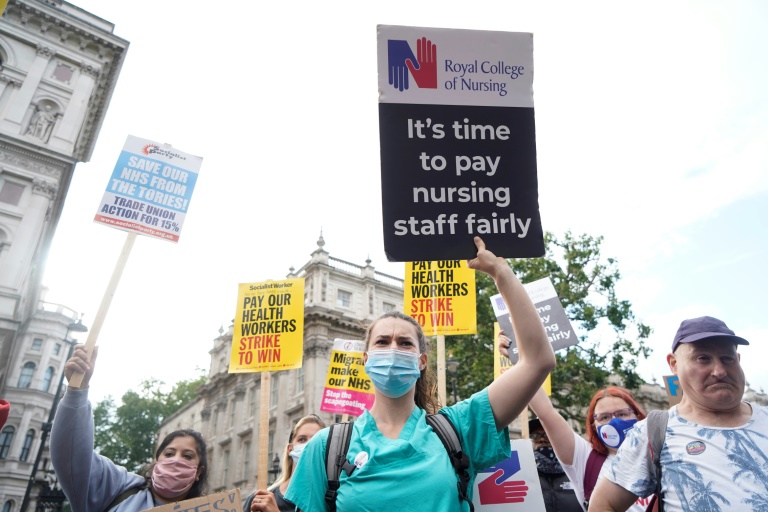
Nurses across most of Britain will next month hold the first strikes in their union’s 106-year history, joining a host of other UK workers taking industrial action over pay.

Staff in England, Wales and Northern Ireland — but not Scotland — will walk out on December 15 and 20, after the Royal College of Nursing (RCN) union said the government had turned down an offer of negotiations.

It will be the latest industrial action in Britain, where decades-high inflation and a cost-of-living crisis has prompted staff in various sectors to demand pay rises to keep up with spiralling prices.

The nurses’ strike will be sandwiched between the first of a series of two-day walkouts by national railway workers, while postal service employees will stage fresh stoppages in the run-up to Christmas.

Numerous other public and private sector staff, from lawyers to airport ground personnel, have also held strikes this year.

“Nursing staff have had enough of being taken for granted, enough of low pay and unsafe staffing levels, enough of not being able to give our patients the care they deserve,” said RCN head Pat Cullen.

The union, which wants a pay rise significantly above inflation, announced earlier this month that a ballot of its more than 300,000 members had found a majority in favour of strikes.

“Ministers have had more than two weeks since we confirmed that our members felt such injustice that they would strike for the first time,” Cullen said, adding that an offer of formal negotiations was declined.

“They have the power and the means to stop this by opening serious talks that address our dispute.”

The RCN will next week announce which particular arms of Britain’s sprawling state-funded National Health Service (NHS) will be affected by the walkouts.

– ‘Challenging times ‘ –

Amid the waves of industrial action, British inflation has continued its recent surge, reaching a 41-year high of 11.1 percent in October on soaring energy and food bills.

Bosses in the NHS said in September that nurses were skipping meals to feed and clothe their children and struggling to afford rising transport costs.

One in four hospitals had set up foodbanks to support staff, according to NHS Providers, which represents hospital groups in England.

The government says it has accepted independent pay recommendations, and given over one million NHS workers a pay rise of at least £1,400 ($1,590) this year. 

That follows on from a three-percent increase last year when public sector pay was frozen.

But the RCN says this leaves experienced nurses worse off by 20 percent in real terms due to successive below-inflation awards since 2010.

In Scotland, the union has paused announcing strike action after the devolved government in Edinburgh, which has responsibility for health policy, reopened pay talks.

UK health minister Steve Barclay said he was “hugely grateful for the hard work and dedication” of nurses and regretted the strikes.

The NHS has “tried and tested plans” to minimise disruption and ensure emergency services continue to operate, he added.

“These are challenging times for everyone and the economic circumstances mean the RCN’s demands, which on current figures are a 19.2 percent pay rise, costing £10 billion a year, are not affordable,” he said.

The RCN has questioned the UK government’s economic rationale, noting it spends billions of pounds on agency staff to plug workforce gaps.

It points to independent research it commissioned indicating that the finance ministry would recoup 81 percent of the initial outlay of a significant pay rise through higher tax receipts and savings on future recruitment and retention costs.

In the last year, 25,000 nursing staff left the Nursing and Midwifery Council (NMC) register, it said. 

Other UK health unions are also balloting workers for industrial action, while ambulance staff in Scotland are due to walk out on Monday.

Meanwhile, across the wider economy, numerous sectors look set to continue their strikes into the new year.

Brazil grinds to halt as World Cup party starts

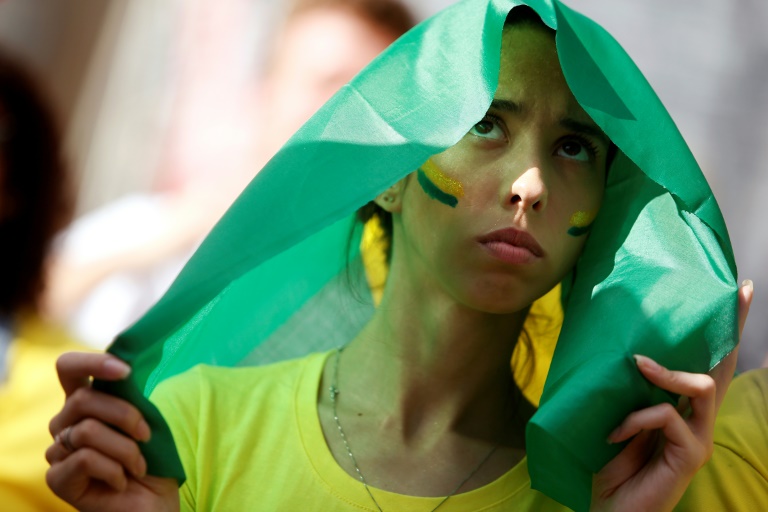
In yellow-and-green bikinis, Neymar jerseys and sparkling tops straight out of carnival, Brazilians dropped everything Thursday to watch the national team make their highly anticipated World Cup debut, exploding in celebration at their opening win.

Packed in front of a giant screen on Rio de Janeiro’s famed Copacabana beach, in the middle of what would normally be a work day, fans of all ages cheered Brazil’s 2-0 football victory over Serbia — and allowed themselves to dream a record-extending sixth World Cup title could be on the horizon.

Standing on the seaside avenue in his Brazil jersey, construction worker Benildo Ferreira erupted in joy at the second of the two goals, both fired home by Tottenham Hotspur striker Richarlison.

“I was worried” during the goalless first half, Ferreira, 51, told AFP, as fireworks exploded overhead.

“But Brazil are going to reach the final, and we’re going to win.”

It was an anguished wait for many in football-mad Brazil, whose fevered passion at World Cup time often draws comparisons to a nation going to war.

Milton de Souza nervously stirred his caipirinha in a seaside bar as he waited for the opening goal.

“We just have to be patient,” said the 58-year-old retiree, who was wearing green and yellow — as was virtually the entire country, it seemed.

He was cautious on the question of whether the “Selecao” could end their 20-year title drought.

“Nothing’s certain in football.”

Others were already daring to dream.

“The Cup is ours this year, without a doubt,” said 23-year-old Marcos Vinicius, who accurately predicted a Richarlison brace before the match.

– Ghost towns –

City centers in Rio, Sao Paulo and other hubs of Latin America’s biggest economy meanwhile turned to ghost towns as Brazil ground to a halt to watch the match.

Street-food vendor Kaua Suarez, 19, and three clients were crowded around a cell phone he had propped up on his hot dog stand, watching the match in Rio’s near-deserted city center.

“I had to work, so I found a way to watch anyway. I’m going to watch every match, no matter what time,” he said.

“Football is every favela kid’s dream in Brazil. We’re crazy about it. Brazilians are born loving football.”

Even president-elect Luiz Inacio Lula da Silva took time out from political horse-trading ahead of his January 1 inauguration to watch.

He tweeted a picture of himself and his wife in national team jerseys, a TV in the background, with the message: “Congratulations Brazil. On our way to title number six!”

– Enough of politics –

The small army of vendors selling jerseys, flags, scarves, hats and endless other World Cup gear were meanwhile happy Lula’s win in Brazil’s divisive October elections had finally brought an end to a taboo on wearing yellow and green, the colors which defeated far-right President Jair Bolsonaro and his supporters had embraced as their own.

“People were resistant. They really waited until the last minute to buy (yellow and green gear), because of the political situation,” said vendor Giselle de Freitas, 41, who was selling a plethora of earrings, tiaras and other accessories on Copacabana.

For most, World Cup fever won out in the end.

Not for everyone, however.

Hotel doorman Osvaldo Alves, a slight 74-year-old with thinning white hair and a bright red uniform, was one of the few not watching the match.

“The country always drops everything when the ‘Selecao’ play. We sit there watching football and don’t fix any of our problems,” he said from his post at the downtown hotel where he works.

“It’s a disease Brazil has. Brazilians are just crazy about football.”

Ottawa rolls out CAN$1.6 bn plan to adapt to climate change

The Canadian government on Thursday unveiled a CAN$1.6 billion (US$1.2 billion) plan to help the country deal with the looming dangers of a warming world, such as floods, wildfires and extreme heat.

The so-called climate adaptation strategy will fund programs to help Canadians shield themselves from heat waves, protect coastlines from rising seas and safeguard infrastructure, including in the far north, which is facing the thaw of permafrost, officials said.

“Climate change is hitting all communities right across Canada,” Emergency Preparedness Minister Bill Blair told a news conference from Prince Edward Island, a province hit hard by Hurricane Fiona in September.

The storm — said to be the costliest to hit Canada’s Atlantic coast — was just a taste of what’s to come, according to the government, which forecasts annual costs of natural disasters in Canada to rise to Can$15.4 billion by 2030.

“We are seeing in the last few years, not just in Canada but around the world, an increase in the frequency and severity of climate related events,” said Blair, citing extreme weather events that killed hundreds and devastated communities across the country.

The adaptation strategy, which the government presented as a work-in-progress, was hailed as a “great step forward” by Greenpeace, while the Insurance Bureau of Canada, which represents home, car and business insurers, called it “ambitious.”

Its goals also include making Canadians more aware of the risks of natural disasters in their communities, establishing 15 new urban national parks, conserving 30 percent of Canada’s lands and waters to stem biodiversity loss, and preventing all future deaths from extreme heat.

Adaptation measures, according to a government statement, could result in up to Can$15 in savings for every dollar spent.

New construction standards in fire and flood zones alone would save an estimated Can$4.7 billion a year, the government said, while noting that urban forests in Toronto — Canada’s largest city — have lowered cooling costs, improved air quality and reduced strains on stormwater sewers.

The new funding builds on more than Can$8 billion already committed by Ottawa for adaptation and disaster relief since 2009.

A fraught United Nations climate summit wrapped up on Sunday with a landmark deal on funding to help vulnerable countries cope with devastating climate impacts.

But it failed to push ahead on further cutting emissions in order to keep alive the aspirational goal of limiting global warming to 1.5 degrees Celsius from pre-industrial levels.

Libya expels over 200 migrants across land borders

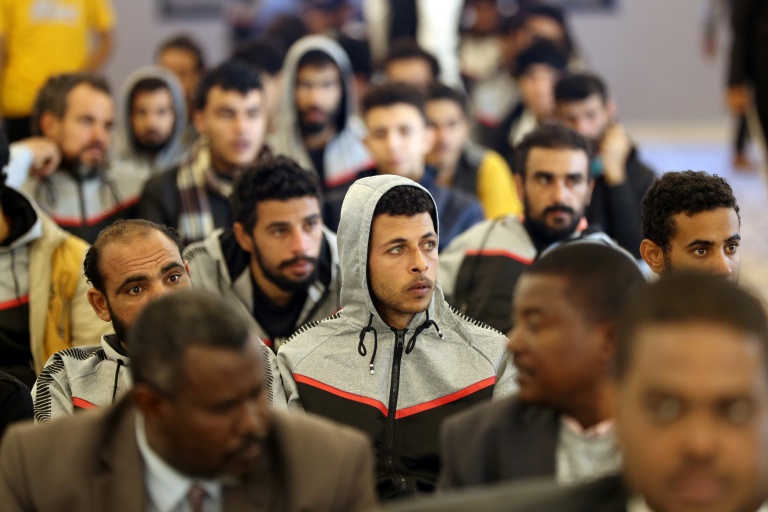
Libya on Thursday sent more than 200 illegal migrants back across its land borders, in a rare display of cooperation from the country’s divided political institutions. 

The migrants, dressed in differing tracksuits to identify their nationalities, were handed biscuits, milk and bottles of water by police in Tripoli, before being bused in convoys to Libyan border crossings.

The group of returnees included “105 Egyptians, 101 Chadians and 20 Sudanese,” Badreddine al-Sed Ben Hamed, deputy chief of the bureau in charge of the operation, told AFP.

Embassy staff from the migrants’ home countries watched the process, with each group driven to border crossings with their home country.

The operation was organised by the Interior Ministry of Prime Minister Abdulhamid Dbeibah’s Tripoli-based government, whose authority is contested by a rival administration in Libya’s east. 

But a deal with authorities there and in the south enabled coordination of the expulsions.

War-ravaged Libya is a conduit for thousands of people each year fleeing conflict and poverty across Africa, seeking refuge across the Mediterranean in Europe.

Most enter via the country’s vast southern borders in the Sahara desert.

Police spokesman General Ahmad Abu Kraa said holding centres for detained migrants had become “overwhelmed, which is creating a lot of problems”.

Libya is regularly criticised for its treatment of migrants, with rights groups alleging horrific treatment at the hands of smuggling gangs and inside state-run detention centres.

Authorities and armed groups operating under state auspices have repeatedly been accused of torture, rape and other abuses.

The United Nations had previously handled the repatriation of refugees from Libya, but the deal between authorities in the west, east and south has enabled the Interior Ministry’s agency tackling illegal migration to work in a unified way across the country.

Still, Libya remains violently fragmented and facing multiple crises following a 2011 NATO-backed revolt that overthrew dictator Moamer Kadhafi.

Tensions between the rival administrations in August spilled over into deadly gun battles between their militias that left more than 30 people dead in Tripoli.

EU frets over Twitter job losses as hate speech grows

The European Union on Thursday expressed concern about layoffs at Twitter since its takeover by Elon Musk, after the reported closure of the tech firm’s lobbying office in Brussels.

“We have concerns about the decisions to have less and less people working at the company,” EU justice commissioner Didier Reynders told reporters in Dublin, where Twitter and other US tech groups have their European headquarters.

“When we discuss hate speech, I am sure we need human resources,” he added after a meeting with unidentified representatives from Twitter.

A new EU evaluation showed the number of hate speech notifications reviewed by major social media companies within 24 hours has fallen from 90 percent in 2020, to 81 percent in 2021 and 64 percent in 2022.

The numbers showed only YouTube improved its removal rate for offensive content — as defined by an EU code of conduct — while Twitter and other tech companies’ efforts fell.

Concerns at Twitter’s post-takeover direction intensified Thursday with the Financial Times reporting that the company has dismantled its Brussels office, following the departure of executives in charge of efforts to comply with the EU’s online rules.

“It’s an additional concern, because to us to have a team dedicated to the relation with the European institutions is very important,” Reynders said, reacting to the FT report.

However, he said he was “optimistic by nature” and had been given commitments that Twitter’s team in Dublin would step into the Brussels role. 

EU commission Vice President Vera Jourova reiterated the bloc’s worries.

“If you want to effectively detect and take action against #disinformation & propaganda, this requires resources,” she tweeted, linking to the FT story.

Tech entrepreneur Musk cut around half of Twitter’s 7,500 workforce, including many employees tasked with fighting disinformation, following his acquisition of the firm last month.

While in Dublin, Reynders is due to meet representatives from Meta, the owner of Facebook, on Friday.

Mark Zuckerberg’s social media behemoth said this month it planned to lay off more than 11,000 staff amid an advertising slump.

Both Meta and Twitter’s EU operations are based in Ireland, along with those of Google, Apple and Microsoft, making Ireland’s data protection agency the lead regulator responsible for holding them to account in Europe.

French MPs vote to enshrine abortion rights in constitution

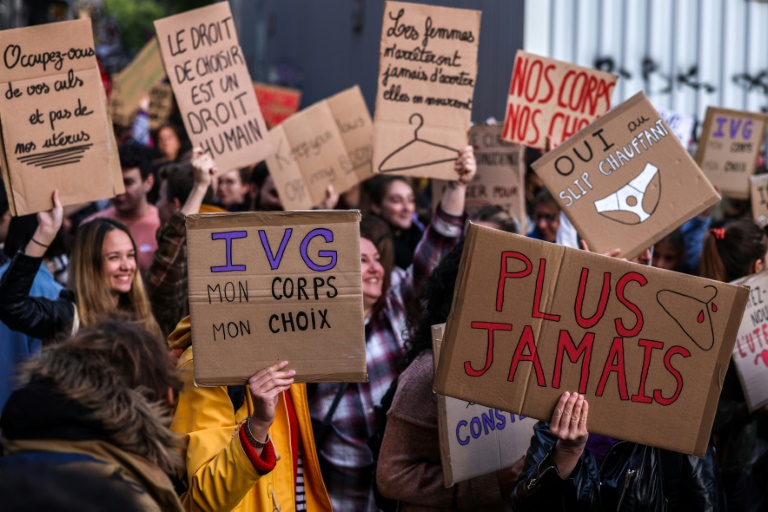
Lawmakers in the French parliament voted Thursday to add the right to abortion to the constitution in response to recent changes in Poland and the United States.

MPs from the left-wing France Unbowed (LFI) party and the ruling centrist coalition struck a deal on the wording of the new clause, which passed with a huge majority.

“The law guarantees the effectiveness and equal access to the right to voluntarily end a pregnancy,” reads the proposed constitutional addition to article 66.

It was approved with 337 votes for and 32 against, with the bill now set to be sent to the conservative-majority Senate for approval.

The initiative was prompted by the US Supreme Court’s explosive decision this year to overturn the nationwide right to termination procedures for Americans.

The conservative government of Poland has also heavily restricted abortion rights.

“The assembly is speaking to the world, our country is speaking to the world,” said jubilant MP Mathilde Panot from LFI, dedicating the vote to women in Hungary, Poland and the United States. 

Panot, who spearheaded the legislation along with a member of President Emmanuel Macron’s party, said the move was necessary in France to protect “against a regression”.

Abortion was legalised in France in 1974 in a law championed by health minister Simone Veil, a women’s rights icon granted the rare honour of burial at the Pantheon by Macron upon her death in 2018.

– Legal for 48 years –

A previous attempt to inscribe the right to abortion as well as contraception into the French constitution, with different wording, was rejected by the Senate in October. 

This second attempt will also need a green light in the upper chamber and must then be voted on in a national referendum.

“It’s a big step… but it’s just the first step,” said centrist MP Sacha Houlie from Macron’s Renaissance party.

Thursday’s agreement was a rare instance of harmony between the hard-left LFI and Macron’s centrist allies in the hung and often bad-tempered National Assembly.

Macron’s minority government has repeatedly struggled to pass legislation, finding cooperation with the different political factions difficult.

Many conservative and Catholic politicians had announced their misgivings about the abortion change, seeing it as unnecessary given the legal protections already in place.

Far-right leader Marine Le Pen, whose National Rally is the biggest single opposition party in parliament, had called it “totally misplaced” earlier this week because abortion rights were not under threat in France.

She missed the vote on Thursday “for medical reasons”, a spokesperson said.

The parliamentary voting system initially indicated by error that she had voted in favour of the text.

— Due to the error in the parliamentary voting system, an earlier version of this story stated in the final paragraph that Marine Le Pen had voted in favour of the proposal. She was absent for the vote. —

Congolese give cautious welcome to deal on rebel violence

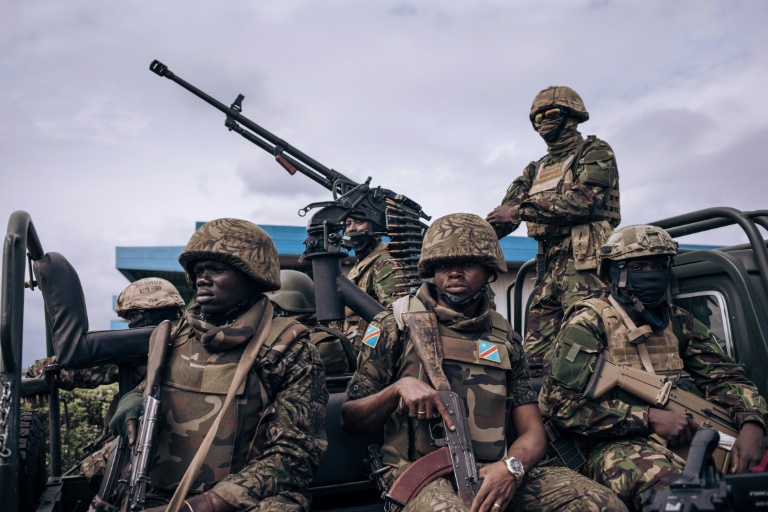
Congolese and security experts reacted cautiously Thursday to the announcement of an impending truce in an escalating conflict in eastern Democratic Republic of Congo.

A militia called the M23 has been gaining ground since mounting an offensive in North Kivu province earlier this year, and is within a few dozen kilometres from Goma, a city of around a million people.

The fighting has sparked a surge in diplomatic tensions with neighbouring Rwanda, which the DRC accuses of abetting the rebels — a charge that Kigali denies.

On Wednesday, though, talks between the two countries in the Angolan capital Luanda gave rise to an agreement for an “immediate ceasefire,” effective from 1600 GMT on Friday.

Both sides also agreed to demand “the immediate withdrawal” of the M23 “from the occupied areas.”

Onesphore Sematumba, an analyst with the International Crisis Group (ICG) think tank, said the fact that the Angolan-brokered meeting had taken place was in itself good news, “given the rising tensions.”

But he questioned whether the deal, reached by DRC President Felix Tshisekedi and Rwandan Foreign Minister Vincent Biruta, would gain traction.

The rebels did not take part, and for reasons that remain unclear Rwandan President Paul Kagame was also absent.

“The M23 can always say that it wasn’t included… and that it is not responsible for a document that it didn’t sign,” Sematumba said, adding that “it would have been better if President Kagame had been there.”

Kagame’s absence “is not a good sign,” said Congolese politician Patrick Mundeke.

Jean-Claude Bambaze, who heads civil society groups in Rutshuru territory, of which swathes have been captured by the M23, said he hoped the rebels would now withdraw.

But, he said, “we are worried, because it won’t have been the first time that (political) decisions are not put into practice.”

The DRC and Rwanda agreed to a de-escalation plan in July — but clashes resumed the very next day.

“The Luanda summit is a strong message to the M23, and we salute it,” said Lumumba Kambere Muyisa, member of a campaign group called LUCHA, meaning Fight for Change.

But, he said, the question was “practicability” — how the agreement would be implemented on the ground.

– Resurgent militia –

The M23, a largely Congolese Tutsi militia, first leapt to prominence 10 years ago when it captured Goma, before being driven out and going to ground.

It re-emerged late last year, claiming the DRC had failed to honour a pledge to integrate its fighters into the army, among other grievances.

The M23 is one of an estimated 120 armed groups that have turned eastern DRC into one of Africa’s most violent regions. 

Many of them are legacies of two wars before the turn of the century that sucked in countries around eastern and central Africa and left millions of people dead.

Rwanda denies the DRC’s charges against it and accuses Kinshasa of colluding with the Democratic Forces for the Liberation of Rwanda (FDLR) — a former Rwandan Hutu rebel group that was established in the DRC after the 1994 genocide.

The East African Community (EAC), of which Rwanda is a member, has also vowed to deploy a joint force to quell the violence.

Kenyan soldiers arrived in the DRC earlier this month and Uganda says it will shortly deploy around 1,000 troops. 

Russian lawmakers approve bill banning LGBTQ 'propaganda'

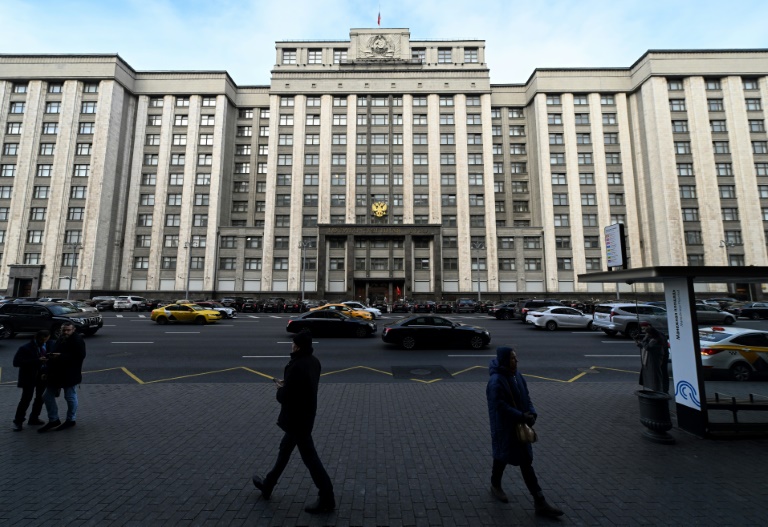
Russian lawmakers unanimously approved a bill banning all forms of LGBTQ “propaganda” in a final reading Thursday, as Moscow presses ahead with its conservative drive at home while its troops fight in Ukraine.

Activists said the new legislation ramps up the crackdown on “non-traditional” sexual relationships in Russia, affecting everything from books and films to social media posts. They have vowed to keep fighting for the rights of minorities.

President Vladimir Putin has sought to promote his country as the antithesis of Western liberal values, pushing an increasingly conservative agenda to rally his core constituency amid heightened tension with the world’s top democracies.

Moscow already has a law against “propaganda” directed at minors regarding LGBTQ relationships. The new bill would broaden that rule to adults.  

The legislation passed by the lower house of parliament, the State Duma, on Thursday bars all mention of what authorities deem “gay propaganda” in media, cinema, books and advertisements.

It also prohibits “the propaganda of paedophilia and sex change”.

“Any propaganda of non-traditional relationships will have consequences,” the speaker of the Duma, Vyacheslav Volodin, said on social media.

The bill “will protect our children and the future of our country from the darkness spread by the US and European states”, he added.

The legislation still needs to be backed by the upper house and Putin before becoming law, but those steps are seen as a formality.

The bill introduces fines of up to 10 million rubles ($165,400) for people who ignore the new ban.

– ‘Absurd law’ – 

Rights groups, who say the legislation will effectively ban all public promotion of LGBTQ rights in Russia, have vowed to keep up the fight.

“We plan on protecting people from this absurd law,” said Natalia Soloviova, chairperson of the Russian LGBT Network organisation.

“LGBTQ people are not leaving, they still need our help and support,” she told AFP.

The exact consequences of the new legislation are still unclear, and rights activists warned that it could be applied indiscriminately.

Soloviova said she and other activists expected “more pressure on activists, an increase in the number of blocked websites… and widespread censorship in the media, movie and other industries”.

Russia has sought to present LGBTQ relationships as a product of dangerous Western influence, toughening its rhetoric as Moscow presses its military campaign in Ukraine.

Dilya Gafurova, the head of LGBTQ rights group Sphere Foundation, said it was especially “disturbing that the state is saying LGBT+ people are a Western invention”.

She warned of the possible effects of the “demonisation of an entire group”.

On Thursday, the European Union also expressed its concern.

“These legislative developments fuel homophobia and further deepen the harsh repression of any critical and alternative discourse in the context of Russia’s illegal, unprovoked and unjustified war of aggression against Ukraine…,” it said in a statement.

The law will enable the authorities to block websites that contain prohibited information. The Duma said it would also be able to ban “the sale of goods (including foreign ones) containing prohibited information”. 

– ‘Nothing wrong with us’ –  

Russian film production companies and book publishers have also expressed concern over the bill, saying it could result in the banning of classics such as Vladimir Nabokov’s “Lolita”, about a middle-aged businessman’s obsession with a 12-year-old girl.

The Duma said “films that promote such relationships will not receive a distribution certificate”.

Senior lawmakers had previously said the bill was needed in the context of Russia’s offensive in Ukraine.

Gafurova urged the authorities not to use the LGBTQ community “as an instrument of ideological confrontation”.

“We just are. There is nothing wrong with us and nothing that needs to be hushed up,” she said, adding that it was impossible “to take our voice away”.

Putin, who turned 70 this year, has repeatedly railed against same-sex parents.

“Do we really want here, in our country, in Russia, instead of ‘mum’ and ‘dad’, to have ‘parent number one’, ‘parent number two’ or ‘parent number three’?” he said in speech at the Kremlin in September.

“Have they gone completely insane?”

EU frets over Twitter job losses as hate speech grows

The European Union on Thursday expressed concern about layoffs at Twitter since its takeover by Elon Musk, after the reported closure of the tech firm’s lobbying office in Brussels.

“We have concerns about the decisions to have less and less people working at the company,” EU justice commissioner Didier Reynders told reporters in Dublin, where Twitter and other US tech groups have their European headquarters.

“When we discuss hate speech, I am sure we need human resources,” he added after a meeting with unidentified representatives from Twitter.

A new EU evaluation showed the number of hate speech notifications reviewed by major social media companies within 24 hours has fallen from 90 percent in 2020, to 81 percent in 2021 and 64 percent in 2022.

The numbers showed only YouTube improved its removal rate for offensive content — as defined by an EU code of conduct — while Twitter and other tech companies’ efforts fell.

Concerns at Twitter’s post-takeover direction intensified Thursday with the Financial Times reporting that the company has dismantled its Brussels office, following the departure of executives who were in charge of efforts to comply with the EU’s online rules.

“It’s an additional concern, because to us to have a team dedicated to the relation with the European institutions is very important,” Reynders said reacting to the FT report.

However, the official added he was “optimistic by nature” and had been given commitments that Twitter’s team in Dublin would step into the Brussels role. 

Tech entrepreneur Musk moved to cut around half of Twitter’s 7,500 workforce, including many employees tasked with fighting disinformation, following his acquisition of the firm last month.

While in Dublin, Reynders is due to meet with representatives from Meta, the owner of Facebook, on Friday.

Mark Zuckerberg’s social media behemoth said this month that it plans to lay off more than 11,000 staff amid an advertising slump.

Both Meta and Twitter’s EU operations are based in Ireland, along with those of Google, Apple and Microsoft, making Ireland’s data protection agency the lead regulator responsible for holding them to account in Europe.

Close Bitnami banner
Bitnami