World

Favourites Brazil kick off World Cup bid as Ronaldo and Portugal enter fray

Favourites Brazil begin their bid to win a sixth World Cup on Thursday when they take on Serbia, while Cristiano Ronaldo will hope to put his acrimonious departure from Manchester United behind him as Portugal enter the fray against Ghana.

Brazil will be wary of a dangerous Serbian side when the teams meet at Lusail Stadium, especially after seeing Argentina suffer a shock defeat against Saudi Arabia on Tuesday at the same venue and Germany lose to Japan on Wednesday.

The Brazilians have arrived in Qatar hoping for a repeat of what happened at the last World Cup held in Asia two decades ago, when they won their fifth title in Japan.

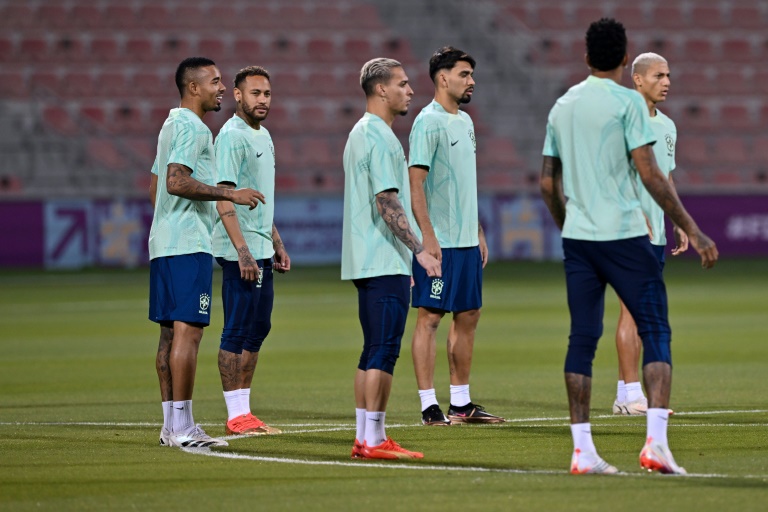
Tite’s side can rely on a Neymar who has been in ominous form for Paris Saint-Germain, but the world’s most expensive player is surrounded by other outstanding attackers ready to share the burden, such as Real Madrid duo Vinicius Junior and Rodrygo.

“In my opinion these players will help Neymar because they can divide up the responsibility and create space for him,” said veteran Brazil skipper Thiago Silva.

“The atmosphere in the squad is super healthy. The mixture of young players and more experienced ones creates a great connection,” he added.

However, Serbia appear a more dangerous proposition than four years ago, when they also faced Brazil in the group stage but lost 2-0 and went home in the first round.

“We are afraid of nobody in the world, not even Brazil,” insisted Serbia coach Dragan Stojkovic, who was hopeful that prolific Fulham striker Aleksandar Mitrovic would be fit for the Group G opener.

– Portugal ‘absolutely focused’ –

Switzerland and Cameroon kick off Thursday’s action in the same section at Al Janoub Stadium at 1:00 PM (1000 GMT).

Swiss skipper Granit Xhaka indicated his side would not copy Germany’s mouth-covering protest against FIFA’s stance on rainbow-themed armbands.

The Swiss were one of the seven European teams whose captains were to wear the armband in support of LGBTQ people at the tournament in Qatar, where homosexuality is illegal.

Germany made the gesture as they lined up for their team photo before their shock 2-1 defeat to Japan after they abandoned plans for skipper Manuel Neuer to wear the armband following threats of on-field disciplinary action by FIFA.

“I don’t think we need to do anything as the Swiss team. We need to respect the rules and concentrate on our football, that’s all I intend to do,” Xhaka said on Wednesday.

Ronaldo’s preparation for what is surely his last World Cup has been overshadowed by his bitter departure from Old Trafford.

It was announced late on Tuesday that the 37-year-old would leave United with “immediate effect” in the wake of an outspoken interview with a British broadcaster in which he said he felt “betrayed” by the club and had no respect for manager Erik ten Hag.

His club form this season has been poor but he is still hoping for a final shot at World Cup glory and Portugal will be expected to start with a victory at Stadium 974 by Doha’s waterfront against a Ghana side who sit 61st in the FIFA rankings.

Portugal coach Fernando Santos claimed that Ronaldo’s split from United had not been discussed by the players.

“The players are absolutely focused, with a great spirit, convinced about what they have to do, what their objectives are and realistic about the challenges they are facing,” Santos said.

“Winning a competition of this magnitude is difficult.”

– Son to play for Korea –

Portugal and Ghana are in Group H with Uruguay and South Korea, who meet in Thursday’s other match.

Son Heung-min will be able to play for South Korea despite wearing a mask after facial surgery.

The Tottenham Hotspur attacker and Korean skipper had surgery earlier this month after suffering a fracture around his left eye during a UEFA Champions League game.

“Son can play and will be able to play,” said coach Paulo Bento.

Ritsu Doan and Takuma Asano scored as Japan came from behind to beat Germany in Group E, while Spain started their campaign with a 7-0 demolition of Costa Rica with Ferran Torres scoring twice for the 2010 World Cup winners.

Belgium also started in winning fashion in Wednesday’s late match as Michy Batshuayi’s goal gave them a 1-0 victory over Canada, for whom Alphonso Davies had a penalty saved.

Group F rivals Morocco drew 0-0 with 2018 beaten finalists Croatia.

Indonesia boy, 6, rescued from quake rubble after two days

A six-year-old boy has been pulled from the rubble of a deadly Indonesia earthquake after spending two days trapped under debris without food or water, in a “miracle” rescue.

The dramatic rescue captured on camera Wednesday evening revived hopes that survivors could still be pulled alive from the wreckage days after the strong tremor that hit the West Java town of Cianjur on Monday, killing at least 271 people.

“Once we realised Azka was alive everybody broke into tears, including me,” 28-year-old local volunteer Jeksen Kolibu told AFP on Thursday.

“It was very moving, it felt like a miracle.”

Video showed rescue workers pulling the boy Azka free from a destroyed home in Cianjur’s worst-hit district of Cugenang, wearing the blue shirt and trousers he had on when he became trapped.

The man who pulled him out of a hole cut in the debris clasped him in both arms, as another rescue worker in an orange hard hat ran after them to hold the boy’s hand, footage released by the administration of West Java’s Bogor district showed.

Azka — whose last name remains unknown — was then shown calmly sipping a drink, held by a soldier as another emergency worker stroked his hair.

His mother died in the earthquake and her body was found hours before Azka’s rescue, a volunteer told AFP on Thursday.

The boy was then found next to his dead grandmother, Kolibu said.

– Protected by pillow –

He was only saved by a wall holding up another collapsed wall, preventing it from falling on him, local media reported.

“He was found on the left side of the house, on a bed. He was protected by a pillow and there was a 10-centimetre gap between him and the concrete slab,” said Kolibu. “Such a narrow space, it was dark, hot and there was not enough hole for air.”

“We didn’t expect him to still be alive after 48 hours, if we knew we would have tried harder the night before,” he said. 

“For all the years since I became a volunteer, I’ve never seen anything like this. How can you not cry?”

The young boy appeared dazed and traumatised from the two-day ordeal.

“Azka did not make a sound, he did not cry for help or whimper at all,” said Kolibu.

“Even when he was pulled out of the rubble he was still conscious and didn’t say anything. He looked so confused.”

Many of those killed in the quake were children at school or in their homes when it struck, officials said.

Authorities warned that time was running out for about 40 people still missing, as rescue workers were delayed by hammering rain and potentially deadly aftershocks.

But the search continued for those still unaccounted for, including a seven-year-old girl.

BTS star to begin S. Korea military service next month: report

The oldest member of K-pop phenomenon BTS will begin his military service on December 13, becoming the first in the band to enlist, local media reported Thursday.

All able-bodied South Korean men under the age of 30 must perform about two years of military service, mainly because the country remains technically at war with nuclear-armed North Korea.

That means the age cut-off is approaching for 29-year-old Jin, senior member of the hugely popular septet.

He will begin his mandatory five-week training at Yeoncheon in Gyeonggi province before being deployed to a “frontline unit”, the Yonhap news agency reported, citing military and industry sources.

The singer had previously hinted on social media that he had been assigned to the front line.

The news left fans overwhelmed and emotional, with some even expressing concern about Jin’s safety.

“My heart literally dropped when I read that he will be deployed to the front line,” one fan tweeted, adding: “This military thing that surround BTS for years NEVER really concerns me until now. Why front line?? Why??”

Another fan said: “I can’t help but think they’re sending him to the hardest scariest place as punishment.”

BTS are credited with generating billions for the South Korean economy, and their label enjoyed a surge in profits despite holding fewer concerts during the coronavirus pandemic.

But the prospect of mandatory military service has long hovered over the K-Pop superstars, and has triggered years-long debate in South Korea over whether they deserved exemptions — which are given to classical musicians and Olympic medallists, for example.

Their agency announced last month that band members would carry out their mandatory military service, starting with Jin.

Seoul’s defence minister had said in August that BTS might be allowed to continue performing and preparing for international concerts even while undertaking military duties.

China's daily Covid cases highest since pandemic began

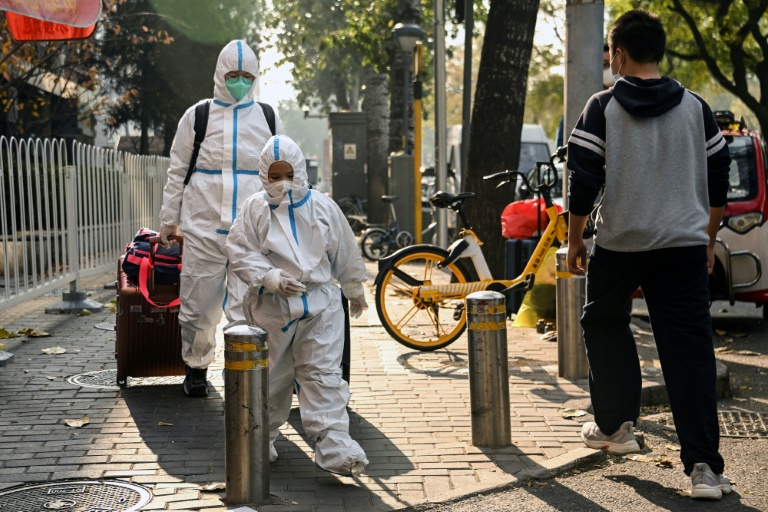
China’s daily Covid cases have climbed to the highest since the pandemic began, official data showed Thursday, despite the government persisting with a zero-tolerance approach involving gruelling lockdowns and travel restrictions.

The numbers are relatively small when compared with China’s vast population of 1.4 billion and the caseloads seen in Western countries at the height of the pandemic. 

But under Beijing’s strict zero-Covid policy, even small outbreaks can shut down entire cities and place contacts of infected patients into strict quarantine.

The country recorded 31,454 domestic cases — 27,517 without symptoms — on Wednesday, the National Health Bureau said.

The unrelenting zero-Covid push has caused fatigue and resentment among swathes of the population as the pandemic’s third anniversary approaches, sparking sporadic protests and hitting productivity in the world’s second-largest economy.

On Wednesday, violent protests erupted at Foxconn’s vast iPhone factory in central China, with video showing dozens of hazmat-clad personnel wielding batons and chasing employees.

The latest figures exceed the 29,390 infections recorded in mid-April when megacity Shanghai was under lockdown, with residents struggling to buy food and access medical care.

Several cities including Beijing, Shanghai, Guangzhou and Chongqing have tightened Covid restrictions as cases surge.

The capital now requires a negative PCR test result within 48 hours for those seeking to enter public places such as shopping malls, hotels and government buildings, Beijing authorities said. Schools across the city have moved to online classes.

The southern manufacturing hub of Guangzhou — where nearly a third of the latest Covid cases were found — has built thousands of temporary hospital rooms to accommodate patients.

– ‘Bumpy’ reopening –

A series of new rules announced by the central government earlier this month appeared to signal a shift away from zero-Covid, easing quarantine requirements for entering the country and simplifying a system for designating high-risk areas.

But China has yet to approve more effective mRNA vaccines for public use and only 85 percent of adults over 60 had received two doses of domestic vaccines by mid-August, according to health authorities.

And Shijiazhuang, a city neighbouring Beijing that was seen as a pilot for testing reopening strategies, reversed most of its easing measures this week.

“The path to reopening may be slow, costly and bumpy,” Ting Lu, chief China economist at Nomura, said in a note.

“Shanghai-style full lockdowns could be avoided, but they might be replaced by more frequent partial lockdowns in a rising number of cities due to surging Covid case numbers.”

Stocks rise, dollar slips as Fed signals softer rate hike pace

Asian markets rallied Thursday and the dollar weakened further after minutes from the Federal Reserve’s latest policy meeting suggested it could slow its pace of rate hikes.

The news provided traders with a cushion against concerns about surging Covid cases in China that have fanned speculation authorities will revert to lockdowns and other economically debilitating measures to fight the outbreak.

Wednesday’s much-anticipated minutes showed most US central bank chiefs felt smaller increases would “likely soon be appropriate” as the economy shows signs of weakness following almost a year of monetary tightening.

Bets were growing on officials announcing a 50-basis-point lift at their December gathering, down from four straight 75-point hikes, with officials keeping tabs on economic data.

The latest indicators showed the manufacturing and services sectors continued to contract last month, while jobless claims picked up.

The developments allowed Wall Street traders to head off to their Thanksgiving break with a spring in their step, the S&P 500 ending at a two-month high as they finally see a glimmer of light at the end of the tunnel after a painful year.

And Asia followed suit, with Tokyo, Hong Kong, Shanghai, Sydney, Seoul, Singapore, Taipei, Manila and Jakarta all in the red.

The more risk-on environment was also reflected in a further drop in the dollar against its peers, having surged for much of the year as traders bet on ever-higher US interest rates.

“Equities are revelling in the wake of the… minutes after the Fed telegraphed a downshift from jumbo to extra-large rate hikes,” said SPI Asset Management’s Stephen Innes.

“A commitment to moving toward restrictive monetary policy remains intact, but the (policy board) is ready to slow the path toward that destination.”

He added that a less aggressive Fed “should pave the runway for take-off in Asia, fuelled by expectations of China’s reopening by March next year”.

Investors are keeping a close watch on China after it announced a record number of new Covid cases on Thursday as authorities worked to curb the spread with snap lockdowns, mass testing and travel restrictions.

While officials are trying more targeted measures to contain the disease, there remains a concern that they will resort to the painful city-wide shutdowns seen in Shanghai earlier this year as part of the country’s zero-Covid strategy, which hammered the economy.

However, the concern has been tempered somewhat after China signalled fresh support measures aimed at boosting growth, with the State Council saying tools would be used to ensure liquidity in markets. 

The comments led to talk of another cut in the amount of cash banks must keep in reserve, freeing them to lend more.

– Key figures around 0230 GMT –

Tokyo – Nikkei 225: UP 1.2 percent at 28,448.58 (break)

Hong Kong – Hang Seng Index: UP 0.5 percent at 17,617.28

Shanghai – Composite: UP 0.3 percent at 3,106.13

Euro/dollar: UP at $1.0424 from $1.0401 on Wednesday

Dollar/yen: DOWN at 138.82 yen from 139.52 yen

Pound/dollar: UP at $1.2088 from $1.2064

Euro/pound: UP at 86.23 pence from 86.18 pence

West Texas Intermediate: DOWN 0.2 percent at $77.77 per barrel

Brent North Sea crude: DOWN 0.3 percent at $85.14 per barrel

New York – Dow: UP 0.3 percent at 34,194.06 (close)

London – FTSE 100: UP 0.2 percent at 7,465.24 (close)

Stocks rise, dollar slips as Fed signals softer rate hike pace

Asian markets rallied Thursday and the dollar weakened further after minutes from the Federal Reserve’s latest policy meeting suggested it could slow its pace of rate hikes.

The news provided traders with a cushion against concerns about surging Covid cases in China that have fanned speculation authorities will revert to lockdowns and other economically debilitating measures to fight the outbreak.

Wednesday’s much-anticipated minutes showed most US central bank chiefs felt smaller increases would “likely soon be appropriate” as the economy shows signs of weakness following almost a year of monetary tightening.

Bets were growing on officials announcing a 50-basis-point lift at their December gathering, down from four straight 75-point hikes, with officials keeping tabs on economic data.

The latest indicators showed the manufacturing and services sectors continued to contract last month, while jobless claims picked up.

The developments allowed Wall Street traders to head off to their Thanksgiving break with a spring in their step, the S&P 500 ending at a two-month high as they finally see a glimmer of light at the end of the tunnel after a painful year.

And Asia followed suit, with Tokyo, Hong Kong, Shanghai, Sydney, Seoul, Singapore, Taipei, Manila and Jakarta all in the red.

The more risk-on environment was also reflected in a further drop in the dollar against its peers, having surged for much of the year as traders bet on ever-higher US interest rates.

“Equities are revelling in the wake of the… minutes after the Fed telegraphed a downshift from jumbo to extra-large rate hikes,” said SPI Asset Management’s Stephen Innes.

“A commitment to moving toward restrictive monetary policy remains intact, but the (policy board) is ready to slow the path toward that destination.”

He added that a less aggressive Fed “should pave the runway for take-off in Asia, fuelled by expectations of China’s reopening by March next year”.

Investors are keeping a close watch on China after it announced a record number of new Covid cases on Thursday as authorities worked to curb the spread with snap lockdowns, mass testing and travel restrictions.

While officials are trying more targeted measures to contain the disease, there remains a concern that they will resort to the painful city-wide shutdowns seen in Shanghai earlier this year as part of the country’s zero-Covid strategy, which hammered the economy.

However, the concern has been tempered somewhat after China signalled fresh support measures aimed at boosting growth, with the State Council saying tools would be used to ensure liquidity in markets. 

The comments led to talk of another cut in the amount of cash banks must keep in reserve, freeing them to lend more.

– Key figures around 0230 GMT –

Tokyo – Nikkei 225: UP 1.2 percent at 28,448.58 (break)

Hong Kong – Hang Seng Index: UP 0.5 percent at 17,617.28

Shanghai – Composite: UP 0.3 percent at 3,106.13

Euro/dollar: UP at $1.0424 from $1.0401 on Wednesday

Dollar/yen: DOWN at 138.82 yen from 139.52 yen

Pound/dollar: UP at $1.2088 from $1.2064

Euro/pound: UP at 86.23 pence from 86.18 pence

West Texas Intermediate: DOWN 0.2 percent at $77.77 per barrel

Brent North Sea crude: DOWN 0.3 percent at $85.14 per barrel

New York – Dow: UP 0.3 percent at 34,194.06 (close)

London – FTSE 100: UP 0.2 percent at 7,465.24 (close)

Taiwanese politicians flaunt good luck veggies on campaign trail

In many parts of the world, a politician might hope for a picture-perfect moment with a voter’s baby to boost their poll numbers. But in Taiwan, vegetables are the kings of the campaign trail.

Whenever the democratic island of 23 million people goes into election mode, prospective candidates race to pose with smorgasbords of vegetables — large white radishes are a favourite — gifted by voters hoping to show their approval.

The reason is Taiwan’s love of homonyms: words that sound identical or similar but can carry multiple meanings.

In a political culture infused with good luck symbols and superstition — where candidates often seek advice from feng-shui masters when deciding the location or opening date of their campaign headquarters — photo-ops with the right vegetable are routine.

Garlic (suan) is immensely popular because when pronounced in Taiwanese it also sounds like the word for “chosen”.

The daikon radish (tsai-tao) is a winner because it is pronounced nearly the same as “good luck”, while pineapple (ong-lai) is a homonym for “prosperity comes”.

Ke Chiong-shu, 60, has been selling vegetables at the Wuxing Street Market in the capital Taipei for more than a decade. 

Many of her district’s candidates have visited the market in recent weeks as Taiwan gears up to hold island-wide local elections on Saturday.

When AFP visited recently, it was former health minister Chen Shih-chung’s turn to press the flesh as he campaigned for the Taipei mayoralty, one of the most important posts up for grabs this weekend.

Ke grabbed some radish and garlic greens from her stall. 

“Hope you get elected,” she beamed as Chen proudly turned around to display the gifted veggies to the chanting crowd behind.

“I give to all candidates regardless of their party affiliation,” Ke added. “I hope they all get elected so that they can serve us folks and strive for our benefit.”

– Progressive democracy –

After shaking off decades of martial law, Taiwan has evolved into one of Asia’s most vibrant and progressive democracies — a stark contrast to Communist Party-run China, which claims the island as its own and has vowed to one day take it, by force if necessary.

It can feel like Taiwan is in near-constant campaign mode. 

Presidential and parliamentary elections are held every four years and are often dominated by relations with Beijing.

In between are local elections held for a variety of positions, from mayoral posts in big cities to indigenous administrators and village chiefs.

Taiwan also has referendum laws that allow voters to regularly decide on a host of constitutional issues.

Saturday’s local election, for example, includes a referendum on whether to lower the voting age from 20 to 18. 

– Bread-and-butter issues –

Local polls tend to be much less focused on geopolitics and centre more on bread-and-butter issues like bad roads, stagnant wages and recent rising inflation.

“Something that is very special about Taiwanese local elections is how personable things get,” political scientist Lev Nachman, who studies Taiwanese electoral politics, told AFP. 

Face-to-face greetings and a handshake or slight bow can go a long way in garnering support for a candidate.

“Older voters like to see their politicians in markets and early in the morning out on the streets,” Nachman explained.

Under President Xi Jinping, China has become much more bellicose towards Taiwan, and Beijing has cut official communications with the island since President Tsai Ing-wen was first elected in 2016.

Tsai’s Democratic Progressive Party, which has won the last two elections, sees Taiwan as a de facto sovereign nation.

The opposition is dominated by the Kuomintang party, which favours warmer ties with China.

Relations with Beijing plunged in August when it conducted huge military drills around Taiwan to protest a visit to the island by US House Speaker Nancy Pelosi.

But despite the very real threat of conflict, the drama has received minimal attention in the lead-up to this Saturday’s polls. 

“Even though we just went through these very high-tension military drills in August, those aren’t really being talked about by local candidates,” Nachman said.

“Instead, it is much more about attacking opponents based on the quality of their character,” he added.

Nonetheless, Lin Pei-ying, 36, a DPP candidate who is running for councillor in the northeastern county of Yilan, says she believes her party’s commitment to maintaining Taiwan’s democratic way of life will still feed into voters’ decisions. 

“We are sending a message to China,” she told AFP. “Taiwan is Taiwan, China is China.”

Indonesia boy, 6, rescued from quake rubble after two days

A six-year-old boy has been pulled from the rubble of a deadly Indonesia earthquake after spending two days trapped under debris without food or water, in a “miracle” rescue.

The dramatic rescue captured on camera Wednesday evening revived hopes that survivors could still be pulled alive from the wreckage days after the strong tremor that hit the West Java town of Cianjur on Monday, killing at least 271 people.

“Once we realised Azka was alive everybody broke into tears, including me,” 28-year-old local volunteer Jeksen told AFP on Thursday.

“It was very moving, it felt like a miracle.”

Video showed rescue workers pulling the boy Azka free from a destroyed home in Cianjur’s worst-hit district of Cugenang, wearing the blue shirt and trousers he had on when he became trapped.

The man who pulled him out of a hole cut in the debris clasped him in both arms, as another rescue worker in an orange hard hat ran after them to hold the boy’s hand, footage released by the administration of West Java’s Bogor district showed.

Azka — who like many Indonesians goes by one name — was then shown calmly sipping a drink, held by a soldier as another emergency worker stroked his hair.

His mother died in the earthquake and her body was found hours before Azka’s rescue, a volunteer told AFP on Thursday.

The boy was then found next to his dead grandmother, Jeksen said.

He was only saved by a wall holding up another collapsed wall, preventing it from falling on him, local media reported.

“He was found on the left side of the house, on a bed. He was protected by a pillow and there was a 10-centimetre gap between him and the concrete slab,” said Jeksen. “Such a narrow space, it was dark, hot and there was not enough hole for air.”

“We didn’t expect him to still be alive after 48 hours, if we knew we would have tried harder the night before,” he said. 

“For all the years since I became a volunteer, I’ve never seen anything like this. How can you not cry?”

Many of those killed in the quake were children at school or in their homes when it struck, officials said.

But authorities warned that time was running out as rescue workers were delayed by hammering rain and potentially deadly aftershocks.

“Today for the search and rescue operation we deployed 6,000 people. It was raining but we keep searching,” said Suharyanto, head of the national disaster mitigation agency, or BNPB.

“Please pray for us so the 40 missing people could be found.”

Authorities are continuing to search for dozens who remain buried under debris, including a missing seven-year-old girl.

Journalists have much to lose if Twitter dies

Few will lose as much as journalists if Twitter dies, having grown reliant on its endless sources and instant updates despite the dangers and distortions that come with it.

There has been fevered talk of the platform’s imminent demise since billionaire Elon Musk took over last month and began firing vast numbers of staff.

But most journalists “can’t leave,” said Nic Newman, of the Reuters Institute for the Study of Journalism. “It’s actually a really important part of their work.”

Newman was working at the BBC when Twitter started making waves in 2008 and 2009.

“It was a new Rolodex, a new way of contacting people — fantastic for case studies and… experts,” he said.

But Twitter also became a competitor, replacing newsrooms as the source of breaking news for the public when terrorist attacks, natural disasters or any fast-moving story struck.

“Journalists realised they wouldn’t always be the ones breaking the news and that their role was going to be different — more about contextualising and verifying that news,” said Newman.

It also meant journalists were tied to the platform for announcements by politicians and celebrities — most famously the dreaded late-night and early-morning tweets from Donald Trump that left hundreds of journalists sleep-deprived throughout his presidency.

– ‘Tribal melodrama’ –

The dependency has bred many problems.

New York Times columnist Farhad Manjoo spoke for many in 2019 when he wrote that “Twitter is ruining American journalism” with the way it “tugs journalists deeper into the rip currents of tribal melodrama, short-circuiting our better instincts in favor of mob- and bot-driven groupthink.”

By rewarding the most vehement voices, the platform tends to drown out the majority of the population — both moderates and non-elites.

“The debates that happen on Twitter are very much the debates of the elite,” said Newman. “It has definitely been a problem in newsrooms.”

“Paying attention only to Twitter tends to distort the way that many people, including journalists, see the world,” agreed Mathew Ingram, digital media specialist at the Columbia Journalism Review.

Though he hopes they have grown savvy enough to deal with the distortions, journalists have been subjected to a “huge tide of disinformation and harassment”.

But for all the frantic talk over Musk’s volatile tenure, many believe the site will survive.

“For the record, I don’t think it’s all that likely that Twitter will shut down anytime soon,” said Stephen Barnard, a sociologist at Butler University in the United States.

But he said journalists have good reason to fear its disappearance.

“They would lose access to what is for many a very large, powerful and diverse social network… (and) also a positive source of prestige and professional identity,” Barnard said.

“There is no real heir apparent in that space, so I’m not sure where they would go,” he added.

On the plus side, Ingram said, it could spur a return to “more traditional ways of researching and reporting”.

“Perhaps that would be a good thing,” he added.

UK police lift lid on largest ever counter-fraud operation

UK police on Thursday said their biggest ever counter-fraud operation had disrupted an international criminal network targeting hundreds of thousands of victims in millions of spam phone calls.

The Metropolitan Police, which spearheaded the 18-month global probe into the iSpoof.cc website, has arrested over 100 people in recent weeks, including one of its alleged London-based administrators.

Working with Europol, the FBI and other law enforcement worldwide, suspects were nabbed in the Netherlands, Australia, France and Ireland, while servers were shuttered in the Netherlands and Ukraine.

UK police believe organised crime groups are linked to the website and its tens of thousands of users, who could access software tools on it to help illicitly obtain victims’ bank account funds and commit other fraud.

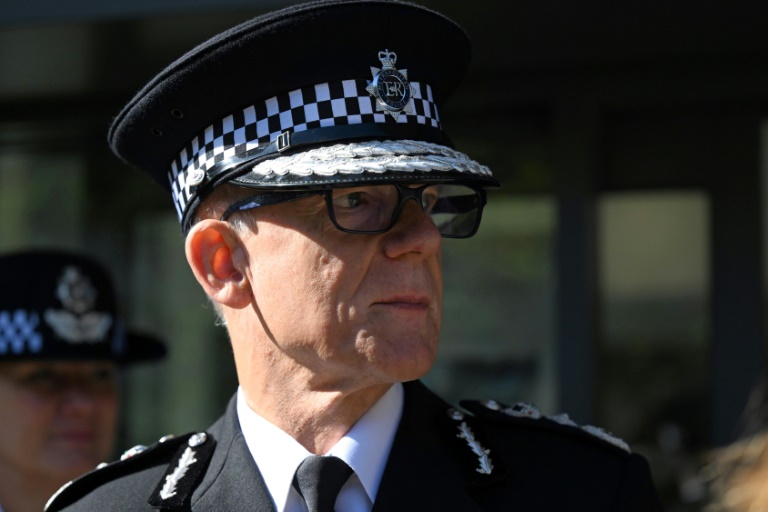
Met Commissioner Mark Rowley said the investigation signalled “a different approach” to criminals exploiting technology.

“This is about starting from the organised criminals that actually drive and create the fraud that we see in the world around us,” he told reporters.

– Industrialised fraud –

The London force — the UK’s largest — said in the year to August, suspects paid to access the website and make more than 10 million fraudulent calls worldwide.

Around 40 percent were in the United States, while more than a third were in the UK targeting 200,000 potential victims there alone.

Fraud detection agencies have so far recorded £48 million ($58 million) in losses in the UK alone, with the largest single theft £3 million and the average £10,000.

“Because fraud is vastly under-reported, the full amount is believed to be much higher,” the Met said.

Those behind the site earned almost £3.2 million from it, the force added.

Only around 5,000 British victims have so far been identified.

However, the Met’s investigation has yielded the phone numbers of more than 70,000 potential victims who have yet to be contacted.

The force will attempt to reach them over the next two days, sending text messages directing those contacted to its website where details can be safely logged.   

“What we’re doing here is trying to industrialise our response to the organised criminals’ industrialisation of the problem,” Rowley added.

– ‘Operation Elaborate’ –

The iSpoof website — described as “an international one stop spoofing shop” — was created in December 2020 and at its peak had 59,000 users paying between £150 and £5,000 for its services, according to the Met.

It enabled subscribers, who could pay in Bitcoin, to access so-called spoofing tools which made their phone numbers appear as if they were calling from banks, tax offices and other official bodies.

Some of the UK’s biggest consumer banks — including Barclays, HSBC, Santander, Lloyds, Halifax — were the mostly commonly imitated.

Combined with customers’ bank and login details illegally obtained elsewhere online, the criminals were then able to defraud their victims.

“They would worry them (about) fraudulent activity on their bank accounts and tricked them,” explained Detective Superintendent Helen Rance, who leads on cyber crime for the Met.

She noted that people contacted would typically be instructed to share six-digit banking passcodes allowing their accounts to be emptied. 

The Met launched “Operation Elaborate” in June 2021, partnering with Dutch police who had already started their own probe after an iSpoof server was based there.

A subsequent server operating in Kyiv was shuttered in September, while the site was permanently disabled on November 8.

The previous day the Met had charged Teejai Fletcher, 34, of east London, with fraud and organised crime group offences.

He remains in custody and will next appear in a London court on December 6.

“It’s fair to say that he was living a lavish lifestyle,” Rance said, noting the investigation remained ongoing.

“Instead of just taking down the website and arresting the administrator, we have gone after the users of iSpoof,” she added. 

Two other suspected administrators outside the UK remain at large, the Met noted. 

Close Bitnami banner
Bitnami