World

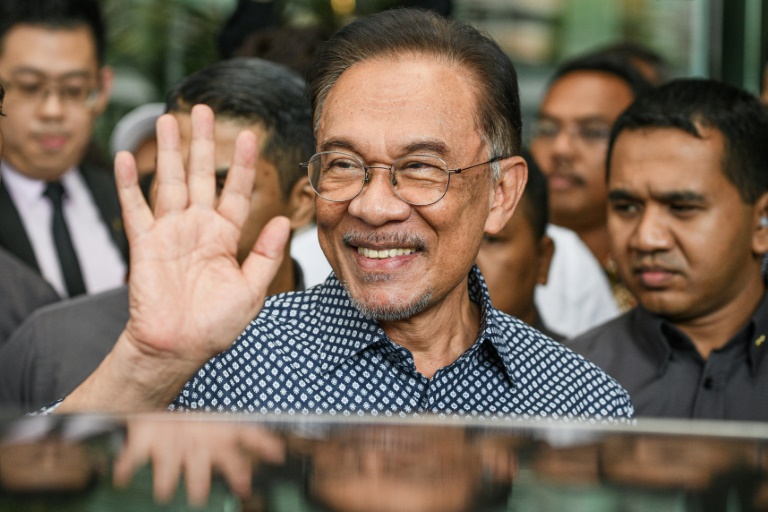
Opposition leader Anwar named next Malaysia PM

Malaysia’s perennial opposition leader Anwar Ibrahim was named prime minister on Thursday, ending a days-long political impasse after inconclusive election results.

The 75-year-old was scheduled to be sworn in at 5 pm (0900 GMT), becoming the country’s fourth leader in as many years.

His ascension will cap a turbulent political life for Anwar — which has not only propelled him into the corridors of power but also landed him inside a jail cell on corruption and sodomy charges.

“After taking into consideration the views of Their Royal Highnesses the Malay Rulers, His Majesty has given consent to appoint Anwar Ibrahim as the 10th Prime Minister of Malaysia,” read a statement from the palace of the king, Sultan Abdullah Ahmad Shah.

In the capital Kuala Lumpur, Anwar supporters were in celebratory mood.

“I got goosebumps, seriously,” said 36-year-old Norhafitzah Ashruff Hassan. “He fought hard to be given the chance to be PM. I hope he performs well and proves his worth.”

“I cannot express in words the ecstatic feeling I have,” said Muhammad Taufiq Zamri, a 37-year-old product manager. “A sense of optimism now flows and I believe Anwar will lead the country forward.”

Anwar’s multi-ethnic Pakatan Harapan coalition won the most seats in the weekend’s election, on an anti-graft message.

But its total of 82 seats was short of the 112 required for a majority.

The king had summoned Anwar and former prime minister Muhyiddin Yassin — whose Perikatan Nasional bloc got 73 seats — in an attempt to break the deadlock, but no deal could be struck.

– Rollercoaster journey-

For Anwar, the premiership is the culmination of a rollercoaster 25 years.

The firebrand former student activist was close to power in the late 1990s, as finance chief and deputy prime minister to Mahathir Mohamad.

But the two had a bitter falling-out over how to handle the 1997-98 Asian financial crisis.

Mahathir sacked his former protege, who was also expelled from their then party the United Malays National Organisation (UMNO), and charged with corruption and sodomy.

Anwar was sentenced to six years in jail for corruption in 1999, with an additional nine years added for the sodomy charge the following year, the two sentences to run consecutively.

As he claimed political persecution, street protests erupted and evolved into a movement for democratic reforms.

The Mahathir-Anwar tussle has dominated and shaped Malaysian politics over the past four decades, “alternately bringing despair and hope, progress and regress to the country’s polity”, according to Oh Ei Sun of the Pacific Research Center of Malaysia.

The Malaysian Supreme Court overturned Anwar’s sodomy conviction in 2004 and ordered him freed.

-‘Long time coming’-

Anwar allied with Mahathir during the 2018 elections, when his erstwhile tormentor came out of retirement to challenge incumbent Najib Razak, who was mired in the billion-dollar 1MDB financial scandal.

Their alliance scored a historic victory against UMNO and Najib, who is now serving a 12-year jail term for corruption.

Mahathir became prime minister for the second time, with an agreement to hand over the premiership to Anwar later.

He never fulfilled that pact, and their alliance collapsed after 22 months.

“This is a long time coming for Anwar Ibrahim,” Asrul Hadi Abdullah Sani, deputy managing director at strategic advisory firm Bower Group Asia, told AFP.

“One of his agendas is to ensure he is able to fulfil his reform agenda as he looks to stabilise a loosely cobbled federal coalition.”

James Chin, a professor of Asian studies at the University of Tasmania, told AFP the announcement “will be welcomed internationally since Anwar is known as a Muslim democrat worldwide”. 

“His biggest challenge will be to lead Malaysia out of the economic malaise following the pandemic.” 
Iran crackdown in spotlight at UN rights council

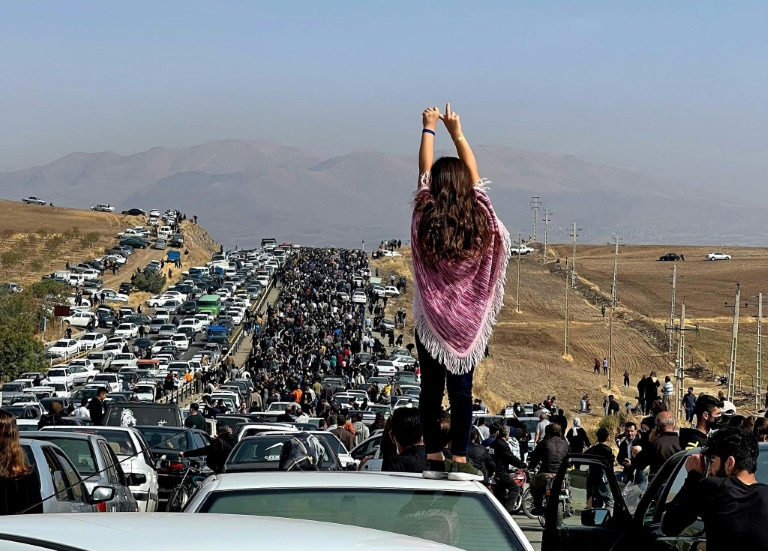
The UN Human Rights Council is holding an urgent meeting Thursday to discuss whether to launch a high-level international investigation into the deadly crackdown on mass protests rocking Iran.

The special session on Iran’s “deteriorating human rights situation” is due to kick off at 10:00 am (0900 GMT) in Geneva, with the new UN rights chief Volker Turk set to open the proceedings in his first appearance before the council.

The meeting, requested by Germany and Iceland with the backing of more than 50 countries, follows two months of protests in Iran sparked by the death of 22-year-old Mahsa Amini, after she was arrested for an alleged breach of the country’s strict dress rules for women based on Islamic sharia law. 

The authorities have grown increasingly heavy-handed in their response, as the demonstrations have spread across the country and swelled into a broad movement against the theocracy that has ruled Iran since 1979.

At least 416 people, including 51 children, have been killed across Iran in the crackdown since Amini’s death, according to Norway-based group Iran Human Rights.

Thousands of peaceful protesters have also been arrested, according to the United Nations, including many women, children and journalists, and six people have so far been handed death sentences over the demonstrations.

– ‘Shine a spotlight’ –

During Thursday’s session, diplomats will debate a call for an international investigation of alleged violations linked to the ongoing protests.

The so-called independent international fact-finding mission should include “the gender dimensions of such violations” in its investigations, according to the draft resolution, presented by Germany and Iceland.

The text calls for the investigators to “collect, consolidate and analyse evidence of such violations, and to preserve evidence,” with a view to future prosecution.

German Foreign Minister Annalena Baerbock, who like her Icelandic counterpart will be in Geneva for the session, stressed that “the Iranian demonstrators have no seat at the Human Rights Council in Geneva.”

Thursday’s meeting, she said, provides the opportunity for the body to “raise its voice for the indivisible rights of Iran’s people.”

Diplomats and rights activists voiced strong support for the initiative.

“We must do all we can to expose the truth of what is happening inside Iran and support the calls of the Iranian people for justice and accountability,” US ambassador Michele Taylor said.

Tara Sepehri Far, an Iran researcher with Human Rights Watch, urged the council to “shine a spotlight on the deepening repression and… hold those responsible accountable.”

– ‘Provocative’ –

Tehran has meanwhile been lobbying hard against the resolution and its Western backers.

“With a long history of colonialism and violation of human rights of other nations, the US and Europe are not in a position to pretend to be an advocate of human rights,” the Iranian foreign ministry tweeted Wednesday.

Foreign Minister Hossein Amir-Abdollahian recently tweeted at Baerbock that his country’s response to Germany’s “provocative, interventionist and undiplomatic stances” would be “proportionate and firm”.

Germany and Iceland received broad backing for their request to hold Thursday’s session, including from more than a third of the council’s 47 members.

Western diplomats voiced cautious optimism that the resolution would go through, but acknowledged it could be tight.

– ‘Every vote counts’ –

Baerbock called for the council to vote in favour of the resolution, saying: “We owe it to the victims.”

“Every vote counts,” she said. 

The Human Rights Council has seen growing pushback from countries including China, Russia and Iran against often Western-led efforts to hold individual states accountable for alleged violations.

Last month, Western nations suffered a crushing defeat when their attempt to get China’s alleged abuses in its Xinjiang region onto the council agenda was thwarted.

But Iran may have a harder time blocking Thursday’s resolution.

The council has already voiced concerns at Iran’s human rights record by in 2011 appointing a so-called special rapporteur to monitor the country, and voting each year since then to renew that mandate.

“It should pass,” said Omid Memarian, an analyst at Democracy for the Arab World Now.

If it does, he told AFP, it will provide “a huge moral boost” to the protesters, and send a warning to rights violators in Iran that “the rest of the world will not be safe for them.” 

Stocks rise, dollar slips as Fed signals softer rate hike pace

Asian markets rallied Thursday and the dollar weakened further after minutes from the Federal Reserve’s latest policy meeting suggested it could slow the pace of its rate hikes.

The news provided traders with a cushion against concerns about surging Covid-19 cases in China that have fanned speculation authorities will revert to lockdowns and other economically debilitating measures to fight the outbreak.

Wednesday’s much-anticipated minutes showed most US central bank chiefs felt smaller increases would “likely soon be appropriate” as the economy shows signs of weakness following almost a year of monetary tightening.

Bets were growing on officials announcing a 50-basis-point lift at their December gathering, down from four straight 75-point hikes.

The latest indicators showed the manufacturing and services sectors continued to contract last month, while jobless claims picked up.

The developments allowed Wall Street traders to head off to their Thanksgiving break with a spring in their step, the S&P 500 ending at a two-month high as they finally see a glimmer of light at the end of the tunnel after a painful year.

Asia mostly followed suit, with Tokyo, Hong Kong, Mumbai, Sydney, Seoul, Singapore, Taipei, Manila and Jakarta all positive, though Shanghai dipped and Wellington barely moved.

Kuala Lumpur surged more than three percent and the ringgit held gains after opposition leader Anwar Ibrahim was named prime minister, ending a days-long leadership impasse after inconclusive polls that had rattled Malaysia’s markets.

London was flat at the open, while Paris and Frankfurt edged up.

The more risk-on environment was also reflected in a further drop in the dollar against its peers, having surged for much of the year as traders bet on ever-higher US interest rates.

“Equities are revelling in the wake of the… minutes after the Fed telegraphed a downshift from jumbo to extra-large rate hikes,” said SPI Asset Management’s Stephen Innes.

“A commitment to moving toward restrictive monetary policy remains intact, but the (policy board) is ready to slow the path toward that destination.”

He added that a less aggressive Fed “should pave the runway for take-off in Asia, fuelled by expectations of China’s reopening by March next year”.

Investors are keeping a close watch on China after it announced a record number of new Covid cases on Thursday as authorities worked to curb the spread with snap lockdowns, mass testing and travel restrictions.

While officials are trying more targeted measures to contain the disease, concerns remain that they will resort to the painful city-wide shutdowns seen in Shanghai earlier this year as part of the zero-Covid strategy, which hammered the economy.

However, that worry has been tempered somewhat after China signalled fresh support measures aimed at boosting growth, with the State Council saying tools would be used to ensure liquidity in markets. 

The comments led to talk of another cut in the amount of cash that banks must keep in reserve, freeing them to lend more.

Oil prices extended Wednesday’s sharp losses fuelled by worries about the impact on demand from China’s Covid outbreaks.

SPI’s Innes added that a reported Group of Seven consideration for capping Russian crude at $65-$70 a barrel was higher than expected and not far from the present discount of the contract. That meant the move would likely not hit exports materially, he said.

– Key figures around 0820 GMT –

Tokyo – Nikkei 225: UP 1.0 percent at 28,383.09 (close)

Hong Kong – Hang Seng Index: UP 0.8 percent at 17,660.90 (close)

Shanghai – Composite: DOWN 0.3 percent at 3,089.31 (close)

London – FTSE 100: FLAT at 7,467.02

Euro/dollar: UP at $1.0410 from $1.0401 on Wednesday

Dollar/yen: DOWN at 139.10 yen from 139.52 yen

Pound/dollar: UP at $1.2074 from $1.2064

Euro/pound: UP at 86.20 pence from 86.18 pence

West Texas Intermediate: DOWN 0.4 percent at $77.62 per barrel

Brent North Sea crude: DOWN 0.5 percent at $85.00 per barrel

New York – Dow: UP 0.3 percent at 34,194.06 (close)

Russians fleeing Putin prepare for life in Serbian exile

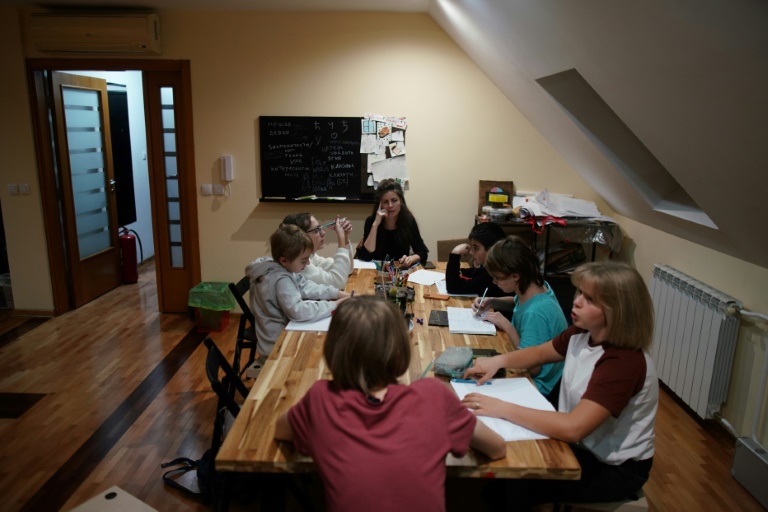
A group of Russian children clamour cheerfully in a Belgrade apartment, proudly shouting out the new Serbian words they’ve just learned to their teacher.

These kids all have one thing in common. Their parents fled after Russian President Vladimir Putin’s invasion of Ukraine and are now preparing to stay in the Balkan country for the long haul.

Just as over a century ago, when thousands of Russians fleeing the Bolshevik revolution settled in Serbia, the country has once again become a haven for Russians fleeing repression, uncertainty and the real possibility of being drafted to fight a war they don’t consider their own.

Maria Nefyodova, whose 10-year-old child Artemii already speaks fluent Serbian after only nine months in Belgrade, packed their bags as soon as the first shot was fired in Ukraine.

“On February 24, everything changed. Our world turned upside down”, Nefyodova told AFP.

“Of course, not in the way it has changed for those who are the directly affected side, but our world was shattered too”.

– 100,000 Russians –

Since then, according to state media, more than 100,000 Russian citizens have arrived in Serbia, a country of under seven million.

They have used one of the few remaining flight routes into Europe that has not been closed off in retaliation for the war. 

Serbian President Aleksandar Vucic said last month the country was “like Casablanca”, likening it to the Moroccan town of the 1942 movie, swarming with war refugees and spies.

While the exact number of Russians who have elected to stay is unknown, almost 3,000 Russian companies have registered in Serbia since February, according to its business registration agency.

Unlike some other parts of Europe, Russians are greeted with open arms in Serbia. Cultural and historical ties between the two predominantly Slavic and Orthodox Christian countries stretch back centuries.

“I definitely want to stay here,” 41-year-old Muscovite artist Anna Cherepanova told AFP. 

The Belgrade apartment where she lives with her two children serves as an unofficial Serbian language school.

“The children like it here. If they didn’t feel as comfortable, I would likely consider moving to another country.”

– Russians leading anti-war rallies –

But the Serbian affection for Russia often extends to support for the Kremlin as well. 

That creates awkward situations for exiled Russians who, almost by definition, vehemently oppose Putin.

Souvenir kiosks in Belgrade sell T-shirts featuring Putin’s face, while the letter Z — the Russian symbol for the invasion of Ukraine — has been daubed on walls across the city. 

Serbia, a candidate to join the European Union, is walking a diplomatic tightrope, condemning the invasion of Ukraine at the United Nations while refusing to align with Western sanctions against Moscow.

It is the Russians living in Serbia who are the most vocal in denouncing Putin’s aggression.

United by an online platform, a group consisting mainly of Russians has staged numerous anti-war rallies, held charity events and spray-painted over the pro-Putin graffiti in Belgrade.

The simple fact that they can now voice their resentment without fear of being arrested or imprisoned is a revelation for many.

“The Russians are thrilled that they can march in the middle of the street, chant and even shout insults against Putin and the war,” Sasha Seregina, a 34-year-old architect who emigrated from Russia to Serbia over a decade ago, told AFP.

“Some said they were constantly on the lookout to see if police would come out of nowhere to arrest them.”

– Business impact –

Several big Russian tech companies, including Yandex, Luxoft and Wargaming, have opened new offices in Belgrade or expanded existing ones. They have moved hundreds of staff to Serbia and also employ locals.

For decades, Serbia has been crippled by the mass exodus of young, well-educated and skilled workers. Some experts believe the sudden influx of Russian tech businesses could provide a lifeline for the country’s economy.

“Educated people stop leaving the country once the number of highly-paid jobs starts to rise,” Danica Popovic, an economics professor at Belgrade University, told AFP.

“If those tech companies start employing Serbian engineers — which they probably will as it is cheaper than any other option — we have a chance to decrease emigration.”

But many Serbs complain that the arrival of predominantly middle-class Russians, whose income far exceeds the average salary in Serbia (640 euros, $657), has doubled the rent charged in big cities like Belgrade and Novi Sad.

While most Russian immigrants work in tech companies, some are using their knowledge and experience to expand the Serbian business scene.

Aleksei Novikov, a 42-year-old businessman from Saint Petersburg who fled to Serbia fearing he might be drafted to serve in Ukraine, recently opened Belgrade’s very first cider bar.

“In Russia, business is a bit more advanced, so I see opportunities and perspective to bring something new to Serbia,” Novikov told AFP.

“Lots of Russians came recently. I hope we won’t become a problem for Serbs, that we will integrate into society and do good things to make life better for everyone.”

French lawmakers to vote on bullfighting ban

French members of parliament are expected to vote for the first time Thursday on a complete ban on bullfighting, after a national debate that has pitched animal rights defenders against fans of the traditional blood sport.

Though public opinion is in favour of outlawing the practice, the bill is expected to be rejected by a majority of lawmakers who are wary about stirring up the bullfighting heartlands in the south of the country. 

There is also a chance that the legislation, proposed by a vegan left-wing lawmaker, fails to be presented for a vote in the National Assembly at the last minute.

“There will not be a ban tomorrow,” President Emmanuel Macron said on Wednesday. “We need to go towards a conciliation, an exchange. From where I am sitting, this is not a current priority.” 

His government has urged members of parliament not to support the text from the opposition France Unbowed party, even though many members of the ruling centrist and centre-right coalition are known to personally favour it. 

During a first debate by lawmakers on the parliament’s law commission last week, a majority voted against the proposal by lawmaker Aymeric Caron, who denounced the “barbarism” of a tradition that was imported from Spain in the 1850s.

He called bullfighting a “hypocritical ceremony in which an animal that is supposedly honoured is massacred with a precision and refinement that is borderline sadism”.

“Caron has antagonised people instead of trying to smooth it over,” a lawmaker from Macron’s party told AFP on condition of anonymity, saying his approach had alienated many sympathetic lawmakers.

The bill proposes modifying an existing law penalising animal cruelty to remove exemptions for bullfights that can be shown to be “uninterrupted local traditions”.

These are granted in towns such as Bayonne and Mont-de-Marsan in southwest France and along the Mediterranean coast including Arles, Beziers and Nimes.

The draft law would also ban cock-fighting, which is permitted in some areas in northern France.

– Spanish import? –

Many bullfighting towns depend on the shows for tourism and see the culture of bull-breeding and the spectacle of the fight as part of their way of life — idolised by artists from Ernest Hemingway to Pablo Picasso.

They organised demonstrations last Saturday in southern towns, while animal rights protesters gathered in Paris — highlighting the north-south and rural-versus-Paris divide at the heart of the debate. 

“Caron, in a very moralising tone, wants to explain to us, from Paris, what is good or bad in the south,” the mayor of Mont-de-Marsan, Charles Dayot, told AFP recently.

Previous attempts to outlaw bullfighting have repeatedly failed, with courts routinely rejecting lawsuits lodged by animal rights activists, most recently in July 2021 in Nimes.

Even if the bill were approved in the lower house on Thursday, the draft legislation would face a struggle to pass in the conservative-dominated Senate. 

The debate in France about the ethics of killing animals for entertainment is echoed in other countries with bullfighting histories, including Spain and Portugal as well as Mexico, Colombia and Venezuela.

In June, a judge in Mexico City ordered an indefinite suspension of bullfighting in the capital’s historic bullring, the largest in the world.

burs-adp/js/ah

Indonesia rescuers race to find dozens missing after quake

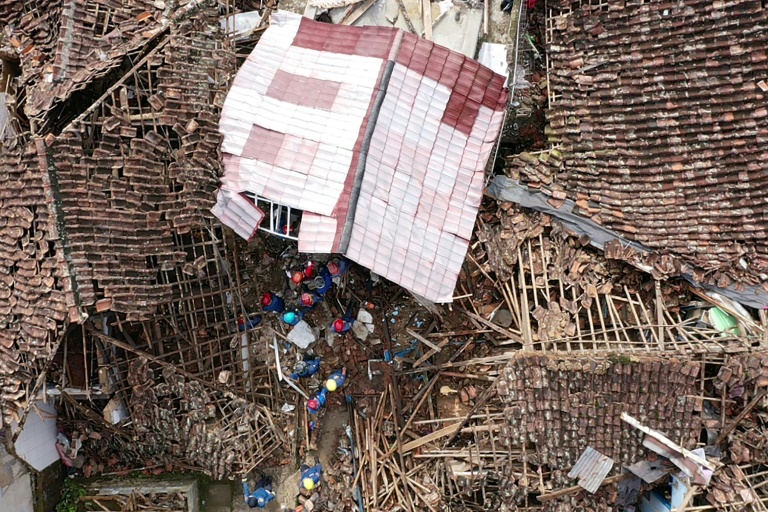
Indonesian authorities deployed heavy machinery, helicopters and thousands of personnel Thursday in a desperate effort to locate dozens trapped in rubble by an earthquake that killed 271 people, as hopes faded to find survivors.

Some have been pulled alive from the hulk of twisted metal and concrete in dramatic rescues in the town of Cianjur in West Java, including a six-year-old boy who spent two days under the wreckage without food or water.

Officials said around 40 people are still missing and believed trapped, including a seven-year-old girl, as rescue efforts were delayed by hammering rains and aftershocks.

But the rescue of the young boy Azka alive, captured on video, gave relatives and rescuers a dash of optimism.

“Once we realised Azka was alive everybody broke into tears, including me,” 28-year-old local volunteer Jeksen Kolibu told AFP on Thursday.

“It was very moving, it felt like a miracle.”

In the worst-hit district of Cugenang, scores of rescue workers drilled on Thursday through big slabs of concrete and removed roof tiles at a destroyed house where they believed a young girl was buried as her distraught mother watched on.

Other rescuers used digging tools, hammers and their bare hands to clear the debris in hope of finding seven-year-old Cika.

Her parents gave possible locations to rescuers for the delicate rescue mission.

“She was playing outside, I was cooking in the kitchen, suddenly the earthquake happened, so fast, only two seconds, my house collapsed,” her mother Imas Masfahitah, 34, told AFP at the scene.

“My instinct tells me she is here because she liked playing here,” she added, referring to the house of the girl’s grandmother where the search is focused.

“Whatever happens I will try to accept it.”

Sastra Winata, a firefighter involved in the rescue, said workers feared she was “running and was buried.”

By Thursday afternoon, workers had prepared a stretcher to be ready for her discovery dead or alive.

– ‘Pray for us’ –

The death toll from the Monday earthquake is expected to rise further with 2,000 people wounded, some of them critically, and at least two villages still cut off.

Thousands of emergency workers were using excavators to break through blocked roads to access the villages and deploying helicopters to drop vital aid to people still trapped there.

The rescue operation is expected to continue beyond the 72-hour window viewed as the best period to find victims alive.

Indonesian President Joko Widodo visited Cianjur again on Thursday, and said 39 people were believed missing in the district of Cugenang alone.

“This afternoon, we will concentrate on this spot,” he told reporters, adding only 24 patients remained at the town’s Sayang hospital, down from 741.

Residents of the district said they had never experienced anything like it before.

“I don’t know why the impact in Cugenang is especially bad. It’s probably fate, God has decided,” Adek, a 52-year-old who like many Indonesians goes by one name, told AFP.

– Many homeless –

More than 22,000 houses were damaged and more than 60,000 people were forced to evacuate to shelters, leaving many homeless in the town without adequate supplies.

Some have put up signs asking for help, while others held cardboard boxes to beg for donations after losing everything.

Widodo said there were significant challenges getting aid to those most in need.

The spots are too many and the terrain is up and down, which is not easy,” he said.

Another fear is a second disaster. Indonesia is vulnerable to landslides and flash floods in the rainy season, which has already begun and peaks in December in West Java.

The country’s meteorology agency said rivers could be blocked by landslides or rubble and spark flash floods in Cianjur.

Indonesia experiences frequent seismic and volcanic activity due to its position on the Pacific “Ring of Fire”, where tectonic plates collide.

Monday’s tremor was the deadliest in the archipelago nation since a 2018 quake and resulting tsunami killed more than 4,000 people on the island of Sulawesi.

But for a few women there was joy on the sidelines of the disaster.

At least three babies were born in the same evacuation tent a day after the disaster, according to West Java governor Ridwan Kamil.

He posted a video Wednesday of his visit to the tent where he named one of the children Gempita — which means “shaking”, after the earthquake. 

As he uttered her new name, smiling friends and relatives of mother Dewi shouted in jubilation: “Thank God!”

Interactive play gives Spain teens insight into gender violence

The row started with something minor: ‘Edu’ was laughing at something on his phone but refused to show it to his girlfriend ‘Ali’. She got upset and they started arguing. 

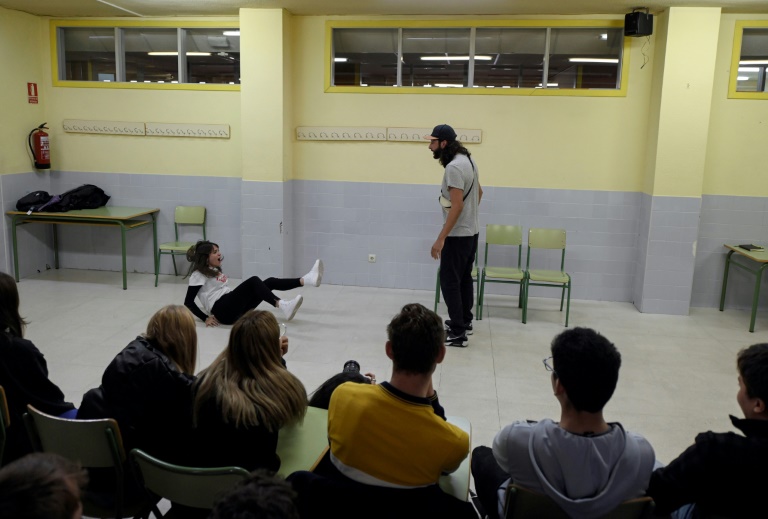
Angry words turned into shouting and insults and suddenly a furious ‘Edu’ grabs her phone and hurls it to the classroom floor where it shatters, the violent gesture shocking the group of watching teenagers.

The confrontation between the two characters, played by actors, is part of a play by Teatro Que Cura (The Healing Theatre) visiting a high school in the town of Parla near Madrid to raise awareness about domestic violence.

November 25 is International Day for the Elimination of Violence Against Women and in Spain, which passed Europe’s first law against it in 2004, experts agree education is key to reducing the problem.

In May, official figures showed gender violence was growing fastest among the under-18s, with the number of female victims up nearly 30 percent from 514 in 2020 to 661 in 2021. 

It was unclear if this was due to an increase in violence or a rise in the number of incidents reported. 

The play at El Olivo high school starts with the couple getting ready for their first date, Edu wining over the 15- and 16-year-olds with a humorous monologue worrying over his looks, what to wear and his chances of getting laid.

But the laughter dies as their relationship develops — and the teenagers are encouraged to reflect on their arguments and what they would do differently.

“The aim is to help adolescents build relationships based on equality and prevent domestic violence,” says Susana Martin Cuezva, a therapist who directs Teatro que Cura and moderates the discussions.

“The idea is that the students experience a situation of tension or conflict in the here and now and that they resolve it in a different way to how the actors are approaching it, which is always through violence.”

– ‘Pretty realistic’ –

“It’s good to show it like this. If you see it in the street, it’s just a couple fighting. But seeing it in this context you realise it is actually violence and that you can do something about it,” says 15-year-old Patricia Garcia.

As the plot develops, the audience is invited to voice their thoughts directly to Edu or Ali, with each actor improvising a response.

“I lost my head, I’m not really like that,” Edu explains to a student after the phone-smashing incident. 

“Yeah right. First, give me some space and don’t try to intimidate me,” she says calmly. As he starts arguing, she walks off — to cheers and applause from the students.

What affected Mario Carmona, 16, most was the insults and the pushing and shoving. 

“Unfortunately, it was pretty realistic, and it happens more often than you’d expect,” he told AFP. 

“It’s not easy to understand what’s happening even though these arguments are pretty normal. But it’s good to have someone to support you, who can give you a wake-up call if things get a bit out of hand.”

Set up in 2017, Teatro que Cura uses interactive theatre to immerse teens in dramatised scenarios of inequality and violence to raise awareness about conflict and gender-based violence.

Over the past five years, they have worked with some 9,000 teenagers aged 14-19, mostly in the Madrid region. 

Studies show education is crucial, with a 2021 Spanish government report finding sex education classes focused on equality and violence “reduce the risk of resorting to gender-based violence in boys, and of suffering it in girls”. 

– ‘Detecting cases of risk’ –

“Adolescents who are taught about gender-based violence are at less risk,” educational psychologist Maria Jose Diaz-Aguado told El Pais newspaper.

“If you get this sort of education at school, you can become aware of such things much earlier,” agreed 16-year-old Maryam Calderon.

Silvia Serrano Martin, El Olivo’s school psychologist, said the sessions were very effective.

“It’s really helped raise awareness about domestic violence because seeing it in such an experiential way reaches them more directly,” she told AFP. 

“This is a useful prevention tool but it’s also good for detecting cases of risk.”

Sometimes students come forward to privately share their experiences, which in some cases has involved situations of “real urgency,” Susana Martin Cuezva says. 

“Once a boy came to talk to the actor and said he identified with Edu, that he was starting to be violent with his partner. He was in tears and told us he needed help and didn’t want to repeat what was happening at home,” she said. 

The case was immediately referred to a regional gender violence unit.

“I’ve learned I need to put myself first,” 15-year-old Garcia told AFP when asked what she had taken from the session.

“If a relationship is starting to become aggressive, you have to walk away for your own good.”

Iran crackdown in spotlight at UN rights council

The UN Human Rights Council is holding an urgent meeting Thursday to discuss whether to launch a high-level international investigation into the deadly crackdown on mass protests rocking Iran.

The special session on Iran’s “deteriorating human rights situation” is due to kick off at 10:00 am (0900 GMT) in Geneva, with the new UN rights chief Volker Turk set to open the proceedings in his first appearance before the council.

The meeting, requested by Germany and Iceland with the backing of more than 50 countries, follows two months of protests in Iran sparked by the death of 22-year-old Mahsa Amini, after she was arrested for an alleged breach of the country’s strict dress rules for women based on Islamic sharia law. 

The authorities have grown increasingly heavy-handed in their response, as the demonstrations have spread across the country and swelled into a broad movement against the theocracy that has ruled Iran since 1979.

At least 416 people, including 51 children, have been killed across Iran in the crackdown since Amini’s death, according to Norway-based group Iran Human Rights.

Thousands of peaceful protesters have also been arrested, according to the United Nations, including many women, children and journalists, and six people have so far been handed death sentences over the demonstrations.

– ‘Shine a spotlight’ –

During Thursday’s session, diplomats will debate a call for an international investigation of alleged violations linked to the ongoing protests.

The so-called independent international fact-finding mission should include “the gender dimensions of such violations” in its investigations, according to the draft resolution, presented by Germany and Iceland.

The text calls for the investigators to “collect, consolidate and analyse evidence of such violations, and to preserve evidence,” with a view to future prosecution.

German Foreign Minister Annalena Baerbock, who like her Icelandic counterpart will be in Geneva for the session, stressed on Twitter “how important it is for the victims that those responsible are held accountable.”

Diplomats and rights activists voiced strong support for the initiative.

“We must do all we can to expose the truth of what is happening inside Iran and support the calls of the Iranian people for justice and accountability,” US ambassador Michele Taylor said.

Tara Sepehri Far, an Iran researcher with Human Rights Watch, urged the council to “shine a spotlight on the deepening repression and… hold those responsible accountable.”

– ‘Provocative’ –

Tehran has meanwhile been lobbying hard against the resolution and its Western backers.

“With a long history of colonialism and violation of human rights of other nations, the US and Europe are not in a position to pretend to be an advocate of human rights,” the Iranian foreign ministry tweeted Wednesday.

Foreign Minister Hossein Amir-Abdollahian recently tweeted at Baerbock that his country’s response to Germany’s “provocative, interventionist and undiplomatic stances” would be “proportionate and firm”.

Germany and Iceland received broad backing for their request to hold Thursday’s session, including from more than a third of the council’s 47 members.

Western diplomats voiced cautious optimism that the resolution would go through, but German foreign ministry spokesman Christofer Burger acknowledged to reporters that “success in obtaining a majority is not certain.”

The Human Rights Council has seen growing pushback from countries including China, Russia and Iran against often Western-led efforts to hold individual states accountable for alleged violations.

Last month, Western nations suffered a crushing defeat when their attempt to get China’s alleged abuses in its Xinjiang region onto the council agenda was thwarted.

– ‘Should pass’ –

But Iran may have a harder time blocking Thursday’s resolution.

The council has already voiced concerns at Iran’s human rights record by in 2011 appointing a so-called special rapporteur to monitor the country, and voting each year since then to renew that mandate.

“It should pass,” said Omid Memarian, an analyst at Democracy for the Arab World Now.

If it does, he told AFP, it will provide “a huge moral boost” to the protesters, and send a warning to rights violators in Iran that “the rest of the world will not be safe for them.” 

China's 'iPhone city' tightens Covid rules after violent protests

China has ordered six million people into lockdown in a city where violent protests broke out at an iPhone factory over Covid isolation policies and working conditions.

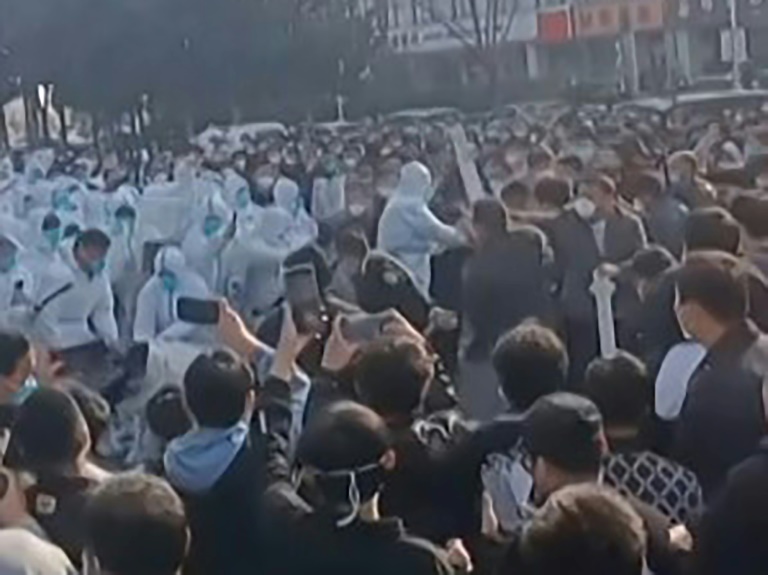
Hundreds of workers took to the streets around the vast iPhone factory in Zhengzhou on Wednesday, confronting hazmat-clad personnel wielding batons in a rare display of public anger in China.

In the wake of the unrest, Zhengzhou authorities ordered mass testing and an effective lockdown for several districts in the central Chinese city starting Friday.

City centre residents cannot leave the area unless they have a negative Covid test and permission from local authorities, and are advised not to leave their homes “unless necessary”.

The restrictions will affect more than six million people but do not cover the iPhone factory, where workers have already been under Covid restrictions for weeks.

One worker told AFP the protests had begun over a dispute over promised bonuses at the locked-down factory, run by Taiwanese tech-giant Foxconn.

Many workers were also incensed by “chaotic” living conditions, the worker, who wished to remain anonymous, said.

Foxconn on Thursday issued an apology, blaming a “technical error” in its payment systems for the salary issues and saying it “fully understands” the concerns of employees.

“The company will also try its best to actively solve the concerns and reasonable demands of employees,” the Taiwanese tech giant said.

– Zero-Covid fatigue –

The curbs in Zhengzhou are part of China’s national zero-tolerance approach to Covid, which involves gruelling lockdowns, travel restrictions and mass testing.

However, nearly three years into the pandemic, Covid cases are now higher than they have ever been in China

There were 31,444 domestic cases on Wednesday, the National Health Bureau reported, the highest since the pandemic began.

The numbers are relatively small when compared with China’s vast population of 1.4 billion or global caseloads at the height of the pandemic. 

But under the zero-Covid policy, even small outbreaks can shut down entire cities and place contacts of infected patients into strict quarantine.

The unrelenting zero-Covid push has caused fatigue and resentment among swathes of the population, sparking sporadic protests and hitting productivity in the world’s second-largest economy.

The Foxconn protests have been among the highest-profile bouts of unrest.

Several cities including Beijing, Shanghai, Guangzhou and Chongqing have tightened Covid restrictions as cases have climbed.

The capital now requires a negative PCR test result within 48 hours for those seeking to enter public places such as shopping malls, hotels and government buildings, Beijing authorities said. Schools across the city have moved to online classes.

The southern manufacturing hub of Guangzhou — where nearly a third of the latest Covid cases were found — has built thousands of temporary hospital rooms to accommodate patients.

A series of new rules announced by the central government this month appeared to signal a shift away from zero-Covid, easing quarantine requirements for entering the country and simplifying a system for designating high-risk areas.

But China has yet to approve more effective mRNA vaccines for public use and only 85 percent of adults over 60 had received two doses of domestic vaccines by mid-August, according to health authorities.

And Shijiazhuang, a city neighbouring Beijing that was seen as a pilot for testing reopening strategies, reversed most of its easing measures this week.

“The path to reopening may be slow, costly and bumpy,” Ting Lu, chief China economist at Nomura, said in a note.

Indonesia rescuers race to find dozens missing after quake

Indonesian authorities deployed heavy machinery, helicopters and thousands of personnel Thursday in a desperate effort to locate dozens trapped in rubble by an earthquake that killed 271 people, as hopes faded to find survivors.

Some have been pulled alive from the hulk of twisted metal and concrete in dramatic rescues in the town of Cianjur in West Java, including a six-year-old boy who spent two days under the wreckage without food or water.

Officials said around 40 people are still missing and believed trapped, including a seven-year-old girl, as rescue efforts were delayed by hammering rains and aftershocks.

But the rescue of the young boy Azka alive, captured on video, gave relatives and rescuers a dash of optimism.

“Once we realised Azka was alive everybody broke into tears, including me,” 28-year-old local volunteer Jeksen Kolibu told AFP on Thursday.

“It was very moving, it felt like a miracle.”

In the worst-hit district of Cugenang, scores of rescue workers drilled on Thursday through big slabs of concrete and removed roof tiles at a destroyed house where they believed a young girl was buried as her distraught mother watched on.

The parents of seven-year-old Cika gave locations to rescuers for the delicate rescue mission, believing she was playing outside the house when the quake struck.

“She was playing outside, I was cooking in the kitchen, suddenly the earthquake happened, so fast, only two seconds, my house collapsed,” her mother Imas Masfahitah, 34, told AFP at the scene.

“My instinct tells me she is here because she liked playing here,” she added, referring to the house of the girl’s grandmother across the street from the family home where the search is focused.

“Whatever happens I will try to accept it.”

Sastra Winata, a firefighter involved in the rescue, said workers feared she was “running and was buried, we found some motorbikes buried here.”

– ‘Pray for us’ –

The death toll from the Monday earthquake is expected to rise further with 2,000 people wounded, some of them critically, and at least two villages still cut off.

Officials cited reports that villagers in the two hamlets had no means of calling for help.

Thousands of emergency workers were using excavators to break through blocked roads to access the villages and deploying helicopters to drop vital aid to people still trapped there.

The rescue operation is expected to continue beyond the 72-hour window — viewed as the best period to find victims alive.

Indonesian President Joko Widodo visited Cianjur again on Thursday, and said 39 people were believed missing in the district of Cugenang alone.

“This afternoon, we will concentrate on this spot,” he told reporters.

National disaster mitigation agency (BNPB) chief Suharyanto said bad weather had hindered the rescue effort the day before.

“It was raining but we keep searching. Please pray for us so the 40 missing people could be found,” he said Wednesday.

– Many homeless –

More than 22,000 houses were damaged, leaving many homeless in the town without adequate supplies.

Some have put up signs asking for help, while others held cardboard boxes to beg for donations after losing everything.

Another fear for residents made homeless and officials is a second disaster.

Indonesia is vulnerable to landslides and flash floods in the rainy season, which has already begun and peaks in December in West Java.

Indonesia’s meteorology agency said rivers could be blocked by landslides or rubble and spark flash floods in Cianjur.

Indonesia experiences frequent seismic and volcanic activity due to its position on the Pacific “Ring of Fire”, where tectonic plates collide.

Monday’s tremor was the deadliest in the archipelago nation since a 2018 quake and resulting tsunami killed more than 4,000 people on the island of Sulawesi.

Close Bitnami banner
Bitnami