World

Harris meets Xi briefly, calls for US-China communication

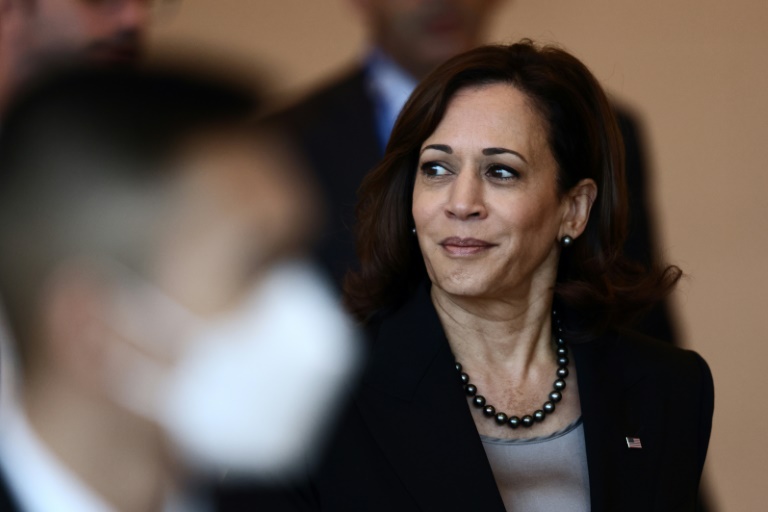
US Vice President Kamala Harris called Saturday for open communication with China during a brief meeting with President Xi Jinping, days after he held extensive talks with President Joe Biden.

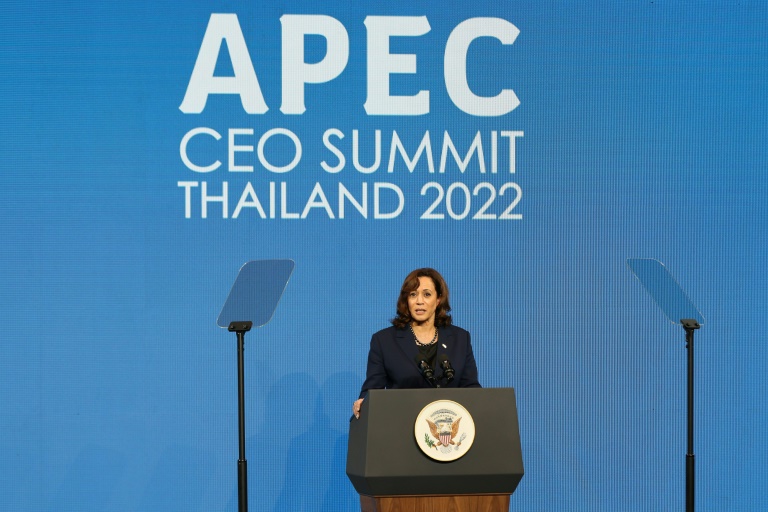
Harris spoke to the Chinese leader as they entered a retreat in Bangkok during a summit of the Asia-Pacific Economic Cooperation (APEC) forum, a White House official said.

The vice president reinforced Biden’s message that “we must maintain open lines of communication to responsibly manage the competition between our countries,” the official said on condition of anonymity.

The meeting came after the United States said it was looking for China to do more to rein in its ally North Korea, which on Friday test-fired a ballistic missile that US and Japanese officials said was capable of hitting the US mainland.

Xi, who is on only his second overseas trip since the pandemic, has been meeting widely with foreign leaders both in Bangkok and earlier in the week at a Group of 20 summit in Bali. 

On Monday, Xi met for three hours with Biden at a hotel on the Indonesian resort island, the first in-person talks between the leaders of the world’s two largest economies since they both became president.

Both sides put a positive spin on the meeting, saying they hoped to prevent recent tensions from spiralling out of control and wanted to cooperate on areas such as climate change.

The Biden-Xi summit and the brief meeting with Harris come ahead of a planned visit to China early next year by Secretary of State Antony Blinken, the first by the top US diplomat since 2018.

Harris on Friday also held crisis talks on Pyongyang’s latest launch with the prime ministers of five US partners — Japan, South Korea, Australia, Canada and New Zealand — to issue a strong condemnation of North Korea.

“We do think that Beijing has a role to play,” another senior US official accompanying Harris said on Friday.

China should use its influence to persuade North Korea “not to go in this provocative direction, which only destabilises the region and the world”, the official said.

Tensions between the United States and China have soared in particular over Taiwan, the self-ruling democracy claimed by Beijing.

China in August carried out major military exercises seen as a trial run for an invasion after a solidarity visit to Taiwan by House Speaker Nancy Pelosi, who is second in line to the White House.

Xi told Biden that support for Taiwan was a red line. Biden later told reporters that the two leaders understood each other’s positions and that he did not expect an “imminent” invasion of Taiwan.

The United States has also been pressing China to limit support to Russia in its invasion of Ukraine, with US officials cautiously upbeat that Beijing has not sent military supplies.
Australia aims to host 2026 UN climate summit

Australia hopes to host the 2026 COP summit, Prime Minister Anthony Albanese said Saturday, seeking to overhaul his country’s reputation for foot-dragging on climate change.

“It is a good opportunity, I believe, for Australia to show and to host what is a major global event,” Albanese said during a visit to Bangkok.

Centre-left Albanese was swept to power this year on a wave of popular anger about the pro-fossil fuel stance of Australia’s decade-old conservative government.  

He has since introduced a 2050 net zero emissions target — not ambitious by world standards, but a near-revolution for Australia, one of the world’s largest gas and coal producers.

He has also vowed to co-host a COP summit with Pacific Island allies — who are under serious threat from rising sea levels and who have long criticised Australia’s climate change scepticism.

Albanese may have hoped to host the event before he faces reelection in 2025, but diplomatic horse-trading means 2026 is now more likely. 

The United Arab Emirates is slated to host the talks in 2023, a European country is hoping for the 2024 event and Brazil is bidding for the 2025 talks, leaving 2026 as the most likely option for Australia. 

“I’ve had a very positive response from all of the nations that I have raised it with,” Albanese said.

If the summit materialises, it would be symbolic of a dramatic shift for Australia.

At successive COP talks, the country’s delegation has been a thorn in the side of negotiators, refusing to compromise and winning deep carve-outs that significantly weakened overall agreements. 

The Climate Council’s Wesley Morgan — an expert on Australia and Pacific policy — described Australia’s COP bid as a “very big deal”.

It would, he argued, confirm Australia’s shift away from fossil fuels, improve sometimes fraught relations with the Pacific Islands and may force even Canberra to adopt more ambitious targets.

“Hopefully (it) means Australia will commit serious policy for deeper emissions cuts this decade,” he said.

Australia remains a large fossil fuel producer and coal mining provides thousands of jobs in key electoral districts. 

But simmering public anger at devastating bushfires and two years of massive flooding have boosted domestic support for change.

Albanese has vowed to turn the sun-kissed island-continent into what he calls a “renewable energy superpower”.

US to help Thailand develop small nuclear reactors

The United States will help Thailand develop nuclear power through a new class of small reactors, part of a programme aimed at fighting climate change, Vice President Kamala Harris announced on a visit Saturday.

The White House said the assistance was part of its Net Zero World Initiative, a project launched at last year’s Glasgow climate summit in which the US partners with the private sector and philanthropists to promote clean energy.

Thailand does not have nuclear power, with the public mood on the issue souring after the 2011 Fukushima disaster in Japan.

The White House said it would offer technical assistance to the Southeast Asian country to deploy the developing technology of small modular reactors, which are factory-built and portable. Such reactors are generally considered safer as they do not need human intervention to shut down in emergencies.

“We really look forward to working with Thailand to take advantage of the benefits of small modular reactors and reliable clean energy sources,” said a senior US official travelling with Harris, speaking on condition of anonymity.

A White House statement said that US experts would work with Thailand on deploying the reactors, which will have the “highest standards of safety, security and nonproliferation” and boast a smaller land footprint than alternatives.

US rivals China and Russia, as well as Argentina, are also developing small modular reactors, the prototypes of which are in the design phase.

The White House did not give a timeline but said it would support Thailand, which is highly vulnerable to climate change, in its goal of going carbon neutral by 2065.

Harris, who is visiting the US ally for an Asia-Pacific Economic Cooperation summit, will discuss the nuclear power initiative in a meeting later Saturday with Thai Prime Minister Prayut Chan-O-Cha.

The White House also announced an initiative with Thailand to boost the safety of fifth-generation internet and a project to build a “world-class” cancer treatment centre in eastern Chonburi province.

Power cuts and infrastructure damage after Russian strike: Kyiv

Millions of Ukrainians in more than a dozen provinces are experiencing severe power disruptions as temperatures plunge and almost half of the country’s energy infrastructure is in need of repair after weeks of Russian attacks, officials in Kyiv said Friday.

Russia, meanwhile, accused Kyiv’s forces of executing a group of its soldiers who were surrendering to Ukraine in what Moscow described as a “massacre” that amounted to a war crime.

The assessment by Ukrainian Prime Minister Denys Shmyhal of the widespread damage to the country’s grid comes after weeks of sustained Russian attacks on its energy infrastructure.

“On November 15 alone, Russia fired about 100 missiles at Ukrainian cities. Nearly half of our energy system has been disabled,” Shmyhal said, appealing to European allies for support.

Ukrainian President Volodymyr Zelensky said 17 provinces and the capital Kyiv were struggling with power cuts, but engineers were working to repair the power grid and blackouts were becoming less frequent.

The Russian defence ministry said Friday it was only targeting military-linked facilities and that a series of long-range and precision strikes the day before had “hit exactly the designated objects”.

The Kremlin this week blamed the blackouts and their civilian impact on Kyiv’s refusal to negotiate with Moscow, not on Russian missile attacks.

Zelensky on Friday dismissed the idea of a “short truce” with Russia, saying it would only make things worse.

“Russia is now looking for a short truce, a respite to regain strength. Someone may call this the war’s end, but such a respite will only worsen the situation,” he said in remarks broadcast at the Halifax International Security Forum in Canada.

“A truly real, long-lasting and honest peace can only be the result of the complete demolition of Russian aggression,” Zelensky said.

– ‘Brutal’ killings –

Nearly nine months of fighting between Ukraine and Russia has spurred credible allegations of war crimes from both sides.

The latest accusations came Friday when Russia accused Ukrainian troops of executing some 10 prisoners of war.

The defence ministry statement referred to videos circulating on Russian-language social media that purport to show the bodies of Russian servicemen who had surrendered and were then killed.

It said this “brutal murder” was not “the first and not the only war crime” committed by Ukrainian forces.

Zelensky did not address Moscow’s claim in his statement Friday.

Ukraine has repeatedly accused Russian forces of committing “war crimes” during their occupation of parts of the Kyiv region in March and also in Kharkiv in the northeast and Kherson in the south, which have been recently reclaimed by Ukrainian troops.

A study by a Yale University group published Friday documented 226 extrajudicial detentions and disappearances in Kherson after Russia seized the province in what appeared to be a “premeditated” campaign.

“These findings demonstrate a range of alarming allegations about treatment of detainees, including allegations of deaths in custody, the widespread use of torture and cruel, inhuman, or degrading treatment, pillage from detainees (and) sexual and gender-based violence,” the report said.

Around a quarter of the 226 people were allegedly subjected to torture and four died in custody, according to the study, which said most of the acts were perpetrated by the Russian military and the FSB security agency.

– Crimea boosts defences –

Following Ukraine’s recapture of part of the Kherson region, Russia said Friday it was strengthening positions in Crimea, which it annexed in 2014.

Moscow used the peninsula, which hosts several important Russian military bases, as a launching pad for its February invasion.

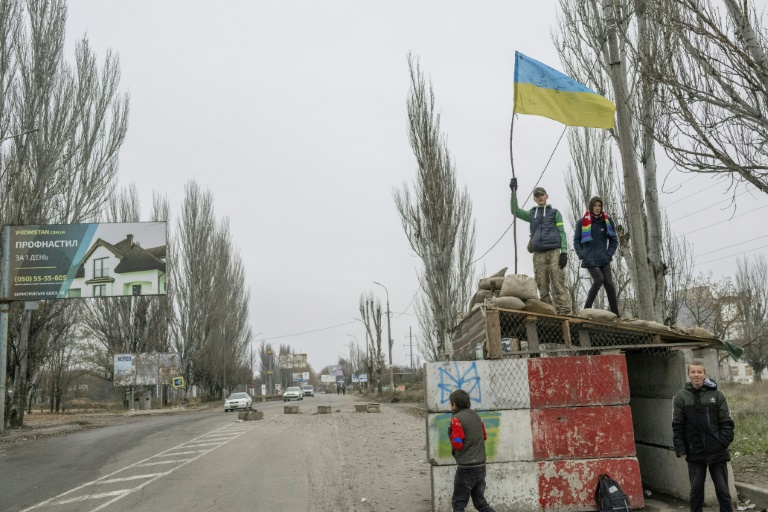
The announcement came as Ukrainian forces were pushing a counter-offensive in the south towards Crimea and after last week’s retaking of Kherson, the capital of the region that borders the strategic peninsula.

With electrical and water supplies cut to the city following the destruction of key utilities by the retreating Russians, residents have been struggling to keep warm as winter sets in.

Zelensky said the government has opened two relief stations where residents can keep warm, drink hot tea and charge their cell phones. He promised more will be opened soon.

“We know that it’s very hard on people because the occupiers destroyed everything when they were retreating,” Zelensky said in his daily address to the nation late Friday. “But we will put everything back online, we will restore everything.”

Kherson regional deputy governor Sergiy Khlan announced that the city’s rail link was being restored, with a first train leaving later in the day.

Russia claimed to have annexed the Kherson region along with three more in September, vowing to defend them with all available military means.

Zelensky has said his forces intend to recapture Crimea as well and has ruled out talks until Russia withdraws its forces from all Ukrainian territory.

In Washington, White House national security spokesman John Kirby sought to refute the notion that the United States was pressuring Kyiv to conduct peace talks.

“Nobody from the United States is pushing, prodding or nudging him to the table,” Kirby told reporters.

French-speaking bloc to focus on development at Tunisia summit

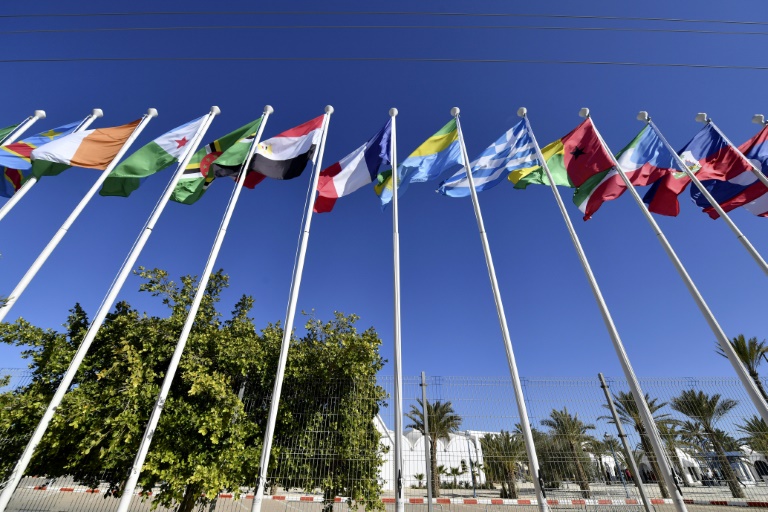
The world’s club of French-speaking countries will meet in Tunisia from Saturday for talks focused on economic cooperation, more than a year after President Kais Saied began an internationally criticised power grab.

Around 30 heads of state and government, including French President Emmanuel Macron, his Senegalese counterpart Macky Sall and Canadian Prime Minister Justin Trudeau, are set to attend the summit of the International Organisation of Francophonie (OIF) on the southern Tunisian resort island of Djerba.

While the two-day summit and an associated economic forum will officially focus on digital technology’s role in development, it will also be an opportunity for Western and African leaders to discuss issues like Russia’s invasion of Ukraine.

Many African countries have decried what they see as a lack of international solidarity in the face of crises on their continent, in sharp contrast with European nations’ swift support of Kyiv.

The summit coincides with the final stage of UN climate talks in Egypt, and comes just days after G20 leaders met in Indonesia for a meeting dominated by the war in Ukraine, which is an OIF observer state. 

Normally held every two years, the meeting was postponed in 2020 due to the Covid-19 pandemic, and then last year after Saied sacked the government and suspended parliament, later dissolving the legislature entirely.

Hosting the summit is a “success” for Saied, said French political researcher Vincent Geisser.

It will see him “leave his isolation — at least temporarily”, Geisser told AFP, after Canada, France and other developed nations last year called on Saied to restore “constitutional order”.

– Economic cooperation –

The summit will belatedly celebrate the 50th anniversary of the now 88-strong group whose members, such as Armenia and Serbia, are not all French-speaking.

The world’s French-speaking community is around 321 million-strong, and is expected to more than double to 750 million in 2050.

Secretary general Louise Mushikiwabo, of Rwanda, who is up for re-election, said the bloc is “more pertinent than ever” and able to bring added value to “most of the world’s problems”.

She told AFP she would ask member states to “redouble their efforts” in the face of a decline in the use of the French language in international organisations, and recalled that promoting “peace, democracy and human rights” is also part of the OIF’s mission.

Senegalese civil society figure Alioune Tine instead criticised the OIF’s record on international crisis mediation.

The group has shown itself to be “totally powerless in the face of fraudulent elections, third mandates (of African leaders) and military coups” in Mali, Guinea, Chad and Burkina Faso, he said.

Summit coordinator Mohamed Trabelsi told AFP the meeting was “a recognition of the role of Tunisia in the Francophone space, and of its regional and international diplomacy”.

It is also an opportunity to “strengthen economic cooperation”, Trabelsi said.

But an official from OIF heavyweight Canada said Ottawa wanted to echo “concern” over “democratic participation” following Saied’s power grab in the only democracy to have emerged from the Arab Spring uprisings more than a decade ago.

Tunisia is confronted by a deep economic crisis which has pushed a growing number of its people to try to reach Europe.

Seeking to draw delegates’ attention to the issue, hundreds of protesters tried Friday to highlight the disappearance of 18 Tunisians onboard a boat that set out in September. Police prevented them from reaching Djerba.

US Justice Dept taps independent prosecutor for Trump probes

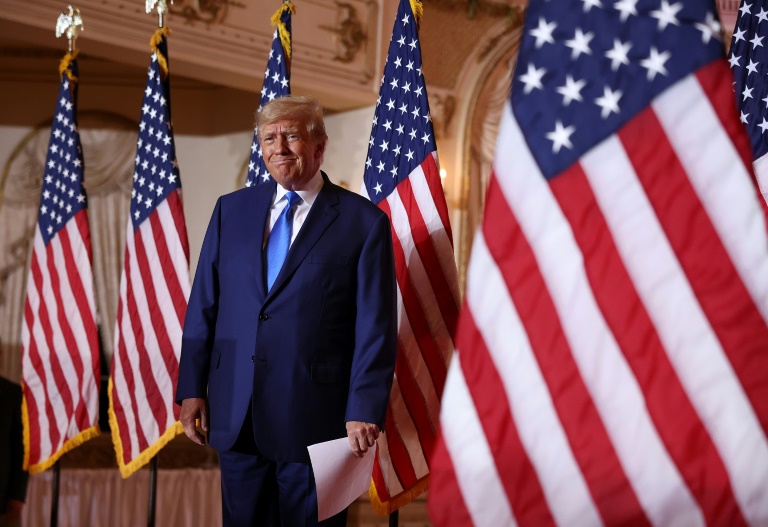
The US Justice Department on Friday named a former war crimes investigator as a special counsel to oversee criminal probes into Donald Trump, three days after the former president announced a new White House run in 2024.

Trump — who claims to be the target of a “witch hunt” — slammed the dramatic move as “unfair” and “the worst politicization of justice in our country.”

The White House strongly denied any political interference, but the unprecedented special counsel investigation of a former president — and current presidential candidate — sets the stage for a drawn-out legal battle.

At a press conference, Attorney General Merrick Garland announced the appointment of Jack Smith, until recently a chief prosecutor in The Hague charged with probing Kosovo war crimes, to take over the two ongoing federal probes into Trump.

One is focused on the former president’s efforts to overturn the results of the 2020 election and the January 6, 2021, attack on the US Capitol by his supporters.

The other is an investigation into a cache of classified government documents seized in an FBI raid on Trump’s Mar-a-Lago residence in Florida in August.

Garland said naming a special counsel was in the public interest because both the Republican Trump and his Democratic successor Joe Biden have stated their intention to run in 2024, although only Trump has officially declared for now.

“Appointing a special counsel at this time is the right thing to do,” Garland said. “The extraordinary circumstances presented here demand it.”

At the White House, Press Secretary Karine Jean-Pierre said Biden had no advance notice of Garland’s plans to name a special counsel.

– ‘So unfair’ –

Trump claimed in an interview with Fox News Digital that he was being targeted by the Biden administration to prevent him winning back the presidency.

“This is a disgrace and only happening because I am leading in every poll in both parties,” he said. “It is not acceptable. It is so unfair. It is so political.”

“This will not be a fair investigation,” Trump told guests later at his Mar-a-Lago home.

“The horrendous abuse of power is the latest in a long series of witch hunts,” he said, to applause.

In a statement, Smith, who previously headed the Justice Department’s Public Integrity section, said the “pace of the investigations will not pause or flag under my watch.”

“I will exercise independent judgement and will move the investigations forward expeditiously and thoroughly to whatever outcome the facts and the law dictate,” he said.

Trump’s entry into the White House race on Tuesday makes indicting him a much more delicate matter.

The appointment of an independent prosecutor to oversee the twin investigations could serve to help insulate Garland, a Biden appointee, from charges that the probe is politically motivated.

The special counsel will determine whether the former president should face any charges but the attorney general will have the ultimate say on whether charges should be filed.

Even if charged, the 76-year-old Trump can still run for president — nothing in US law bars a person charged with or convicted of a crime from doing so.

While in office, Trump was investigated by special counsel Robert Mueller over obstruction of justice and possible 2016 election collusion with Russia, but no charges were brought against him.

– Other legal woes –

In addition to the federal investigations, Trump faces other legal woes.

New York state’s attorney general Letitia James has filed a civil suit against Trump and three of his children, accusing them of business fraud.

And Trump is being investigated for pressuring officials in the southern swing state of Georgia to overturn Biden’s 2020 victory — including a now-infamous taped phone call in which he asked the secretary of state to “find” enough votes to reverse the result.

Trump’s unusually early announcement that he was running for president in 2024 was seen by some analysts in Washington as an attempt to stave off potential criminal charges.

Trump was impeached by the Democratic-majority House of Representatives in 2019 for seeking political dirt on Biden from Ukraine, and again after the January 6 attack on the Capitol, but was acquitted by the Senate both times.

Malaysia election kicks off, close race expected

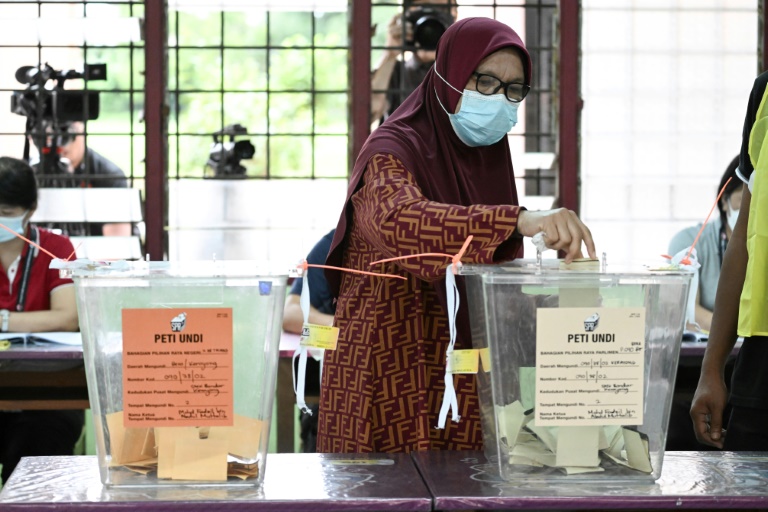
Malaysians headed to the polls on Saturday with jailed ex-leader Najib Razak’s scandal-hit party seeking to cement its grip on power in a race analysts say is too close to call.

Opposition leader Anwar Ibrahim, who campaigned on a platform of fighting corruption, said he was “cautiously confident” his coalition would win a simple majority in the 222-member parliament.

“A win today would certainly be gratifying after more than two decades of fighting to win the hearts and minds of the people,” Anwar told AFP before casting his vote in Penang state. 

“Let us be clear: this would be a victory for the people.”

About 21 million registered voters will troop to polling centres throughout the day amid fears heavy monsoon rains could disrupt the polls in certain areas.

In the rural town of Bera in Pahang state, women in traditional Malay headscarves arrived in cars and on motorcycles, while some of the elderly came in wheelchairs.

Nurul Hazwani Firdon, a 20-year-old tutor, said the economy was her top priority as she went to cast her ballot.

“I want a strong government and a stable economy so that there will be more job opportunities for the youth,” she said.

Mohamed Ali Moiddeen, 60, a scrap metal picker, said he simply wanted honest leadership.  

“We just want someone who is trustworthy and able to do the job properly,” he said.

Najib’s United Malays National Organisation (UMNO) usually dominates politics in the Southeast Asian country, but suffered a major defeat in the 2018 general election after a massive corruption scandal at state fund 1MDB.

The two governments that succeeded UMNO, however, were plagued by infighting, allowing the party to creep back into power last year. Now, UMNO will be seeking a stronger mandate in an election called ten months ahead of schedule.

Anwar, 75, leads the ethnically-diverse Pakatan Harapan (Alliance of Hope) coalition and is campaigning on an anti-corruption platform.

With age catching up, this election could be the perennial opposition leader’s last chance to fulfil his 20-year dream of leading Southeast Asia’s third-largest economy.

He is up against the ruling Barisan National coalition, which is dominated by UMNO and led by Najib loyalist and ex-interior minister Ahmad Zahid Hamidi. It also includes caretaker prime minister Ismail Sabri Yaakob.

UMNO remains hobbled by corruption allegations. Najib, who was at the centre of the 1MDB scandal, is currently serving a 12-year jail term.

Corruption was a key issue at campaign rallies, where opposition parties repeatedly warned that Najib could walk free and corruption charges against Zahid and other party leaders could be dropped if UMNO wins.

The scandal, where billions in state funds were diverted to Beverly Hills properties, a superyacht, a Hollywood film and Najib’s own bank account, sparked investigations from Singapore, Switzerland and the United States.

Former prime minister Mahathir Mohamad, 97, and another ex-leader, 75-year-old Muhyiddin Yassin, head two other coalitions contesting the elections.

– ‘Fragmented political landscape’ –

Analysts said there was no clear frontrunner among the four coalitions seeking the 222 parliamentary seats at stake.

Malaysians will choose from a record 945 candidates across the largely Muslim nation, which also includes the states of Sabah and Sarawak on Borneo island.

“Voters can expect a plethora of candidates on their ballot papers such that they will have a hard time deciding between candidates with similar positions,” said Oh Ei Sun of the Pacific Research Center of Malaysia.

The number of eligible voters has risen from 18 million four years ago to more than 21 million after the voting age was lowered in 2021.

About 1.4 million of the new additions are first-time voters aged between 18 and 20. 

The majority of voters live in rural areas, where patronage politics continues to hold sway.

Analysts said the multi-racial country would be in for further political instability if no coalition wins a clear majority.

“Unless Pakatan Harapan can clinch an outright parliamentary majority… the dominant UMNO party or one of the Malay Muslim parties would get to form a coalition government,” Oh told AFP.

“Voters are likely to look forward to a similarly fragmented political landscape after the election, with a lot of horse-trading to form the next ruling coalition.”

The election comes as Malaysians face soaring food prices, and parts of the country continue to be battered by flash floods due to monsoon rains.

Skies were overcast and drizzly in the capital Kuala Lumpur, and the meteorological department forecasted rain and thunderstorms around the country.

Kim oversees N. Korea's ICBM launch with daughter in tow

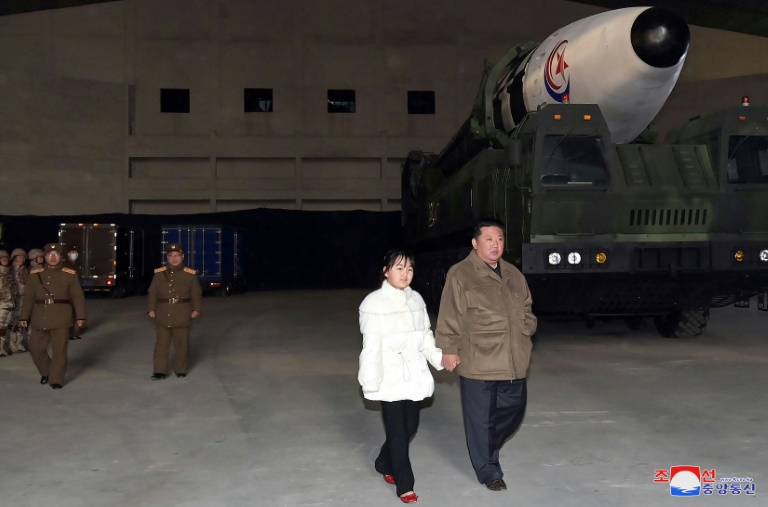
North Korean leader Kim Jong Un oversaw a test of Pyongyang’s newest intercontinental ballistic missile with his daughter in tow for the first time, state media reported Saturday.

Declaring he would meet perceived US nuclear threats with nukes of his own, he supervised the launch on Friday of a vast black-and-white missile, which KCNA said was the Hwasong-17, dubbed the “monster missile” by analysts.

The launch of the “new-type ICBM” was successful, KCNA said, adding that the “test-fire clearly proved the reliability of the new major strategic weapon system”.

KCNA said that Kim attended the launch “together with his beloved daughter and wife”, and state media images showed a beaming Kim accompanied by a young girl in a puffer jacket and red shoes as he walked in front of the missile.

It is extremely rare for state media to mention Kim’s children, and this is the first official confirmation that he has a daughter, experts said.

The latest launch shows that “the nuclear forces of the DPRK have secured another reliable and maximum capacity to contain any nuclear threat,” KCNA said, using the country’s official name, the Democratic People’s Republic of Korea.

Since Kim declared North Korea an “irreversible” nuclear state in September, Washington has ramped up regional security cooperation, including its largest-ever joint air exercises with the South.

– Daughter’s debut –

Kim slammed what he called “hysteric aggression war drills” and said that if America continues to make threats against the North, Pyongyang “will resolutely react to nukes with nuclear weapons and to total confrontation with all-out confrontation,” KCNA reported.

North Korea has conducted a record-breaking blitz of launches in recent weeks, which Pyongyang — and Moscow — have repeatedly blamed on US moves to boost the protection it offers allies Seoul and Tokyo.

The presence of the country’s first family provided “greater strength and courage in the dynamic advance for bolstering up the state nuclear strategic forces”, KCNA reported.

KCNA said the missile hit a maximum altitude of 6,040.9 kilometres (3,750 miles) and flew 999.2 kilometres, matching estimates by Seoul and Tokyo on Friday.

North Korea previously claimed to have launched a Hwasong-17 — its most powerful missile to date — on March 24, releasing a slick promotional video and photos of the event.

But Seoul later cast doubt on that claim, with local reports suggesting the Hwasong-17 had exploded over the skies of Pyongyang on March 17, and that the North had faked a successful launch using a smaller, older missile.

This time, analysts said it seemed the North had succeeded.

“This launch is significant because it is thought to be the first successful full flight test of the Hwasong-17 ICBM,” Joseph Dempsey, a researcher at the International Institute for Strategic Studies (IISS) told AFP. 

As with all North Korean ICBM tests, the missile was fired on a “lofted” trajectory — up not out, to avoid flying over Japan — which means key questions remain — “particularly in terms of surviving reentry into the atmosphere and testing the accuracy over greater ranges,” he said.

The “monster missile”, despite likely having greater payload capacity, has disadvantages, Dempsey added.

“Its sheer size makes it less practical as a road-mobile system, and production would be likely a significantly greater strained on limited resources,” he said.

– Next generation of Kims –

North Korea has fired scores of ballistic missiles this year, far more than any other year on record. 

Recent launches have been increasingly provocative, including the firing of a missile over Japan last month, triggering a rare air raid warning.

On November 2, Pyongyang fired 23 missiles, including one that crossed the de facto maritime border and landed near the South’s territorial waters for the first time since the end of hostilities in the Korean War in 1953. Seoul called it “effectively a territorial invasion”.

The next day, North Korea fired an ICBM — although Seoul said it appeared to fail mid-flight.

The most significant takeaway from Friday’s ICBM launch is “the permanence of the Kim regime’s weapons programme, because it is so integral to Kim’s own survival and the continuity of his family’s reign,” Soo Kim, a former CIA analyst now with the RAND Corporation, told AFP.

With the state media coverage, “we have seen with our own eyes the fourth generation of the Kim family. And his daughter — along with potential other siblings — will surely be groomed by her father”, she said.

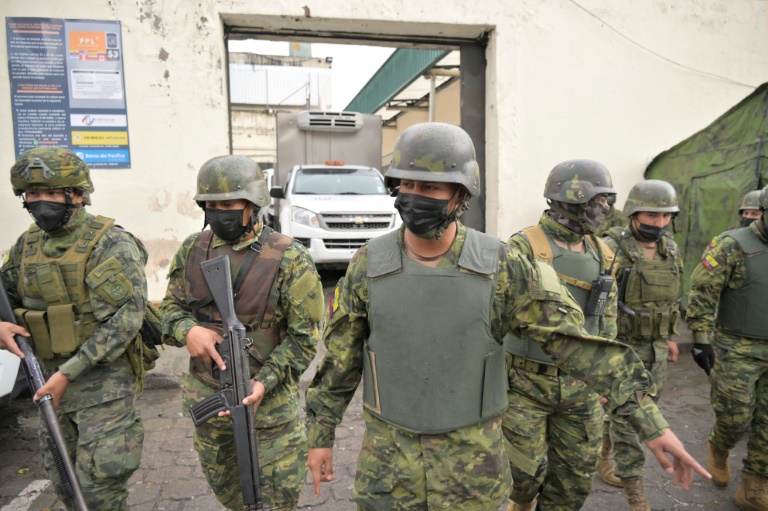
10 killed in latest Ecuador prison riot

At least 10 people died Friday in the latest prison unrest to hit violence-stricken Ecuador, where some 400 inmates have been killed since last year, the prison authority said.

The violence broke out at El Inca prison north of the capital, Quito, shortly after the government said it was moving two inmates it suspected of being the masterminds behind previous prison disturbances to a maximum security prison.

Police commander Victor Herrera told reporters the prison had been secured, with heavy security deployed as forensics personnel removed the bodies of those killed. Herrera said the cause of death “appeared to be strangulation.” 

One of the two prisoners whose relocation sparked the violence, Los Lobos gang leader Jonathan Bermudez, had been responsible for a previous massacre at El Inca, according to a statement from the president’s office.

“We told them that our hand would not tremble,” President Guillermo Lasso said of the transfer on Twitter on Friday, warning of “the same fate for those who continue with their attempts to break the peace of Ecuadorans.”

In other tweets, the president posted photographs of inmates with their hands tied and others lying face-down in prison courtyards and corridors.

The SNAI prison authority said that “members of this criminal organization (Los Lobos) undertook violent reprisals” for the relocation of Bermudez to another prison.

“We will continue to act firmly and tirelessly to combat organized crime, which threatens the security and peace of Ecuadorans,” it added.

Earlier this month, Lasso’s government relocated some 2,400 inmates, triggering an uprising by gang members who went on shooting sprees and set off car bombs at gas stations and police stations. 

Eight people, including five police members, were killed during the attacks in the port city of Guayaquil.

Lasso responded to those attacks by declaring a state of emergency and a night-time curfew in the provinces of Guayas, Esmeraldas and Santo Domingo de los Tsachilas.

He also ordered the deployment of troops to the three provinces, home to a third of Ecuador’s 18 million people.

Since February 2021, Ecuador has experienced eight prison massacres that left about 400 dead, many of them beheaded or burnt.

The last gang-led prison riot was on November 8 in Quito, when five inmates died.

Once a relatively peaceful neighbor of major cocaine producers Colombia and Peru, Ecuador has gone from being a drug transit route to a vital distribution center wracked by drug violence.

Authorities blame the wave of violent crime on rival gangs with ties to Mexican cartels.

The murder rate in Ecuador nearly doubled in 2021 to 14 per 100,000 inhabitants, and reached 18 per 100,000 between January and October this year, according to official data.  

Elizabeth Holmes sentenced to 11 years in prison for Theranos fraud

Fallen US biotech star Elizabeth Holmes was sentenced Friday to just over 11 years in prison for defrauding investors with her Silicon Valley start-up firm. 

The Theranos founder had been convicted on four felony fraud counts in January for persuading investors that she had developed a revolutionary medical device before the company flamed out after an investigation by The Wall Street Journal.

The closely watched case became an indictment of Silicon Valley, and US federal prosecutors had sought a 15-year jail term for Holmes. She was sentenced to 135 months.

US attorney Stephanie Hinds said the sentence “reflects the audacity of her massive fraud and the staggering damage she caused.”

“For almost a decade, Elizabeth Holmes fabricated and spread elaborate falsehoods to draw in a legion of capital investors, both big and small, and her deceit caused the loss of hundreds of millions of dollars,” the prosecutor said in a statement following the judge’s decision.

Holmes, who is pregnant, will not have to surrender herself until April next year, ordered US District Judge Edward Davila in a courtroom in San Jose, California. 

Holmes’s lawyer indicated she will appeal her conviction.

Moments before her sentencing, a tearful Holmes told the court: “I stand before you taking responsibility for Theranos. I loved Theranos. It was my life’s work.”

She added: “I am devastated by my failings. Every day for the past years I have felt deep pain for what people went through because I failed them.”

“I gave everything I had to building our company and trying to save our company.”

– ‘Tragedy’ –

Holmes became a star of Silicon Valley when she said her now defunct start-up was perfecting an easy-to-use test kit that could carry out a wide range of medical diagnostics with just a few drops of blood.

At the time, Holmes often dressed soberly in black turtlenecks that evoked her hero, the late Apple icon Steve Jobs.

She sold investors on the idea that her invention would disrupt medical practice, replacing expensive lab tests with her cheap kits.

But prosecutors said Holmes knew her device was not producing accurate and reliable results, yet induced dozens of investors to contribute nearly one billion dollars, all without ever achieving meaningful revenue.

Holmes’s meteoric rise and fast demise has been the subject of books, movies and a TV series that framed her story as a cautionary tale on the excesses of the tech industry that blindly followed a charismatic founder.

At one point, the Theranos board included former US defense secretary James Mattis and former US secretaries of state Henry Kissinger and the late George Shultz.

Sentencing Holmes on Friday, Davila said the case was a “tragedy” and “troubling on so many levels.”

He described Holmes as “a big thinker” who had fought to get into an industry dominated by “male ego.”

But he noted “significant evidence about manipulation and untruths that were being used in the negotiation of the business.”

“What is it that caused that? Was it hubris? Was it intoxication with the fame that comes from being a young entrepreneur?” he asked.

– ‘Amazing things’ –

After hearing her prison sentence, Holmes hugged her partner Billy Evans, who is the father of her 15-month-old son, and her mother, Noel Holmes.

Lawyers for Holmes, 38, had asked for leniency, presenting her as a devoted friend who cares for a young child and has a second child on the way.

This was backed up by 140 letters of support filed to the court, including from her family, friends and a US senator.

“I am confident that on the other side of this, Elizabeth will do amazing things for society with her talents and boundless passion for changing the world for the better,” said one letter.

That was in sharp contrast to descriptions given at her trial that painted her as an ambitious con artist who harassed her workers. 

In a letter, Holmes’s aunt, who was an early investor in Theranos, called on the court to give her a tough sentence, The Wall Street Journal reported.

Prosecutors want Holmes to pay $800 million in restitution to investors that included the Walton family of Walmart, the Walgreens chain of pharmacies and media mogul Rupert Murdoch.

A restitution hearing will be scheduled, although Holmes says she has no money to pay.

Close Bitnami banner
Bitnami