World

Malaysia election under way with race too close to call

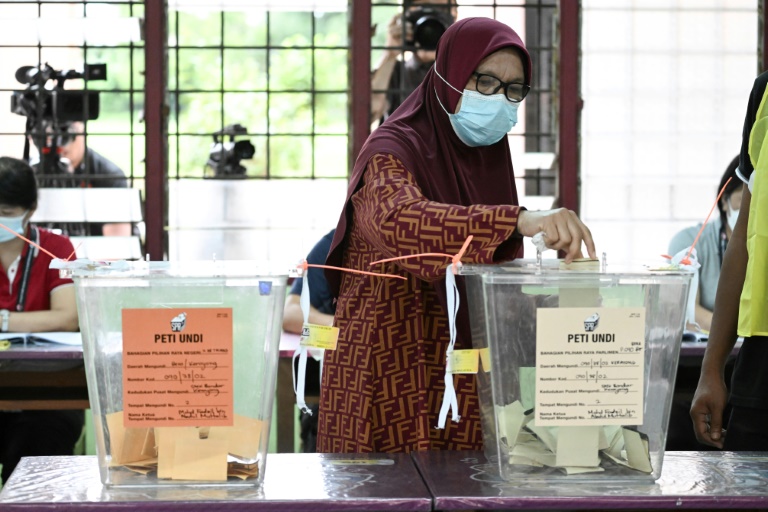
Malaysians headed to the polls on Saturday with jailed ex-leader Najib Razak’s scandal-hit party seeking to cement its power in a race analysts say is too close to call.

Its main challenge is from the coalition led by opposition leader Anwar Ibrahim, who has campaigned on a promise to fight corruption in Southeast Asia’s third-largest economy.

There were long lines at polling centres across the country despite concerns about monsoon rains, indicating a strong turnout from among the 21 million registered voters.

“I want a strong government and a stable economy so that there will be more job opportunities for the youth,” Nurul Hazwani Firdon, a 20-year-old tutor, said as she went to cast her ballot in the rural town of Bera in Pahang state.

Malaysians face soaring food prices, and parts of the country are being battered by flash floods sparked by monsoon rains.

Najib’s United Malays National Organisation (UMNO) usually dominates Malaysian politics but it suffered a humiliating defeat in the 2018 general election after a massive corruption scandal at state fund 1MDB.

The former prime minister, who was at the centre of the 1MDB storm, is currently serving a 12-year jail term.

Because of infighting in the two successive governments since 2018, UMNO crept back into power last year despite lingering corruption allegations, and is seeking a stronger mandate in Saturday’s election — called 10 months ahead of schedule.

– Anwar’s dream –

The UMNO-dominated ruling Barisan National coalition is up against Anwar and his allies.

With age catching up, this may be Anwar’s last chance to fulfil his long-standing dream of leading Malaysia.

“A win today would certainly be gratifying after more than two decades of fighting to win the hearts and minds of the people,” Anwar, 75, told AFP before casting his vote in Penang state.

He added he was “cautiously confident” that his Pakatan Harapan (Alliance of Hope) could secure a simple majority in the 222-member parliament.

Caretaker Prime Minister Ismail Sabri Yaakob, from the ruling coalition, cast his vote in Bera.

“I hope the voters will choose a government that can guarantee security and stability,” he told reporters.

A record 945 candidates are contesting for seats in parliament across the largely Muslim nation.

Former prime ministers Mahathir Mohamad, 97, and 75-year-old Muhyiddin Yassin head two other coalitions.

– Corruption a key issue –

Corruption was a key issue during the campaign, with opposition parties repeatedly warning that if UMNO wins, Najib could walk free and graft charges against other party leaders could be dropped.

The 1MDB scandal, in which billions of dollars in state funds were diverted to Beverly Hills properties, a superyacht, a Hollywood film and Najib’s own bank account, sparked investigations in Singapore, Switzerland and the United States.

Analysts said there was no clear frontrunner among the four coalitions.

A survey by pollster Merdeka Centre on the eve of the elections showed Anwar’s coalition winning 82 seats, and 33 percent favouring him as the prime minister.

Merdeka analyst Ibrahim Suffian told AFP it was “still possible for Anwar to achieve a simple majority” given the large turnouts in the final days of his campaign.

Malaysia lowered its voting age from 21 to 18 last year, a move that added six million voters to the rolls for this election.

Nearly 1.4 million of total registered voters are aged 18-20.

Analysts have said young voters lean towards the more progressive politics of the opposition.

The majority of registered voters, however, live in Malaysia’s rural areas where the patronage politics dominated by UMNO still holds sway.

Analysts said the multi-racial country would be in for further political instability if no coalition wins a clear majority.

There is likely to be a “similarly fragmented political landscape after the election,” Oh Ei Sun of the Pacific Research Center of Malaysia told AFP.


Colombia, ELN guerrillas to start new peace talks Monday in Caracas

Colombia’s government and the leftist National Liberation Army (ELN) guerrilla group will resume peace talks on Monday after a nearly four-year hiatus, the parties announced.

The resumption of negotiations “will be next Monday, November 21, in the afternoon in the city of Caracas,” read a statement posted to Twitter Friday and signed by the Colombian High Commissioner for Peace, Danilo Rueda, and ELN peace delegation member Pablo Beltran.

Colombia has suffered more than half a century of armed conflict between the state and various groups of left-wing guerrillas, right-wing paramilitaries and drug traffickers.

The ELN is the last recognized rebel group operating in Colombia, although FARC dissidents who refused to sign the 2016 peace deal remain active.

Negotiations with ELN, started in 2016, were interrupted three years later by conservative president Ivan Duque following a car bomb attack on a police academy in Bogota that left 22 people dead.

President Gustavo Petro, who in August became Colombia’s first leftist leader, has vowed to take a less bellicose approach than his predecessors to seeking an end to the violence.

“We are aware of the deep desire of the Colombian people… to move forward through a peace process and democracy building,” the joint statement read. 

As a good-will gesture, the guerrillas on Wednesday released two soldiers who had been captured near Venezuela earlier this month.  

While the two sides have not declared a ceasefire, they agreed in October to resume talks. The new round has Venezuela, Cuba and Norway acting as guarantors.

The initial, 2016 dialogue with the ELN kicked off under ex-president Juan Manuel Santos, who signed a peace treaty with the larger Marxist Revolutionary Armed Forces of Colombia (FARC) rebel group, which subsequently laid down weapons and created a political party.

The ELN’s peace delegation spent four years based in Cuba, as they had been barred from returning to Colombia.

They left Cuba for Venezuela in October to begin the new talks promised by Petro, himself a former urban guerrilla.

The government and ELN have not yet released full lists of negotiators for the talks beginning Monday.

Colombia and Venezuela recently resumed relations after a 2019 rupture caused by Duque’s refusal to recognize President Nicolas Maduro’s reelection the year before in a vote widely condemned as a sham by the international community.

Duque had accused Venezuela’s socialist leader of harboring rebels across the border.

But since Petro came to power, he has reestablished diplomatic ties with Caracas, allowing the Maduro government to help facilitate peace talks with the ELN.

Founded in 1964, the ELN counts around 2,500 members, about 700 more than it did when negotiations were broken off.

It is mostly active in the Pacific region and along the 2,200-kilometer (1,367-mile) border with Venezuela.

Climate damages are key flashpoint as UN COP talks go overtime

Climate negotiators were grappling for an agreement Saturday at the UN COP27 in Egypt after high stakes talks went deep into the night with key sticking points over funding for countries wracked by climate disasters and ambition in tackling global warming.

The meeting at the Red Sea resort of Sharm el-Sheikh has been dominated by the controversial issue of climate “loss and damage” funds to help developing nations cope with the impacts of increasingly intense and costly floods, heatwaves and droughts.

Wealthy nations, long reluctant to discuss the issue over fears of liability, have accepted that vulnerable nations are facing devastating impacts.

But there are disagreements over who pays and which countries are considered particularly affected.

With nations struggling to find common ground, Britain and several other countries circulated new suggestions trying to break the deadlock late Friday.

The issue was among a daunting list of outstanding areas of contention at the COP27 talks, where representatives from nearly 200 countries have gathered with the aim of driving forward action on climate change as the world faces a worsening onslaught of weather extremes.

Egyptian Foreign Minister Sameh Shoukry, who chairs the COP27 talks, told delegates on Friday — the day talks were officially due to end — that the negotiations would go into Saturday.

“I remain concerned at the number of outstanding issues,” he said.

Delegates are looking to find agreement on emissions-cutting ambitions and reaffirm a goal to limit average warming to 1.5 degrees Celsius from pre-industrial levels, which scientists say is a safer guardrail to avoid the most dangerous impacts.

– Pressure over $100 bn promise –

Rich countries are also under pressure to finally fulfil promises to provide $100 billion a year to help developing countries green their economies and adapt to future impacts.

For many vulnerable countries loss and damage is the defining issue of the conference, with some saying the success of the meeting hinges on the creation of a specific fund at the Egypt talks.

Richer nations, which have previously baulked at the issue over fears of open-ended liability, have accepted that countries in the crosshairs of increasingly destructive climate-driven disasters need funding help, but have called for a broader set of donors — and prioritising the most climate-vulnerable countries as recipients.

The G77 and China bloc of 134 developing countries launched an opening gambit on loss and damage this week, with a proposal to create a fund at COP27, with operational details to be agreed later.

A compromise response from the European Union, proposed late Thursday, suggested a fund specifically for the most vulnerable nations saying the money should come from a “broad funder base” — code for countries including China and Saudi Arabia that have become wealthier since they were listed as developing nations in 1992.

Britain and several other countries have circulated a new draft proposal document, seen by AFP and confirmed by a source close to the negotiations, which suggested the fund could be part of a range of “funding arrangements”.

The document, which has not been formally submitted to the UN process, suggested the new source of monies could be operationalised in two years.

But this would “only agree some ambiguous funding arrangements that kick the can down the road” said Mohamed Adow, of the think tank Power Shift Africa.  

Xi, Harris meet briefly, call for US-China communication

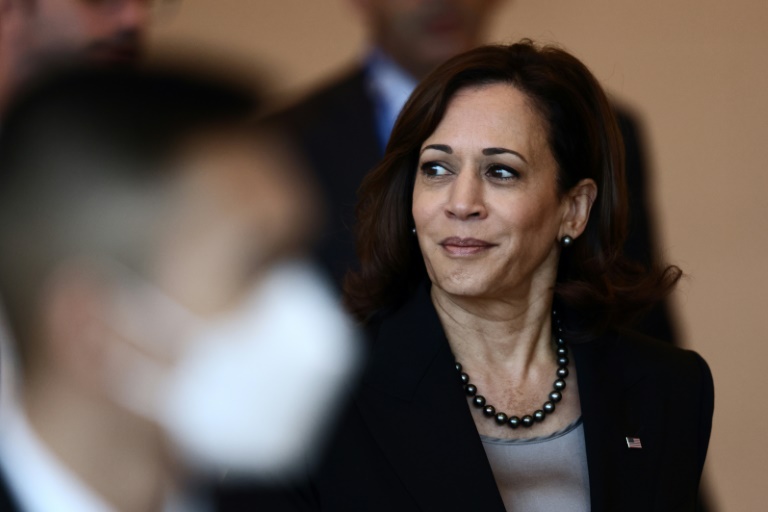
Chinese President Xi Jinping and US Vice President Kamala Harris called for open communication during a brief meeting on Saturday, days after his extensive talks with President Joe Biden. 

Harris spoke to the Chinese leader as they entered a retreat in Bangkok during a summit of the Asia-Pacific Economic Cooperation (APEC) forum, a White House official said.

The vice president reinforced Biden’s message that “we must maintain open lines of communication to responsibly manage the competition between our countries”, the official said on condition of anonymity.

The meeting came after the United States said it was looking for China to do more to rein in its ally North Korea, which on Friday test-fired a ballistic missile that US and Japanese officials said was capable of hitting the US mainland.

Xi, who is on only his second overseas trip since the pandemic, has been meeting widely with foreign leaders both in Bangkok and earlier in the week at a G20 summit in Bali. 

On Monday, Xi met for three hours with Biden at a hotel on the Indonesian resort island, the first in-person talks between the leaders of the world’s two largest economies since they both became president.

Both sides put a positive spin on the meeting, saying they hoped to prevent recent tensions from spiralling out of control and wanted to cooperate on areas such as climate change.

Chinese state media on Saturday quoted Xi as saying his meeting with Biden was “strategic and constructive, and has important guiding significance for China-US relations in the next stage”.

“It is hoped that the two sides will further enhance mutual understanding, reduce misunderstanding and misjudgment, and jointly promote the return of China-US relations to a healthy and stable track,” Xi added, according to the report.

– N. Korea missile drama –

The Biden-Xi summit and the brief meeting with Harris come ahead of a planned visit to China early next year by Secretary of State Antony Blinken, the first by the top US diplomat since 2018.

Harris on Friday held crisis talks on Pyongyang’s latest missile launch with the prime ministers of five US partners — Japan, South Korea, Australia, Canada and New Zealand — to issue a strong condemnation of North Korea.

“We do think that Beijing has a role to play,” another senior US official accompanying Harris said on Friday.

China should use its influence to persuade North Korea “not to go in this provocative direction, which only destabilises the region and the world”, the official said.

Tensions between the United States and China have soared in particular over Taiwan, the self-ruling democracy claimed by Beijing.

China in August carried out major military exercises seen as a trial run for an invasion after a solidarity visit to Taiwan by House Speaker Nancy Pelosi, who is second in line to the White House.

Xi told Biden that support for Taiwan was a red line. Biden later told reporters that the two leaders understood each other’s positions and that he did not expect an “imminent” invasion of Taiwan.

The United States has also been pressing China to limit support to Russia in its invasion of Ukraine, with US officials cautiously upbeat that Beijing has not sent military supplies.

Twitter fate in doubt as employees defy Musk ultimatum

The future of Twitter seemed to hang in the balance Friday after its offices were locked down and key employees announced their departures in defiance of an ultimatum from new owner Elon Musk.

Fears grew that a fresh exodus would threaten the very existence of one of the world’s most influential internet platforms, which serves as a key communication tool for the world’s media, politicians, companies, activists and celebrities.

According to ex-employees and US media, hundreds of employees chose “no” to Musk’s demand that they either be “extremely hardcore” or leave the company.

“So my friends are gone, the vision is murky, there is a storm coming and no financial upside. What would you do?” tweeted Peter Clowes, who refused Musk’s final warning.

Musk, also the CEO of Tesla and SpaceX, has come under fire for radical changes at the California-based firm, which he bought less than a month ago for $44 billion.

He had already fired half of Twitter’s 7,500 staff, scrapped a work-from-home policy and imposed long hours, all while his attempts to overhaul the company faced backlash and delays.

His stumbling attempts to revamp user verification with a controversial subscription service led to a slew of fake accounts and pranks, and prompted major advertisers to step away from the platform.

On Friday, Musk appeared to be pressing on with his plans and reinstated previously banned accounts, including that of comedian Kathy Griffin, which had been taken down after she impersonated him on the site.

Musk did not immediately welcome back former US president Donald Trump, saying the “decision has not yet been made” on the return of the ex-leader. 

Trump was banned for inciting last year’s attack on the Capitol by a mob seeking to overturn the results of the 2020 US election.

But hours later, Musk posted a poll to Twitter asking users to vote “yes” or “no” on whether to “Reinstate former President Trump,” though there was no clear indication that he would adhere to the results of the ad hoc survey.

Musk has done similar polls in the past, asking followers last year if he should sell stock in his electric car company Tesla. 

– ‘Not super worried’ –

Fevered talk of the site’s imminent demise was driving record-high engagement on Twitter, according to Musk.

In a tweet, the South African-born billionaire said: “Record numbers of users are logging in to see if Twitter is dead, ironically making it more alive than ever!”

Musk added that the “best people are staying, so I’m not super worried.”

Despite Musk’s assurances, entry to Twitter’s offices was temporarily closed until Monday, even with a badge, according to an internal message seen on US media.

In leaked emails reported in The New York Times, Musk asked engineers critical to the site’s functioning to make their way to Twitter’s headquarters in San Francisco on Friday to meet him in person.

Twitter did not respond to AFP requests for comment on the new measure.

In the ultimatum sent Wednesday, Musk had asked staff to follow a link to affirm their commitment to “the new Twitter” by 5:00 pm New York time (2200 GMT) on Thursday.

If they did not do so, they would have lost their jobs, receiving three months of severance pay.

Signs that government regulators were becoming impatient with Musk’s handling of Twitter also grew on Friday, especially over the platform’s ability to moderate content with a severely reduced headcount.

A group of US senators on Thursday said Musk’s plans for the site “undermined the integrity and safety of the platform… despite clear warnings those changes would be abused for fraud, scams, and dangerous impersonation.”

A top regulator for the European Union, meanwhile, said that Musk should be increasing the number of moderators in Europe, not reducing them.

Musk “knows perfectly well what the conditions are for Twitter to continue operating in Europe,” EU commissioner Thierry Breton told French radio.

A spokesman for German Chancellor Olaf Scholz said his government was watching developments at Twitter “with growing concern” and reviewing its presence on the platform.

NASA Moon mission 'exceeding' expectaions

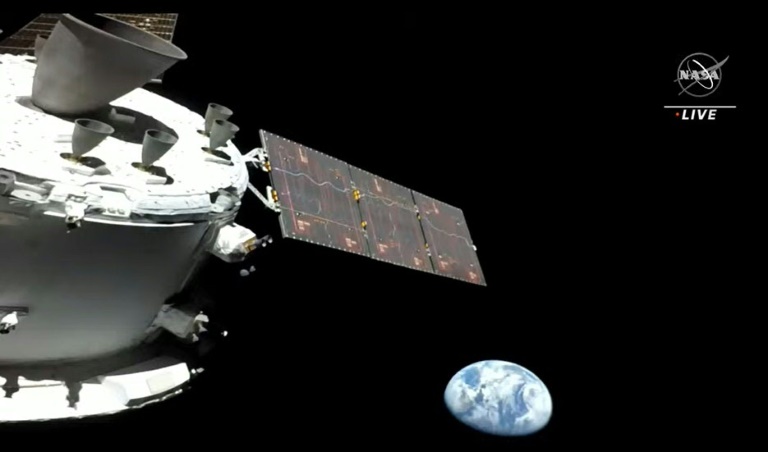
On the third day after lifting off from Florida bound for the Moon, the Orion spacecraft is “exceeding performance expectations,” NASA officials said on Friday. 

The spacecraft is to take astronauts to the Moon in the coming years — the first to set foot on its surface since the last Apollo mission in 1972. 

This first test flight, without a crew on board, aims to ensure that the vehicle is safe.

“Today we met to review the Orion spacecraft performance… it is exceeding performance expectations,” said Mike Sarafin, head of the Artemis 1 mission. 

The spacecraft’s four solar panels, about 13 feet (four meters) long, deployed correctly and are providing more energy than expected, said Jim Geffre, the Orion manager at the Johnson Space Center in Houston. 

It is from that control center in Texas that the spacecraft is being piloted. 

Orion is already some 200,000 miles (320,000 kilometers) from Earth and preparing to perform the first of four main thrusts scheduled during the mission using its engines. 

This maneuver, which will take place early Monday morning, will bring the spacecraft as close as 80 miles (130 kilometers) from the lunar surface, in order to take advantage of the Moon’s gravitational force. 

Since this will take place on the far side of the Moon, NASA is expected to lose contact with the spacecraft for approximately 35 minutes.

“We will be passing over some of the Apollo landing sites,” said  flight director Jeff Radigan, although they will be in darkness. Footage of the flyover will be released by NASA.

Four days later, a second thrust from the engines will place Orion in a distant orbit around the Moon. 

The ship will go up to 40,000 miles beyond the Moon, a record for a habitable capsule. 

It will then begin the journey back to Earth, with a landing in the Pacific Ocean scheduled for December 11, after just over 25 days of flight. 

The success of this mission will determine the future of the Artemis 2 mission, which will take astronauts around the Moon without landing, then Artemis 3, which will finally mark the return of humans to the lunar surface. 

Those missions are scheduled to take place in 2024 and 2025, respectively. 

Sarafin also said Friday that 10 scientific micro-satellites had been deployed when the rocket took off, but that half of them were experiencing technical or communication problems. 

Those experiments, carried out separately by independent teams, will have no impact on the main mission, however.

NASA Moon mission 'exceeding' expectaions

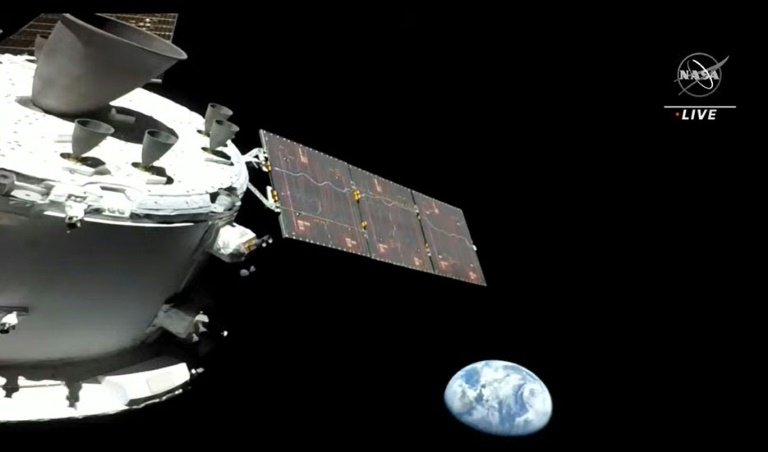
On the third day after lifting off from Florida bound for the Moon, the Orion spacecraft is “exceeding performance expectations,” NASA officials said on Friday. 

The spacecraft is to take astronauts to the Moon in the coming years — the first to set foot on its surface since the last Apollo mission in 1972. 

This first test flight, without a crew on board, aims to ensure that the vehicle is safe.

“Today we met to review the Orion spacecraft performance… it is exceeding performance expectations,” said Mike Sarafin, head of the Artemis 1 mission. 

The spacecraft’s four solar panels, about 13 feet (four meters) long, deployed correctly and are providing more energy than expected, said Jim Geffre, the Orion manager at the Johnson Space Center in Houston. 

It is from that control center in Texas that the spacecraft is being piloted. 

Orion is already some 200,000 miles (320,000 kilometers) from Earth and preparing to perform the first of four main thrusts scheduled during the mission using its engines. 

This maneuver, which will take place early Monday morning, will bring the spacecraft as close as 80 miles (130 kilometers) from the lunar surface, in order to take advantage of the Moon’s gravitational force. 

Since this will take place on the far side of the Moon, NASA is expected to lose contact with the spacecraft for approximately 35 minutes.

“We will be passing over some of the Apollo landing sites,” said  flight director Jeff Radigan, although they will be in darkness. Footage of the flyover will be released by NASA.

Four days later, a second thrust from the engines will place Orion in a distant orbit around the Moon. 

The ship will go up to 40,000 miles beyond the Moon, a record for a habitable capsule. 

It will then begin the journey back to Earth, with a landing in the Pacific Ocean scheduled for December 11, after just over 25 days of flight. 

The success of this mission will determine the future of the Artemis 2 mission, which will take astronauts around the Moon without landing, then Artemis 3, which will finally mark the return of humans to the lunar surface. 

Those missions are scheduled to take place in 2024 and 2025, respectively. 

Sarafin also said Friday that 10 scientific micro-satellites had been deployed when the rocket took off, but that half of them were experiencing technical or communication problems. 

Those experiments, carried out separately by independent teams, will have no impact on the main mission, however.

Kim oversees N. Korea's ICBM launch with daughter in tow

North Korean leader Kim Jong Un oversaw a test of Pyongyang’s newest intercontinental ballistic missile with his daughter in tow for the first time, state media reported Saturday.

Declaring he would meet perceived US nuclear threats with nukes of his own, he supervised the launch on Friday of a vast black-and-white missile, which KCNA said was the Hwasong-17, dubbed the “monster missile” by analysts.

The launch of the “new-type ICBM” was successful, KCNA said, adding that the “test-fire clearly proved the reliability of the new major strategic weapon system”.

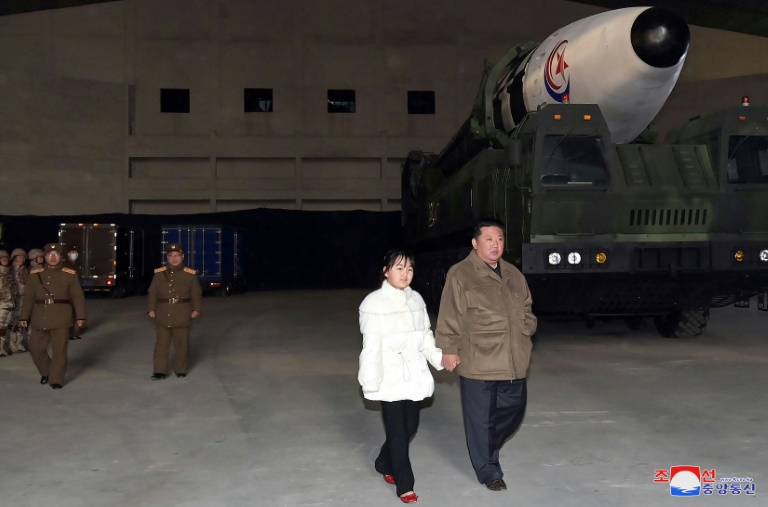
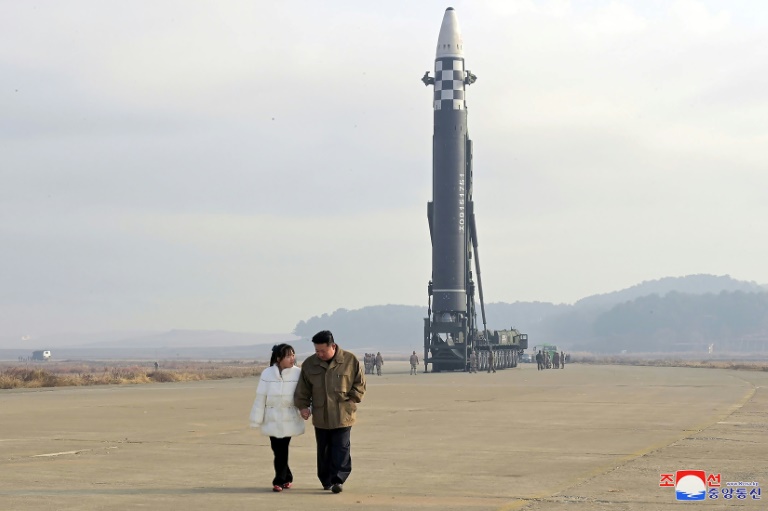
KCNA said Kim attended the launch “together with his beloved daughter and wife”, and state media images showed a beaming Kim accompanied by a young girl in a puffer jacket and red shoes as he walked in front of the missile.

It is extremely rare for state media to mention Kim’s children, and this was the first official confirmation that he had a daughter, experts said.

The latest launch shows that “the nuclear forces of the DPRK have secured another reliable and maximum capacity to contain any nuclear threat,” KCNA said, using the country’s official name, the Democratic People’s Republic of Korea.

Since Kim declared North Korea an “irreversible” nuclear state in September, Washington has ramped up regional security cooperation, including its largest-ever joint air exercises with the South.

– Daughter’s debut –

Kim slammed what he called “hysteric aggression war drills” and said that if America continued to make threats against the North, Pyongyang would “resolutely react to nukes with nuclear weapons and to total confrontation with all-out confrontation,” KCNA reported.

North Korea has conducted a record-breaking blitz of launches in recent weeks, which Pyongyang — and Moscow — have repeatedly blamed on US moves to boost the protection it offers allies Seoul and Tokyo.

The presence of the country’s first family provided “greater strength and courage in the dynamic advance for bolstering up the state nuclear strategic forces”, KCNA reported.

KCNA said the missile hit a maximum altitude of 6,040.9 kilometres (3,750 miles) and flew 999.2 kilometres, matching estimates by Seoul and Tokyo on Friday.

North Korea previously claimed to have launched a Hwasong-17 — its most powerful missile to date — on March 24, releasing a slick promotional video and photos of the event.

But Seoul later cast doubt on that claim, with local reports suggesting the Hwasong-17 had exploded over the skies of Pyongyang on March 17, and that the North had faked a successful launch using a smaller, older missile.

This time, analysts said it seemed the North had succeeded.

“This launch is significant because it is thought to be the first successful full flight test of the Hwasong-17 ICBM,” Joseph Dempsey, a researcher at the International Institute for Strategic Studies (IISS) told AFP. 

As with all North Korean ICBM tests, the missile was fired on a “lofted” trajectory — up not out, to avoid flying over Japan — which means key questions remain — “particularly in terms of surviving reentry into the atmosphere and testing the accuracy over greater ranges,” he said.

The “monster missile”, despite likely having greater payload capacity, also has disadvantages, Dempsey said.

“Its sheer size makes it less practical as a road-mobile system, and production would be likely a significantly greater strained on limited resources,” he said.

The UN Security Council on Saturday said it would discuss the nuclear-armed country in a Monday meeting. 

– Next generation of Kims –

North Korea has fired scores of ballistic missiles this year, far more than any other year on record. 

Recent launches have been increasingly provocative, including the firing of a missile over Japan last month, triggering a rare air raid warning.

On November 2, Pyongyang fired 23 missiles, including one that crossed the de facto maritime border and landed near the South’s territorial waters for the first time since the end of hostilities in the Korean War in 1953. Seoul called it “effectively a territorial invasion”.

The next day, North Korea fired an ICBM — although Seoul said it appeared to fail mid-flight. 

The most significant takeaway from Friday’s ICBM launch is “the permanence of the Kim regime’s weapons programme, because it is so integral to Kim’s own survival and the continuity of his family’s reign,” Soo Kim, a former CIA analyst now with the RAND Corporation, told AFP.

With the state media coverage, “we have seen with our own eyes the fourth generation of the Kim family. And his daughter — along with potential other siblings — will surely be groomed by her father”, she said.

Colombia, ELN guerrillas to start new peace talks Monday in Caracas

Colombia’s government and a delegation from the leftist National Liberation Army (ELN) guerrilla group will resume peace talks suspended since 2019 on Monday in Caracas, the parties announced Friday.

The resumption of negotiations “will be next Monday, November 21, in the afternoon in the city of Caracas,” read a statement posted to Twitter and signed by the Colombian High Commissioner for Peace, Danilo Rueda, and ELN peace delegation member Pablo Beltran.

Colombia has suffered more than half a century of armed conflict between the state and various groups of left-wing guerrillas, right-wing paramilitaries and drug traffickers.

President Gustavo Petro, who in August became Colombia’s first-ever leftist leader, has vowed to take a less bellicose approach to seeking an end to the violence wrought by armed groups.

The new talks were announced in October, with Venezuela, Cuba and Norway acting as guarantors.

Dialogue was started in 2016 under ex-president Juan Manuel Santos, who signed a peace treaty with the larger Marxist Revolutionary Armed Forces of Colombia (FARC) rebel group, which subsequently laid down its weapons and created a political party.

The ELN is the last recognized rebel group operating in Colombia, although FARC dissidents that refused to sign the 2016 peace deal remain active.

Talks were called off in 2019 by conservative then-president Ivan Duque following a car bomb attack on a police academy in Bogota that left 22 people dead.

The ELN’s peace talks delegation spent four years based in Cuba, as they had been barred from returning to Colombia.

They left Cuba for Venezuela in October to begin the new talks promised by Petro, himself a former urban guerrilla.

The government and ELN have not yet released full lists of negotiators for the talks beginning Monday in the Venezuelan capital.

Colombia and Venezuela recently resumed relations after a 2019 rupture caused by Duque’s refusal to recognize President Nicolas Maduro’s reelection the year before in a vote widely condemned as a sham by the international community.

Duque had accused Venezuela’s socialist leader of harboring rebels across the border.

But since Petro came to power, he has reestablished diplomatic ties with Caracas, allowing the Maduro government to help facilitate peace talks with the ELN.

Founded in 1964, the ELN has around 2,500 members, about 700 more than it did when negotiations were broken off.

It is mostly active in the Pacific region and along the 2,200-kilometer (1,370 miles) border with Venezuela.

Kim's daughter reveal shows dynastic dream for N. Korea: analysts

Kim Jong Un unveiled the fourth generation of his ruling family Saturday, appearing in photographs with his daughter for the first time ever, giving analysts a clear indication of his dynastic vision for North Korea.

State media has never mentioned Kim’s children — the regime has not even officially confirmed they exist — but on Saturday, KCNA reported that Kim, “together with his beloved daughter and wife”, oversaw the launch of an intercontinental ballistic missile.

Pictures showed a beaming Kim holding hands with an adoring girl in a white puffer jacket and red shoes, walking in front of a giant black-and-white missile and appearing to celebrate a successful test.

Kim — the grandson of North Korea’s founding leader Kim Il Sung and the third generation of the Kim family to lead the country — married his wife Ri Sol Ju, in 2009, according to Seoul’s spy agency.

She gave birth to their first child the following year, with their second and third born in 2013 and 2017, the agency has said.

The only previous confirmation of the children’s existence had come from former NBA star Dennis Rodman, who made a quixotic visit to the North in 2013 and claimed he’d met a baby daughter of Kim’s called Ju Ae.

The North Korean leader was “a good dad”, Rodman said at the time.

– North Korean ‘princess’ –

The daughter revealed in the photographs is presumed to be Ju Ae — likely Kim’s second child, Cheong Seong-chang of the Center for North Korea Studies at the Sejong Institute in South Korea told AFP, adding that she was the equivalent of a North Korean “princess”.

Now that her identity has been revealed, she will likely be able to participate in state affairs, he said, adding her appearance with her father could even indicate she was his anointed successor.

Kim Jong Un’s own father, Kim Jong Il, selected him to be his successor over his elder children because he most resembled him, Cheong said.

“Kim Jong Un may want to do the same with this particular daughter. Perhaps she has the qualities that Kim thinks are a lot like his,” he said, adding if she continued to accompany her father to important events it would be an indication this was the case. 

– ‘Next generation’ –

North Korea has fired scores of ballistic missiles this year, far more than any other year on record. 

Japan said Friday’s ICBM launch likely had the range to hit the US mainland.

To introduce Kim’s daughter to the world at this juncture could be a message to the world that the North Korean regime is not going away, analyst Soo Kim told AFP. 

“In a way, it’s a symbolic picture of Kim passing the sceptre of rule to the next generation,” she said, which sends “a message to the international community to accept and brace for North Korea’s fourth iteration of terror and belligerence”.

She said that the photos also suggest “a degree of closeness and comfort between Kim and his daughter”, which could indicate that she is being groomed for future leadership. 

“The third time is not the charm when it comes to dealing with the Kim family,” she said, adding that the world needs to “think about dealing with the fourth generation” of the regime.

– ‘Messed up’ –

The photographs may also be part of a carefully stage-managed attempt by Pyongyang to show Kim is a “normal” leader, North Korean studies scholar Ahn Chan-il told AFP.

“Pyongyang seems to be trying to brand itself as a ‘normal’ nation — while conducting these ICBM launches that show off its military prowess — by showing images of Kim being a seemingly loving father,” Ahn said.

“It is also a gesture of stabilising the regime by declaring to the outside world that it is now heading for its fourth-generation succession and that it is well-prepared for it.”

Including his wife in the public appearance and “especially his daughter ‘soften’ the image, at least [maybe] for domestic audience,” North Korea expert John Delury wrote on Twitter. 

“This is not a warmonger or narcissistic Little Rocket Man. He’s a good Dad, protecting his family, like he protects the Nation,” he added.

Other analysts said the timing and location of the daughter’s introduction to the world — at an ICBM launch — was disturbing.

It is the “most messed up bring-your-kid-to-work day,” said US-based security expert Ankit Panda on Twitter.

Close Bitnami banner
Bitnami