World

North Korea fires ICBM, lands near Japan

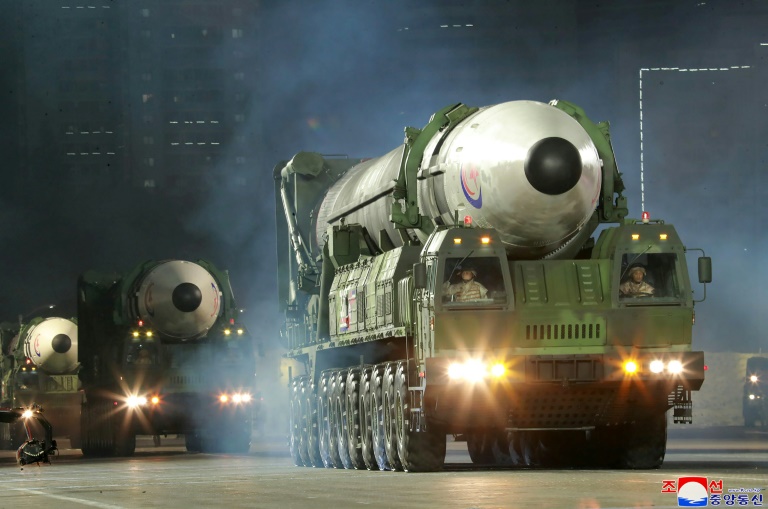
North Korea fired an intercontinental ballistic missile Friday, which Japan said may have had the range to hit the US mainland.

The missile was believed to have landed in Japan’s exclusive economic zone (EEZ), Prime Minister Fumio Kishida said as he blasted the launch as “absolutely unacceptable”.

The launch is Pyongyang’s second in two days and part of a record-breaking blitz in recent weeks.

Confirming the launch, Tokyo said that — based on its calculations — the missile may have had the range to hit the US mainland.

In a statement, the White House “strongly” condemned the test launch.

North Korea claims the recent wave of launches is a response to Washington’s moves to bolster its protection of regional security allies, South Korea and Japan.

South Korea’s Joint Chiefs of Staff said it had “detected a long-range ballistic missile (ICBM) around 10:15 (0115 GMT) fired from the Sunan area in Pyongyang towards the East Sea”, referring to the body of water also known as the Sea of Japan.

The missile flew 1,000 km (621 miles) at an altitude of 6,100 km and speeds of Mach 22, the South Korean military said, calling it a “serious provocation damaging peace and security on the Korean Peninsula”.

Tokyo’s Defence Minister Yasukazu Hamada told reporters that the “ICBM-class missile” had been fired on a “lofted trajectory” — meaning the missile is fired up not out, typically to avoid overflying neighbouring countries.

“Based on calculations taking the trajectory into account, the ballistic missile this time around could have had a range capability of 15,000 km, depending on the weight of its warhead, and if that’s the case, it means the US mainland was within its range,” he said.

The launch comes a day after North Korea fired a short-range ballistic missile as its minister of foreign affairs, Choe Son Hui, warned Pyongyang would take “fiercer” military action if the United States strengthened its “extended deterrence” commitment to regional allies.

Washington has been seeking to boost regional security cooperation and ramp up joint military drills in response to increasing provocations from the nuclear-armed North.

US President Joe Biden discussed North Korea’s recent missile tests with Chinese counterpart Xi Jinping earlier this week and also spoke with leaders from Tokyo and Seoul, as fears grow that the reclusive regime will soon carry out its seventh nuclear test.

North Korea was also top of the agenda when leaders of China and Japan held their first face-to-face talks in three years Thursday at the Asia-Pacific Economic Cooperation (APEC) forum in Bangkok.

Experts said the launch of one of North Korea’s most powerful weapons was a clear sign leader Kim Jong Un was displeased by the recent talks.

Firing an ICBM “is a clear message to the US and Japan,” said Han Kwon-hee, manager of the Missile Strategy Forum.

After the launch, it was announced that US Vice President Kamala Harris would hold urgent North Korea-related talks Friday with leaders from Japan, South Korea, Australia, New Zealand and Canada.

– Repeated launches –

Earlier this month, North Korea conducted a flurry of launches, including an ICBM, which Seoul said at the time appeared to have failed.

Pyongyang also fired a short-range ballistic missile that crossed the de facto maritime border between the two countries and landed near the South’s territorial waters for the first time since the end of the Korean War in 1953.

President Yoon Suk-yeol said at the time that it was “effectively a territorial invasion”.

Both launches were part of a November 2 barrage in which Pyongyang fired 23 missiles — more than it launched during the entirety of 2017, the year of “fire and fury” when Kim traded barbs with then US president Donald Trump on Twitter and in state media.

Experts say North Korea is seizing the opportunity to conduct banned missile tests, confident of escaping further UN sanctions due to Ukraine-linked gridlock at the United Nations.

China, Pyongyang’s main diplomatic and economic ally, joined Russia in May in vetoing a US-led bid at the UN Security Council to tighten sanctions on North Korea.

Washington has responded to North Korea’s sanction-busting missile tests by extending exercises with South Korea and deploying a strategic bomber.

Pyongyang has also been under a self-imposed coronavirus blockage since early 2020, which experts say would limit the impact of any additional external sanctions.


Uruguay's Jorge Drexler eclipses Bad Bunny at Latin Grammys

Uruguay’s top musical export Jorge Drexler overshadowed megastar Bad Bunny’s hype at Thursday’s Latin Grammys, scoring seven trophies including Best Record during the gala that saw Spain’s Rosalia take home the coveted top album award.

The Puerto Rican reggaeton phenom Bad Bunny had been tipped as the favorite coming in with 10 nominations, though he was unable to attend the 23rd edition of the awards held in Las Vegas as he continues his massively popular world tour.

The 28-year-old — currently the highest-grossing and most streamed artist on the planet following the release of his album “Un Verano Sin Ti” — did nab five trophies but fell short of the night’s most prestigious prizes.

“Are you sure?” asked a surprised Drexler as he took the stage to accept the award for Song of the Year for “Tocarte,” a track that also featured Spanish rapper C. Tangana.

Along with Bad Bunny — whose smash “Titi Me Pregunto” ultimately scored two awards in the “urban” categories — the 58-year-old was up against stacked competition including Rosalia, who won four awards including for her critically acclaimed album “Motomami,” and Colombia’s Karol G. 

In his speech Drexler acknowledged the massive reach of Latin urban music including reggaeton, dedicating the award “to everyone who does urban music in Spanish because you’ve taken our music to places it was never in before.”

Drexler was the big winner but in some respects it was Cuban Angela Alvarez who stole the show: at 95 years old the singer scored a gramophone for Best New Artist.

“It’s never too late,” said Alvarez, bringing the auditorium to tears in accepting the award that she shared in a tie with the Mexican artist Silvana Estrada.

“I want to dedicate this award to God, and to my beloved Cuba, which I will never forget. And to those who have yet to make their dreams come true, know that although life is hard, there’s always a way out and with faith and love everything can be achieved,” Alvarez said. 

“With faith and love you can make it, I promise you.”

– Anitta, Bad Bunny head to Grammys –

Rosalia was visibly surprised in accepting the night’s top award for her genre-fusing masterpiece “Motomami,” telling the cheering crowd that it was “the album I had to fight the hardest to make.”

“But I put it out there and that has given me the most joy.”

Colombian crooner Sebastian Yatra — who made a splash last year with the Oscar-nominated song “Dos Oruguitas” from the film “Encanto” — notched two awards in the pop categories including Best Pop Song for “Tacones Rojos,” which he performed during the gala with John Legend.

Brazil’s Anitta left the show empty-handed — she was up for two awards for her booty-grinding reggaeton hit “Envolver” — but delivered a show-stopping performance of that hit and a twerk-heavy mashup of Brazilian dance tracks.

The 29-year-old is among the contenders for Best New Artist at February’s Grammys to be held in Los Angeles.

Bad Bunny’s work will also feature at the forthcoming Grammy gala, with “Un Verano Sin Ti” in the running for Album of the Year.

It’s the first time an all-Spanish album has a chance at that coveted award, and the Puerto Rican reggaeton megastar’s first time landing a solo nomination in the major Grammy categories.

New wave of Russian strikes batter Ukraine grid as first snow falls

Fresh Russian strikes hit cities across Ukraine on Thursday, crippling the country’s energy infrastructure and plunging millions into darkness as winter sets in and temperatures drop.

Repeated barrages have disrupted electricity and water supplies across Ukraine, but the Kremlin blamed civilians’ suffering on Kyiv’s refusal to negotiate, rather than on Russian attacks.

AFP journalists in several Ukrainian cities said the latest assault coincided with the season’s first snow, after officials in Kyiv warned of “difficult” days ahead.

“Currently, more than 10 million Ukrainians are without electricity,” Ukrainian President Volodymyr Zelensky said Thursday, adding that the regions of Odessa, Vinnytsia, Sumy and Kyiv were most affected.

The strikes on Ukraine’s power grid follow a series of battlefield setbacks for Russia, including last week’s retreat from Kherson.

Since Russian forces ended their eight-month occupation of the strategic southern city, chilling accounts have emerged, with Ukrainian ombudsman Dmytro Lubynets describing the conditions there as “horrific”.

Lubynets said authorities had uncovered Russian “torture chambers” where dozens of people had been abused and killed.

On Thursday, Kherson residents rushed to stockpile food, blankets, diapers and winter clothing, with shouting matches and shoving erupting as volunteers tossed supplies into the crowds that had waited hours in freezing rain.

Capturing the fatigue of Ukrainians weathering power and heating outages nine months into the war, British street artist Banksy posted a video to Instagram that showed a woman comforting her child outside a bombed-out kindergarten. 

“We already cried so much, we don’t have any tears left,” she says. 

The elusive graffiti artist has decorated walls and ruins outside the Ukrainian capital with stencils and murals that some hailed as a symbol of their country’s invincibility.

As winter descends, Moscow and Kyiv managed to extend an agreement allowing Ukraine to export grain through the Black Sea, after the deal’s looming expiration had sparked fears for the global food supply.

UN chief Antonio Guterres said the deal was “essential” to averting a worldwide food crisis.

– ‘Critical infrastructure’ –

As Russia steps up its aerial bombardment of Ukraine, officials say energy infrastructure and other civilian targets are being barraged. 

The head of the central region of Dnipropetrovsk, Valentyn Reznichenko, said strikes had hit the administrative centre of Dnipro. 

“An industrial enterprise has been hit. There is a big fire,” he said, later announcing that 23 people were injured, including a 15-year-old girl.

The capital’s regional administration said, “Four missiles and five Shahed drones were shot down over Kyiv,” referring to Iranian-made suicide drones Moscow has been deploying in swarms against Ukraine targets.

In the southern Odessa region, a Russian strike targeted infrastructure, and the governor warned residents of the threat of a “massive” missile attack, urging them to seek shelter.

The eastern region of Kharkiv was also struck, governor Oleg Synegubov announced, adding that Russia hit “critical infrastructure” in strikes that injured at least three people.

In response, Zelensky described Russia as a “terrorist state” and said Moscow “wants to bring Ukrainians only more pain and suffering”.

The Kremlin, however, said Kyiv was ultimately to blame for the blackouts.

“The unwillingness of the Ukrainian side to settle the problem, to start negotiations, its refusal to seek common ground — this is their consequence,” Kremlin spokesman Dmitry Peskov said.

On Tuesday, the largest onslaught of Russian missiles on infrastructure across Ukraine cut power to millions, but supplies were largely restored within hours.

Ukrainian energy company Ukrenergo said Thursday that the “cold snap” had brought increased demand in regions where electricity was recently brought back, and government energy adviser Oleksandr Kharchenko told media that 50 percent of Ukrainians were experiencing disruptions.

“We are doing everything to normalise the supply,” Zelensky said.

– ‘Harbouring murderers’ –

Tensions spiked earlier this week after a missile landed in a Polish town on the border with Ukraine, and there was a flurry of accusations over who was responsible for the blast that killed two.

Zelensky, after previously saying a Russian missile was to blame, seemed to soften his comments on the incident, which had raised the spectre of forcing a NATO response.

“I don’t know what happened. We don’t know for sure. The world does not know,” Zelensky said.

Foreign Minister Dmytro Kuleba also appeared to roll back Kyiv’s position that it was a Russian missile that struck Poland following a call with US Secretary of State Antony Blinken.

“Our experts are already in Poland,” Kuleba tweeted. “We expect them to swiftly get access to the site in cooperation with Polish law enforcement.”

The conflict also reverberated in European courts this week as a Dutch judge on Thursday sentenced two Russians and a Ukrainian to life in prison over the downing of Malaysia Airlines flight MH17 over Ukraine in 2014, killing all 298 people on board.

None of the suspects from that earlier stage of hostilities were present in court or likely to serve their sentences, prompting Zelensky to hail the “important” ruling but call for those responsible to be held to account.

The Kremlin dismissed the ruling as politically motivated while Australia accused Moscow of “harbouring murderers”.

China's Tencent wins first game licence in 18 months

China has granted tech giant Tencent its first licence for a video game in 18 months, ending a dry spell that had threatened its position as the world’s top game maker.

Beijing moved against the country’s vibrant gaming sector last year as part of a sprawling crackdown on big tech companies, including a cap on the amount of time children could spend playing games.

Officials also froze approvals of new titles for nine months until April.

China’s gaming regulator, the National Press and Publication Administration, on Thursday said it had approved 70 new titles in November including Tencent’s action game “Metal Slug: Awakening” and a role-playing game “Journey to the West: Return” by rival NetEase.

Gaming licences are mandatory for video games to be published and sold in the Chinese market.

The last time Tencent obtained a major license was in May 2021.

A Tencent subsidiary received a licence in September but it was for a free educational game.

Shares of the Hong Kong-listed company edged up 0.5 percent in early trade on Friday after the licensing announcement, while NetEase gained five percent.

The approval signals a relaxing of China’s strict attitude towards tech companies.

During the tech crackdown, hundreds of game makers pledged to scrub “politically harmful” content from their products and enforce curbs on underage players in a bid to comply with government demands.

Strict restrictions announced last year allow players under the age of 18 to play for three hours a week.

Japan inflation hits four-decade high in October

Japanese inflation hit a four-decade high last month, government data showed Friday, fuelled by high energy costs and a weak yen and ramping up pressure on the central bank to move away from its ultra-loose monetary policies.

Core consumer prices excluding volatile fresh food rose 3.6 percent on-year in October, marginally higher than analyst expectations.

The reading marked the fastest pace since 1982, although it remains below the sky-high levels that have pummelled the United States and other countries.

In reaction to the data, chief cabinet secretary Hirokazu Matsuno told reporters the government “must protect people’s livelihoods from these price rises”.

“Price increases have continued for items closely related to daily life such as utilities and food, due to rising raw material prices and the weak yen,” he said.

The government said last month it would spend $260 billion on an economic stimulus package that includes support for energy bills, which have spiked since Russia’s invasion of Ukraine in February.

“Policies targeting energy and food, which are the main causes of high prices” are included in the relief measures, Matsuno said as he vowed to “pass the extra budget as soon as possible”.

Darren Tay, Japan Economist at Capital Economics, told AFP that the impact of inflation on the average consumer was “very real”.

Prime Minister Fumio Kishida has responded with an “aggressive” stimulus package because “he knows that his electorate is not too happy with rising prices”, Tay added.

– Economy ‘on shaky footing’ –

When energy prices were not taken into account, October’s inflation was a more moderate 2.5 percent, but still higher than in September.

The headline core consumer price index (CPI) has now risen for 14 straight months — putting pressure on the Bank of Japan to tweak its longstanding monetary easing policies.

The US Federal Reserve and other central banks have sharply hiked interest rates this year to tackle inflation.

But Japan, which since the 1990s has swung between periods of sluggish inflation and deflation, has gone against the grain and continues to keep interest rates at ultra-low levels as it tries to kickstart the torpid economy.

Although inflation is now higher than the two-percent targeted by the Bank of Japan for the past decade, it sees the recent price rises as temporary and says there is no reason to change course.

The starkly different approaches taken by the BoJ and the Fed have driven down the value of the yen against the dollar this year from levels of around 115 yen per dollar in March to 140 on Friday, having hit a 32-year low of 151 yen last month.

But while the bank keeps a close watch on inflation, Tay added: “I still don’t think it’s enough for them to change their policy at this point.”

One reason is that Japan’s latest growth data, released on Tuesday, showed a surprise contraction of the world’s third-largest economy in the July-September quarter.

“That shows the bank very clearly that the economy is actually on much shakier footing than they might otherwise have expected,” Tay said.

“The other thing is the global economy is probably going to enter a recession next year, in the first half,” he added.

“We’re basically looking at very weak economic conditions overall, and the Bank of Japan will not risk jeopardising the economy even further by tightening monetary policy at this point.”

Asian markets rise but caution over rate outlook dulls sentiment

Asian markets edged up Friday, though caution permeated trading floors as investors tried to gauge the outlook for Federal Reserve monetary policy after several officials tried to temper optimism over signs that inflation is slowing.

While the week has been broadly positive for equities following softer-than-expected US consumer and wholesale price figures, a strong reading on retail sales and jobless claims showed plenty of resilience to higher interest rates.

With that in mind, St Louis Fed President James Bullard warned more hikes were needed to bring inflation down from four-decade highs, adding that they might need to go as high as seven percent.

That was followed by Minneapolis Fed boss Neel Kaskari saying he had not witnessed much evidence that underlying demand was cooling and did not want to forecast when the tightening would end.

The comments followed a similar message put out by other policymakers, who have sought to calm markets, which soared in the wake of last Thursday’s consumer prices reading.

They also fuelled fears among traders that the sharp tightening campaign — including four straight bumper 0.75 point increases in a row — will tip the world’s top economy into recession

On Wednesday, Kansas City Fed chief Esther George said it was unclear how the bank can douse inflation “without having some real slowing” or even a contraction.

Wall Street’s three main indexes ended in the red.

Still, Hong Kong led gains across much of Asia thanks to rally in tech firms, and after China indicated it will ease back on some of its strict Covid restrictions and help the troubled property sector.

Tokyo, Sydney, Seoul, Wellington, Taipei, Manila and Jakarta also rose though Shanghai and Singapore dipped.

– ‘Fundamental disconnect’ –

While most of Asia rose, there was a fear that the recent rally may have run a little ahead of itself.

“The market believes that inflation is on the downtrend. We also believe that, but the fact of inflation having peaked is not a reason for the Fed to turn and cut rates,” Paul Christopher, at Wells Fargo Investment Institute, told Bloomberg Radio.

“That’s the fundamental disconnect that still exists between the Fed and the market.”

And SPI Asset Management’s Stephen Innes added: “Things can turn on a dime, primarily when the fear of missing (out) drives sentiment.

“However, the odds of a pre-Thanksgiving rally are giving way to the hawkish Fed drumbeat and pushback on China reopening plays.”

The pound clawed back some of its losses suffered Thursday after Britain unveiled a budget filled with 55 billion pounds ($65 billion) of tax hikes and spending cuts that traders fear will deepen a cost-of-living crisis and a recession that could last two years.

– Key figures around 0230 GMT –

Tokyo – Nikkei 225: UP 0.2 percent at 27,978.06 (break)

Hong Kong – Hang Seng Index: UP 1.2 percent at 18,266.41

Shanghai – Composite: DOWN 0.2 percent at 3,110.06

Pound/dollar: UP at $1.1892 from $1.1867 on Thursday

Euro/dollar: DOWN at $1.0367 from $1.0370

Dollar/yen: DOWN at 139.91 yen from 140.20 yen

Euro/pound: DOWN at 87.18 from 87.34 pence

West Texas Intermediate: UP 1.1 percent at $82.57 per barrel

Brent North Sea crude: UP 0.9 percent at $90.57 per barrel

New York – Dow: FLAT at 33,546.32 points (close)

London – FTSE 100: DOWN 0.1 percent at 7,346.54 (close) 

N. Korea fires suspected ICBM, Seoul and Tokyo say

North Korea fired a suspected intercontinental ballistic missile Friday, Seoul’s military said, its second launch in two days, which Japan said had splashed down in its exclusive economic zone.

Seoul’s Joint Chiefs of Staff said it had “detected a presumed long-range ballistic missile around 10:15 (0115 GMT) fired from the Sunan area in Pyongyang towards the East Sea,” referring to the body of water also known as the Sea of Japan.

South Korea’s National Security Council met Friday to discuss the presumed ICBM launch, the presidential office said.

Tokyo also confirmed the launch, with Japanese Prime Minister Fumio Kishida saying it was believed to have fallen in waters within the country’s exclusive economic zone (EEZ) off the northern region of Hokkaido.

“The ballistic missile launched by North Korea is believed to have landed in our EEZ west of Hokkaido,” Kishida told reporters on the sidelines of a Bangkok summit, calling the launch “absolutely unacceptable”.

He added there were no initial reports of damage to ships or aircraft.

Seoul-based specialist site NK News reported that photos and videos taken from Pyongyang showed a white contrail in the sky that was visible from the city.

The launch comes a day after North Korea fired a short-range ballistic missile as its minister of foreign affairs, Choe Son Hui, warned Pyongyang would take “fiercer” military action if the United States strengthened its “extended deterrence” commitment to regional allies.

Washington has been seeking to boost regional security cooperation and ramp up joint military drills in response to increasing provocations from the nuclear-armed North, which views all such moves as evidence of US aggression.

US President Joe Biden discussed North Korea’s recent missile tests with Chinese counterpart Xi Jinping earlier this week and also spoke with leaders from Tokyo and Seoul, as fears grow that the reclusive regime will soon carry out its seventh nuclear test.

North Korea was also top of the agenda when leaders of China and Japan held their first face-to-face talks in three years Thursday at the Asia-Pacific Economic Cooperation (APEC) forum in Bangkok.

Experts said the launch of one of North Korea’s most powerful weapons was a clear sign leader Kim Jong Un was displeased by the recent talks.

“Now, it’s estimated to be an ICBM, if that’s the case, it is a clear message to the US and Japan,” said Han Kwon-hee, manager of the Missile Strategy Forum.

– Repeated launches –

Earlier this month, North Korea conducted a flurry of launches, including an ICBM, which Seoul said at the time appeared to have failed.

Pyongyang also fired a short-range ballistic missile that crossed the de facto maritime border between the two countries and landed near the South’s territorial waters for the first time since the end of the Korean War in 1953.

President Yoon said at the time that it was “effectively a territorial invasion”.

Both launches were part of a November 2 barrage in which Pyongyang fired 23 missiles — more than it launched during the entirety of 2017, the year of “fire and fury” when Kim traded barbs with then US president Donald Trump on Twitter and in state media.

Experts say North Korea is seizing the opportunity to conduct banned missile tests, confident of escaping further UN sanctions due to Ukraine-linked gridlock at the United Nations.

China, Pyongyang’s main diplomatic and economic ally, joined Russia in May in vetoing a US-led bid at the UN Security Council to tighten sanctions on North Korea.

Washington has responded to North Korea’s sanction-busting missile tests by extending exercises with South Korea and deploying a strategic bomber.

Pyongyang has also been under a self-imposed coronavirus blockage since early 2020, which experts say would limit the impact of any additional external sanctions.

Upstarts challenge elderly political elite in Nepal election

Shouting matches with public officials and undercover sting operations on corrupt bureaucrats helped Nepali television host Rabi Lamichhane tap into widespread discontent over an elderly, back-scratching political leadership.

The bombastic journalist is one of several young upstart candidates who will contest the Himalayan republic’s election on Sunday against the familiar faces that have strode the corridors of power for decades.

An elite club of parliamentary veterans taking turns as leader — at a time when the economy is teetering — has fuelled perceptions that the government is out of touch with Nepal’s problems.

“People say, ‘we have been cheated, there is discrimination, we have to pay bribes, we don’t have access to drinking water, we don’t have jobs’,” Lamichhane told AFP during a campaign pit stop.

A cheering crowd lined the roadside to greet the star candidate and garland him with flowers as his entourage moved through the streets of Padampur, a small town around six hours’ drive from the capital, Kathmandu.

“I helped people solve some of these problems even when I was not in a position of power,” he said. “So we can deliver on our promises.”

Lamichhane, with telegenic charisma and a winning smile, is no stranger to drawing an audience as one of Nepal’s most famous and voluble television personalities.

He once held the Guinness World Record for hosting the longest talk show, a 62-hour marathon of celebrity interviews and talkback calls themed around the origins of the Buddha.

Later, he launched the muckraking news programme “Straight Talk with the People”, anchored around combative interviews with political leaders and tabloid-style hidden camera stings that shamed authorities who demanded bribes for routine government services.

His work resonated with Nepalis dismayed at widespread graft that has routinely broken into open scandal, such as when members of the government’s integrity agency were forced to step down after they were themselves accused of corruption.

– ‘Their leaders have failed’ –

The television host is the most prominent among a crop of young candidates — nearly all in their early-to-mid 30s — running for the first time. 

Lamichhane, 48, is practically a senior citizen compared with his peers in this loose coalition for change in Nepal, where the median age is an even younger 25.

Yet he is still a full generation younger than the leaders who have ruled since the end of Nepal’s civil war, a decade-long Maoist insurgency that killed more than 17,000 people.

The conflict ended in 2006 with a peace deal that brought the rebels into the government fold. Since then, power has alternated between the one-time guerrillas and pre-war political elites.

Political instability has been a recurrent feature of Nepal’s parliament since, and no prime minister has served a full term after the war ended. 

The current premier, 76-year-old Sher Bahadur Deuba, is holding the office for the fifth time.

Deuba has formed an electoral alliance with former Maoist guerrilla leader Pushpa Kamal Dahal, 67, against 70-year-old KP Sharma Oli, who helms another communist party. Dahal and Oli have each served as premier twice.

“Young voters have become a dominant force now. While the parents or grandparents used to decide whom to vote for among the family, it’s their children now who are doing that,” political analyst Hari Sharma told AFP. 

“Established political parties and their leaders have not been able to speak the language of these young voters,” he added. “These voters think that their leaders have failed.”

– ‘No, Not Again’ – 

Public disaffection has intensified with the economy still in the doldrums from the coronavirus pandemic, which devastated the vital tourism industry and dried up remittances from the huge number of Nepalis working abroad.

Inflation is spiking and the government has banned imports of several goods, including foreign liquor and television sets, to shore up its dwindling foreign exchange reserves.

The mood for change among ordinary Nepalis is palpable, with an anonymous Facebook campaign group calling itself “No, Not Again” gaining 43,000 followers in just weeks by urging the public to reject “the same old names and faces” in Sunday’s poll.

“I had voted for other political parties in the past and they have done nothing,” Radha Tamang, 56, told AFP.

Tamang survives on money sent by her son, who found work abroad in Malaysia, but hopes that a generational change can help create jobs in Nepal and allow him to make a living back home.

“My son has told me to vote for Rabi Lamichhane. He will hear our voices,” she said. “I am going to vote for him this time.”

Wildlife summit could upend Hong Kong's shark fin trade

Hong Kong’s controversial shark fin trade may face its biggest shakeup in years if conservationists get their way in securing tighter regulations at an international wildlife conference in Panama.

The city is one of the world’s largest markets for shark fin, which is viewed by many Chinese communities as a delicacy and often served as a soup at expensive banquets.

While domestic consumption has shrunk after years of activist campaigning, Hong Kong remains a vital trade hub for shark fins — both legal and illegal — headed for the Chinese mainland and Southeast Asia.

“Last year, over 90 percent of shark fin imports in Hong Kong were re-exported, and a major market is mainland China,” said Loby Hau, oceans sustainability assistant manager at WWF-Hong Kong.

The city regulates its shark fin trade using an international treaty on endangered species, meaning certain types of fins must have export permits showing they were sustainably captured.

The latest meeting of the 184-nation Convention on International Trade in Endangered Species of Wild Fauna and Flora (CITES), which began in Panama on Monday, may add protections for two major shark families.

Researchers say the proposals, if passed, will protect a huge number of shark species and place further pressure on Hong Kong’s law enforcement, which is already battling a surge in illicit shark fins.

Hong Kong seized 27.5 tonnes of legally regulated shark fins in 2021 and 29.5 tonnes the year before, a government spokesman told AFP. In 2019, the figure was just 6.5 tonnes.

– Tough enforcement –

Marine biologists estimate that upwards of 100 million sharks are killed each year, pushing vital apex predators towards extinction and ocean ecosystems to the brink of collapse.

The fins are usually sliced from their bodies and the animals thrown back into the sea where they suffer a slow death.

There are signs Hong Kong consumers have become more aware. 

A survey in 2009 found that 73 percent of respondents had eaten shark fin in the preceding year, but a decade later that number fell to 33 percent.

The government, major caterers and image-conscious brands have also been keen to bolster their environmentalist credentials by ditching shark fin from banquet menus.

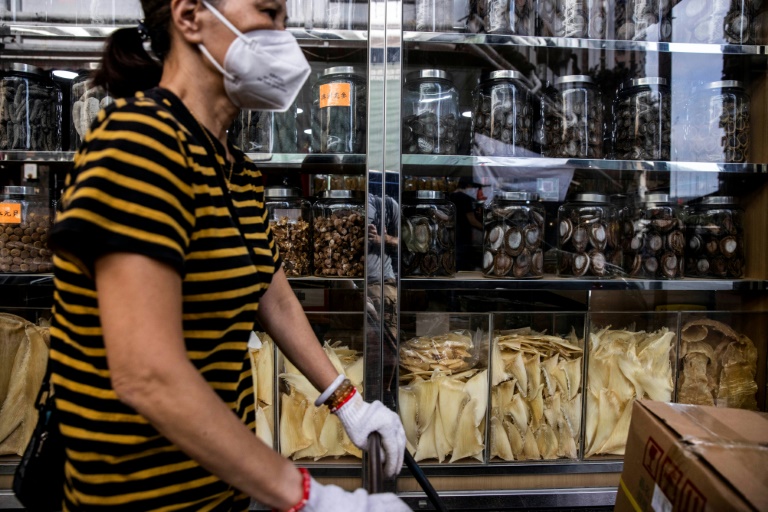
But in Hong Kong’s “Dried Seafood Street”, where shops display shark fins behind glass like trophies, business remains steady.

“Fewer people want to buy shark fins nowadays, but we have our regulars, mostly the elderly,” said one shopkeeper who declined to be named, adding that her customers spend an average of HK$2,500 ($320) per catty (a measurement equal to 605 grams).

A nearby restaurant was offering a range of shark fin soups that maxed out at HK$980 per bowl.

It is hard to tell the level of compliance among import-export firms and retail vendors, according to Stan Shea, marine programme director for the BLOOM Association Hong Kong.

“As an ordinary citizen, the only thing you can do is ask the shopkeeper, ‘Are your fins legal?'” he told AFP. “(Sellers) are not required to label their goods and very few do.”

Once a piece of shark fin is skinned and processed, the only reliable way to check if it belonged to an endangered species is DNA analysis — which Shea and other researchers conducted in 2014.

More than 10 percent came from sharks regulated by CITES at the time. 

A more recent 2020-2021 study by Shark Guardian in Taiwan found half of shark fin traders were selling protected species. 

– Broad proposal –

Blue sharks — which industry representatives argue have stable populations — are the most commonly found among fin traders.

But that could change if a CITES proposal backed by more than 40 countries to regulate all species of requiem sharks is successful.

“If the proposal is passed, and assuming the market composition hasn’t changed since 2014, then 90 percent of shark fins on the market will need to have export permits,” Shea said.

Over the past five years, Hong Kong has prosecuted five people for importing endangered shark fin without a licence — an offence punishable by up to 10 years in jail and a HK$10 million fine.

The government last year expanded the law on organised crime to cover wildlife smuggling, but no such prosecutions have taken place.

Hau, of WWF-Hong Kong, called on authorities to conduct more inspections and impose mandatory record-keeping for shark fin vendors.

“If this Panama conference adds more species to (CITES regulations), the government should pay close attention,” he told AFP. 

“Wildlife smuggling has become very systematic and organised, so investigations need to be dialled up.”

Cuba bets on specialty coffee to boost industry

In the lush, fertile mountains of Cuba, farmer Jesus Chaviano dreams of adding his arabica beans to a list of specialty coffees the country hopes will lift an industry in decline.

It’s harvest time on Chaviano’s eight-hectare (20-acre) plantation in the central Guamuaya mountain range, and his 42,000 coffee plants burst with ripe reddish fruit in the shadow of avocado and banana trees.

At 800 meters (2,600 feet) altitude, conditions are ideal for the eight varieties of high-quality arabica coffee beans he planted with his “own hands.”

While Cuba has been growing coffee for almost 300 years, it has never produced the specialty coffees beloved worldwide for their unique flavor profiles that come from careful cultivation in a specific terroir.

In the past two decades, the appeal of high-end coffee has soared, and so has its price on the international market.

“I think that needs to be the path we take: going after specialty coffees. Not large quantities… small batches that we can sell well,” said Chaviano, 46.

As the island catches on to the appeal of high-end coffee, the first five specialty coffees will be unveiled in December at the first-ever Cuba-Cafe producers fair, which is being held in the eastern city of Santiago de Cuba.

The name and origins of the chosen coffees are being kept secret.

“We are taking the first concrete steps to add value to this coffee,” said Ramon Ramos, the scientific director of Cuba’s National Institute for Agroforestry Research. He added that “with the same production, the same yield, it will be sold at a much higher price.”

-‘It’s the future’-

According to Ramos, the price for 1,000 kilograms of commercial coffee varies between $4,000 and $5,000. Meanwhile, a kilogram of specialty coffee can sell for “up to $10,000.”

According to the Specialty Coffee Association (SCA) a coffee must score above 80 points on a 100-point scale to reach the required standard, after being evaluated by “a certified coffee taster.”

The final score will influence the price at which it is sold.

“It’s the future,” says Chaviano, who built his house in the middle of his plantation, in the style of the French colonists who fled Haiti in the 18th century and brought the culture of coffee cultivation to Cuba.

In 1960, Cuba produced more than 60,000 tonnes of coffee. Last year, this figure stood at only 11,500 tonnes, less than half of what is consumed locally.

According to official figures, only 1,365 tonnes were exported.

Experts say climate change — drastically reducing coffee-growing areas worldwide — is partly to blame for the drop in production.

In Cuba, the emigration of plantation workers has also impacted the industry.

“Why did the country once produce a lot of coffee, but now it can’t produce coffee?” asked Chaviano.

“I’m focused on doing it right and demonstrating that it’s possible to produce coffee, and quality coffee,” but “you have to put your heart into it,” he added.

In 2021, his yield was one tonne of coffee per hectare, four times the national average.

– ‘We can do it’-

Some 25 kilometers from his farm, researchers at the Jibacoa Agroforestry Research Station, have been tasked with training and providing technology to producers to improve their yields.

Director Ciro Sanchez, said the goal is to produce 30,000 tonnes of coffee by 2030.

To achieve this, the aim is to recover some plantations in areas affected by climate change, by planting more resistant varieties of coffee. Sanchez also wants to prioritize the growth of “high-quality arabica” in mountainous areas.

Chaviano is optimistic that one day his coffee will be one of the feted specialty brands being exported from Cuba.

“We can do it. We just need to work!” he said. 

Close Bitnami banner
Bitnami