World

Rainforest giants Brazil, Indonesia, DR Congo sign deforestation pact

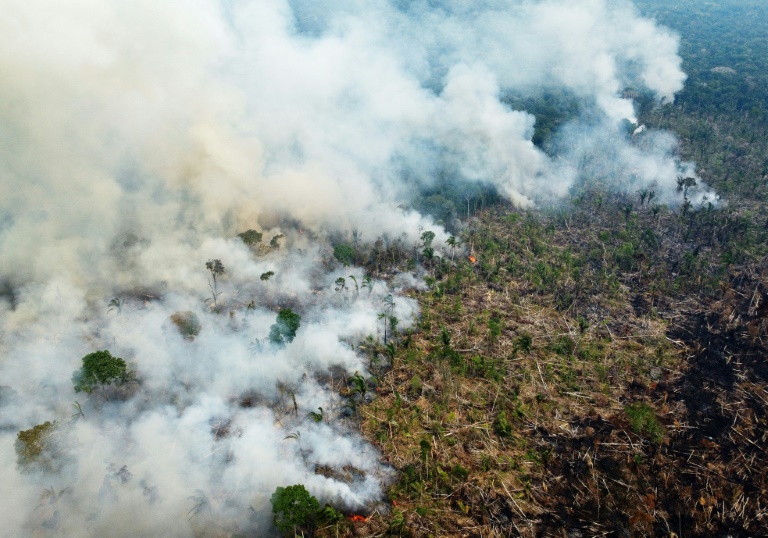
The world’s biggest rainforest nations Brazil, Indonesia and the Democratic Republic of Congo on Monday formally launched a climate partnership to work together on conservation.

All three nations have vast tropical rainforests threatened by logging and agriculture. 

“Representatives from Indonesia, Brazil and DRC… announced a tropical forest cooperation and climate action in the Egyptian COP27 (climate summit) side event on November 7, and agreed to sign a Joint Statement today,” Indonesia’s coordinating minister of maritime and investment affairs Luhut Binsar Pandjaitan said in a statement.

“We do need cooperation with others to achieve common goals. Alone we can do so little, together we can do so much,” he said on the eve of the G20 summit.

The agreement calls for all three to be compensated by the international community for reducing deforestation, focusing on joint issues such as access to climate finance and the price of a tonne of carbon in the carbon-credit market.

The Indonesian statement said the countries “have a common interest in collaborating to increase the value of their tropical forests, and to ensure that these tropical forests continue to benefit the climate and people.”

Brazilian president-elect Luiz Inacio Lula da Silva is expected to pledge a reversal of the environmental policies of his right-wing predecessor Jair Bolsonaro to protect the Amazon rainforest.

His trip to the COP27 talks in Egypt’s Sharm el-Sheikh — which he will address on Wednesday — will be his first international visit since beating Bolsonaro in an election run-off last month.

The 77-year-old promised on the campaign trail to work towards zero deforestation. Brazil will be represented at the G20 summit on Tuesday and Wednesday by Foreign Minister Carlos Franca.

The DRC, which is home to 60 percent of the vast Congo Basin rainforest, has faced criticism for launching an auction in July for oil and gas blocks, some of which are in sensitive areas. 

The impoverished central African nation maintains that developing its fossil resources is an economic imperative.

But the country’s Environment Minister Eve Bazaida Mazudi said the three nations can offer solutions to climate change together.

“The world is currently getting warmer and warmer, so humanity needs rainforests to bind CO2,” she said, according to the Indonesian statement.

Biden, Xi cool Cold War rhetoric in landmark summit

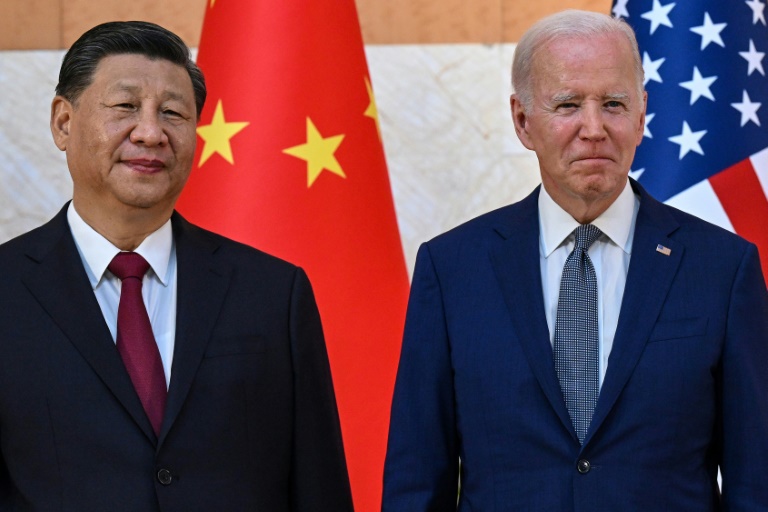
Presidents Joe Biden and Xi Jinping tried to take some heat out of their simmering superpower rivalry Monday, during a three-hour summit that found common ground on Ukraine but left little doubt that stark differences remain.

Biden emerged from the meeting proclaiming there need not be a new Cold War, as both leaders spoke of the desire to prevent high tensions from spilling over into conflict.

Xi told Biden that the two countries “share more, not less, common interests”, according to a Chinese account of the meeting, sounding more conciliatory than the last three pandemic-filled years without face-to-face presidential meetings would suggest.

“The world expects that China and the United States will properly handle the relationship,” Xi told him.

Trying to scotch the notion that China is bent on usurping the United States and remaking the world in its own authoritarian image, Xi reportedly said Beijing does not seek to challenge the United States or “change the existing international order”.

On the pressing issue of Russia’s war in Ukraine and President Vladimir Putin’s veiled threats to use nuclear weapons, the pair agreed that nuclear war should not be fought and cannot be won, according to the White House.

They “underscored their opposition to the use or threat of use of nuclear weapons in Ukraine,” the US added.

That common cause is likely to give Putin pause as he weighs how to turn the tide of a war that his regime’s survival could hinge on.

But Biden and Xi’s meeting was no kumbaya summit. 

The two leaders notably clashed on the question of Taiwan’s future.  

Tensions have risen sharply over Taiwan, with China in August conducting major military exercises after a visit to the self-governing democracy, which it claims, by US House Speaker Nancy Pelosi.

Xi told Biden that Taiwan is the “first red line that must not be crossed in China-US relations,” according to the Chinese foreign ministry statement.

Biden told Xi he opposed any changes on Taiwan — after the US leader repeatedly indicated that Washington was ready to defend the island militarily.

And he raised US “objections” to China’s “coercive and increasingly aggressive actions toward Taiwan, which undermine peace and stability across the Taiwan Strait and in the broader region, and jeopardise global prosperity,” the White House said.

Biden also nudged China to rein in ally North Korea after a record-breaking spate of missile tests has raised fears that Pyongyang will soon carry out its seventh nuclear test, and said he was “confident China’s not looking for North Korea to engage in further escalation”.

In a sign of thawing ties, Biden announced that US Secretary of State Antony Blinken will visit China “to follow up on their discussions”.

A senior State Department official, speaking on condition of anonymity, told AFP the two countries were working “to schedule a visit tentatively planned for early next year”.

Xi’s last in-person meeting with a US president was in 2019 with Donald Trump, who along with Biden identified China as a top international concern and the only potential challenger to US primacy on the world stage. 

Although the meeting was the first time Xi and Biden have met as presidents, the pair have an unusually long history together. 

By Biden’s estimation, he spent 67 hours as vice president in person with Xi including on a 2011 trip to China aimed at better understanding China’s then-leader-in-waiting, and a 2017 meeting in the final days of Barack Obama’s administration.

On Tuesday, Xi will hold the first formal sitdown with an Australian leader since 2017, Prime Minister Anthony Albanese announced, following a concerted pressure campaign by Beijing against the close US ally. 

He will also meet French President Emmanuel Macron, and Britain’s new Prime Minister Rishi Sunak has said he also hopes to speak with the Chinese leader.

– Absent Putin –

Though he is engaging Xi, Biden has refused since the invasion of Ukraine to deal directly with Putin, who is conspicuously absent from the Bali summit.

The Kremlin cited scheduling issues and has instead sent longtime foreign minister, Sergei Lavrov, who arrived Sunday evening and underwent two health checks at a Bali hospital, according to an Indonesian health ministry official.

Lavrov, 72, denied reports that he was receiving treatment at a Bali hospital, telling Tass news agency that he was in his hotel preparing for the summit.

Lavrov’s presence has thrown into question a customary G20 group photo and joint statement, with Russia sure to reject any explicit calls to end its invasion of Ukraine.

Brazil's Embraer announces 3rd quarter loss

Brazilian plane-maker Embraer announced on Monday a third quarter loss of 160.4 million reais ($30.2 million) due to falling revenue in its defense and security sectors.

Compared to the third quarter in 2021, when Embraer lost 234 million reais, defense and security revenues fell by 42 percent.

That was partially offset, however, by increases of five percent in commercial aviation, six percent in executive business and seven percent in support and services.

Embraer, the world’s third-biggest plane-maker after Airbus and Boeing, had made a 372.6 million reais net profit in the second quarter, having lost 170.7 million reais in the first three months of the year.

In a statement, Embraer said it had delivered 10 commercial airplanes and 23 executive jets during the last quarter.

It has delivered 79 aircraft in the year to date.

The company said continued disruption to the supply chain affecting the airline industry accounted for the third quarter losses.

Embraer’s overall debt stood at $1.3 billion at the end of the third quarter, down from the $1.8 billion figure a year earlier.

Wall Street rally reverses as dollar rises

Wall Street stocks slipped Monday following last week’s global surge as the dollar advanced against major rivals. 

The dollar crept higher as traders urged caution over expectations that the Federal Reserve would pull back from massive US interest hikes as inflation cools in the world’s biggest economy.

US stocks had bounded higher last week on the prospect the Fed might be able to let up on its aggressive interest rate hikes, with the tech-heavy Nasdaq jumping 8.1 percent and the blue-chip Dow rising 4.1 percent.

But Wall Street opened lower, with the Dow shedding 0.3 percent.

“This morning … there is a little bit of questioning as to whether the market overreacted last week,” said Briefing.com analyst Patrick O’Hare.

Susannah Streeter, senior investment and markets analyst at Hargreaves Lansdown, said “the burst of euphoria which erupted… at the end of last week is ebbing away after fresh warnings that the fight against inflation is still a hard slog yet to be won.”

Investors will get a look this week whether that cooling has spread to consumers, with US retail sales data due out on Wednesday. Earnings figures from major retailers Walmart and Target will also provide a window into how inflation is impacting consumer spending, a major driver of the US economy.

European stocks were higher in afternoon trading, where data helped improved sentiment.

“There was good news from the eurozone as industrial production came in better than expected this morning,” said market analyst Fawad Razaqzada at City Index and FOREX.com.

While the eurozone is widely seen as heading for a recession, the data showed a month-on-month gain of 0.9 percent in September, while analysts had expected practically no gain. 

Sentiment also won a lift from China, which is relaxing some of its strict Covid-19 restrictions that have hammered growth in the world’s second largest economy.

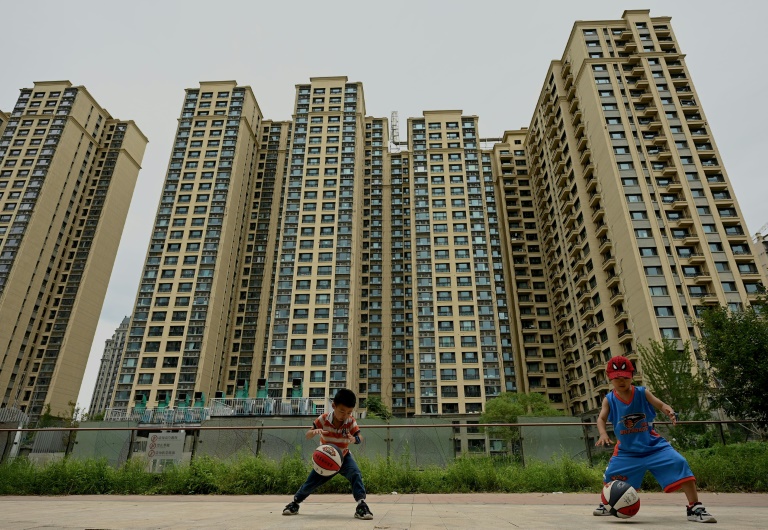
Authorities have also reportedly unveiled a 16-point plan to support the beleaguered property sector, a major component of the country’s economic engine.

The industry has come under immense pressure since China imposed a number of restrictions in 2020 aimed at reeling in debt as major developers teetered on the brink of collapse.

The latest moves indicate that China’s leadership is beginning to focus on supporting the economy, a crucial driver of global growth, according to analysts.

Nomura’s Lu Ting warned, however, that the “measures may have little direct impact on stimulating home purchases”.

Hong Kong’s stock exchange ended more than one percent higher Monday — having soared over seven percent Friday.

Property firms were the best performers with Country Garden leading the way with a massive 40-percent jump.

– Key figures around 1330 GMT –

London – FTSE 100: UP 1.0 percent at 7,388.60 points

Frankfurt – DAX: UP 0.6 percent at 14,314.24

Paris – CAC 40: UP 0.5 percent at 6,630.54

EURO STOXX 50: UP 0.6 percent at 3,891.75

New York – Dow: DOWN 0.3 percent at 33,649.45

Tokyo – Nikkei 225: DOWN 1.1 percent at 27,963.47 (close)

Hong Kong – Hang Seng Index: UP 1.7 percent at 17,619.71 (close)

Shanghai – Composite: DOWN 0.1 percent at 3,083.40 (close)

Euro/dollar: DOWN at $1.0308 from $1.0361 on Friday

Pound/dollar: DOWN at $1.1736 from $1.1839 

Dollar/yen: UP at 140.49 yen from 138.70 yen

Euro/pound: UP at 87.84 pence from 87.49 pence

West Texas Intermediate: DOWN 1.5 percent at $87.62 per barrel

Brent North Sea crude: DOWN 1.2 percent at $94.83 per barrel

burs-rl/yad

Net-zero in fashion, but clothing giants struggle to cut emissions

The world’s fashion giants have pledged to trim their carbon footprint but that goal remains elusive at a time “fast fashion” is all the rage — a topic in the spotlight at the UN climate summit.  

With a chance to strut their climate commitments at COP27 talks, clothing brands and manufacturers discussed global warming — but some admitted that their pledge to halve emissions by 2030 and reach net-zero by mid-century may be a stretch. 

“Are we there yet? Of course not. Are we on track? I would say … maybe,” Stefan Seidel, senior head of sustainability at Puma, told a panel at the COP27 in the Egyptian seaside resort of Sharm el-Sheikh.

Greenpeace and other groups have urged the sector — already under fire for often exploitative labour practices — to slow down or end the wasteful trend of mass-producing low-cost clothes that are quickly thrown away.

Fast fashion, they charge, uses up massive amounts of water, produces hazardous chemicals and clogs up landfills in poor countries with textile waste, while also generating greenhouse gases in production, transport and disposal.

The fashion sector was responsible for four percent of global emissions in 2018 — about the same as Britain, France and Germany combined — according to the McKinsey consultancy firm.

Some 30 firms — from retail giants H&M and Zara owner Inditex to sports apparel rivals Adidas and Nike — signed up to the Fashion Industry Charter for Climate Action at the COP24 summit in Poland in 2018.

At the time they pledged to cut emissions by 30 percent by 2030 and to be net-zero emitters by mid-century.

A year ago they set the new, more ambitious goal of slashing their CO2 emissions by half by the end of the decade, with more than 100 companies now signatories to the pledge.

But meeting the target is a major challenge for an industry with long and complex supply chains that span the globe, industry insiders admit.

– ‘Difficult and costly’ –

Industry figures at COP27 barely mentioned the “fast fashion” business model, which critics say is at the heart of the problem, focussing instead on ideas around the use of renewable energy in factories and regulation.

But greening the entire supply chain and introducing climate-friendly standards among suppliers of raw materials and factories is a monumental task.

Leyla Ertur, head of sustainability at H&M, said the Swedish firm has more than 800 suppliers.

And Marie-Claire Daveu, sustainability chief at Kering Group, which owns luxury brands Gucci and Yves Saint Laurent, said: “Even us, we’re not big enough to change all the supplies chains. That’s why collaboration is key.”

Ali Nouira, an Egyptian manufacturer, told another COP27 panel that certification bodies do not even exist in the region.

“When we manufacture, we need to have all the right certifications and the carbon footprints and all that, and for a small brand coming out from Egypt that is extremely difficult and also costly,” Nouira said.

“We also manufacture for other brands, in Europe and other places,” he said. “And we’re pressured to have the certifications and also to go down with our prices, so they can continue to make the profits they make.”

– ‘Leap of faith’ –

Nicholas Mazzei, head of environmental sustainability at online retailer Zalando, said there had been a culture change in developed countries, with banks offering lower interest rates to companies that commit to a net-zero target.

“If you make that transformation, you may end up paying nothing because the loans are so low the costs are basically free,” Mazzei said.

But suppliers face big costs as sewing clothes in factories requires more energy than that used by retail stores at the end of the supply chain.

“We need, at a far bigger scale, more renewable energy than brands do,” said Catherine Chiu, vice president of corporate quality and sustainability at Kong Kong firm Crystal International Group.

“Even if we install solar panels in all of our 20 plants, that would only represent 17 percent of the energy consumption of the group,” she said.

Delman Lee, vice chair for sustainability at TAL Apparel, another Hong Kong garment manufacturer, said it has been decarbonising its operations for a decade.

But with subsidiaries in countries including Vietnam and Ethiopia, it is complicated to navigate the different regulations, Lee said.

Aiming to become a net-zero business “is a leap of faith commitment,” Lee said. “You commit to something you don’t know how to achieve.”

Turkey arrests Syrian woman, accuses PKK over Istanbul attack

Turkey on Monday accused a Syrian woman of planting a bomb that killed six people in Istanbul, blaming the outlawed Kurdistan Workers’ Party (PKK) of carrying out the attack.

Two girls, aged nine and 15, were among those killed when the bomb exploded shortly after 4:00 pm (1300 GMT) on Sunday in Istiklal Avenue, home to smart boutiques and European consulates. More than 80 other people were wounded.

“The person who planted the bomb has been arrested,” Interior Minister Suleyman Soylu said in a statement broadcast by the official Anadolu news agency early Monday. 

“According to our findings, the PKK terrorist organisation is responsible,” Soylu said.

The PKK, blacklisted as a terrorist group by Ankara and its Western allies, has waged a deadly insurgency for Kurdish self-rule in southeastern Turkey since the 1980s.

It denied any role in the latest attack.  

“There is no relationship between the PKK and yesterday’s explosion in Istanbul,” the group’s spokesman told AFP.

A Turkish official told AFP that initial findings point to “units within a youth organisation affiliated with the PKK.” 

Police, quoted by private NTV television, said the chief suspect is a Syrian woman working for Kurdish militants. Forty-six people were detained in total, police said.

Police footage shared with Turkish media showed a young woman in a purple sweatshirt being apprehended in an Istanbul flat.

Police, cited by NTV, named her as Alham Albashir and said she was arrested at 02:50 am in an Istanbul suburb. Local media said she was a trained PKK intelligence operative and 23 years old. 

– ‘Profoundly sad’ –

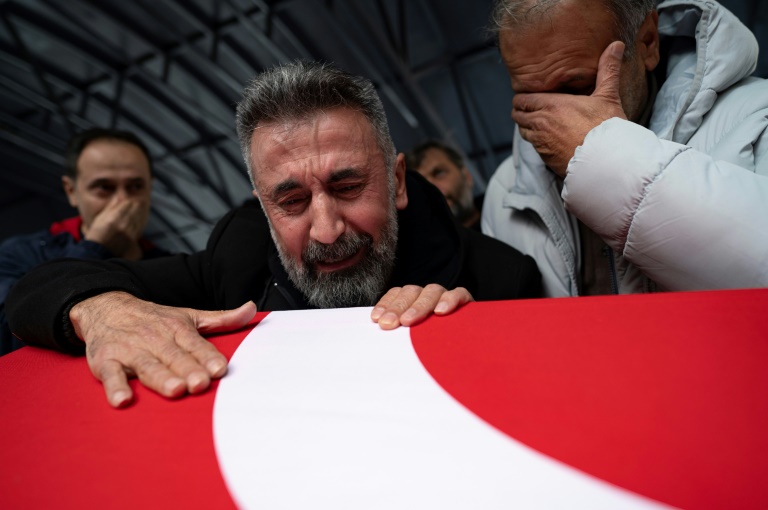
Turkey buried the victims on Monday.   

“Of course we are profoundly sad. A young teacher and her daughter being the victims of such a treacherous attack has upset us deeply,” said Orhan Akkaya, a relative of a mother and her 15-year-old daughter killed in the attack. 

The grieving father, Nurettin Ucar, was crying over his daughter’s Turkish flag-wrapped coffin. 

There has been no claim of responsibility. 

“We believe that the order for the attack was given from Kobane,” Soylu said, referring to a city in Syria near the Turkish border.

PKK-affiliated Kurdish militants control most of northeastern Syria and, in 2015, Kurdish fighters drove Islamic State jihadists out of the city. 

The Kurdish-led Syrian Democratic Forces (SDF) also denied any role in the attack. 

“Our forces have nothing to do with the Istanbul bombing,” said Mazloum Abdi, the chief commander of the US-allied SDF.

Justice minister Bekir Bozdag told A Haber television that a woman had been sitting on a bench for more than 40 minutes, “then she got up”, leaving a bag. 

“One or two minutes later, an explosion occurred,” he said. 

On Monday, all the benches had been removed from Istiklal Avenue, where residents laid red carnations at the scene of the blast, some wiping away tears and others speaking of their fear of further attacks in the run-up to elections next June.

“We need more security!” said Idris Cetinkaya, who works at a nearby hotel and who came to pay his respects. 

– ‘Live with fear’ –

“The police just searched my bag when I got here, but that’s the first time in a year. Millions of people come here, anything could happen at any second!”

Istiklal Avenue was previously targeted during a campaign of nationwide bombings in 2015-16 that were blamed mostly on the Islamic State group and outlawed Kurdish militants, killing nearly 500 people and wounding more than 2,000.

On Sunday, Turkish President Recep Tayyip Erdogan denounced the “vile attack” that had the “smell of terror” shortly before leaving for the G20 summit on the Indonesian resort island of Bali.

Kemal Ozturk, a shopkeeper, is among those who fear another explosion ahead of presidential and legislative elections in seven months’ time.

“In an election period it can happen,” the 42-year-old told AFP. “We live with fear”.

Regularly targeted by Turkish military operations, the PKK has also been at the heart of a tussle between Sweden and Turkey, which has blocked Stockholm’s bid to join NATO since May, accusing it of leniency towards the group.

– Reject US condolences –

International condemnation flooded in from across the world, including from the United States, but on Monday, Turkey said it rejected US condolences over the attack.

Erdogan’s government has often accused Washington of supplying weapons to Kurdish fighters in northern Syria who Ankara labels as terror group linked to the PKK. 

“We do not accept the US embassy’s message of condolences. We reject it,” Soylu said.

“We stand shoulder-to-shoulder with our NATO ally Turkey in countering terrorism,” said White House Press Secretary Karine Jean-Pierre. The US embassy tweeted it was “deeply saddened by the explosion”.

President Vladimir Putin on Monday added his own condolences in a message to Erdogan. 

“We reaffirm our readiness for the closest interaction with our Turkish partners in the fight against all forms and manifestations of terrorism,” Putin said.

Istiklal Avenue reopened Monday to pedestrian traffic.

“My son was there. He called me and said an explosion happened,” said Mecit Bal, who runs a small shop a few metres from the scene. 

He will not go back to work today. He is psychologically affected,” he told AFP.

Hong Kong protest song replaces China anthem at S. Korea rugby match

Hong Kong’s government reacted with fury on Monday after a popular democracy protest song was played instead of the Chinese national anthem for the city’s team at a rugby sevens tournament in South Korea.

The city’s sports teams play the Chinese national anthem, but before Hong Kong took on South Korea in the final of the Asia Rugby Sevens Series in Incheon on Sunday, “Glory to Hong Kong” was broadcast instead.

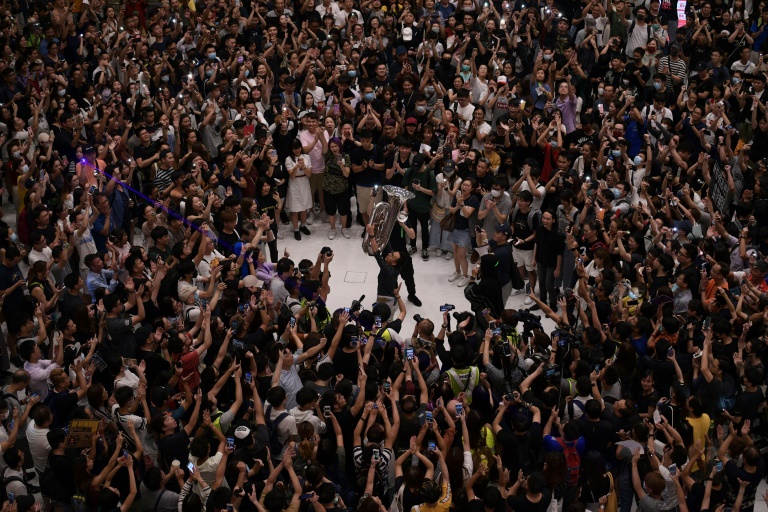
The song was written by an anonymous composer during the huge and sometimes violent protests in 2019 and became an anthem for the city’s now-crushed democracy movement.

The Hong Kong government “strongly deplores and opposes the playing of a song closely associated with violent protests and the ‘independence’ movement” in place of China’s national anthem, it said in a statement.

“The National Anthem is a symbol of our country. The organiser of the tournament has a duty to ensure that the National Anthem receives the respect it warranted,” a government spokesperson said.

In a subsequent statement, Hong Kong’s government said the city’s chief secretary Eric Chan met Seoul’s consul general on Monday “and requested the Korean side to comprehensively look into the incident and responsibilities involved”.

The mix-up has engulfed Hong Kong’s rugby team in a political row.

Video of the incident showed the players kept straight faces and did not react to the wrong song being played.

Junius Ho, a firebrand pro-Beijing Hong Kong lawmaker, attacked the players for that choice.

“They just let the country be humiliated,” Ho wrote on Facebook. “They have completely failed and lost our trust. Now the only solution is to dissolve the Hong Kong rugby team.”

Ronny Tong, who serves in Hong Kong’s cabinet, said the incident “cannot be a careless mistake” and has likely breached the city’s national security law. 

China imposed a sweeping security law on Hong Kong in response to the 2019 protests to stamp out dissent.

Its wording claims universal jurisdiction — Hong Kong and Chinese authorities say they can prosecute people for national security offences committed overseas.

“It is hardly believable that the incident does not involve any assistance provided by people in Hong Kong,” Tong wrote on Facebook.

Hong Kong’s government said the police had launched an investigation.

– ‘Human error’ –

Asia Rugby said the error was a mistake and issued an apology to both the Hong Kong and Chinese governments.

“The incident happened due to a simple human error from a junior member of the local organising committee, playing a song downloaded from the internet instead of the correct anthem,” the tournament organisers said.

After the final — which Hong Kong won — Asia Rugby said apologies were broadcast in the stadium in Korean and English and the Chinese national anthem was then played.

Hong Kong Rugby Union said they had “registered our deepest concern and regret over this incident” with the tournament organisers.

“Whilst we accept this was a case of human error it was nevertheless not acceptable,” HKRU said.

China’s “March of the Volunteers” was born out of the Communist Party’s struggle to liberate the country from Japanese occupation and begins with the rallying cry “Arise! Ye who refuse to be slaves”.

It was played at the 1997 handover of Hong Kong to China as colonial Britain departed.

Before the 2019 democracy protests, Hong Kong football fans often used to boo the national anthem, something that infuriated Beijing.

Hong Kong later passed a law that outlawed insults to the anthem. The first person convicted under that new law was jailed last week. 

“Glory to Hong Kong” is a similarly rousing composition and was secretly recorded by an anonymous orchestra during the protests.

But its lyrics are about a very different struggle — freeing Hong Kong from Beijing’s control and bringing democracy to the city.

Playing the song in Hong Kong is now all but illegal under the national security law.

In September, a harmonica player who played the tune to a crowd commemorating Britain’s late Queen Elizabeth II was arrested.

Can't kill Ukraine, Zelensky hails in surprise Kherson visit

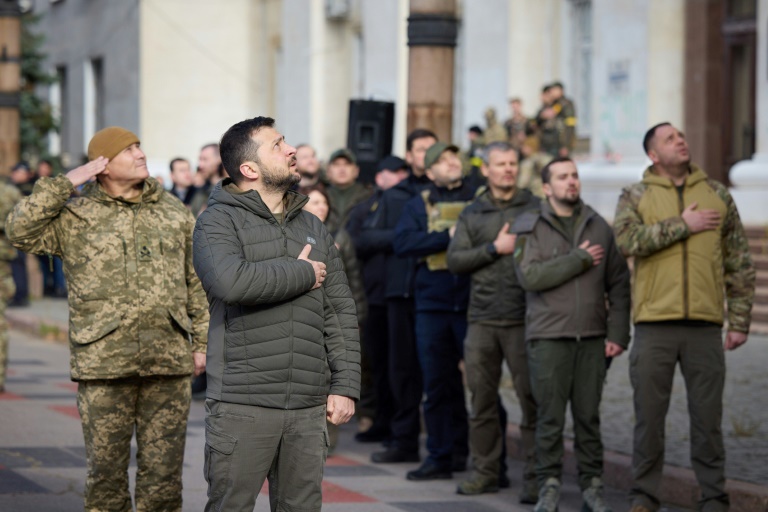
President Volodymyr Zelensky on Monday said it was “impossible to kill Ukraine” as he hailed the liberation of city of Kherson in a surprise visit.

NATO secretary general Jens Stoltenberg meanwhile cautioned that Ukraine was facing difficult months ahead and Russia’s military capability should not be underestimated, despite the takeover of Kherson city.

And US President Joe Biden and his Chinese counterpart Xi Jinping — a key ally of Vladimir Putin — agreed in talks Monday that nuclear weapons should never be used, including in Ukraine.

The Ukrainian presidency distributed images of Zelensky singing the national anthem with his hand over his chest as the country’s blue and yellow flag was hoisted next to Kherson’s main administrative building.

“This is what the Russian Federation did in our country, it showed the whole world that it can kill. But all of us, our armed forces, our National Guard and intelligence (services) have shown that it is impossible to kill Ukraine,” Zelensky said.

Russian President Vladimir Putin’s spokesman denied, however, that the Ukrainian leader’s visit had any impact on the status of the Kherson region, which Moscow formally annexed into Russia at a ceremony last month. 

In Kherson, Zelensky said that “the price of this war is high”.

“People are injured. A large number of dead. (Russian forces) have left or escaped — we believe that they have escaped because our army has surrounded the enemy and they were in danger,” Zelensky said.

“There were fierce battles, and the result is — today we are in Kherson region.”

– ‘Fierce battles’ –

Late Sunday, Zelensky said Ukrainian forces found evidence of hundreds of new “war crimes” carried out by Russian occupiers in Kherson.

His subsequent visit came just days after Ukrainian troops entered the city — the Kherson region’s administrative centre — after Russia pulled back its forces on Friday.

The takeover by Ukrainian troops is the latest in a string of setbacks for the Kremlin, which invaded Ukraine on February 24 hoping for a lightning takeover and to topple the government in days.

But Russian troops failed to capture the capital Kyiv and have since been pushed back from large portions of territory in the south and east.

Still, Stoltenberg said that “the coming months will be difficult” and cautioned that: “we should not make the mistake of underestimating Russia”.

“Putin’s aim is to leave Ukraine cold and dark this winter,” he told a press conference in The Hague after meeting the Dutch foreign and defence ministers.

The city of Kherson was the first major urban hub to fall to Russian forces and the only regional capital Moscow’s troops gained control over.

Its recapture opens a gateway for Ukraine to the entire Kherson region, with access to both the Black Sea in the west and the Sea of Azov in the east.

The region was one of four that the Kremlin announced in September were annexed and part of Russia. Russian President Vladimir Putin vowed to use all available means to defend them from Ukrainian forces, hinting at the use of nuclear weapons.

Biden and Xi agreed in talks at the G20 however that nuclear weapons should never be used, including in Ukraine, the White House said.

“President Biden and President Xi reiterated their agreement that a nuclear war should never be fought and can never be won and underscored their opposition to the use or threat of use of nuclear weapons in Ukraine,” it said in a statement.

Kremlin spokesman Dmitry Peskov said Monday he would not comment on Zelensky’s visit to Kherson but added: “this territory is part of the Russian Federation.”

– ‘Very scared’ –

A self-described partisan in Kherson told AFP after the Russian withdrawal that he and his friends had spent months walking the streets observing the Russians’ every move.

“You watch closely and then come home and write it all down. And then you send the information and hide absolutely everything — phones, papers, clothes, everything,” 19-year-old aspiring musician named Volodymyr Timor said.

“We reported everything — where their equipment and ammunition sites were, where they slept and where they went out drinking,” Timor said.

Ukraine’s forces could then use the coordinates to target strikes during a counteroffensive that has seen Russia cede roughly half the land it seized in the first weeks of war.

“I was scared,” the imposing but soft-spoken guitarist said of the prospect of being caught and possibly killed.

Fuelling concerns that Moscow may have a lingering presence in Kherson, Ukrainian intelligence services said they had detained a Russian military serviceman dressed in civilian clothes.

It said his task was “to gather information, adjust fire on the Ukrainain armed forces and carry out sabotage.”

Elsewhere, Ukraine’s forces had retaken 12 towns and villages in the eastern region of Lugansk, the military and local officials said Monday.

The eastern industrial region has been held by Russian-supported separatists since 2014 but Kyiv’s forces have slowly been clawing back territory there.

But Russia’s military also said its forces were making gains in the neighbouring region of Donetsk, capturing the village of Pavlivka, where fighting had caused controversy in Russia.

Last week, soldiers from the Far Eastern 155th Marine Guards Brigade complained about heavy losses in an address to the governor of the Far Eastern region of Primorye, Oleg Kozhemyako. 

King Charles III, ruler for two months, turns 74

King Charles III turned 74 on Monday, with ceremonial gun salutes booming across the British capital to mark his first birthday as monarch.

The former prince of Wales has thrown himself into his new role following the death of his mother, Queen Elizabeth II, on September 8.

His birthday fell a day after Remembrance Sunday, when he led a sombre tribute to Britain’s war dead at London’s Cenotaph for the first time as monarch.

Liveried troops fired salutes in London parks and from the Tower of London on the banks of the River Thames.

A military band played “Happy Birthday” at the daily Changing of the Guard ceremony outside Buckingham Palace.

Charles has not scheduled any public appearances for his birthday.

But he was pictured in a new photograph wearing a tweed jacket and corduroy trousers posing by an ancient oak tree to mark his appointment as Ranger of Windsor Great Park, west of London.

The post was previously held by his father, Prince Philip, who died in 2021.

In May next year, Charles, who was born on November 14, 1948, will become the oldest British monarch ever crowned. 

He became heir to the throne aged just three and spent most of his life waiting to succeed his mother.

Since doing so in September he has immersed himself in his new role, although has held true to his word that he would not “meddle” in politics as king.

Despite being an outspoken advocate of environmental causes, he has not gone the United Nations COP27 summit on climate change, following government advice.

He has met a string of foreign dignitaries, including ambassadors and heads of state, as well as making public appearances around the country.

Last week, he hosted Nigerian President Muhammadu Buhari and Jordan’s King Abdullah II, met refugees from Ukraine and Afghanistan, and visited Northern Ireland.

– Dodging eggs –

Queen Elizabeth II saw 15 British prime ministers come and go during her record-breaking 70-year reign.

Charles has already had two — Liz Truss, whose short-lived tenure ended in a furore over her tax plans, and Rishi Sunak, who was defeated by Truss during a party leadership contest but ended up replacing her.

When he met Truss, who accompanied Charles on a tour of the nation after his mother’s death, the monarch was picked up saying: “Back again. Dear oh dear.”

Last week, he had to dodge eggs thrown by a student opponent of the monarchy during a walkabout in York, northern England. 

Yet his first months have been relatively well received.

An Ipsos poll in late October found Charles’s approval rating had risen 11 percent since March, to 54 percent, behind his eldest son, William, daughter-in-law Catherine, and his only sister Anne.

Right-wing tabloid The Sun headlined a story for his birthday: “Bonnie King Charles”.

“Two months have gone extremely well,” royal commentator Richard Fitzwilliams told AFP, praising Charles’s energy and “the way he handled events after his mother’s death, which I thought was excellent”. 

At a time of political turmoil, the royals provide a “symbol of national unity, which the politicians frankly have not provided”, Fitzwilliams added.

Obstacles loom ahead though, most notably the contents of the confessional memoir “Spare”, penned by Charles’s estranged younger son Prince Harry, which is set to come out in January 2023.

The royal-themed drama “The Crown” this month released its fifth series, covering the most scandalous years of the breakdown of Charles’s marriage to his first wife, Diana.

The fictionalised Netflix drama rehashes the circumstances behind Diana’s bombshell 1995 BBC interview, in which she lifted the lid on Charles’s adulterous relationship with Camilla Parker Bowles.

In the interview, Diana also admitted to being unfaithful and expressed doubts about Charles’s fitness to be king.

“The Crown” also covers the tabloid newspaper publication of the transcript of an intimate phone call between Charles and Camilla, which also dented his reputation at the time.

Trump poised to launch 2024 comeback bid

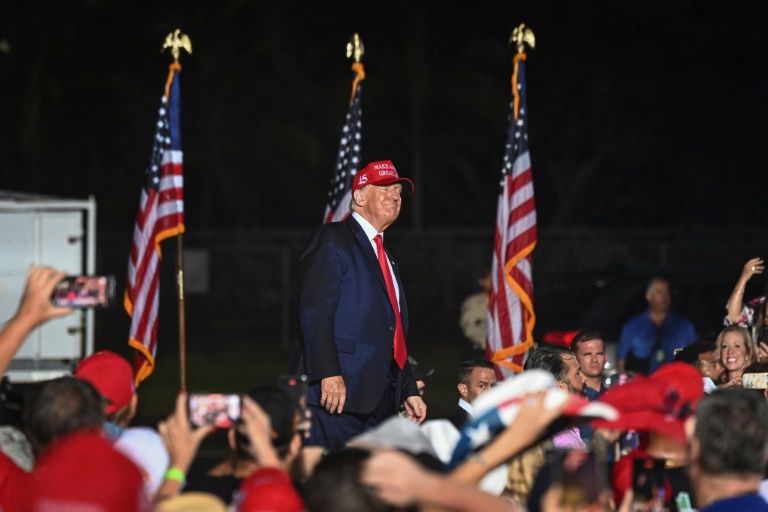
Former US president Donald Trump is expected to officially launch another White House bid on Tuesday, refusing calls from within his own Republican party to fade away after his loyalists underperformed in this year’s midterm elections.

The 76-year-old billionaire, whose 2016 win shocked America and the world, has summoned the press to his Florida mansion for a “very big announcement” at 9:00 pm Tuesday (0200 GMT Wednesday).

“President Trump is going to announce on Tuesday that he’s running for president,” said one of his advisors, Jason Miller, who predicts the speech will be “very professional, very buttoned up.”

Known for his unpredictability, Trump could still change his mind at the last minute, but for months he has barely hidden his desire to vie for the presidency again in 2024.

And delaying the announcement now, as some of his advisors have reportedly suggested to him, would be highly awkward considering Trump’s boast that it would “perhaps be the most important speech given in the history of the USA.”

– ‘Red wave’ crashes –

A 2024 White House bid would be Trump’s third presidential campaign and — if he wins his party’s nomination — the fifth national election with him as the Republican Party standard-bearer.

In 2016, Trump and the Republicans swept into power, taking control of the White House and maintaining their majorities in both chambers of Congress.

But Democrats won back the House of Representatives in a 2018 landslide after campaigning largely against Trump’s caustic style.

Trump then lost reelection in 2020 to Democrat Joe Biden — Trump still refuses to accept defeat — while Democrats won control of the 100-seat Senate with a de-facto majority due to Vice President Kamala Harris’s tie-breaking vote in the chamber split 50-50.

After leaving Washington in chaos shortly after his partisans stormed the US Capitol, Trump chose to remain in the political arena, continuing to fundraise and hold rallies around the country.

Leading up to the 2022 midterm vote, in which Biden’s Democrats had been expected to lose handily, Trump made denial of the 2020 election results a key litmus test for candidates to win his influential political endorsement.

But the predicted Republican “red wave” failed to materialize, and Democrats will maintain their control of the Senate. In the still-undecided House, Republicans seem likely to eke out only a razor-thin majority.

The results have emboldened Trump’s Republican detractors and sapped most of his political momentum heading into the Tuesday campaign launch.

– ‘Three strikes’ –

“It’s basically the third election in a row that Donald Trump has cost us the race, and it’s like, three strikes and you’re out,” said Maryland Governor Larry Hogan, a vocal Trump critic, Sunday on CNN.

Trump’s response has been to double down on unfounded claims of ballot rigging in the midterms, posting on his Truth Social platform that the results were a “scam” — and pointing a finger of blame at Senate Republican leader Mitch McConnell.

“It’s Mitch McConnell’s fault,” he posted, saying the Kentuckian had badly allocated campaign funds and pursued a flawed legislative agenda. 

“He blew the Midterms, and everyone despises him,” said Trump, who has long been at loggerheads with McConnell.

Tuesday’s announcement is widely seen as a way to take the wind out of the sails of potential Republican rivals, namely Ron DeSantis, the freshly-reelected Florida governor and rising star who has also won the backing of Rupert Murdoch’s conservative media empire.

The speech is also set for the day that another possible 2024 rival — former vice president Mike Pence — publishes his memoirs recounting the pressure Trump laid on him to overturn the last election. 

Trump’s new White House pursuit will be hampered by the multiple investigations into his conduct before, during and after the presidency — which could result in his disqualification.

Those include allegations of fraud by his family business, his role in last year’s January 6 attack on the US Capitol and his handling of classified documents at his private Florida home, which was raided by the FBI in August.

But the former president is no stranger to scandal and has even survived two impeachments due to his continued Republican support in Congress.

The 2024 election could yet prove to be a repeat of 2020, with Biden reaffirming on Wednesday that he intends to stand for reelection.

But despite the strong midterm results, some in Biden’s own camp would clearly prefer him to sit out, due to his age and unpopularity. Biden, 80, said he will make a final decision next year.

cjc/des/dw/ec

Close Bitnami banner
Bitnami