World

Jailed Egypt hunger striker says 'doing well' in letter

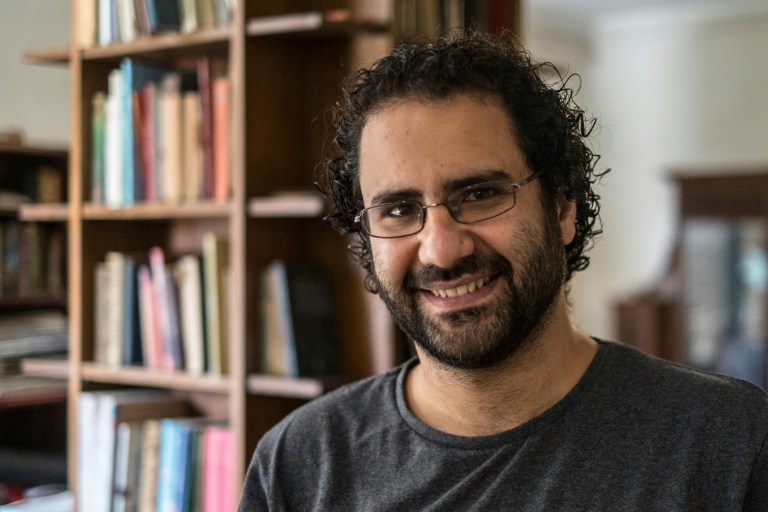
Jailed British-Egyptian activist Alaa Abdel Fattah has written he is “doing well” and is taking liquids after fears rose for his health amid a months-long hunger strike, his family said Monday.

Abdel Fattah, who consumed “only 100 calories a day” for seven months, escalated his strike, first to all food, then water as the COP27 climate summit opened on November 6 in the Egyptian resort town of Sharm el-Sheikh.

His sister Sanaa Seif on Monday welcomed a letter he addressed to his family as “proof of life, at last”.

The activist’s lawyer Khaled Ali, a former presidential candidate, was denied access when he attempted to visit Abdel Fattah at the Wadi al-Natroun prison on Thursday and again on Sunday, despite saying he had been issued with the necessary permits.

He and Abdel Fattah’s mother Laila Soueif were handed the letter on Monday when they returned to the prison a third time, before the lawyer was again denied the right to visit.

In Abdel Fattah’s letter, “dated November 12, he writes he is doing well, under medical supervision, and has begun drinking water,” Ali wrote on Facebook.

The activist’s sister meanwhile confirmed in a statement that “it is his handwriting”, but asked “why did they hold this letter back from us for two days? Is it just cruelty to punish the family for speaking up?”

Echoing demands she made during COP27, Seif said her brother “needs to be on a plane to London and only then will we allow ourselves to feel true relief”.

“Alaa is still on hunger strike, the UK embassy has still failed to achieve consular access, he’s still arbitrarily detained with no end in sight.”

– ‘Watched’ at COP27 –

Abdel Fattah, a key figure in the 2011 uprising that toppled longtime dictator Hosni Mubarak, is serving a five-year prison sentence for “spreading false news” by sharing a Facebook post about police brutality.

He has been leading headlines since the UN climate talks began last week in Egypt, which sought to burnish its image by hosting COP27 but has come under fire over its human rights record.

Attending the summit to campaign for her brother’s release, Seif was last week heckled by pro-government attendees, who called her brother a “criminal”, not a “political prisoner”.

A German diplomatic source said a complaint was lodged with Egypt as their delegation — which hosted Seif and other human rights defenders — “felt we were being watched”.

Since the beginning of the UN climate summit, activists have complained about “being questioned” and feared they would “be followed”, as rights groups warned against draconian surveillance measures.

Liane Schalatek, associate director of the Heinrich Boll Stiftung foundation in Washington, said on German television that she felt “more uncomfortable than at any other COP before”.

A climate finance expert who has attended COP conferences since 2008, she said this time cameras in meeting rooms were directed at the faces of speakers.

“This is both unnecessary and unusual for such internal coordination meetings,” she said. “The possibility that everything is being recorded cannot be ruled out.”

– Presidential pardons –

International pressure has mounted since world leaders began arriving in Sharm el-Sheikh last week. Several raised the case in bilateral meetings with President Abdel Fattah al-Sisi, most recently US President Joe Biden on Friday.

Biden welcomed Sisi’s reactivation of a dormant presidential pardon committee, which has facilitated the release of several high-profile political prisoners this year.

On Friday, Abdel Fattah’s other sister Mona Seif announced the family had submitted a new request for presidential pardon.

The plea was picked up by one of Egypt’s most watched talk show hosts, the ardently pro-Sisi Amr Adib.

On prime time television Friday, Adib said the pardon would be in “the interest of Egypt first and foremost”.
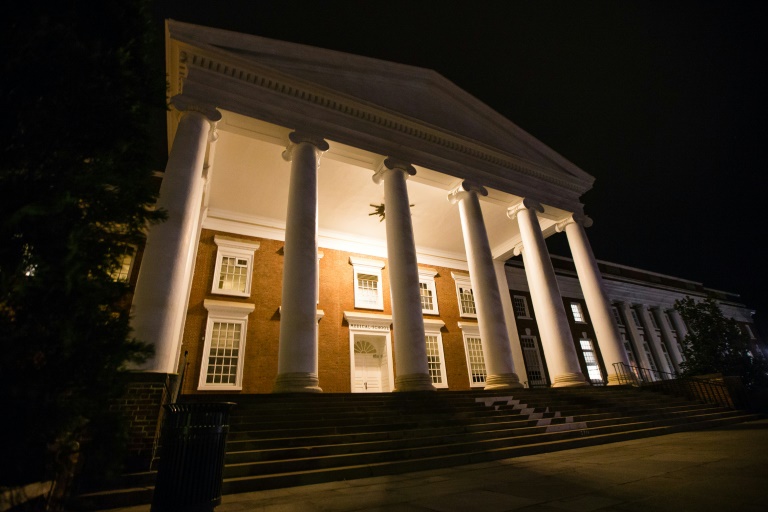
Seven killed as violence strikes two US universities

Seven university students were dead and at least one gunman was on the run Monday following weekend violence that struck two US campuses in the states of Idaho and Virginia, authorities said.

Police were hunting for the student suspect in a shooting that left three people dead and two others wounded at the University of Virginia about 100 miles (160 kilometers) southwest of the nation’s capital Washington.

The campus in Charlottesville, Virginia was locked down early Monday while helicopters and police searched for a man considered to be “armed and dangerous,” the UVA Office of Emergency Management tweeted.

A student at the university identified as Christopher Darnell Jones Jr was suspected to have carried out the shooting on campus Sunday night, UVA president Jim Ryan said in a statement.

“This is a traumatic incident for everyone in our community, and we have cancelled classes for today,” Ryan said.

Counseling and psychological support would be made available to students and faculty, he said.

Virginia Governor Glenn Youngkin said state officers were coordinating with the campus police department and local authorities.

“Please shelter in place while the authorities work to locate the suspect,” he wrote on Twitter.

More than 2,000 miles to the west in the Rocky Mountain state of Idaho, police were investigating a separate incident in which four students were found dead Sunday in a home near the University of Idaho campus, believed to be the “victims of homicide.”

Officers responded to a call in the town of Moscow, near the University of Idaho, about an unconscious individual.

“Upon arrival, officers discovered four individuals who were deceased,” police said in a statement.

“It is with deep sadness that I share with you that the university was notified today of the death of four University of Idaho students living off-campus believed to be victims of homicide,” University of Idaho president Scott Green said in a statement.

Meanwhile near Michigan’s largest city Detroit, police were scouring Oakland University early Monday “to pursue two armed suspects on campus,” the school said in a Twitter statement as they urged students and faculty to stay away.

School shootings are alarmingly common as part of a broader wave of gun violence in the United States, where the proliferation of firearms has skyrocketed in recent years.

In May an 18-year-old gunman in Uvalde, Texas burst into Robb Elementary School and killed 19 students and two teachers, in an attack that shocked the nation and renewed calls for gun reform.

In 2007, Virginia Tech became the scene of the worst school shooting on record in the United States when a 23-year-old student killed 32 students and faculty members before committing suicide.

After Sunday’s UVA shooting, US Senator Tim Kaine of Virginia said he was “heartbroken to hear of another Virginia community devastated by gun violence.”

Stocks mostly rise, dollar up with focus on China, US

Stock markets mostly rose Monday after last week’s global surge, helped by China’s loosening of Covid rules and plans to help its property sector.

The dollar advanced against major rivals as traders urged caution over expectations that the Federal Reserve would pull back from massive US interest hikes as inflation cools in the world’s biggest economy.

Presidents Joe Biden and Xi Jinping meanwhile voiced hope Monday that the United States and China can manage growing differences and avoid conflict as they met for the first time in more than three years.

“The burst of euphoria which erupted… at the end of last week is ebbing away after fresh warnings that the fight against inflation is still a hard slog yet to be won,” noted Susannah Streeter, senior investment and markets analyst at Hargreaves Lansdown.

Sentiment won a lift from China, which is relaxing some of its strict Covid-19 restrictions that have hammered growth in the world’s second largest economy.

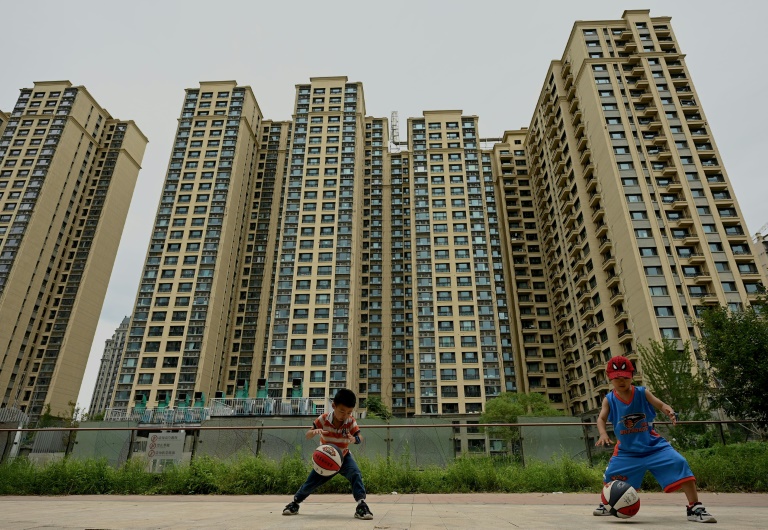
Authorities have also reportedly unveiled a 16-point plan to support the beleaguered property sector, a major component of the country’s economic engine.

The industry has come under immense pressure since China imposed a number of restrictions in 2020 aimed at reeling in debt as major developers teetered on the brink of collapse.

The latest moves indicate that China’s leadership is beginning to focus on supporting the economy, a crucial driver of global growth, according to analysts.

Nomura’s Lu Ting warned, however, that the “measures may have little direct impact on stimulating home purchases”.

Hong Kong’s stock exchange ended more than one percent higher Monday — having soared over seven percent Friday.

Property firms were the best performers with Country Garden leading the way with a massive 40-percent jump.

– Key figures around 1200 GMT –

London – FTSE 100: UP 0.3 percent at 7,336.45 points

Frankfurt – DAX: UP 0.4 percent at 14,279.75

Paris – CAC 40: UP 0.3 percent at 6,612.61

EURO STOXX 50: UP 0.3 percent at 3,880.51

Tokyo – Nikkei 225: DOWN 1.1 percent at 27,963.47 (close)

Hong Kong – Hang Seng Index: UP 1.7 percent at 17,619.71 (close)

Shanghai – Composite: DOWN 0.1 percent at 3,083.40 (close)

New York – Dow: UP 0.1 percent at 33,747.86 (close)

Euro/dollar: DOWN at $1.0280 from $1.0361 on Friday

Pound/dollar: DOWN at $1.1779 from $1.1839 

Dollar/yen: UP at 139.52 yen from 138.70 yen

Euro/pound: DOWN at 87.33 pence from 87.49 pence

West Texas Intermediate: DOWN 1.3 percent at $87.82 per barrel

Brent North Sea crude: DOWN 1.0 percent at $94.99 per barrel

Turkey arrests Syrian woman, accuses PKK over Istanbul attack

Turkey on Monday accused a Syrian woman of planting a bomb that killed six people in Istanbul, blaming the outlawed Kurdistan Workers’ Party (PKK) of carrying out the attack.

Two girls, aged nine and 15, were among those killed when the bomb exploded shortly after 4:00 pm (1300 GMT) on Sunday in Istiklal Avenue, home to smart boutiques and European consulates. More than 80 other people were wounded.

“The person who planted the bomb has been arrested,” Interior Minister Suleyman Soylu said in a statement broadcast by the official Anadolu news agency early Monday. 

“According to our findings, the PKK terrorist organisation is responsible,” Soylu said.

The PKK, blacklisted as a terrorist group by Ankara and its Western allies, has waged a deadly insurgency for Kurdish self-rule in southeastern Turkey since the 1980s.

It denied any role in the latest attack.  

“Our people and the democratic public know closely that we are not related to this incident, that we will not directly target civilians and that we do not accept actions targeting civilians,” the group said in a statement published by the Firat news agency, close to the PKK.

Police, quoted by private NTV television, said the chief suspect is a Syrian woman working for Kurdish militants. Forty-six people were detained in total, police said.

Police footage shared with Turkish media showed a young woman in a purple sweatshirt being apprehended in an Istanbul flat.

Police, cited by NTV, named her as Alham Albashir and said she was arrested at 02:50 am in an Istanbul suburb. Local media said she was a trained PKK intelligence operative. 

– ‘Order from Kobane’ –

There has been no claim of responsibility. 

“We believe that the order for the attack was given from Kobane,” Soylu said, referring to a city in Syria near the Turkish border.

PKK-affiliated Kurdish militants control most of northeastern Syria and in 2015, Kurdish fighters drove Islamic State jihadists out of the city. 

Turkey’s NTV channel also shared surveillance footage of a young woman dressed in trousers and wearing a loose black scarf who ran away into the crowd on Sunday afternoon.

Justice minister Bekir Bozdag told A Haber television that a woman had been sitting on a bench for more than 40 minutes, “then she got up”, leaving a bag. 

“One or two minutes later, an explosion occurred,” he said. 

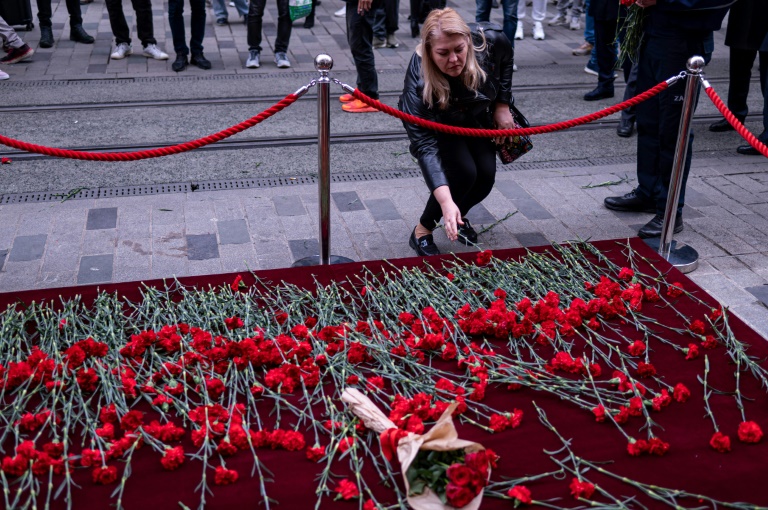
On Monday, all the benches had been removed from Istiklal Avenue, where residents laid red carnations at the scene of the blast, some wiping away tears and others speaking of their fear of further attacks in the run-up to elections next June.

“We need more security!” said Idris Cetinkaya, who works at a nearby hotel and who came to pay his respects. 

– ‘Live with fear’ –

“The police just searched my bag when I got here, but that’s the first time in a year. Millions of people come here, anything could happen at any second!”

Istiklal Avenue was previously targeted during a campaign of nationwide bombings in 2015-16 that were blamed mostly on the Islamic State group and outlawed Kurdish militants, killing nearly 500 people and wounding more than 2,000.

On Sunday, Turkish President Recep Tayyip Erdogan denounced the “vile attack” that had the “smell of terror” shortly leaving for the G20 summit in the Indonesian resort island of Bali.

Kemal Ozturk, a shopkeeper, is among those who fear another explosion ahead of presidential and legislative elections in seven months’ time.

“In election period it can happen,” the 42-year-old told AFP. “We live with fear”.

Regularly targeted by Turkish military operations, the PKK has also been at the heart of a tussle between Sweden and Turkey, which has blocked Stockholm’s bid to join NATO since May, accusing it of leniency towards the group.

– Reject US condolences –

International condemnation flooded in from across the world, including from the United States, but on Monday Turkey said it rejected US condolences over the attack.

Erdogan’s government has often accused Washington of supplying weapons to Kurdish fighters in northern Syria who Ankara labels as terror group linked to the PKK. 

“We do not accept the US embassy’s message of condolences. We reject it,” Soylu said.

“We stand shoulder-to-shoulder with our NATO ally Turkey in countering terrorism,” said White House Press Secretary Karine Jean-Pierre. The US embassy tweeted it was “deeply saddened by the explosion”.

President Vladimir Putin on Monday added his own condolences in a message to Erdogan. 

“We reaffirm our readiness for the closest interaction with our Turkish partners in the fight against all forms and manifestations of terrorism,” he said in the telegram.

Istiklal Avenue reopened Monday to pedestrian traffic.

“My son was there. He called me and said an explosion happened,” said Mecit Bal, who runs a small shop a few metres from the scene. 

He will not go back to work today. He is psychologically affected,” he told AFP.

Sri Lanka govt takes over $1.7 bn in debt owed to China

Crisis-hit Sri Lanka said Monday it would take responsibility for $1.7 billion owed to China by state enterprises as it seeks to sell them off and restructure its foreign debt to secure an IMF bailout.

The government of President Ranil Wickremesinghe is in talks with the Washington-based lender as it seeks funding to enable the island to recover from its worst-ever financial crisis.

His predecessor Gotabaya Rajapaksa was forced to flee the country and resign after demonstrators overran his house following months of protests over the unprecedented economic hardships faced by the 22 million population.

Sri Lanka defaulted on its foreign debt in April and the IMF has said its borrowings must be “sustainable” to unlock any new external funding.

That will require its creditors to take a haircut on their loans, but China is its biggest lender and Beijing has given no indication it is willing to do so.

Wickremesinghe said $1.7 billion in loans taken from China’s Export-Import Bank by three key loss-making state-owned enterprises (SOE) — the electricity utility, Port Authority, and Airport and Aviation Services — would be considered government debt.

Taking the loans off their books will strengthen their balance sheets, which could make them more attractive to buyers or outside investors.

The IMF has said the country should also restructure its loss-making state enterprises.

Wickremesinghe, who is also the finance minister, signalled the selling-off of five state-owned companies, including the national carrier SriLankan Airlines — which has debts of more than $1 billion — to reduce the strain on the national budget.

Proceeds from the “restructure” of the companies will be used to boost the country’s depleted foreign reserves, he said, without giving estimates.

“A glimmer of hope on emerging from the economic abyss is currently visible,” Wickremesinghe told parliament as he presented his first full budget in the legislature.

“After the era of waiting in queues for days and protesting in various occupied places, our sufferings have been eased to some extent and we have reached an era where our peace of mind is much settled.”

He said bailout talks with the International Monetary Fund were on track and hoped for a deal with lenders.

“We are confident that these discussions will lead to positive outcomes,” he added.

The government revised its external debt figure down from $51 billion to $46 billion. 

Just over $14 billion of that is bilateral debt owed to foreign governments, of which China holds 52 percent.

Wickremesinghe, a six-times prime minister, has sharply raised taxes and increased fuel, water and electricity tariffs and rationed petrol and diesel since coming to power in July.

UN climate talks enter home stretch split over money

COP27 entered its final week Monday with rich carbon polluters and developing nations at loggerheads over how to speed up and fund reductions in emissions.

The stand-off comes as advanced economies are pressed into acknowledging the need to compensate their developing peers for accelerating climate damage, and as total funding needs appear poised to run into trillions, rather than billions, of dollars.  

Somewhere in the middle, China — accounting for 30 percent of global greenhouse gas emissions, by far the largest share — is feeling pressure from both sides, not only to enhance its carbon cutting goals but to step up as a donor nation, negotiators and analysts say.

At last year’s UN climate summit in Glasgow, nearly 200 countries vowed to “keep alive” the Paris Agreement’s aspirational goal of capping global warming at 1.5 degrees Celsius above pre-industrial levels.

Nearly 1.2C of warming so far has seen a cascade of increasingly severe climate disasters, such as the flooding that left a third of Pakistan under water this summer, claiming at least 1,700 lives and inflicting $30 to $40 billion in damage.

The Glasgow Pact urged nations to ramp up their emissions reduction commitments ahead of this year’s summit in the Red Sea resort of Sharm el-Sheikh, but with little immediate uptake by nations.

This leaves the world on track to hot up by about 2.5C — enough, scientists say, to trigger dangerous climate tipping points. 

– ‘Make our lives easier’ –

Meanwhile, China and India have called the 1.5C goal into question, with Beijing pointing out that the binding target agreed in Paris was “well below” 2C. The 1.5C is a non-binding ambition, but has since been confirmed by science as a far safer global threshold. 

“Egypt doesn’t intend to be the country that hosts a retreat from what was achieved in Glasgow,” US special climate envoy John Kerry said at the weekend, adding that “most countries here have no intention of going backwards”.

At COP27’s midpoint, countries are at an impasse, awaiting the arrival of ministers to cut through political knots above the pay grade of negotiators. 

“All the big political crunch issues are unresolved,” said Alden Meyer, a senior analyst at climate think tank E3G. 

A reality-check report released at COP27 last week showed CO2 emissions from coal, gas and oil are on track to hit record levels in 2022.

To accelerate decarbonisation, many developing nations — including small island states whose very existence is threatened by rising seas — favour a deepened commitment to the 1.5C target. 

Negotiators in Sharm el-Sheikh will look to a bilateral meeting Monday in Bali between China’s Xi Jinping and US President Joe Biden, along with the communique from a G20 meeting both will subsequently attend, for signals that could break the deadlock in Egypt.

“Confirming the 1.5C goal in Bali would make our lives easier,” a senior negotiator at the climate talks said. 

– ‘Polluters must pay’ –

When it comes to money, the spotlight in Egypt is on so-called loss and damage, UN-speak for the life, property and cultural heritage lost in natural disasters.

Rich nations fearful of creating an open-ended liability regime agreed only this year to include this thorny topic on the formal agenda. 

Developing nations are calling for the creation of a separate facility, but the US and the European Union — while not precluding such an outcome — have said they favour using existing financial channels.

“This is the highest profile, most political issue at the COP,” said Meyer.

On Monday, G7 countries and nearly 60 nations most vulnerable to climate change formally launched a scheme aimed at providing financial support for communities battered by climate disasters, with around $211 million of initial funding.

Kenneth Ofori-Atta, Ghana’s finance minister and chair of the ‘V20’ group of nations most vulnerable to the effects of climate change, said the scheme “is long overdue”.

Another track of the talks, meanwhile, has opened on how much money the Global South will get — after current pledges of $100 billion a year expire in 2024 — to help green their economies and prepare for future warming.

Options range from expanding access to IMF and World Bank funds, to a windfall tax on fossil fuel companies, to broadening the base of donor nations to include China, the United Arab Emirates, Saudi Arabia and other nations. 

“China and India are major polluters, and the polluter must pay,” Gaston Browne, prime minister of Antigua and Barbuda, said last week, speaking for the AOSIS coalition of small island states.

“I don’t think there are free passes for any country.”

Vuitton heir's apartment burgled in Paris

The Paris home of an heir of the Louis Vuitton luxury empire was burgled at the weekend, sources close to the case said Monday, with thieves taking high-end watches, jewelry and bags.

Benoit-Louis Vuitton, a sixth generation descendant of the fashion house’s founder, lives in the swanky seventh district of the capital near the Invalides military museum.

The exact value of the pieces taken was still being evaluated, but they are worth at least several hundreds of thousands of euros (dollars), the sources said.

An investigation is underway, the Paris prosecutors’ office said, with the capital’s anti-gang unit handling the case.

The Actu17 website, which first broke the news, put the value of the bounty at several million euros.

The burglary happened overnight Sunday to Monday, when the apartment was empty, it said, adding that some of the bags taken were “hugely valuable prototypes”.

Louis Vuitton, who founded his namesake luxury house in 1854 by making trunks, died aged 70 in 1892.

In 1987, the company merged with champagne maker Moet et Chandon and cognac brand Hennessy to create LVMH, which is now the world’s biggest luxury company, grouping 75 brands and employing 175,000 people.

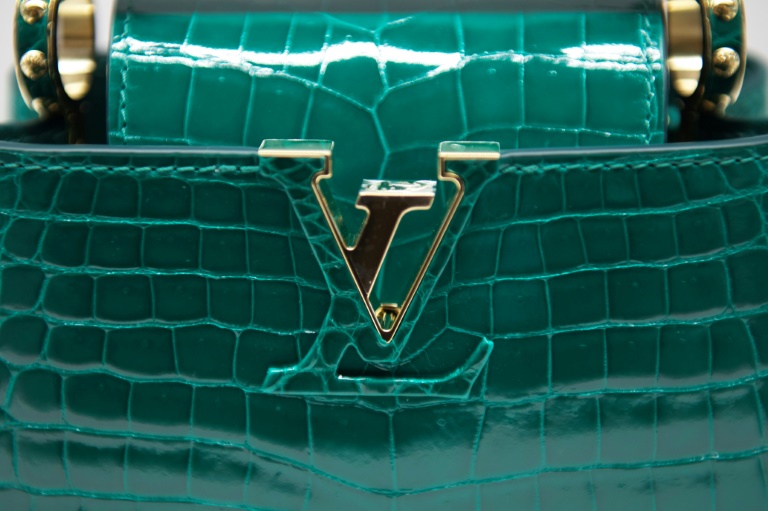
Louis Vuitton bags, with the famous “LV” monogram, are among the world’s most prestigious fashion items and often copied by counterfeiters.

Last week, fake Louis Vuitton bags were among nearly one million euros’ worth of knock-offs police found in a raid on a clandestine outlet near Paris.

In September, a group of armed robbers stole 300 Louis Vuitton bags from a sub-contractor working for the company, with their retail value estimated at several hundreds of thousands of euros. 

Lavrov 'in good health' after hospital checks on G20 summit eve

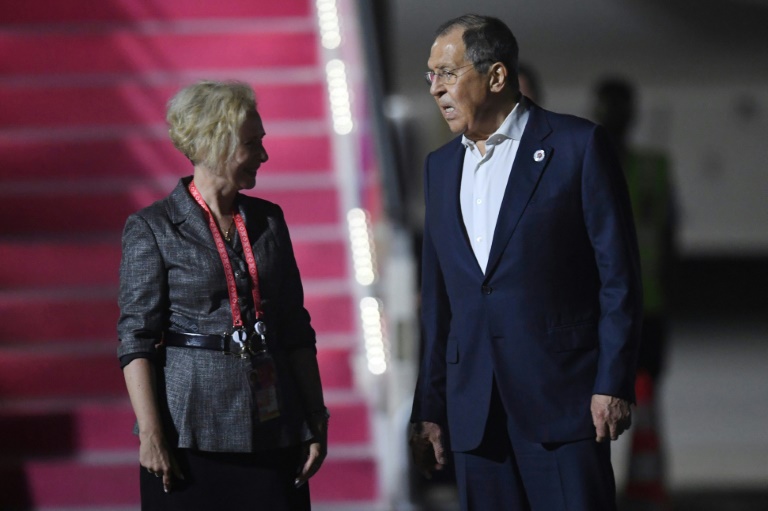
Russian Foreign Minister Sergei Lavrov is in good health after two health checks at a hospital in Bali, an Indonesian health ministry official said Monday, as Moscow denied the top diplomat had been hospitalised.

Russia called reports Lavrov had been hospitalised “the highest level of fake” and Moscow’s foreign ministry spokeswoman posted a video of the 72-year-old diplomat in a T-shirt and shorts.

An Indonesian official told AFP said Lavrov had been taken to hospital two days in a row after arriving on the resort island of Bali on Sunday, where he is replacing President Vladimir Putin as the head of Moscow’s delegation.

“He (Lavrov) is in good health, he came to the hospital yesterday after he arrived in Bali, only to get his health checked,” said health ministry official Sunarto, who like many Indonesians goes by one name.

“Earlier (Monday), he came again to the hospital only for another health check and thank God he is healthy,” he told AFP.

A spokesperson for Sanglah hospital in Bali’s Denpasar city said a delegation had arrived at the hospital under tight security but that they were not authorised to disclose the identity or the condition of the individual involved.

Indonesia’s foreign ministry referred all questions to the Russian embassy in Jakarta, which did not respond to a request for comment.

Russian foreign ministry spokeswoman Maria Zakharova slammed speculation around the health of Moscow’s top diplomat and showed herself laughing with Lavrov in a video.

“We’re here with Sergei Viktorovich (Lavrov) in Indonesia, reading the wires and we can’t believe our eyes,” Zakharova said.

“It’s the highest level of fake.” 

Lavrov claimed the reports were part of “some kind of game” that he blamed on Western media.

“They’ve been writing for about 10 years that our president is sick,” he said.

Lavrov will represent Russia at the two-day summit of the world’s 20 biggest economies, which starts Tuesday, with Moscow’s invasion of Ukraine likely to dominate the agenda.

In July, Lavrov stormed out of a foreign ministers’ meeting after the majority of those in attendance roundly condemned Russia’s assault on its neighbour.

Zelensky visits Ukraine's Kherson after Russian retreat

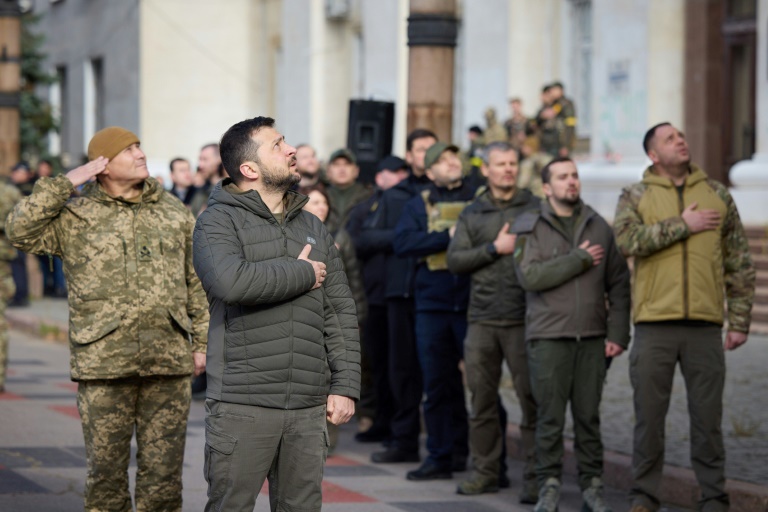
President Volodymyr Zelensky on Monday visited the newly liberated city of Kherson in southern Ukraine after Russian forces retreated from the strategic hub near the Black Sea.

The Ukrainian presidency distributed images of him singing the national anthem, holding his hand over his chest as the country’s blue and yellow flag was hoisted next to the city’s main administrative building.

Russian President Vladimir Putin’s spokesman denied, however, that the Ukrainian leader’s visit had any impact on the status of the Kherson region, which Moscow formally annexed into Russia at a ceremony last month.

“It’s important to be here,” Zelensky told reporters in the city as his office released images of him meeting Kherson residents and military officials.

“We should speak here… support the people so that they feel that we are not just talking, not just making promises but really returning and really raising our flag,” he added.

Late Sunday, Zelensky said Ukrainian forces found evidence of hundreds of new “war crimes” carried out by Russian occupiers in Kherson.

His subsequent visit came just days after Ukrainian troops entered the city — the Kherson region’s administrative centre — after Russia pulled back its forces on Friday.

– Kremlin dismissive –

The takeover by Ukrainian troops is the latest in a string of setbacks for the Kremlin, which invaded Ukraine on February 24 hoping for a lightning takeover and to topple the government in days.

But Russian troops failed to capture the capital Kyiv and have since been pushed back from large portions of territory in the south and east.

Ukrainians in the liberated city expressed relief at the end of months of occupation.

“I am extremely happy we’re finally free,” Andriy, 33, a philosophy student, told AFP.

“We have no electricity in the city, no water, no central heating, no mobile signal, no internet connection — but we have no Russians,” he said.

The city of Kherson was the first major urban hub to fall to Russian forces and the only regional capital Moscow’s troops gained control over.

Its recapture opens a gateway for Ukraine to the entire Kherson region, with access to both the Black Sea in the west and the Sea of Azov in the east.

The region was one of four that the Kremlin announced in September were annexed and part of Russia. Russian President Vladimir Putin vowed to use all available means to defend them from Ukrainian forces. 

Kremlin spokesman Dmitry Peskov said Monday he would not comment on Zelensky’s visit to Kherson but added: “this territory is part of the Russian Federation.”

– ‘Very scared’ –

A self-described partisan in Kherson told AFP after the Russian withdrawal that he and his friends had spent months walking the streets observing the Russians’ every move.

“You watch closely and then come home and write it all down. And then you send the information and hide absolutely everything — phones, papers, clothes, everything,” 19-year-old aspiring musician named Volodymyr Timor said.

“We reported everything — where their equipment and ammunition sites were, where they slept and where they went out drinking,” Timor said.

Ukraine’s forces could then use the coordinates to target strikes during a counteroffensive that has seen Russia cede roughly half the land it seized in the first weeks of war.

“I was scared,” the imposing but soft-spoken guitarist said of the prospect of being caught and possibly killed.

“Believe me, I was very scared.”

Elsewhere, Ukraine’s forces were posting gains in the eastern region of Lugansk, the military and local officials said Monday.

The eastern industrial region has been held by Russian-supported separatists since 2014 but Kyiv’s forces have slowly been clawing back territory there.

“Twelve towns and villages have been liberated by the Armed Forces of Ukraine from the occupiers in the Lugansk region,” the regional governor announced on social media without specifying when the towns had been captured.

Somaliland parties snub president after vote storm

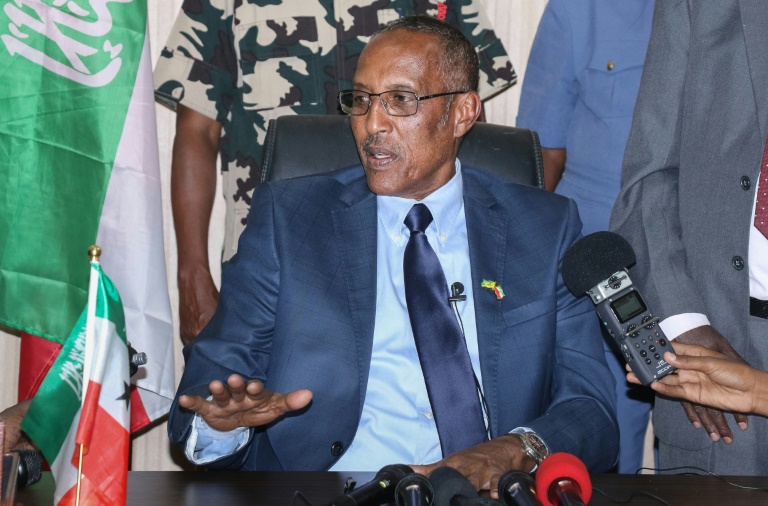
The main opposition parties in the breakaway Somali region of Somaliland say they will no longer recognise the territory’s president after elections were postponed and his term extended.

President Muse Bihi Abdi’s term of office has been extended to 2024 by the Guurti, a non-elected gathering of elders drawn from traditional tribes that is also the upper house of parliament.

Elections should have taken place on Sunday, a month before Bihi was due to leave office, but were postponed by Somaliland’s electoral commission in September.

“The mandate of the current president Bihi has ended today after he had failed to hold an election,” the two biggest opposition parties said in a statement issued late Sunday.

“Starting from today, we don’t recognize the legitimacy of the president and his government,” it said.

The two parties, Waddani and the Justice and Welfare Party (UCID), said they stood by unity and democracy and urged supporters to show “restraint and calm.”

Somaliland is a former British protectorate that declared independence from Somalia in 1991.

The move has not been recognised by the international community, and the Horn of Africa region of some 4.5 million people is poor and isolated.

On September 24, Somaliland’s electoral body said the November 13 presidential ballot could not take place on schedule for “technical and financial reasons”.

It did not indicate a potential new date, saying only that there would be “a nine-month delay from October 1, 2022.”

The Guurti announced on October 1 that Bihi’s tenure would be extended by two years, despite opposition parties warning that they were against the move, and fears of bloodshed have risen.

In August, several people were killed and dozens were wounded after police opened fire on protesters angered at suspicions that the elections would be postponed.

Bihi was elected to a five-year term in November 2017, which itself had been delayed by around two years because of drought and technical problems. 

Despite its problems, Somaliland has remained relatively stable compared with Somalia, which has been wracked by decades of civil war, political violence and an Islamist insurgency.

On Thursday, the International Crisis Group (ICG) think tank urged Somaliland’s international partners to play a more active role to resolve the political crisis.

They should “push its political elites to chart a consensus path forward, offer to mediate if they fail and volunteer to serve as guarantors for whatever resolution emerges,” the ICG said.

Close Bitnami banner
Bitnami