World

Rewire financial system to aid climate-hit nations: UN chief

The world needs to rethink the international financial system to provide debt relief to countries battered by devastating and costly climate impacts like Pakistan, UN chief Antonio Guterres said Monday.

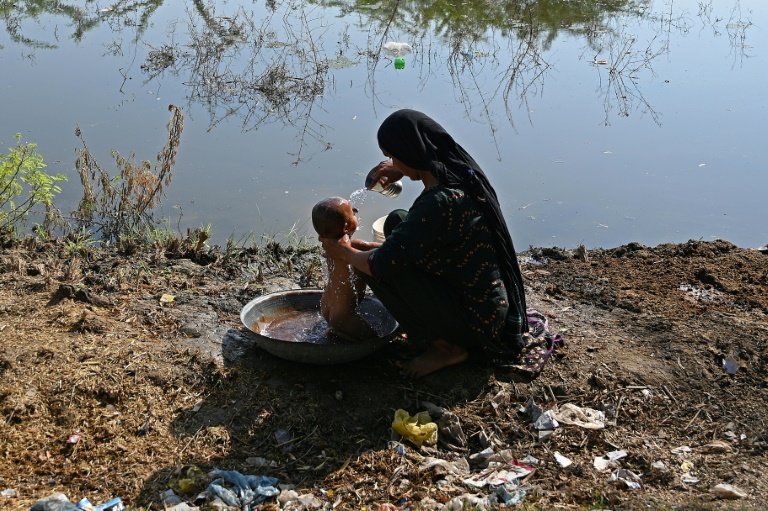
The catastrophic flooding that put a third of Pakistan under water this year displaced millions of people, swamped swathes of key farmland, and destroyed homes, roads and bridges.

The disaster caused more than $30 billion of damages and economic losses, according to World Bank estimates, piling pressure on an already fragile economy.

“Pakistan deserves massive support directly from the international community,” Guterres said, at a packed meeting with Pakistani Prime Minister Shehbaz Sharif at the UN COP27 climate summit in Egypt.

Guterres renewed support for “loss and damage” funds to help vulnerable nations deal with the accelerating impacts of climate change.

But he said the world needs to go further and rewire how countries access finance, particularly from the multilateral development banks.

“It is important to review the way the international financial system works in order for Pakistan to have access to effective debt relief,” he said, as well as to access “concessional funding” needed for the “huge” levels of reconstruction.

– ‘Billions to trillions’ –

Pakistan, already facing a cost-of-living crisis, a nose-diving rupee and dwindling foreign exchange reserves, saw inflation surge after the floods.

Ratings agency Moody’s later downgraded its sovereign credit rating, saying the floods had exacerbated Pakistan’s liquidity and external credit weaknesses.

Guterres said Pakistan was a “victim of being a middle-income country”, which means it has not been able to access sufficient debt relief.

The UN chief called for arrangements in which the country could swap debt payments for investments in rehabilitation and recovery.

Guterres also said G20 rich nations, which hold sway over the boards of the International Monetary Fund and World Bank and are meeting next week in Indonesia, should promote reforms.

His calls echo those of Barbados Prime Minister Mia Mottley, who said Monday that the “world looks still too much like it did when it was part of an imperialistic empire”.

Calling for a “new deal” for the post-World War II Bretton Woods financial system, Mottley said lending should be expanded “from billions to trillions”. 

While wealthy nations can borrow at rates of between one to four percent, nations in the global south are saddled with rates of 14 percent, severely hampering the abilities of emerging economies to meet their climate goals, she noted. 

What she called “fault lines” in the global industrial strategy dominated by wealthy nations, meanwhile, constrain the access of developing nations to renewable energy technology.

“The global south remains at the mercy of the global north on these issues,” she said. 

In recent weeks the IMF has announced financing deals with Barbados and Costa Rica under a new arrangement called the Resilience and Sustainability Trust (RST).   

The Washington-based lender aims to mobilise $45 billion for a new facility funded by member governments, and to provide 20-year loans to about 140 low- and middle-income eligible nations.

klm/mh/lth/pjm

Tough choices as Brazil's Lula gets down to business

Fresh off a celebratory beach holiday, Brazilian president-elect Luiz Inacio Lula da Silva got down to uglier business Monday: figuring out how to govern with a hostile Congress, nasty budget crunch and impossible-looking to-do list.

The political horse-trading of the transition period now starts in earnest for the veteran leftist, who will be inaugurated for a third term on January 1, facing a far tougher outlook than the commodities-fueled boom he presided over in the 2000s.

Lula, 77, celebrated his narrow win over far-right incumbent Jair Bolsonaro in the October 30 runoff election by escaping last week to the sun-drenched coast of Bahia (northeast).

He joked he needed a belated honeymoon with his first-lady-to-be, Rosangela “Janja” da Silva, whom the twice-widowed ex-metalworker married in May.

His other honeymoon — the political one — could be short, analysts say.

Lula is meeting Monday with advisors in Sao Paulo. Tuesday, he will travel to the capital, Brasilia, to start negotiating with members of Congress, allies told AFP.

He faces a battle to get bills passed in a legislature where conservatives scored big gains in October’s elections.

Lula’s coalition has around 123 votes in the 513-seat Chamber of Deputies, and 27 in the 81-seat Senate, meaning he will have to strike alliances to get anything done — and even just survive, given the threat of impeachment in Brazil, where two presidents have been impeached in the past 30 years.

– Into the shark tank –

Lula is expected to meet in Brasilia with lower-house speaker Arthur Lira, a key Bolsonaro ally from the loose coalition of parties known as the “Centrao,” a group known for striking alliances with whoever is in power — in exchange for feeding on the federal pork barrel.

Analysts say Lula will be under pressure from the Centrao not to oppose the so-called “secret budget”: 19.4 billion reais ($3.8 billion) in basically unmonitored federal funding that Bolsonaro agreed to allocate to select lawmakers to boost support for his reelection bid.

Meanwhile, money will be tight for Lula’s campaign promises, including increasing the minimum wage and maintaining a beefed-up 600-reais-per-month welfare program, “Auxilio Brasil.”

Bolsonaro, who introduced the program, did not allocate sufficient funding to continue it in the 2023 budget.

“We can’t start 2023 without the ‘Auxilio’ and a real increase in the minimum wage,” the leader of Lula’s Workers’ Party, Gleisi Hoffmann, said Friday.

“That’s our contract with the Brazilian people.”

Facing the impossible math of funding such pledges without breaking the government spending cap, Lula’s allies are exploring their options, including passing a constitutional amendment allowing exceptional spending next year.

But they are racing the clock: it would have to be approved by December 15.

– Markets watching –

Lula, who ran on vague promises of restoring Latin America’s biggest economy to the golden times of his first presidency (2003-2010), inherits a struggling economy time around.

“The challenge is… how to balance fiscal responsibility with a highly anticipated social agenda,” said political scientist Leandro Consentino of Insper university.

Markets are watching closely — especially his pick for finance minister.

Lula is expected to split Bolsonaro’s economy “super-ministry” into three portfolios: finance, planning, and trade and industry.

“We can expect not-totally-orthodox economic policy, but which maintains a certain level of fiscal discipline,” said Adriano Laureno, of consulting firm Prospectiva.

Laureno predicted a political choice for finance minister, a technocrat for planning and a business executive for trade.

Names floated for the finance job include Lula’s former education minister Fernando Haddad and his campaign coordinator, Aloizio Mercadante.

– COP27 stage –

Other closely watched portfolios are the environment and a promised new Indigenous affairs ministry — both sore spots under Bolsonaro, who presided over a surge of destruction in the Amazon rainforest.

The former job could go to Lula’s one-time environment minister Marina Silva, credited with curbing deforestation in the 2000s.

In a key gesture, the president-elect will make his return to the international stage at the COP27 UN climate summit in Egypt, where he will arrive next week, advisors said.

Silva, who will travel with him, told newspaper Folha de Sao Paulo: “The climate issue is now a strategic priority at the highest level.”

Three migrants jump into sea in Italy port standoff

Three migrants rescued from the Mediterranean and brought to a Sicilian port but then banned from disembarking jumped into the sea in desperation Monday, trapped in a standoff between charity ships and Italy’s new hard-right government.

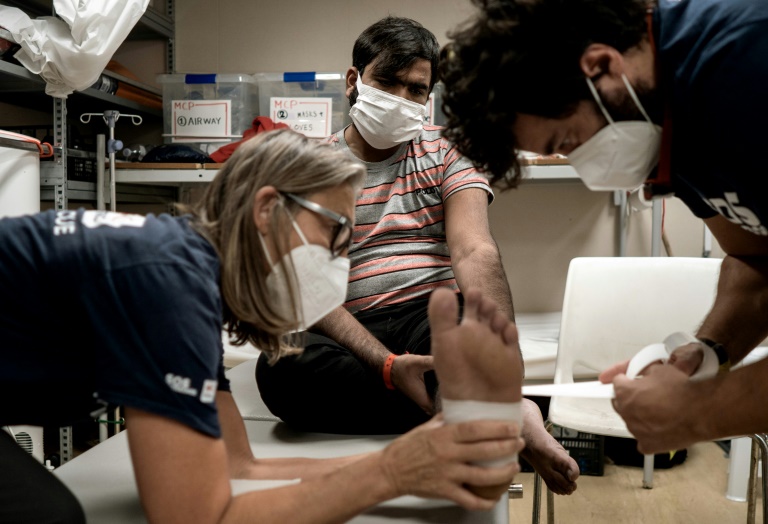
The men were quickly pulled from the water near the Geo Barents ship, according to operator Doctors Without Borders (MSF), as it was docked in Catania with more than 200 people on board.

It is one of a handful of charity vessels that save migrants at risk of drowning during the perilous crossing from North Africa to Europe, and which are now in the crosshairs of new Prime Minister Giorgia Meloni’s government.

Shortly after the men jumped — apparently one had been trying to save the other two — a dozen other migrants standing on the deck of the ship chanted “Help Us”, an AFP journalist witnessed.

After days at sea, Geo Barents docked in Catania this weekend and Italian authorities allowed 357 people to disembark, including children, while refusing entry to 215 others. 

Nearby, German-flagged rescue ship Humanity 1 disembarked 144 people, but still has 35 adult male migrants onboard who were similarly refused permission to go ashore.

A government decree issued Friday said Humanity 1 was only allowed into an Italian port for the time it took to help those in “emergency conditions”.

Italy’s two-week-old government, led by Meloni’s far-right Brothers of Italy party and comprising Matteo Salvini’s anti-immigration League, has vowed to stop the tens of thousands of migrants who arrive on the country’s shores each year.

Most come in overcrowded, leaky boats and many die as they try to reach Europe. But Italy has long complained that the EU does not share the burden of managing the problem.

Salvini, who is currently on trial for blocking migrant boats when he was interior minister in 2019, said Monday the arrivals must be stopped.

“They are organised trips, increasingly dangerous, which finance weapons and drugs. They must be cut off,” the now deputy prime minister tweeted.

Even as tensions rose in Catania, however, more than 500 people were rescued by Italian authorities and disembarked in Sicily, the head of the Syracuse administration told AFP.

– Psychological stress –

One of the 215 left onboard Geo Barents was later evacuated by ambulance after suffering “acute abdominal pain”, MSF said on Monday, bringing the total to 214.

Antonio Nicita, a senator with the centre-left Democratic Party, said he had visited the ship and found “a lot of suffering”.

“Many people undressed in front of us to show their scabies infection,” he told AFP.

“Their situation, their level of psychological stress is very, very high,” added Riccardo Gatti, the chief of search and rescue at MSF.

“The ship has its limitations in terms of medical assistance: a ship is like an ambulance and people are still in the ambulance,” he said.

The charity SOS Humanity, which operates the Humanity 1 ship, said authorities decided after a “brief” medical exam that the 35 men left onboard its vessel were “healthy” and so need not disembark.

But it said no translator attended and there was no psychological evaluation, and has launched legal action against the Italian authorities.

“It is our government’s obligation to provide a safe harbour… But there is a new strategy that has been put forward, the selection of people who have the right to disembark,” said SOS Humanity lawyer Riccardo Campochiaro.

“If a port is secure, then it’s secure for everybody,” he told AFP.

The ship’s captain, Joachim Ebeling, has defied the demand to leave the port, telling reporters on Monday: “I’m not going anywhere with these people onboard.”

– International obligations –

Amnesty International has accused Italy of “violating its international obligations”, saying “the law of the sea is clear; a rescue ends when all those rescued are disembarked in a place of safety”.

In a joint statement on Monday, UN agencies the UNHCR, the UN Refugee Agency and the International Organization for Migration all urged the embarkation of the migrants “without delay”.

Two other migrant rescue ships have also requested a safe port. The Ocean Viking and Rise Above are still off the coast of Sicily although media reports said the latter, carrying around 90 migrants, was assigned an Italian port.

Ukraine hails new air defences, warns power situation 'tense'

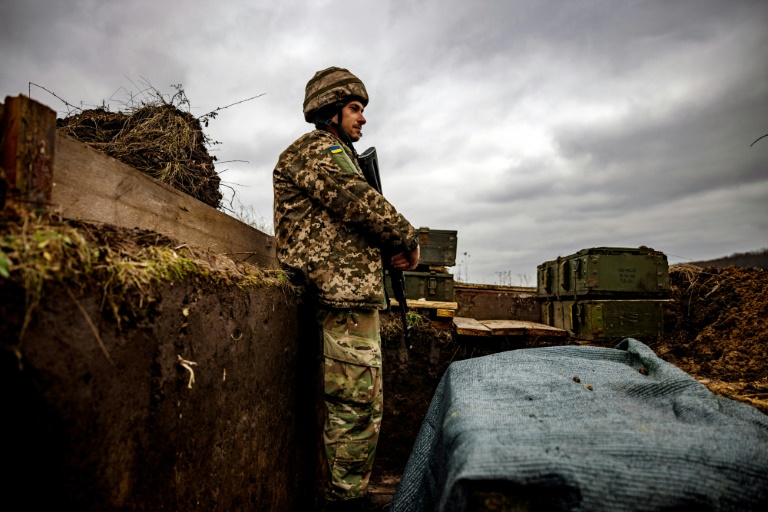
Ukraine announced Monday it had received more air defence systems from Western military allies, as officials in Kyiv said the situation with electricity supplies was “tense” after protracted Russian attacks on energy facilities.

The defence ministry meanwhile said it was requisitioning several energy and manufacturing companies “of strategic importance” to guarantee sufficient supplies for the military to fend off Russia’s invasion.

Attacks by Moscow’s forces, including with Iranian-made drones over the past month, have destroyed around 40 percent of Ukraine’s power stations and the government has urged Ukrainians to maximise electricity savings.

Kyiv has been rocked by barrages of Russian attacks on the first day of each week for nearly a month but air raid sirens were quiet on Monday with residents out as normal.

In a grey and foggy Kyiv — conditions that military observers say make attacks with missiles and low altitude drones more difficult — residents were unfazed by the threat of fresh strikes Monday. 

“To be honest, it’s not only Mondays, it’s been eight months that we know this can happen every day and we adapted. I’m not going to change my routine for that. I’m coming to work… just like every other day,” 21-year-old Kyiv resident Alyona Plekh told AFP.

– ‘Struggle on the energy front’ –

Defence Minister Oleksiy Reznikov announced Monday that Ukraine had received National Advanced Surface-to-Air Missile System (NASAMS) and Italian Aspide air defences, adding to weapons supplied by Germany.

“NASAMS and Aspide air defence systems arrived in Ukraine! These weapons will significantly strengthen the Ukrainian army and will make our skies safer,” Reznikov said on social media.

“We will continue to shoot down the enemy targets attacking us. Thank you to our partners — Norway, Spain and the US,” Reznikov added.

Weeks of Russian attacks have caused sweeping blackouts and restrictions on energy use across Ukraine, and authorities in the capital have asked residents and businesses to reduce consumption.

“The situation in the power system is tense. We ask all residents of the region to support energy workers in the struggle on the energy front. To do this, use electricity sparingly,” city authorities said in a statement.

Those pleas come just one day after Kyiv mayor Vitali Klitschko warned of a possible total blackout in the capital, saying that city authorities were preparing for the worst and bracing for “various scenarios”.

The secretary of Ukraine’s national security and defence council Oleksiy Danilov said the decision to take over several companies was made “in connection with military necessity”.

Danilov said the enterprises include aircraft engine manufacturer Motor Sich working from the partially Russian-controlled region of Zaporizhzhia and the oil and gas company UkrNafta.

The Ukrainian presidency meanwhile said Monday that, over the last 24 hours, Russia had fired four missiles and carried out more than 24 air strikes across Ukraine. 

The Deputy Head of Presidency Kyrylo Tymoshenko said one person was killed by Russian shelling in the Zaporizhzhia region, and another was killed in the northeastern Sumy region.

Those attacks came a day after Russian-installed authorities in the southern region of Ukraine, Kherson, said attacks by Kyiv’s forces had cut power and electricity to the region’s main city, also called Kherson.

– Ukraine advances on ‘fortress’ Kherson –

But authorities said Monday that power had been partially restored again in the city, towards which Ukrainian forces have been slowly advancing for weeks, saying that “all critical infrastructure” in the city was back online.

As Ukraine presses a counteroffensive in the south, Moscow’s occupation forces in Kherson have vowed to turn the city into a “fortress”.

They have for weeks organised a civilian pull-out from the Kherson region deeper into Russian-held territory as Ukrainian troops advance, which Kyiv labels “deportations”.

Lyudmyla and Oleksandr Shevchuk managed to escape to Ukrainian-held territory in the Kherson region.

They said Russian troops in their village of Kachkarivka put “psychological pressure” on residents to move to the Kremlin-annexed peninsula of Crimea.

“They would walk from house to house with their weapons. Then they would throw all the phones in a bucket and walk away,” Lyudmyla said. 

Russia has imposed martial law and curtailed communications across Kherson and three other Ukrainian regions it proclaimed as its own, but does not fully control.

Stocks mostly rise, dollar dips before US midterms

Global stock markets mostly rose Monday, extending last week’s strong gains, while dollar dipped against key rivals ahead of this week’s US midterm elections.

Even China dousing speculation of a relaxation of its strict Covid policies failed to crush positive sentiment in the markets.

Wall Street stocks pushed higher the day before most US voters go to the polls, although early voting was underway in many states.

US voters decide every two years who gets the majority in both chambers of Congress. The outcome will decide whether US President Joe Biden, who was swept to power two years ago in one of the most fraught elections Washington has witnessed, will be able to get any new policies passed or if the opposition will be able to frustrate his agenda.

“A divided government can be good for the market,” noted Neil Wilson, analyst at Markets.com. 

“A Republican clean sweep would likely take key Democrat legislation off the table — mainly positive for markets — whilst in the unlikely event that the Democrats retain both houses it could see them push on with fiscal stimulus, mainly negative since it might be inflationary.”

The positive sentiment carried over from last week.

On Friday, Wall Street equities ended a volatile session higher after US jobs data showed hiring remained resilient and wages continued to rise, though at a slower pace.

That raised hopes of a soft landing for the world’s biggest economy despite aggressive rate hikes by the US Federal Reserve aimed at taming inflation.

“The bullish reversal in the markets suggests investors are perhaps happy to see signs that the US economy is holding its own rather well in terms of employment,” said market analyst Fawad Razaqzada at City Index and FOREX.com.

Craig Erlam at the OANDA online trading platform said the US inflation report on Thursday will be the next major data point that investors will be looking at, but there will also be another one before the next Fed meeting.

“You have to think we need two good readings for the Fed to scale back its expectations and give markets the festive cheer they so clearly want,” said Erlam.

“Until then, more choppy and confused trade may be what we get,” he added.

Investors have been hoping that any signs that the US economy or inflation is slowing would prompt the Fed to scale back its interest rate hikes, but Fed chief Jerome Powell has indicated policymakers won’t let up until inflation comes down, even at the cost of a recession.

Global markets and oil prices were also buoyant last week on hopes Beijing may begin to roll back policies aimed at stamping out coronavirus within its borders.

But on Saturday, the Chinese government said it would “unswervingly” stick to the current plan involving harsh lockdowns and strict quarantine and testing regimens for even the smallest clusters of cases.

Despite the official stance, “there are still hopes in the market” that Beijing may relax Covid-19 curbs in the coming months, Iris Pang, chief economist for Greater China at ING Wholesale Banking, told AFP.

“Traders believe that the Chinese government cannot permanently hold these existing Covid measures, and therefore the only direction is… looser Covid measures,” she said.

Ongoing large-scale events, such as the China International Import Expo in Shanghai, are also seen by investors as “a kind of water-testing” by Beijing, to see if cases and deaths rise significantly, Pang added.

Hong Kong’s Hang Seng index bounded 2.7 percent higher.

– Key figures around 1530 GMT –

New York – Dow: UP 0.7 percent at 32,635.22 points

EURO STOXX 50: UP 0.6 percent at 3,708.80

London – FTSE 100: DOWN 0.5 percent at 7,299.99 (close)

Frankfurt – DAX: UP 0.6 percent at 13,533.52 (close)

Paris – CAC 40: FLAT at 6,416.61 (close)

Tokyo – Nikkei 225: UP 2.7 percent at 27,527.64 (close)

Hong Kong – Hang Seng Index: UP 2.9 percent at 16,595.91 (close)

Shanghai – Composite: UP 0.2 percent at 3,077.82 (close)

Euro/dollar: UP at $0.9999 from $0.9964 Friday

Pound/dollar: UP at $1.1467 from $1.1309

Dollar/yen: DOWN at 146.37 from 147.44 yen

Euro/pound: DOWN at 87.21 pence from 87.80 pence

West Texas Intermediate: UP 1.1 percent at $93.59 per barrel

Brent North Sea crude: UP 0.7 percent at $99.30 per barrel

burs/rl/ach 

Three Egyptian journalists start hunger strike to free dissident

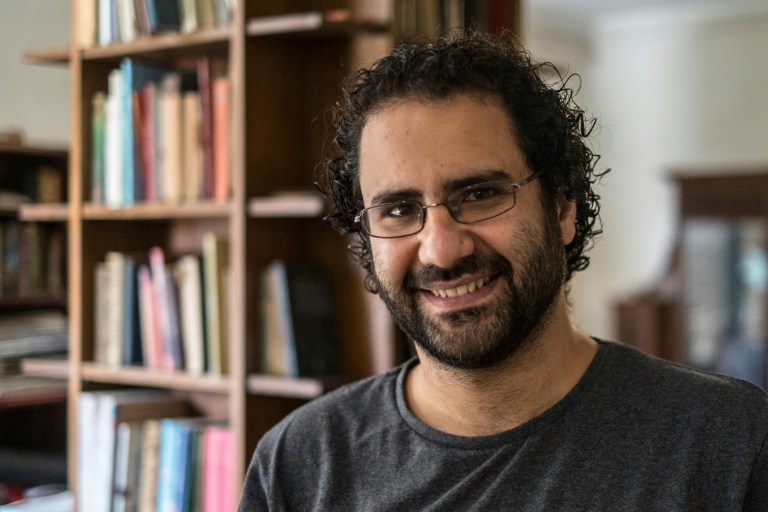
Three Egyptian journalists said Monday they had begun hunger strikes to demand authorities free Alaa Abdel Fattah, a jailed political dissident who has been refusing food and now water too.

British-Egyptian Abdel Fattah, 40, a major figure in the 2011 revolt that toppled longtime president Hosni Mubarak, stopped drinking water on Sunday to coincide with the opening of the COP27 climate summit in Egypt.

“We have stopped eating now because Alaa Abdel Fattah is in danger of dying,” journalist Mona Selim told AFP during a sit-in at the journalists’ union in Cairo.

She was speaking alongside Eman Ouf and Racha Azab, the two colleagues who have gone on hunger strike with her.

Selim said that the three are also demanding the “liberation of all prisoners of conscience” in Egypt. 

They number more than 60,000 in Egypt, according to rights groups — jailed under the rule of President Abdel Fattah al-Sisi, who deposed Islamist president Mohamed Morsi in 2013, before being elected the following year.

After a seven-month hunger strike during which he consumed only “100 calories a day”, Alaa Abdel Fattah has refused food altogether since last Tuesday.

On Sunday he launched a “water strike”, said his sister Sanaa Seif, who on Monday travelled to Sharm el-Sheikh where world leaders arrived for the COP27. 

– ‘Not a lot of time’ –

British Prime Minister Rishi Sunak has said Abdel Fattah’s plight is “a priority”, and in a letter to the activist’s sister strongly suggested that his case will be discussed at the summit.

Speaking to journalists at the climate summit, Sunak said: “I am hoping to see President Sisi later today.  I will, of course, raise this issue.”

“It’s something that not just the United Kingdom but many countries want to see resolved,” he added.

Activists at COP27 have posted prolifically on Twitter under the hashtag #FreeAlaa and several speakers have ended their speeches with the words “you have not yet been defeated” — the title of his book, prefaced by Canadian author Naomi Klein. 

“There is not a lot of time — 72 hours at best,” Amnesty International chief Agnes Callamard said in Cairo on Sunday, referring to Alaa Abdel Fattah’s possible remaining lifespan.

She urged Egypt to release him and said that, “if they don’t, that death will be in every single discussion in this COP”. 

Abdel Fattah has since late last year been serving a five-year sentence for “broadcasting false news”, having already spent much of the past decade behind bars.

In Lebanon’s capital Beirut, around 100 people protested against his detention near the British embassy, an AFP photographer reported. 

Abdel Fattah “embodies the Arab world’s fight against repressive authorities in the past 12-13 years,” said journalist Diana Moukalled.

“We are gathering today to raise our voice and demand the release of Alaa and thousands of other political detainees in Egypt and other Arab countries,” she said.

Abdel Fattah’s continued detention comes despite Egypt having granted presidential pardons to a total of 766 political prisoners since the reactivation of a pardon policy in April this year, according to data compiled by Amnesty. 

But over this period 1,540 political dissidents have also been put behind bars, Amnesty says.

The group Reporters Without Borders, in its 2022 World Press Freedom Index, ranked Egypt 168 out of 180 countries.

Court summons Kenya pilots' union over strike

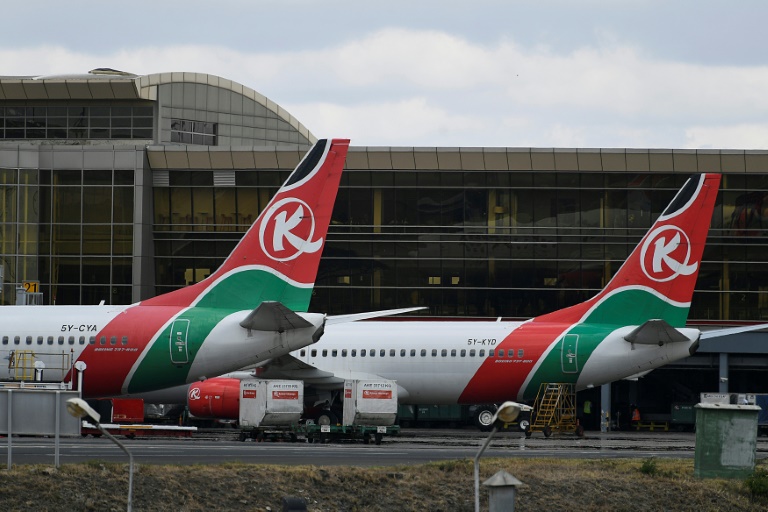
A Nairobi court on Monday summoned officials from the Kenyan pilots’ union behind an ongoing strike that has left thousands of Kenya Airways passengers stranded, as the airline cancelled most of its flights.

The Kenya Airline Pilots Association (KALPA) launched the strike at Nairobi’s Jomo Kenyatta International Airport on Saturday, defying a court order issued last week against the industrial action.

The walkout has exacerbated the woes facing the troubled national carrier, which has been running losses for years, despite the government pumping in millions of dollars to keep it afloat.

“Due to the ongoing unlawful industrial action by Kenya Airline Pilots Association (KALPA), most of our flights have been cancelled,” Kenya Airways said in a statement.

The airline known as KQ also upped the ante in the dispute by announcing it was ending its recognition of the union and withdrawing from their collective bargaining deal because of KALPA’s “wilful and malicious acts”.

“Due to this unlawful action by KALPA, the customers of KQ both locally and globally have suffered and continue to suffer immeasurable inconvenience and losses,” Kenya Airways said in a statement.

This is “exposing the airline to irreparable damage in respect of its financial position and reputation thus resulting in the wider Kenyan economy taking massive hits”, it said. 

“This amounts to economic sabotage.”

The Nairobi Employment and Labour Relations Court issued a summons to union officials to appear in court on Tuesday “for disobeying Court orders”, Justice Anna Ngibuini Mwaure said in the document seen by AFP.

The airline, which is part owned by the government as well as Air France-KLM, is one of the biggest in Africa, connecting multiple countries to Europe and Asia. 

On Sunday, Transport Minister Kipchumba Murkomen urged the pilots to return to work, threatening them with disciplinary action for “defying a court order”.

“Considering the defiance of KALPA and their total disregard for the existing court order –- which is at the heart of the rule of law — the Ministry of Labour now has to activate the procedures governing industrial relations,” the newly-appointed minister said.

KALPA has not responded directly to the government warning but said Monday it had been “working tirelessly to resolve the issues at hand”.

The pilots have accused the airline’s management of making “no concessions” to end the stalemate and have given no indication of how long the strike will last.

– Thousands of passengers disrupted –

On Sunday, the airline said 56 flights had been cancelled due to the strike, disrupting 12,000 passengers’ plans.

The protesting pilots, who make up 10 percent of the workforce, are pressing for the reinstatement of contributions to a provident fund and payment of all salaries stopped during the Covid-19 pandemic.

Last week, the airline won a court injunction stopping the strike, but an official at KALPA, which has 400 members, told AFP at the time that the pilots “were acting within the provisions of the law” and were yet to be served with a court order.

The carrier has warned that the strike would jeopardise its recovery, estimating losses at $2.5 million per day.

The airline was founded in 1977 following the demise of East African Airways, and flies more than four million passengers to 42 destinations annually.

It has been operating in large part thanks to state bailouts following years of losses.

Military leaders of Ethiopia warring parties talk disarmament

Ethiopian government officials met with representatives of the Tigrayan authorities in Kenya on Monday to discuss plans for disarming the rebels following a peace deal signed last week between the warring sides.

The breakthrough accord inked in South Africa, which has been hailed internationally as a key step towards ending the two-year conflict, includes a timetable for disarming the rebels, according to a copy of the document seen by AFP.

In a statement issued Monday, the African Union (AU), which mediated the Pretoria talks, said it had convened a meeting of senior commanders from both sides to “discuss and work out… disarmament issues, taking into account the security situation on the ground”.

Field Marshal Berhanu Jula, chief of staff of the Ethiopian Armed Forces, and General Tadesse Worede, commander-in-chief of the Tigray rebel forces, will lead the talks, negotiators told reporters in Kenya’s capital Nairobi.

The government’s chief negotiator Redwan Hussein, who is also national security adviser to Prime Minister Abiy Ahmed, said: “Political leaders have signed the agreement, but our military leaders will pave the way to expedite the implementation.” 

According to the AU statement, “the meeting should also provide a roadmap for immediate humanitarian access and restoration of services in the Tigray region”.

Ethiopia’s northernmost region has been in the grip of a severe humanitarian crisis for over a year due to lack of food and medicine, as well as limited access to basic services including electricity and banking. 

Getachew Reda, chief negotiator for the Tigray People’s Liberation Front (TPLF), told reporters it was up to the military commanders “to figure out how effectively to carry out the deal and to make sure that we continue to hold our fire and, of course, silence the guns forever”. 

Tigray remains inaccessible to journalists and it is impossible to verify if violence has eased since the agreement was signed.

The war between the TPLF and pro-Abiy forces, which include regional militias and the Eritrean army, has caused an untold number of deaths and sparked reports of horrific abuses by all parties.

Estimates of casualties vary widely, with the United States saying that as many as half a million people have died, while the EU’s foreign envoy Josep Borrell said last week that possibly more than 100,000 people have been killed.

UN investigators have accused Addis Ababa of possible crimes against humanity in Tigray and of using starvation as a weapon of war — claims denied by the Ethiopian authorities.

Abiy — a Nobel Peace Prize laureate — sent troops into Tigray on November 4, 2020 to topple the TPLF, the region’s ruling party, in response to what he said were attacks on federal army camps.

Three Egyptian journalists start hunger strike to free dissident

Three Egyptian journalists said Monday they had begun hunger strikes to demand authorities free Alaa Abdel Fattah, a jailed political dissident who has been refusing food and now water too.

British-Egyptian Abdel Fattah, 40, a major figure in the 2011 revolt that toppled longtime president Hosni Mubarak, stopped drinking water on Sunday to coincide with the opening of the COP27 climate summit in Egypt.

“We have stopped eating now because Alaa Abdel Fattah is in danger of dying,” journalist Mona Selim told AFP during a sit-in at the journalists’ union in Cairo.

She was speaking alongside Eman Ouf and Racha Azab, the two colleagues who have gone on hunger strike with her.

Selim said that the three are also demanding the “liberation of all prisoners of conscience” in Egypt. 

They number more than 60,000 in Egypt, according to rights groups — jailed under the rule of President Abdel Fattah al-Sisi, who deposed Islamist president Mohamed Morsi in 2013, before being elected the following year.

After a seven-month hunger strike during which he consumed only “100 calories a day”, Alaa Abdel Fattah has refused food altogether since last Tuesday.

On Sunday he launched a “water strike” too, said his sister Sanaa Seif, who on Monday travelled to Sharm el-Sheikh where world leaders arrived for the COP27. 

– ‘Not a lot of time’ –

British Prime Minister Rishi Sunak has said Abdel Fattah’s plight is “a priority”, and in a letter to the activist’s sister strongly suggested that his case will be discussed at the summit.

Activists at COP27 have posted prolifically on Twitter under the hashtag #FreeAlaa and several speakers have ended their speeches with the words “you have not yet been defeated” — the title of his book, prefaced by Canadian author Naomi Klein. 

“There is not a lot of time — 72 hours at best,” Amnesty International chief Agnes Callamard said in Cairo on Sunday, referring to Alaa Abdel Fattah’s possible remaining lifespan.

She urged Egypt to release him and said that, “if they don’t, that death will be in every single discussion in this COP”. 

Abdel Fattah has since late last year been serving a five-year sentence for “broadcasting false news”, having already spent much of the past decade behind bars.

In Lebanon’s capital Beirut, around 100 people protested against his detention near the British embassy, an AFP photographer reported. 

Abdel Fattah “embodies the Arab world’s fight against repressive authorities in the past 12-13 years,” said journalist Diana Moukalled.

“We are gathering today to raise our voice and demand the release of Alaa and thousands of other political detainees in Egypt and other Arab countries,” she said.

Abdel Fattah’s continued detention comes despite Egypt having granted presidential pardons to a total of 766 political prisoners since the reactivation of a pardon policy in April this year, according to data compiled by Amnesty. 

But over this period 1,540 political dissidents have also been put behind bars, Amnesty says.

The group Reporters Without Borders, in its 2022 World Press Freedom Index, ranked Egypt 168 out of 180 countries.

Biden, Trump clash on eve of midterms set to upend Washington

Democrats and Republicans traded final blows Monday ahead of midterm elections that could upend Joe Biden’s presidency, weaken Western support for Ukraine and even open the door to a comeback attempt by Donald Trump.

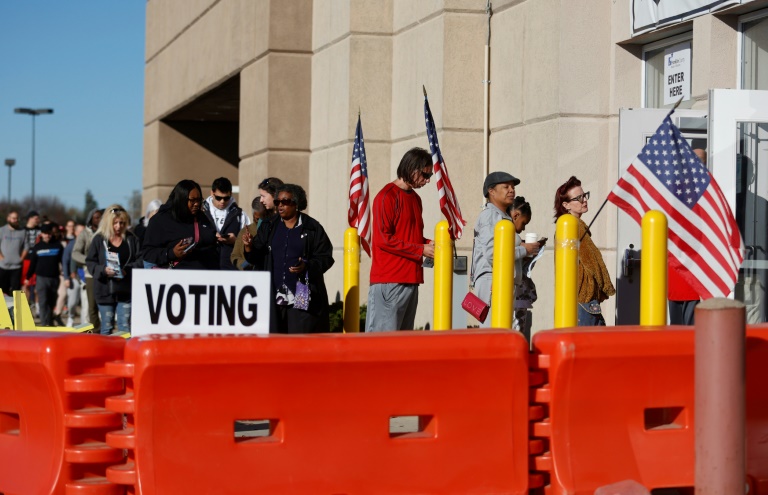
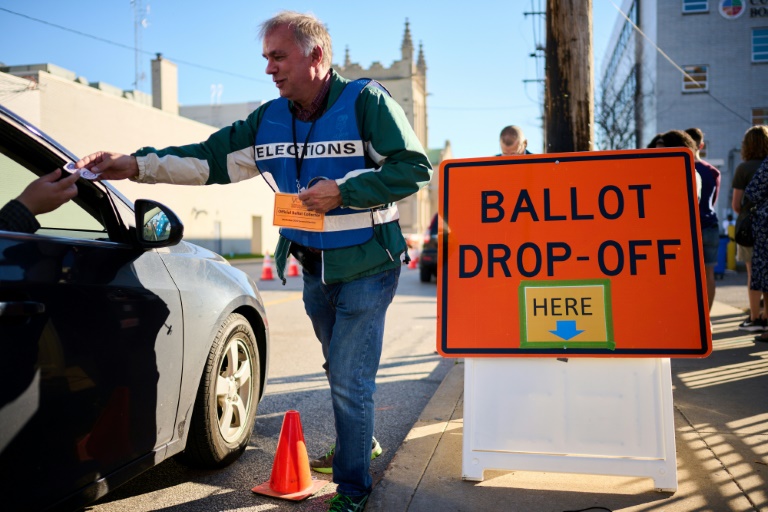
More than 40 million ballots have been cast through early voting options, meaning the fate of the world’s biggest economy was already in play, with hours to go before polls open nationwide Tuesday.

Adding to tensions — and a reminder of the international stakes — Kremlin-connected oligarch Yevgeny Prigozhin boasted that Russia was trying to tilt the outcome.

“We interfered, we are interfering and we will interfere… carefully, precisely, surgically and the way we do it, the way we can,” said Prigozhin, a pivotal figure in the Ukraine invasion where his Wagner military contractor group is on the front lines.

Biden, who has framed his closing argument as a warning that American democracy is on the line, was set to close out days of frantic campaigning for Democratic candidates at a rally Monday evening near Baltimore. 

Trump, who is using the midterms to repeatedly tease a possible 2024 White House run, was holding a rally in Ohio.

With polls showing Republicans in line to seize the House of Representatives, the increasingly far-right party eyed snarling the rest of Biden’s first term in aggressive investigations and opposition to spending plans.

Kevin McCarthy, who would likely become speaker of the House — placing him second in line to the president — also refused to rule out impeachment proceedings.

“We will never use impeachment for political purposes,” McCarthy told CNN. “That doesn’t mean if something rises to the occasion, it would not be used at any other time.”

One key question remained whether the US Senate would also flip, leaving Biden as little more than a lame duck.

With Congress out of Democrats’ hands, Biden would see his legislative agenda collapse. 

That would raise questions over everything from climate crisis policies, which the president will be laying out at the Cop27 conference in Egypt this week, to Ukraine, where Republicans are reluctant to maintain the current rate of US financial and military support.

While insisting he supports Ukraine’s struggle, McCarthy told CNN that there could be no “blank check” — a nod to the isolationist, far-right Trump wing of his party and a signal likely sending shivers through Kyiv.

Just how bad Tuesday goes will also likely determine whether Biden, who turns 80 this month and is the oldest president ever, will seek a second term or step aside, plunging his party into fresh uncertainty.

– ‘Wake-up call’ –

Up for grabs are all 435 House seats, a third of the 100 Senate seats, and a slew of state-level posts.

Popular former president Barack Obama and other Democratic stars have been racing from campaign to campaign in hopes of seeing off the predicted Republican “red wave.”

But the political landscape has been tilting away from Democrats since the summer, as Republican messaging about high inflation, crime and illegal immigration overwhelmed the incumbents.

“This is going to be a wake-up call to President Biden,” was the bullish weekend prediction of Glenn Youngkin, Virginia’s Republican governor and a rising star being touted as a possible party alternative to Trump in 2024.

The Senate is more of a toss-up but Democratic hopes of keeping the upper chamber, which they currently only barely control thanks to the tiebreaking vote from Vice President Kamala Harris, hang in the balance.

Dave Wasserman of the nonpartisan Cook Political Report said Republican candidates have “a little more upside” with late-deciders.

Wasserman told MSNBC there could be a  Republican gain of 15-25 House seats, while “Republicans might gain the one seat they need to win control of the Senate.”

Races in Pennsylvania, Nevada, Arizona, Georgia, Wisconsin, New Hampshire and Ohio have narrowed to projected photo finishes, and any one of them could swing the balance of power.

Democrats have focused their closing arguments on voting rights, protecting abortion access and welfare — and on the threat posed by growing support among Trump Republicans for political conspiracy theories.

The Republicans counter that a vote for Democrats means more soaring inflation and rising violent crime, seeking to make the midterms a referendum on the president. 

With his own approval rating marooned around 42 percent, Biden has largely avoided campaigning in the most contentious states.

Close Bitnami banner
Bitnami