World

Iranians defy crackdown as another teen reported killed

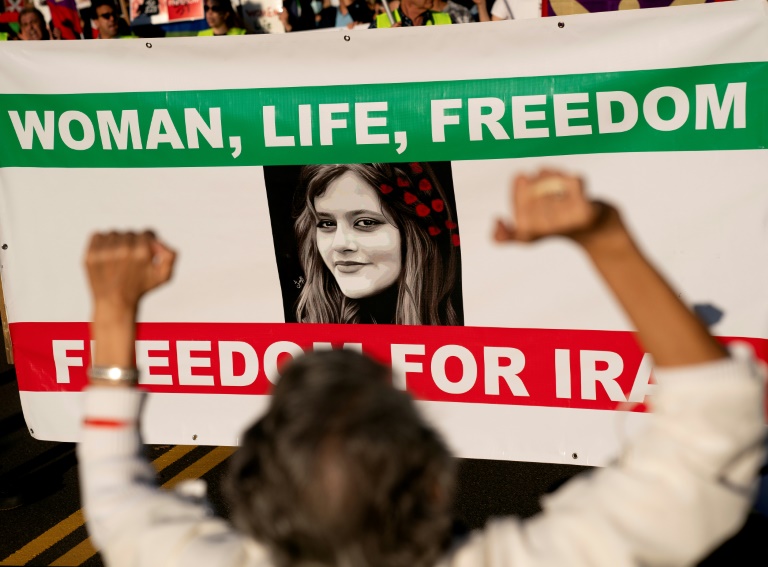
Iranians staged new protest actions Thursday in defiance of a crackdown by the authorities as a rights groups said an 18-year-old became the latest teen killed in clashes in the northwest.

Iran has for over six weeks been gripped by protests sparked by the death of Mahsa Amini who had been arrested by the notorious morality police — a movement that poses the biggest challenge to the Islamic republic since the 1979 revolution.

The clerical leadership under Ayatollah Ali Khamenei, 83, has responded with a crackdown that as well as killing dozens has seen 1,000 people charged so far and according to activists risking the death penalty.

With the movement no signs of abating, the problems for the authorities are compounded by the tradition in Iran of holding a “chehelom” mourning ceremony 40 days after a death, meaning each new killing can fuel new protest actions.

Norway-based group Iran Human Rights said large numbers in the city of Karaj outside Tehran were Thursday attending a 40-day ceremony for Hadis Najafi, a 22-year-old woman activists say was killed by security forces in September.

IHR said police had blocked the highway leading to the cemetery to prevent even larger numbers attending.

“This year is the year of blood, Seyyed Ali (Khamenei) will be toppled,” the video showed them chanting.

– ‘Show trials’ –

The Kurdish rights organisation Hengaw reported a sequence of protests had taken place Wednesday in the Kurdish-populated regions of northwestern Iran where Amini hailed from, including the city of Sanandaj which has become a major protest flashpoint.

It said Momen Zandkarimi, 18-year-old from Sanandaj, was killed by direct fire from Iranian security forces.

Due to the pressure from Iranian security agencies who fear his funeral could turn into a protest, his body has been moved to another village for burial, it added.

According to an updated death toll issued Wednesday by IHR, 176 people have been killed in the crackdown on protests sparked by Amini’s death.

Another 101 people have lost their lives in a distinct protest wave in Zahedan in the southeastern Sistan-Baluchistan province.

Of all those killed, 40 were under 18 years of age, it added.

Thousands have been arrested nationwide, rights activists say, while Iran’s judiciary has said 1,000 people had already been charged over what it describes as “riots”.

The trial of five men charged with offences that can carry the death penalty over the protests opened Saturday in Tehran.

“The charges and sentences have no legal validity and their sole purpose is to commit more violence and create societal fear,” said IHR director Mahmood Amiry-Moghaddam, condemning the “show trials”.

Hadi Ghaemi, head of the New York-based Center for Human Rights in Iran, warned that courts handing down death sentences would be a “blatant attempt to terrorise the Iranian people into silence”.

– ‘Brutal crackdown’ –

Activists condemned as a forced confession a video published by state-run Iranian media of Toomaj Salehi, a prominent rapper arrested at the weekend after backing the protests, in which a blindfolded man saying he is Salehi admits to making “a mistake”.

Freedom of expression group Article 19 said it was “extremely disturbed Iran state media are sharing forced confessions” with the subject “under clear duress”.

He is currently being held incommunicado under the control of intelligence agents in Tehran’s Evin prison, his uncle Iqbal Iqbali told news site Iran Wire.

At least 51 journalists have been detained in the protest crackdown, according to the New York-based Committee to Protect Journalists. Fourteen are confirmed to have been released on bail.

Journalist Yaghma Fashkhami became the latest prominent figure to be arrested, his wife Mona Moafi wrote on Twitter.

There is also growing concern over the wellbeing of Wall Street Journal contributor and freedom of expression campaigner Hassan Ronaghi, who was arrested in September and according to his family is on hunger strike with two broken legs sustained in custody.

On Wednesday, US Vice President Kamala Harris saluted the “bravery” of the women-led protests, as she said Washington would work to remove Iran from the UN Commission on the Status of Women.

“Iran has demonstrated through its denial of women’s rights and brutal crackdown on its own people that it is unfit to serve on this commission,” Harris said.
Tropical Storm Lisa moves towards Mexico after lashing Belize

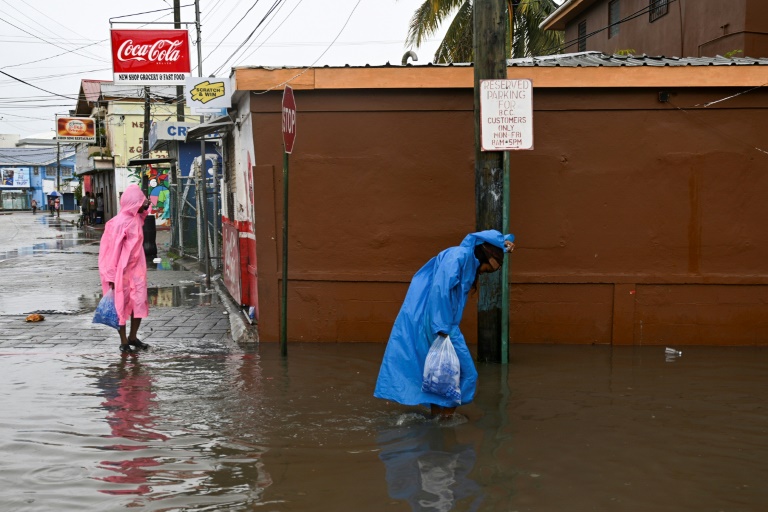
Tropical Storm Lisa slowed on Thursday after making landfall in Belize, causing flooding and plunging parts of the country into darkness as it churned westwards toward Mexico. 

Both Mexico and Belize dropped their coastal tropical storm warnings as the former hurricane weakened and headed west at 10 miles per hour (16 kilometers per hour), according to the US National Hurricane Center (NHC) in Miami.

Forecasters warned that the tourist-popular coast of Central America and the Yucatan Peninsula should continue monitoring the situation as the maximum sustained winds decreased to around 45 mph (75 kph). 

For the next day or so, the storm system is expected to pack a gusty punch and deliver heavy rain, swells and flash flooding to northern Guatemala and southeastern Mexico, further weakening as it moves inland.

Lisa slammed into the Sibun River just southwest of economic hub and former capital Belize City around 2120 GMT on Wednesday, uprooting trees, downing power lines and inundating streets.

“It’s very dangerous for us” because in Belize “it floods quickly, even with moderate rain,” Jasmin Ayuso, a 21-year-old secretary, told AFP.

A state of emergency was declared in two areas, while a curfew was in effect until dawn on Thursday.

Some parts of Belize were left without power as the storm lashed the country of about 405,000 people.

“BEL is aware of power outages affecting several areas of the country,” the utility wrote on Facebook. “We assure the public that our teams are taking note of the reports of damages to the power system, including fallen power lines and poles.”

Schools and most businesses were closed in anticipation of the storm and the government set up several shelters. 

In Belize City and neighboring areas, local media showed weather-battered buildings, flooded streets and yanked out trees after Lisa landed. 

The storm is forecast to be further downgraded to a tropical depression by the end of the day before dissipating over Mexico.

– Evacuations in Guatemala –

The NHC said Lisa could drop up to 10 inches (250 millimetres) of rain in some areas of Belize, northern Guatemala and several states in southern Mexico.

The Yucatan Peninsula, Honduras’ Bay Islands and other areas of Central America were forecast to receive up to six inches of rain. 

In Guatemala, heavy rain caused flooding and landslides in the northernmost department Peten on the border with Belize.

About 143 people were evacuated and 48 remain in a shelter, Oscar Cossio, secretary of the National Coordination for Disaster Reduction (CONRED), told a press conference. 

Schools in the north canceled classes.

Lisa arrives not even three weeks after the passage of Julia, another Category 1 hurricane, which caused dozens of deaths in Honduras, Guatemala and El Salvador.

Lisa is the 12th named storm this season, a designation given to systems that produce winds of 39 mph (63 kph) or greater, according to the NHC.

Last year’s active Atlantic hurricane season, which officially runs from June through November, saw 21 named storms.

Norway brings climate ambitions in line with EU

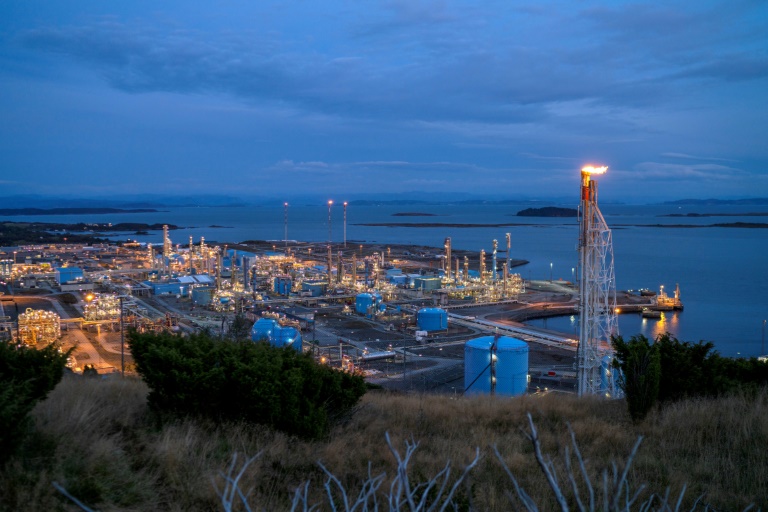
Norway, the largest oil producer in Western Europe, on Thursday announced it intended to cut 1990 emissions levels “at least 55 percent” by 2030, in line with EU goals.

Just days before the COP27 climate conference in Egypt, the announcement is in line with commitments made by the centre-left coalition government when it took power in 2021.

While not a member of the European Union, the Scandinavian country’s new target brings Oslo in line with the overall target set by the 27-member bloc. Oslo also announced that it would present climate plans each year going forward.

Norway’s climate target was previously to reduce emissions by between 50 and 55 percent of 1990 levels.

“This sends a strong signal to other countries, and we hope that more will up their targets,” Prime Minister Jonas Gahr Store said on Thursday.

Store’s Labour Party and its ally, the Centre Party, rule out dismantling the oil sector, which is a major part of the national economy.

The war in Ukraine and the reduction in Russian exports have seen Norway become the leading gas supplier to Britain and the European Union.

“The demand for fossil fuel energy will fall and renewable energy production must increase. This has to go hand in hand,” Store told a news conference.

He stressed that the planet would still need oil in years to come and argued it was “not a bad thing that some of it comes from the Norwegian continental shelf, which has the lowest emissions.” 

Last week, the United Nations said current country climate pledges leave the world on track to heat by as much as 2.6 degrees Celsius this century, warning that emissions must fall 45 percent this decade to limit disastrous global warming.

A day earlier, the UN’s climate change agency had said governments were doing “nowhere near” enough to keep global heating to 1.5C and would steer a world already wracked by increasing floods, heatwaves and storms towards “catastrophic” warming.

iPhone factory lockdown shows risks of China dependence, analysts say

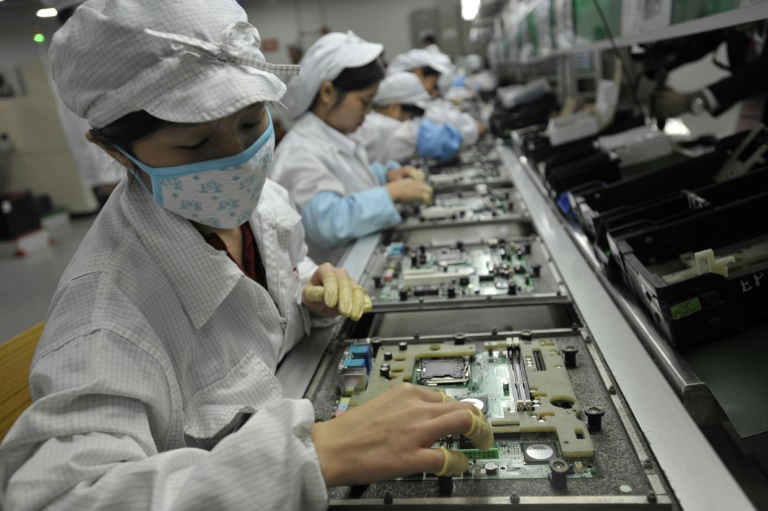
The lockdown of Foxconn’s Zhengzhou factory, the world’s biggest producer of iPhones, has highlighted some of the risks of relying on zero-Covid China’s manufacturing sector, analysts told AFP.

Foxconn, Apple’s principal subcontractor, has seen a surge in Covid-19 cases at its Zhengzhou site, leading the company to lock down the vast complex in a bid to keep the virus in check.

Images then emerged of panicking workers fleeing the site on foot in the wake of allegations of poor conditions at the facility, which employs hundreds of thousands of workers.

Foxconn is China’s biggest private sector employer, with over a million people working across the country in its around thirty factories and research institutes.

But Zhengzhou is the Taiwanese giant’s crown jewel, churning out iPhones in quantities not seen anywhere else.

“In a normal situation, almost all the iPhone production is happening in Zhengzhou,” said Ivan Lam, an analyst with specialist firm Counterpoint.

– Risk of ‘strong dependence’ –

Apple manufactures more than 90 percent of its products in China, which is also one of its most important markets.

“For Apple, it is once again a bad example in terms of the stability of production chains,” Alicia Garcia Herrero, Asia-Pacific manager for Natixis bank, told AFP.

Experts say the company’s heavy dependence on China “brings potential risks, especially when the US-China trade war shows no signs of de-escalating,” according to Dezan Shira & Associates, a consulting firm.

Opened in 2010, the Zhengzhou factory employs up to 300,000 people who live on-site all year round  — creating a sprawling tech hub known as “iPhone city”.

It is made up of three factories, one of which produces the iPhone 14 — Apple’s newest handset model.

Apple did not respond to AFP’s request for comment on how exactly the lockdown will affect its production.

Analyst Lam estimates the partial stopping of work at the site resulted in a loss of “10 to 30 percent” of output, but said part of the production has also been temporarily moved to other Foxconn sites in China.

According to Foxconn, the site is currently operating a “closed loop” with the workers avoiding all contact with the outside world, while their daily bonuses have been quadrupled.

“This incident may have a limited impact,” on worldwide iPhone production, estimated analyst Ming-Chi Kuo, who specialises in Apple products.

“But suppliers in China must learn to improve closed-loop production efficiency in response to the zero-Covid policy,” he added.

– Looking elsewhere –

China is the last major economy committed to a zero-Covid strategy, persisting with snap lockdowns, mass testing and lengthy quarantines in a bid to stamp out emerging outbreaks.

But new variants have tested local officials’ ability to snuff out flare-ups faster than they can spread, causing much of the country to live under an ever-changing mosaic of Covid curbs.

Apple has already begun outsourcing part of its production to India and is eyeing Vietnam in a bid to wean itself off Chinese manufacturing — a trend accelerated by Covid.

But that’s not so simple — last year, nearly 7.5 million iPhones were made in India, just three percent of Apple’s total production.

“Increasing the capacity of factories (in India) is difficult,” Lam said.

iPhone factory lockdown shows risks of China dependence, analysts say

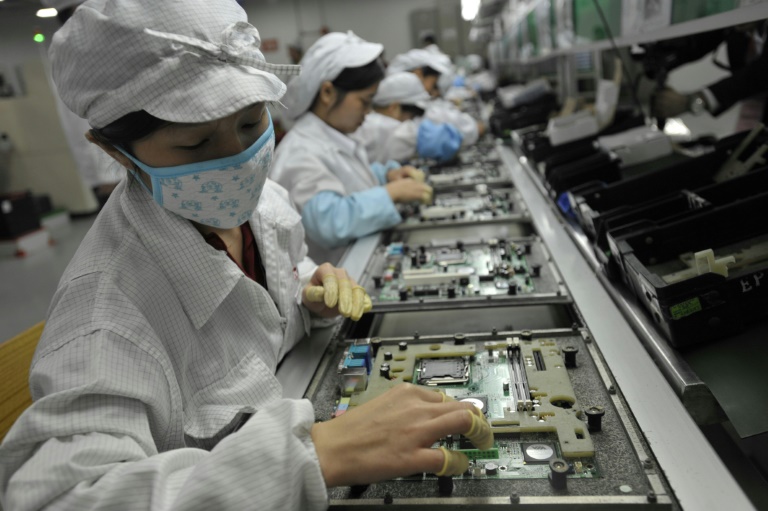
The lockdown of Foxconn’s Zhengzhou factory, the world’s biggest producer of iPhones, has highlighted some of the risks of relying on zero-Covid China’s manufacturing sector, analysts told AFP.

Foxconn, Apple’s principal subcontractor, has seen a surge in Covid-19 cases at its Zhengzhou site, leading the company to lock down the vast complex in a bid to keep the virus in check.

Images then emerged of panicking workers fleeing the site on foot in the wake of allegations of poor conditions at the facility, which employs hundreds of thousands of workers.

Foxconn is China’s biggest private sector employer, with over a million people working across the country in its around thirty factories and research institutes.

But Zhengzhou is the Taiwanese giant’s crown jewel, churning out iPhones in quantities not seen anywhere else.

“In a normal situation, almost all the iPhone production is happening in Zhengzhou,” said Ivan Lam, an analyst with specialist firm Counterpoint.

– Risk of ‘strong dependence’ –

Apple manufactures more than 90 percent of its products in China, which is also one of its most important markets.

“For Apple, it is once again a bad example in terms of the stability of production chains,” Alicia Garcia Herrero, Asia-Pacific manager for Natixis bank, told AFP.

Experts say the company’s heavy dependence on China “brings potential risks, especially when the US-China trade war shows no signs of de-escalating,” according to Dezan Shira & Associates, a consulting firm.

Opened in 2010, the Zhengzhou factory employs up to 300,000 people who live on-site all year round  — creating a sprawling tech hub known as “iPhone city”.

It is made up of three factories, one of which produces the iPhone 14 — Apple’s newest handset model.

Apple did not respond to AFP’s request for comment on how exactly the lockdown will affect its production.

Analyst Lam estimates the partial stopping of work at the site resulted in a loss of “10 to 30 percent” of output, but said part of the production has also been temporarily moved to other Foxconn sites in China.

According to Foxconn, the site is currently operating a “closed loop” with the workers avoiding all contact with the outside world, while their daily bonuses have been quadrupled.

“This incident may have a limited impact,” on worldwide iPhone production, estimated analyst Ming-Chi Kuo, who specialises in Apple products.

“But suppliers in China must learn to improve closed-loop production efficiency in response to the zero-Covid policy,” he added.

– Looking elsewhere –

China is the last major economy committed to a zero-Covid strategy, persisting with snap lockdowns, mass testing and lengthy quarantines in a bid to stamp out emerging outbreaks.

But new variants have tested local officials’ ability to snuff out flare-ups faster than they can spread, causing much of the country to live under an ever-changing mosaic of Covid curbs.

Apple has already begun outsourcing part of its production to India and is eyeing Vietnam in a bid to wean itself off Chinese manufacturing — a trend accelerated by Covid.

But that’s not so simple — last year, nearly 7.5 million iPhones were made in India, just three percent of Apple’s total production.

“Increasing the capacity of factories (in India) is difficult,” Lam said.

Ethiopia fractured and fragile after two years of war

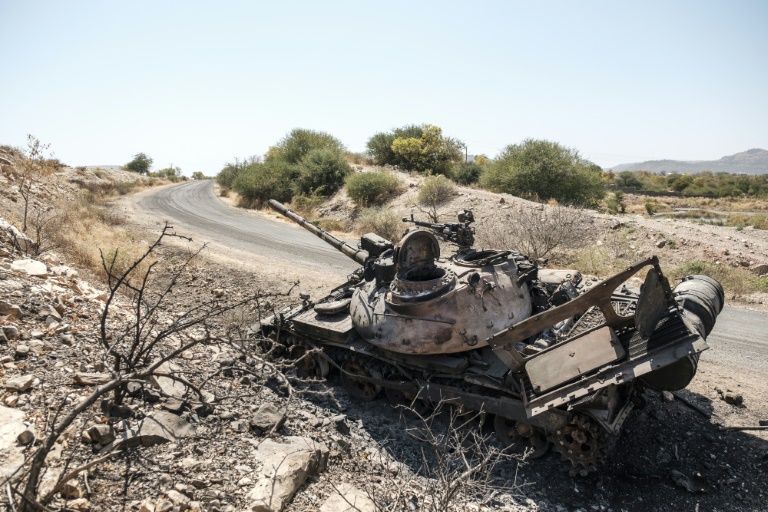
Two years after war broke out in northern Ethiopia between federal forces and Tigrayan rebels, the country remains in deep crisis, with its once-vibrant economy in ruins and a humanitarian disaster roiling Tigray.

A breakthrough agreement announced Wednesday between the federal government and Tigrayan regional authorities to cease hostilities has been hailed as “a welcome first step” by UN chief Antonio Guterres but crucial details remain unclear, with no mention of Eritrea, a key player in the conflict.

– ‘Half a million dead’ –

The war’s toll is unknown, but the US envoy to the UN, Linda Thomas-Greenfield, recently said that the devastation and deaths “rival what we’re seeing in Ukraine”.

“Over two years of conflict, as many as half a million… people have died, and the United States is deeply concerned about the potential for further mass atrocities.” 

The war erupted on November 4, 2020, following tensions between the federal government and the Tigray People’s Liberation Front (TPLF), which dominated Ethiopian politics for nearly three decades until the election of Prime Minister Abiy Ahmed in 2018.

The violence has drawn in regional militias from Amhara and Afar in northern Ethiopia as well as forces from Eritrea, whose leader Isaias Afwerki has a longstanding enmity with the TPLF.

Tigray has faced severe shortages of food and medicines and limited access to electricity, banking and communications, with UN warnings that hundreds of thousands of people were on the brink of famine.

UN investigators have accused Abiy’s government of crimes against humanity in Tigray, including the use of starvation as a weapon — claims rejected by the authorities.

The region of six million people has been largely closed off to the outside world for well over a year, making it very difficult to assess conditions on the ground.

“We will never know the real toll,” said Patrick Ferras, a geopolitical researcher and president of Strategies Africaines, who told AFP that at least 300,000 people had likely lost their lives in the conflict.

A military source who spoke to AFP on condition of anonymity said it was impossible to count the fighters involved but analysts believe the number extends into several hundred thousand. 

– A fractured country –

The war has exposed underlying fissures within Africa’s second most populous nation, with both sides accused of abuses against civilians based on their ethnicity.

A mosaic of more than 80 ethno-linguistic communities, Ethiopia has long struggled to manage the diversity within its borders, with its most populated region Oromia witnessing constant clashes even as the war in Tigray dominates headlines.

Abiy, who was awarded the Nobel Peace Prize for engineering a rapprochement with Eritrea, now presides over a country fractured along ethnic lines.

The non-profit ACLED, which focuses on conflict, has pointed to “rising levels of violence in many areas throughout Ethiopia”, singling out the regions of Oromia, Gambella and Benishangul-Gumuz.

With federal forces focused on northern Ethiopia, the risk of violence elsewhere flaring into prolonged instability poses yet another threat to the country of 120 million people.

– An economy in ruins –

When Abiy took the reins in 2018, Ethiopia’s economy was growing at breakneck speed, expanding annually by nearly 10 percent from 2010 onwards.

Since then, the economy has encountered several roadblocks, including the war and the Covid pandemic, to name two.

This year GDP is projected to grow less than four percent, according to the International Monetary Fund.

“The economic situation is disastrous,” said Ferras. 

Annual inflation, which already averaged 13.5 percent between 2010 and 2018, exploded to around 33 percent this year, driven by rising food prices. 

“This is largely due to the setbacks of Ethiopian agriculture,” a diplomat told AFP on condition of anonymity, referring to a locust invasion, flooding and drought.

The situation will likely worsen as the war in Ukraine drags on, with the Ethiopian currency’s value plummeting against the US dollar and the import-dependent nation’s foreign exchange reserves drying up.

The IMF estimates that Ethiopia only has enough reserves to pay for about three weeks of imports as it struggles with a shortfall in development aid given by foreign nations.

“Since the beginning of the conflict, Ethiopia has lost half of its official development assistance,” the diplomat said. 

– Faint hopes for peace –

Even as peace talks opened in South Africa last week, observers were pessimistic, with fighting showing no signs of letting up after a resumption of combat in August shattered a five-month truce.

In recent weeks, federal forces — backed by Eritrean soldiers — captured a string of towns in Tigray, piling pressure on the TPLF.

Wednesday’s surprise announcement of a deal to end hostilities was greeted with cautious hope, with the United States calling it an “important step towards peace”.

But there are “too many unknowns” surrounding the agreement, said Benjamin Petrini, a research fellow at the International Institute for Strategic Studies in Washington.

It is unclear how the implementation of the deal will be monitored and crucially, no mention has been made of a withdrawal by Eritrean troops, who have been accused of gruesome abuses against Tigrayan civilians.

“If someone wants to be sceptical you would say that solving it all in eight days of negotiations is not a serious effort,” Petrini told AFP. 

“You may have only scratched the surface.”

Turkish inflation tops 85%, highest since 1997

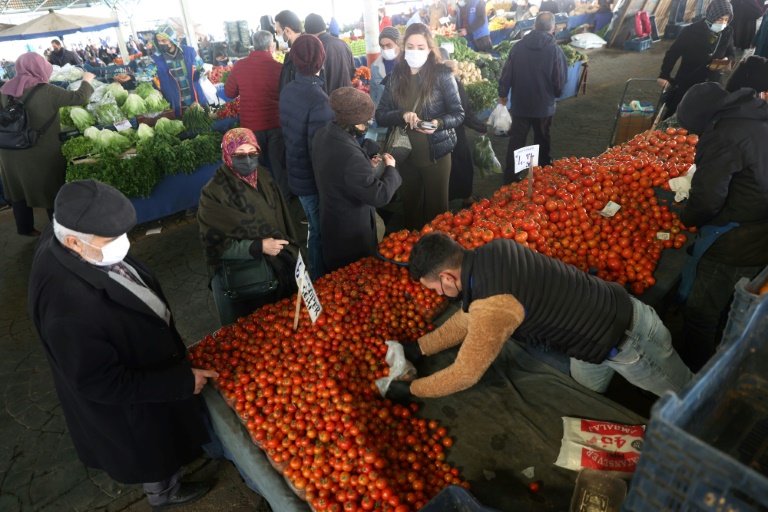
Turkish inflation surged past 85 percent in October, its highest level since 1997, official data showed Thursday, as President Recep Tayyip Erdogan sticks to unorthodox policies to combat a cost-of-living crisis.

Central banks worldwide are raising borrowing costs in efforts to tame soaring consumer prices, but Turkey has bucked the global trend, with Erdogan calling higher interest rates his “biggest enemy”.

Last month, Turkey’s central bank cut its policy rate for a third consecutive time, bringing it down to 10.5 percent from 12 percent.

With an election looming next year, Erdogan argues that high rates are the cause of inflation, not the opposite, in defiance of orthodox economic theories.

Turkey’s inflation has steadily risen since reaching a low of 16.6 percent in May 2021.

It hit 85.51 percent in October, according to state statistics agency TUIK, up from 83.45 percent in September.

Independent economists, however, say the rate is more than twice as high.

At the same time, the Turkish lira has plunged against the dollar.

Despite soaring consumer prices, Erdogan praised the state of the country’s economy in an address to his ruling AKP lawmakers in parliament on Wednesday.

“Thank God, the wheels of the economy are turning,” he said. 

“Our economic model, which we have summarised as growth through investment, employment, production, export and current account surplus, is bearing fruit.”

The head of the central bank, however, has said that success could not be declared.

“We cannot consider ourselves very successful in the fight against inflation,” central bank governor Sahap Kavcioglu said last month. 

“If there is inflation, there is a problem, it is not right to talk about success there, we know the distress of the citizens very closely, we take measures, we believe that we will see the result in a very short time,” he added. 

The October surge was fuelled by a 117 percent rise in transportation prices and a 99 percent jump for food.

The central bank has raised its inflation forecast for the full year from 60.4 percent to 65.2 percent.

– ‘Disguise the real figure’ –

Many Turks and the opposition question the credibility of the official government data. 

According to a respected monthly study released by independent economists from Turkey’s ENAG research institute, the annual rate of consumer price increases reached 185.34 percent in October.  

Opposition leader Kemal Kilicdaroglu accused the government of hiding the real inflation while setting public employees’ salaries. 

“Why does TUIK (statistics agency) disguise the real figure?” he asked last month.

“Because when it gives the real figure, the pensions will be determined accordingly. Workers’ wages will be determined accordingly. Civil servants’ salaries will be determined accordingly. If you show it low, it will give a low raise,” he argued.

Erdogan’s government blames inflation on outside factors such as the global spike in food and energy prices caused by Russia’s invasion of Ukraine.

The central bank is expected to cut rates again at its next policy meeting and then end the easing cycle, as Erdogan has said the rate should be in single digits.

Liam Peach, senior emerging markets economist at London-based Capital Economics, said the bank would remain “under pressure” from Erdogan for looser policy.

While the central bank has said that it will deliver one more 150-basis-point rate cut at its meeting later this month, “there is a risk of further easing beyond that, adding more downward pressure onto the lira,” he said in a note to clients. 

Homesick Ukrainians test luck along Kherson front

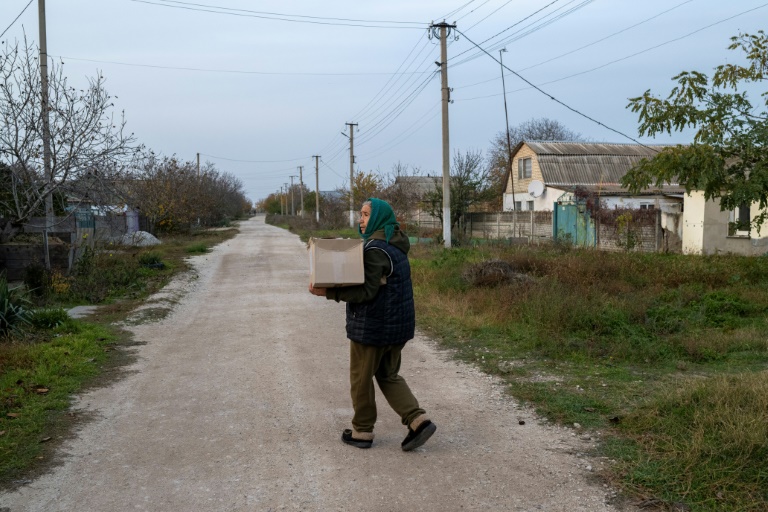
Yulia Pogrebna has given up telling homesick villagers that now was not the time to go back to Ukraine’s southern front.

The bubbly 32-year-old volunteer was meting out boxes of food to a crowd of pensioners who had given up waiting out the war and returned to the riverside village of Lymany.

The sun dipped over a yawning bay that separates the villagers from Russian forces that poured in from the nearby Crimea peninsula the Kremlin seized in 2014.

Tough-talking Ukrainian troops hidden in surrounding forests were loading Grad rockets onto truck-mounted launchers ahead of the next round in the battle for Kherson.

The hour of nightly exchanges of fire was nearing and the villagers were scurrying to their cellars loaded with weekly supplies of rice and tinned meat.

Pogrebna shook her head and tugged on her bulletproof vest as the sun set.

“It would be a lot easier if these people were not out here,” she said with a soft smile.

“But how can you ask someone who has lived in one place for 70 years — where they know every blade of grass — to leave? Especially if they have nowhere else to go.”

– ‘Back to work’ –

Ukraine’s counteroffensive across the north and push ever deeper into the south has encouraged growing numbers to resettle lands precariously close to the front.

Many return because they cannot afford to pay rent in places more removed from the war zone.

Others feel they have worn out their welcomes with relatives or friends.

And many more simply want to take care of their abandoned country cottages and damaged flats.

“It has gotten a lot better here in the past few days,” school janitor Yekaterinodar Dudik said with a resolute nod.

“The last bomb dropped what, five days ago now? I went back to work today,” the 27-year-old said.

“I was sweeping leaves.”

All but a few hundred of Lymany’s 4,000 residents fled when the Russians passed through the village days into their invasion eight months ago.

Local officials say about 1,000 are here today.

“I visit four such villages a week,” Pogrebna said. “There are some places we can only reach by foot across fields.”

– ‘Running out of men’ –

The soldiers sliding rockets the length of a car into the tubes of a multiple-launcher system some distance away had no qualms about the villagers’ return.

Junior Sergeant Oleksandr Veretennik said artillery battles were still common in the surrounding forests and fields.

“But things are becoming a little easier for us,” the 32-year-old said.

“I don’t think they are running out of weapons. I think they are running out of men. They seem to be rotating in less and less qualified soldiers.”

The Kremlin has sent in reinforcements from all directions toward the city of Kherson — Ukraine’s gateway to both Crimea and the commercially crucial Sea of Azov.

The city’s eponymous region runs to within a few minutes’ drive of Lymany’s fenced-off cottage homes.

The soldiers of the 28th brigade were brandishing drone killer guns and talking up air defence systems that made the skies over Lymany feel slightly safer.

“This is a technology and innovation-driven war. And our engineers are second to none,” said a soldier who uses the nickname Balkan.

“I want to extend thanks to our allies, but most of the technology we are using is our own.”

– ‘Less lonely’ –

Russia’s retreat on the ground has forced the Kremlin to switch to an air assault involving cruise missiles and suicide drones.

Moscow is mostly targeting power plants and other civilian infrastructure — a campaign evidently aimed at demoralising Ukrainians by leaving them without winter heat or light.

But Lymany is already cold and dark.

Its residents wheel out gas canisters to boil potatoes and tea in daytime.

Many choose to huddle at night at a central bunker rather than staying in cellars on their own.

Village elder Natalia Panashiy moves around a lot because the building housing Lymany’s main offices is now a pile of rubble.

She rushed in to direct the traffic in the noisy queue of locals waiting to pick up their weekly food rations before dusk.

“Of course it is too early for them to be coming back,” the 54-year-old said.

“But I am glad that they are because now I feel less lonely out here.”

Italy's far-right PM Meloni to meet EU chiefs

Italy’s far-right Prime Minister Giorgia Meloni meets EU chiefs in Brussels on Thursday for the first time since her election, with the energy crisis expected to dominate the agenda.

Nationalist Meloni has vowed to put Italy’s interests first, and the trip will be closely watched amid fears of turbulent relations ahead between Meloni’s populist government in Rome and the bloc’s powerhouses.

“The voice of Italy in Europe will be strong: we are ready to confront the big questions, starting with the energy crisis, working together for a solution to help families and businesses to halt speculation,” Meloni tweeted on Thursday. 

Meloni’s tone towards Europe has been more conciliatory in recent months despite once calling for Italy to scrap the euro, but in a book to be published on Friday she slams “a Europe that is invasive in small things and absent in big matters”.

In her first international trip since taking office, Meloni meets European Commission President Ursula von der Leyen, European Council chief Charles Michel and European Parliament speaker Roberta Metsola.

It will be the first face-to-face encounter since von der Leyen angered Italy’s right-wing parties ahead of the September general election by warning of consequences should the country veer away from democratic principles.

But Meloni, the first woman to become Italian prime minister and head of Italy’s most far-right government since World War II, will arrive in Brussels on a diplomatic rather than war footing, political analyst Lorenzo Codogno told AFP.

– Treading carefully –

“Meloni is pragmatic and wants to be perceived as a moderate and mainstream leader,” he said.

The leader of the eurozone’s third-largest economy is expected to stress the urgency of European measures to reduce sky-high energy prices, a battle begun by her predecessor Mario Draghi.

“The real focus will be on energy… the most urgent issue with winter around the corner,” Codogno said, adding Meloni will be determined “to show continuity with the Draghi government”.

Draghi joined other countries in calling for bloc-wide solutions to the energy crunch aggravated by the war in Ukraine, rather than Germany’s controversial go-it-alone approach.

Meloni, too, has insisted the continent’s worst energy crisis in decades should be dealt with “at an EU level”.

The trip “will have no immediate practical consequences”, Italy’s Messaggero daily said, but it will help Meloni gauge “what the prospects are” for help from the bloc on the country’s most pressing issues.

For their part, EU chiefs hope to use the meeting to “understand better what Meloni intends to do”, said Sebastien Maillard, director of the Jacques Delors Institute.

– ‘No interest in picking a fight’ –

“Beyond messages of appeasement” — in which Meloni pledged support for NATO and the West and distanced her Brothers of Italy party from fascism — “she has remained rather vague about her intentions”, he said.

Brussels will be treading carefully, wary of pushing Meloni towards other nationalist governments in Hungary and Poland.

There is unlikely to be a showdown over the EU’s post-pandemic recovery fund, which is funnelling almost 200 billion euros ($197 billion) to Italy on the condition that it implements major reforms.

While Meloni has said she wants to “adjust” the plan to take into account the rising cost of energy and raw materials, those tweaks — if they come — will likely be dealt with on a technical level, Codogno said.

Maillard agreed that “on economic issues (Meloni) has no interest in picking a fight with Brussels”.

“If she were to step out of line with Europe, it would be against Italian interests”.

But Brussels is unlikely to avoid a clash at some point soon over immigration, a hot-button issue for the right in Italy, which has long been a frontline entry point for migrants to Europe.

Bank of England set for biggest rate hike in 33 years

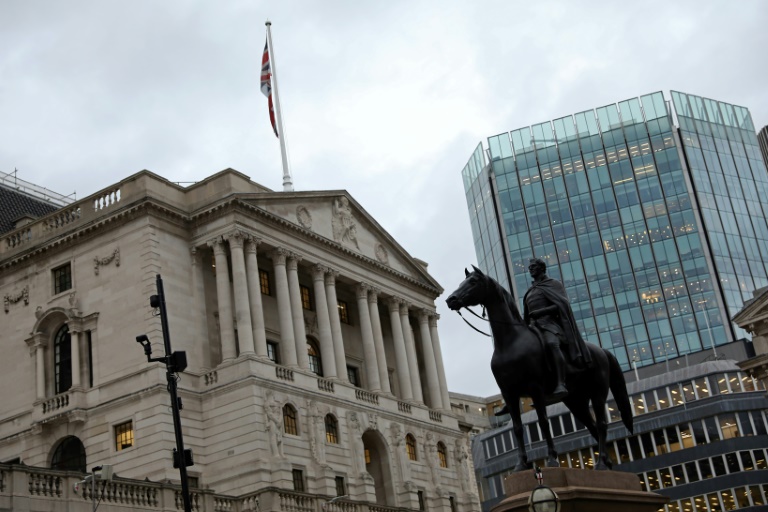
The Bank of England is widely expected to hike its key interest rate on Thursday by the biggest amount since 1989 as it bids to cool sky-high British inflation.

Following a regular meeting, the BoE is expected to lift borrowing costs by 0.75 percentage points to three percent, according to market consensus, which would be the highest level since the 2008 global financial crisis.

Some analysts, however, are predicting a rise of one percentage point, also a 33-year high.

The move would mirror aggressive rate-tightening by central banks worldwide as economies battle the highest prices in decades.

Ahead of the UK decision, the London stock market opened sharply lower after the US Federal Reserve sprang a fourth consecutive hike of 0.75 percentage points — and its boss Jerome Powell suggested they would go higher than expected.

– ‘Unenviable job’ –

The BoE rate call, due at 1200 GMT, is set to worsen a cost-of-living crisis for millions of Britons as hikes by central banks see retail lenders push up interest rates on their own loans.

“The Bank of England will likely join the Fed in raising rates by 75 basis points,” said Oanda analyst Craig Erlam.

“The central bank has had the unenviable job of fighting soaring inflation amid enormous economic and political uncertainty.”

Repayments on UK mortgages have surged in recent weeks also after the debt-fuelled budget of previous British prime minister Liz Truss spooked markets, forcing her to resign and triggering emergency buying of UK government bonds by the BoE.

Her successor Rishi Sunak has attempted to bring calm to markets by hinting at tax rises in a fresh budget on November 17, even if such a move further harms Britain’s economy.

“I think everyone knows we do face a challenging economic outlook and difficult decisions will need to be made,” Sunak, a former UK finance minister, told parliament on Wednesday.

British annual inflation stands above 10 percent, the highest level in 40 years, on soaring food prices and energy bills.

– Inflation update –

The BoE will also give its latest inflation and growth forecasts, with analysts indicating that the UK economy may already be in recession.

“The Bank of England is expected to hike its interest rate by no more than 75 basis points, on conviction that the Sunak government would opt for some fiscal austerity, and nothing too crazy to wreak havoc, again,” forecast Swissquote analyst Ipek Ozkardeskaya.

As the Covid-19 pandemic began in early 2020, the BoE slashed its key interest rate to a record-low 0.1 percent and also pumped massive sums of new cash into the economy.

The Bank of England started raising rates last December and another hike Thursday would be the eighth increase in a row.

Ruth Gregory, senior UK economist at Capital Economics, predicts that the BoE will raise its interest rate by one percentage point on Thursday and by the same amount in December.

“If we are right that domestic inflation will be sticky, it may mean that the Bank of England ultimately has to act more aggressively further ahead,” she added.

Close Bitnami banner
Bitnami