World

N.Ireland set for fresh elections over post-Brexit impasse

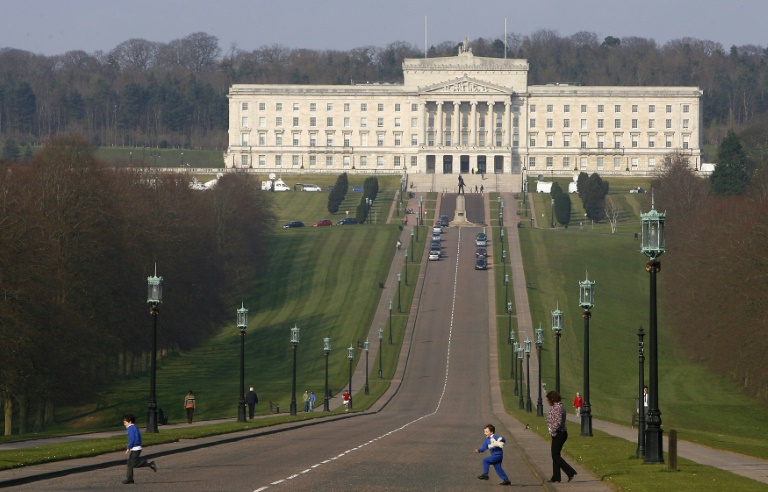
Northern Ireland on Wednesday appeared headed for a second election this year, after UK government efforts to resolve months of political stalemate over its post-Brexit status failed to secure a breakthrough.

Chris Heaton-Harris, Britain’s Northern Ireland minister, has been holding talks with the political parties in a fresh bid to get them to form a new executive.

If no agreement is reached by Friday, London will be legally required to call early elections for the devolved assembly in the volatile province.

It has been without a functioning government since February, after the pro-UK Democratic Unionist Party (DUP) collapsed the executive over its staunch opposition to post-Brexit trade rules there.

It wants the so-called Northern Ireland Protocol agreed by London and Brussels as part of Britain’s 2019 Brexit deal overhauled or scrapped entirely. They say it weakens the province’s place within the UK.

Many unionists also argue the pact is threatening the delicate balance of peace between the pro-Irish nationalist community and those in favour of continued union with the UK.

The measures, which effectively keep Northern Ireland in the European Union’s single market and customs union, were agreed to avoid the return of a hard land border with the neighbouring Republic of Ireland which remains an EU member.

Eliminating that hard border was a key strand of the 1998 Good Friday Agreement, which ended three decades of sectarian violence in Northern Ireland.

– Sinn Fein appeal –

Pro-Irish party Sinn Fein scored a historic first electoral victory in May, further complicating efforts to restore power-sharing.

DUP leader Jeffrey Donaldson said Wednesday he had reiterated to Heaton-Harris the need “to clear away the debris of the protocol”. An election would do little to resolve the standoff, he said.

“I don’t think it helps us to get any quicker towards the solution that we need or to get the political institutions back up and running,” he added.

Donaldson noted the party was nonetheless ready to contest a fresh ballot.

Sinn Fein leader Michelle O’Neill, who is set to become Northern Ireland’s first minister if the executive can be restarted, renewed her call for the DUP to end its boycott. 

“I appeal to those blocking an executive, to work with the rest of us & put money into people’s pockets,” she tweeted on Wednesday.

Britain’s government, wracked by political turmoil which has seen three prime ministers in two months, has urged Brussels to revise the protocol, and is passing contentious legislation to rip it up.

Britain has previously threated to unilaterally modify the protocol.

That has sparked fears of a trade war and worsening relations with Europe, when the economic landscape is already gloomy.

– ‘Strong relationship’ –

Northern Ireland’s political impasse was discussed in a phone call on Wednesday between Irish premier Micheal Martin and the new British Prime Minister Rishi Sunak, who only took office the previous day.

The two leaders “agreed on the vital importance of a strong relationship between the UK and Ireland”, Downing Street said.

On the Northern Ireland Protocol, Sunak stressed that he would prefer “a negotiated outcome and hoped all parties would approach the current challenges with pragmatism and goodwill,” his office added.

The British premier tweeted that he discussed with Martin “how the UK and Ireland as close neighbours and friends can work together in the coming months”.

Sunak also spoke by phone with EU leader Ursula von der Leyen, who said on Twitter that she hopes to find “joint solutions under the protocol… that will provide stability and predictability”.

12 women foreign ministers condemn Iran's crackdown

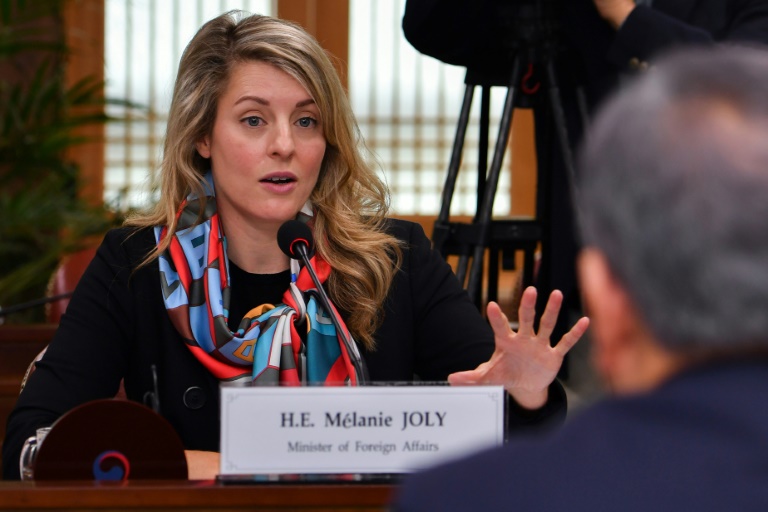
Women foreign ministers from a dozen nations led by Canada’s Melanie Joly on Wednesday jointly condemned Iran’s violent crackdown on women’s rights, as protesters in the Islamic republic marked 40 days of unrest.

“As women foreign ministers, we feel a responsibility to echo the voices of Iranian women,” said a joint statement issued by ministers from Albania, Andorra, Australia, Canada, France, Germany, Iceland, Kosovo, Libya, Liechtenstein, New Zealand and Norway.

In it, they expressed “solidarity with the courageous Iranian women engaging in their right of peaceful assembly and advocating for their human rights.”

They also condemned the “violent enforcement” of Iran’s hijab and chastity law and the “ongoing crackdown against protesters,” including women and students, that has led to more than 200 deaths.

Mahsa Amini, a 22-year-old Iranian of Kurdish origin, died on September 16, three days after her arrest in Tehran by the notorious morality police for allegedly breaching the Islamic dress code for women requiring use of headscarves.

Anger flared at her funeral and quickly sparked widespread protests that saw young women lead the charge, burning their headscarves and confronting security forces, in the biggest wave of unrest in the Islamic republic for years.

Painter Pierre Soulages, French master of black, dies at 102

French abstract artist Pierre Soulages, who has died aged 102, was the Henry Ford of painting: for him there was just one colour, black, and he spent a lifetime exploring the light within it.

“I love the authority of black, its severity, its obviousness, its radicalism,” declared the tall painter who was himself always clad in black.

“It’s a very active colour. It lights up when you put it next to a dark colour,” he told AFP in an interview in February 2019.

Soulages’s death was confirmed to AFP on Wednesday by his longtime friend Alfred Pacquement, who is also president of the Soulages museum in southern France.

Works by the best-selling French artist have commanded seven-figure sums, with a 1960 canvas of thick black stripes selling at auction at the Louvre for $10.5 million in 2019.

A household name in France but less known internationally, his paintings hung in more than 110 museums around the world, including the Guggenheim in New York and London’s Tate Gallery, with hundreds more housed in the Musee Soulages in his southern hometown of Rodez.

For his 100th birthday in December 2019, he was treated with a retrospective at the Louvre — a rare honour for a living artist.

“Beyond the black, his works are vivid metaphors from which each of us draws hope,” French President Emmanuel Macron wrote on Twitter.

– Beyond black –

Soulages titled all his pieces “Peinture”, or “Painting” in English, distinguishing them afterwards by their size and date of production.

One, called “Peinture 162 x 130 cm, 2 mai 1963”, sold for almost six million euros on Wednesday, auctioneers Sotheby’s said. 

When he was around 60, Soulages shifted from black to the reflection of light from black — a technique he called “outrenoir” or “beyond black” in English.

It involved scraping, digging and etching thick layers of paint with rubber, spoons or tiny rakes to create different textures that absorb or reject light, taking him to what he called a “different country” from plain black.

Standing 1.9 metres (six foot two inches) tall, “his body language is often described in the same terms as his paintings: strong, vital, powerful,” the New York Times noted in 2014.

Hollywood celebrities including Alfred Hitchcock reportedly snapped up his works.

– Dark obsession –

Born on December 24, 1919, he was even as a child obsessed by the dark sheen of ink.

With all his “black marks on paper”, his mother would tease him that he “was already mourning her death”, he said in the AFP interview.

He showed his first works shortly after World War II in 1947.

While contemporaries and friends, such as Hans Hartung and Francis Picabia, were dabbling in colour, he opted for the walnut stain used on furniture to create geometric works on paper or canvas.

For a while he even tried daubing dark tar on glass.

At 33, Soulages showed at the prestigious Venice Biennale in 1954 and held his first solo New York exhibition just two years later.

Black was not just his own obsession, he said, wondering: “Why did people in prehistoric times draw in black inside dark black caves when they could have used chalk?”

Soulages was also known for perfectionism: if he was not 100 percent happy with a painting, “I burn the canvas outside. If it is mediocre, it goes,” he told AFP.

He is survived by his wife of 80 years, Colette. 

'Chief Twit' Elon Musk visits Twitter HQ as takeover deadline looms

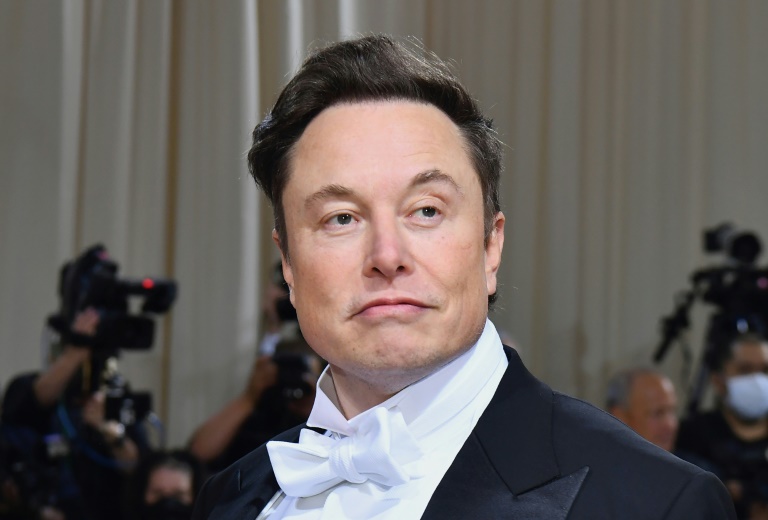
Elon Musk changed his Twitter profile to “Chief Twit” and posted video of himself walking into the social network’s California headquarters carrying a sink Wednesday, days before his contentious takeover of the company must be finalized.

The billionaire Tesla chief captioned the video “Entering Twitter HQ – let that sink in!” He also listed his location as Twitter headquarters in San Francisco. 

It was not clear whether Musk met with anyone at Twitter, but he is supposed to be working with the company to complete the on-again, off-again $44 billion takeover.

The deal must be sealed by Friday, or Musk will face trial over the contract.

He had made an unsolicited offer to buy Twitter, and inked a deal in April — but then sought to terminate the sale. Twitter filed a lawsuit to hold him to it. 

With a trial looming, the unpredictable billionaire capitulated, reviving his takeover plan on the condition that legal proceedings were put on hold.

Musk, the world’s richest man, has reportedly been lining up financing since a judge paused litigation on October 6.

Musk said in July he was canceling the deal because he was misled by Twitter over the number of fake “bot” accounts — allegations rejected by the company.

Twitter, in turn, sought to prove Musk was contriving excuses to walk away simply because he changed his mind.

“I’m excited about the Twitter situation,” Musk said during a recent Tesla earnings call.

“I think it’s an asset that has just sort of languished for a long time but has incredible potential, although obviously myself and the other investors are overpaying for Twitter right now.”

S.Africa to swallow part of Eskom's debt to keep it afloat

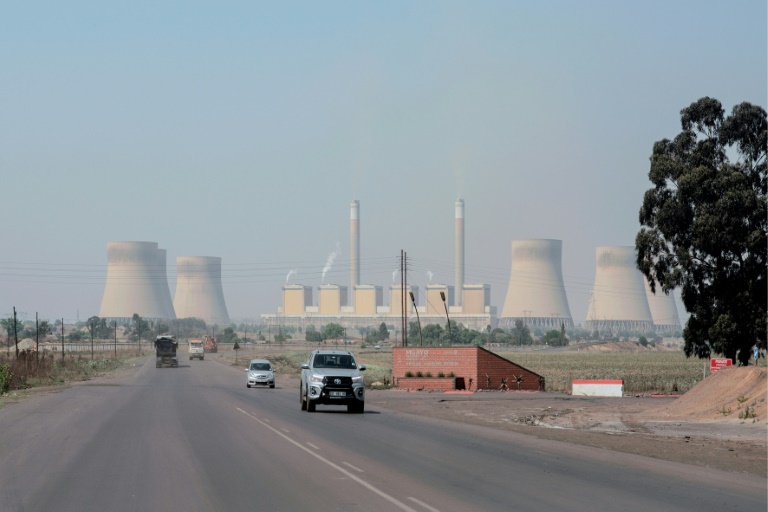
South Africa’s treasury vowed Wednesday to take over more than half of Eskom’s multi-billion-dollar debt to ensure the embattled energy utility’s viability and curb the energy crisis that has put a break on growth.

In a mini budget statement, Finance Minister Enoch Godongwana said government has decided to give Eskom 225 billion rand ($12.4 billion) towards debt for the period 2019 to 2026.

“The programme will allow Eskom to focus on plant performance and capital investment,” the minister said before parliament, adding the debt takeover will ensure the company no longer relies on government bailouts. 

Eskom, which he labelled the biggest risk to the economy, is bucking under a 400-billion-rand debt.

“The debt takeover, once finalised, together with other reforms will ensure that Eskom is financially sustainable,” he said.

The government has for more than a decade poured billions of rands into Eskom, “with limited improvements in the reliability of the electricity supply or the financial health of the company,” he said.

Sweeping power outages, caused by failures at ageing and poorly maintained infrastructure at Eskom — which provides almost all of South Africa’s electricity — have worsened in recent months.

Projected economic growth for this year is 1.9 percent, falling from 4.9 percent in 2021.

– ‘Disastrous’ –

“The intensity of load shedding is having a disastrous effect on our economy,” said the minister. 

Economists have welcomed the government’s move on Eskom, but said more needs to be done.

“Transferring between one-third and two-thirds of Eskom’s debt to the government will support the corporation’s financial sustainability,” said Aurelien Mali, of Moody’s Investors Service.

“But will not alone resolve its maintenance and operational challenges, which continue to be a drag on the South African economy,” added Mali.

For Godongwana, constraints in transport industries have also severely impacted economic activity. 

In October workers at Transnet, state rail and port logistics firm, went on a weeks long strike that crippled South Africa’s economy and stranded mineral and fresh fruit exports.

The strike cost mining firms $45 million in exports a day, according to the Minerals Council South Africa, an industry group.

Looming labour strikes by public service workers demanding wage hikes further threaten the nation’s prospects of cleaning up its economy.

In addition to recurring power cuts economic recovery has also been hampered by a series of shocks.

These include massive damage caused by riots, which broke out in July 2021 following former president Jacob Zuma’s jailing and left more than 350 dead.

Unprecedented floods that swept through the third largest city of Durban, killing hundreds, also put a damper on growth.

President Cyril Ramaphosa’s Sunday promises to crack down on graft, following a probe into state corruption under his predecessor Zuma, saw the finance minister state the government would act against implicated individuals and companies.

He also targeted reducing inflation to 5.1 percent in 2023, following a peak of 7.8 percent last July — the highest level in 13 years.

Soaring fuel prices triggered by the Russia-Ukraine war, as well as food inflation have been “a key source of inflationary pressure” in South Africa, the minister added.

Russian media figure flees to Lithuania

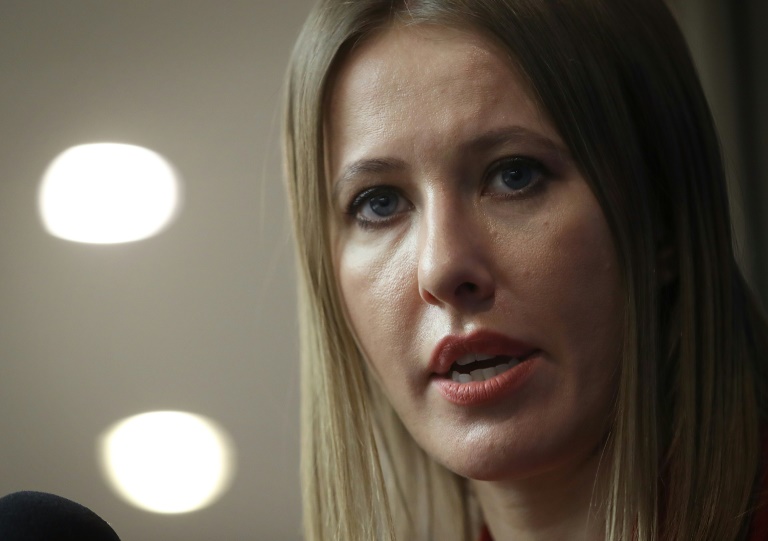
Ksenia Sobchak, a Russian media figure and the daughter of Vladimir Putin’s mentor, has fled her country for Lithuania, border officials in Vilnius said Wednesday, after Russian news agencies reported that she had become a suspect in an extortion case.

Sobchak dismissed the case as the Russian government’s attempt to put pressure on her media group, Attention Media.

“It is clear that it’s an attack on my editorial team, the last remaining free editorial team in Russia which had to be pressured,” the 40-year-old said on Telegram.

An official at Lithuania’s state border service speaking on condition of anonymity told AFP that Sobchak had arrived on an Israeli passport.

In September, Lithuania barred entry to Russians travelling with tourist visas over the Kremlin’s invasion of Ukraine.

Sobchak, a popular media personality and journalist who ran against Putin in the 2018 presidential election, is reportedly his goddaughter.

Her father, the late Saint Petersburg mayor Anatoly Sobchak, was once Putin’s boss.

Earlier in the day, Russia’s TASS news agency reported that Sobchak had departed Moscow during the night, citing a police source that said she had travelled to Lithuania via Belarus.

TASS and state-run channel RT cited law enforcement sources as saying Sobchak was suspected of large-scale extortion, a crime punishable by up to 15 years in prison.

Kirill Sukhanov, the commercial director of Attention Media, was arrested earlier in the week as part of the investigation.

Attention Media runs a number of social media projects, including Sobchak’s YouTube channel that has over three million subscribers.

“Kirill, we love you and we don’t believe anything,” Sobchak said on Telegram.

Russian media said Sobchak’s villa outside Moscow was searched in connection with a case against her commercial director, Arian Romanovsky.

Sobchak has for years been involved in Russian opposition politics, though she remains a divisive figure among Putin critics. 

When she ran for the presidency against Putin in 2018, Russian opposition politicians accused her of being used by the Kremlin as a spoiler candidate. 

Thousands of Russians have fled the country since Putin launched an attack on Ukraine in February, with a second wave leaving after he announced a military mobilisation on September 21.

Putin oversees nuclear response drills

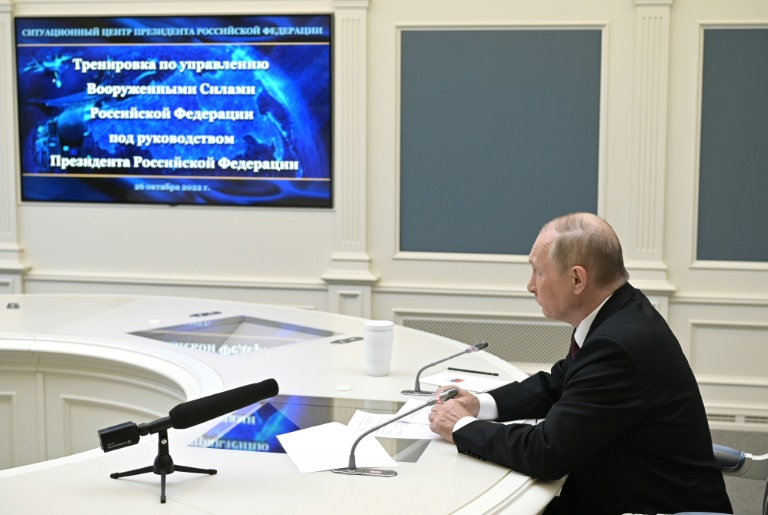
Russian President Vladimir Putin on Wednesday surveyed drills carried out by his nuclear-capable forces as Moscow pressed unfounded claims to India and China that Ukraine was developing a “dirty bomb.”

The drills follow a series of escalatory comments by Moscow and Putin — who observed the manoeuvres from a control room — that the eight-month conflict in Ukraine could turn nuclear.

“Under the leadership of… Vladimir Putin, a training session was held with ground, sea and air strategic deterrence forces, during which practical launches of ballistic and cruise missiles took place,” the Kremlin said in a statement.

Russian state-run media ran footage of a submarine crew preparing the launch of a Sineva ballistic missile from the Barents Sea in the Arctic.

The drills also included launching test missiles from the Kamchatka peninsula in the Russian Far East. 

Footage of the drills across state media came after Russia’s Defence Minister Sergei Shoigu pressed ahead with telephone calls to his global counterparts, claiming that Ukraine was developing a “dirty bomb”.

A dirty bomb is laced with radioactive, biological or chemical materials.

Shoigu, who has made these allegations in recent days to counterparts from NATO countries, reiterated them to China’s defence minister Wei Fenghe on Wednesday. 

– Moscow alleges ‘irresponsible behaviour’ –

Shoigu also voiced the same “concerns” in a call with India’s Defence Minister Rajnath Singh earlier on Wednesday, Moscow said.  

Ukraine has dismissed the allegations as “absurd” and “dangerous,” suggesting the claims could be cover for Russia’s own plans on the battlefield — as have its western allies, including Britain, France and the United States.

Kremlin spokesman Dmitry Peskov told reporters earlier Wednesday that Russia had information pertaining to the “existing threat” of Ukraine using a “dirty bomb” and that Kyiv was “preparing for such a terrorist act of sabotage”.

He added: “We will continue vigorously bringing our point of view to the world community to encourage them to take active steps to prevent such irresponsible behaviour.” 

Nuclear rhetoric from Russia began building in September, when Moscow said it was annexing four regions of Ukraine over which its forces have partial control. Putin warned Russia could use nuclear weapons to defend them.

– Advance on Kherson –

One of those regions is Kherson, in southern Ukraine near Moscow-annexed Crimea, where Kyiv has been clawing back territory since a counter-offensive it announced at the end of the summer. 

Russian-backed authorities in recent days urged residents to flee what they say is an oncoming onslaught. They claimed to have turned the city of Kherson into a “fortress”, vowing to defend it at all costs. 

A Moscow-installed official in the region, Vladimir Saldo, said Wednesday that at least 70,000 people have left their homes within the last week. 

Ukraine’s capture of the Kherson region would restore important access to the Sea of Azov. It would also cut off Moscow’s land bridge to Russian-annexed Crimea. 

Saldo banned entry to the right bank area of the region for a period of seven days “due to the tense situation on the contact line”, according to a statement on his social media on Wednesday.  

Russia’s offensive to capture Ukrainian territory has spurred a wave of international solidarity with Kyiv, including hundreds of foreigners who volunteered to help fend off Russian advances. 

Kyiv said Wednesday that Russia had returned the remains of US citizen Joshua Alan Jones, who was killed fighting Moscow’s forces in August.

Also on Wednesday Ukrainian President Volodymyr Zelensky said he saw a “positive trend” in Kyiv’s relations with Israel, after the two countries shared intelligence on Russia’s purported use of hundreds of Iranian drones against its neighbour — something the Kremlin denies.

Zelensky’s comments came two days after he criticised Israel’s neutrality in the Ukraine conflict, saying the decision by Israeli leaders not to support Kyiv had encouraged a Russian military partnership with Iran.

“We are at the beginning of cooperation”, Zelensky said during a press conference in Kyiv. “After a long pause, I see us moving forward”.

Climate pledges still 'nowhere near' enough for 1.5C: UN

The world’s current climate pledges are far off track to limit temperature rises to 1.5 degrees Celsius and will steer a world already wracked by increasing floods, heatwaves and storms towards “catastrophic” warming, the UN said Wednesday.  

In a report released just over a week before high-stakes climate negotiations, the United Nation’s climate change organisation, said combined commitments from nearly 200 nations put Earth on track to warm around 2.5C compared to pre-industrial levels by the century’s end.

With the planet already battered by weather extremes after 1.2C of warming, experts say the world is failing to act with sufficient urgency to curb greenhouse gas emissions.     

“We are still nowhere near the scale and pace of emission reductions required to put us on track toward a 1.5 degrees Celsius world,” said UN Climate Change chief Simon Stiell. 

“To keep this goal alive, national governments need to strengthen their climate action plans now and implement them in the next eight years.”

The UN’s climate experts have said emissions — compared to 2010 levels — need to fall 45 percent by 2030 in order to meet the 2015 Paris climate deal’s more ambitious 1.5C goal.

Current commitments from governments around the world will in fact increase emissions from the 2010 benchmark by 10.6 percent by 2030, the UN said. This was a slight improvement from a similar analysis a year ago.

UN chief Antonio Guterres stressed that the goal of limiting warming to 1.5C was still within reach, but warned that the current trajectory of countries’ climate commitments was “catastrophic”. 

“We must absolutely start reducing emissions now,” he said in an interview with the BBC.  

– ‘Disappointing’ –

When nations met for landmark climate talks in Glasgow last year, they agreed to speed up national climate pledges to cut carbon pollution and increase financial flows to vulnerable developing nations. 

But only 24 countries had updated their plans at the time of the report, which Stiell said was “disappointing”.    

“Government decisions and actions must reflect the level of urgency, the gravity of the threats we are facing, and the shortness of the time we have remaining to avoid the devastating consequences of runaway climate change,” he said.

He called on governments to revisit and strengthen their carbon-cutting plans in line with the Paris temperature goals before the UN climate meeting, which will be held from November 6 to 18 in Sharm el-Sheikh, Egypt.

Nations are meeting in the shadow of Russia’s invasion of Ukraine and cascading global crises of hunger, energy prices and living costs, exacerbated by extreme weather.  

Research by the World Resources Institute suggests that the world needs to curb emissions six times faster by 2030 than current trends to meet the 1.5C warming cap. 

Australia and Indonesia have offered “some momentum” by stepping up their climate pledges since the last UN climate negotiations, said WRI’s Taryn Fransen, adding that further announcements from a range of countries including the European Union, Turkey and Vietnam are expected this year.  

She said the world’s second biggest emitter, the United States, took a “massive step” this year with measures in its new sweeping climate and inflation bill and urged China, the biggest emitter, to set a specific goal to cut planet-warming methane pollution.  

– ‘Transformative response’ –

A second UN report also released Wednesday looked at longer term and “net-zero” climate goals to around mid-century put forward by dozens of countries. 

It found that those countries’ greenhouse gas emissions would be 68 percent lower by 2050 than they were in 2019, if all strategies were fully implemented. 

“This is a sobering moment, and we are in a race against time,” said Sameh Shoukry, Egyptian Minister of Foreign Affairs and President-Designate of the upcoming UN COP27 talks.   

The report comes as the UN’s World Meteorological Organization warned that levels of planet-warming carbon dioxide, methane and nitrous oxide all reached new records last year.

It raised particular concerns about an “exceptional” surge in powerful methane, which is released from fossil-fuel, waste and agriculture sectors as well as through natural processes. 

The WMO said it was “not clear” what caused the biggest year-on-year jump in concentrations since systematic measurements began nearly 40 years ago, but said it appeared to be from both human and biological sources. 

Scientists have warned that any rise above 1.5C risks the collapse of ecosystems and the triggering of irreversible shifts in the climate system.

With the impacts slamming hardest into countries least responsible for fossil fuel emissions, calls have grown louder for richer polluters to pay “loss and damage” to vulnerable nations.

In a landmark report this year on climate impacts and vulnerabilities, the UN’s 195-nation Intergovernmental Panel on Climate Change (IPCC) warned that time had nearly run out to ensure a “liveable future” for all. 

That report was signed off by the same governments that will return to negotiations in Egypt. 

N.Ireland set for fresh elections over post-Brexit impasse

Northern Ireland on Wednesday appeared headed for a second election this year, after UK government efforts to resolve months of political stalemate over its post-Brexit status failed to find a breakthrough.

Chris Heaton-Harris, Britain’s Northern Ireland minister, has been holding talks with the political parties in a fresh bid to get them to form a new executive.

If no agreement is reached by Friday, London will be legally required to call early elections for the devolved assembly in the volatile province.

It has been without a functioning government since February, after the pro-UK Democratic Unionist Party (DUP) collapsed the executive over its staunch opposition to post-Brexit trade rules there.

It wants the so-called Northern Ireland Protocol agreed by London and Brussels as part of Britain’s 2019 Brexit deal overhauled or scrapped entirely. They say it weakens the province’s place within the UK.

Many unionists also argue the pact is threatening the delicate balance of peace between the pro-Irish nationalist community and those in favour of continued union with the UK.

The measures, which effectively keep Northern Ireland in the European Union’s single market and customs union, were agreed to avoid the return of a hard land border with the neighbouring Republic of Ireland.

Eliminating that hard border was a key strand of the 1998 Good Friday Agreement, which ended three decades of sectarian violence in Northern Ireland.

– Finn Fein appeal –

Pro-Irish party Sinn Fein scored a historic first elections win in May, further complicating efforts to restore power-sharing.

DUP leader Jeffrey Donaldson said Wednesday he had reiterated to Heaton-Harris the need “to clear away the debris of the protocol”. An election would do little to resolve the standoff, he said.

“I don’t think it helps us to get any quicker towards the solution that we need or to get the political institutions back up and running,” he added.

Donaldson noted the party was nonetheless ready to contest a fresh ballot.

Sinn Fein leader Michelle O’Neill, who is set to become Northern Ireland’s first minister if the executive can be restarted, renewed her call for the DUP to end its boycott. 

“I appeal to those blocking an executive, to work with the rest of us & put money into people’s pockets,” she tweeted on Wednesday.

Britain’s government, wracked by political turmoil which has seen three prime ministers in two months, has urged Brussels to revise the protocol, and is passing contentious legislation to rip it up.

That has sparked fears of a trade war and worsening relations with Europe, when the economic landscape is already gloomy.

Seeing no China progress, Boeing eyes other prospective MAX buyers

Boeing said Wednesday it is seeking other potential customers for its 737 MAX because China is still not taking delivery of the jetliners it has ordered.

Chief Financial Officer Brian West said the company was in “active discussions” with other customers about 138 planes in inventory ordered by Chinese companies.

There is “more to come and we’ll keep you updated,” West told analysts.

Executives described the outreach as part of an effort to “de-risk” Boeing’s finances given the murky outlook for the company’s China business.

China’s zero-tolerance Covid-19 policies “have reduced demand for airplanes in general,” Chief Executive Dave Calhoun said during a conference call with analysts.

“We still would like to deliver airplanes to China. We continue to support our customers,” Calhoun said.

“But we also are clear-eyed about the geopolitical risks that are out there and we are not going to impart new risks on our investors,” said Calhoun, adding, “I have not gotten a single signal … they’re going to take deliveries in the near term.”

The MAX was grounded globally following the second of two deadly crashes in March 2019 until the Federal Aviation Administration became the first major regulator to clear the plane in November 2020 to resume service following upgrades, extensive testing and new training protocols.

China was the last major Boeing market to deem the jet airworthy in December 2021. But the plane still needs to clear a few final hurdles with Chinese regulators and has not resumed service in that country.

Close Bitnami banner
Bitnami