World

New Italy PM meets Macron on first day of office

Italian Prime Minister Giorgia Meloni took her first steps on the international stage Sunday, meeting French President Emmanuel Macron just hours after formally taking office.

The two leaders met away from the media for more than an hour in central Rome, after which Macron vowed in a post on Twitter to work together “with dialogue and ambition”.

Meloni’s post-fascist Brothers of Italy scored a historic victory in general elections on September 25.

Her new government is the most far-right in Italy since World War II, and takes power at a time of soaring inflation and an energy crisis linked to Russia’s invasion of Ukraine.

But there are already tensions within her coalition, which includes Matteo Salvini’s far-right League and former premier Silvio Berlusconi’s right-wing Forza Italia.

Meloni was forced this week to repeat her support for Ukraine and Western sanctions against Russia after Berlusconi was recorded defending President Vladimir Putin.

“We must be united, there are emergencies the country is facing. We have to work together,” the 45-year-old told her first cabinet meeting Sunday.

The prospect of a Eurosceptic, populist government leading the eurozone’s third largest economy has sparked concern among Italy’s allies, particularly in the European Union.

But European Commission President Ursula von der Leyen said she had a “good first call” Saturday with Meloni, saying she looked forward to “constructive cooperation”.

– ‘Friendly and fruitful’ –

Meloni’s office described Sunday’s talks with Macron as informal but “friendly and fruitful”, covering the need for urgent and common action on high energy bills, support for Ukraine and migration.

“Meloni and Macron agreed on the willingness to continue to cooperate on the major common challenges at the European level and in respect of mutual national interests,” it said in a statement.

A statement from Macron’s office described the talks as “pragmatic and constructive”, but also “frank”.

Macron’s aides had refused to confirm the meeting with Meloni until the last minute, and it came during his pre-planned trip to Rome and the Vatican.

In a tweet accompanied by a photo of him and Meloni on a rooftop at dusk, Macron insisted on the need for the two countries to keep working together, as Europeans, neigbouring countries and friends.

But Macron’s entourage made it clear that they would judge Meloni on her actions.

Earlier, Macron posted a picture of outgoing prime minister Mario Draghi, with the words “Grazie (thank you) Mario”.

– Reassuring ministers –

On Sunday, Meloni joined Draghi, a former European Central Bank chief in office since February 2021, for a symbolic handover of power.

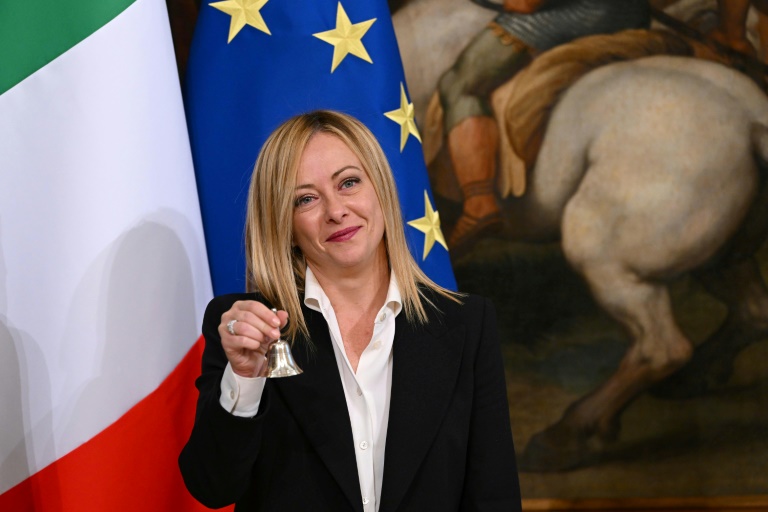
They held private talks for almost 90 minutes before a smiling Draghi gave Meloni a small bell used in cabinet debates, which she, grinning, rang a few times for the television cameras.

As a teenage activist, Meloni praised late dictator Benito Mussolini, but insists fascism is history. She has transformed her once-marginal party into a national force.

As the only real opposition to Draghi’s national unity government, Meloni swept up disillusioned voters and secured 26 percent of the vote last month.

She presents herself as a straight-talking “Christian mother”, a defender of traditional values and of Italy’s national interests, but her party has never before held power.

Meloni has sought to reassure investors that Italy’s debt-laden economy is safe in her hands, appointing Giancarlo Giorgetti as economy minister.

Giorgetti, economic development minister under Draghi, is considered one of the more moderate, pro-Europe members of Salvini’s League.

Draghi’s energy minister, Roberto Cingolani, will stay on as government advisor as Italy tries to wean itself off Russian gas, reports said.

Pope Francis had earlier marked the start of the new government in his weekly Angelus Sunday, offering his prayers for “unity and peace in Italy”.

– Coalition tensions –

Meloni’s party no longer wants Italy to leave the EU’s single currency but remains strongly Eurosceptic, as is the League, which won nine percent in the elections.

However, she named as foreign minister and deputy prime minister Antonio Tajani, a former president of the European Parliament who co-founded Forza Italia with Berlusconi. Their party won eight percent of the vote last month.

Salvini will serve as deputy prime minister and minister of infrastructure and transport.

Like Berlusconi, Salvini is a long-time admirer of Putin and has criticised Western sanctions imposed on Russia over its invasion of Ukraine.

The tensions with her allies reinforce doubts as to how long Meloni can keep her coalition together, in a country that has had almost 70 governments since 1946.

On Saturday, she again affirmed her desire to work with NATO, “a bulwark of common values we’ll never stop standing for”.

NATO chief Jens Stoltenberg and US President Joe Biden sent their congratulations, as did Ukrainian leader Volodymyr Zelensky. 
Nine dead and 47 wounded in attack on south Somalia hotel

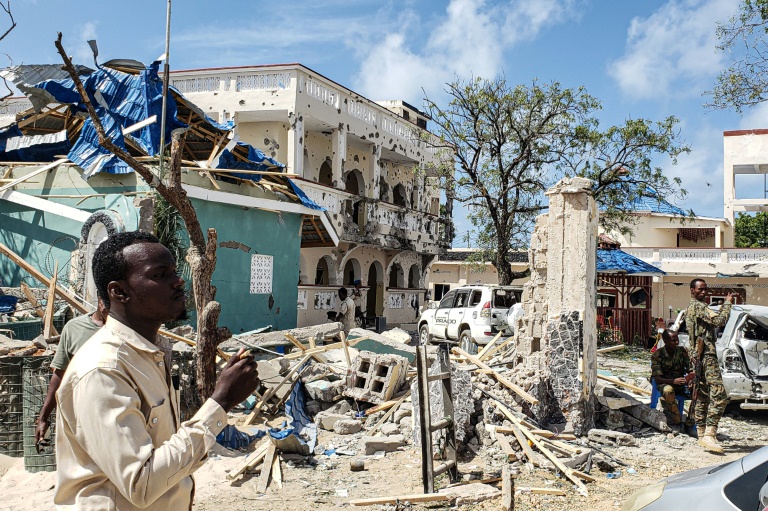
Nine people were killed and 47 wounded Sunday in an attack on a hotel in Kismayo, southern Somalia, claimed by the Al-Shabaab Islamist group, the region’s security minister said.

The port city is the latest to be hit following a recent resurgence of attacks by the Al-Qaeda-linked group, which has mainly targeted the capital Mogadishu and central Somalia.

Sunday’s assault began at 12:45 pm (0945 GMT) when a booby-trapped car rammed the entrance of Hotel Tawakal. It ended around 7:00 pm after the attackers were killed by security forces.

Among the casualties were students leaving a nearby school, Jubaland security minister Yusuf Hussein Osman told reporters. All four attackers, including the suicide bomber, were killed, he added.

“The first one detonated himself and the (remaining) three were killed by the security forces”, he said, confirming an early police statement.

“This is not a government target,” police officer Abdullahi Ismail said. “It is just an ordinary, civilian-frequented hotel.”

Farhan Hassan was outside the hotel when the attack happened. “A suicide bomber drove a vehicle into the entrance of the hotel before the gunmen entered the building,” he said.

Al-Shabaab claimed responsibility for the six-hour attack, saying members of the federal government of Jubaland, where Kismayo is located, were meeting in the hotel at the time.

– ‘All-out war’ –

Al-Shabaab has been trying to overthrow the government for more than 15 years and regularly attacks civilian and military targets.

Kismayo was once an Al-Shabaab stronghold before it was taken over in 2012 by local militias backed by Kenyan forces.

In August, the group launched a 30-hour gun and bomb attack on the popular Hayat hotel in Mogadishu, killing 21 people and wounding 117.

In 2019, the group conducted a similar attack on a hotel in Kismayo, killing 26 and injuring 56.

Somali President Hassan Sheikh Mohamud, who was elected in May, vowed after the August siege to wage “all-out war” on the Islamists.

In September he urged citizens to stay away from areas controlled by jihadists, saying the armed forces and tribal militia were ratcheting up offensives against them.

A joint US-Somali drone strike killed one of the militants’ most senior commanders on October 1.

Just hours after his death was announced, a triple bombing in the southern city of Beledweyne killed at least 30 people. 

In addition to violence, Somalia — like its neighbours in the Horn of Africa — is in the grip of the worst drought in more than 40 years. Four failed rainy seasons have wiped out livestock and crops.

Some 7.8 million Somalis — nearly half the population — are affected by the drought and 213,000 are on the brink of famine as a result, according to the United Nations

Xi secures historic third term as China's leader

Xi Jinping secured a historic third term as China’s leader on Sunday and filled his inner circle with close allies, achieving after a decade in power complete dominance over the ruling Communist Party.

The party’s Central Committee elected Xi as its general secretary for another five-year period, bringing the country back towards one-man rule after decades of power-sharing among its elite.

“I wish to thank the whole party sincerely for the trust you have placed in us,” Xi told journalists at Beijing’s Great Hall of the People after the closed-door, rubber-stamp vote was announced.

Xi, 69, was also reappointed head of China’s Central Military Commission, keeping him in charge of the People’s Liberation Army.

He is now all but certain to sail through to a third term as the country’s president, due to be formally announced during the government’s annual legislative sessions in March.

Sunday’s developments cement Xi as the most powerful leader since Communist Party founder Mao Zedong.

In a wide-ranging acceptance speech on Sunday, Xi made signature remarks celebrating China’s rise as a global power and its success under his rule.

“The world needs China,” he said.

“After more than 40 years of unflagging efforts towards reform and opening up, we have created two miracles — rapid economic development and long-term social stability.”

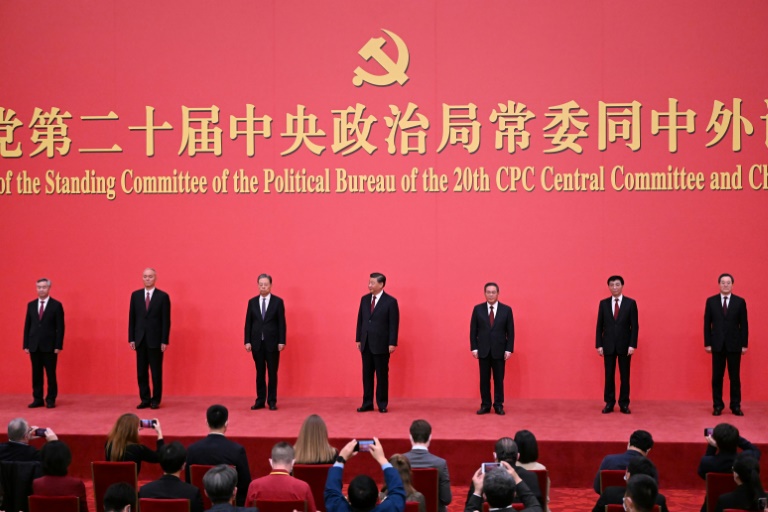
Six of Xi’s proteges and allies were also unveiled on Sunday alongside him as members of the Politburo Standing Committee — the party’s apex of power that rules the country.

Li Qiang — Xi’s former chief of staff who oversaw a gruelling two-month Covid lockdown in Shanghai this year — was named as number two in the Standing Committee.

This means he is likely to take over as premier from Li Keqiang, a former Xi rival who will retire next year. 

Close aide Ding Xuexiang and Guangdong party chief Li Xi, a longtime confidante of the president, were among other allies named in the Standing Committee.

“The new Politburo Standing Committee confirms decisively that Xi has consolidated power at the top of the Communist Party to an extent unseen since the Mao era,” said Neil Thomas, a senior China analyst at Eurasia Group.

“Xi has installed allies onto all seven seats of the Communist Party’s top decision-making body, allowing him to dominate the political system for the foreseeable future.”

Alfred Wu Muluan, a Chinese politics expert at the National University of Singapore, said: “It is all Xi’s people, signalling he wants to rule even beyond a third term.”

Xi abolished the presidential two-term limit in 2018, paving the way for him to govern indefinitely.

The leader was swiftly congratulated Sunday by some of China’s allies, including Russian President Vladimir Putin, North Korea’s Kim Jong Un, and Cuba, whose President Miguel Diaz-Canel expressed a willingness to work with Xi on the “irreversibility and vitality of socialism” in the world.

Washington offered no immediate response to Xi.

– No women –

Sunday’s announcements came after a week-long Congress of 2,300 hand-picked party delegates during which they endorsed Xi’s “core position” in the leadership and approved a sweeping reshuffle that saw Li and other former Xi rivals relegated.

On Saturday the delegates elected the Central Committee of around 200 senior party officials, who on Sunday chose the 24-person Politburo and the Standing Committee.

The Politburo will have no women members for the first time in 25 years.

Analysts had closely watched for whether the party charter would be amended during the Congress to enshrine “Xi Jinping Thought” as a guiding philosophy, a move that would put Xi on a par with Mao.

That did not take place, though a resolution did call the creed “the Marxism of contemporary China and of the 21st Century”, adding that it “embodies the best Chinese culture and ethos of this era”.

– Hu led away – 

In the most dramatic moment of the Congress, Hu Jintao — Xi’s predecessor as party leader and president — was forcibly led out of Saturday’s closing ceremony.

The frail-looking 79-year-old was reluctant to leave the front row, where he was sitting next to Xi.

State media reported that Hu had been removed because he was feeling unwell, and that he had since recovered. 

But the extraordinary events, with Xi seemingly unfazed as Hu was lifted from his chair and escorted out, fuelled frenzied speculation among observers and analysts as to whether there were political factors at play.

Xi has promoted a narrative that he has rectified huge problems that beset China and the Communist Party during the reigns of Hu and his predecessors.

These include graft within the party and unequal distribution of wealth.

Adding to the intrigue, China’s censors scrubbed references to Hu from the internet after he was removed from the Congress. 

A Hu protege, Hu Chunhua, had been tipped by some to be named to the Standing Committee on Sunday. But Xi sidelined him.

New Italy PM Meloni to meet Macron in Rome

Italy’s new Prime Minister Giorgia Meloni will take her first steps on the international stage in a meeting later on Sunday with French President Emmanuel Macron, hours after she formally took office.

Four weeks after her post-fascist Brothers of Italy party won general elections, Meloni assumed office in a handover ceremony with outgoing premier Mario Draghi, before gathering her cabinet.

“We must be united, there are emergencies the country is facing. We have to work together,” the 45-year-old told her ministers during their first meeting, lasting half an hour.

The new government is the most far-right in Italy since World War II, and takes power at a time of soaring inflation and an energy crisis linked to Russia’s invasion of Ukraine.

Macron was headed to Rome and the Vatican for a pre-planned visit and his spokesman had left the prospect of meeting Meloni open.

He will meet Meloni in the centre of Rome rather than the prime minister’s official residence, a French source told AFP.

Her government has already been rocked by tensions within Meloni’s coalition, which includes Matteo Salvini’s far-right League party and former premier Silvio Berlusconi’s right-wing Forza Italia.

Meloni was forced this week to repeat her unwavering support for Ukraine and Western sanctions against Russia after Berlusconi was recorded defending President Vladimir Putin.

The prospect of a Eurosceptic, populist government taking the helm of the eurozone’s third largest economy has already sparked concern among Italy’s allies, particularly in the European Union.

European Commission President Ursula von der Leyen said on Saturday she had a “good first call” with Meloni, saying she looked forward to “constructive cooperation”.

Chancellor Olaf Scholz of Germany said he wanted to keep “working closely together with Italy in EU, NATO and G7” — a sentiment Meloni reflected in responses to congratulatory messages on Twitter.

– Reassuring ministers –

Meloni and her 24 ministers were sworn in on Saturday before President Sergio Mattarella and she declared her intention to get “straight to work”.

On Sunday Meloni joined outgoing prime minister Draghi, a former European Central Bank chief who took over in February 2021, for a formal handover of power.

They held private talks for almost 90 minutes before a smiling Draghi symbolically handed to Meloni a small bell used in cabinet debates, which she, grinning, rang a few times for the television cameras.

As a teenage activist, Meloni praised late dictator Benito Mussolini, but insists fascism is history and has transformed her party from a marginal group of radicals to a national force.

Brothers of Italy won just four percent of the vote in 2018 elections, but secured a 26 percent in the September 25 poll.

During 18 months as the only real opposition to Draghi’s national unity government, Meloni swept up disillusioned voters, presenting herself as a straight-talking defender of traditional values and Italy’s national interests.

But her ministerial experience is limited to three years as youth minister under Berlusconi’s 2008-2011 government, while her party has never held power.

In an attempt to reassure investors that Italy’s debt-laden economy was safe in her hands, Meloni has appointed Giancarlo Giorgetti as economy minister.

Giorgetti, who served as minister of economic development under Draghi, is considered one of the more moderate, pro-Europe members of Salvini’s League.

Draghi’s energy minister, Roberto Cingolani, will stay on as government advisor as Italy tries to wean itself off Russian gas, reports said.

– Coalition tensions –

Meloni’s party no longer wants Italy to leave the EU’s single currency but remains strongly Eurosceptic, as is the League, which won nine percent in the elections.

However, she named committed European Antonio Tajani, a former president of the European Parliament who co-founded Forza Italia with Berlusconi, as foreign minister and deputy prime minister.

Salvini will serve as deputy prime minister and minister of infrastructure and transport.

Like Berlusconi, Salvini is a long-time fan of Putin and has criticised Western sanctions imposed on Russia over its invasion of Ukraine.

On Saturday Meloni again affirmed her desire to work with NATO, which she described as “more than a military alliance: a bulwark of common values we’ll never stop standing for”.

NATO chief Jens Stoltenberg and US President Joe Biden sent their congratulations, as did Ukrainian leader Volodymyr Zelensky. 
The tensions with her allies reinforce doubts as to how long she can keep her coalition together, in a country that has had almost 70 governments since 1946.

Pope Francis noted the start of the new government in his weekly Angelus Sunday, offering his prayers for “unity and peace in Italy”.

At least four dead in attack on south Somalia hotel

At least four people have been killed during a six-hour attack on a hotel in Kismayo, southern Somalia, claimed by Al-Shabaab Islamists, police and a witness said on Sunday.

The port city is the latest to be hit following a resurgence of bloody attacks in recent months by the Al-Qaeda-linked group, which has mainly targeted the capital Mogadishu and central Somalia.

Sunday’s assault began at 12:45 pm (0945 GMT) when a booby-trapped car rammed the entrance of Hotel Tawakal. It ended around 7:00 pm after the three attackers were killed by security forces.

“The situation has returned to normal, all three attackers are dead now. The security forces are in control of the situation,” Mohamed Hassan, a police officer, said.

Earlier on Sunday, officials said that as security forces sought to bring the siege to an end, they had killed two assailants.

Police put the provisional death toll for civilians at four on Sunday afternoon. 

“This is not a government target,” police officer Abdullahi Ismail said. “It is just an ordinary, civilian-frequented hotel.”

Witness Abdirashid Adan, who lives close to the hotel, said “the building is secured now, there is no gunfire.

“I can see movement is returning gradually in the area but there are still members of the security forces restricting traffic movement,” Adan added.

Another witness, Farhan Hassan, was outside the hotel when the attack happened and said “a suicide bomber drove a vehicle into the entrance of the hotel before the gunmen entered the building”.

Al-Shabaab claimed responsibility for the attack, saying members of the federal government of Jubaland, where Kismayo is located, were meeting in the hotel at the time.

– ‘Total war’ –

Al-Shabaab has been trying to overthrow the government for more than 15 years and regularly attacks civilian and military targets. 

Kismayo was once an Al-Shabaab stronghold before it was taken over in 2012 by local militias backed by Kenyan forces.

In August the group launched a 30-hour gun and bomb attack on the popular Hayat hotel in Mogadishu, killing 21 people and wounding 117.

In 2019, the group conducted a similar attack on a hotel in Kismayo, killing 26 and injuring 56.

Somali President Hassan Sheikh Mohamud, who was elected in May, vowed after the siege in August to wage “all-out war” on the Islamists.

In September he urged citizens to stay away from areas controlled by jihadists, saying the armed forces and tribal militia were ratcheting up offensives against them.

A joint US-Somali drone strike killed one of the militants’ most senior commanders on October 1.

Just hours after his death was announced, a triple bombing in the southern city of Beledweyne killed at least 30 people. 

In addition to violence, Somalia — like its neighbours in the Horn of Africa — is in the grip of the worst drought in more than 40 years. Four failed rainy seasons have wiped out livestock and crops.

Some 7.8 million Somalis — nearly half the population — are affected by the drought and 213,000 are on the brink of famine as a result, according to the United Nations

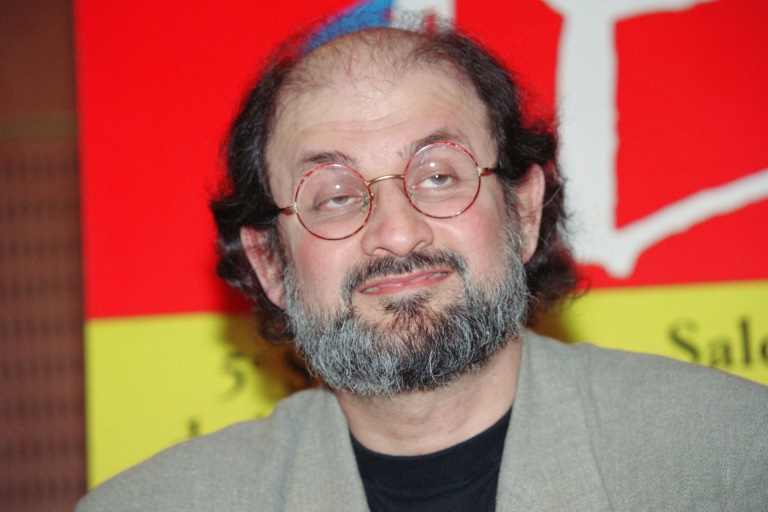
Rushdie lost sight in eye, use of hand in attack: agent

Author Salman Rushdie lost vision in one eye and was left “incapacitated” in a hand after he was stabbed in the United States in August, his agent said in an interview published this weekend.

The 75-year-old writer, who had received several death threats after the publication of his “The Satanic Verses”, was stabbed several times in the neck and abdomen before he was due to give a talk in the state of New York.

Rushdie was then air-lifted to a nearby hospital for emergency surgery but his condition had improved in the weeks after.

“He’s lost the sight of one eye… He had three serious wounds in his neck. One hand is incapacitated because the nerves in his arm were cut. And he has about 15 more wounds in his chest and torso,” Andrew Wylie told Spanish daily El Pais, providing an update on Rushdie’s health.

The injuries “were profound… it was a brutal attack”, Wylie added.

He would not give any information about the writer’s whereabouts, or whether he was still in hospital, but said: “He’s going to live.”

The British author had lived in hiding for years after Iran’s first supreme leader Ayatollah Ruhollah Khomeini ordered his killing for what he deemed the blasphemous nature of “The Satanic Verses”.

The main suspect, Hadi Matar, a 24-year-old from New Jersey with roots in Lebanon, was arrested immediately after the attack on Rushdie and he then pleaded not guilty during a hearing in New York state in mid-August.

The attack sparked outrage in the West but was praised by extremists in Muslim countries like Iran and Pakistan.

At least four dead in attack on south Somalia hotel

At least four people have been killed in an attack on a hotel in Kismayo, southern Somalia, claimed by Al-Shabaab Islamists, police and a witness said on Sunday.

The port city is the latest to be hit following a resurgence of bloody attacks in recent months by the Al-Qaeda-linked group, which has mainly targeted the capital Mogadishu and central Somalia.

Sunday’s assault began at 12:45 pm (0945 GMT) when a booby-trapped car rammed the entrance of Hotel Tawakal.

“Another dead body of a civilian was discovered, making four the overall civilian casualties we have confirmed so far,” police officer Abdullahi Ismail said, updating the toll of three given by officials earlier.

“This is not a government target,” Ismail said. “It is just an ordinary, civilian-frequented hotel.”

As security forces sought to bring the siege to an end, they killed “two of the attackers”, he added. “They are clearing the hotel building and will soon announce the siege is over.”

Witness Abdikarin Yare told AFP the forces “managed to storm the main building and we can still hear gunshots”, adding: “Two dead bodies of the attackers were dragged out.”

Another witness Farhan Hassan, who was outside the hotel when the attack happened, said “a suicide bomber drove a vehicle into the entrance of the hotel before the gunmen entered the building”.

Al-Shabaab claimed responsibility for the attack, saying members of the federal government of Jubaland, where Kismayo is located, were meeting in the hotel at the time.

– ‘Total war’ –

Al-Shabaab has been trying to overthrow the government for more than 15 years and regularly attacks civilian and military targets. 

Kismayo was once an Al-Shabaab stronghold before it was taken over in 2012 by local militias backed by Kenyan forces.

In August it launched a 30-hour gun and bomb attack on the popular Hayat hotel in Mogadishu, killing 21 people and wounding 117.

In 2019, the group conducted a similar attack on a hotel in Kismayo, killing 26 and injuring 56.

Somali President Hassan Sheikh Mohamud, who was elected in May, vowed after the siege in August to wage “all-out war” on the Islamists.

In September he urged citizens to stay away from areas controlled by the jihadists, saying the armed forces and tribal militia were ratcheting up offensives against them.

A joint US-Somali drone strike killed one of the militants’ most senior commanders on October 1.

Just hours after his death was announced, a triple bombing in the southern city of Beledweyne killed at least 30 people. 

In addition to violence, Somalia — like its neighbours in the Horn of Africa — is in the grip of the worst drought in more than 40 years. Four failed rainy seasons have wiped out livestock and crops.

Some 7.8 million Somalis — nearly half the population — are affected by the drought and 213,000 are on the brink of famine as a result, according to the United Nations

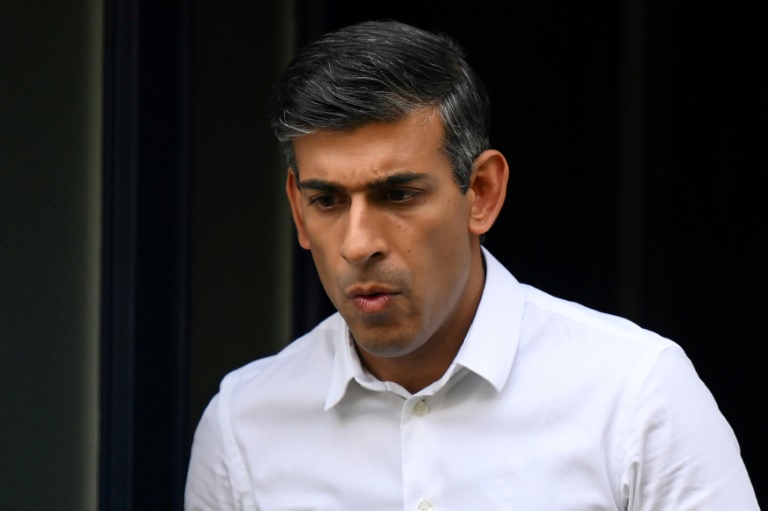
Sunak declares fresh bid for British PM

British Conservative Rishi Sunak on Sunday announced he is standing to be prime minister, just weeks after failing in a first attempt — and setting up a potentially bruising battle with his former boss Boris Johnson.

Ex-finance minister Sunak vowed “integrity, professionalism and accountability” and to lead Britain out of “profound economic crisis”, which experts say has been worsened by the aborted policies of outgoing leader Liz Truss.

“I want to fix our economy, unite our party and deliver for our country,” he said in a short statement posted on Twitter confirming his widely expected candidacy.

The no-frills announcement contrasted with his last failed bid to be Tory leader, when he faced criticism for a slickly produced video launched just days after he had helped depose ex-prime minister Johnson by resigning in July. 

Sunak, 42, is the second Conservative MP to declare a run at the top job, after cabinet member Penny Mordaunt launched her campaign on Friday.

Johnson is anticipated to enter the likely week-long contest, after he cut short a Caribbean holiday to return to Britain Saturday and attempt an audacious political comeback less than two months after leaving office.

The 58-year-old is said to be intensely lobbying Conservative colleagues ahead of a Monday afternoon deadline to secure the 100 nominations required to face a vote of the Tories’ 357 MPs.

– ‘Secret summit’ –

Sunak has raced ahead in that count, crossing the minimum threshold Friday and currently boasting the public backing of 146 Tory lawmakers, according to a BBC tally.

That compares to Johnson’s 57 and 23 for Mordaunt, though the ex-leader’s allies insist he has secured the 100 nominations.

“Boris’s campaign tell me that they have the numbers,” Business Secretary Jacob Rees-Mogg told the broadcaster. “Clearly, he is going to stand. There is a great deal of support for him.”

The Tories have been forced into a second, this time expedited, leadership contest since the summer following Truss’s resignation after only 44 disastrous days into her tenure over her calamitous tax-slashing mini-budget.

If two candidates remain after Conservative lawmakers vote Monday, the party’s approximately 170,000 members will make their choice, with the result announced Friday.

Johnson, who only relinquished power in early September following a government revolt over a slew of scandals, is still seen as the grassroots’ favourite. 

Amid growing calls for unity within the fractured ruling party, he and Sunak held talks late into the night, reports said Sunday, as the feuding political heavyweights battle behind the scenes.

Few details have emerged about what The Sun dubbed a “secret summit”. The Sunday Times said it lasted several hours “in the hope of burying the hatchet and thrashing out a deal to govern together”.

However, Sunak’s subsequent declaration suggests he is confident he can vanquish Johnson.

The ex-leader also reportedly spoke on Sunday to Mordaunt, who is said to have rebuffed his calls to back him, noting her supporters were likely to split more for Sunak.

– ‘Guaranteed disaster’ –

Mordaunt, who missed out on the last contest’s run-off by just eight MPs’ votes, is adamant she alone is able to bring the party together.

“I’m best placed to unite our party,” the 49-year-old told the BBC, arguing she was “the halfway house” between Sunak and Truss in the summer race.

Johnson’s attempt at political resurrection has already been decried by opposition politicians, and even some in his own party.

“This isn’t the time for Boris,” Sunak-supporting Northern Ireland minister Steve Baker told Sky News, arguing another Johnson-led government “would be a guaranteed disaster” and implode within months.

Sunak has also picked up several other endorsements, including from Home Secretary Grant Shapps, a former ally of Johnson, and trade minister Kemi Badenoch, an influential right-winger who finished fourth in the last leadership contest.

In a swipe at the ex-premier in The Sunday Times, she cautioned against “nostalgia for the cavalier elan of 2019” — when he won an 80-seat majority — and said the party “is not a vehicle for any one individual’s personal ambitions”.

New polling showed the Tories could benefit from a change of leader, after Truss’s missteps plunged them to unprecedented lows.

But a survey by Conservative pollster James Johnson still found all three Tory candidates had negative favourability, with Johnson on -24, Mordaunt -15 and Sunak -2. 

The main Labour opposition, which has opened up huge poll leads, is demanding a general election.

“The country needs to get rid of this chaos,” its leader Keir Starmer said.

Power cuts hit Kyiv as Russia pummels energy grid

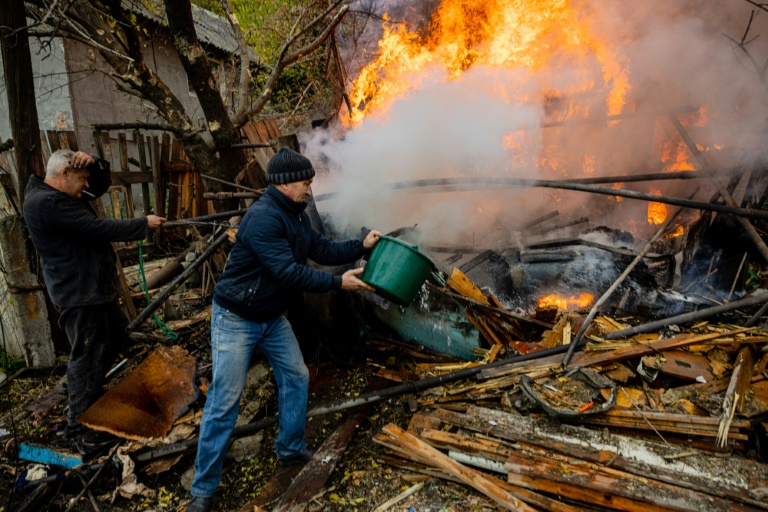
Kyiv’s energy operator on Sunday said scheduled power cuts have been introduced in the Ukrainian capital as Russia has repeatedly targeted the nation’s power network.

More than one million Ukrainian households have lost electricity following recent Russian strikes, according to the Ukrainian presidency, with at least a third of the country’s power stations destroyed ahead of winter.

Moscow announced a new incursion on Sunday, saying it had destroyed a depot in central Ukraine that was storing over 100,000 tonnes of aviation fuel.

Ukrainian President Volodymyr Zelensky on Saturday evening denounced “vile strikes on critical objects” by Russia after fresh attacks on energy facilities and power outages were reported nationwide including in western Ukraine — far from the frontline.

National energy operator Ukrenergo introduced “stabilisation shutdowns” in Kyiv on Sunday to “avoid accidents”, energy company DTEK said in a statement on its website.

The blackouts started from 11:13 am (0813 GMT) with consumers in Kyiv divided into three groups that will be “disconnected for a certain period of time”, DTEK said.

It added that the blackouts should last “no more than four hours” but may be longer “due to the scale of damage to the power supply system”.

DTEK reiterated calls for residents to use electricity “sparingly” and for businesses to limit their use of external lighting.

– ‘Save your strength’ –

In the southern Ukrainian city of Kryvyi Rig, deputy mayor Sergiy Miliutin was dealing with emergencies and power outages from his underground bunker used as a venue for a children’s martial arts competition.

“I’ve reached a point where I just survive on my drive. You have to stay level-headed and save your strength. No one knows how long this will all last,” he told AFP.

The intensification of Russian strikes on Ukraine, particularly energy facilities, came after the bridge linking the annexed Crimea peninsula to mainland Russia was partially destroyed by an explosion earlier this month.

The incident was seen as another major setback for Moscow’s forces, which are battling to contain a Ukrainian counter-offensive in the south and east of the country.

Russian Defence Minister Sergei Shoigu held telephone calls with his French, Turkish and British counterparts to discuss Ukraine.

Shoigu conveyed “concerns about possible provocations by Ukraine with the use of a ‘dirty bomb'” in all three calls, the Russian defence ministry said.

Ukraine reported three deaths in an overnight Russian artillery strike in the Toretsk area, said a governor of the eastern Donetsk region.

In Russia itself, two lines of defence have been built in the region of Kursk near the border with Ukraine to deal with a possible attack, a local governor said Sunday.

The move came a day after the governor in the neighbouring region of Belgorod, which also borders Ukraine, said the construction of defence structures began in parts of the region.

The governor, Vyacheslav Gladkov, also reported the death of two civilians in strikes on his region on Saturday, adding that 15,000 people were left without electricity.

– Kherson evacuations –

Ukraine’s SBU intelligence service offered a new accusation of alleged collaboration, saying it had detained two officials of Ukrainian aircraft engine maker Motor Sich on suspicion of working with Russia.

The SBU said the management of the company’s plant in Ukraine’s southern Zaporizhzhia region — part of which is controlled by Russian forces — “acted in collusion” with Russian state-owned defence conglomerate Rostec.

“The suspects established transnational channel for the illegal supply of wholesale batches of Ukrainian aircraft engines to the aggressor country,” the SBU said, specifying that Russia used them to produce and repair attack helicopters. 

The power cuts and deadly strikes came as pro-Moscow officials in the southern Ukrainian region of Kherson that Russia claims to have annexed urged residents on Saturday to leave “immediately” amid a “tense situation” at the front.

Kherson, the region’s main city, was the first to fall to Moscow’s troops and retaking it would be a major prize in Ukraine’s counter-offensive.

A Moscow-installed official in Kherson, Kirill Stremousov, told Russian news agency Interfax on Saturday that around 25,000 people had left Kherson city to the left bank of the Dnipro River.

Ukraine has denounced the removal of residents from Kherson as “deportations”.

Hurricane Roslyn hits Mexico's Pacific coast

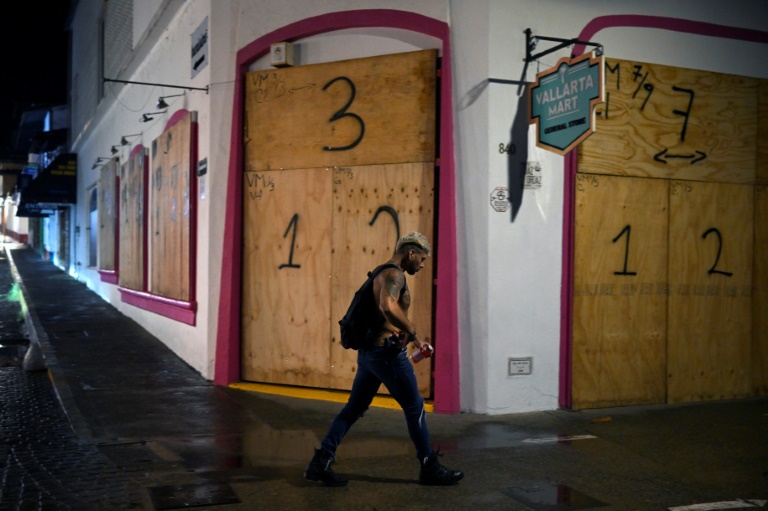
Hurricane Roslyn made landfall on the west coast of Mexico on Sunday as a powerful Category 3 storm, the US National Hurricane Center said, as communities sheltered from damaging winds, a dangerous storm surge and flash flooding.

The storm hit near the small town of Santa Cruz in the coastal Nayarit state around 5:30 am (1130 GMT) packing estimated maximum sustained winds of 120 miles (195 kilometers) per hour, the NHC said.

Just hours before hitting the Mexican shore, Roslyn was downgraded from a Category 4 to a Category 3 storm on the five-tier Saffir-Simpson Wind Scale, with the NHC predicting “rapid weakening” after landfall.

The NHC and the Mexico meteorological service warned of damaging winds, heavy rains that could cause flash flooding and landslides and waves up to six meters (20 feet) high along the Pacific coast. 

“Roslyn is expected to produce a life-threatening storm surge with significant coastal flooding in areas of onshore winds” through Sunday, the NHC said, adding that near the coast “the surge will be accompanied by large and destructive waves.”

Authorities issued hurricane warnings for portions of the Pacific coast states of Jalisco, Nayarit, Sinaloa and Las Islas Marias, some 60 miles offshore.

High winds and rough seas hit the Jalisco resort of Puerto Vallarta, home to some 220,000 people and one of the largest towns in the area affected by the hurricane, around 0900 GMT.

In the Nayarit town of Bucerias, the downpour turned some roads into rivers.

Residents were on high alert after Roslyn, the most powerful storm so far of the Pacific season, reached Category 4 after forming on Friday before it was downgraded. 

– ‘Heed every warning’ –

Jalisco, which is slated to get up to 10 inches (25 centimeters) of rain in some spots, set up shelters in the cities of Cabo Corrientes, La Huerta and Puerto Vallarta.

Victor Hugo Roldan, director of civil protection in Jalisco, told reporters on Saturday that several hundred people had been evacuated from the town of La Huerta, close to the hurricane’s expected path. 

Most went to relatives’ homes, while some went to shelters, he said.

Businesses in the resort town began to close Saturday afternoon on officials’ recommendations.

Residents rushed to make last-minute preparations, though by late Saturday afternoon some tourists were still lounging on the beach or unsuccessfully searching for open bars and restaurants. 

For 59-year-old shopping mall manager Graciano Pena, the memory of 2002’s Hurricane Kenna, which made landfall as a damaging Category 4 and left four dead, is still fresh.

“After that experience, we heed every warning and make preparations ahead of time,” he said. 

Other coastal states also prepared shelters.

Tropical cyclones hit Mexico every year on both its Pacific and Atlantic coasts, usually between May and November.

At the end of May, Agatha, the first Pacific storm of the season, hit the coast of the southern state of Oaxaca, where heavy rain in mountainous towns killed 11 people.

In October 1997, Hurricane Pauline struck Mexico’s Pacific coast as a Category 4 storm, leaving more than 200 dead.

Close Bitnami banner
Bitnami