World

ECB again eyes jumbo rate hike to 'tame inflation beast'

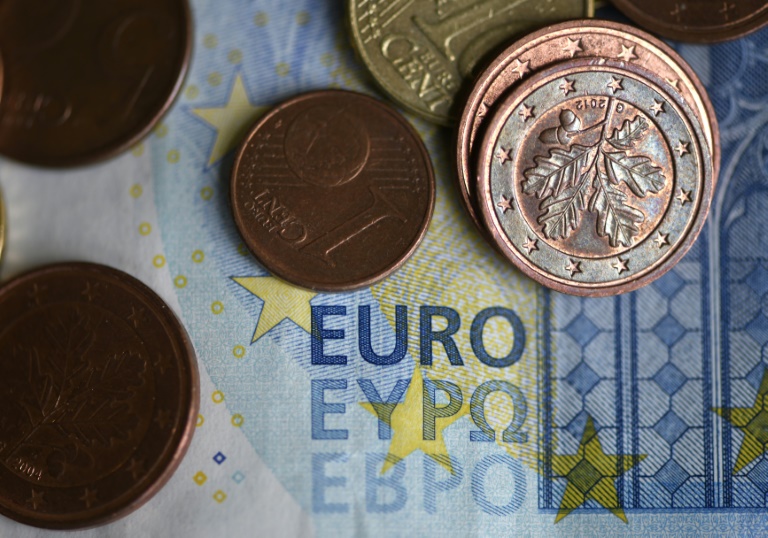
The European Central Bank is expected to set aside recession worries and deliver another jumbo interest rate hike this week to cool inflation, as Russia’s war on Ukraine sends energy prices soaring.

Inflation in the 19-nation eurozone climbed to an all-time high of nearly 10 percent in September, five times the ECB’s target of two percent.

The ECB’s governing council last month raised its key interest rates by an unprecedented 75 basis points, and many observers expect it to repeat the move at Thursday’s meeting.

Households and businesses are bracing for a grim winter as Russia continues to squeeze gas supplies to Europe, raising fears of energy shortages and eye-wateringly high electricity and heating bills.

The war has also pushed up food costs, while pandemic-era supply chain snarls combined with higher manufacturing costs have added to price pressures on a range of goods.

“Those who thought inflation was dead now know better,” said Joachim Nagel, the head of Germany’s Bundesbank central bank.

“Now the beast has woken up from its slumber… it’s up to monetary policymakers to tame it again,” he recently told students at Harvard University.

Like other central banks, the ECB is using a series of rate hikes to bring inflation under control — at the risk of slowing economic activity to such an extent that it triggers a downturn.

“The 75 basis point rate hike looks like a done deal,” said ING economist Carsten Brzeski.

“The ECB has turned a blind eye on recession risks,” he added.

Analysts from Capital Economics said they saw the ECB going even bigger, predicting a 100 basis-point jump followed by smaller hikes over the coming months.

– ‘Not painless’ –

In the United States, where inflation is running at a 40-year high, the Federal Reserve recently said there was no “painless” way to combat runaway prices.

A slowdown of economic growth and the US job market will be “required” to bring down inflation, said the Fed, which has hiked rates faster and more aggressively than the ECB.

ECB president Christine Lagarde has warned that the euro area was also facing “a significant slowdown”.

If Russia completely cuts off gas flows to Europe, the eurozone economy could shrink by nearly one percent in 2023, ECB vice-president Luis de Guindos added.

It’s a scenario that has become more likely after Russia in late August halted gas flows through the crucial Nord Stream 1 pipeline to Europe’s biggest economy, Germany.

– Government spending –

The German economy, whose energy-hungry industries relied heavily on Russian gas before the war, is now forecast to shrink by 0.4 percent in 2023.

Chancellor Olaf Scholz has unveiled a 200-billion-euro ($197 billion) energy fund to help citizens cope with price shocks, irking European neighbours who can’t afford the same fiscal largesse.

With other eurozone countries such as France and Spain also rolling out support measures, the ECB has warned governments not to fall into the trap of spending so much that they boost inflation.

Germany’s hawkish Finance Minister Christian Lindner agreed, saying last week that fiscal policy “must not counter the measures of central banks” by strengthening demand.

The ECB is also expected to use this week’s meeting to discuss bringing other monetary policy levers in line with its inflation-busting efforts.

Policymakers are likely to consider changes to the super cheap, long-term loans (TLTROs) offered to banks in recent years to help the eurozone through several crises — sometimes at negative rates.

As a consequence of the ECB’s rapid rate hikes since July, lenders can now make a profit by parking their excess TLTRO cash at the central bank and pocketing the new, higher deposit rate — leaving the ECB looking for ways to incentivise early repayment of the loans.

The ECB may also ponder how best to shrink its multi-trillion-euro balance sheet, after years of hoovering up government and corporate bonds to drive up stubbornly low inflation.

But given the uncertain outlook and the risk of rattling financial markets, analysts say the start of any “quantitative tightening” is some way off.
Most Asian markets up on rate hopes but China fear casts shadow

Most Asian markets rose Monday after a surge on Wall Street fuelled by hopes the Federal Reserve could begin to slow its pace of interest rate hikes.

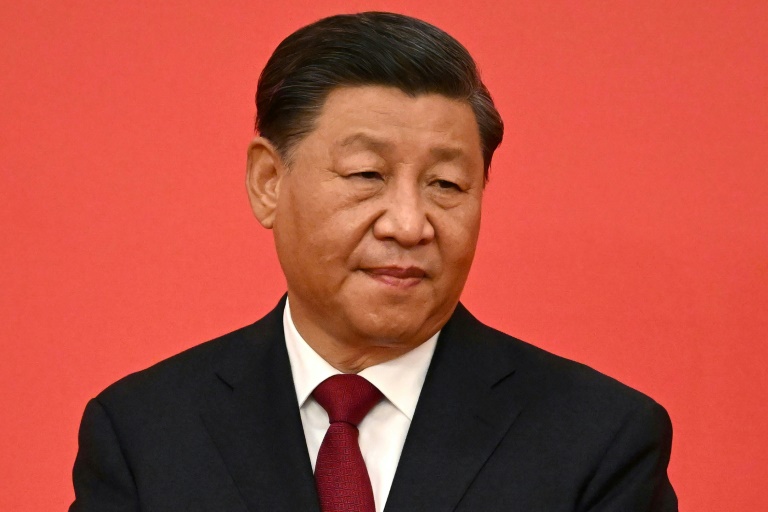
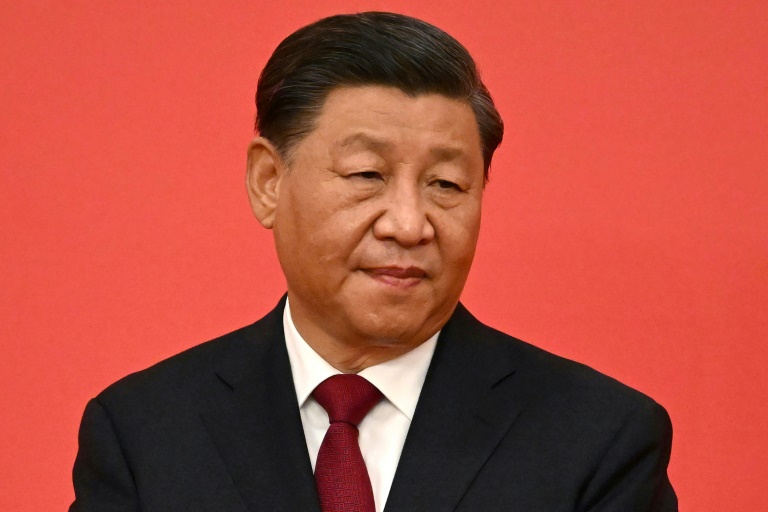
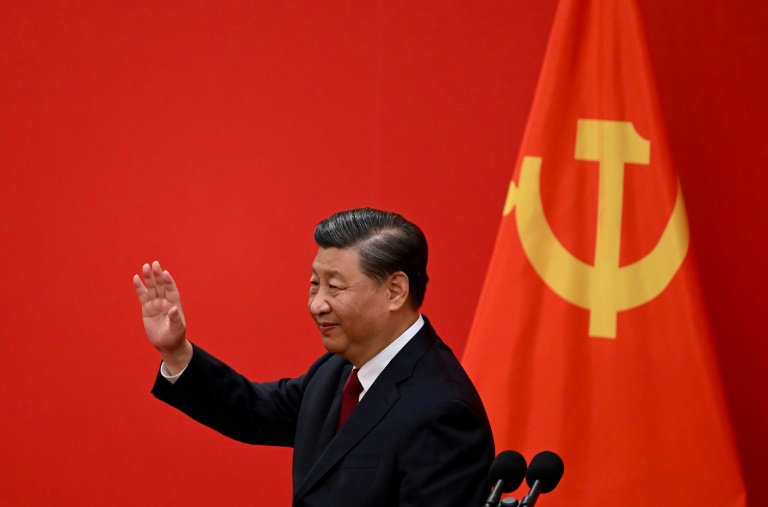
However, the bright start to the week was overshadowed by a plunge in Hong Kong and Shanghai after Xi Jinping was handed a third term as leader and put in place a team who back his economically damaging zero-Covid strategy.

The yen fluctuated against the dollar as speculation swirled that Japanese authorities had stepped into forex markets again to support their currency for a second time in as many sessions.

Tokyo, Sydney, Seoul and Taipei led gains after a strong performance in New York that was sparked by a report the Fed could begin to take its foot off the pedal in its rate hike campaign.

The Wall Street Journal article said some officials were keen to discuss a slowdown when they meet next month.

Markets have been hammered this year by fears that moves by the Fed and other central banks to fight decades-high inflation will spark a recession.

Officials had been expected to lift rates 75 basis points for a fourth successive time next month, while bets were increasing on another such move in December.

“The mere suggestion of the Fed stepping down from 75 basis points to a 50 basis point incremental rate hike in December produced a fierce rally in US equities, partial reversal of the recent surge in US Treasury yields and smart about-turn in the US dollar,” said National Australia Bank’s Ray Attrill.

However, while most equity markets across the region were well up, Chinese markets were being hammered by the reshuffle at the top of government. Hong Kong shed more than four percent and Shanghai almost one percent.

-Zero-Covid worries-

Xi, who was at the weekend given a third five-year term as leader, handed key positions to loyalists who back his strategy of fighting Covid outbreaks with lockdowns and other strict measures.

The policy has been blamed for the sharp drop in growth in the world’s number two economy, and while data showed Monday that it expanded more than forecast in the third quarter, traders remain on edge.

On currency markets, the yen was hovering around 149 to the dollar, having strengthened to 145.65 earlier amid talk that authorities had intervened to support the unit for a second time in as many sessions.

Observers said officials likely stepped in on Friday after the dollar soared to a fresh 32-year high of 151.93 yen. That came after warnings from the finance ministry that it was keeping tabs on movements, and follows a similar move last month.

“Whilst the (finance ministry) has since declined to comment on whether they intervened, such action has not come without multiple warnings from officials,” said Matt Simpson at City Index.

“The MoF last week said they will deal with speculators ‘severely’ and the strong price reaction on Friday suggests they did just that.

“Price action has also been erratic in Monday’s Asian session, which points to another probable intervention.”

The pound rose after former UK prime minister Boris Johnson said he would not stand for the Conservative leadership again, after the resignation of Liz Truss last week.

His decision leaves his former finance minister Rishi Sunak the favourite to take the reins and become the country’s third premier this year.

The choice of the less-controversial Sunak could provide a little stability in Westminster after weeks of turmoil sparked by Truss’s debt-fuelled mini-budget that hammered the pound and sent shivers through markets.

– Key figures around 0230 GMT –

Tokyo – Nikkei 225: UP 1.0 percent at 27,156.95 (break)

Hong Kong – Hang Seng Index: DOWN 4.4 percent at 15,497.13

Shanghai – Composite: DOWN 0.9 percent at 3,010.37

Pound/dollar: UP at $1.1318 from $1.1258 on Friday

Dollar/yen: UP at 148.92 yen from 147.65 yen

Euro/dollar: DOWN at $0.9840 from $0.9863

Euro/pound: DOWN at 86.93 pence from 87.26 pence

West Texas Intermediate: FLAT at $85.05 per barrel

Brent North Sea crude: FLAT at $93.47 per barrel

New York – Dow: UP 2.5 percent at 31,082.56 (close)

London – FTSE 100: UP 0.4 percent at 6,969.73 (close)

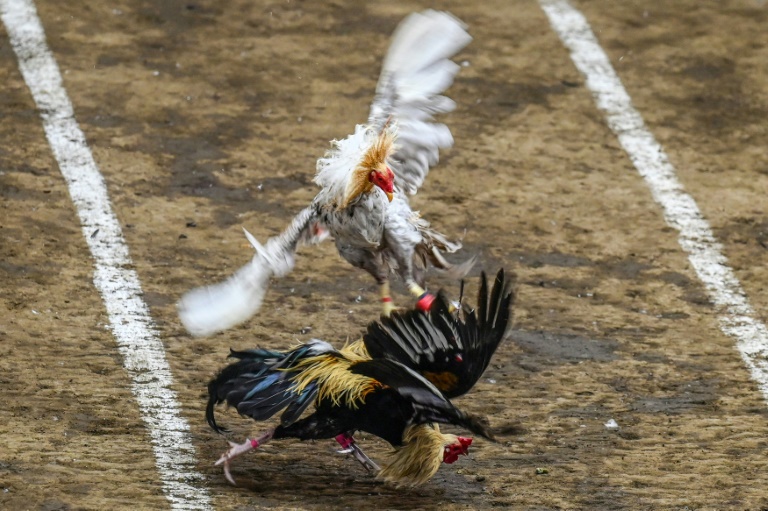
Feathers fly as Philippine cockfighting shakes off Covid closures

In a raucous cockpit in the Philippines, Dennis de la Cruz grins from ear to ear as he watches his roosters slash their opponents to death in a frenzy of blood and feathers.

Shut for two years during the Covid-19 pandemic, traditional cockfighting arenas are getting back to full capacity across the archipelago nation.

Cockfighting is hugely popular in the Philippines, where millions of dollars are bet on matches every week.

Roosters wearing bladed spurs on their legs go beak to beak in a brutal fight to the death, as spectators — mostly men — wager on the result.

Supporters defend the blood sport as being part of the Filipino identity and argue the birds would be eaten if they did not fight.

But opponents maintain it is cruel and should be banned, as it is in many other countries.

“In our village, more than half the residents are cockfighters,” de la Cruz, 64, told AFP at a recent derby in San Pedro, a city south of Manila, where he fell one win short of the one-million-peso ($17,000) champion’s pot.

The son of a longtime cockpit operator, de la Cruz said he had never held a regular job. Instead, he relied on his winnings from the roosters bred by his nephews on a large farm.

In a country plagued by inequality, cockfighting is a unique “neutral zone” where rich and poor mingle and play by the same rules, said University of the Philippines anthropologist Chester Cabalza.

Adhering to a strict honour code, spectators prior to the pandemic used hand signals like stock brokers to lay their bets during a match that can last less than a minute.

It is common for 300,000 to 400,000 pesos to be bet on a single fight, one aficionado told AFP.

After each fight — there are 15 per hour — crumpled banknotes are flung towards the winning bettor.

Losers welching on bets run the risk of being attacked.

When cockpits reopened, regulators wary of spreading the coronavirus through excessive crowd interaction ordered operators to install betting machines, so winners could collect their money from the cashier instead.

“If your cock wins, you stride out of the ring like a tough guy — you exude a macho image,” said gamefowl breeder Edwin Lumbres, thrusting his chest out for emphasis.

“But if you lose, you hang your head and shuffle out like somebody whose manhood is suspect.”

– ‘Forced to fight’ – 

Katrina Del Espiritu Santo, of People for the Ethical Treatment of Animals, is pushing for cockfighting to be banned as the birds are “forced to fight to the death”. 

But the activist’s efforts have failed to gain much traction in the Philippines.

Fighting roosters are ubiquitous across the country and are prized possessions — despite their loud crowing at all hours. 

A bird can cost between 3,000 and 15,000 pesos depending on its parents’ win record. 

Fighting fowls are kept in wire cages outside homes in urban areas or in triangular shelters on farms that dot the countryside.

As cockpits fell silent at the start of the pandemic, many small breeders could not afford to feed their flocks and were forced to sell roosters at firesale prices — or throw them in the cooking pot. 

Others admitted staging illegal fights to make ends meet. 

To revive the sport and get revenue flowing into government coffers drained by the Covid-19 response, former president Rodrigo Duterte issued permits to seven outfits to operate online cockfighting.

Known as e-sabong, fights were held in empty arenas and streamed 24 hours a day, allowing people to place minimum bets of 200 pesos per fight on their mobile phones.

The sport’s popularity exploded — and so did the earnings.

People who had never watched cockfighting before began betting, while large breeding farms saw demand for their fowl surge.

Duterte said the national government was raking in 640 million pesos a month in fees — even as the economy tanked.

It was also lucrative for e-sabong operators. 

Charlie Ang, who runs Lucky 8 Star Quest, told a Senate inquiry this year that Filipinos wagered between one and two billion pesos on his platform every day, which he claimed accounted for about 95 percent of e-sabong bets.

But the disappearance earlier in the year of 34 cockfighting workers, who are feared dead, and reports of gamblers being driven to financial ruin revealed the seedy side of e-sabong.

Some punters reportedly killed themselves, while a woman was arrested for allegedly selling her baby to pay off debts.

Under growing pressure from the public and lawmakers, Duterte reluctantly shut down online cockfighting shortly before his term ended in June.

But as pandemic restrictions eased in the past year, local governments began giving traditional cockpit operators permission to resume fights — to the relief of millions of Filipinos.

“People were angry because their favourite pastime was taken away,” said Dondon Clanor, 45, a cockfighting enthusiast. 

“Now everyone is happy.” 

UK's Sunak poised to become PM as Johnson quits leadership race

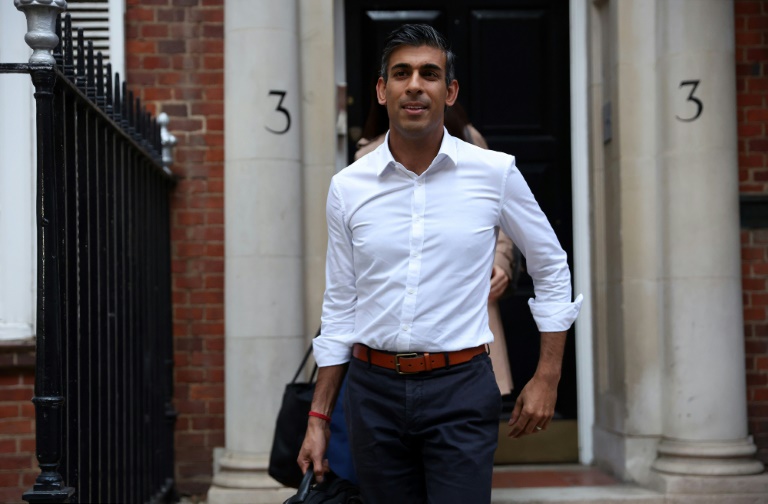
British Conservative Rishi Sunak was on Monday poised to become prime minister and the country’s first leader of colour, after the dramatic decision by Boris Johnson to abandon an audacious political comeback.

Just weeks after failing in a first attempt to lead the ruling Tories, Sunak could cap a stunning reversal in fortunes by winning the leadership as early as Monday afternoon, following ex-premier Johnson’s unexpected move late Sunday.

The contest, triggered by outgoing leader Liz Truss’s resignation on Thursday, requires candidates to secure the support of at least 100 Conservative MPs by 2:00 pm (1300 GMT) on Monday.

Sunak had crossed that threshold by Friday night, ahead of declaring his candidacy on Sunday and amassing nearly 150 public nominations from Tory lawmakers.

Johnson’s withdrawal from the race — before he had even formally announced his candidacy — left cabinet member Penny Mordaunt as the only other declared contender.

But she has struggled for momentum, attracting just two dozen public backers among her fellow MPs. Mordaunt is expected to come under growing pressure to abandon her leadership bid and end the contest quickly as Britain grapples with multiple crises.

If the 49-year-old resists and is able to garner 100 nominations, the race will be decided by the party’s roughly 170,000 members in an online vote later in the week. If it came to that, the result would be announced Friday.

Just two months ago, the members selected Truss over Sunak, who had more support among MPs. Mordaunt is popular with the grassroots.

First, however, the Tories’ 357 MPs would hold an “indicative” ballot — from 3:30 pm to 5:30 pm on Monday — to show members which candidate commands the most support within the fractious parliamentary party.

– ‘Dire straits’ –

The Tories were forced into their second leadership contest since the summer due to Truss’s resignation after only 44 days following the disastrous market response to her tax-slashing mini-budget.

She had replaced Johnson in early September following another government revolt over a slew of scandals, most notably the “Partygate” controversy involving Covid lockdown-breaching parties.

His attempt to make an immediate return to Downing Street appeared set to continue months of disarray and disunity within the ruling Conservatives.

Critical backbench Tory MPs warned there could be a wave of resignations under Johnson’s renewed leadership, which might have led to the general election demanded by opposition parties. It is not due for at least two years.

Onetime Johnson allies, such as interior minister Grant Shapps, switched to Sunak. So too did right-wingers including Steve Baker, Kemi Badenoch and Suella Braverman.

Some, such as Baker, went out of their way to speak out against the former leader’s return. He predicted a Johnson-led government would be “a guaranteed disaster”.

The Brexit figurehead had cut short a Caribbean holiday to return to Britain on Saturday and had won the backing of numerous cabinet members, including Foreign Secretary James Cleverly and Business Secretary Jacob Rees-Mogg.

But in a sign of his diminished political standing, Johnson abruptly conceded late Sunday that “you can’t govern effectively unless you have a united party in parliament”.

While he had been “overwhelmed” by the encouragement, he reluctantly decided that “the best thing is that I do not allow my nomination to go forward”, he said in Sunday’s statement.

“I believe I have much to offer but I am afraid that this is simply not the right time,” Johnson added, while insisting he had secured the 100 nominations needed to progress in the current contest.

– ‘Unifying’ –

Sunak was quick to pay tribute to Johnson, tweeting: “I truly hope he continues to contribute to public life at home and abroad.”

The pair had held talks late into Saturday night, reports said — thought to be their first face-to-face since a political falling out erupted in the summer.

But hopes they would somehow form a unity ticket were swiftly dashed by Sunak announcing his candidacy 12 hours later.

The ex-leader also reportedly spoke on Sunday to Mordaunt, who was said to have rebuffed his calls to back him, noting her supporters were likely to split more for Sunak.

She appears intent on remaining in the now two-person race.

“Penny is the unifying candidate who is most likely to keep the wings of the Conservative Party together,” a campaign source said after Johnson’s withdrawal.

“Polling shows that she is the most likely candidate to hold onto the seats the Conservative Party gained in 2019.”

Polls over the weekend suggested that the Tories could benefit from a change of leader, after Truss’s missteps plunged them to unprecedented lows.

But a survey by Conservative pollster James Johnson still found Mordaunt had a negative rating of -15 among the electorate, with Sunak polling at -2.

China economy grows 3.9 percent year-on-year in third quarter

China’s economy grew 3.9 percent year-on-year in the third quarter, according to official data released Monday, beating forecasts a day after President Xi Jinping was re-elected to a historic third term as leader.

Beijing last week delayed the release of the third-quarter growth figures — along with a host of other economic indicators — as the country’s leaders gathered in Beijing for the five-yearly Communist Party Congress. 

China had been expected to announce some of its weakest quarterly growth figures since 2020, with its economy hobbled by Covid-19 restrictions and a real estate crisis.

In the previous quarter, growth in the world’s second-largest economy collapsed to 0.4 percent compared with the previous year, the worst performance since 2020. The country posted 4.8 percent growth in the first quarter of 2022.

But Monday’s data, published six days later than scheduled, showed a slight rebound, with China posting growth higher than the 2.5 percent predicted by a panel of experts surveyed by AFP.

It did, however, show a marked rise in unemployment from last month, a figure officials blamed on the pandemic. 

Many economists continue to think China will struggle to attain its 2022 growth target of around 5.5 percent, and the International Monetary Fund (IMF) has lowered its GDP growth forecast to 3.2 percent for 2022 and 4.4 percent for next year.  

AFP’s panel of experts predicted average growth of three percent in 2022, far below the 8.1 percent seen in 2021. 

That would equal China’s weakest growth rate in four decades, excluding 2020, when the global economy was hammered by the emergence of the coronavirus.

“The big policy challenge is accepting that the economy has reached a state of maturity that means growth numbers are likely permanently reset to the zero-to-4.5 percent range for the coming decade,” Clifford Bennett, chief economist at ACY Securities, told AFP. 

– Zero-Covid –

Beijing’s zero-Covid policy, which continues to weigh heavily on the economy, appears no closer to loosening than before the weekend’s Party Congress. 

China is the last of the world’s major economies to continue following the strategy, which imposes tight travel restrictions, mass PCR testing and obligatory quarantines.  

It involves sudden and strict lockdowns — including of businesses and factories — which has disrupted production and weighed heavily on household consumption.

But despite the impact on the economy, “there is no clear sign of a significant easing of the zero-Covid strategy”, Nomura’s Ting Lu said, noting that, if anything, the opposite had happened. 

In the week leading up to the Congress, state media published multiple editorials warning the policy should not be relaxed, and officials have pounced on recent outbreaks across the country with increased curbs.

Meanwhile, China is also battling an unprecedented crisis in its real estate sector — historically a driver of growth and representative of more than a quarter of the country’s GDP when combined with construction. 

Following years of explosive growth fuelled by easy access to loans, Chinese authorities launched a crackdown on excessive debt in 2020.

Property sales are now falling across the country, leaving many developers struggling and some owners refusing to pay their mortgages for unfinished homes.

Despite the problems, “many economic indicators have actually recovered reasonably well from the mass lockdowns of March and April”, according to analyst Thomas Gatley of Gavekal Dragonomics.

Car sales held strong in September, driven by strong demand for electric clean vehicles.

August exports increased by 7.1 percent compared with the previous year, and Beijing has invested in infrastructure to support activity.

However, “those pillars of growth are becoming more fragile”, Gatley said. 

China economy grows 3.9 percent year-on-year in third quarter

China’s economy grew 3.9 percent year-on-year in the third quarter, according to official data released Monday, beating forecasts a day after President Xi Jinping was re-elected to a historic third term as leader.

Beijing last week delayed the release of the third-quarter growth figures — along with a host of other economic indicators — as the country’s leaders gathered in Beijing for the five-yearly Communist Party Congress. 

China had been expected to announce some of its weakest quarterly growth figures since 2020, with its economy hobbled by Covid-19 restrictions and a real estate crisis.

In the previous quarter, growth in the world’s second-largest economy collapsed to 0.4 percent compared with the previous year, the worst performance since 2020. The country posted 4.8 percent growth in the first quarter of 2022.

But Monday’s data, published six days later than scheduled, showed a slight rebound, with China posting growth higher than the 2.5 percent predicted by a panel of experts surveyed by AFP.

It did, however, show a marked rise in unemployment from last month, a figure officials blamed on the pandemic. 

Many economists continue to think China will struggle to attain its 2022 growth target of around 5.5 percent, and the International Monetary Fund (IMF) has lowered its GDP growth forecast to 3.2 percent for 2022 and 4.4 percent for next year.  

AFP’s panel of experts predicted average growth of three percent in 2022, far below the 8.1 percent seen in 2021. 

That would equal China’s weakest growth rate in four decades, excluding 2020, when the global economy was hammered by the emergence of the coronavirus.

“The big policy challenge is accepting that the economy has reached a state of maturity that means growth numbers are likely permanently reset to the zero-to-4.5 percent range for the coming decade,” Clifford Bennett, chief economist at ACY Securities, told AFP. 

– Zero-Covid –

Beijing’s zero-Covid policy, which continues to weigh heavily on the economy, appears no closer to loosening than before the weekend’s Party Congress. 

China is the last of the world’s major economies to continue following the strategy, which imposes tight travel restrictions, mass PCR testing and obligatory quarantines.  

It involves sudden and strict lockdowns — including of businesses and factories — which has disrupted production and weighed heavily on household consumption.

But despite the impact on the economy, “there is no clear sign of a significant easing of the zero-Covid strategy”, Nomura’s Ting Lu said, noting that, if anything, the opposite had happened. 

In the week leading up to the Congress, state media published multiple editorials warning the policy should not be relaxed, and officials have pounced on recent outbreaks across the country with increased curbs.

Meanwhile, China is also battling an unprecedented crisis in its real estate sector — historically a driver of growth and representative of more than a quarter of the country’s GDP when combined with construction. 

Following years of explosive growth fuelled by easy access to loans, Chinese authorities launched a crackdown on excessive debt in 2020.

Property sales are now falling across the country, leaving many developers struggling and some owners refusing to pay their mortgages for unfinished homes.

Despite the problems, “many economic indicators have actually recovered reasonably well from the mass lockdowns of March and April”, according to analyst Thomas Gatley of Gavekal Dragonomics.

Car sales held strong in September, driven by strong demand for electric clean vehicles.

August exports increased by 7.1 percent compared with the previous year, and Beijing has invested in infrastructure to support activity.

However, “those pillars of growth are becoming more fragile”, Gatley said. 

North, South Korea trade warning shots on maritime border

South Korea’s military said Monday it had fired warning shots at a North Korean ship that crossed the countries’ de facto maritime border, prompting the North to fire a warning in return.

Pyongyang has conducted a blitz of weapons tests, including what it claimed were tactical nuclear drills, in recent weeks, with Seoul and Washington ramping up joint military exercises in response.

With talks long-stalled, North-South relations are at one of their testiest points in years, with Pyongyang’s Kim Jong Un last month declaring his country an “irreversible” nuclear power, effectively ending negotiations over his banned weapons programmes.

Never officially delineated by the 1953 armistice agreement that brought Korean War hostilities to a close, the maritime border remains a flashpoint and has been the location of several previous clashes between the two sides.

A North Korean merchant vessel crossed what is known as the Northern Limit Line at 3:42 am (1842 GMT) but retreated north after Seoul’s navy fired warning shots, South Korea’s Joint Chiefs of Staff said.

“The North’s continuing provocations and reckless claims undermine peace and stability on the Korean peninsula and international community,” JCS said in a statement, urging Pyongyang to “stop immediately”. 

– North Korea response –

Pyongyang’s Korean People’s Army said a South Korean military vessel had “invaded” the de facto border by 2.5 to 5 kilometres (1.5 to 3 miles) a few minutes later and that the KPA fired 10 warning rounds from the country’s west coast.

KPA “coastal defence units on the western front… took an initial countermeasure to powerfully expel the enemy warship by firing 10 shells of multiple rocket launchers toward the territorial waters, where naval enemy movement was detected, at 5:15,” a KPA General Staff spokesman said in a statement carried by state media.

“The KPA General Staff once again sends a grave warning to the enemies who made (a) naval intrusion in the wake of such provocations as the recent artillery firing and loudspeaker broadcasting,” he said.

North Korea has fired multiple artillery barrages this month into a maritime “buffer-zone” that was set up in 2018 as a way to reduce tensions between the two countries during a period of ill-fated diplomacy.

The moves are part of a dramatic increase this year in what Seoul calls “provocations” by the North, including conducting its longest-ever missile launch by distance, which overflew Japan and prompted rare evacuation warnings.

Seoul has also recently conducted live-fire drills, and the US re-deployed a nuclear-powered aircraft carrier to the region to conduct large-scale trilateral drills also involving Tokyo.

“The merchant ship’s incursion and the North’s artillery firings demonstrate the lack of consensus on the NLL border,” Cheong Seong-chang, a researcher at the Sejong Institute told AFP.

“The North could attempt to invalidate the NLL later with the backdrop of military confidence in its tactical nuclear arsenal,” he said.

Experts and officials in Seoul and Washington have been warning for months that Kim is close to conducting another nuclear test — which would be his country’s seventh.

Kim has made developing tactical nukes — smaller, battlefield-ready weapons — a priority, and Seoul warned recently the North could be preparing to conduct multiple consecutive nuclear tests in a row as part of this drive.

Monday’s exchange of warning fire comes on the same day that US Deputy Secretary of State Wendy Sherman is expected to hold three-way talks with allies Japan and South Korea in Tokyo in a show of unity after the North’s slew of launches.

It's a man's world: no more women leaders in China's Communist Party

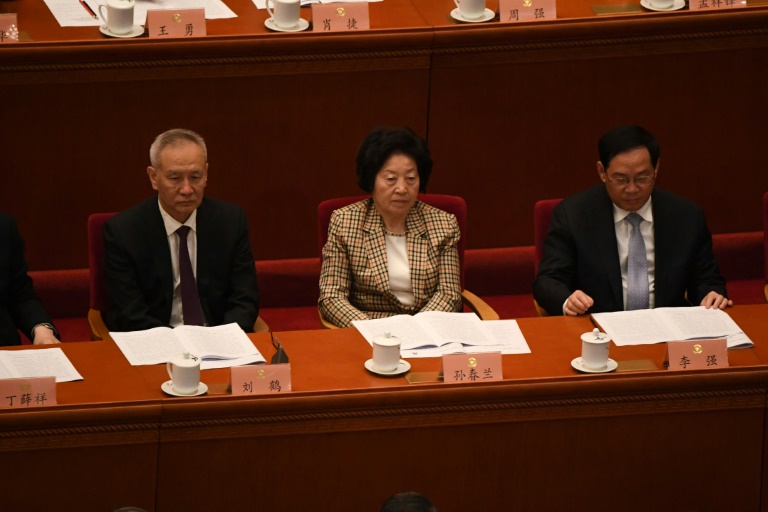
The Communist Party Congress has laid bare the striking gender imbalance in the upper echelons of Chinese politics, with not a single woman making the 24-person Politburo for the first time in at least a quarter of a century.

As Xi Jinping and his allies concentrated power over the weekend, the party’s highest-ranking woman leader retired.

Veteran politician Sun Chunlan, a vice premier overseeing China’s health policies, was absent from the Central Committee list published Saturday, meaning she has stepped down.

In the world’s biggest political party — which counts 96 million active members — women have never held much power, and now hold even less.

They make up just five percent of the party’s new 205-member Central Committee, while the seven-member Standing Committee — the apex of China’s power — remains an all-male club headed by Xi.

Sun, 72, was the only woman in the former Politburo, the party’s executive decision-making body.

Often dispatched to inspect Chinese cities in the grip of surging Covid-19 outbreaks, the former party chief of Fujian province and Tianjin municipality became the public face of the zero-Covid policy, commanding tough measures wherever she went, prompting the nickname “Iron Lady”.

But figures like Sun are a rarity in Chinese politics, where male patronage networks and ingrained sexism have stymied the careers of promising candidates, experts say.

It is a far cry from Communist Party forefather Mao Zedong’s pledge that “women hold up half the sky”.

“The Chinese Communist Party’s commitment to women’s rights I think is more like a commitment to advance women’s economic rights,” said Minglu Chen, a senior lecturer at the University of Sydney.

“It’s really about: ‘women should join the paid labour force’.”

Chen added that the Communist Party is by nature a masculine and patriarchal institution, from its roots as a social movement to today.

– Social conservatism –

China is hardly unique in its lack of women in politics. 

A prevailing social conservatism and repression of domestic women’s rights activism have made it difficult for women to defy expectations that they will prioritise family life over their careers.

The state has played into these expectations by encouraging women to have babies to offset China’s rapidly ageing population. Young women have especially chafed at this, partly due to the lack of policy support for working mothers.

“A lot of women talk about how they cannot juggle the double roles of being a good mother, wife and worker,” said Chen.

She added that most provincial officials selected for promotion have multiple higher education degrees — a  prerequisite that disadvantages women.

Many informal patronage networks are also established through frequent socialising at restaurants in heavily male — and often boozy — environments.

“Many of Xi’s former male colleagues in Zhejiang and Fujian are now Politburo members,” said Victor Shih, political science professor at UC San Diego.

“Yet none of his previous female colleagues have made it into the Politburo and not even to top provincial positions.”

China also has low retirement ages for women — 55 for women civil servants compared to 60 for men in the same profession, rising to 60 for women officials at deputy division level and above.

Ministers are expected to retire at 65, while central leaders mostly abide by an informal age cap of 68.

China introduced an informal quota system in 2001, requiring one woman at all levels of government and party except the Politburo. But without a proper supervision mechanism, this was lightly enforced.

“If we had seen a better quota system in place which was reinforced strictly, then we’d start to see different outcomes,” Chen added.

“One-party dominance has led to this as well.”

– ‘Marginal positions’ –

The Politburo has only admitted six women since 1948, with only three of them made vice premiers, and no woman has ever made it into the elite Standing Committee.

Observers had hoped Sun would be replaced by Shen Yueyue, head of the All-China Women’s Federation, or Shen Yiqin, who became the third-ever woman provincial party head when she was made chief of Guizhou — but not one woman was promoted.

Even though women make up about 29 percent of the total Communist Party membership, vanishingly few of them manage to ascend from grassroots positions.

For instance, the proportion of women in the Central Committee has hovered at between five and eight percent for the past two decades, according to Shih.

“Discrimination at lower levels prevent them from obtaining high-level positions,” he said.

“Because women held more marginal positions at lower levels, they enter government later than men and they are forced to retire earlier than male counterparts.”

DR Congo troops clash with M23 rebels, 4 civilians killed

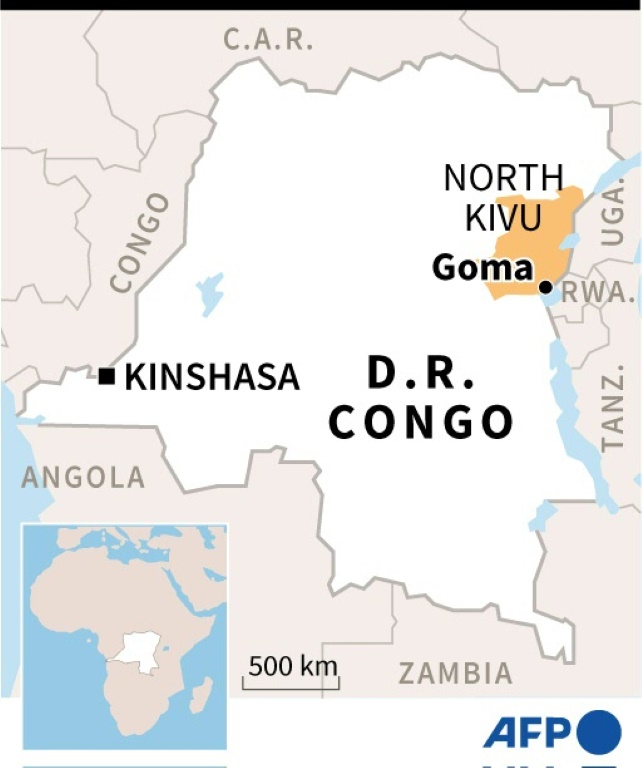
Fresh clashes between the army and M23 rebels have erupted in eastern DR Congo, officials said Sunday, with at least four civilians killed and dozens more wounded in the fighting.

A mostly Congolese Tutsi group, the M23 resumed fighting in late 2021 after lying dormant for years. It has since captured swathes of territory in the Central African country’s North Kivu province, including the strategic town of Bunagana on the Ugandan border in June.

Army officials and residents on Sunday said that M23 fighters had captured the village of Ntamugenga in North Kivu’s Rutshuru area, a strategic target that lies close to the highway leading north out of the provincial capital Goma.

The resurgence of the group has destabilised regional relations in central Africa, with the Democratic Republic of Congo accusing its smaller neighbour Rwanda of backing the militia.

The frontline between Congolese troops and M23 rebels had been calm in recent weeks. But clashes erupted again on Thursday, violence monitor Kivu Security Tracker said late Saturday. 

Three civilians were killed and 35 wounded in fighting on the road around Ntamugenga, Congo’s army said, while on another front to the north, one person was killed and another five were wounded.

Congo’s army said Sunday that the situation was under control “on all fronts”.

Congolese Colonel Serge Mavinga had earlier told AFP that troops were “next door” after the village had been captured.

Another officer, Lieutenant Colonel Ndjike Kaiko, said the army was “containing” the rebels. 

– Village bombed  –

The rebels had erected a barrier at the entrance to Ntamugenga, said village chief Celestin Nyamugira.

“The situation is gloomy here,” Nyamugira said. “They came from the forest and infiltrated the city.”

Doctors Without Borders (MSF) tweeted that 500 people had taken refuge in a convent in the settlement, including some who were wounded, and urged the creation of a humanitarian corridor to evacuate civilians.

Benedicte Lecoq, MSF’s emergency coordinator for the Rutshuru area, told AFP she was “very worried” about the humanitarian situation in Ntamugenga, explaining that bombs had been striking the village from morning to the afternoon.

The official death toll from clashes earlier this week remains unclear. Kivu Security Tracker on Saturday said at least two civilians had been killed and a dozen wounded.

Medical officials from Rutshuru Hospital also said that four civilians had been killed on Friday and Saturday, with eight wounded.

On Sunday, John Sebatware, head of Ntamugenga hospital, said that five soldiers and one civilian had been killed, with 33 people wounded. 

At least 23,000 people have fled the fighting since Thursday, according to the United Nations emergency response agency OCHA.

The M23 first leapt to prominence in 2012 when it briefly captured Goma before a joint Congolese-UN offensive drove it out.

The militia is one of scores of armed groups that roam eastern DRC, many of them a legacy of two regional wars that flared late last century.

Despite official denials from Kigali, an unpublished report for the United Nations seen by AFP in August pointed to Rwandan involvement with the M23.

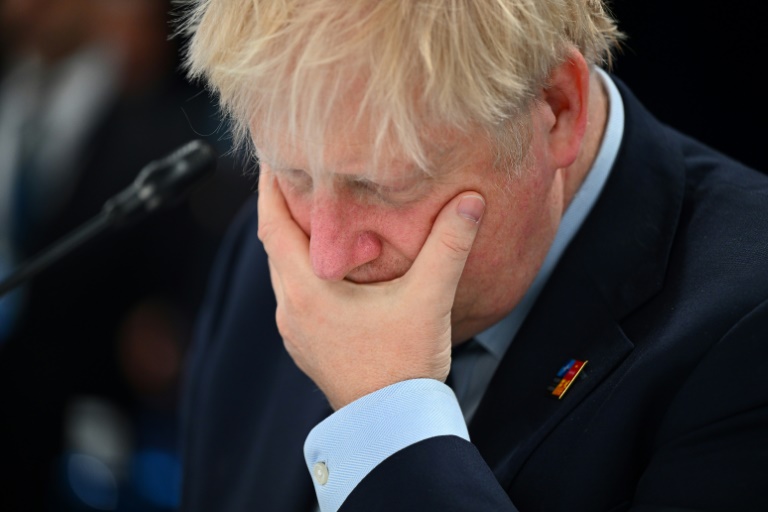
UK's Johnson ends bid for comeback as PM

Britain’s Boris Johnson on Sunday dramatically ended an audacious bid to return to power within weeks of having been ousted, announcing he would not run to replace outgoing leader Liz Truss.

The surprise decision, which the ex-premier said had been reached reluctantly after recognising he would not lead “a united party in parliament”, removes a major obstacle to his political foe, former finance minister Rishi Sunak, becoming leader.

That could now happen as soon as Monday.

Johnson, 58, said he had reached out to both Sunak and cabinet member Penny Mordaunt — who launched her leadership campaign on Friday — to “come together in the national interest”.

But the three of them had “not been able to work out a way of doing this”, he added.

“Therefore I am afraid the best thing is that I do not allow my nomination to go forward and commit my support to whoever succeeds,” he said in a statement.

“I believe I have much to offer but I am afraid that this is simply not the right time.”

Earlier Sunday, Sunak formally announced he was standing for the top job, just weeks after having failed in a first attempt.

The former finance minister vowed “integrity, professionalism and accountability” and to lead Britain out of “profound economic crisis”.

“I want to fix our economy, unite our party and deliver for our country,” he said in a short statement posted on Twitter confirming his widely expected candidacy.

– ‘Right thing’ –

The Tories have been forced into a second, this time expedited, leadership contest since the summer following Truss’s resignation after only 44 disastrous days into her tenure over her calamitous tax-slashing mini-budget.

Johnson had cut short a Caribbean holiday to return to Britain Saturday to try to stage a political comeback less than two months after leaving office.

He was reportedly lobbying Conservative colleagues ahead of a Monday afternoon deadline to secure the 100 nominations required to face a vote of the Tories’ 357 MPs.

In his statement, he said he had met the threshold by gathering 102 nominations, after being “overwhelmed by the number of people who suggested that I should once again contest the… leadership”.

There was “a very good chance” he could win the race — to be decided by the approximately 170,000 party members this week if a run-off is held.

“But in the course of the last days I have sadly come to the conclusion that this would simply not be the right thing to do,” he added. 

“You can’t govern effectively unless you have a united party in parliament.”

Johnson, who only relinquished power in early September following a government revolt over a slew of scandals, is still seen as the grassroots’ favourite.

Sunak had raced ahead in the count for Tory MPs’ support, drawing backing from across the parliamentary party and crossing the minimum threshold Friday.

He currently boasts the public backing of 146 Tory lawmakers, according to a BBC tally. The publicly declared support for Johnson ran at 57, and 23 for Mordaunt.

– ‘Guaranteed disaster’ –

Johnson’s attempt at political resurrection, while drawing significant cabinet and party backing, had also stirred opposition within his own party.

“This isn’t the time for Boris,” Sunak-supporting Northern Ireland minister Steve Baker told Sky News, arguing another Johnson-led government “would be a guaranteed disaster” and implode within months.

Johnson and Sunak held talks late into Saturday night, reports said.

The ex-leader also reportedly spoke on Sunday to Mordaunt, who was said to have rebuffed his calls to back him, noting her supporters were likely to split more for Sunak.

Mordaunt, 49, who missed out on the last contest’s run-off by just eight MPs’ votes, will now come under pressure to concede rather than force the contest to a vote of members.

Following Johnson’s announcement a campaign source said she would remain in the race.

“Penny is the unifying candidate who is most likely to keep the wings of the Conservative Party together,” the source told UK media.

“Polling shows that she is the most likely candidate to hold onto the seats the Conservative Party gained in 2019.”

New polling suggested the Tories could benefit from a change of leader, after Truss’s missteps plunged them to unprecedented lows.

But a survey by Conservative pollster James Johnson still found the remaining Tory candidates both have negative favourability: Mordaunt -15 and Sunak -2.

The main Labour opposition, which has opened up huge poll leads, is demanding a general election.

“The country needs to get rid of this chaos,” its leader Keir Starmer said.

Close Bitnami banner
Bitnami