World

Xi secures historic third term as China's leader

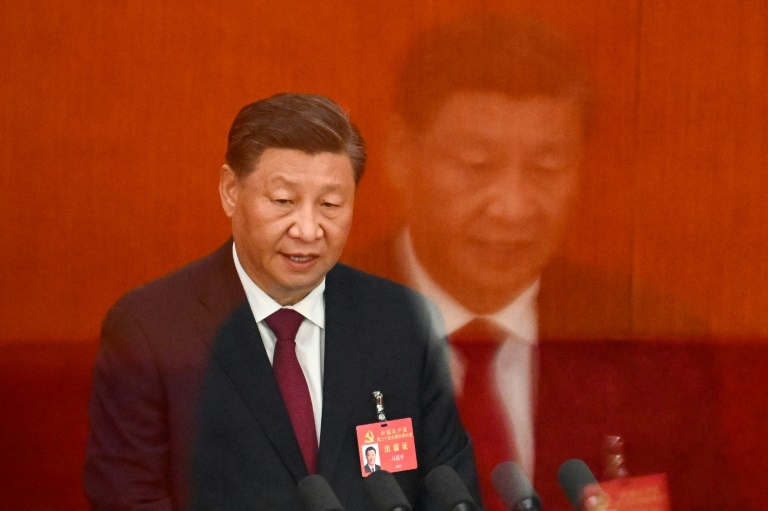
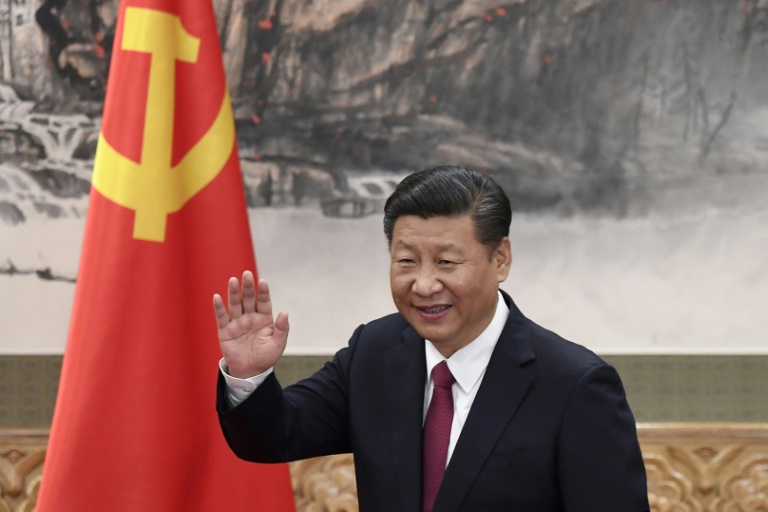
Xi Jinping secured a historic third term as China’s leader on Sunday and filled his inner circle with close allies, achieving after a decade in power complete dominance over the ruling Communist Party.

The party’s Central Committee elected Xi as its general secretary for another five-year term, bringing the country back towards one-man rule after decades of power-sharing among its elite.

“I wish to thank the whole party sincerely for the trust you have placed in us,” Xi told journalists at Beijing’s Great Hall of the People after the closed-door, rubber-stamp vote was announced.

Xi, 69, was also reappointed head of China’s Central Military Commission, keeping him in charge of the People’s Liberation Army.

He is now all but certain to sail through to a third term as the country’s president, due to be formally announced during the government’s annual legislative sessions in March.

Sunday’s developments cement him as the most powerful leader since Communist Party founder Mao Zedong.

In a wide-ranging acceptance speech on Sunday, Xi made signature remarks celebrating China’s rise as a global power and its success under his rule.

“The world needs China,” Xi said.

“After more than 40 years of unflagging efforts towards reform and opening up, we have created two miracles — rapid economic development and long-term social stability.”

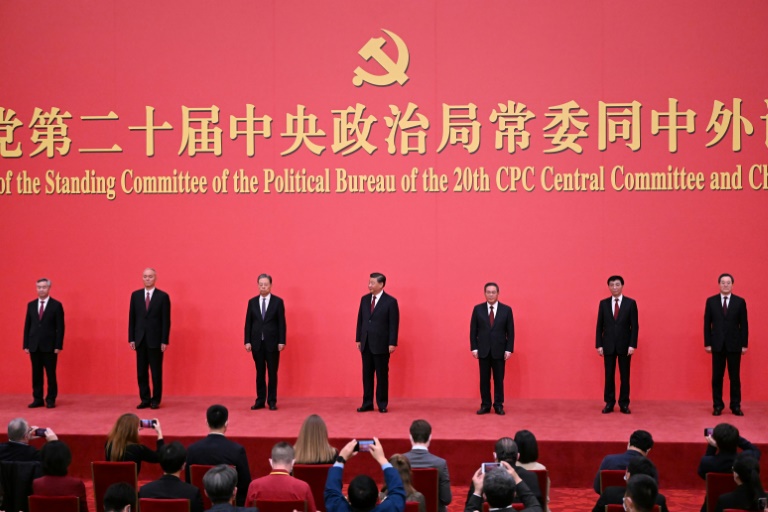
Six of Xi’s proteges and allies were also unveiled on Sunday alongside him as members of the Politburo Standing Committee — the party’s apex of power that rules the country.

Li Qiang — a former chief of staff for Xi who oversaw a gruelling two-month Covid lockdown in Shanghai this year — was named as number two in the Standing Committee.

This means he is likely to take over as premier from Li Keqiang, a former Xi rival who will retire next year. 

Close aide Ding Xuexiang and Guangdong party chief Li Xi, a longtime confidante of the president, were among other allies named in the Standing Committee.

“The new Politburo Standing Committee confirms decisively that Xi has consolidated power at the top of the Communist Party to an extent unseen since the Mao era,” said Neil Thomas, a senior China analyst at Eurasia Group.

“Xi has installed allies onto all seven seats of the Communist Party’s top decision-making body, allowing him to dominate the political system for the foreseeable future.”

Alfred Wu Muluan, a Chinese politics expert at the National University of Singapore, said: “It is all Xi’s people, signalling he wants to rule even beyond a third term.”

Xi abolished the presidential two-term limit in 2018, paving the way for him to govern indefinitely.

Xi was swiftly congratulated on Sunday by some of China’s allies, including Russian President Vladimir Putin and North Korean leader Kim Jong Un. The United States offered no immediate response.

– No women –

Sunday’s announcements came after a week-long Congress of 2,300 hand-picked party delegates during which they endorsed Xi’s “core position” in the leadership and approved a sweeping reshuffle that saw Li and other former Xi rivals relegated.

On Saturday the delegates elected the Central Committee of around 200 senior party officials, who on Sunday chose the 24-person Politburo and the Standing Committee.

The Politburo will have no women members for the first time in 25 years.

Analysts had closely watched for whether the party charter would be amended during the Congress to enshrine “Xi Jinping Thought” as a guiding philosophy, a move that would put Xi on a par with Mao.

That did not take place, though a resolution did call the creed “the Marxism of contemporary China and of the 21st Century”, adding that it “embodies the best Chinese culture and ethos of this era”.

– Hu led away – 

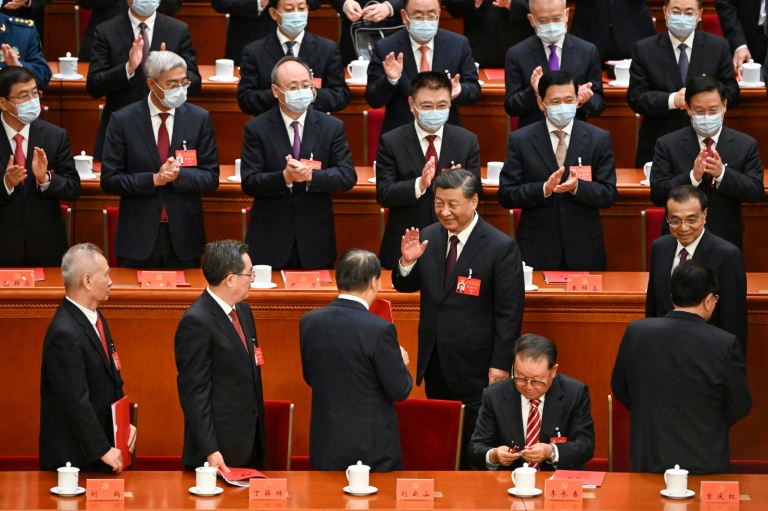
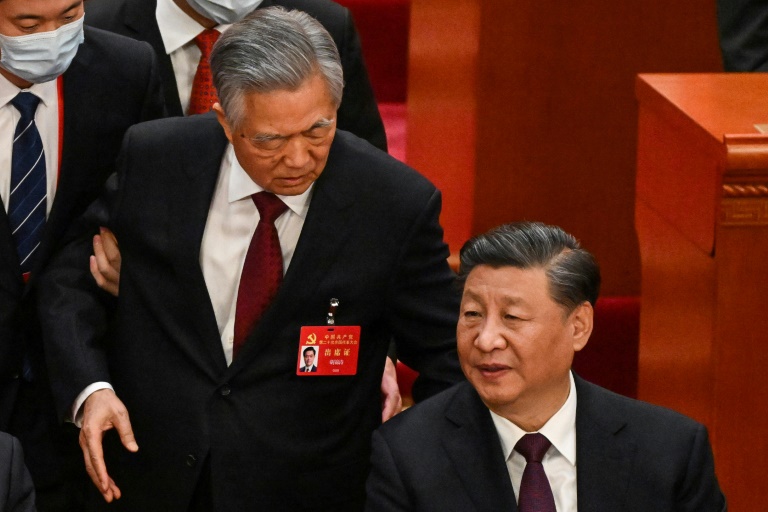
In the most dramatic moment of the Congress, Hu Jintao — Xi’s predecessor as party leader and president — was forcibly led out of Saturday’s closing ceremony.

The frail-looking 79-year-old was reluctant to leave the front row, where he was sitting next to Xi.

State media reported that Hu had been removed because he was feeling unwell, and that he had since recovered. 

But the extraordinary events, with Xi seemingly unfazed as Hu was lifted from his chair and escorted out, fuelled frenzied speculation among observers and analysts as to whether there were political factors at play.

Xi has promoted a narrative in his first decade of power that he has rectified huge problems that beset China and the Communist Party during the reigns of Hu and his predecessors.

These include graft within the party and unequal distribution of wealth.

Adding to the intrigue, China’s censors scrubbed references to Hu from the internet after he was removed from the Congress. 

One of Hu’s proteges, Hu Chunhua, had been tipped by some to be named to the Standing Committee on Sunday. But Xi sidelined him.
Far-right Meloni to take over as Italy's first woman PM

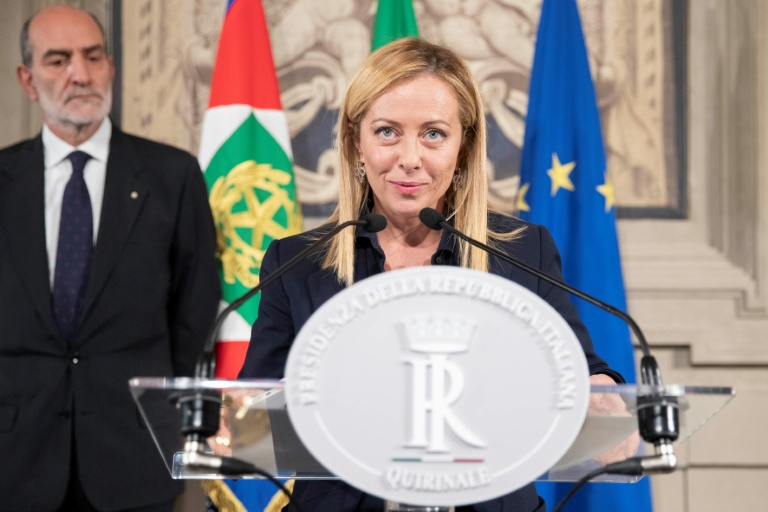
Giorgia Meloni formally takes over as Italy’s first woman prime minister on Sunday, a day after being sworn in as the leader of the country’s most right-wing government since World War II.

The handover of power from outgoing premier Mario Draghi to Meloni will take place at Rome’s Chigi Palace and a first cabinet meeting will follow shortly afterwards.

The symbolic act at the seat of Italy’s government will see former European Central Bank chief Draghi, in charge since February 2021, hand over a bell used by the cabinet president to manage cabinet debates.

European Union chiefs, wary of the far-right taking power, on Saturday said they were ready to cooperate with the new coalition government led by Meloni’s post-fascist and Eurosceptic Brothers of Italy party.

European Commission President Ursula von der Leyen congratulated Meloni and said she held “good” telephone talks with her, while Meloni said she was ready to work with the bloc’s leaders.

La Stampa daily spoke of a “European beginning” on its front page on Sunday. “Meloni: down to work, with pride”, blared the Corriere della Sera.

– Challenges ahead –

On Saturday, Meloni and her 24 ministers took the oath before President Sergio Mattarella at the Quirinal Palace in Rome, once home to popes and kings of Italy.

The 45-year-old’s appointment is a historic event for the eurozone’s third-largest economy and for Brothers of Italy, which has never been in government.

It won 26 percent of the vote in last month’s election, compared to eight and nine percent respectively for Meloni’s coalition partners, former leader Silvio Berlusconi’s Forza Italia and the far-right League led by Matteo Salvini.

A former admirer of former dictator Benito Mussolini, Meloni has managed to distance her party from its fascist roots.

Major challenges including soaring inflation and Italy’s high debt ratio — the eurozone’s highest after Greece — await the new government.

Meloni’s cabinet, including six women, suggests a desire to reassure Italy’s partners. She appointed Giancarlo Giorgetti as economy minister, who served under the previous government of Mario Draghi.

Giorgetti, a former minister of economic development, is considered one of the more moderate, pro-Europe members of Salvini’s League.

Meloni also named ex-European Parliament president Antonio Tajani, of Forza Italia, as foreign minister and deputy prime minister.

Salvini will serve as deputy prime minister and minister of infrastructure and transport, which will likely disappoint Salvini.

He wanted the role of interior minister, a post he previously held between 2018 and 2019. That went instead to a technocrat, Rome prefect Matteo Piantedosi.

– ‘Common values’ –

The talks to form a government had been overshadowed by disagreements with her two would-be coalition partners.

Italian news media made much of the recorded comments by Berlusconi defending Russian President Vladimir Putin, remarks he insists have been taken out of context.

Salvini, too, is a long-time fan of Putin and has criticised Western sanctions imposed on Russia over its invasion of Ukraine.

Despite her Eurosceptic stance however, Meloni has been firm in her support for Kyiv, in line with the rest of the European Union and the United States.

On Saturday she affirmed her desire to work with NATO, which she described as “more than a military alliance: a bulwark of common values we’ll never stop standing for”.

NATO chief Jens Stoltenberg and US President Joe Biden sent their congratulations to Meloni, as did Ukrainian leader Volodymyr Zelensky. 

Meloni said Italy would “always be on the side of the brave people of Ukraine”.

But the tensions with her coalition partners are already raising questions as to whether she will be able to maintain a majority in Italy’s notoriously volatile parliamentary system.

Conservative European leaders including Hungarian Prime Minister Viktor Orban and Polish premier Mateusz Morawiecki hailed a victory for the right.

Ill health or power play? Hu Congress exit sparks speculation storm

The abrupt exit of former Chinese leader Hu Jintao from a key political meeting grabbed global headlines, providing a rare moment of drama at the meticulously choreographed event intended to hand President Xi Jinping a historic third term in power.

And while Beijing’s state media later said Hu was escorted out by security due to ill health, the 79-year-old appeared reluctant to leave his seat next to Xi — leading to speculation his departure was a political power play.

Here are some of the main theories about what took place:

– Ill health –

State news agency Xinhua said late Saturday that Hu had insisted on attending the session despite being unwell.

“When he was not feeling well during the session, his staff, for his health, accompanied him to a room next to the meeting venue for a rest. Now, he is much better,” Xinhua said on Twitter, a social media platform that is blocked in China.

State broadcaster CCTV showed Hu casting a ballot for the party’s new leadership during a closed-door session on the last day of the Congress — before foreign journalists were allowed into the venue.

Later, a steward attempted to take a sitting Hu by the arm before being shaken off. The steward then tried to lift Hu up with both hands from under the armpits, and he was escorted out as most of his colleagues stared firmly ahead.

Speculation has long swirled that Hu is suffering from health issues, Alfred Wu Muluan, a Chinese politics expert at the National University of Singapore, told AFP.

“Hu has aged dramatically,” Wu said, adding that in 2012 — when he handed the reins of power over to Xi — the former leader already appeared “to have some sort of Parkinsons-like symptoms.”

Hu’s hands were “trembling significantly” during another public appearance in 2015, Wu noted.

– Political show of force –

But others said the unexpected move was meant to send a strong political signal to those in the party that might oppose Xi’s coronation.

Hu’s 2003-2013 tenure was seen as a period of increased tolerance of different political factions within the Communist Party and a greater opening up to the world — a time of comparative pluralism now unthinkable in China under Xi. 

Hu’s unceremonious exit, then, “must be read together with the scathing criticism of the Hu era as outlined in the 20th Party Congress report by Xi,” Henry Gao at Singapore Management University said.

“Given how carefully choreographed the Party Congress is, it is no coincidence that this was allowed to be seen in front of all party delegates and the media,” he said.

Xi on Sunday promoted some of his closest Communist Party allies, cementing his position as the nation’s most powerful leader since Mao Zedong.

He also notably removed several officials seen as reform-minded and close to his predecessor, including Hu Chunhua, a vice premier once dubbed “little Hu” due to his similarities with China’s former leader.

“The way Hu was basically dragged out of the Great Hall of the People is a way of saying in no ambiguous terms that this new era has no room for anyone affiliated with the Jiang-Hu era,” William Sima, a China expert at Australian National University, told AFP, referencing Hu’s predecessor Jiang Zemin.

– Discontent – 

Another expert suggested that Hu was removed after expressing his reservations about the current Chinese leader’s policy decisions.

“My speculation is that (Hu) was very unhappy about the composition of the Central Committee,” Willy Lam, adjunct professor at the Chinese University of Hong Kong, said. 

“I think he must have said something that upset Xi Jinping, maybe some words of protest, and that’s why Xi Jinping summoned security people to drag him away.” 

– Opaque politics –

The Communist Party typically does not air its dirty laundry in public. 

And critics say it’s for that reason that Hu’s removal has sparked so much speculation — there is simply no transparency on the power struggles within the party.

The former leader being escorted out was “unusual but not consequential,” Jean-Pierre Cabestan, professor of political science at Hong Kong Baptist University, argued.

“It’s impossible to know what happened to Hu Jintao,” Mary Gallagher, who specialises in Chinese politics at the University of Michigan, added.

“Even if he was ill… it’s hard to believe that the last general secretary of the CCP would be removed from the stage,” she added. 

“It shows that Xi is in charge and no one challenges him.”

Slovenians vote for president as conservatives hope for comeback

Slovenians vote on Sunday in close presidential elections seen as a chance by the country’s conservatives to regain some support after their defeat in April parliamentary elections.

Electors in the small Alpine EU member of two million people will choose from seven candidates standing for the largely ceremonial post — but with no candidate expected to clinch the 50 percent support needed for an outright victory, a second round of voting looks likely.

The frontrunner, with a forecast 30.1 percent of the vote, is expected to be Anze Logar, a foreign minister under the former conservative government of veteran Janez Jansa. 

Slovenia’s former head of the data protection authority, centre-left candidate Natasa Pirc Musar, 54, is tipped to gain around 20 percent of the vote, according to a poll published by daily Delo on Friday.

Liberal Prime Minister Robert Golob has backed European Social Democrats parliament member, Milan Brglez, and called for the centre-left parties to unify behind one candidate.

The 55-year-old Brglez is tipped to get just over 17 percent of the vote.

Political newcomer Golob and his Freedom Movement party won more than a third of votes in the April 24 election after mass protests over a crackdown on civil liberties by the previous government, led by Jansa.

Critics accused three-time premier Jansa of attacking media freedom and the judiciary and undermining the rule of law in his latest term in office.

During the campaign Jansa did not publicly support the 46-year-old Logar, who pledged to be a president for “bringing together” people from all political sides.

Pirc Musar, hoping to become Slovenia’s first woman president, had to face strong attacks over her husband’s lucrative businesses at home and abroad during the pre-electoral campaign.

But she has received the backing of independent Slovenia’s first president, reformed communist Milan Kucan, who said it was “time for a female president”.

Incumbent Borut Pahor, a former Social Democrat, could not run for re-election after having held the post for two five-year mandates. 

Polls opened in the former Yugoslav republic at 7:00 am (0500 GMT) and will close at 7:00 pm, with partial results expected later in the evening.

Xi secures historic third term as China's leader

Xi Jinping secured a historic third term as China’s leader on Sunday and filled his inner circle with close allies, achieving after a decade in power complete dominance over the ruling Communist Party.

The party’s Central Committee elected Xi as its general secretary for another five-year term, bringing the country back towards one-man rule after decades of power-sharing among its elite.

“I wish to thank the whole party sincerely for the trust you have placed in us,” Xi told journalists at Beijing’s Great Hall of the People after the closed-door, rubber-stamp vote was announced.

Xi, 69, was also reappointed head of China’s Central Military Commission, keeping him in charge of the People’s Liberation Army.

He is now all but certain to sail through to a third term as the country’s president, due to be formally announced during the government’s annual legislative sessions in March.

Sunday’s developments cement him as the most powerful leader since Communist Party founder Mao Zedong.

In a wide-ranging acceptance speech on Sunday, Xi made signature remarks celebrating China’s rise as a global power and its success under his rule.

“The world needs China,” Xi said.

“After more than 40 years of unflagging efforts towards reform and opening up, we have created two miracles — rapid economic development and long-term social stability.”

Six of Xi’s proteges and allies were also unveiled on Sunday alongside him as members of the Politburo Standing Committee — the party’s apex of power that rules the country.

Current Shanghai Party boss Li Qiang — who oversaw a gruelling two-month Covid-19 lockdown in the financial capital this year — was named as number two in the Standing Committee.

This means he is likely to take over as premier from Li Keqiang, a former Xi rival who will retire next year. 

Close aide Ding Xuexiang, Guangdong Party chief Li Xi and Beijing Party boss Cai Qi were also in the re-jigged lineup.

“The new Politburo Standing Committee confirms decisively that Xi has consolidated power at the top of the Communist Party to an extent unseen since the Mao era,” said Neil Thomas, a senior China analyst at Eurasia Group.

“Xi has installed allies onto all seven seats of the Communist Party’s top decision-making body, allowing him to dominate the political system for the foreseeable future.”

Alfred Wu Muluan, a Chinese politics expert at the National University of Singapore, said: “It is all Xi’s people, signalling he wants to rule even beyond a third term.”

Xi abolished the presidential two-term limit in 2018, paving the way for him to govern indefinitely.

– No women –

Sunday’s announcements came after a week-long Congress of 2,300 hand-picked party delegates during which they endorsed Xi’s “core position” in the leadership and approved a sweeping reshuffle that saw Li and other former Xi rivals relegated.

On Saturday the delegates elected the Central Committee of around 200 senior party officials, who on Sunday chose the 24-person Politburo and the Standing Committee.

The Politburo will have no women members for the first time in 25 years.

Analysts had closely watched for whether the party charter would be amended during the Congress to enshrine “Xi Jinping Thought” as a guiding philosophy, a move that would put Xi on a par with Mao.

That did not take place, though a resolution did call the creed “the Marxism of contemporary China and of the 21st Century”, adding that it “embodies the best Chinese culture and ethos of this era”.

– Hu led away – 

In the most dramatic moment of the Congress, Hu Jintao — Xi’s predecessor as party leader and president — was forcibly led out of Saturday’s closing ceremony.

The frail-looking 79-year-old was reluctant to leave the front row, where he was sitting next to Xi.

State media reported that Hu had been removed because he was feeling unwell, and that he had since recovered. 

But the extraordinary events, with Xi seemingly unfazed as Hu was lifted from his chair and escorted out, fuelled frenzied speculation among observers and analysts as to whether there were political factors at play.

Xi has promoted a narrative in his first decade of power that he has rectified huge problems that beset China and the Communist Party during the reigns of Hu and his predecessors.

These include graft within the party and unequal distribution of wealth.

Adding to the intrigue, China’s censors scrubbed references to Hu from the internet after he was removed from the Congress. 

One of Hu’s proteges, Hu Chunhua, had been tipped by some to be named to the Standing Committee on Sunday. But Xi sidelined him.
Xi cements control over China, but huge challenges await in third term

Xi Jinping has secured near total control over China’s Communist Party but experts warn his unchecked power is a huge risk, with a debt-ridden economy and a US rivalry also presenting major challenges.

His reappointment as party leader is a watershed moment in China’s modern history, tilting decisively back towards one-man rule after decades of power-sharing among the elite.

Xi was again confirmed as party general secretary and military chief on Sunday at the conclusion of a twice-a-decade party congress in Beijing, sealing a third term at the helm of the world’s second-largest economy.

Party faithful also approved a sweeping reshuffle that stocked the top ruling body — the seven-member Politburo Standing Committee — with Xi’s allies.

The outcome capped 10 years in which Xi has accrued more power than any Chinese leader since Mao Zedong, and broke with the example set by his two predecessors who smoothly handed their authority to those next in line.

It has also sparked warnings that Xi’s increasingly unchecked power may trigger a succession crisis when his rule finally comes to an end.

“(Xi’s) reappointment today is the result of his concentration of extreme individual power,” said a senior Chinese political scholar who requested anonymity to avoid potential repercussions from the authorities.

The move was “catastrophically negative for the Chinese state”, harming the party’s resilience and heralding “decline and stagnation”, the scholar said, adding that it was “inevitable” that Xi would now seek to rule for life.

– Economic woes –

It is the economy that is likely to command Xi’s immediate focus as he embarks on his history-making third term.

In recent years, he has thrown his weight behind the development of a more consumption-driven economy — a policy known as “dual circulation” — and has sought to address China’s yawning wealth gap under the banner of “common prosperity”.

However, his signature zero-Covid strategy, with its snap lockdowns, mass testing and curbs on movement, has pummelled consumer sentiment and chipped away at growth.

“Consumption is unlikely to recover to pre-Covid level with the current scale of Covid control,” said Dan Wang, chief economist at Hang Seng Bank China.

She said the policy has “added to the woes” in the property sector, where a debt crisis has sparked developer defaults and sown fears of a looming financial crunch for local governments.

“The government will have to choose a new model to develop the housing sector while keeping the deleveraging requirement in place,” Wang said.

China this week delayed the release of its third-quarter economic growth figures, amid expectations that the country was on course for its weakest performance since the early days of the pandemic in 2020.

The country eked out just 0.4 percent growth in the second quarter, and analysts widely expect it to miss its annual growth target of 5.5 percent by a wide margin.

– Eye on Taiwan –

More problems on Xi’s horizons include China’s relations with the West, which have cratered as Beijing has forcefully quelled huge pro-democracy protests in Hong Kong and taken an aggressive stance on Taiwan.

Xi himself has repeatedly said global geopolitics is “undergoing changes unseen in a century”, and peppered his opening address to the Congress with references to “security”.

He also reiterated that China would never renounce the option of using force to impose its rule on Taiwan, a thriving island democracy that Beijing views as part of its own territory and the US has vowed to help defend itself.

Xi’s Communist Party even enshrined its opposition to Taiwanese independence in its constitution, according to a resolution published on Saturday.

Shi Yinhong, professor of international relations at Renmin University of China, said Xi “again and again integrates unification across the (Taiwan) Strait into his cause for Chinese national greatness”.

The focus on national security in the military, economic and ideological realms “reflects the fact, as most observers in the world judge, that there is no indication of any major and lasting mitigation of relations with US and its maritime allies… in the predictable future,” he told AFP.

While Xi’s reappointment is unlikely to raise the risk of war over Taiwan, “it could be one step in a chain of events that ultimately raises the risk of armed conflict”, said Shanghai-based political risk analyst Dan Macklin.

Beijing might step up plans for reunification if slower economic growth through the mid-2020s leads the party to expand upon other sources of legitimacy, he told AFP.

But Xi’s advancing age combined with a top leadership stacked with personal allies could “raise the risk of miscalculation” — and “give Xi an extreme level of control and greater capacity to take bold moves on Taiwan”, Macklin said.

Jeffrey Wasserstrom, a leading scholar of modern Chinese history at the University of California, Irvine, said Xi’s unassailable position at the top of the party raised concerns about the “willingness of people to talk about things that diverge from the official line”.

'Lost hope': Inflation, abuse force doctors to quit Turkey

Turkish doctor Mesut began his career wanting to help patients and be of use to his country, but now the threat of patient violence and soaring inflation has forced him to plan a move abroad.

Mesut says he will quit his job at a private Istanbul hospital and next year leave with his wife and two children for Germany.

He is one of a growing number of highly skilled professionals who are leaving or want to leave Turkey — a trend that experts say has accelerated in recent years as families struggle to keep up with the rising cost of living.

“We have lost all hope for the future,” the 38-year-old anaesthesiologist told AFP.

“When I talk to my colleagues and close friends, they’re desperate. Everyone is considering alternative options,” said Mesut, who did not wish to give his full name.

Turkish doctors in particular say their working conditions have worsened, with long hours, an increase in physical and verbal abuse from patients or their relatives, and bullying by bosses.

In one of the most recent attacks, a gunman in July shot cardiologist Ekrem Karakaya 15 times and killed him, reportedly because he held the doctor responsible for his mother’s death.

Turkey’s economic woes have only made emigrating more attractive, with inflation exceeding 83 percent and the Turkish lira having lost around 30 percent in value against the dollar since the start of the year.

Some say even next year’s elections — in which President Recep Tayyip Erdogan will struggle to extend his two-decade rule — offer no hope for change.

– ‘Lost all motivation’ –

A specialised doctor at a Turkish public hospital earns a monthly average of more than $1,000 — more than three times the minimum wage of nearly $300, but still much less than what a doctor earns in Europe.

Mesut says he earns $2,000 a month, but even that is not enough now life is so much more expensive.

“We work hard but the money we get… has no value,” he said.

“We are exposed to violence, beatings and attacks from patients, and we’ve lost all motivation.”

The government says it is trying to solve these issues, and in July increased doctors’ wages by 42 percent in the public sector.

It introduced reforms in August towards further improving their economic conditions and protecting them from violence.

The regulations aim to limit the number of doctors leaving Turkey, and curb the rising trend of medical professionals switching from public to private hospitals for better pay.

– Demonisation of doctors –

Erdogan last month unleashed his anger on Turks leaving the country. 

“We pity those who arrive at the door of other countries for superficial aspirations, just because they want to drive a better car or go to more concerts,” he said.

Mesut said the government’s demonisation of doctors was the “last straw”.

“We already make a lot of sacrifices in this profession,” he said.

“I had been thinking about it for a while, but our president’s words, ‘let them leave’, played a major part in my decision to go abroad.”

Mesut is already learning German ahead of his move with his wife, an intensive care unit nurse, and their children.

– Brain drain –

Professor Nergis Erdogan, chair of the Istanbul Medical Chamber, said applications for certificates of good standing — documents that allow doctors to work abroad — had soared this year.

In 2012, only 59 Turkish doctors applied to receive the certificates.

But in the first nine months of this year alone, 1,938 physicians — 1,014 specialists and 924 generalists — put in requests.

“We ask first-year students about their projections. A significant part of them start by saying: ‘I will take a German course’,” she told AFP.

Mehmet Cihan Dulluc, a first-year medical student in Ankara, said he had chosen to study in English to increase his chances of finding a job abroad. 

“We all dream about going overseas,” the 19-year-old told AFP, citing violence against doctors and too many patients per doctor in Turkey as just some of the reasons.

Erdogan, the chair of the Istanbul Medical Chamber, said Turkish physicians see a new patient every three to five minutes. 

“I have sometimes seen 80 to 100 patients a day in my career. Even 25 patients a day is a lot,” she said. 

Like most of his classmates, Dulluc says he wants to travel abroad as soon as he finishes medical school.

“Even before graduation, if I have the chance, I would like to go to Europe,” he said.

Who is China's President Xi Jinping?

When Xi Jinping took power in 2012, some observers predicted he would be the most liberal Communist Party leader in China’s history, based on his low-key profile, family backstory and perhaps a degree of misguided hope.

Ten years later, those forecasts lie in tatters, proving only how little was understood of the man who is now China’s most powerful ruler since Mao Zedong after being handed a historic new five-year term on Sunday.

Xi has shown himself to be ruthless in his ambition, intolerant of dissent, with a desire for control that has infiltrated almost every aspect of life in modern China.

He has gone from being primarily known as the husband of a celebrity singer to someone whose apparent charisma and aptitude for political storytelling have created a personality cult not seen since Mao’s day.

The colourful details of his early life have been rinsed and repackaged in official party lore, but the man himself — and what drives him — remain somewhat more of an enigma.

“I dispute the conventional view that Xi Jinping struggles for power for power’s sake,” Alfred L. Chan, author of a book on Xi’s life, told AFP.

“I would suggest that he strives for power as an instrument… to fulfil his vision.”

Another biographer, Adrian Geiges, told AFP that he did not think Xi was motivated by a desire for personal enrichment, despite international media investigations having revealed his family’s amassed wealth.

“That’s not his interest,” Geiges said.

“He really has a vision about China, he wants to see China as the most powerful country in the world.”

Central to that vision — what Xi calls the “Chinese Dream” or “great rejuvenation of the Chinese nation” — is the role of the Communist Party (CCP). 

“Xi is a man of faith… for him, God is the Communist Party,” wrote Kerry Brown, author of “Xi: A Study in Power”. 

“The greatest mistake the rest of the world makes about Xi is to not take this faith seriously.”  

– ‘Traumatised’ – 

Xi might not seem an obvious candidate to become a CCP diehard, though he grew up as a “princeling”, or member of the party elite.

His father Xi Zhongxun was a revolutionary hero turned vice premier, whose “strictness toward his family members was so serious that even those close to him believed it bordered on the inhuman”, according to the elder Xi’s biographer Joseph Torigian.

But when Xi Zhongxun was purged by Mao and targeted during the Cultural Revolution, “(Xi Jinping) and his family were traumatised”, said Chan.

His status vanished overnight, and the family was split up. One of his half-sisters is reported to have killed herself because of the persecution.

Xi has said he was ostracised by his classmates, an experience the political scientist David Shambaugh suggests contributed to a “sense of emotional and psychological detachment and his autonomy from a very young age”.

At just 15, Xi was ordered to the countryside in central China where he spent years hauling grain and sleeping in cave homes. 

“The intensity of the labour shocked me,” he later said.

He also had to take part in “struggle sessions” in which he had to denounce his father. 

“Even if you don’t understand, you are forced to understand,” he said, describing the sessions to a Washington Post reporter “with a trace of bitterness” in a 1992 interview.

“It makes you mature earlier.”

Biographer Chan said the experiences of his youth had given him “toughness”.

“He tends to go for broke. He tends to use a two-fisted approach when he approaches problems. But he also has a certain appreciation of the arbitrariness of power and that’s why he also emphasises law-based governance.”

– Systematic, low profile –

Nowadays, the cave Xi slept in is a domestic tourist draw, used to emphasise traits such as his concern for China’s poorest.

When AFP visited in 2016, one local painted a picture of an almost legendary figure, reading books between breaks in hard labour “so one could see he was no common man”.

That does not seem to have been obvious at the time though. Xi himself said he was not even rated “as high as the women” when he first arrived.

His application for CCP membership was rejected multiple times because of the family stigma, before it was finally accepted.

Beginning as a village party boss in 1974, Xi climbed to the governorship of coastal Fujian province in 1999, then party chief of Zhejiang province in 2002 and eventually Shanghai in 2007.

“He was working very systematically… to get experience by starting at a very low level, in a village, then in a prefecture… and so on,” said biographer Geiges.

“And he was very clever by keeping a low profile.”

Xi’s father was rehabilitated in the late 1970s following the death of Mao, massively boosting his son’s standing.

Following a divorce from his first wife, Xi married superstar soprano Peng Liyuan in 1987, at a time when she was much better known than him.

Even so, his potential was not apparent to all, exemplified by comments made by his host on a trip to the United States in 1985.

“No one in their right mind would ever think that that guy who stayed in my house would become the president,” Eleanor Dvorchak was quoted as saying years later in the New Yorker magazine.

Cai Xia, a former high-ranking CCP cadre who now lives in exile in the United States, believes Xi “suffers from an inferiority complex, knowing that he is poorly educated in comparison with other top CCP leaders”.

As a result, he is “thin-skinned, stubborn, and dictatorial”, she wrote in a recent article in Foreign Affairs.

– ‘Heir of the revolution’ –

But Xi has always regarded himself “as an heir of the revolution”, said Chan.

In 2007, he was appointed to the Politburo Standing Committee, the party’s highest decision-making body.

When he replaced Hu Jintao five years later, there was little in Xi’s past administrative record that foreshadowed his actions once installed as leader.

He has cracked down on civil society movements, independent media and academic freedoms, overseen alleged human rights abuses in the northwest Xinjiang region, and promoted a far more aggressive foreign policy than his predecessor.

In the absence of access to either Xi or any of his inner circle, scholars are left to survey his earlier writings and speeches for clues to his motivations.

“The absolute centrality of the party’s mission to make China a great country again is evident from Xi’s earliest recorded statements,” wrote Brown.

Xi has harnessed that narrative of an ascendant China to great effect, using nationalism as a tool for his own and the party’s legitimacy among the population. 

But there is also evidence he fears that grasp on power might decline.

“The fall of the Soviet Union and of socialism in eastern Europe was a big shock,” said Geiges, adding Xi blames the collapse on its political opening up. 

“So he decided that something like this shall not happen to China… that’s why he wants strong leadership of the Communist Party, with one strong leader.”

Qatar pressed on safety of women travelling to World Cup

Lawyers for a group of women subjected to intrusive searches at Doha Airport two years ago called Sunday for Qatar to guarantee female fans travelling to next month’s football World Cup will be safe.

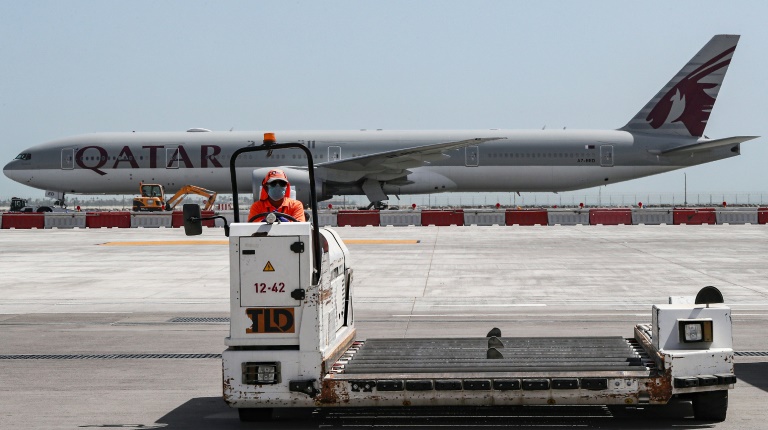
Five women are suing Qatar Airways and the state-run Qatar Civil Aviation Authority after they were removed from flights for non-consensual gynaecological examinations in October 2020.

“This group of brave women have been forced to go to court to send a message to Qatar that what happened was wrong and should not be allowed to take place again,” lawyer Damian Sturzaker told AFP. 

“With the World Cup less than a month away female travellers are entitled to an assurance from Qatar that their human rights will be respected.”

Authorities in Doha carried out the searches hoping to find the mother of a newborn baby abandoned in an airport bathroom bin.

After the child was discovered the airport was locked down and women on about 10 flights were shooed into ambulances where they were subject to invasive examinations to see if they had recently given birth.

The incident caused a major diplomatic incident and prompted a “sincerest apology” from the prime minister of Qatar.

Two years later, a group of women are taking Qatari authorities to court in Australia, claiming unspecified costs and damages for the trauma of the event. 

– Aftermath –

According to papers filed with an Australian federal court earlier this month, the five women were between 31 and 73 years old at the time.

They were all passengers on flight QR908 from Doha’s Hamad International to Sydney. 

One was legally blind, and another was accompanying her five-month-old child. 

As the plane sat on the tarmac, a cabin announcement instructed all women aboard to leave the aircraft with their passports and “persons in dark uniforms armed with guns entered the aircraft”.

Four of the women were then taken into ambulances, their clothing was removed and they were subjected to intrusive examinations of their genitals — and in one case the breasts and stomach. 

One woman had her infant son on her chest at the time.

The women are all said to be suffering from post-traumatic stress. 

They accuse Qatar Airways and the authorities of neglect, assault, battery, false imprisonment and a range of other breaches of the law.

Qatar Airways and the government of Qatar did not immediately respond to requests for comment, but the authorities have previously announced that prosecutions would be made of those responsible for the searches.

Facing potentially devastating commercial and reputational damage, Qatar has repeatedly vowed to guarantee the future “safety and security” of passengers.

The timing of the court case comes as Qatar prepares to host at least a million fans for the FIFA World Cup from November 20.

The Gulf nation has faced intense scrutiny over its human rights record ahead of the tournament, and concerns about strict local customs that might trip up foreign visitors. 

Wearing a Muslim veil is not compulsory for women but they must dress “modestly” in public, covered from the shoulders to knees.

Sex outside marriage is illegal and can be punished by flogging though there is no record of when it was last used.

In November 2020, Qatari authorities said they had identified the parents of the abandoned child and the “fugitive” mother from an Asian country. She faces 15 years in jail if apprehended. 

China's Xi set to secure historic third term in office

Chinese President Xi Jinping was poised Sunday to secure a historic third term in power, cementing his position as the nation’s most influential leader since founder Mao Zedong.

Xi is all but certain to be unveiled as general secretary of the ruling Communist Party again — tilting the country decisively back towards one-man rule after decades of power-sharing among its elite.

His anointment will cap a week-long gathering of the party faithful in China’s capital during which high-ranking cadres endorsed his “core position” in the leadership and approved a sweeping reshuffle that saw several top officials step down.

However, in an unexpected move that punctured the proceedings at Beijing’s Great Hall of the People, former leader Hu Jintao was led out of the closing ceremony.

The frail-looking 79-year-old seemed reluctant to leave the front row where he was sitting next to Xi.

State media reported late Saturday that Hu had insisted on attending the session despite being unwell. 

“When he was not feeling well during the session, his staff, for his health, accompanied him to a room next to the meeting venue for a rest. Now, he is much better,” Xinhua news agency said on Twitter, a social media platform that is blocked in China.

– Sunday unveiling –

The delegates also elected a new Central Committee of around 200 senior party officials, who will gather on Sunday to elect the Standing Committee — the apex of Chinese political power at which Xi is set to sit firmly at the top.

More than a hundred journalists were gathered Sunday morning in the Great Hall of the People’s Golden Hall, an imposing space bedecked with chandeliers and gold and red pillars, where China’s new Standing Committee is set to be unveiled at a press conference around noon (0400 GMT).

A list of officials in the new Central Committee earlier revealed that four out of seven members of the Standing Committee will be replaced, allowing Xi to further pack the top body with loyalists.

“Whichever way you look at it, it’s almost a total victory for Xi,” said Willy Lam, a political analyst at the Chinese University of Hong Kong.

The move will allow Xi to sail through to a third term as China’s president, due to be formally announced during the government’s annual legislative sessions in March.

– ‘Marxism of 21st century’ –

It brings to an end a triumphant week in which China’s top brass have hailed their leadership of the country over the last five years. 

In his opening speech to its 20th Congress last Sunday, Xi lauded the party’s achievements while glossing over domestic problems such as the stalling economy and the damage inflicted by his harsh zero-Covid policy.

Heavy on ideological rhetoric and light on policy, a defiant Xi also urged party members to steel themselves against numerous challenges including a hardening geopolitical climate.

Analysts were closely watching for whether the party charter would be amended to enshrine “Xi Jinping Thought” as a guiding philosophy, a move that would put Xi on a par with Mao.

That did not take place, though a resolution did call the creed “the Marxism of contemporary China and of the 21st century”, adding that it “embodies the best Chinese culture and ethos of this era”.

Xi previously abolished the presidential two-term limit in 2018, paving the way for him to rule indefinitely.

Close Bitnami banner
Bitnami