World

Russian 'kamikaze drones' strike Kyiv: Ukraine

Russian-launched “kamikaze drones” attacked Kyiv early Monday, the Ukrainian presidency said, describing the strikes as an act of desperation nearly eight months into a war that has claimed thousands of lives.

Photos captured by an AFP photographer showed the drones swooping low across the skies of Kyiv as police officers fired at them from the ground. Other images showed smoke rising from explosions across the city.

Air raid sirens sounded in Kyiv shortly before the first explosion at around 6:35 am (0335 GMT), followed by sirens across most of the country.

“The capital was attacked by kamikaze drones,” the president’s chief of staff Andriy Yermak said on social media.

“The Russians think it will help them, but it shows their desperation,” he added.

“We need more air defence systems and as soon as possible. More weapons to defend the sky and destroy the enemy.”

The attacks come exactly a week after Russia unleashed a massive wave of missile strikes on the Ukrainian capital and cities across the country.

Kyiv mayor Vitali Klitschko said the drone attack had caused a fire and damaged several buildings in the central Shevchenkivsky district and warned residents to take shelter.

“Fire departments are working. Several residential buildings were damaged. Medics are on the spot,” he said on Telegram.

“We are clarifying the information about the casualties.”

The mayor also posted a picture of what he said was the charred wreckage of one of the kamikaze drones, loitering munitions that can hover while waiting for a target to attack.

– ‘Iranian drones’ –

Ukrainian President Volodymyr Zelensky last week said Iranian drones were used in Russian attacks on energy infrastructure in several cities, although Tehran denies supplying Russia with weapons for the war.

On October 10, Russian missiles rained down on Kyiv and other cities in the biggest wave of strikes in months.

The attacks killed at least 19 people, wounded 105 others and sparked an international outcry.

Moscow carried out further strikes on October 11, though on a smaller scale, striking energy installations in western Ukraine far from the front.

Russian President Vladimir Putin said the strikes were in retaliation for an explosion that damaged a key bridge linking Russia to the Moscow-annexed Crimean peninsula.

Putin on Friday had expressed satisfaction and said there was no need for further massive strikes on Ukraine “for now”.

The Russian president also claimed Moscow was “doing everything right” in its invasion of Ukraine despite a string of embarrassing defeats.

In southern Ukraine, Kyiv’s troops have been pushing closer and closer to Kherson, the main city in the region of the same name just north of Crimea.

Kherson is one of four regions in Ukraine that Moscow recently claimed to have annexed, and the city of Kherson was the first major city to fall after the Kremlin launched its invasion.

Washington on Friday announced fresh military assistance for Kyiv “in the wake of Russia’s brutal missile attacks on civilians across Ukraine”.

The new $725 million package included more ammunition for the Himars rocket systems that have been used by Ukraine to wreak havoc on Russian targets.

It brings the total US military assistance to Ukraine to $17.6 billion since the Russian invasion began on February 24.
Portugal bets all on renewables after abandoning coal

As the UN steps up calls to make the switch to renewable energy to fight the global climate emergency, Portugal is among the first European Union countries to abandon coal.

It will share the lessons it has learned so far at November’s COP27 UN climate summit in Egypt.

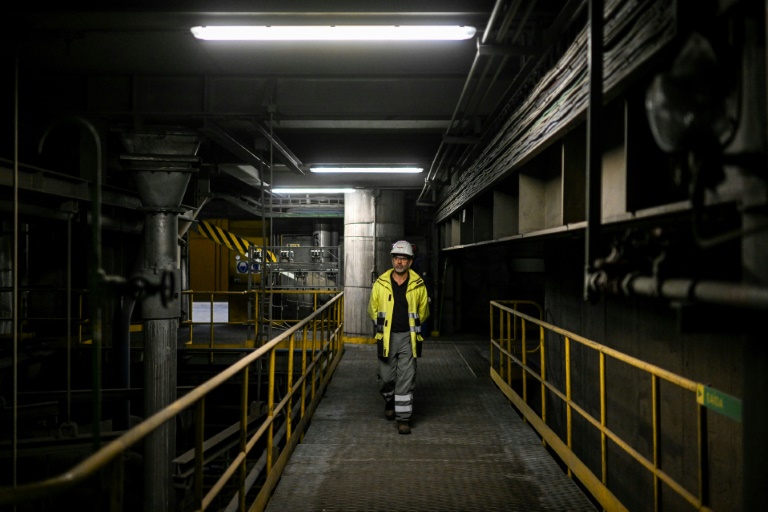
It has been nearly a year now since smoke has trailed up from the cooling towers of the coal plant in Pego, 120 kilometres (70 miles) northeast of the capital Lisbon.

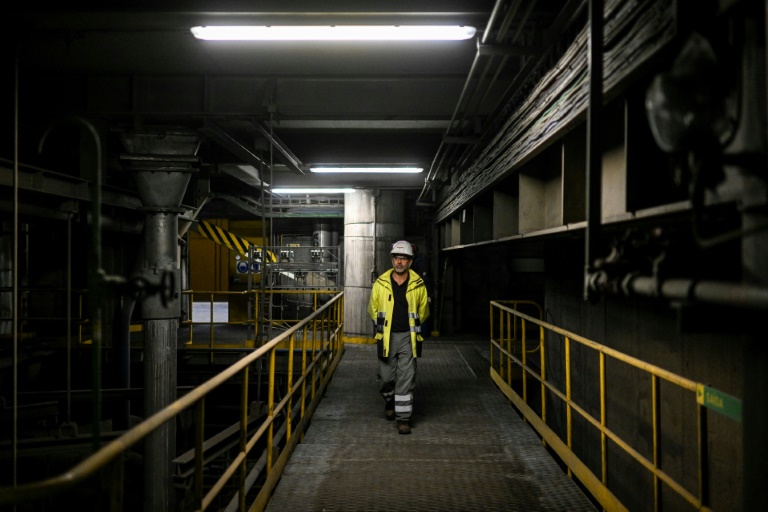
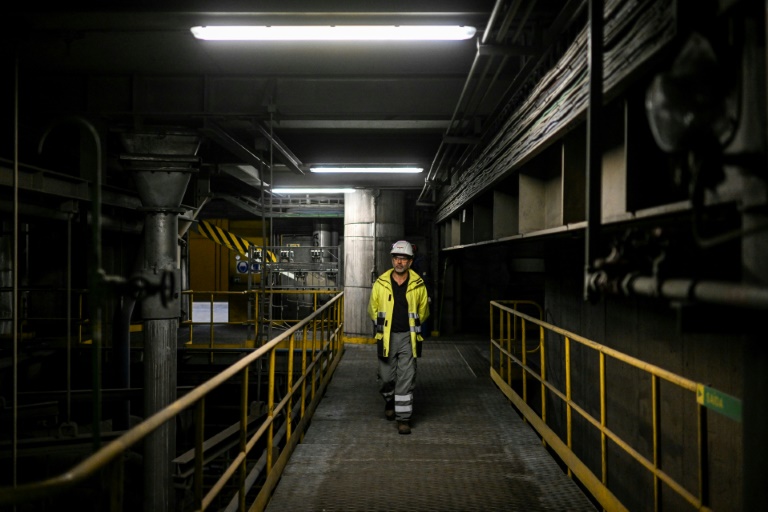
The lights are off at the station, and the dust gathering on the steel structure attests to the fact that the last coal plant in Portugal shut down in November last year after 30 years in service.

The authorities in Lisbon shut down this fossil-fuel eight years sooner than planned — and just months after the Sines coal plant, some 90 kilometres south of Lisbon, closed at the start of 2021.

Portugal is one a handful of EU member states — along with Belgium and Sweden — to have renounced coal as an energy source.

The energy crisis triggered by the war in Ukraine prompted Austria to reverse a previous decision to close coal-fired plants.

Portugal however “remains convinced that it will not be necessary to renege on this decision,” Environment Minister Duarte Cordeiro said in mid-September.

– ‘An example in Europe’ –

“Portugal is an example in Europe,” says Pedro Nunes, an expert in renewable energy at the University of Lisbon, and policy officer with the environmental group Zero.

The two coal plants recently closed accounted for nearly 20 percent of Portugal’s greenhouse gases, he points out.

To replace coal’s contribution to electricity production, the government hopes to continue developing its green energy to provide 80 percent of its energy by 2026, up from 40 percent in 2017.

If the share of renewables in electrical output hit nearly 60 percent in 2021, the figure dropped back to 40 percent this year owing to a historic drought which slashed hydro-electric power.

The UN’s World Meteorological Organization called Tuesday for the world to double the supply of electricity from renewables by 2030 to prevent climate change from undermining global energy security.

Electricity has not only been a major source of carbon emissions driving climate change, but it is also vulnerable to the effects of a warming planet, the WMO said.

Portugal is aiming to increase its wind power and solar capacity — it currently ranks 8th and 13th respectively in Europe. But it remains heavily dependent on fossil fuels, which accounted for 71 percent of its energy mix in 2020, according to Eurostat.

In this transition phase, the strategy “initially passes via electricity produced by gas plants, which are one-third less polluting than coal”, said Nunes.

– Imports rising –

Portugal has used natural gas-fired combined cycle power plants like the one running since 2011 on the Pego site, next to the decommissioned coal plant. It is scheduled to run until 2035.

“It’s not by chance” that Portugal has been among the first in Europe to abandon coal, says Pedro Almeida Fernandes, tasked with renewable energies for the Portuguese subsidiary of Spain’s Endesa.

The country has been preparing for its energy transition “for a long time”, he says.

Endesa won the contract to reconvert by 2025 the Pego coal plant into a complex combining solar power, wind energy and green hydrogen. This is, after all, a place that enjoys 300 days of sunshine per year.

With that kind of resource, Portugal aims to increase solar power production by 50 percent to three gigawatts, in 2022 alone, according to a government estimate.

Nevertheless, Pedro Clemente Nunes, an energy specialist at Lisbon’s Technical University, said the country’s move away from coal had been “badly planned” in Portugal.

For a year, Portugal “considerably increased its electrical imports” from neighbouring Spain which “continues to produce energy from coal,” he said.

Portugal bets all on renewables after abandoning coal

As the UN steps up calls to make the switch to renewable energy to fight the global climate emergency, Portugal is among the first European Union countries to abandon coal.

It will share the lessons it has learned so far at November’s COP27 UN climate summit in Egypt.

It has been nearly a year now since smoke has trailed up from the cooling towers of the coal plant in Pego, 120 kilometres (70 miles) northeast of the capital Lisbon.

The lights are off at the station, and the dust gathering on the steel structure attests to the fact that the last coal plant in Portugal shut down in November last year after 30 years in service.

The authorities in Lisbon shut down this fossil-fuel eight years sooner than planned — and just months after the Sines coal plant, some 90 kilometres south of Lisbon, closed at the start of 2021.

Portugal is one a handful of EU member states — along with Belgium and Sweden — to have renounced coal as an energy source.

The energy crisis triggered by the war in Ukraine prompted Austria to reverse a previous decision to close coal-fired plants.

Portugal however “remains convinced that it will not be necessary to renege on this decision,” Environment Minister Duarte Cordeiro said in mid-September.

– ‘An example in Europe’ –

“Portugal is an example in Europe,” says Pedro Nunes, an expert in renewable energy at the University of Lisbon, and policy officer with the environmental group Zero.

The two coal plants recently closed accounted for nearly 20 percent of Portugal’s greenhouse gases, he points out.

To replace coal’s contribution to electricity production, the government hopes to continue developing its green energy to provide 80 percent of its energy by 2026, up from 40 percent in 2017.

If the share of renewables in electrical output hit nearly 60 percent in 2021, the figure dropped back to 40 percent this year owing to a historic drought which slashed hydro-electric power.

The UN’s World Meteorological Organization called Tuesday for the world to double the supply of electricity from renewables by 2030 to prevent climate change from undermining global energy security.

Electricity has not only been a major source of carbon emissions driving climate change, but it is also vulnerable to the effects of a warming planet, the WMO said.

Portugal is aiming to increase its wind power and solar capacity — it currently ranks 8th and 13th respectively in Europe. But it remains heavily dependent on fossil fuels, which accounted for 71 percent of its energy mix in 2020, according to Eurostat.

In this transition phase, the strategy “initially passes via electricity produced by gas plants, which are one-third less polluting than coal”, said Nunes.

– Imports rising –

Portugal has used natural gas-fired combined cycle power plants like the one running since 2011 on the Pego site, next to the decommissioned coal plant. It is scheduled to run until 2035.

“It’s not by chance” that Portugal has been among the first in Europe to abandon coal, says Pedro Almeida Fernandes, tasked with renewable energies for the Portuguese subsidiary of Spain’s Endesa.

The country has been preparing for its energy transition “for a long time”, he says.

Endesa won the contract to reconvert by 2025 the Pego coal plant into a complex combining solar power, wind energy and green hydrogen. This is, after all, a place that enjoys 300 days of sunshine per year.

With that kind of resource, Portugal aims to increase solar power production by 50 percent to three gigawatts, in 2022 alone, according to a government estimate.

Nevertheless, Pedro Clemente Nunes, an energy specialist at Lisbon’s Technical University, said the country’s move away from coal had been “badly planned” in Portugal.

For a year, Portugal “considerably increased its electrical imports” from neighbouring Spain which “continues to produce energy from coal,” he said.

Portugal bets all on renewables after abandoning coal

As the UN steps up calls to make the switch to renewable energy to fight the global climate emergency, Portugal is among the first European Union countries to abandon coal.

It will share the lessons it has learned so far at November’s COP27 UN climate summit in Egypt.

It has been nearly a year now since smoke has trailed up from the cooling towers of the coal plant in Pego, 120 kilometres (70 miles) northeast of the capital Lisbon.

The lights are off at the station, and the dust gathering on the steel structure attests to the fact that the last coal plant in Portugal shut down in November last year after 30 years in service.

The authorities in Lisbon shut down this fossil-fuel eight years sooner than planned — and just months after the Sines coal plant, some 90 kilometres south of Lisbon, closed at the start of 2021.

Portugal is one a handful of EU member states — along with Belgium and Sweden — to have renounced coal as an energy source.

The energy crisis triggered by the war in Ukraine prompted Austria to reverse a previous decision to close coal-fired plants.

Portugal however “remains convinced that it will not be necessary to renege on this decision,” Environment Minister Duarte Cordeiro said in mid-September.

– ‘An example in Europe’ –

“Portugal is an example in Europe,” says Pedro Nunes, an expert in renewable energy at the University of Lisbon, and policy officer with the environmental group Zero.

The two coal plants recently closed accounted for nearly 20 percent of Portugal’s greenhouse gases, he points out.

To replace coal’s contribution to electricity production, the government hopes to continue developing its green energy to provide 80 percent of its energy by 2026, up from 40 percent in 2017.

If the share of renewables in electrical output hit nearly 60 percent in 2021, the figure dropped back to 40 percent this year owing to a historic drought which slashed hydro-electric power.

The UN’s World Meteorological Organization called Tuesday for the world to double the supply of electricity from renewables by 2030 to prevent climate change from undermining global energy security.

Electricity has not only been a major source of carbon emissions driving climate change, but it is also vulnerable to the effects of a warming planet, the WMO said.

Portugal is aiming to increase its wind power and solar capacity — it currently ranks 8th and 13th respectively in Europe. But it remains heavily dependent on fossil fuels, which accounted for 71 percent of its energy mix in 2020, according to Eurostat.

In this transition phase, the strategy “initially passes via electricity produced by gas plants, which are one-third less polluting than coal”, said Nunes.

– Imports rising –

Portugal has used natural gas-fired combined cycle power plants like the one running since 2011 on the Pego site, next to the decommissioned coal plant. It is scheduled to run until 2035.

“It’s not by chance” that Portugal has been among the first in Europe to abandon coal, says Pedro Almeida Fernandes, tasked with renewable energies for the Portuguese subsidiary of Spain’s Endesa.

The country has been preparing for its energy transition “for a long time”, he says.

Endesa won the contract to reconvert by 2025 the Pego coal plant into a complex combining solar power, wind energy and green hydrogen. This is, after all, a place that enjoys 300 days of sunshine per year.

With that kind of resource, Portugal aims to increase solar power production by 50 percent to three gigawatts, in 2022 alone, according to a government estimate.

Nevertheless, Pedro Clemente Nunes, an energy specialist at Lisbon’s Technical University, said the country’s move away from coal had been “badly planned” in Portugal.

For a year, Portugal “considerably increased its electrical imports” from neighbouring Spain which “continues to produce energy from coal,” he said.

Age, health on the ballot in Brazil's Bolsonaro-Lula runoff

One is a 67-year-old who has been in and out of hospital over the past four years for gastric problems. The other is a 76-year-old ex-smoker and cancer survivor.

But both far-right incumbent Jair Bolsonaro and leftist rival Luiz Inacio Lula da Silva are bending over backwards to project an image of youthful energy as the grueling campaign for Brazil’s October 30 presidential runoff election enters the home stretch.

Battling for every last vote, the current and former presidents both face scrutiny over their age and health.

The issue has gained prominence in a relatively young country — median age: 32.8 — where many voters are frustrated over the lack of new options, given that the clash pits the man who has led Brazil for the past four years against the one who led it for eight in the 2000s.

A scroll through the candidates’ social media accounts betrays their campaigns’ concern, with numerous pictures and videos of the rivals — both grandfathers — looking vigorous as they straddle horses, a bull, jet skis and motorcycles (Bolsonaro) or hit a punching bag, lift weights, play the drums and pose in a Speedo-style swimsuit (Lula).

– ‘Spring chicken’ –

The age issue is most sensitive for Lula, who turns 77 three days before the runoff.

The veteran leftist, who served two terms from 2003 to 2010, has indicated he would not seek a fourth.

“I have four years to get everything done. Everyone knows an 81-year-old can’t possibly want to be re-elected,” he said in September.

But he has simultaneously laughed off the age issue as he runs his sixth presidential campaign.

“I’m a spring chicken compared to Joe Biden,” who was inaugurated as US president at 78, Lula quipped last year.

Lula, who smoked for five decades before quitting in 2010, was diagnosed with cancer of the larynx in 2011.

The ex-metalworker underwent chemo and radiation therapy, and doctors declared him in “complete remission” the following year.

But his gravelly voice has grown even hoarser on the campaign trail, to the point Brazilians struggle to understand him at times.

“I’m going to have to stop talking (for) a month to recover,” jokes the twice-widowed former president, who married 56-year-old Rosangela “Janja” da Silva in May.

Smelling blood, opponents have attacked.

“Lula is physically and psychologically weaker by the day,” center-left rival Ciro Gomes posted online in August ahead of the October 2 first-round vote, in which he placed fourth, behind Lula (48 percent) and Bolsonaro (43 percent).

Gomes later backtracked, deleting the post and saying he had been “very harsh.”

Bolsonaro backers have been particularly virulent online questioning the ex-president’s health.

Lula has been at pains to prove his doctor’s assessment that he has “the health of a bull,” crisscrossing the country giving fiery speeches, and hopping up and down at rallies.

“I wake up every day at 5:30 am to work out,” beams Lula, who says he started running nine kilometers a day when he was controversially jailed in 2018 on corruption charges — since overturned.

“I want to live to be 120.”

– Stabbing after-effects –

A decade younger, Bolsonaro has had his share of health issues, too.

The ex-army captain, who was stabbed in the abdomen at a rally during the 2018 campaign that won him the presidency, has had recurring problems ever since.

As president, he has been hospitalized multiple times for intestinal obstructions and undergone six surgeries since 2018: four stemming from the attack, one to remove a bladder stone, and a vasectomy.

When he was last rushed to the hospital, in January, his surgeon, Antonio Luiz Macedo, said the president arrived “crying in pain” and saying, “I’m going to die.”

Macedo said the problem was a shrimp the president swallowed without chewing.

During his hospitalizations, Bolsonaro maintains an active presence on social media, posting pictures of himself flashing a thumbs-up from bed or visiting with First Lady Michelle, 40, the twice-divorced president’s third wife.

His eldest son, Senator Flavio Bolsonaro, said after the last hospital stay that doctors had told his father he needed a regime of permanent dietary restrictions.

But the president has stuck to unhealthy eating habits, according to media reports.

At least four inmates killed in fire at notorious Iran prison

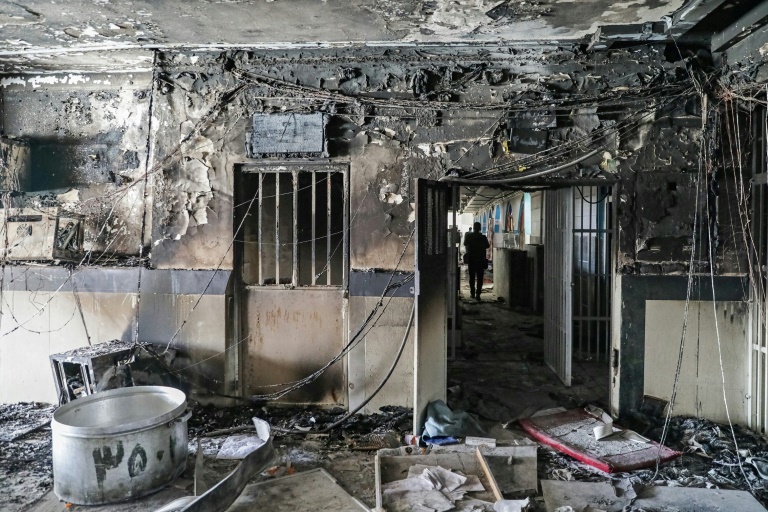
At least four Iranian inmates died in a fire in Tehran’s notorious Evin prison overnight, the judiciary said Sunday, further stoking tensions one month into protests sparked by the death of Mahsa Amini.

The Iranian authorities blamed the fire on “riots and clashes” among prisoners, but rights groups said they had little faith in the official version of events.

“Four prisoners died due to smoke inhalation caused by the fire, and 61 were injured,” the judiciary authority’s website Mizan Online reported.

Four others were in “serious condition”, it said, adding that the fire had been extinguished.

Prisoners’ relatives and rights groups voiced grave fears for the inmates, and said authorities had used tear gas at the facility.

Gunshots and explosions were heard during the blaze from inside the complex, illuminated by flames and smothered by smoke, in video footage posted on social media channels.

The fire came after four weeks of protests over the death of 22-year-old Amini, following her arrest for allegedly violating Iran’s strict dress code for women.

The wave of demonstrations has turned into a major anti-government movement in the Islamic republic, confronting its clerical leadership with one of its biggest challenges since the ousting of the shah in 1979.

Evin, infamous for the ill-treatment of political prisoners, also holds foreign detainees and thousands facing criminal charges.

Hundreds of those arrested during the recent demonstrations and in a crackdown on civil society have been sent there.

“We do not accept official explanations,” the Norway-based group Iran Human Rights (IHR), adding it had received reports that guards had sought to “incite” prisoners.

– ‘Arbitrarily detained’ –

Rights groups reported night-time protests in Tehran in solidarity with Evin detainees, and more demonstrations were held Sunday, including at Tehran University.

Iranian rights activist Atena Daemi, herself a long-time inmate of Evin, wrote on Twitter that in the early hours of Sunday several buses and ambulances were seen leaving the facility.

She said some prisoners in Ward 8, which houses political detainees, had been transferred to another jail.

IHR reported that inmates’ relatives gathered outside Evin on Sunday, seeking information about their loved ones.

Kazem Gharibabadi, deputy head of Iran’s judiciary, visited the prison and blamed “those incarcerated in Ward 7” for the unrest. He said the fire “did not spread to other wards”.

Citing a Tehran prosecutor, the official IRNA news agency said the clashes had “nothing to do with the recent unrest in the country”.

The four inmates who died had been convicted of robbery, Mizan said.

Evin prison holds French-Iranian academic Fariba Adelkhah and US citizen Siamak Namazi, whose family said he was taken back into custody days ago after a temporary release. Namazi’s US attorney Jared Genser said he had spoken to his family, and that he was unharmed.

France said it was following “with the greatest attention” the situation of French citizens “arbitrarily detained” in the facility.

– In ‘distress’ –

Australian academic Kylie Moore-Gilbert, who was held in Evin for most of her 800-plus days behind bars in Iran, told AFP she had heard that all the women political prisoners were safe.

But supporters of Austrian prisoner Massud Mossaheb said he was suffering from the effects of smoke inhalation and tear gas.

“He can barely speak… He is in big distress,” their Twitter account said. 

Hossein Sadeghi, the father of rights activist Arash Sadeghi who was arrested days ago, said he had spoken with his son. 

Amnesty International’s secretary general Agnes Callamard stressed that Iranian authorities “have the legal obligation to respect and protect the lives and wellbeing of all the prisoners”.

European Union foreign policy chief Josep Borrell said the bloc expected “maximum transparency on the situation” at Evin.

The EU has agreed to level new sanctions, a move expected to be endorsed by its foreign ministers Monday.

At least 108 people have been killed in the Amini protests, and at least 93 more died in separate clashes in Zahedan, Sistan-Baluchestan province, according to IHR.

Iranian President Ebrahim Raisi on Sunday accused US President Joe Biden of “inciting chaos” after he expressed support for protests, while the head of the Revolutionary Guards accused the West of a cultural “invasion” of Iranian schools.

“The riots are a path that has come from strategic think tanks in America and England which has spread to our classrooms,” the Guards’ Sepah News website quoted Major General Hossein Salami as saying.

From mediocre to medal-winning: Japan's koshu wine

Japanese food is famously paired with sake, but winemakers near Mount Fuji are on a mission to prove their bottles go just as well with crispy tempura and delicately sliced raw fish.

With its abundant rain and formidable summer humidity, Japan is far from ideal wine terroir, so producers have fine-tuned their craft to adapt to the challenges of the climate.

The result is an acclaimed wine called koshu: a light, dry white designed to complement the subtle flavours of Japanese cuisine that has scooped international awards.

Koshu has been produced in the mountainous region of Yamanashi since the first commercial vineyards were established there in the 1870s.

The thick-skinned grape variety grown for centuries in Yamanashi was seen as a hardy choice by early winemakers, who learned their techniques in France.

But the results were mediocre, even until two decades ago.

“We used to say koshu was not good for wine, or for eating — that it had no taste, no flavour, no colour,” Takayuki Tamura of Chateau Mercian, one of Yamanashi’s largest wine producers, told AFP.

Tamura, Mercian’s chief winemaker in the region, said the turning point for Koshu came in 2003, when a team of Japanese and French researchers from the University of Bordeaux discovered citrus notes in fermentation tests.

That “led to a re-think of agriculture methods and vinification techniques” to draw out these aromas, he explained.

Since then, winemakers in Yamanashi have invested heavily in koshu production, and it has paid off.

In 2021, two koshu vintages from the region’s wineries won the second-place platinum medal at the Decanter World Wine Awards, the world’s largest wine competition.

– Grape ‘umbrellas’ –

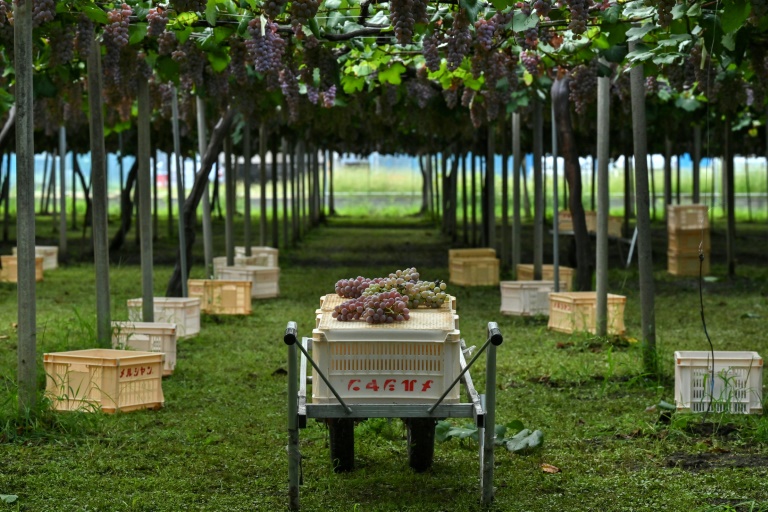
One of those award-winners was L’Orient Shirayuri Winery, a small family vineyard established in 1938, where workers inspect the dusky lilac grapes on their pergola under a low, stormy sky.

Growing on the structures “reduces the grapes’ exposure to humidity, and helps them dry in the wind”, said Keiya Uchida, general manager at Shirayuri.

To protect the fruit from the rain, each bunch is given a small umbrella-like hat made from a white material with a waxy surface.

“Foreign visitors often find that a bit mad” because of the time spent to attach the umbrellas, said the 28-year-old, who studied viticulture in France’s Burgundy.

But it’s an “essential” measure, as frequent downpours and high humidity “makes grapes fragile and prone to disease”.

Such efforts have transformed the fertile soils of Yamanashi, near Japan’s most famous peak, into the country’s premier wine region.

Around 90 producers compete to supply a burgeoning market for local wine, with many vineyards squeezed into rural corridors between built-up areas.

Imported wine, mainly from France, Chile and Italy, still makes up around two-thirds of the domestic market by volume, with prices ranging from cheap mass-produced plonk to eye-wateringly expensive vintages.

Most of the rest is produced in Japan, but using grapes from elsewhere.

However, in 2018, a special label was introduced to distinguish wine grown in the country, with the average price for a bottle around 2,000 to 3,000 yen ($13 to $20).

– ‘Renewed interest’ –

Such ‘made-in-Japan’ wine accounts for around five percent of the market, a share that is slowly increasing.

That could grow to 10 percent within five or six years thanks to the improving quality of koshu, said Mitsuhiro Anzo, director general at Chateau Mercian and president of the Yamanashi Prefecture Wine Manufacturers’ Association.

Marie Ishiyama, a 30-year-old Tokyo resident tasting the wines at Shirayuri, also believes demand is rising.

“Although foreign products are very popular, there’s a renewed interest for local, made-in-Japan products,” including wine, she told AFP.

Japan still sells very little wine abroad, with exports in 2021 worth 687 million yen (then $6.2 million) — compared with 46 billion yen ($420 million) for whisky and 40 billion yen for sake, its famous rice wine.

High labour costs, obstacles posed by Japan’s climate and limited farmland mean the nation will never produce and export wine at large volumes, said Frederic Cayuela, an instructor at Academie du Vin, a wine academy in Tokyo.

“So they have this really big focus on the quality rather than the quantity,” he told AFP.

Japan’s wine industry can grow a niche appeal by focusing on its unique tastes and how well the wine accompanies Japanese or fusion food, he said.

Anzo from Chateau Mercian, which is owned by drinks giant Kirin and picked up a gold medal for a koshu wine at the 2021 International Wine Challenge, is on the same wavelength.

“Twenty years ago, we were only trying to imitate foreign wine. But now, we have very specific varieties, like koshu,” he said.

“Many overseas consumers are interested in Japanese culture and cuisine, which is a good thing for Japanese wine.”

Asian markets track Wall St losses but sterling bounces

Asian equities dropped Monday, tracking a selloff on Wall Street as last week’s rally ran out of steam on fresh worries about rising interest rates and surging inflation.

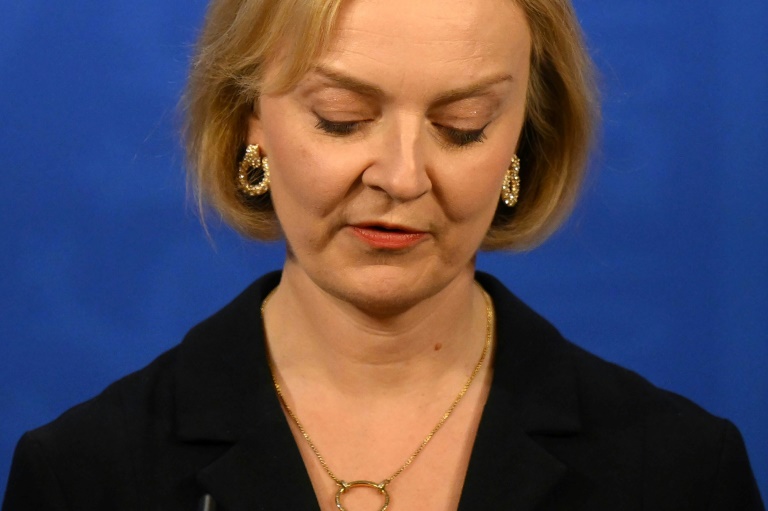
The pound rose, however, after British Prime Minister Liz Truss replaced her finance minister and speculation swirled that she would row back on more of the debt-fuelled, tax-cutting budget that sent shivers through finance markets.

The healthy gains Asian markets enjoyed on Friday were largely wiped out in early trade as expectations about elevated prices and central bank moves to rein them in continued to fan recession fears.

Last week’s strong US inflation reading ramped up bets that the Federal Reserve will hike borrowing costs by 75 basis points twice more before the end of the year, stoking concerns the world’s top economy will flip into a recession.

All three main indexes on Wall Street finished sharply lower Friday, and Asia followed suit Monday.

Hong Kong shed more than one percent and Shanghai was also in the red, with Chinese President Xi Jinping at the weekend reasserting his commitment to the zero-Covid strategy of lockdowns that has hammered the economy this year.

There were also losses in Tokyo, Sydney, Seoul, Singapore, Taipei, Jakarta and Wellington.

Traders are also keeping tabs on looming earnings reports, with expectations that higher rates and prices will have eaten into companies’ bottom lines.

They will also be keeping a close eye on the United Kingdom as Truss battles for her political future just weeks after taking the keys to Number 10.

She sacked her finance minister Kwasi Kwarteng on Friday after coming under intense pressure following his controversial tax-cutting mini-budget.

His replacement, Jeremy Hunt, looked set to roll back several of the measures in a bid to reassure markets.

“It does indicate that they are moving back to some degree of fiscal probity and employing a slightly more prudent fiscal outlook,” said Peter Kinsella, of Union Bancaire Privee UBP SA. 

The pound was holding above $1.12 in Asian trade, having sunk Friday owing to the uncertainty in Westminster, while a news conference by Truss did very little to reassure nervous investors.

Eyes are also on Tokyo as the yen sits around a three-decade low against the dollar owing to US rate hike expectations and the Bank of Japan’s refusal to tighten monetary policy, citing a need to support the economy.

The yen is approaching 150 to the dollar for the first time since 1990, but while officials have said they are keeping tabs on developments, they have yet to intervene in markets for a second time, having done so last month.

– Key figures around 0230 GMT –

Tokyo – Nikkei 225: DOWN 1.4 percent at 26,703.00 (break)

Hong Kong – Hang Seng Index: DOWN 1.3 percent at 16,365.82

Shanghai – Composite: DOWN 0.2 percent at 3,065.88

Pound/dollar: UP at $1.1236 from $1.1180 Friday

Dollar/yen: DOWN at 148.59 yen from 148.72 yen

Euro/dollar: UP at $0.9747 from $0.9724

Euro/pound: DOWN at 86.76 pence from 86.93 pence

West Texas Intermediate: UP 0.8 percent at $86.31 per barrel

Brent North Sea crude: UP 0.9 percent at $92.41 per barrel

New York – Dow: DOWN 1.3 percent at 29,634.83 (close)

London – FTSE 100: UP 0.1 percent at 6,858.79 (close) 

Brazil's Bolsonaro, Lula in first head-to-head debate

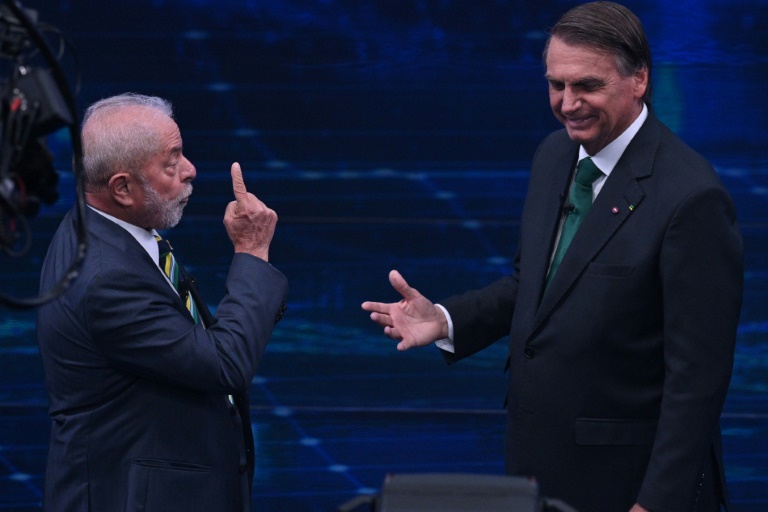
Far-right incumbent Jair Bolsonaro and leftist challenger Luiz Inacio Lula da Silva traded jabs and insults as they squared off Sunday in their first-ever head-to-head debate, two weeks from Brazil’s presidential runoff election.

Lula attacked Bolsonaro as a “little dictator” and the “king of fake news,” drawing accusations of lying, corruption and a “disgraceful” record in return, as the rivals sparred in the first debate for their polarizing second-round showdown on October 30.

Front-runner Lula, the charismatic but tarnished ex-president (2003-2010) who is seeking a comeback at 76, was particularly fiery criticizing Bolsonaro over his handling of Covid-19, which has killed 687,000 people in Brazil, second only to the United States.

Attacking Bolsonaro over his resistance to buying vaccines and embrace of unproven medications such as hydroxychloroquine, Lula said the president “carries the weight of those deaths on his shoulders.”

“Your negligence led to 680,000 people dying, when more than half could have been saved,” the ex-metalworker said in his trademark gravelly voice.

Bolsonaro, 67, sought to shift the focus to the issue of corruption — a weak spot for Lula, who was jailed in 2018 on controversial, since-overturned charges stemming from the investigation of a massive graft scheme centered on state-run oil company Petrobras.

“Your past is disgraceful… You did nothing for Brazil but stuff public money in your pockets and those of your friends,” Bolsonaro said, calling Lula a “national shame.”

“Lula, stop lying, it’s bad for you at your age,” said the ex-army captain at another point, simultaneously defending his own record and taking a shot at his rival’s age.

– Below the belt –

Already bitter, divisive and full of mud-slinging, the campaign has if anything veered further into negative territory since the first-round vote.

Lula’s camp in particular has embraced attack strategies once seen more on the far-right, scouring archive video footage of Bolsonaro and pouncing on unflattering quotes to try to link him to freemasonry and cannibalism, for example.

Their latest attack implied Bolsonaro was a pedophile, with Lula allies calling the president a “depraved criminal” and expressing “disgust” Saturday for comments he made on visiting a house last year where a group of underage Venezuelan girls were apparently working as prostitutes.

The head of Brazil’s top electoral tribunal, Judge Alexandre de Moraes, ordered dozens of Lula-linked websites to remove attacks related to the Bolsonaro video, ruling Sunday the incumbent’s comments had been taken out of context.

Arriving at the debate in Sao Paulo — the first in which only Lula and Bolsonaro took part — the president said the previous 24 hours had been “the most terrible of my life” because of the attacks.

Lula did not mention the issue during the debate, but wore a pin for an anti-child sex abuse campaign on his lapel.

The free-wheeling debate rules allowed the candidates to roam the stage and approach the cameras, which both did frequently — though they rarely looked at each other, with the notable exception of one tense silence that Bolsonaro finally interrupted by putting his hand on Lula’s shoulder with a smile.

As has been the case for much of the campaign, far more time was spent on personal attacks than substantive discussion.

“Policy proposals have lost their central role, and accusations have taken their place,” political scientist Christopher Mendonca told AFP.

– Are polls wrong again? –

Bolsonaro, the vitriolic hardline conservative who took office in 2019, finished second in the first-round election on October 2 with 43 percent of the vote, to 48 percent for Lula.

But many opinion polls had put Lula’s lead in the double digits.

Bolsonaro’s stronger-than-expected performance has given him an aura of momentum heading into the runoff, and increased speculation over the possibility of another surprise in two weeks’ time.

Lula has 53 percent of the vote heading into the runoff, to 47 percent for Bolsonaro, according to a poll released Friday by the Datafolha institute.

Oldest author in contention as UK's Booker prize returns in full

Britain’s Booker Prize for fiction on Monday holds its first large-scale awards ceremony since 2019 with six novels in the running — including the oldest author yet nominated, and the shortest book.

Queen Consort Camilla will award the coveted prize at the televised ceremony, in one of her highest-profile appearances since her husband King Charles III ascended the throne last month.

The evening event will also feature a speech by singer-songwriter Dua Lipa, as it resumes in front of a full in-person audience following the Covid pandemic.

All but one of the six shortlisted authors is due to attend in person. Englishman Alan Garner, who turns 88 on Monday, is expected to appear virtually.

Garner, who made his name with children’s fantasy titles and folk retellings, is shortlisted for “Treacle Walker”, which is the shortest finalist novel by word count.

“They’re not easy books, even though they may be short,” Neil MacGregor, chair of the 2022 judges, said of the final six.

“But, like many great pleasures, some require hard work, and we found them well worth the effort,” he said.

The shortlist sees an equal split of men and women battling for the £50,000 ($56,000) prize, which can provide a career-changing boost in sales and public profile.

NoViolet Bulawayo made it for the second time, for “Glory”, an animal fable set in her native Zimbabwe, while Sri Lanka’s Shehan Karunatilaka was the only other writer not from the British Isles or United States, for “The Seven Moons of Maali Almeida”. 

American Percival Everett was included for “Trees”, earning independent publisher Influx Press its first Booker shortlist place.

Fellow US writer Elizabeth Strout featured for “Oh William!” while Irish author Claire Keegan’s “Small Things Like These” completes the shortlist.

At 116 pages, Keegan’s is the shortest finalist by the number of pages in the prize’s 53-year history.

The Booker is Britain’s foremost literary award for novels written in English. Its previous recipients include Salman Rushdie, Margaret Atwood and Hilary Mantel.

Monday’s ceremony is to feature a special tribute to Mantel, who died last month aged 70.

She was the first British writer, and first woman, to win the prize twice with the first two novels in her “Wolf Hall” trilogy.

British-Turkish author Elif Shafak will meanwhile discuss the implications for writers worldwide after Rushdie was stabbed on-stage during a US appearance in August.

Close Bitnami banner
Bitnami