World

Scientists scour global waters testing ocean plankton and pollution

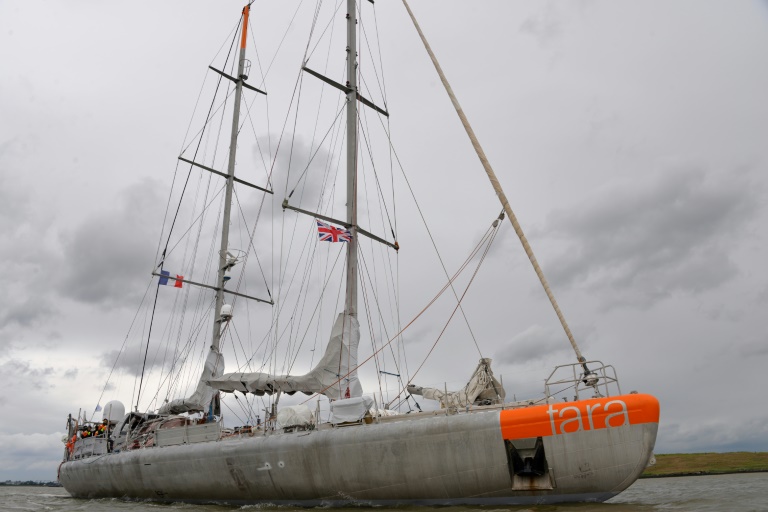
After a near two-year “Microbiome” mission around the world, scientists said on Saturday they had gathered thousands of samples of marine micro-organisms in a bid to better understand ocean plankton and pollution.

The survey was carried out from the 33-year-old Tara research schooner, which returned to her home port of Lorient on France’s western coast at the weekend.

From Chile to Africa, via the Amazon and the Antarctic, nearly 25,000 samples were collected over the 70,000-kilometre (43,000-mile) route.

“All this data will be analysed,” Tara Ocean Foundation director Romain Trouble told a press conference.

“Within 18 months to two years we will start to have the first discoveries from the mission,” he said.

At the base of the food chain, micro-organisms were the “invisible people of the sea”, accounting for two-thirds of marine biomass, said Trouble.

“They capture atmospheric CO2 (carbon dioxide) and supply half of the oxygen we breathe.”

Trouble said the mission sought to find out how it all works.

“How do all these marine viruses, bacteria, micro-algue manage to interact to produce oxygen?”

“And how will that change tomorrow with climate change and pollution?”

The Tara team paid particular attention to the impact on the oceans of the River Amazon, which has a water flow rate of 200 million litres (53 million gallons) per second.

They wanted to test a theory that deforestation and the spread of agriculture has increased nitrate fertiliser discharge, leading to an abundance of toxic algae along river banks and coasts, particularly in the Caribbean.

The 22-month odyssey also sought to trace the sources of plastic pollution at river mouths, to understand distribution and the types of material involved.

The mission was Tara’s 12th global journey and involved 42 research institutions around the world.

Next spring, Tara sets off to research chemical pollution off European coasts. 

'Mullahs must get lost,' Iranians sing at new Mahsa Amini protests

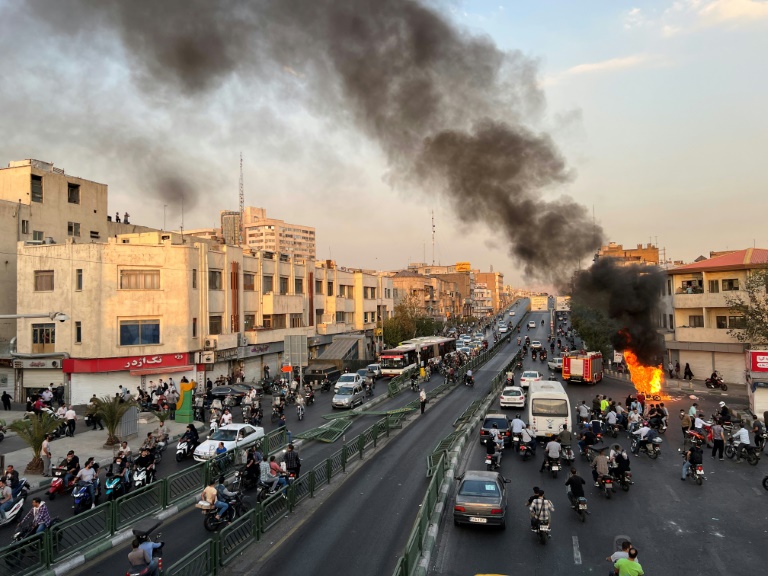
Angry demonstrators took to streets across Iran again Saturday despite internet cuts, as the protest movement sparked by Mahsa Amini’s death in custody entered a fifth week.

The 22-year-old died on September 16, three days after falling into a coma following her arrest by Iran’s notorious morality police for an alleged breach of the Islamic republic’s strict dress code for women.

Young women have been at the forefront of the biggest wave of street protests seen in the country for years.

“Guns, tanks, fireworks; the mullahs must get lost,” women without hijabs chanted at a gathering at Tehran’s Shariati Technical and Vocational College, in a video widely shared online.

Scores of jeering and whistling protesters hurled projectiles at security forces near a landmark roundabout in Hamedan city, west of Tehran, in footage verified by AFP.

Despite what online monitor NetBlocks called a “major disruption to internet traffic”, protesters were also seen pouring onto the streets of the northwestern city of Ardabil, in videos shared on Twitter.

Shopkeepers went on strike in Amini’s hometown Saqez, in Kurdistan province, and Mahabad in West Azerbaijan, said the 1500tasvir social media channel that monitors protests and police violations.

They were responding to an appeal for a huge turnout for protests on Saturday under the catchcry “The beginning of the end!”

“We have to be present in the squares, because the best VPN these days is the street,” activists declared, referring to virtual private networks used to skirt internet restrictions.

– ‘Brave women of Iran’ –

In response to the protests, one of Iran’s main revolutionary bodies, the Islamic Development Coordination Council, has urged people to “express their revolutionary anger against sedition and rioters” after prayers on Saturday evening.

A call also went out this week for “retirees” of the Revolutionary Guards to meet on Saturday given “the current sensitive situation”, according to a journalist at Shargh newspaper.

At the gathering, a Guards commander said three members of its Basij militia had been killed and 850 wounded in Tehran since the start of the “sedition”, state news agency IRNA said.

The women-led protests have won support from the US president.

“I want you to know that we stand with the citizens, the brave women of Iran,” Joe Biden said late Friday.

“It stunned me what it awakened in Iran. It awakened something that I don’t think will be quieted for a long, long time.”

Iran “has to end the violence against its own citizens simply exercising their fundamental rights”, the US leader added.

At least 108 people have been killed in the Amini protests, and at least 93 more have died in separate clashes in Zahedan, capital of the southeastern province of Sistan-Baluchestan, according to Oslo-based group Iran Human Rights.

The unrest has continued despite what Amnesty International has called an “unrelenting brutal crackdown” that has included an “all-out attack on child protesters” — leading to the deaths of at least 23 minors.

The crackdown has drawn international condemnation and sanctions on Iran from Britain, Canada and the United States.

Iran’s supreme leader has accused the country’s enemies, including the US and Israel, of fomenting the “riots”.

– ‘Great moment in history’ –

Foreign minister Hossein Amir-Abdollahian, has called on the European Union to adopt a “realistic approach” over the Amini protests as the bloc prepares to impose new sanctions on the Islamic republic.

“Who would believe that the death of one girl is so important to Westerners?” he said in a statement on Friday.

“If it is so, what did they do regarding the hundreds of thousands of martyrs and deaths in Iraq, Afghanistan, Syria and Lebanon?” he added.

EU countries agreed this week to level new sanctions, and the move is due to be endorsed at the bloc’s foreign ministers’ meeting in Luxembourg on Monday.

In response to the protests, the clerical state’s security forces have also launched a campaign of mass arrests of artists, dissidents, journalists and athletes.

Iranian filmmaker Mani Haghighi said the authorities barred him from travelling to the London Film Festival over his support for the protests.

The British Film Institute said Haghighi had been due to attend the festival for his latest film “Subtraction”, but the Iranian authorities “confiscated his passport”.

“I cannot put into words the joy and the honour of being able to witness first-hand this great moment in history,” said Haghighi

“So if this is a punishment for what I’ve done, then by all means, bring it on.”

burs-dv/lg

New UK finance minister tears up tottering PM's agenda

Britain’s new finance minister on  Saturday warned of looming tax hikes as he admitted to “mistakes” made in a disastrous budget that still threatens to bring down Prime Minister Liz Truss.

“Truss fights for survival,” The Times newspaper headlined a day after she forced chancellor of the exchequer Kwasi Kwarteng to carry the can for market turmoil sparked by their budget on September 23.

The Times, Telegraph and other newspapers reported that senior Conservative members of parliament were still plotting to unseat Truss, possibly within days, aghast at the party’s collapse in opinion polls since she replaced Boris Johnson on September 6.

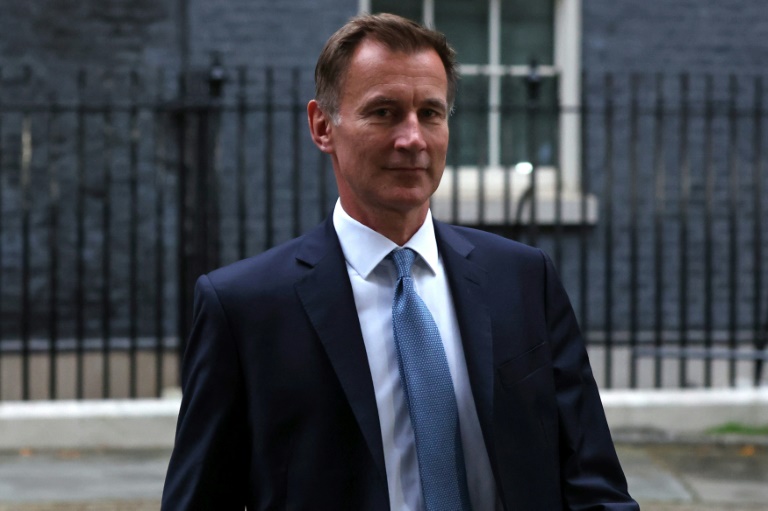
New chancellor Jeremy Hunt, a former foreign secretary seen as a Tory centrist, made clear he was ripping up the strategy that brought Truss to 10 Downing Street.

“There were mistakes,” acknowledged Hunt, whom one ally called the government’s new “chief executive” — with Truss now relegated to the role of back-seat chairwoman.

Hunt said Kwarteng and Truss had erred in trying to cut taxes for the highest earners, and in presenting their plan without independent forecasts from the Office for Budget Responsibility.

“The prime minister’s recognised that, that’s why I’m here,” Hunt told Sky News.

In one of his first acts on taking office Friday, the new chancellor spoke to Bank of England governor Andrew Bailey, who has had to stage costly interventions to calm febrile bond markets.

“They discussed the importance of tackling global inflation, and their commitment to economic growth and fiscal discipline,” the Treasury tweeted.

Tax cuts were the centrepiece of the ill-starred budget announced by Kwarteng and Truss. 

But they were financed through billions in extra borrowing, causing panic on financial markets at the prospect of higher inflation, which has already left British households in the grip of a cost-of-living crisis.

“We will have some very difficult decisions ahead,” Hunt said, warning that “all government departments” face spending curbs including welfare, health and defence. 

“And some taxes will not be cut as quickly as people want. Some taxes will go up.”

Hunt confirmed he would deliver a new fiscal statement on October 31, agreeing on BBC radio that he had a “clean slate” to start afresh despite Truss’s prior promises.

Soon after, on November 3, the Bank of England will hold its next rate-setting meeting.

– ‘Hanging by a thread’ –

In a speech in Washington Saturday, Bailey warned anew that the central bank would “not hesitate” to raise rates to keep soaring inflation under control, threatening more pain for UK households and businesses after the botched budget.

Truss dismissed Kwarteng hours after he had rushed home early from international finance meetings in Washington, and she staged another U-turn in acquiescing to a significant rise in profits tax levied on companies.

At a subsequent Downing Street news conference, her first since succeeding Johnson, the prime minister took only four questions, glancing nervously around the room and delivering terse replies before abruptly leaving after just over eight minutes. 

“Robotic, hesitant, tone-deaf, defiant and still utterly convinced of the purity and necessity of her mission, Liz Truss killed off her political career in a matter of minutes,” Times columnist Jenni Russell wrote.

Asked why she herself should not resign, Truss said she was “absolutely determined to see through what I have promised”.

But having abandoned the right-wing economic promises that won her the Conservative leadership election against rival Rishi Sunak, Truss faced mounting criticism that her credibility was in tatters.

“I feel let down, very badly let down,” Tory MP Christopher Chope, a Truss loyalist, told BBC television.

Former Conservative leader William Hague said Truss’s premiership now “hangs by a thread”, while ex-chancellor Philip Hammond said she had “thrown away years and years of painstaking work” to establish the party’s record for economic competence.

But with the opposition Labour party surging in the polls, Welsh Secretary Robert Buckland warned his restive colleagues against “throwing another prime minister to the wolves”.

Labour leader Keir Starmer accused Truss of “clinging on”, and demanded an early general election.

“There are no historical precedents for what they have done to our economy,” he said in a speech Saturday.

Oil depot hit and on fire in Russia's Belgorod: governor

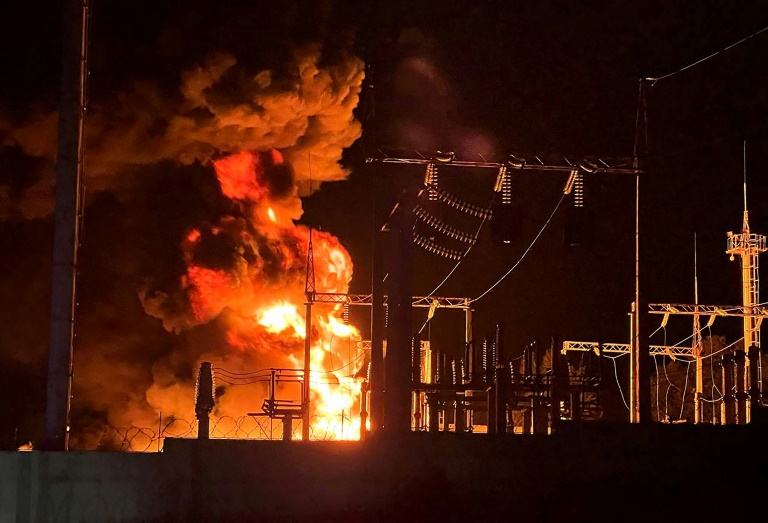
An oil depot in Russia’s Belgorod region bordering Ukraine is on fire after being shelled on Saturday, the governor said, as strikes increases against the area.

“We’re getting bombed again. One of the shells hit the oil depot in the Belgorod region,” regional governor Vyacheslav Gladkov said.

He said emergency services were already on site, adding there was “no risk” of the fire spreading.

Gladkov posted a photo showing flames and plumes of black smoke rising above a building.

State-run news agency TASS cited a source in the emergency services saying the burning depot was located in the village of Razumnoye-71, near the city of Belgorod. 

Last week Russia complained of an increase in artillery and missile strikes on its territory bordering Ukraine.

The Belgorod region has regularly come under fire. 

The capital of the region, also called Belgorod, had been hit more rarely.

But on Friday a power station in the city was set on fire by a Ukrainian strike, causing electricity cuts. 

This came a day after a rocket gutted the top floor of an apartment building in the city of Belgorod, without causing injuries.

A munition depot in the region was also destroyed on Thursday. 

Earlier in the week, Ukrainian strikes knocked out power in the town of Shebekino, in the same region. A 74-year-old woman died and several others were wounded in the town. 

Strikes persist at TotalEnergies refineries, fuel depot in France

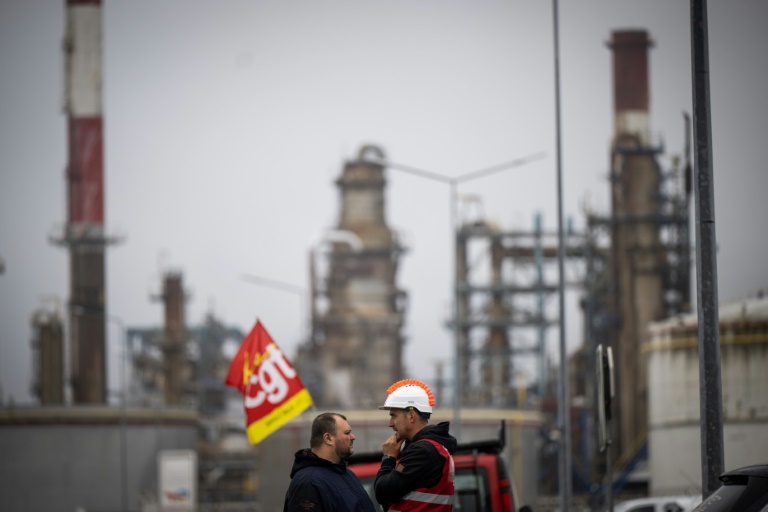
French refinery and fuel depot workers at five sites owned by oil giant TotalEnergies vowed to continue striking on Saturday, compounding concern over petrol supply ahead of wider protests early next week.

Four of France’s seven refineries and one fuel depot were out of action, after strikers rejected a pay offer from the hydrocarbon industry leader.

Operations had resumed earlier in the week at two other refineries run by Esso-ExxonMobil, however, after workers struck a bargain with management.

The blockages have caused queues outside petrol stations, and worry across all sectors of the economy ,from mobile healthcare workers to farmers.

President Emmanuel Macron’s government forced some strikers back to work this week to open fuel depots, a move that infuriated unions but has been upheld by courts.

The hard-left CGT union, which launched the industrial action three weeks ago, said on Saturday that workers at three TotalEnergies sites had decided to extend their strike.

“The action has been extended at three sites,” said Eric Sellini, the CGT coordinator at the company.

Employees at the two others, including France’s largest refinery near the northwestern city of Le Havre, had already decided to prolong their action.

Left-wing opponents of Macron have called for anti-inflation marches on Sunday.

The CGT has called a strike for Tuesday that could disrupt public transport nationwide.

The union risks stoking resentment in a country where three-fourths of workers rely on personal vehicles for their jobs, with public support for the strike at just 37 percent in a BVA poll released Friday.

The CGT is pushing for a 10-percent pay rise for staff at TotalEnergies, retroactive for all of 2022.

It says the French group can more than afford it, citing TotalEnergies’ net profit of $5.7 billion in the April-June period as energy prices soared with the war in Ukraine, and its payout of billions of euros in dividends to shareholders.

It walked out of talks with the French group in the night of Thursday to Friday, even as other unions representing a majority of workers accepted a deal for a lesser pay hike.

TotalEnergies on Saturday urged its workers to resume work, “in view of the signing of a majority deal on salaries” with two other unions.

Esso-ExxonMobil has said it would take two to three weeks to relaunch production at its refineries.

Pakistan summons US envoy over Biden 'most dangerous nation' remark

Pakistan on Saturday summoned the US ambassador for an explanation after President Joe Biden described the South Asian country as “one of the most dangerous nations in the world” and questioned its nuclear weapons safety protocols.

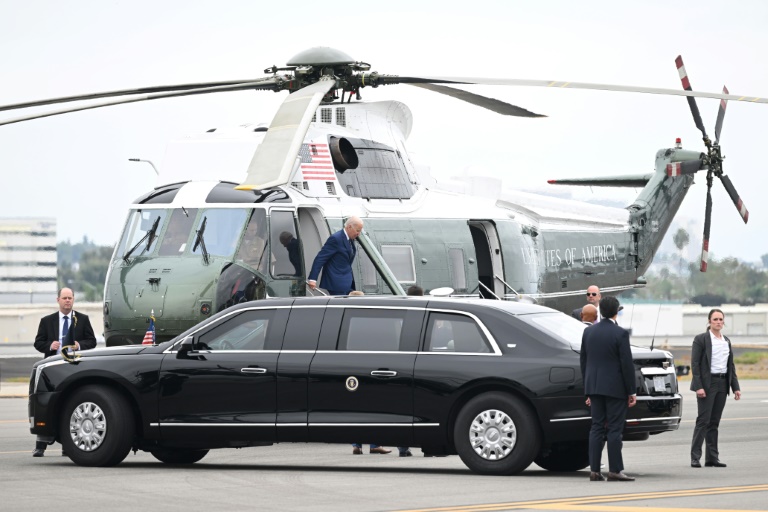
Biden made the apparently off-the-cuff remark late Thursday while talking about United States foreign policy during a private Democratic Party fundraiser in California, but the White House later published a transcript of his comments, sparking outrage in Pakistan.

Washington’s relations with Pakistan have soured since last year, when the US ended a two-decade war in Afghanistan.

Pakistan provided crucial logistical access, but US officials believe Islamabad’s powerful military and intelligence apparatus also aided the Taliban, who swept back to power as foreign troops pulled out.

Biden was speaking about his frequent interactions with Chinese leader Xi Jinping, when he said: “Did anybody think we’d be in a situation where China is trying to figure out its role relative to Russia and relative to India and relative to Pakistan?

“This is a guy who understands what he wants but has an enormous, enormous array of problems. How do we handle that? How do we handle that relative to what’s going on in Russia? 

“And what I think is maybe one of the most dangerous nations in the world: Pakistan. Nuclear weapons without any cohesion.”

Hours after the transcript of his address was posted, Pakistan summoned the US ambassador Donald Blome to the foreign office in Islamabad.

– Room to manoeuvre –

“I have discussed it with the prime minister, and we have summoned the ambassador of the United States… for an official demarche,” Pakistani Foreign Minister Bilawal Bhutto Zardari said during a press conference in Karachi.

“I am surprised by the remarks of President Biden. I believe this is exactly the sort of misunderstanding that is created when there is lack of an engagement.”

Zardari appeared to offer Washington some room to manoeuvre.

“It was not an official function, it was not an address to the nation or an address to the parliament,” he said.

“We should allow them an opportunity to explain this position. I don’t believe that this should negatively impact the relations between Pakistan and the United States.”

The US is wary of Pakistan’s close partnership with China, as Beijing pushes ahead with a $54 billion “economic corridor” that will build infrastructure and give Beijing an outlet to the Indian Ocean.

Washington has repeatedly said China will reap most of the benefits, leaving Pakistan with unsustainable debt.

The warnings by the US — which considers China its preeminent global competitor — have repeatedly been brushed aside by Pakistan.

Nuclear-armed Pakistan this week abstained from a United Nationals General Assembly vote to condemn Russia’s annexation of parts of Ukraine, despite a major US diplomatic push to seek clearer condemnation of Moscow.

Iranians pour onto streets after Mahsa Amini death

Demonstrators took to streets across Iran again Saturday over Mahsa Amini despite internet cuts, as the protest movement sparked by outrage over her death in custody enters a fifth week.

Amini’s death on September 16, three days after she was arrested by Iran’s notorious morality police, has fuelled the biggest wave of street protests and violence seen in the country for years.

Young women have been at the forefront of the demonstrations, shouting anti-government slogans, removing and burning their headscarves, and standing up to security forces on the streets.

Despite what online monitor NetBlocks called a “major disruption to internet traffic”, protesters were seen pouring onto the streets of the northwestern city of Ardabil, in videos shared on Twitter.

Shopkeepers went on strike in Amini’s hometown Saqez, in Kurdistan province, and Mahabad in West Azerbaijan, according to the 1500tasvir social media channel that monitors protests and police violations.

“Freedom, freedom, freedom,” young women at Shariati Technical and Vocational College in Tehran chanted as they waved their headscarves in the air, 1500tasvir said.

“Schoolgirls in Ney village in Marivan began the protests by setting fires on the ground and yelling anti-government chants,” said Hengaw, an Oslo-based rights group.

Youths were also seen demonstrating at universities in Tehran, Isfahan and Kermanshah, in footage widely shared online.

They were responding to an appeal for a huge turnout for protests on Saturday under the catchcry “The beginning of the end!”

“We have to be present in the squares, because the best VPN these days is the street,” activists declared, referring to virtual private networks used to skirt internet restrictions.

In response to the call for fresh protests, one of Iran’s main revolutionary bodies, the Islamic Development Coordination Council, has urged people to “express their revolutionary anger against sedition and rioters”.

A call also went out this week for “retirees” of the Islamic Revolutionary Guard Corps to gather on Saturday given “the current sensitive situation”, according to a journalist at the Shargh newspaper.

– ‘Brave women of Iran’ –

The women-led protests have won support from the US president.

“I want you to know that we stand with the citizens, the brave women of Iran,” Joe Biden said late Friday.

“It stunned me what it awakened in Iran. It awakened something that I don’t think will be quieted for a long, long time,” he said.

Iran “has to end the violence against its own citizens simply exercising their fundamental rights”, he added.

At least 108 people have been killed in the Amini protests, and at least 93 more have died in separate clashes in Zahedan, capital of the southeastern province of Sistan-Baluchestan, according to Oslo-based group Iran Human Rights.

The unrest has continued despite what Amnesty International called an “unrelenting brutal crackdown” that included an “all-out attack on child protesters” — leading to the deaths of at least 23 minors.

The crackdown has drawn international condemnation and sanctions on Iran from Britain, Canada and the United States.

Iran’s supreme leader has accused the country’s enemies, including the US and Israel, of fomenting the “riots”.

– ‘Great moment in history’ –

His foreign minister, Hossein Amir-Abdollahian, has called on the European Union to adopt a “realistic approach” over the Amini protests as the bloc prepares to impose new sanctions on the Islamic republic.

“Who would believe that the death of one girl is so important to Westerners?” he said in a statement on Friday.

“If it is so, what did they do regarding the hundreds of thousands of martyrs and deaths in Iraq, Afghanistan, Syria and Lebanon?” he added.

EU countries agreed this week to level new sanctions, and the move is due to be endorsed at the bloc’s foreign ministers’ meeting in Luxembourg on Monday.

In response to the protests, the clerical state’s security forces have also launched a campaign of mass arrests of artists, dissidents, journalists and athletes.

Iranian filmmaker Mani Haghighi said the authorities barred him from travelling to the London Film Festival over his support for the protests.

The British Film Institute said Haghighi had been due to attend the festival for his latest film “Subtraction”, but the Iranian authorities “confiscated his passport”.

“I cannot put into words the joy and the honour of being able to witness first-hand this great moment in history,” said Haghighi

“So if this is a punishment for what I’ve done, then by all means, bring it on.”

burs-dv/jsa

At least 40 killed, one still missing in Turkey mine blast

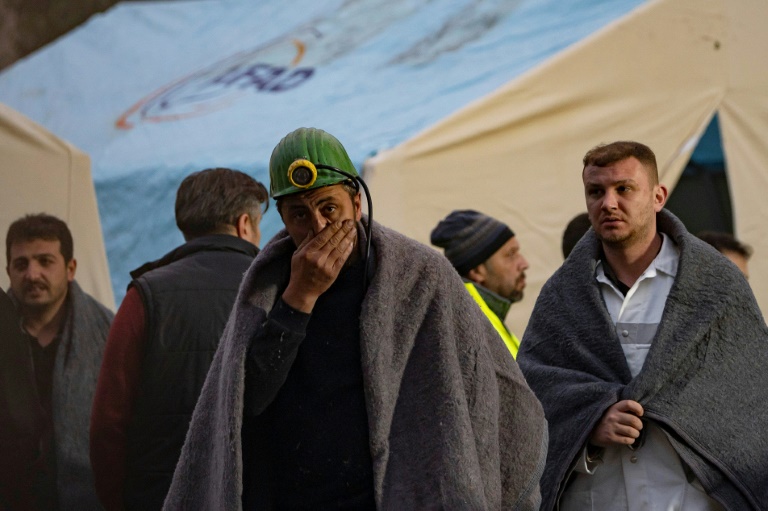
Rescuers on Saturday searched for the last miner missing at a coal mine in northern Turkey, where a methane blast the previous day killed at least 40 people in one of the country’s worst industrial accidents in years.

The blast ripped through the mine near the small coal mining town of Amasra on Turkey’s Black Sea coast shortly before sunset on Friday.

“We are approaching the end of the rescue operation,” a tearful Energy Minister Fatih Donmez said at the scene on Saturday.

“The search continues for the sole person whose fate is unknown,” he said, adding that the fire that had broken out in the tunnels following the blast was now mostly under control.

Updating the death toll, Interior Minister Suleyman Soylu said: “We have counted 40 dead in total. 58 miners were able to be rescued, either by themselves or thanks to rescuers.”

He said 28 people had been injured as a result of the blast.

Soylu had said earlier some 110 people had been underground at the time of the explosion.

Television images late on Friday showed anxious crowds — some with tears in their eyes — congregating around a damaged white building near the entrance to the pit in search of news of their friends and loved ones.

Turkish President Recep Tayyip Erdogan, who was due to fly to the scene of the accident on Saturday, vowed on Twitter that the incident will be thoroughly investigated.

Most initial information about those trapped inside was coming from workers who had managed to climb out relatively unharmed.

But Amasra mayor Recai Cakir said many of those who survived had suffered “serious injuries”.

Turkey’s Maden Is mining workers’ union attributed the blast to a build-up of methane gas.

But other officials said it was premature to draw definitive conclusions over the cause of the accident.

– 2014 disaster –

Rescuers sent in reinforcements from surrounding villages to help in the search and rescue.

Television footage showed paramedics giving oxygen to the miners who had climbed out, then rushing them to the nearest hospitals.

The local governor said a team of more than 70 rescuers had managed to reach a point in the pit some 250 metres below.

Turkey’s AFAD disaster management service said the initial spark that caused the blast appeared to have come from a malfunctioning transformer.

It later withdrew that report and said methane gas had ignited for “unknown reasons”.

The local public prosecutor’s office said it was treating the incident as an accident and launching a formal investigation.

Turkey suffered its deadliest coal mining disaster in 2014 when 301 workers died in a blast in the western town of Soma.

burs/yad/ah

Iran braces for new demos after Mahsa Amini death

Demonstrators are expected to take to streets across Iran again Saturday over Mahsa Amini despite internet cuts, as the protest movement sparked by outrage over her death in custody enters a fifth week.

Amini’s death on September 16, three days after she was arrested by Iran’s notorious morality police, has fuelled the biggest wave of street protests and violence seen in the country for years.

Young women have been at the forefront of the demonstrations, shouting anti-government slogans, removing and burning their headscarves, and standing up to security forces on the streets.

Online monitor NetBlocks on Saturday reported a “new major disruption to internet traffic in #Iran” from around 10:00 am (0630 GMT).

Despite blocked access to the internet, including platforms like Instagram and WhatsApp, activists issued an online appeal for a huge turnout for protests on Saturday under the catchcry “The beginning of the end!”

They have called on people across Iran to show up at spots where the security forces are not present and to chant “Death to the dictator” — a reference to Iran’s supreme leader Ayatollah Ali Khamenei.

“We have to be present in the squares, because the best VPN these days is the street,” they declared, referring to virtual private networks used to skirt internet restrictions.

In response to the call for fresh protests, one of Iran’s main revolutionary bodies, the Islamic Development Coordination Council, has urged people to “express their revolutionary anger against sedition and rioters”.

A call also went out this week for “retirees” of the Islamic Revolutionary Guard Corps to gather on Saturday given “the current sensitive situation”, according to a journalist at the Shargh newspaper.

– ‘Brave women of Iran’ –

The women-led protests have won support from the US president.

“I want you to know that we stand with the citizens, the brave women of Iran,” Joe Biden said late Friday.

“It stunned me what it awakened in Iran. It awakened something that I don’t think will be quieted for a long, long time,” he said.

“Women all over the world are being persecuted in various ways, but they should be able to wear in God’s name what they want to wear.”

Iran “has to end the violence against its own citizens simply exercising their fundamental rights”, he added.

At least 108 people have been killed in the Amini protests, and at least 93 more have died in separate clashes in Zahedan, capital of the southeastern province of Sistan-Baluchestan, according to Oslo-based group Iran Human Rights.

The unrest has continued despite what Amnesty International called an “unrelenting brutal crackdown” that included an “all-out attack on child protesters” — leading to the deaths of at least 23 minors.

The crackdown has drawn international condemnation and sanctions on Iran from Britain, Canada and the United States.

Iran’s supreme leader has accused the country’s enemies, including the United States and Israel, of fomenting the “riots”.

– ‘Great moment in history’ –

His foreign minister, Hossein Amir-Abdollahian, has called on the European Union to adopt a “realistic approach” over the Amini protests as the bloc prepares to impose new sanctions on the Islamic republic.

“Who would believe that the death of one girl is so important to Westerners?” he said in a statement on Friday.

“If it is so, what did they do regarding the hundreds of thousands of martyrs and deaths in Iraq, Afghanistan, Syria and Lebanon?” he added.

EU countries agreed this week to level new sanctions, and the move is due to be endorsed at the bloc’s foreign ministers’ meeting in Luxembourg on Monday.

In response to the protests, the clerical state’s security forces have also launched a campaign of mass arrests of artists, dissidents, journalists and sports stars.

An Iranian filmmaker said the authorities barred him from travelling to the London Film Festival over his support for the protests.

The British Film Institute said Mani Haghighi had been due to attend the festival for his latest film “Subtraction”, but the Iranian authorities “confiscated his passport”.

“Let me tell you that being here in Tehran right now is one of the greatest joys of my life,” said Haghighi.

“I cannot put into words the joy and the honour of being able to witness first-hand this great moment in history.

“So if this is a punishment for what I’ve done, then by all means, bring it on.”

burs-dv/hc

UK's new finance minister admits taxes to rise as PM reels

Britain’s new finance minister Saturday warned of looming tax hikes as he admitted to “mistakes” made in a disastrous budget that still threatens to bring down Prime Minister Liz Truss.

“Truss fights for survival,” The Times newspaper headlined a day after she forced chancellor of the exchequer Kwasi Kwarteng to carry the can for market turmoil sparked by their budget on September 23.

The Times, Telegraph and other newspapers reported that senior Conservative members of parliament were still plotting to unseat Truss, possibly within days, aghast at the party’s collapse in opinion polls since she replaced Boris Johnson on September 6.

New chancellor Jeremy Hunt indicated he would be tearing up the strategy that brought Truss to 10 Downing Street.

“There were mistakes,” acknowledged Hunt, a former foreign secretary who is seen as a Tory centrist.

He said Kwarteng and Truss had erred in trying to cut taxes for the highest earners, and in presenting their budget without independent forecasts from the Office for Budget Responsibility.

“The prime minister’s recognised that, that’s why I’m here,” Hunt told Sky News.

In one of his first acts on taking office late Friday, the new minister spoke to Bank of England governor Andrew Bailey, who has had to stage costly interventions to calm febrile bond markets.

“They discussed the importance of tackling global inflation, and their commitment to economic growth and fiscal discipline,” the Treasury tweeted.

Tax cuts were the centrepiece of the ill-starred budget announced by Kwarteng and Truss. 

But they were financed through billions in more borrowing, causing panic on financial markets, which has fed into higher costs for British households in the middle of a cost-of-living crisis.

“We will have some very difficult decisions ahead,” Hunt said, warning that “all government departments” face spending restraint. 

“And some taxes will not be cut as quickly as people want. Some taxes will go up.”

Hunt confirmed he would deliver a new fiscal statement on October 31, telling BBC radio he had a “clean slate” to start afresh — underlining that Truss has considerably weakened her own position after coming to power on a hard-charging platform of reform.

– ‘Hanging by a thread’ –

Truss dismissed Kwarteng hours after he had rushed home early from international finance meetings in Washington, and staged another U-turn in acquiescing to a significant rise in profits tax levied on companies.

At a subsequent Downing Street news conference, her first since succeeding Johnson, the prime minister gave a widely panned performance which did nothing to calm market nerves. 

Truss took only four questions, looking nervously around the room and delivering terse replies. 

She insisted she had acted “decisively” in firing Kwarteng to bring about “economic stability” — but the pound resumed its slide on currency markets and UK bond markets wobbled anew.

Asked why she herself should not resign, Truss said she was “absolutely determined to see through what I have promised”.

But having abandoned the right-wing economic promises that won her the Conservative leadership election against rival Rishi Sunak, Truss faced mounting criticism that her political credibility was in tatters.

“I feel let down, very badly let down,” Christopher Chope, a Tory parliamentarian and Truss loyalist, told BBC television.

Truss’s actions Friday were “totally inconsistent with everything that the prime minister stood for when she was elected”, he complained.

Former Conservative leader William Hague said Truss’s premiership now “hangs by a thread”, while ex-chancellor Philip Hammond said she had “thrown away years and years of painstaking work” to establish the party’s record for economic competence.

But with the opposition Labour party surging in the polls, Welsh Secretary Robert Buckland warned his restive colleagues against another putsch so soon after they toppled Johnson.

“I think if we start with gay abandon, throwing another prime minister to the wolves, we’re going to be faced with more delay, more debate, more instability,” he told BBC radio.

Close Bitnami banner
Bitnami