World

Strikes persist at TotalEnergies refineries, fuel depot in France

French refinery and fuel depot workers at five sites owned by oil giant TotalEnergies have extended their strike, union leaders said Saturday, compounding concern over petrol supply ahead of wider protests early next week.

Four of France’s seven refineries and one fuel depot were out of action after striking members of the hard-left CGT union rejected a pay offer from the hydrocarbon industry leader that other unions accepted.

Operations had resumed earlier this week at two other refineries run by Esso-ExxonMobil, however, after workers reached a deal with management.

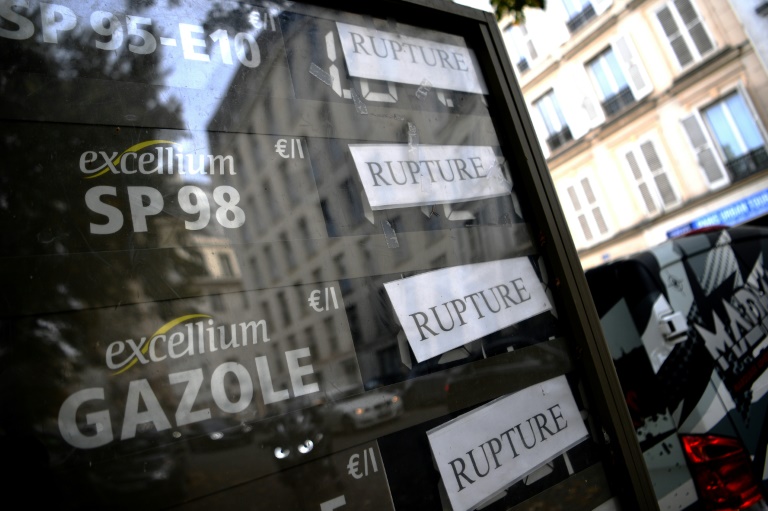
The strike action has forced many filling stations to close and had a knock-on effect across all sectors of the economy.

President Emmanuel Macron’s government used requisitioning powers this week to force some strikers back to open fuel depots, a move that infuriated unions but has so far been upheld in the courts.

The CGT, which launched the industrial action three weeks ago, said on Saturday that workers at three TotalEnergies sites had decided to extend the stoppage.

Employees at the two others, including France’s largest refinery near the northwestern city of Le Havre, had already decided to stay out.

– Protest in Paris –

On Sunday, left-wing opponents of Macron will hold a march and rally in Paris to campaign against the rising cost of living.

Jean-Luc Melenchon, leader of the left-wing France Unbowed (LFI) party, had planned the march well before the current strike, but organisers are hoping to pick up some of the momentum from the current industrial unrest.

“The rise in prices is unbearable,” LFI deputy Manon Aubry told broadcaster LFI. “It is the greatest loss of purchasing power in 40 years.”

It is time the billions that the big companies were reaping in profits were passed down to those struggling to make ends meet, she added.

Police are expecting around 30,000 people to attend, with one source saying they feared problems from hard-left troublemakers. “The organiser has been warned of these fears,” said the official.

– More protests, strikes –

The CGT meanwhile has extended its strike action up to Tuesday, when it has also called a broader strike involving public transport nationwide.

The union risks stoking resentment in a country where three-quarters of workers rely on personal vehicles for their jobs, with public support for the strike at just 37 percent in a BVA poll released Friday.

The CGT is pushing for a 10-percent pay rise for staff at TotalEnergies, retroactive for all of 2022.

It says the French group can more than afford it, citing TotalEnergies’ net profit of $5.7 billion in the April-June period as energy prices soared with the war in Ukraine, and its payout of billions of euros in dividends to shareholders.

The CGT walked out of talks with the French group, even as other unions representing a majority of workers accepted a deal for a smaller pay hike.

TotalEnergies on Saturday urged employees to resume work, “in view of the signing of a majority deal on salaries” with two other unions.

Esso-ExxonMobil has said it would take two to three weeks to relaunch production at its refineries.

Prime Minister Elisabeth Borne is due to appear on primetime television Sunday evening to discuss the petrol shortage.
At least 20 dead in Colombia bus accident: police

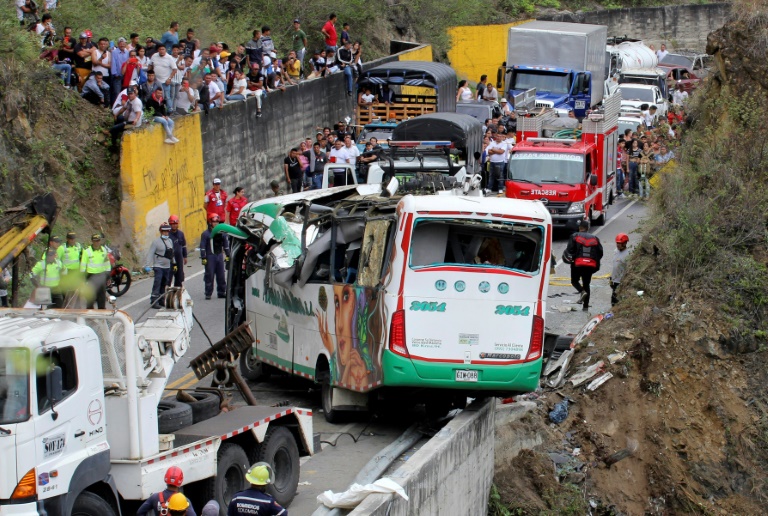
At least 20 people died and 15 others were injured Saturday when a bus overturned on the Pan-American Highway in southwestern Colombia, police said.

The bus was traveling between the port city of Tumaco, in the southwestern corner of Colombia, and Cali, 200 miles (320 kilometers) to the northeast when the incident occurred. 

“Unfortunately, we have a toll of 20 people dead,” said Captain Albertland Agudelo of the Narino department traffic police. 

Among the injured were a three-year-old girl and an eight-year-old boy.

Investigators are looking at possible “mechanical failures in the brake system,” Colonel Oscar Lamprea, director of traffic and transportation in the area, said in a message to reporters.

A preliminary report said the driver lost control after coming out of a curve in a foggy area.

It took rescue workers from the police and fire departments nine hours to set the vehicle upright, evacuate the injured and recover the dead. 

Images obtained by AFP showed the bus, its roof caved in, perched dangerously at the edge of a steep drop-off.

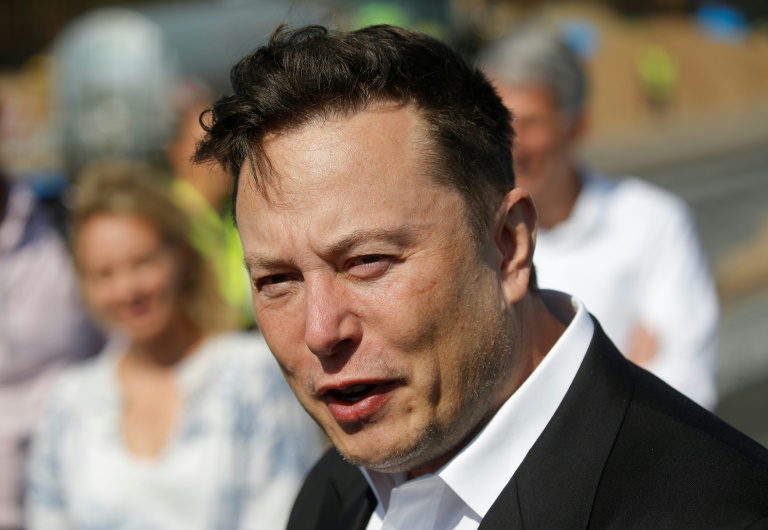
In reversal, Musk to continue funding Starlink in Ukraine

Elon Musk said Saturday that his company SpaceX will continue to pay for Starlink satellite internet in war-torn Ukraine, one day after the tech mogul suggested he could not keep funding the project.

Starlink, a constellation of more than 3,000 small satellites in low Earth orbit, has been vital to Ukraine’s communications as it battles Russia.

But Musk has found himself embroiled of late in public spats with Ukrainian leaders who were angered by his controversial proposals for de-escalating the conflict, which included acknowledging Russian sovereignty over Crimea.

“The hell with it,” Musk, the world’s richest man, wrote on Twitter.

“Even though Starlink is still losing money & other companies are getting billions of taxpayer $, we’ll just keep funding Ukraine govt for free.”

In a series of tweets Friday, Musk had detailed the logistics of the operation and said it was costing SpaceX nearly $20 million per month, and suggested the company could not fund it indefinitely.

Meanwhile, the US military confirmed it was communicating with the billionaire’s company about funding for the key network.

“SpaceX is not asking to recoup past expenses, but also cannot fund the existing system indefinitely *and* send several thousand more terminals that have data usage up to 100X greater than typical households,” he said Friday. 

“This is unreasonable.”

– Pentagon funding on cards? –

SpaceX has donated some 25,000 ground terminals to Ukraine, according to an updated figure given by Musk last week.

He says the operation has already cost SpaceX $80 million, and that total is projected to exceed $100 million by the end of the year.

Musk also appeared to confirm a report by CNN saying he had written to the Pentagon warning that his financial contributions would come to an end, and that the military would need to foot the bill.

According to CNN, SpaceX figures shared with the Pentagon show about 85 percent of the first 20,000 terminals in Ukraine were paid at least in part by countries such as the United States, Poland, or other entities, which also paid for about 30 percent of internet connectivity.

Deputy Pentagon Press Secretary Sabrina Singh said Friday the Pentagon is in contact with Musk about the funding issue, saying it had “received correspondence from SpaceX about the funding of… their satellite communications product in Ukraine.”

Musk has recently been in a spat with Ukrainian officials including President Volodymyr Zelensky after suggesting a peace deal that involved re-running controversial referendums in Russian-occupied territories in Ukraine — an idea welcomed by Moscow.

A senior Ukrainian presidential aide, Mykhaylo Podolyak, acknowledged the importance of Starlink in a tweet on Friday.

“Like it or not, @elonmusk helped us survive the most critical moments of war,” Podolyak wrote, adding that Ukraine “will find a solution to keep #Starlink working.”

Polish NGOs stage mock vote on annexing Russian embassy

Hundreds of people turned out Saturday to take part in a mock referendum on whether Poland should annex Russia’s embassy in Warsaw, part of a protest organised by several campaigning groups.

“Annexations are in this season,” the organisers said in a statement, referring to Moscow’s recent claim to have annexed four Ukrainian regions following referendums dismissed as a “sham” by the West.

“We decided to go down that road and organise a referendum on the annexation of the Russian embassy… in Warsaw.”

The NGOS also referred to a viral social media joke proposing that Czechs seize the Russian exclave of Kaliningrad.

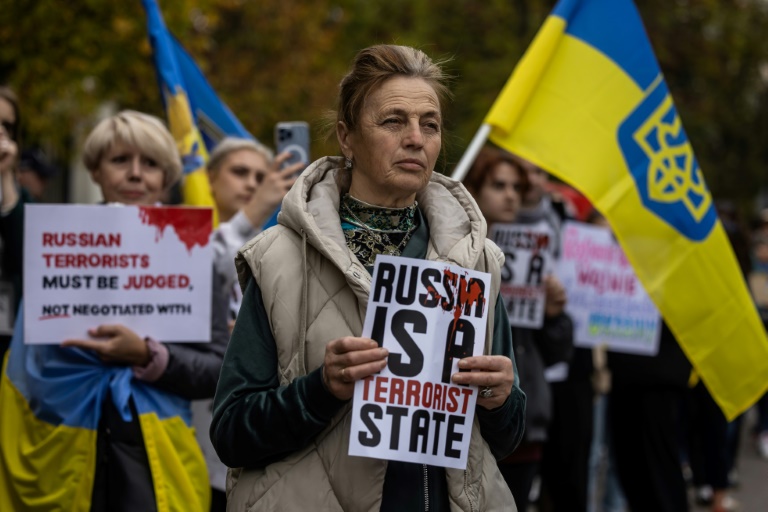
Brandishing the blue-and-yellow Ukrainian flag and placards notably reading “Terrorussia” and “Hands off Ukraine”, some 3,000 people, according to organisers, attended the mock referendum in Warsaw.

The queue to cast a vote extended down the street housing the palatial Russian embassy, in front of which the ballot box had been placed. 

The ballot asked whether Poland should annex the Russian embassy and provided three voting options — all of them “Yes”.

“This is a much more democratic idea than those referendums on Ukrainian territory that were held under guns and missiles,” Mariia Volkolup, a 33-year-old Ukrainian lawyer in Warsaw, told AFP.

The rally organisers proposed alternative uses for the embassy building, including refugee accommodation, a cultural centre, a zoo and even public toilets.

Grigorij, 46, a Russian who left Moscow in August, said he attended the rally to show his support for Ukraine.

“I condemn this war waged by (Russian President Vladimir) Putin, and I want to say that not all Russians support it,” he told AFP. He said he had moved to Warsaw because he felt complicit in the war by remaining in Russia.

The event organisers said they would send an open letter to Poland’s leaders calling on them to expel the Russian ambassador.

The event was organised by a loose alliance of groups supporting women, Ukraine, democracy and human rights.

One dead, two missing as Crete hit by major flooding

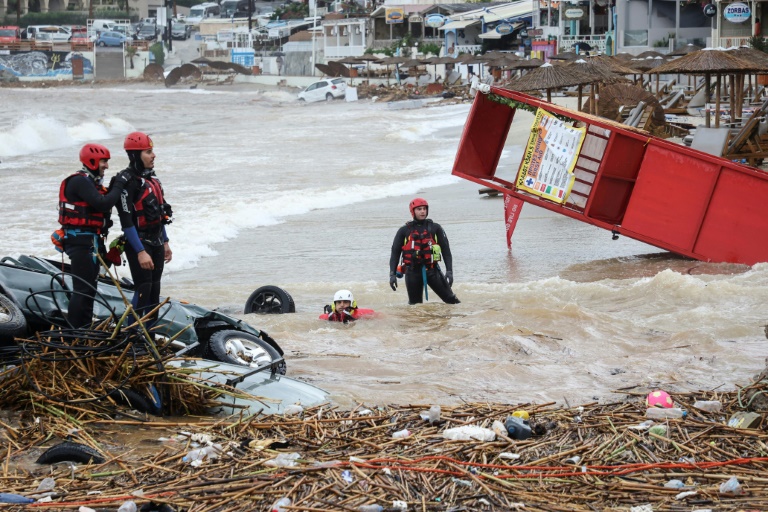
A man was found dead and two people were missing on Saturday after torrential rain brought major flooding to the Greek island of Crete, emergency workers said.

The victim, a man in his fifties, was trapped in his car as the rains began to fall in the southern Greek island, a popular holiday destination.

Local media reported extensive damage in seaside villages, where streets have become rivers carrying away everything in their path.

According to emergency services, a woman was slightly injured when she too became trapped in a car. 

At least nine vehicles surrounded by water still need to be rescued.The emergency services received over 450 calls within an hour on Friday morning as the extent of the problem became clear.

Eight tourists and a security guard were also stranded in the Archaeological Museum in the coastal resort town of Sitia.

All the gorges on the island, popular hiking spots for tourists, were closed to the public until further notice.

The mayor of Sitia told the Skai TV channel, “The situation was out of control and the (weather) phenomena in the region were exceptional.” 

Scientists say human-induced climate change is amplifying extreme weather — including the floods, heatwaves, droughts seen in several parts of the planet — and say these events will become more frequent and more intense.

A senior official for the Heraklion region, Nikos Syrigonakis, urged residents to limit their movements.

“This is a difficult day,” he added. 

The Civil Defence department said it was mobilised and asked all citizens to be vigilant in Crete and the surrounding islands of Rhodes, Karpathos, Kastellorizo and Kasos.

One dead, two missing as Crete hit by major flooding

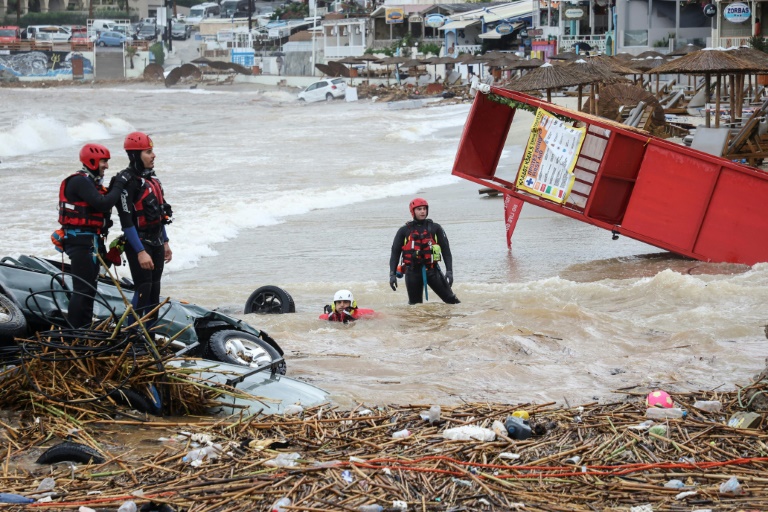
A man was found dead and two people were missing on Saturday after torrential rain brought major flooding to the Greek island of Crete, emergency workers said.

The victim, a man in his fifties, was trapped in his car as the rains began to fall in the southern Greek island, a popular holiday destination.

Local media reported extensive damage in seaside villages, where streets have become rivers carrying away everything in their path.

According to emergency services, a woman was slightly injured when she too became trapped in a car. 

At least nine vehicles surrounded by water still need to be rescued.The emergency services received over 450 calls within an hour on Friday morning as the extent of the problem became clear.

Eight tourists and a security guard were also stranded in the Archaeological Museum in the coastal resort town of Sitia.

All the gorges on the island, popular hiking spots for tourists, were closed to the public until further notice.

The mayor of Sitia told the Skai TV channel, “The situation was out of control and the (weather) phenomena in the region were exceptional.” 

Scientists say human-induced climate change is amplifying extreme weather — including the floods, heatwaves, droughts seen in several parts of the planet — and say these events will become more frequent and more intense.

A senior official for the Heraklion region, Nikos Syrigonakis, urged residents to limit their movements.

“This is a difficult day,” he added. 

The Civil Defence department said it was mobilised and asked all citizens to be vigilant in Crete and the surrounding islands of Rhodes, Karpathos, Kastellorizo and Kasos.

New UK finance minister tears up tottering PM's agenda

Britain’s new finance minister on Saturday warned of looming tax hikes as he admitted to “mistakes” made in a disastrous budget that still threatens to bring down Prime Minister Liz Truss.

“Truss fights for survival,” The Times newspaper headlined a day after she forced chancellor of the exchequer Kwasi Kwarteng to carry the can for market turmoil sparked by their budget on September 23.

The Times, Telegraph and other newspapers reported that senior Conservative members of parliament were still plotting to unseat Truss, possibly within days, aghast at the party’s collapse in opinion polls since she replaced Boris Johnson on September 6.

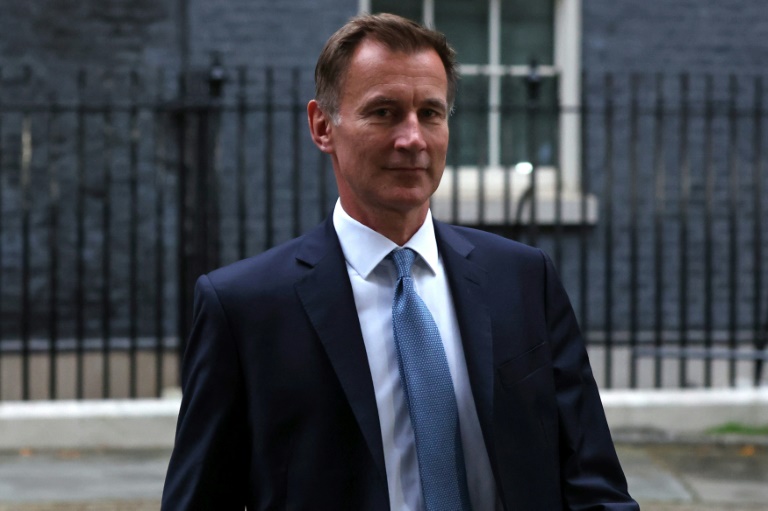
New chancellor Jeremy Hunt, a former foreign secretary seen as a Tory centrist, made clear he was ripping up the strategy that brought Truss to 10 Downing Street.

“There were mistakes,” acknowledged Hunt, whom one ally called the government’s new “chief executive” — with Truss now relegated to the role of back-seat chairwoman.

Hunt said Kwarteng and Truss had erred in trying to cut taxes for the highest earners, and in presenting their plan without independent forecasts from the Office for Budget Responsibility.

“The prime minister’s recognised that, that’s why I’m here,” Hunt told Sky News.

In one of his first acts on taking office Friday, the new chancellor spoke to Bank of England governor Andrew Bailey, who has had to stage costly interventions to calm febrile bond markets.

Briefing reporters in Washington, Bailey said on Saturday: “I can tell you there is a very clear and immediate meeting of minds on the importance of stability and (fiscal) sustainability.”

Tax cuts were the centrepiece of the ill-starred budget announced by Kwarteng and Truss. 

But they were financed through billions in extra borrowing, causing panic on financial markets at the prospect of higher inflation, which has already left British households in the grip of a cost-of-living crisis.

“We will have some very difficult decisions ahead,” Hunt said, warning that “all government departments” face spending curbs including welfare, health and defence. 

“And some taxes will not be cut as quickly as people want. Some taxes will go up.”

– ‘Clinging on’ –

Hunt confirmed he would deliver a new fiscal statement on October 31, agreeing on BBC radio that he had a “clean slate” to start afresh despite Truss’s election-winning promises to rank-and-file Conservatives.

Soon after, on November 3, the Bank of England will hold its next rate-setting meeting.

In a separate speech Saturday, Bailey warned anew that the central bank would “not hesitate” to raise rates to keep soaring inflation under control, threatening more pain for UK households and businesses after the botched budget.

Truss dismissed Kwarteng hours after he had rushed home early from international finance meetings in Washington, and she staged another U-turn in acquiescing to a significant rise in profits tax levied on companies.

At a subsequent Downing Street news conference, the prime minister took only four questions, glancing nervously around the room and delivering terse replies before abruptly leaving after just over eight minutes. 

“Robotic, hesitant, tone-deaf, defiant and still utterly convinced of the purity and necessity of her mission, Liz Truss killed off her political career in a matter of minutes,” Times columnist Jenni Russell wrote.

Asked why she herself should not resign, Truss said she was “absolutely determined to see through what I have promised” — but her comments only served to depress the pound and bond markets further.

Former Conservative leader William Hague said Truss’s premiership now “hangs by a thread”, while ex-chancellor Philip Hammond said she had “thrown away years and years of painstaking work” to establish the party’s record for economic competence.

But with the opposition Labour party surging in the polls, Welsh Secretary Robert Buckland warned his restive colleagues against “throwing another prime minister to the wolves”.

Labour leader Keir Starmer accused Truss of “clinging on”, and demanded an early general election.

“There are no historical precedents for what they have done to our economy,” he said in a speech Saturday.

'Words not enough' to convey disaster, say Turkish miners

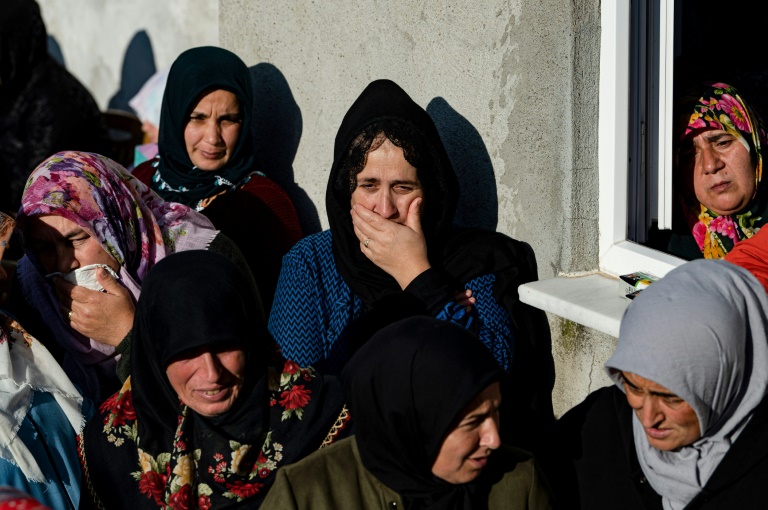
Their soot-stained faces drained with exhaustion, Turkish miners are at a loss to describe the disaster that killed their friends in Friday’s coal mine explosion. 

“Words are not enough,” said Erdogan Yanardag, who was on a day shift at the moment when the blast ripped through the mine near the small mining town of Amasra on Turkey’s Black Sea coast shortly before sunset. 

The 43-year-old rushed to the scene to help the rescue effort, working through the night to stretcher survivors pulled out of the mine.

The coal stains on his clothes testified to hours of nonstop effort. 

“Everyone grabbed the stretchers, some at the back, some in the middle and some at the front,” he said. 

No matter where in the world it occurs, it is impossible for families to remain indifferent in the face of a disaster such as this, Yanardag said.

“Anyone who heard about the explosion — the miners’ families, neighbours and relatives — rushed here,” he added. 

Such (accidents) are “in the DNA of mining”.

Yanardag and others were struck with grief over the death of the miners — 41 in total.

Preliminary findings indicate a build-up of methane gas underground may have been to blame, authorities said.

-‘Great pain’-

Adem Usluoglu, who works for another mine in the region, heard the news on his way home from work and ran to help the rescue effort. 

“People were burned to death or seriously wounded  by the force of the explosion. It’s a huge disaster,” he said. 

“I am in great pain. Words are not enough to describe it,” he told AFP. 

“We are at a point where words are not enough. Our throats gets stuck and our tongues are unable to get around the words,” he added. 

“We don’t want to experience this kind of sufferings again. I can’t find anything more to say.”

Around 600 workers are believed to work in the Amasra mine, which produces 300,000 to 400,000 tonnes of coal per year. 

Ilyas Borekci, deputy head of the neighboring Hattat energy and mining company, a few metres (yards) from the blast scene, sent three special rescue teams to pull survivors out.

“Our friends went down the mine and stayed there four, five hours and they had to have a break after that because the methane level increased,” he said. 

“The methane level was constantly monitored. The friends who went down the mine to rescue the miners had mobile devices in their hands, special breathing devices.

“Otherwise it’s not possible to go down there,” he added. 

Then the rescue teams tried to containt the fire and stop it spreading. 

The only way to survive such a huge explosion is to get out immediately, Borekci explained. 

Respirators and ventilators are only enough for about 45 minutes. Inhale too much carbon monoxide and it kills you. 

“There are no pocket rooms in the mine, no life rooms,” he said.

“The best thing to do is to be able to get out as fast as possible.”

When his teams went back down the mine again, in the early hours of Saturday morning, they were faced with the tragic sight of dead bodies. 

Borekci was in tears describing the scene. 

The survivors, not in a position to talk, were taken to hospital. 

The local public prosecutor’s office has said it is treating the explosion as an accident and has launched a formal investigation. 

Pakistan summons US envoy over Biden 'most dangerous nation' remark

Pakistan on Saturday summoned the US ambassador for an explanation after President Joe Biden described the South Asian country as “one of the most dangerous nations in the world” and questioned its nuclear weapons safety protocols.

Biden made the apparently off-the-cuff remark late Thursday while talking about United States foreign policy during a private Democratic Party fundraiser in California, but the White House later published a transcript of his comments, which sparked outrage in Pakistan.

Washington’s relations with Pakistan have soured since last year, when the US ended a two-decade war in Afghanistan.

Pakistan provided crucial logistical access, but US officials believe Islamabad’s powerful military and intelligence apparatus also aided the Taliban, who swept back to power as foreign troops pulled out.

Biden was speaking about his frequent interactions with Chinese leader Xi Jinping, when he said: “Did anybody think we’d be in a situation where China is trying to figure out its role relative to Russia and relative to India and relative to Pakistan?

“This is a guy who understands what he wants but has an enormous, enormous array of problems. How do we handle that? How do we handle that relative to what’s going on in Russia? 

“And what I think is maybe one of the most dangerous nations in the world: Pakistan. Nuclear weapons without any cohesion.”

Hours after the transcript of his address was posted, Pakistan summoned the US ambassador Donald Blome to the foreign office in Islamabad.

– Room to manoeuvre –

“I have discussed it with the prime minister, and we have summoned the ambassador of the United States… for an official demarche,” Pakistani Foreign Minister Bilawal Bhutto Zardari said during a press conference in Karachi.

“I am surprised by the remarks of President Biden. I believe this is exactly the sort of misunderstanding that is created when there is lack of an engagement.”

Later, Prime Minister Shehbaz Sharif tweeted that Pakistan was a “responsible nuclear state”.

“We are proud that our nuclear assets have the best safeguards… We take these safety measures with the utmost seriousness. Let no one have any doubts,” he said.

The foreign minister also appeared to offer Washington some room to manoeuvre diplomatically away from Biden’s remarks.

“It was not an official function, it was not an address to the nation or an address to the parliament,” he said.

“We should allow them an opportunity to explain this position. I don’t believe that this should negatively impact the relations between Pakistan and the United States.”

The US is wary of Pakistan’s close partnership with China, as Beijing pushes ahead with a $54 billion “economic corridor” that will build infrastructure and give Beijing an outlet to the Indian Ocean.

Washington has repeatedly said China will reap most of the benefits, leaving Pakistan with unsustainable debt.

The warnings by the US — which considers China its preeminent global competitor — have repeatedly been brushed aside by Pakistan.

Pakistan this week abstained from a United Nations General Assembly vote to condemn Russia’s annexation of parts of Ukraine, despite a major US diplomatic push to seek clearer condemnation of Moscow.

Scientists scour global waters testing ocean plankton and pollution

After a near two-year “Microbiome” mission around the world, scientists said on Saturday they had gathered thousands of samples of marine micro-organisms in a bid to better understand ocean plankton and pollution.

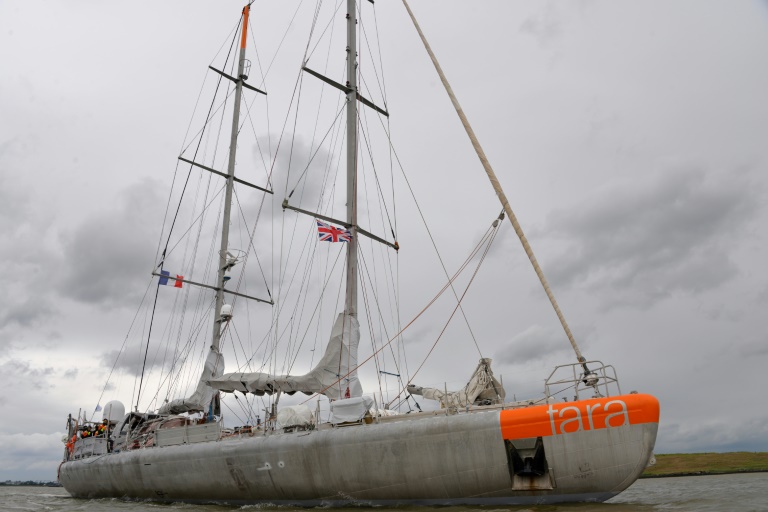
The survey was carried out from the 33-year-old Tara research schooner, which returned to her home port of Lorient on France’s western coast at the weekend.

From Chile to Africa, via the Amazon and the Antarctic, nearly 25,000 samples were collected over the 70,000-kilometre (43,000-mile) route.

“All this data will be analysed,” Tara Ocean Foundation director Romain Trouble told a press conference.

“Within 18 months to two years we will start to have the first discoveries from the mission,” he said.

At the base of the food chain, micro-organisms were the “invisible people of the sea”, accounting for two-thirds of marine biomass, said Trouble.

“They capture atmospheric CO2 (carbon dioxide) and supply half of the oxygen we breathe.”

Trouble said the mission sought to find out how it all works.

“How do all these marine viruses, bacteria, micro-algue manage to interact to produce oxygen?”

“And how will that change tomorrow with climate change and pollution?”

The Tara team paid particular attention to the impact on the oceans of the River Amazon, which has a water flow rate of 200 million litres (53 million gallons) per second.

They wanted to test a theory that deforestation and the spread of agriculture has increased nitrate fertiliser discharge, leading to an abundance of toxic algae along river banks and coasts, particularly in the Caribbean.

The 22-month odyssey also sought to trace the sources of plastic pollution at river mouths, to understand distribution and the types of material involved.

The mission was Tara’s 12th global journey and involved 42 research institutions around the world.

Next spring, Tara sets off to research chemical pollution off European coasts. 

Close Bitnami banner
Bitnami