World

Copyright or copycat?: Supreme Court hears Andy Warhol art case

The nine justices of the US Supreme Court took on the role of art critics on Wednesday as they grappled with whether a photographer should be compensated for a picture she took of Prince used in a work by Andy Warhol.

In a lighter vein than in most cases before the court, arguments were sprinkled with eclectic pop culture references ranging from hit TV show “Mork & Mindy” to hip hop group 2 Live Crew to Stanley Kubrick’s horror film “The Shining.”

Justice Clarence Thomas volunteered at one point that he was a fan of Prince in the 1980s while Chief Justice John Roberts displayed a familiarity with Dutch abstract artist Piet Mondrian.

The case, Andy Warhol Foundation for the Visual Arts v. Goldsmith, could have far-reaching implications for US copyright law and the art world.

“The stakes for artistic expression in this case are high,” said Roman Martinez, a lawyer for the Foundation, which was set up after Warhol’s death in 1987.

“It would make it illegal for artists, museums, galleries and collectors to display, sell profit from, maybe even possess, a significant quantity of works,” Martinez said. “It would also chill the creation of new art.”

The case stems from a black-and-white picture taken of Prince in 1981 by celebrity photographer Lynn Goldsmith.

In 1984, as Prince’s “Purple Rain” album was taking off, Vanity Fair asked Warhol to create an image to accompany a story on the musician in the magazine.

Warhol used one of Goldsmith’s photographs to produce a silk screen print image of Prince with a purple face in the familiar brightly colored style the artist made famous with his portraits of Marilyn Monroe.

Goldsmith received credit and was paid $400 for the rights for one-time use.

After Prince died in 2016, the Foundation licensed another image of the musician made by Warhol from the Goldsmith photo to Vanity Fair publisher Conde Nast.

Conde Nast paid the Foundation a $10,250 licensing fee.

Goldsmith did not receive anything and is claiming her copyright on the original photo was infringed.

– ‘At the mercy of copycats’ –

The Foundation argued in court that Warhol’s work was “transformative” — an original piece infused with a new meaning or message — and was permitted under what is known as the “fair use” doctrine in copyright law.

Lisa Blatt, a lawyer for Goldsmith, disagreed.

“Warhol got the picture in 1984 because Miss Goldsmith was paid and credited,” Blatt said.

The Foundation, she said, is claiming that “Warhol is a creative genius who imbued other people’s art with his own distinctive style.

“But (Steven) Spielberg did the same for films and Jimi Hendrix for music,” Blatt said. “Those giants still needed licenses.”

The Foundation is arguing that “adding new meaning is a good enough reason to copy for free,” she said. “But that test would decimate the art of photography by destroying the incentive to create the art in the first place.

“Copyrights will be at the mercy of copycats.”

Several justices appeared bemused about being thrust into the role of art critics.

“How is a court to determine the purpose or meaning, the message or meaning of works of art like a photograph or a painting,” asked Justice Samuel Alito. “There can be a lot of dispute about what the meaning of the message is.

“Do you call art critics as experts?”

“I think you could just look at the two works and figure out what you think, as a judge,” Martinez replied.

The Foundation lawyer added that a ruling in favor of Goldsmith would have “dramatic spillover consequences, not just for the Prince Series, but for all sorts of works in modern art that incorporate preexisting images.”

The Supreme Court heard the case after two lower courts issued split decisions — one in favor of the Foundation, the other in favor of Goldsmith.

The justices will issue their ruling by June 30.

Brain cells in dish learn to play video game

Neuroscientists have shown that lab-grown brain cells can learn to play the classic video game Pong, and could be capable of “intelligent and sentient behavior.”

Brett Kagan, who led a study published in the journal Neuron Wednesday, told AFP his findings open the door to a new type of research into biological information processors, complementing normal digital computers.

“What machines can’t do is learn things very quickly — if you need a machine learning algorithm to learn something, it requires thousands of data samples,” he explained.

“But if you ask a human, or train a dog, a dog can learn a trick in two or three tries.”

Kagan, chief scientific officer at Melbourne-based Cortical Labs, set out to answer whether there is a way to harness the inherent intelligence of neurons.

Kagan and colleagues took mice cells from embryonic brains, and derived human neurons from adult stem cells.

They then grew them on top of microelectrode arrays that could read their activity and stimulate them. The experiments involved a cluster of around 800,000 neurons, roughly the size of a bumblebee brain.

In the game, a signal was sent from the left or right of the array to indicate where the ball was located, and “DishBrain,” as the researchers called it, fired back signals to move the paddle, in a simplified, opponent-free version of Pong.

– ‘Sentient, but not conscious’ – 

One of the major hurdles was figuring out how to “teach” the neurons.

In the past, it has been proposed to give them a shot of the “feel good” hormone dopamine to reward a correct action — but that was difficult to achieve in a time-sensitive way.

Instead, the team relied on a theory called the “free energy principle” that was coined by the paper’s senior author Karl Friston, which says cells are hardwired to minimize unpredictability in their environments.

When the neurons succeeded in making the paddle hit the ball, they received “predictable” electrical signals. But when they missed, they were sent randomized, or “unpredictable” signals.

“The only thing that the neurons could do is actually get better at trying to hit the ball to keep their world controllable and predictable,” said Kagan.

DishBrain’s performance isn’t up to AI (artificial intelligence) or human standards, but “the fact we see any significant learning is really just evidence of how robust neurons are at processing information and adapting to their environment,” he added.

The team believes DishBrain is sentient — which they defined as being able to sense and respond to sensory information in a dynamic way — but drew the line at calling it “conscious,” which implies awareness of being.

DishBrain also tried out another task — the dinosaur game that appears in Google Chrome when no internet connection is found — and the preliminary results were encouraging, said Kagan.

For their next steps, the team plans to test how DishBrain’s intelligence is affected by medicines and alcohol — though Kagan himself is most excited by the future possibilities of biological computers based on this discovery.

“We compare it to the first transistor,” he said, the building block of modern electronics invented in 1947, which eventually led to today’s powerful digital computers.

“This is robustly conducted, interesting neuroscience,” said Tara Spires-Jones of the Centre for Discovery Brain Science at the University of Edinburgh, who was not involved in the study.

“Don’t worry, while these dishes of neurons can change their responses based on stimulation, they are not SciFi style intelligence in a dish, these are simple (albeit interesting and scientifically important) circuit responses.”

Germany forecasts 2023 recession as energy crisis bites

Germany will sink into recession next year and inflation will soar, the government forecast Wednesday, as Europe’s top economy battles skyrocketing energy prices following Russia’s gas shutdown.

The official predictions were the latest warning that Germany’s economy, which was just getting back on its feet after the pandemic, is set to shrink in 2023 due to the fallout of Moscow’s invasion of Ukraine. 

Unveiling the government’s latest forecasts of 0.4 percent economic contraction and seven percent inflation for 2023, Economy Minister Robert Habeck painted a dark picture of a “serious energy crisis”. 

It “threatens to become an economic and social crisis”, he warned — but insisted that Russian President Vladimir Putin will “fail in this attempt to destabilise the basic economic and political order”. 

Putin “will also fail on the battlefield in Ukraine”, he added. 

Moscow’s move to cut off gas supplies to Europe amid tensions over Ukraine has triggered an energy crisis across the continent, with consumers and businesses facing high prices as winter approaches.

Germany has been particularly hard hit, as 55 percent of its gas supplies came from Moscow prior to the Ukraine conflict.

The soaring energy costs are expected to send inflation to eight percent in 2022 and seven percent in 2023, the government forecast.

Nevertheless, Germany’s economy is still set to register growth of 1.4 percent in 2022, according to the government forecasts, after having enjoyed a post-pandemic rebound earlier in the year.

But it will then shrink in 2023, with the economy ministry saying the “central reason” for the downgrade from forecasts earlier this year was “the halt to Russian gas supplies”.

High energy prices are acting as “a brake on industrial production — above all in energy-intensive sectors”. The economy will return to growth with expansion of 2.3 percent in 2024, according to the forecasts. 

– Energy price cap –

The government recently unveiled a 200-billion-euro ($194-billion) fund to shield consumers and businesses from surging prices, which includes a cap on energy costs.

Without the cap, consumer prices would be much higher in 2023, the forecasts said.

Forecasts by leading economic institutes late last month showed inflation coming in at 8.4 percent for the year as a whole in 2022 — and climbing further to 8.8 percent in 2023.

Warnings are mounting that global growth will slow further next year due to myriad crises, with the IMF this week downgrading its 2023 global GDP growth forecast.

It forecast that Germany, along with Italy, will become the first advanced economies to contract in the wake of Russia’s invasion of Ukraine.

Signs are rapidly multiplying of Germany’s escalating economic crisis. 

Last week, official figures showed that industrial production — the pillar of the German economy — produced 0.8 percent less in August compared with the previous month, with energy-intensive industries badly impacted. 

Inflation meanwhile hit a 70-year high of 10 percent in September. 

The European Central Bank has started aggressively tightening monetary policy to bring inflation under control, lifting rates a historic 75 basis points last month, but some are worried the move adds to recession risks.

Berlin has been scrambling to find alternative energy sources, accelerating the construction of infrastructure to import gas from further afield, and is preparing to keep two nuclear plants running longer than initially anticipated.

Despite the crisis, Habeck sought to strike a positive note about efforts to find new partners to supply energy.

“We are making very good progress in loosening the grip of Russian energy imports,” he said. 

Ukraine grain ships stuck in Istanbul traffic jam

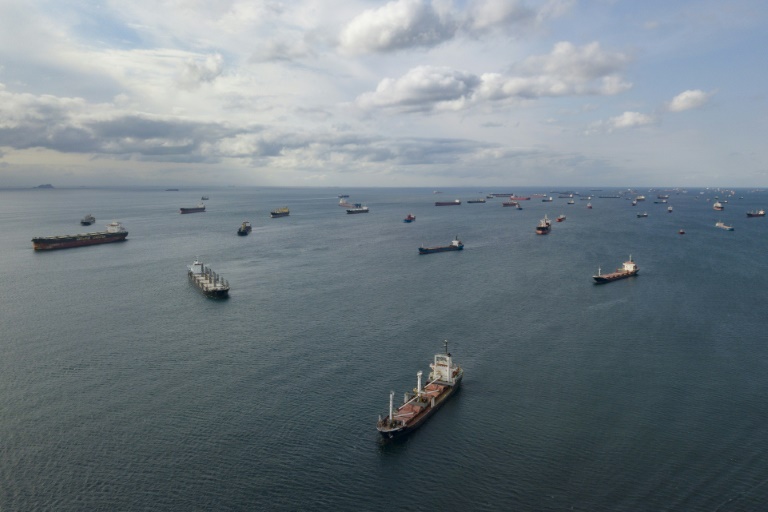
A cargo ship traffic jam stretched as far as the eye could see off Istanbul, where a key deal to get Ukraine grain to market has translated into major hold-ups.

Dozens of vessels were waiting Tuesday to clear the meticulous inspection process required under the Turkey and UN-backed accord aimed at easing fears of a global food crisis.

Some vessels spend days at anchor for a procedure that officials said they were trying to speed up, amid growing desperation among some crews to get through.

On board the Barbados-flagged black-and-white Nord Vind ship, the relief was palpable when a team of inspectors arrived.

One of the boat’s Syrian sailors said the crew had been waiting for eleven days. 

“It’s too much,” said Marwan, who declined to give his full name.

Despite views on the landmark Hagia Sophia mosque and historic Sultanahmet district, “the anchorage area is difficult. We must constantly change places and restart the motors… Why are we waiting like this?” he said.

Since the deal between Russia and Ukraine came into force on August 1, more than 6.9 million tons of grain have left for Europe, the Middle East and to a lesser extent, Africa, according to data from the Joint Coordination Center (JCC) overseeing the agreement.

– Massive daily costs –

When Russia invaded Ukraine in February, there were fears of a global food crisis. The agreement allowing Ukrainian grain exports has brought much-needed relief.

The downside however are the delays on either side of the Bosphorus Strait, the busy maritime passage that allows onward passage from Ukraine’s Black Sea ports to the rest of the world.

Under the terms of the deal, ships must be inspected entering and leaving the Black Sea.

The JCC itself raised the alarm over the delays last week, reporting the backlog build despite increasing the number of inspection teams from two to four.

The group noted last week the waiting time for cargo ships leaving Ukraine reached nine days on average, in a statement that warned of “congestion” in some of the waters near Istanbul.

Shipping companies were angry, complaining about delays that cost them “$5,000 a day, plus a loss of earnings”, said a local source who spoke on condition of anonymity.

But, as debate renews over extending the deal by November 19, the JCC has urged ships to prepare for inspections before declaring they are ready for a check.

“On more than 50 occasions, inspections could not be completed at the first attempt due to the lack of readiness of the vessel,” it said.

– ‘Ships’ lack of readiness’ –

Each team has eight inspectors: two for each of the parties to the agreement, which is to say Russia, Ukraine, the UN — and Turkey, mainly responsible for logistics.

The process, which can take hours, involves several procedures.

The ships’ cargo must be fumigated with a pesticide to protect the grain from various infestations, said Udani Perera, a UN inspector from the Sri Lankan navy.

On one ship, inspectors had to disembark before returning to the vessel as the hold’s doors had been left open, putting their health at risk.

Once on board the Nord Vind, the inspectors divided up the tasks: checking logbooks, identity papers, the route, fuel tanks and the state of the grain.

Perera also had to check there were no unauthorised individuals on board.

Her Ukrainian colleagues checked the fuel gauge, while the Russian inspectors walked along the gangways and carried out tests in the hold.

Perera said an inspection could take an hour, depending on the vessel’s size and the crew’s preparation.

But on Tuesday morning, one empty 225-metre (740-feet) Singapore-flagged ship, had to wait more than three hours during its inspection before it was allowed to proceed to its destination near the Ukrainian port of Odessa.

“This morning it took a little more time because they were missing some documentation,” Perera said.

But it was good news for the Nord Vind.

After a two-hour inspection of the 169-metre (555-foot) long ship, carrying 27,250 tonnes of wheat, it got the green light to travel to Tunisia.

ach/raz/jmm/jj

Peru villagers accuse government of ignoring harm from mining

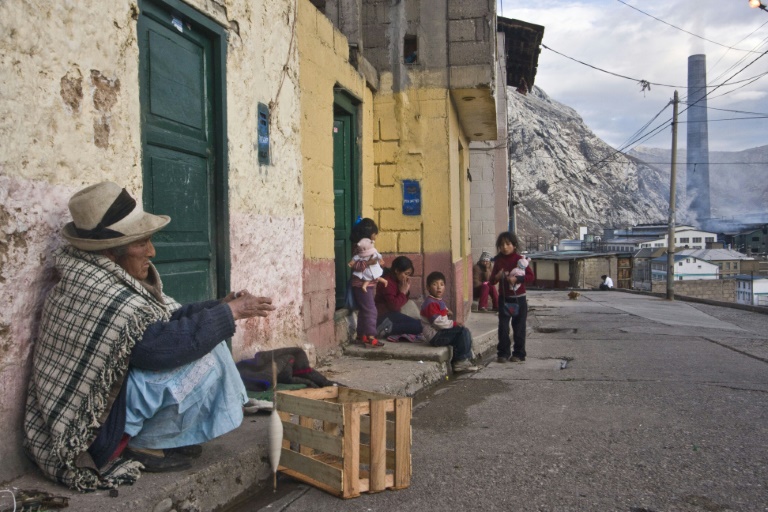
Andean villagers in Peru told an inter-American rights court on Wednesday about how their health has suffered for decades due to environmental damage caused by a mining company extracting heavy metals in their midst.

The community of La Oroya accuses the government in Lima of having allowed the Doe Run Peru company, owned by US group Renco, to pollute at will while turning a blind eye to their fate.

“The State was like a father who ignored us,” 74-year-old villager Rosa Amaro told the Inter-American Court of Human Rights on the first day of a hearing against the Peruvian government.

She was one of several residents to recount the effects of decades of exposure to heavy metals such as lead, cadmium and arsenic.

Watchdogs say La Oroya, a town of 30,000 some 185 kilometers (115 miles) east of Lima, is one of the world’s most polluted cities because of smelters refining lead, zinc, gold and copper in the area.

Amaro told the court, sitting this week in the Uruguayan capital Montevideo, that she witnessed the hills surrounding her town become bare over time because “the plants would not grow.”

Through tears, she testified of residents struggling with burning throats and eyes, headaches and difficulty breathing.

Others told of tumors, muscular problems and infertility blamed on pollution from the smelters.

Amaro, who headed a local lobby group in La Oroya, said she was forced in 2017 to leave the town where she had lived all her life due to threats from the relatives of mine workers worried about their jobs if Doe Run were brought to account.

The plaintiffs claim the state also failed to investigate threats and harassment against them.

– ‘Compromised its obligation’ –

La Oroya residents sued the Peruvian government and obtained a partially favorable ruling in 2006 from the Constitutional Court, which ordered protective measures.

Last year the Inter-American Commission on Human Rights, which investigates suspected violations of human rights, said those measures were never implemented.

The commission found that the State had failed to regulate and oversee the behavior of the mining company and “compromised its obligation to guarantee human rights.”

It referred the matter to the court now sitting in Montevideo to determine reparations.

“My health is already destroyed. All I want is for future generations to be in good health,” plaintiff Yolanda Zurita, 63, told the court on Wednesday of her expectations from the process.

Doe Run Peru, which has operated in La Oroya since 1997, declared bankruptcy in 2009. 

Under a credit agreement, the company was handed to its miner employees who want to reopen the abandoned smelter.

Peru villagers accuse government of ignoring harm from mining

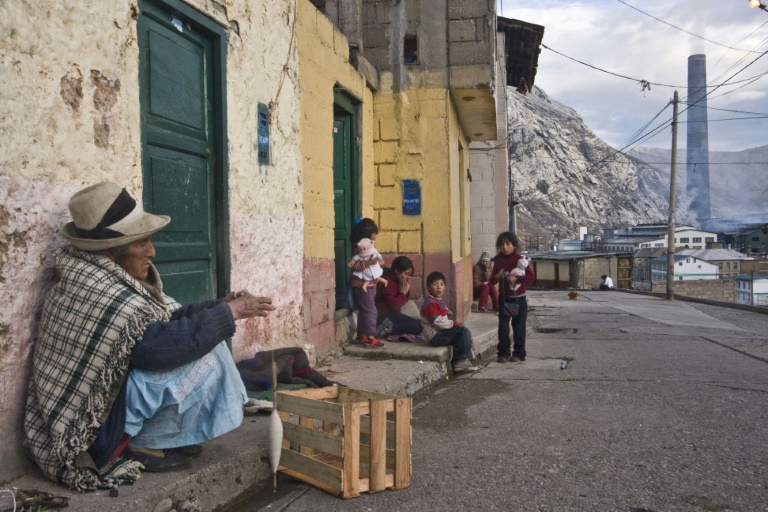
Andean villagers in Peru told an inter-American rights court on Wednesday about how their health has suffered for decades due to environmental damage caused by a mining company extracting heavy metals in their midst.

The community of La Oroya accuses the government in Lima of having allowed the Doe Run Peru company, owned by US group Renco, to pollute at will while turning a blind eye to their fate.

“The State was like a father who ignored us,” 74-year-old villager Rosa Amaro told the Inter-American Court of Human Rights on the first day of a hearing against the Peruvian government.

She was one of several residents to recount the effects of decades of exposure to heavy metals such as lead, cadmium and arsenic.

Watchdogs say La Oroya, a town of 30,000 some 185 kilometers (115 miles) east of Lima, is one of the world’s most polluted cities because of smelters refining lead, zinc, gold and copper in the area.

Amaro told the court, sitting this week in the Uruguayan capital Montevideo, that she witnessed the hills surrounding her town become bare over time because “the plants would not grow.”

Through tears, she testified of residents struggling with burning throats and eyes, headaches and difficulty breathing.

Others told of tumors, muscular problems and infertility blamed on pollution from the smelters.

Amaro, who headed a local lobby group in La Oroya, said she was forced in 2017 to leave the town where she had lived all her life due to threats from the relatives of mine workers worried about their jobs if Doe Run were brought to account.

The plaintiffs claim the state also failed to investigate threats and harassment against them.

– ‘Compromised its obligation’ –

La Oroya residents sued the Peruvian government and obtained a partially favorable ruling in 2006 from the Constitutional Court, which ordered protective measures.

Last year the Inter-American Commission on Human Rights, which investigates suspected violations of human rights, said those measures were never implemented.

The commission found that the State had failed to regulate and oversee the behavior of the mining company and “compromised its obligation to guarantee human rights.”

It referred the matter to the court now sitting in Montevideo to determine reparations.

“My health is already destroyed. All I want is for future generations to be in good health,” plaintiff Yolanda Zurita, 63, told the court on Wednesday of her expectations from the process.

Doe Run Peru, which has operated in La Oroya since 1997, declared bankruptcy in 2009. 

Under a credit agreement, the company was handed to its miner employees who want to reopen the abandoned smelter.

Brussels backs Bosnia for EU candidate status

The European Commission on Wednesday said it was recommending that EU countries give Bosnia candidacy status to join the bloc.

“The Commission recommends that candidate status be granted to Bosnia and Herzegovina by the (European) Council on the understanding that a number of steps are taken,” commissioner for enlargement Oliver Varhelyi tweeted after making the announcement to EU lawmakers.

If the EU, which currently comprises 27 member countries, adopts the recommendation, Bosnia would join seven other nations with candidate status: Turkey, North Macedonia, Montenegro, Serbia, Albania, Moldova and Ukraine.

The process to join the European Union can take many years as candidates implement reforms that have to be rigorously evaluated by Brussels. It can also grind to a halt, which is the case with Turkey’s bid.

Commission chief Ursula von der Leyen told EU ambassadors: “Today we have proposed to grant candidate status to Bosnia and Herzegovina.”

But she added: “Of course it is up to the candidate countries to reform their economies and their institutions and to advance towards our union.”

The commission said Bosnia needed to make progress on “democracy, functionality of state institutions, rule of law, the fight against corruption and organised crime” as well as guaranteeing media freedom and migration management.

The commission will help all candidate countries in their accession bids, von der Leyen said, stating that “I think that is Europe’s moment and it is up to us to seize that moment”.

The “wind of change is once again blowing through Europe and we have to capture this momentum,” she said. 

“The Western Balkans belong in our family and we have to make this very, very clear.”

– ‘Concerns’ over Turkey –

Brussels is concerned that other powers, such as China or Russia, might spread their influence into the Balkans if countries hopeful of joining the EU are thwarted.

Already, Serbia is maintaining cosy relations and energy links with Russia, while also keeping visa-free access for citizens of many countries that require visas for the European Union, some of whom try to enter the bloc.

In Bosnia’s case, the country of three million people is burdened with ethnic divisions continuing since its devastating war three decades ago.

It remains partitioned between a Serb entity and a Muslim-Croat federation connected by a weak central government. 

It has a dysfunctional administrative system created by the 1995 Dayton Agreement that succeeded in ending the conflict in the 1990s, but largely failed in providing a framework for the country’s political development.

The top international envoy to Bosnia, Christian Schmidt, welcomed the move.

“This unanimous message from Brussels is especially important now, when international law is being trampled and the sovereignty and territorial integrity of independent states are questioned or violated,” Schmidt said in a statement.

In terms of Turkey, Varhelyi said the annual EU report on all current candidate countries confirmed Ankara’s “negative trend of moving away from the European Union in key areas of fundamental rights, rule of law and independence of the judiciary”.

He also noted tensions between Turkey and EU members Greece and Cyprus.

“The EU’s relations with Turkey remain complex,” he told journalists.

On one hand, he said, Turkey remains a “key partner” on issues such as migration, climate, food security and trade, and was a valuable interlocutor with Russia as the war in Ukraine grinds on, particularly in freeing up grain deliveries.

“However, it has also decided to increase trade and financial relations with Russia, and has not aligned with EU restrictive measures. This is a cause for increasing concerns,” Varhelyi said.

Western allies vow to get air defence to Ukraine 'as fast as can'

International backers of Ukraine vowed on Wednesday to deliver new air defences “as fast as we can”, as Kyiv pressed them to bolster protection against Russia’s missile blitz.

A US-led group of some 50 countries held talks at NATO headquarters in Brussels with the focus on air defences after Russian President Vladimir Putin unleashed a barrage across Ukraine following a blast at a bridge to the annexed Crimea peninsula. 

Ukrainian Defence Minister Oleksiy Reznikov said just three words when asked what he hoped for from the meeting: “Air defence systems.”

Western allies have scrambled to work out how to supply more advanced systems to Ukraine as diplomats admit they have precious few to spare.

“The systems will be provided, as fast as we can physically get them there,” United States Defence Secretary Lloyd Austin said after the meeting, without giving details on any new pledges.  

“We’re going to provide systems that we have available … We’re also going to try to provide additional munitions to the existing systems that the Ukrainian forces are using.”

A first Iris-T medium-range system has arrived in Ukraine after Germany decided to ship it before even giving it to its own troops. 

The United States has also said it is looking to expedite the delivery of its NASAMS anti-missile and anti-drone system to Kyiv and a first batch of two is expected in the coming weeks. 

Deliveries of a further six units could take far longer as they need to be manufactured and US sources said Washington is eyeing the possibility of trying to get Cold War-era Hawk systems to Ukraine in the meantime. 

“There’s other systems out there throughout the world that are available,” US top general Mark Milley said. 

“The task will be to bring those together, get them deployed.”

– ‘Pivotal moment’ –

Ukraine’s President Volodymyr Zelensky had called on G7 leaders on Tuesday to help establish an “air shield” over his country more than seven months into the war against Moscow. 

Austin said that the resolve of Ukraine’s allies to support Kyiv had been “heightened by the deliberate cruelty of Russia’s new barrage against Ukraine’s cities”. 

“Those assaults on targets with no military purpose again revealed the malice of Putin’s war of choice,” he said. 

NATO defence ministers, who will meet on Thursday, are pushing for ways to bolster their overall weapons stockpiles as the war in Ukraine has depleted their shelves.

NATO members have supplied weaponry worth billions of dollars to help fight Russia’s more than seven-month invasion of Ukraine and have vowed to keep supplies flowing as Kyiv pushes to recapture occupied territories. 

“Allies have provided support to Ukraine by reducing NATO stocks, or ammunition, or weapons. This has been the right thing to do, but of course, we need to address how to refill those stocks,” Stoltenberg said. 

“I expect that the ministers will agree to review our guidelines for stocks and also to engage more with industry.”

The NATO chief said the meeting in Brussels comes at a “pivotal moment” as Putin has followed up battlefield losses by annexing seized territory and issuing veiled nuclear threats. 

Western powers say they have seen no change in Moscow’s nuclear posture that would suggest it is getting ready to launch a strike. They have warned Moscow against deploying any small, tactical atomic bomb in Ukraine.

“There would be a sharp response — almost certainly drawing a physical response from many allies, and potentially from NATO itself,” a senior NATO official said. 

Ukraine claims new gains after days of mass Russian strikes

Ukraine said Wednesday it reclaimed more territory from Russia in the south and welcomed the delivery of Western air defences Kyiv said would herald a “new era” after mass strikes by Moscow.

Russia for two days pummelled Ukraine with missiles, damaging energy facilities nationwide, in attacks that President Vladimir Putin said were retaliation for a deadly explosion at the Crimea bridge.

Moscow’s FSB security service said Wednesday it detained eight suspects over the blast that ripped through the road and rail bridge connecting Crimea to Russia.

But it also claimed to have foiled two more attacks that Ukrainian special services allegedly planned to carry out on Russian territory.

NATO chief Jens Stoltenberg said Wednesday after Russia’s missile barrage that Ukraine’s Western backers were looking to provide Kyiv with more air defences to protect against Russia’s “indiscriminate” attacks across the country. 

“The top priority will be more air defence for Ukraine,” Stoltenberg said at the start of a meeting by Ukraine’s allies on arms supplies to Kyiv.

United States Defence Secretary Lloyd Austin said after the meeting “the systems will be provided, as fast as we can physically get them there”. 

Putin has vowed a “severe” response to any further attack on Russia and what Moscow considers to be its territory, including the Crimea peninsula that it annexed from Ukraine in 2014.

Despite warnings from the Kremlin, Kyiv has vowed to retake the peninsula as well as four regions in Ukraine’s east and south that Moscow says are now part of Russia.

Kyiv said Wednesday that it had retaken five more settlements in the southern region of Kherson — one of the four territories Moscow said it annexed in late September — in the latest setback for Russia’s campaign.

– Putin ‘miscalculated’ –

The Russian military meanwhile said it had fended off Ukrainian attacks in the eastern Donetsk, Lugansk and Kharkiv regions.

And Russian strikes on the frontline town of Avdiivka killed at least eight people at a market, the Ukraine-appointed chief of the region said.

The Ukrainian army announced its counter-offensive in the south in late August. 

After regaining almost full control of the northeastern region of Kharkiv, Ukrainian forces recently claimed more gains on the eastern and southern fronts.

Faced with mounting setbacks since September, the Russian president announced the mobilisation of hundreds of thousands of reservists to join the fighting in Ukraine. 

With the Crimea bridge blast, Russia also lost a vital transport link for moving military equipment for its soldiers fighting in Ukraine.

US President Joe Biden said Tuesday that he believes his Russian counterpart “miscalculated” the situation in Ukraine and underestimated the ferocity of Ukrainian defiance.

“He thought he was going to be welcomed with open arms, that this was the home of Mother Russia in Kyiv,” Biden told CNN in a rare televised interview.

“I think he just totally miscalculated.”

Putin is due to meet Turkish President Recep Tayyip Erdogan in Kazakhstan later this week, with a Kremlin official suggesting Ankara will formally offer to mediate talks between Russia and Ukraine.

– Mass graves discovered –

After two days of nationwide Russian strikes that especially targeted Ukraine’s energy infrastructure, leaving villages and towns without power and hot water, Ukraine said it had started receiving anti-aircraft defence systems from its Western allies. 

“A new era of air defence has begun in Ukraine,” Defence Minister Oleksiy Reznikov said on Twitter, announcing the arrival of Germany’s Iris-Ts and the upcoming delivery of NASAMS from Washington. 

He said he had met with Austin and General Mark Milley and discussed the “strengthening of the combat potential of the Ukrainian army”, according to a tweet.

On Tuesday, Ukraine’s President Volodymyr Zelensky called on the G7 club of wealthy nations to help Kyiv create an “air shield”, warning that Russia “still has room for further escalation”.

On the frontline in Donetsk, Western weapons have helped boost Ukrainian morale and the abilities of Kyiv’s forces.

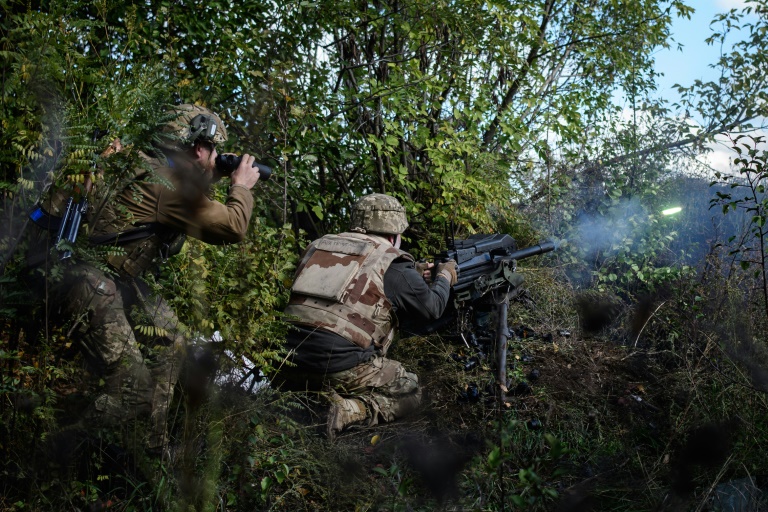
“We definitely need more artillery,” said an officer who gave his name as “Sergiy” with Ukraine’s 5th Regiment on a hill overlooking Russian-held Gorlivka in Donetsk.

“When it comes to artillery, they still have an advantage so we can’t return fire equally. 

“We are firing more precisely now, but with fewer strikes,” Sergiy said about the US-made Mk-19 automatic grenade launcher.

In two towns elsewhere in the Donetsk region, Ukrainian officials announced Tuesday the recovery of the remains of dozens of civilians found at mass burial sites.

In Lyman, a railway hub retaken by Ukraine in early October, a forensic team dressed in protective gear was exhuming dozens of bodies, an AFP journalist saw. 

More than 50 bodies of both soldiers and civilians were found, officials said.

Russian forces have been accused of numerous abuses — torture, rape, extrajudicial executions — in Ukraine, claims Moscow has repeatedly denied.

Native Americans fear loss of Indigenous languages in US

As Native Americans this week celebrated Indigenous Peoples Day — the holiday increasingly recognized in the United States in lieu of “Columbus Day” — members of the continent’s hundreds of tribes shared a common concern: the ongoing extinction of their ancestral languages. 

The United States is currently home to 6.8 million Native Americans, or two percent of the population. 

Members of the Shinnecock Nation on Long Island gathered for the sunrise to honor this week’s holiday, which has been adopted by more than a dozen US states and cities amid the growing view that Italian explorer Christopher Columbus brought little more than genocide and colonization to the Americas in 1492.

And further north on the Atlantic Coast, people of the Americas and Caribbean ate together as they held discussions, danced and sang.

But while their ancestors saw their communities decimated by centuries of colonization, descendants today fear their culture and languages could be swallowed up in a single generation by English and Spanish.

Decrying “the invasion of the 21st century,” Anthony Sean Stanton, the 64-year-old head of the Narragansett tribe, said his people must “hang onto what we got because once it’s gone, it’s gone forever.”

Further west, the Lakota — a prominent subculture of the Sioux, located primarily in North and South Dakota — also fear the extinction of their language, currently spoken by 1,500 people, compared to 5,000 speakers two decades ago.

For many communities, including the Lakota, the generational transmission of languages halted around the mid-1980s, said linguist and activist Wilhelm Meya, who serves as president of The Language Conservancy (TLC) in Indiana.

There is “a very small window of opportunity to try to bring the language back before the last speakers of this language pass on. And this is a story that’s replicated across hundreds of communities in North America,” he said. 

“We’re in the forefront of trying to prevent this total collapse of Indigenous languages in North America.”

– ‘Hungry’ for language –

According to TLC, some 2,900 languages of the approximately 7,000 spoken worldwide are endangered.

At this rate, the organization says, nearly 90 percent of all languages could become extinct in the next 100 years.

Native American languages are dying out at an even faster rate, according to the non-profit, with more than 200 already eradicated.

The best preservation strategy is to teach these languages in schools, says Meya, who notes that the federal government finally allowed communities to take up the practice in the early 1970s.

He also urges the development of other materials in the ancestral languages, including translating cartoon series and documentary films, as well as creating dictionaries and assisting with teacher trainings.

“Anything we can do to reach the young people who are very, very hungry for their language,” Meya said. “They want their culture, they want their identity.”

– ‘Part of who I am’ –

Miya Peters, an 18-year-old member of the Wampanoag tribe along the northeastern US coast, is one such example. She learns her language as part of a partnership between her tribal school and public school.

“I love it. It is hard. It’s very different,” she said. “But it’s part of who I am. So it always just gives me that encouragement to just keep going and bring it back.”

Meya and his colleague Travis Condon aim to continue the work of Kevin Locke, an ardent defender of his Lakota language and culture.

The 68-year-old flautist, hoop dancer and storyteller died suddenly on September 30.

“He was definitely a warrior for his tribe, you know, an ambassador for mankind,” Meya said.

The linguist emphasized the need for federal investment in language preservation.

“It took the federal government 100 years and billions of dollars to eradicate Native American languages through the boarding school system,” he said. “And it’s gonna take equal amount of resources to bring back Indigenous languages in North America.”

“It’s much, much more difficult to create than it is to destroy.”

Close Bitnami banner
Bitnami