World

Nigeria floods kill 500, displace 1.4 million people

About 500 people have died in Nigeria’s worst floods in a decade and 1.4 million others been displaced from their homes since the start of the rainy season, the government said.

Floods caused by abundant rains and poor infrastructure have affected vast swathes of Africa’s most populous country sparking fears they could worsen food insecurity and inflation. 

Nigeria’s Ministry of Humanitarian Affairs said Tuesday that “over 1.4 million persons were displaced, about 500 persons have been reported dead… and 1,546 persons were injured”.

“Similarly, 45,249 houses were totally damaged… while 70,566 hectares of farmlands were completely destroyed,” added the statement from the ministry’s Deputy Director Information, Rhoda Ishaku Iliya.

National Emergency Management Agency spokesman Manzo Ezekiel told AFP on Wednesday the latest figures were from last weekend.

While the rainy season usually begins around June, most deaths and displacements started “around August and September” Ezekiel added.

“We are taking all the necessary actions to bring relief to the people affected by the flood,” humanitarian affairs ministry official Nasir Sani-Gwarzo said.

Fuel scarcity caused long queues at petrol stations in the capital Abuja this week after tankers were blocked by floods in neighbouring states.

In southern Anambra state, 76 people died when a boat capsized  last Friday during flooding of the Niger River.

More abundant rains are expected in the coming weeks and months — the rainy season typically ends in November in northern states and in  December in the south. 

Until Thursday, “heavy rainfall is anticipated over parts of Taraba, Ebonyi, Benue and Cross Rivers State,” the  Meteorological Agency said on Facebook, adding that “flash flooding is likely”.

Floods were also caused by the release of water from several damns, a process that was meant to prevent excessive flooding.

The high level of damage caused is also because “people violate regional planning (rules), constructing (houses and buildings) near waterways,” said Ezekiel.

In 2012, 363 people died and more than 2.1 million were displaced from flooding. 

Sub-Saharan Africa is disproportionately affected by climate change and many of its economies are already struggling from ripple effects of the Russia-Ukraine war.

Rice producers have warned that the devastating floods could impact prices in the country of some 200 million people where rice imports are banned to stimulate local production.

The World Food Programme and the UN’s Food and Agriculture Organization said last month that Nigeria was among six countries facing a high risk of catastrophic levels of hunger.
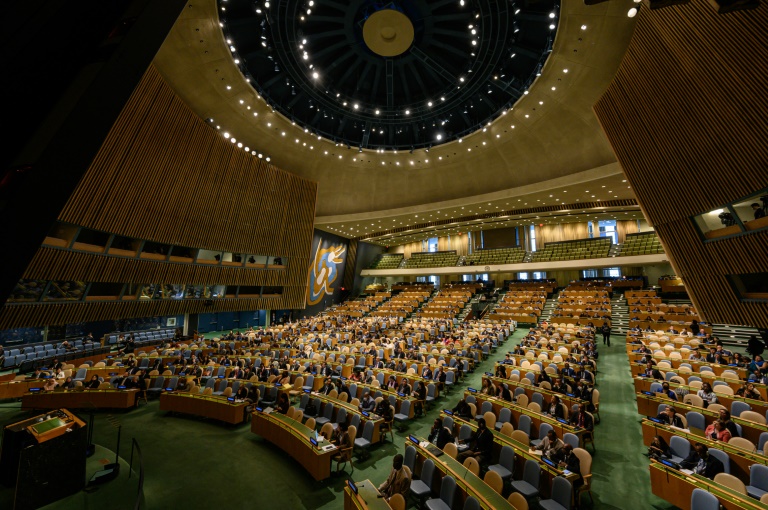

UN General Assembly condemns Russia 'illegal annexation' of Ukraine land

The United Nations General Assembly on Wednesday overwhelmingly voted to condemn Russia’s annexation of parts of Ukraine, a move US President Joe Biden said sent a “clear message” to Moscow.

The General Assembly approved the resolution with 143 in favor and five against, but 35 nations abstained including China, India, South Africa and Pakistan despite a major US diplomatic effort to seek clearer condemnation of Moscow.

The resolution “condemns the organization by the Russian Federation of so-called referendums within the internationally recognized borders of Ukraine” and “the attempted illegal annexation” announced last month of four regions by President Vladimir Putin.

It calls on all UN and international agencies not to recognize any changes announced by Russia to borders and demands that Moscow “immediately and unconditionally reverse” its decisions.

The vote showed Russia that it “cannot erase a sovereign state from the map,” Biden said in a White House statement.

“By attacking the core tenets of the UN Charter, Russia is tearing at the very foundations of international peace and security,” the statement said. “The stakes of this conflict are clear to all — and the world has sent a clear message in response.”

The US ambassador to the United Nations, Linda Thomas-Greenfield, had urged all nations to send a message that the world “will not tolerate seizing a neighbor’s land by force.”

“Today it is Russia invading Ukraine. But tomorrow it could be another nation whose territory is violated. It could be you. You could be next. What would you expect from this chamber?” she said.

– International condemnation –

The United States had put special energy into seeking to persuade South Africa and especially India, a growing US partner that has a historically close relationship with Russia and also abstained in the Security Council, where it holds a non-permanent seat.

The vote was largely the same — with a net two more votes against Russia — as when the General Assembly in March condemned the initial invasion of Ukraine.

Bangladesh, Iraq and Senegal — which abstained in March — on Wednesday voted to condemn Russia.

Eritrea, one of the world’s most closed states, moved from a “no” to an abstention, while Nicaragua, under growing international pressure over human rights, switched from abstaining to voting “no” alongside only Russia, Belarus, North Korea and Syria.

“South Africa considers the territorial integrity of states and that of Ukraine to be sacrosanct, and we reject all actions that undermine the purposes and principles of the UN Charter and international law,” said South Africa’s representative, Mathu Joyini. 

“We have abstained on the resolution because we believe that the objective of this assembly in keeping with its mandate must always be to contribute to a constructive outcome conducive to the creation of sustainable peace in Ukraine,” she said. 

Western powers counter that Russia is not genuinely interested in peace, as witnessed by deadly strikes on civilians in Kyiv and western Ukraine. 

India’s envoy, Ruchira Kamboj, said that “the entire Global South has suffered a substantial collateral damage” from the war and that “pressing issues” were not addressed in the resolution. 

Bangladesh, explaining its move to condemn Russia, said that the international community should also stand firm against any attempt by Israel to annex occupied Palestinian territory. 

“We strongly believe that the purposes and principles of the UN Charter regarding respect for sovereignty and territorial integrity and peaceful settlement of all disputes must be complied universally for everyone, everywhere, under all circumstances,” said Bangladesh’s ambassador, Muhammad Abdul Muhith.

Striking French refinery workers defy government threats

Striking French oil refinery employees voted Wednesday to maintain blockades for a third week, despite a government order for some of them to return to work in a bid to get fuel supplies flowing.

The industrial action in pursuit of pay hikes has paralysed six of the seven fuel refineries in France, leading to shortages of petrol and diesel exacerbated by panic-buying drivers.

But President Emmanuel Macron vowed in a television interview that things would return to normal “in the coming week”.

Having previously threatened to use emergency powers to order essential workers back on pain of fines or jail time, the government announced Wednesday it was putting them into action.

Officials said an Esso-Exxon-Mobil fuel depot in northwest France and another belonging to TotalEnergies in the northeast would be the first where workers are “requisitioned”.

Long queues of motorists desperately seeking fuel again clogged streets in Paris and other major cities.

As of Tuesday evening, 31 percent of stations across the country lacked at least one grade of fuel. In the greater Paris region, that figure stood at 44 percent.

Esther Berrebi, a home health aide in the capital, was trying her third station since 7:00 am (0500 GMT).

“I’m very angry, and very worried,” she told AFP. “I understand they want higher salaries, but I don’t understand how they can halt an entire country.”

Speaking to broadcaster France 2, Macron warned managers that “it’s important to get back around the table and talk”.

“We can’t allow the country to be blocked because a few people always want to take things further even when a deal has been reached” between bosses and some of the unions, he said.

– Growing frustration –

The hard-left CGT union leading the stoppages said Tuesday any requisitioning would be “not necessary and illegal”, raising the prospect of legal challenges.

It is seeking a 10 percent pay rise for staff at TotalEnergies, retroactive for all of 2022, and says management has refused to hold talks.

“It would have been easier to requisition our CEO and bring him to the negotiating table,” said Germinal Lancelin, the CGT leader for ExxonMobil at the Gravenchon-Port-Jerome refinery.

Earlier on Wednesday, TotalEnergies said it would meet all union representatives, having previously insisted it would meet only those who accepted the end of the blockades.

“We’ll see what management puts on the table, but this is a first step,” said Antoine Lopez, 50, enjoying a barbecue with colleagues at a picket outside the Feyzin refinery in eastern France.

CGT’s branch inside the company said bosses had agreed to drop its demand for an end to the refinery strike before opening wage talks, but were still insisting fuel deliveries should resume.

CGT representative Thierry Defresne told AFP late Wednesday the striking workers rejected the demand for deliveries to restart early Thursday.

“We consulted those striking and it is a strong unequivocal refusal, they don’t want this requirement to negotiate,” Defresne said.

TotalEnergies confirmed the “negative outcome of the discussions”.

– ‘General strike’ –

Until now, the government had been reluctant to inflame the conflict, but in recent days, officials have had to acknowledge the growing frustration and economic damage caused by drivers spending hours trying to fill their tanks.

“Petrol is too important for us. It’s been a nightmare for a week,” Santiago, a delivery driver, told AFP in Paris.

Even if key personnel are ordered back to work, “it will take at least two weeks” to restore fuel supplies, said Gil Villard, a CGT representative for Esso at the Fos-sur-Mer refinery outside Marseille, in the southeast.

At a time of high energy prices and inflation, TotalEnergies’ bumper profits have caused anger, leading to calls for a windfall tax.

The standoff could invigorate a march planned by left-wing political parties on Sunday against the policies of President Macron and the high cost of living. 

“I hope this is the spark that begins a general strike,” leading Greens party parliamentarian Sandrine Rousseau told Franceinfo radio on Wednesday.

The industrial action comes as Macron is preparing to push through a contentious pension overhaul by the end of the winter, despite warnings from some allies about the risk of widespread resistance.

Labour unions and left-wing political parties have vowed to try to block the reform, which would see the pension age raised to 64 or 65 for most people, up from 62 currently.

Biden to prioritize China competition amid 'dangerous' Russia

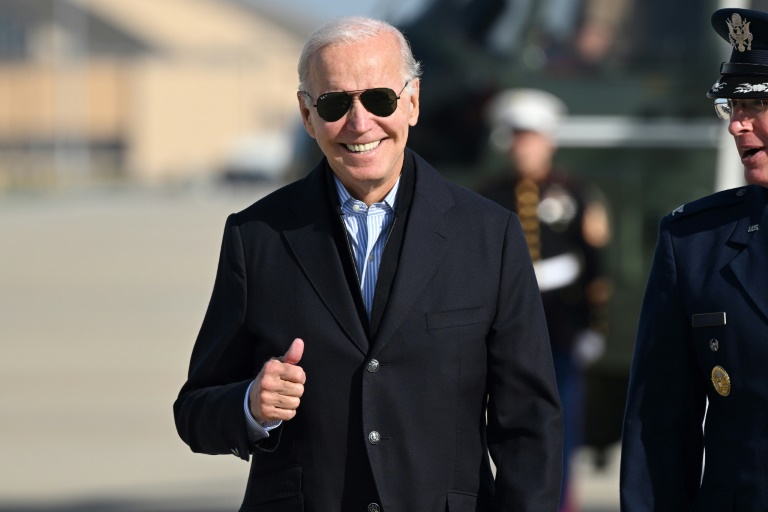
President Joe Biden’s administration said Wednesday it would prioritize winning over China, seeing it as the only global rival to the United States, even as it also works to constrain a “dangerous” Russia.

“The post-Cold War era is over, and the competition is underway between the major powers to shape what comes next,” Biden’s national security advisor, Jake Sullivan, said in a speech at Georgetown University to unveil the national security strategy.

The strategy said the 2020s would be a “decisive decade for America and the world” — for reducing conflict, promoting democracy over authoritarianism and confronting the key shared threat of climate change.

“We will prioritize maintaining an enduring competitive edge over the PRC while constraining a still profoundly dangerous Russia,” the strategy said, referring to the People’s Republic of China.

Vladimir Putin’s Russia “poses an immediate threat to the free and open international system, recklessly flouting the basic laws of the international order today, as its brutal war of aggression against Ukraine has shown,” the strategy added.

China, “by contrast, is the only competitor with both the intent to reshape the international order and, increasingly, the economic, diplomatic, military and technological power to advance that objective.”

The release of the strategy was delayed by the Ukraine war, with Biden spending most of this year rallying allies against Russia and marshalling billions of dollars in weapons to Kyiv, but it remains largely consistent with interim guidance laid out shortly after he took office in January 2021.

“I don’t believe that the war in Ukraine has fundamentally altered Joe Biden’s approach to foreign policy, which long predates his presidency,” Sullivan earlier told reporters.

“But I do believe that it presents in living color the key elements of our approach — the emphasis on allies, the importance of strengthening the hand of the democratic world and standing up for our fellow democracies and for democratic values,” he said.

– China wants to be ‘world’s leading power’ –

The strategy said the United States was willing to work even with competitors on shared interests, amid the Biden team’s talks with top carbon emitter China on climate change, described as “the existential challenge of our time.”

But the White House emphasized risks from China, warning that its rapid advances in technology aimed to mold the world order in support of “its own authoritarian model.”

Despite Beijing’s repeated denials it is seeking hegemony, the strategy said China “has ambitions to create an enhanced sphere of influence in the Indo-Pacific and to become the world’s leading power,” using the favored US term for the broader Asia region.

The White House also tied a rising China to Biden’s vows to prioritize the US middle class, saying Beijing was seeking to make the world dependent on its economy while limiting access to its own billion-plus market.

The strategy called for major investment at home, two months after Biden signed a $52 billion package to improve US capacity for building semiconductors, but also said the United States sought to “coexist peacefully” with China and manage the competition “responsibly.”

“We are not seeking to have competition tip over into confrontation or a new Cold War and we are not engaging each country as simply a proxy battleground,” Sullivan said.

The strategy release comes as Biden vows a reassessment of relations with one longtime US ally, Saudi Arabia, which moved to slash oil output — benefitting energy exporter Russia and potentially raising gas prices for American consumers weeks before congressional elections.

Amid reconciliation between Israel and Gulf Arab states, the strategy called for a “more integrated Middle East” that would reduce the long-term “resource demands” of the United States, which for decades has provided security for oil-producing nations.

The strategy also acknowledged the need to address democratic shortcomings at home, where former president Donald Trump refused to concede defeat in the 2020 election and whose supporters led a deadly assault on the US Capitol.

“We have not always lived up to our ideals and in recent years our democracy has been challenged from within. But we have never walked away from our ideals,” it said.

Dozens still missing four days after Venezuela landslide

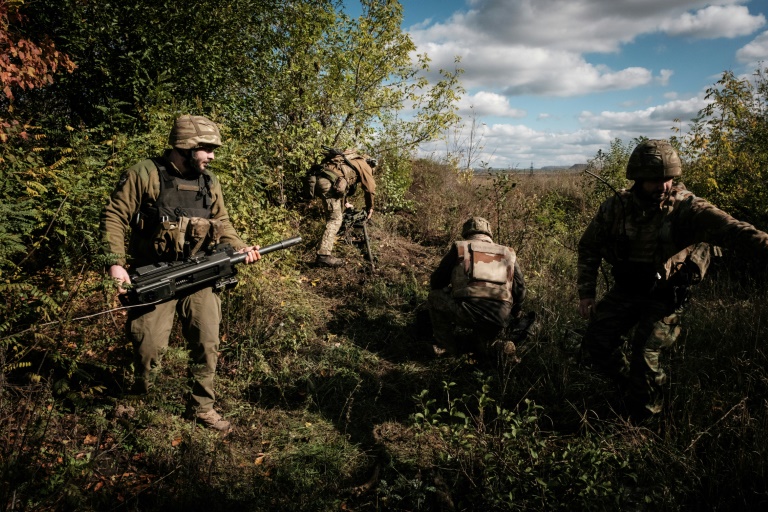
Thousands of rescuers and residents were engaged in an increasingly desperate search through thick mud Wednesday for 56 people still missing after a devastating landslide swept through a Venezuelan town, killing dozens.

At the last official count, 43 bodies had been found after disaster struck Las Tejerias, a town of some 50,000 people nestled in the mountains about 50 kilometers (30 miles) from the capital Caracas, on Saturday.

President Nicolas Maduro said Tuesday the toll from Venezuela’s worst natural disaster in decades was likely to reach 100.

Unusually heavy rains caused a major river and several streams to overflow, creating a torrent of mud that washed away cars, parts of homes, businesses and telephone wires, and felled massive trees.

“This is no longer Las Tejerias. It is a disaster,” 60-year-old housewife Maria Romero, who had clung to a tree trunk stuck between two walls to avoid being swept away, told AFP Wednesday.

Romero and six family members found temporary shelter at a primary school that survived the deluge. She lost everything and, like hundreds of others, is uncertain about the future.

The search for the missing continued, with emergency personnel using pickaxes, shovels and chainsaws to break through the hardening mud now covering the town.

The military dropped food parcels and water with parachutes from a helicopter in isolated areas, as a mass cleanup was under way to clear trees, rocks, cars, street lamps and electric poles piled up among thick mud layers in the roads.

Water and electricity had been partially restored.

– ‘Only in the movies’ –

“I had never seen a river so big, only in the movies,” Romero said as she recounted how her husband had saved their children one by one from their flooded home, and then came back for the adults.

She herself was paralyzed by panic.

“My granddaughter screamed… ‘Neighbors, save us!’ but how could the neighbors save us if they had it worse than us?” said Romero.

Vice President Delcy Rodriguez has said that a month’s worth of rain fell in the area in just eight hours.

The government declared three days of mourning.

Already on Tuesday, rescuers told AFP it would be difficult to find any survivors. 

Gabriel Castillo, 32, ran through the village in tears, desperate for news on his mother, his partner and a cousin with whom he had shared a house on the banks of a stream that overflowed.

He did not find their names on a survivors’ list at a nearby hospital.

At the hospital, “they offered me food, but I don’t want food, what I want is for my family to reappear,” he told AFP.

Experts say the storm was aggravated by the seasonal La Nina weather phenomenon gripping the region, as well as the effects of Hurricane Julia, which claimed at least 26 lives in Central America and caused extensive damage.

Crisis-hit Venezuela is no stranger to seasonal storms, but this was the worst so far this year following historic rain levels that caused dozens of other deaths in recent months. 

Maduro has vowed to rebuild “each and every” home and business destroyed in the landslide.

“Las Tejerias will rise like the phoenix, Las Tejerias will be reborn,” he said.

According to Rodriguez, 317 homes were destroyed and 757 damaged by the mudslide. 

In 1999, about 10,000 people died in a massive landslide in the northern state of Vargas. 

G7, IMF vow to support Ukraine after Russia strikes

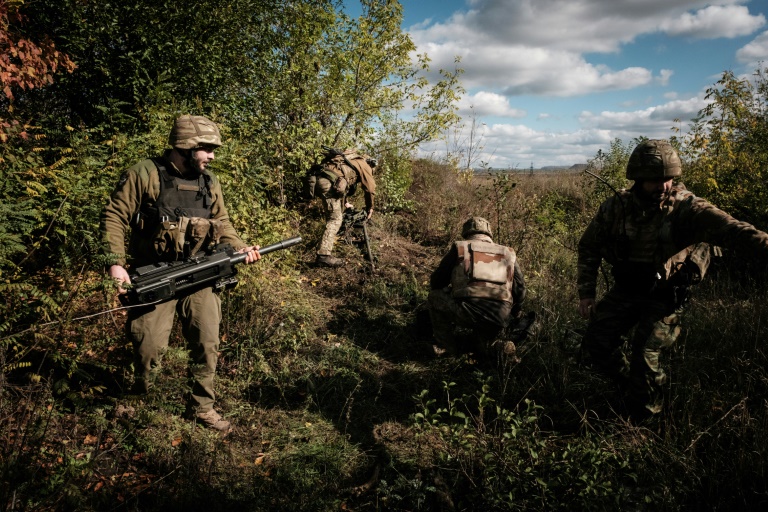
The G7 and IMF pledged their steadfast financial support to Ukraine on Wednesday as the country reels from Russian missile strikes and needs billions of dollars in monthly aid.

Ukrainian President Volodymyr Zelensky appeared by video link to urge more aid at a finance ministers gathering in Washington for the annual meetings of the International Monetary Fund and World Bank, just days after Russia’s missile salvo on Kyiv and other cities.

“We can see that Russian terror attacks can be intensified,” Zelensky said through an interpreter to the meeting dedicated to supporting Ukraine.

“So we need to intensify our collaboration for assistance in a symmetric way to rebuild what was destroyed and to guarantee the financial stability of our state,” he said, adding that Kyiv faces a $38 billion budget hole next year.

IMF chief Kristalina Georgieva said Ukraine’s financing needs in 2023 will range between $3 billion and $4 billion a month.

She said that at the request of Zelensky, the IMF would create the Ukraine Economic Forum to share information and clarify the country’s financing needs.

“We are moving with you in the direction of a strong Ukraine,” she said.

US Treasury Secretary Janet Yellen said meeting Ukraine’s needs “will require a unified and coordinated effort.”

“But together, the G7, the international financial institutions, and all of Ukraine’s partners can help Ukraine win this war and rebuild to become the prosperous and secure democracy that the Ukrainian people have fought so hard for,” she said.

The United States has provided $65 billion in aid, including military equipment to Kyiv since February.

– ‘Stand with Ukraine’ –

Earlier, Yellen and other finance ministers and central bankers from the Group of Seven wealthy democracies held their own talks about Russia’s war in Ukraine.

“We urge Russia to immediately end its unjust and brutal war,” they said in a statement.

“The G7 will continue to stand with Ukraine for as long as it takes and remain strongly committed to supporting Ukraine’s urgent short-term financing needs,” the statement added.

The G7 also discussed its efforts to impose a price cap on Russia oil in a bid to deny the country a key source of funding for its war and contain soaring energy prices.

The group — which includes Britain, Canada, France, Germany, Italy, Japan and the United States — said it had made “significant progress on all key aspects” of the proposal, but they did not give any details.

The G7 welcomed Australia’s addition to the coalition. One of the challenges the G7 faces is rallying countries around the world behind the idea of a price cap.

– Putin warning –

Hours earlier, Russian President Vladimir Putin lashed out at the proposal, which the United States has pushed and the EU supports pending details from the G7. 

“With their cavalier decisions, some Western politicians are destroying the global market economy and are in fact posing a threat to the well-being of billions of people,” Putin told an energy forum in Moscow.

Moscow has warned that it would cut off oil supplies to countries that impose such a cap.

Officials have yet to say at what level the cap would be set, but they have said that it would remain above the cost of production so that Russia would still have an incentive to supply importing countries.

G7, IMF vow to support Ukraine after Russia strikes

The G7 and IMF pledged their steadfast financial support to Ukraine on Wednesday as the country reels from Russian missile strikes and needs billions of dollars in monthly aid.

Ukrainian President Volodymyr Zelensky appeared by video link to urge more aid at a finance ministers gathering in Washington for the annual meetings of the International Monetary Fund and World Bank, just days after Russia’s missile salvo on Kyiv and other cities.

“We can see that Russian terror attacks can be intensified,” Zelensky said through an interpreter to the meeting dedicated to supporting Ukraine.

“So we need to intensify our collaboration for assistance in a symmetric way to rebuild what was destroyed and to guarantee the financial stability of our state,” he said, adding that Kyiv faces a $38 billion budget hole next year.

IMF chief Kristalina Georgieva said Ukraine’s financing needs in 2023 will range between $3 billion and $4 billion a month.

She said that at the request of Zelensky, the IMF would create the Ukraine Economic Forum to share information and clarify the country’s financing needs.

“We are moving with you in the direction of a strong Ukraine,” she said.

US Treasury Secretary Janet Yellen said meeting Ukraine’s needs “will require a unified and coordinated effort.”

“But together, the G7, the international financial institutions, and all of Ukraine’s partners can help Ukraine win this war and rebuild to become the prosperous and secure democracy that the Ukrainian people have fought so hard for,” she said.

The United States has provided $65 billion in aid, including military equipment to Kyiv since February.

– ‘Stand with Ukraine’ –

Earlier, Yellen and other finance ministers and central bankers from the Group of Seven wealthy democracies held their own talks about Russia’s war in Ukraine.

“We urge Russia to immediately end its unjust and brutal war,” they said in a statement.

“The G7 will continue to stand with Ukraine for as long as it takes and remain strongly committed to supporting Ukraine’s urgent short-term financing needs,” the statement added.

The G7 also discussed its efforts to impose a price cap on Russia oil in a bid to deny the country a key source of funding for its war and contain soaring energy prices.

The group — which includes Britain, Canada, France, Germany, Italy, Japan and the United States — said it had made “significant progress on all key aspects” of the proposal, but they did not give any details.

The G7 welcomed Australia’s addition to the coalition. One of the challenges the G7 faces is rallying countries around the world behind the idea of a price cap.

– Putin warning –

Hours earlier, Russian President Vladimir Putin lashed out at the proposal, which the United States has pushed and the EU supports pending details from the G7. 

“With their cavalier decisions, some Western politicians are destroying the global market economy and are in fact posing a threat to the well-being of billions of people,” Putin told an energy forum in Moscow.

Moscow has warned that it would cut off oil supplies to countries that impose such a cap.

Officials have yet to say at what level the cap would be set, but they have said that it would remain above the cost of production so that Russia would still have an incentive to supply importing countries.

US growth slowdown 'required' to beat inflation: Fed minutes

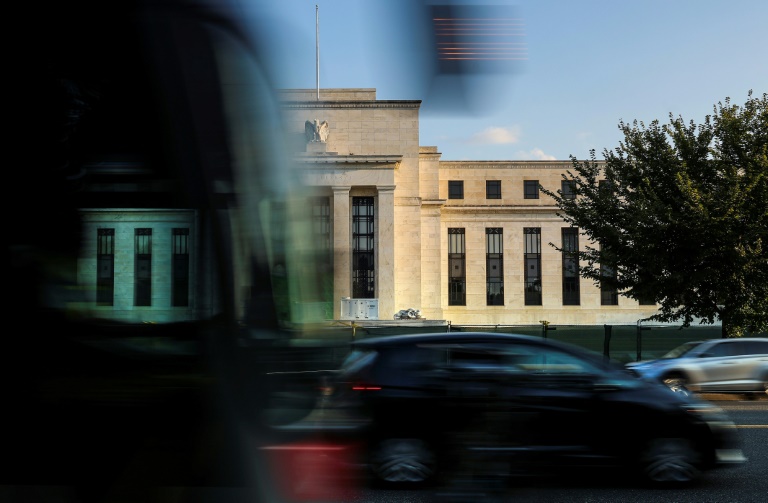
A slowdown of economic growth and the US job market will be “required” to bring down inflation, the Federal Reserve said in notes released Wednesday, adding that prices remain “unacceptably high.”

Fed officials also said inflation has “not yet responded” to increased interest rates, according to minutes of the US central bank’s September meeting, and that “a significant reduction in inflation would likely lag that of aggregate demand.”

In September, the Fed’s policy-setting Federal Open Market Committee (FOMC) increased the key interest rate by 0.75 percentage point for the third consecutive time, continuing its forceful action to tamp down inflation, which has surged to the highest level in 40 years.

On Tuesday, US President Joe Biden admitted there was a chance the country could suffer a “slight” recession, when asked about fears for the economy amid gloomy growth projections.

But some of the Fed officials cited in the minutes also noted that “it would be important to calibrate the pace of further policy tightening with the aim of mitigating the risk of significant adverse effects on the economic outlook.”

Several of the officials added that “the cost of taking too little action to bring down inflation likely outweighed the cost of taking too much action.”

Participants also noted their strong “commitment to returning inflation to the committee’s two percent objective.”

The Fed’s preferred inflation measure, the personal consumption expenditures (PCE) price index, showed the annual pace of price increases slowed slightly in August.

Another measure of price increases, the CPI index, will be published Thursday morning for the month of September. 

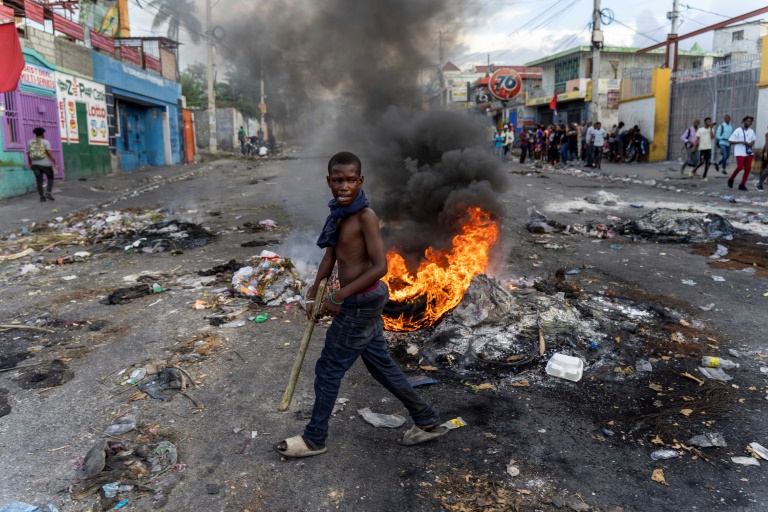
US offers help for troubled Haiti but cautious on troops

The United States on Wednesday offered new help to Haiti in combatting the Caribbean nation’s spiraling security and health crises, but made clear it was reluctant to send troops for a proposed international force.

Promising more steps to come, President Joe Biden’s administration imposed US visa restrictions on Haitians blamed for the unrest and said it was working with Mexico on a draft UN Security Council resolution to create targeted sanctions and additional security measures.

At the request of the Haitian government, the US Coast Guard will also deploy one of its major cutters to patrol off the capital Port-au-Prince, the State Department said, describing the move as an “additional sign of resolve and support.”

Brian Nichols, the top US diplomat for the Western Hemisphere, and Lieutenant General Andrew Croft, deputy commander of the US Southern Command, began two days in Port-au-Prince where they will meet Prime Minister Ariel Henry and other key stakeholders, the State Department added.

“We are sending a clear message that the United States will continue to support the Haitian people during this critical time,” Secretary of State Antony Blinken said in a statement.

He said the United States was identifying Haitian officials and others involved in street gangs that have blocked humanitarian aid and would prevent them as well as their families from entering their giant neighbor to the north.

“Our intent in imposing these visa restrictions is to demonstrate that there are consequences for those instigating violence and unrest in the country,” Blinken said.

– US ‘reviewing’ request –

The Haitian government on Friday formally requested international assistance as a cholera epidemic worsens and law and order break down, with armed gangs seizing vast pockets of the Western Hemisphere’s poorest country including its largest fuel import terminal.

UN Secretary-General Antonio Guterres has called for the immediate deployment of a special armed force, warning of a “dramatic deterioration in security.”

State Department spokesman Ned Price said the United States was “reviewing this request in coordination with international partners.”

But another US official indicated that Biden — a frequent skeptic of troop deployments and who last year pulled all US soldiers out of Afghanistan — was in no mood to send American forces to Haiti, which the United States controlled for nearly two decades a century ago.

“The question of security presence is obviously an area where we are treading very carefully to make sure that we are doing the right things and not doing the things that in the past have not worked,” the official said on condition of anonymity.

“I think it’s premature to really start thinking about whether the United States is going to have a physical presence inside of Haiti.”

Blinken said Washington’s immediate focus was increasing assistance to the Haitian National Police, which was created in 1995 under the country’s first elected president, Jean-Bertrand Aristide, to ensure civilian control of public security.

The United States has devoted $90 million since last year to strengthening the police as well as $171 million in humanitarian assistance, an official said.

State Department spokesman Price said that the United States would “accelerate” new humanitarian assistance, with officials noting that the aid would include cholera relief and fuel.

The United States has long been the key player in Haiti, which lies 1,300 kilometers (800 miles) off the Florida coast, but has been increasingly jaded about prospects for change after spearheading billions of dollars in aid following a devastating 2010 earthquake.

A previous deployment of UN peacekeepers in 2010 led to disillusion after their poor handling of wastewater was found to have provoked a cholera outbreak that claimed 10,000 lives before it was brought under control in 2019.

World's first space tourist plans new flight to Moon with SpaceX

Dennis Tito, an American entrepreneur who in 2001 became the first person to pay for their own space voyage, said Wednesday he plans to fly with his wife Akiko on a future SpaceX mission around the Moon.

The voyage will take place after Elon Musk’s company has finished developing its prototype Starship rocket and has flown a first commercial flight that will include Japanese billionaire Yusaku Maezawa.

“Since my first human spaceflight I continue to be passionate about space, and the possibilities it has for all humanity, which leads me to this mission” Tito, 82, told reporters on a call Wednesday. 

The weeklong mission would see Starship fly within 125 miles of the lunar surface before returning home.

Tito did not disclose how much he and Akiko had paid for their tickets, but said ten more seats remain open for others to sign up.

Maezawa, on the other hand, has chartered all the seats on his mission called “dearMoon,” set to fly no sooner than 2023 but likely much later.

In 2001, Tito paid $20 million to fly on a Russian rocket to the International Space Station, heralding the era of space tourism.

An aeronautics and astronautics engineer by training, Tito worked for NASA’s Jet Propulsion Laboratory in the 1960s, before founding the investment management firm Wilshire Associates in 1972.

Japanese born Akiko, a systems engineer who later moved to the finance industry and relocated to New York in 1995, added: “I want people to know that they can do whatever they set their mind to. 

“It’s never too late, no matter your age, race or gender.”

It’s unclear when SpaceX will commence commercial missions with Starship — a giant rocket that the company hopes to one day use to colonize Mars.

Musk has promised the rocket will complete its first orbital test this year, and a version of Starship has already been selected to be used as a lander for NASA’s Artemis missions to return humans to the Moon.

Aarti Matthews, director of Starship crew and cargo, said SpaceX envisaged the commercial missions as a step towards airline-like space operations.

Close Bitnami banner
Bitnami