World

Ukraine vows to unite against 'terrorist' Russia

Ukraine vowed Monday it would not be intimidated by a wave of deadly missile strikes from “terrorist state” Russia as Moscow stoked fears of further retaliation with threats of more “severe” attacks. 

The heaviest bombardment of Ukraine in months, which killed 11 and wounded more than 80, came in response to an explosion at the weekend that damaged a vital bridge from Russia to the Moscow-annexed Crimean peninsula.

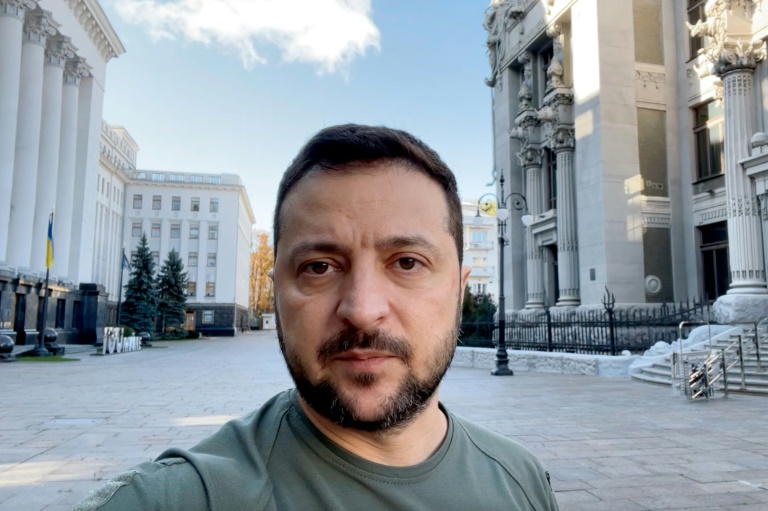
“Ukraine cannot be intimidated. It can only be more united. Ukraine cannot be stopped,” President Volodymyr Zelensky said in a defiant video, vowing to make the “battlefield even more painful” for Russian troops.

Kyiv said Russian forces had fired more than 80 missiles on cities across the country — including the capital — and that Russia had used Iranian drones launched from neighbouring Belarus, spurring panic and damaging energy facilities.

“Let there be no doubt,” Russia’s President Vladimir Putin said in televised comments addressed to his security council, “if attempts at terrorist attacks continue, the response from Russia will be severe.”

Kyiv’s ambassador to the United Nations denounced Russia during an urgent General Assembly meeting to discuss Moscow’s annexation of four Ukrainian regions.

“Russia has proven once again, that this is a terrorist state that must be deterred in the strongest possible ways,” said Sergiy Kyslytsya, speaking hours after the assault.

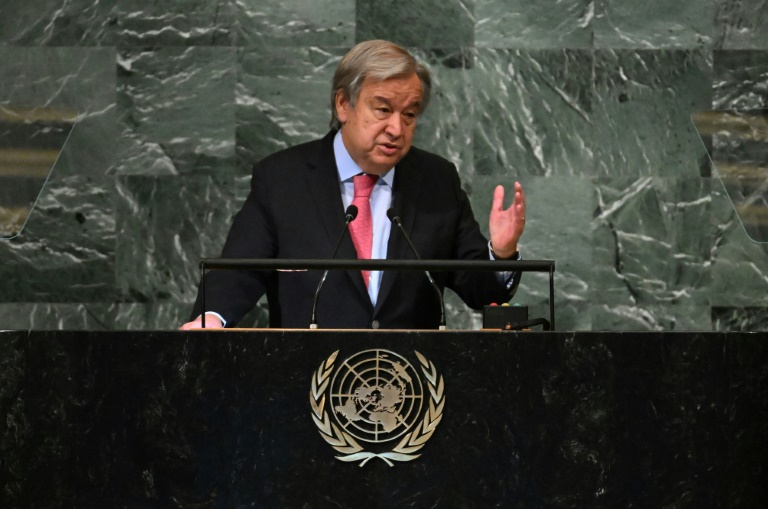
Ahead of the session, and with tensions at a boiling point, UN chief Antonio Guterres described Russia’s attacks as an “unacceptable escalation of the war,” his spokesman said.

US President Joe Biden said the strikes “demonstrate the utter brutality” of Putin’s “illegal war.”

Biden pledged to “continue providing Ukraine with the support needed to defend itself, including advanced air defence systems” during a call with Zelensky, the White House said.

Zelensky described the call as “productive” in a tweet in which he asserted air defence as “the number 1 priority” for Ukraine. 

– ‘Killing civilians’ –

Ksenia Ryazantseva, a 39-year-old language teacher, told AFP she was awoken by the blasts.

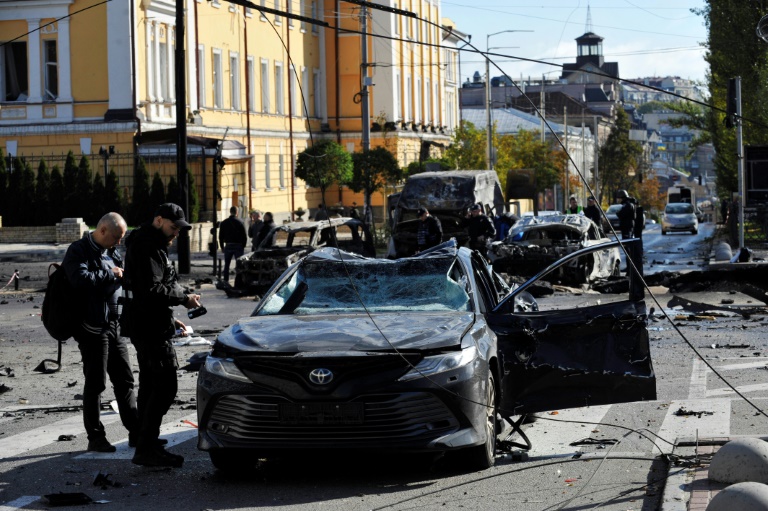
“We saw the smoke, then the cars, and then we realised we didn’t have a window anymore,” she added. “There’s no military target or anything like that here. They’re just killing civilians”.

Zelensky said the strikes aimed to take down Ukrainian energy infrastructure and regional officials across the country confirmed widespread disruption.

Russia’s defence ministry meanwhile confirmed it had targeted Ukrainian energy, military command and communications facilities, claiming the strikes had been a success and “achieved their aims”.

Kuleba said the attacks had not been “provoked” and that the onslaught was Moscow’s response to a series of embarrassing military losses in eastern Ukraine.

“Putin is desperate because of battlefield defeats and uses missile terror to try to change the pace of war in his favour,” he wrote on social media. 

With Putin’s actions in the spotlight, UN debate will open on a draft resolution denouncing what has been widely seen in the West as Russia’s illegal seizure of Ukrainian land.

The decision to bring the annexation matter before the General Assembly, where the 193 UN members have one vote each — and no one wields veto power — was taken after Russia used its veto in a Security Council meeting September 30 to block a similar proposal.

Zelensky said he had spoken with the leaders of France and Germany and urged them to “increase pressure” on Russia.

– Black smoke –

US Secretary of State Antony Blinken pledged “unwavering economic, humanitarian, and security assistance” to Ukraine as the national police service put the nationwide death toll from the Russian assault at 11.

Ukrainian officials said downtown Kyiv was hit and that a university, museums and the philharmonic building had been damaged.

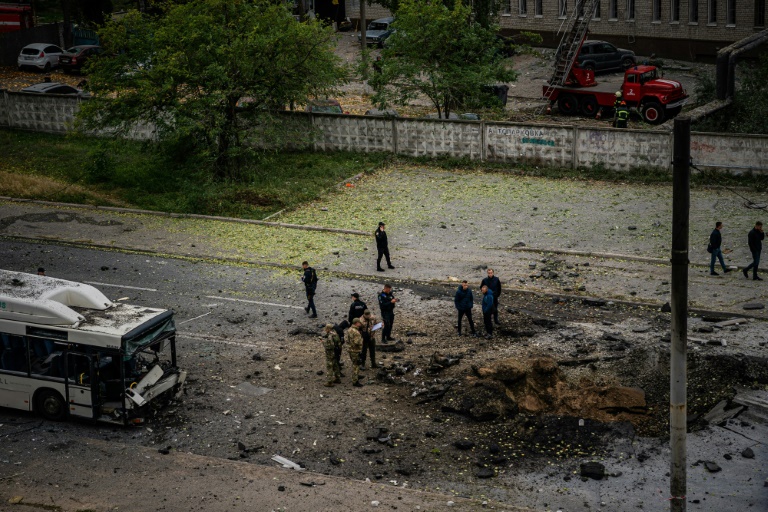
An AFP journalist in Kyiv said a projectile landed near a playground and saw smoke rising from a large crater at the impact site. Trees and benches were charred by the blast and a number of ambulances were at the scene.

In the western city of Lviv, mayor Andriy Sadovyi said electricity and hot water services were disrupted after critical infrastructure was bombarded.

AFP photographers there saw plumes of black smoke rising above the town’s skyline.

Moldova, west of Ukraine, said several Russian cruise missiles targeting Ukraine had crossed its airspace, and that it had summoned Moscow’s envoy to demand an explanation.

The ex-Soviet country, which is a candidate to join the European Union, has a small breakaway region, Transnistria, which is armed and supported by Russia.

– Crimean bridge attack –

Belarusian President Alexander Lukashenko, a close ally of Putin, meanwhile claimed that Ukraine was preparing an attack on his country.

He said Russia and Belarus would “deploy” troops together, without specifying where.

The autocratic leader also accused Ukraine, alongside neighbouring Poland and Lithuania, of training Belarusian militants to carry out attacks at home.

The strikes across Ukraine came a day after Moscow blamed Kyiv for the blast that damaged a bridge linking Crimea to Russia, leaving three people dead.

The blast that hit the bridge — a symbol of the Kremlin’s 2014 annexation of Crimea — sparked celebrations by Ukrainians, although officials in Kyiv have made no direct claim of responsibility.

The 19-kilometre (12-mile) bridge is also a vital supply link between Russia and the annexed Crimean peninsula.
US airport websites hit by suspected pro-Russian cyberattacks

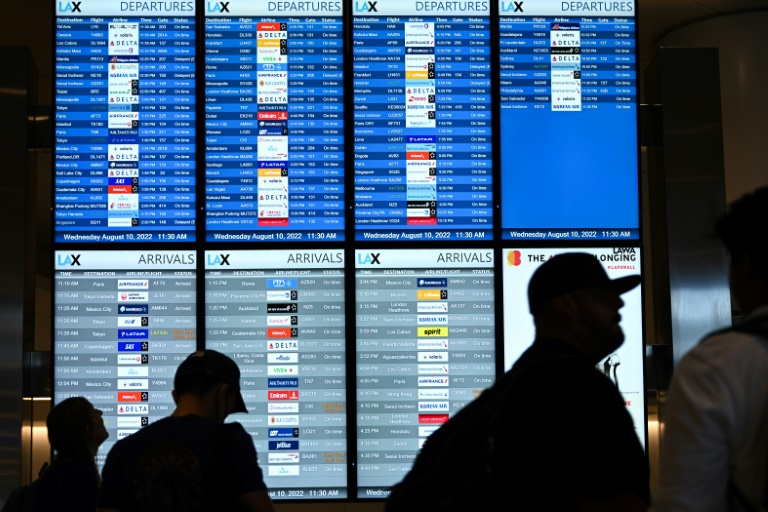
The websites for a number of major US airports were briefly knocked offline Monday after a cyberattack promoted by a pro-Russian hacking group.

The disruptions affected airport websites in cities such as Atlanta, Chicago, Los Angeles, New York, Phoenix and St Louis, and were carried out via distributed denial of service (DDoS) attacks, which involve taking a website offline by flooding it with traffic.

The airport websites were targeted after the pro-Russian hacking group known as “KillNet” published a list of sites and encouraged its followers to attack them.

The DDoS attacks only affected the public-facing websites of the airports, which supply flight and services information and do not have any impact on operations.

Atlanta’s Hartsfield-Jackson Airport said its website is “up and running after an incident early this morning that made it inaccessible to the public.”

“An investigation into the cause of the incident is underway,” it said. “At no time were operations at the airport impacted.”

Most of the airport websites targeted appeared to be functioning normally after being temporarily shut down.

KillNet claimed responsibility last week for attacks on a number of US state government websites, and it has taken aim at other countries opposing Russia’s invasion of Ukraine.

The US Cybersecurity and Infrastructure Security Agency (CISA) said it was “aware of reports of DDoS attacks targeting multiple US airport websites.”

“We are coordinating with potentially impacted entities and offering assistance as needed,” a CISA spokesperson said.

UN set to meet after Russia strikes in Ukraine

The UN General Assembly meets Monday hours after Russia launched a deadly barrage of missile strikes at cities across Ukraine, as Western powers condemned Moscow’s latest attacks and sought to underscore its isolation.

The United Nations called the urgent meeting to discuss Russia’s declared annexation of four partly occupied Ukrainian regions, but the debate was set to be overshadowed by the attacks on Kyiv and other cities in one of the most punishing assaults on Ukraine in months.

Russian President Vladimir Putin vowed even more “severe” retaliation after the recent explosion that damaged a key bridge in Moscow-annexed Crimea — an attack the Kremlin has blamed on Kyiv.

Ahead of the General Assembly session, and with tensions at a boiling point, UN chief Antonio Guterres described Russia’s attacks as an “unacceptable escalation of the war,” his spokesman said.

US President Joe Biden meanwhile condemned the strikes in stark terms, saying they “demonstrate the utter brutality” of Putin’s “illegal war.”

“The United States strongly condemns Russia’s missile strikes today across Ukraine,” he said in a statement.

– ‘Illegal annexations’ –

With Putin’s actions in the spotlight, UN debate will open on a draft resolution denouncing what has been widely seen in the West as Russia’s illegal seizure of Ukrainian land.

The decision to bring the annexation matter before the General Assembly, where the 193 UN members have one vote each — and no one wields veto power — was taken after Russia used its veto in a Security Council meeting September 30 to block a similar proposal.

The vote is expected no sooner than Wednesday.

“It’s extremely important,” said Olof Skoog, who, as EU ambassador to the world body, drafted the text in cooperation with Ukraine and other countries.

The international community will be in “a very, very bad place,” the Swedish diplomat told reporters, “unless the UN system and the international community through the General Assembly react to this kind of illegal attempt.”

A failure by the General Assembly to act would give “carte blanche to other countries to do likewise or to give recognition to what Russia has done,” he added.

A resolution draft seen by AFP condemns Russia’s “attempted illegal annexations” of the Ukrainian regions of Donetsk, Luhansk, Zaporizhzhia and Kherson following “so-called referendums,” and it stresses these actions have “no validity under international law.”

It calls on all states, international organizations and agencies not to recognize the annexations, and demands the immediate withdrawal of Russian troops from Ukraine.

In response to the resolution, Russia has written to all member states in a letter attacking “Western delegations” whose actions “have nothing to do with protection of international law and the principles of the UN Charter.”

“They only pursue their own geopolitical objectives,” said the letter, signed by Russian Ambassador Vassily Nebenzia.

Nebenzia said that given the circumstances, the General Assembly should vote by secret ballot — a highly unusual procedure normally reserved for matters like electing the rotating members of the Security Council.

– ‘A bit of desperation’ –

“It doesn’t suggest a high degree of confidence in the outcome if Russia is seeking to obscure the vote count,” a senior official in US President Joe Biden’s administration told reporters. “It does suggest a bit of desperation.”

Guterres himself has bluntly denounced the annexations as being “against everything the international community is meant to stand for,” he said. 

“It has no place in the modern world. It must not be accepted.”

During last month’s Security Council vote, no other country sided with Russia, though four delegations — China, India, Brazil and Gabon — abstained.

Some developing countries have complained the West is devoting all its attention to Ukraine, and others might be tempted to join them this week.

The vote will provide a clear picture of exactly how isolated Russia has become. Given the high stakes, backers of the draft are going all out to win over potential abstentionists. 

On Monday, Ukrainian diplomat Dmytro Kuleba issued a plea to African nations to get off the fence.

“Neutrality will only encourage Russia to continue its aggression and malign activities across the world, including in Africa,” he said.

Weinstein sex assault trial opens in Los Angeles

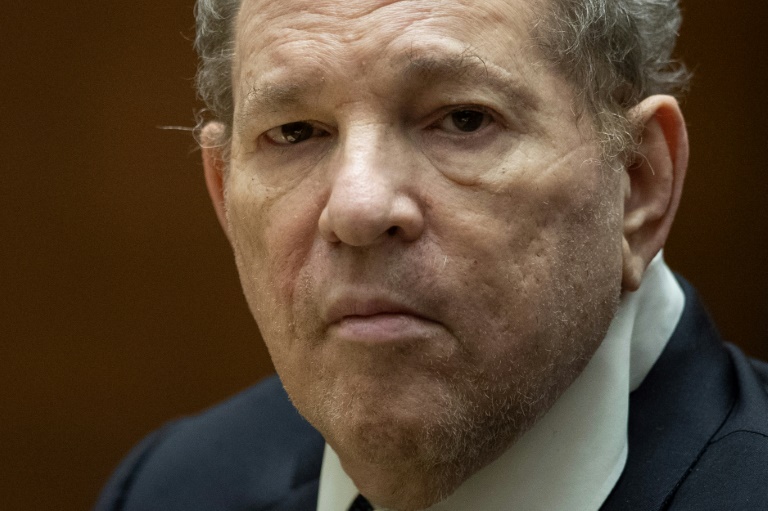
Jury selection began Monday in the Los Angeles trial of disgraced Hollywood mogul Harvey Weinstein, with five alleged victims expected to take the stand during the two-month case.

The 70-year-old “Pulp Fiction” producer is already serving 23 years in jail in New York after being convicted there of a series of sex crimes.

He now faces 11 more charges, including sexual battery by restraint, forcible rape and forcible oral copulation against women in Beverly Hills and Los Angeles hotels between 2004 and 2013.

If convicted, Weinstein — who has pleaded not guilty to all counts — could be sentenced to more than 100 additional years behind bars.

A crowd of journalists gathered Monday outside the downtown Los Angeles court where the one-time Hollywood power player had been ordered to appear.

Widespread sexual abuse and harassment allegations against Weinstein exploded in October 2017, and his conviction in New York in 2020 was a landmark in the #MeToo movement.

In June, he lost a bid to have that sex crimes conviction overturned. He has also been separately charged by British prosecutors with the 1996 indecent assault of a woman in London.

In total, nearly 90 women, including Angelina Jolie, Gwyneth Paltrow and Salma Hayek, have accused Weinstein of harassment or assault.

– Power players –

The Los Angeles Times on Monday quoted Weinstein attorney Mark Werksman as saying there would be testimony from well-known figures.

“Some of these victims, people will recognize them. Some of these women, you’ve seen them in movies, they’ve been in ad campaigns, a couple of them have achieved some success as actresses or models,” Werksman said, according to the paper.

The Times said one of the five accusers — all of whom will be known formally as “Jane Doe” — would be Jennifer Siebel Newsom, wife of California Governor Gavin Newsom.

“Like many other women, my client was sexually assaulted by Harvey Weinstein at a purported business meeting that turned out to be a trap,” her lawyer Elizabeth Fegan told the paper. 

“She intends to testify at his trial in order to seek some measure of justice for survivors, and as part of her life’s work to improve the lives of women.”

Siebel Newsom has previously written about Weinstein’s behavior in an essay published in 2017, but did not give details about the alleged assaults.

Weinstein says that all his sexual encounters were consensual, and his lawyer told reporters that the Los Angeles accusations “stem from many years ago” and cannot “be substantiated or corroborated by any forensic evidence” or “credible witnesses.”

The New York Film Festival this week will premiere “She Said,” a film about the 2017 newspaper investigation into Weinstein that sparked the demise of his movie empire.

Before the allegations against him emerged, the producer and his brother Bob were Hollywood’s ultimate power players.

They co-founded Miramax Films, a distribution company named after their mother Miriam and father Max, in 1979. It was sold to Disney in 1993.

Their hits included 1998’s “Shakespeare in Love,” for which Weinstein shared a best picture Oscar. Over the years, Weinstein’s films received more than 300 Oscar nominations and 81 statuettes.

US airport websites hit by suspected pro-Russian cyberattacks

The websites for a number of major US airports were briefly taken offline Monday after a cyberattack promoted by a pro-Russian hacking group.

The distributed denial of service (DDOS) attacks hit the airport websites of several major US cities including Atlanta, Chicago, Los Angeles, New York, Phoenix and St Louis.

A DDOS attack involves knocking a website offline by flooding it with traffic.

The airport websites were targeted after the pro-Russian hacking group known as “KillNet” published a list of sites and encouraged its followers to attack them.

The DDOS attacks only affected the public-facing websites of the airports, which supply flight and services information and do not have any impact on operations.

Atlanta’s Hartsfield-Jackson Airport said its website is “up and running after an incident early this morning that made it inaccessible to the public.”

“An investigation into the cause of the incident is underway,” it said. “At no time were operations at the airport impacted.”

Most of the airport websites targeted appeared to be functioning normally after being temporarily knocked offline.

KillNet claimed responsibility last week for attacks on a number of US state government websites, and it has taken aim at other countries opposing Russia’s invasion of Ukraine.

There was no immediate comment from the US Cybersecurity and Infrastructure Security Agency (CISA).

Greece, Turkey set tensions aside for direct maritime link

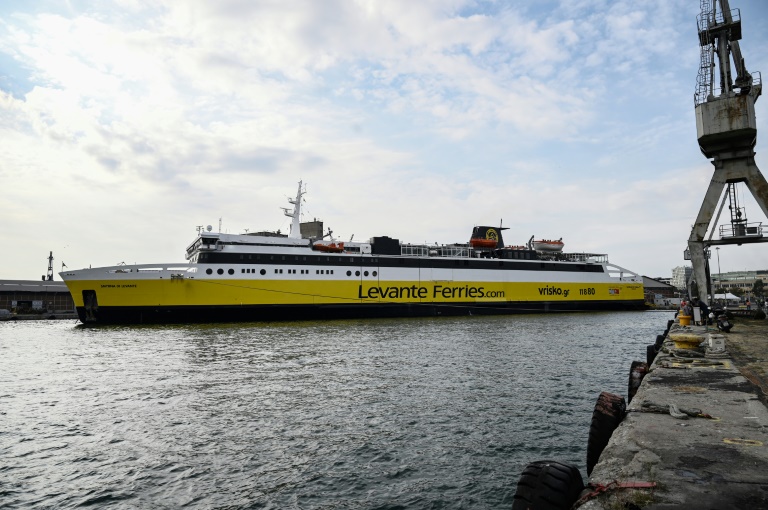
Setting aside longstanding strategic rivalry, Greece and Turkey on Monday inaugurated a “friendship line” ferry link between Thessalonika in northern Greece and the western Turkish port of Izmir.

Greek-based shipping company Levante Ferries announced the MV “Smyrna di Levante” vessel had started passenger and freight services between the two countries, the first direct maritime link between the regional rivals.

The company said the vessel carrying up to 948 passengers and as many as 300 vehicles would both promote the neighbours’ commercial interests and deepen ties. 

The ship began its maiden test voyage from Thessalonika at 5.15 pm (1414 GMT) on Monday with 35 people aboard — mainly Levante employees — bound for Izmir some 14 hours away.   

The ferry firm has over the past three years invested a reported 16 million euros in the three-times weekly route, the first direct major link between continental Greece and Turkey.

Some eastern Greek islands off the Turkish coast offer more ad hoc trips to nearby Turkish ports courtesy of small boats.

“We want to link Europe and Asia (and) benefit from market demand” to “promote maritime and tourist transport,” said Greek operator Yannis Dimitriadis.

Greece and Turkey have endured long bouts of sometimes bitter rivalry with a series of maritime border disputes raising tensions amid Turkish accusations its fellow NATO member seeks to militarise more than a dozen of its islands in the Aegean Sea.

Athens has pushed back against Ankara’s demands that it desist from doing so.

Last week saw a further spat at an informal EU gathering in Prague when Greek Prime Minister Kyriakos Mitsotakis left an official dinner during an address by Turkish President Recep Tayyip Erdogan. 

Putin seeks escalation with Ukraine missile blitz: experts

With Russia firing a hail of missiles into Ukraine on Monday and Belarus making fresh threats against Kyiv, President Vladimir Putin is seeking to escalate the nearly eight-month war and compensate for humiliating recent losses, Western analysts say.

According to Ukrainian authorities, 41 out of 75 missiles were intercepted, but the remainder struck cities around the country, including the capital Kyiv and western Lviv near the border with Poland.

Putin warned Ukraine he was ready to authorise more “severe” attacks, while deputy head of the Russian Security Council Dmitry Medvedev said that “the first episode has been played. There will be others.” 

UN chief Antonio Guterres condemned the strikes as “another unacceptable escalation” while French leader Emmanuel Macron called them “a profound change in the nature of this war.”

Analysts said the strikes appeared to be a response to a blast on Saturday on the Kerch bridge linking the occupied Crimea peninsula to Russia which was personally inaugurated by Putin in 2018.

Yordan Bozhilov, director of Bulgarian think-tank Sofia Security Forum, called the explosion that downed one of the road sections “the first personal humiliation for Putin”.

The attack — not claimed by Ukraine but immediately blamed on Kyiv by Russia — came after major battlefield reverses for Russian troops around Lyman in northeast Ukraine and Kherson in the south in recent weeks.

“Russia demonstrated that it can still escalate the conflict but it can only escalate by attacking more and more civilian targets,” said Wojciech Lorenz, head of the international security programme at the Polish Institute of International Affairs.

“The Russian regime was under pressure from its own propagandists and some opinion makers to demonstrate that it was able to respond to Ukrainian offensives,” he told AFP.

– Belarus –

Belarusian leader Alexander Lukashenko, a close ally of Putin, also issued fresh threats against Kyiv on Monday, raising fears he might be preparing to finally join Russia’s offensive against its neighbour.

Lukashenko has granted Russia use of his territory but has declined to send troops directly into battle.

He said Monday he had agreed to deploy “a regional grouping” that would mix Russian and Belarusian troops but did not say where they would be sent. 

“I am sceptical of Belarus entering the conflict. Belarus troops are primarily engaged in repressing their own people,” said William Alberque, a military expert at the International Institute for Strategic Studies, a London-based think-tank.

Lorenz said he was also doubtful about Belarus’s direct involvement, but he said that “Ukraine will have to devote some resources to defend its border.”

“It’s better to concentrate those resources in the east (against Russia) without having to spare thousands of troops in the west and the north,” he said. 

– Options –

Strong-arming Belarus into greater involvement, nuclear threats and increasing the brutality of attacks on Ukraine are seen as some of the few options available to Putin in the short-term as he seeks to change the momentum on the battlefield.

Alberque viewed Monday’s missile attacks as being part of Putin’s strategy of trying to raise pressure on Ukraine and the West.

“Russia has entered a cycle of shock and the peak of violence. It started with mobilisation and annexation, then with nuclear threats and now with indiscriminate attacks against civilians,” he said.

Despite recent setbacks, Putin formally annexed four Ukrainian regions in late September and ordered a partial mobilisation of up to 300,000 men.

“Putin is trying both to put pressure on Ukrainian society by destroying power plants and civilian infrastructure and to put pressure on Western countries, to try to undermine their unity,” added Bozhilov from the Sofia Security Forum.

Attacks on civilians also helps him “portray himself as someone ready for anything.”

But Lorenz stressed that large-scale missile attacks of the sort seen Monday could not be repeated regularly by Russian forces and that Western nations were now likely to boost Ukrainian air defences to help protect major cities.

“Russia’s precision-strike capabilities are limited and because of international sanctions it is able to rebuild them quickly,” he said.

“It can do a show of force, but because its resources are depleted, it is just a gesture.”

Putin vows more 'severe' attacks after Russian missiles batter Ukraine

President Vladimir Putin threatened on Monday more “severe” attacks against Ukraine after Russian missiles rained down on the capital Kyiv and other Ukrainian cities in what Washington branded “utter brutality”.

The biggest wave of strikes across Ukraine in months killed at least 11 and wounded more than 80 in retaliation for an explosion this weekend that damaged a key bridge linking Russia to the Moscow-annexed Crimean peninsula.

“Let there be no doubt,” Putin said in televised comments addressed to his security council, “if attempts at terrorist attacks continue, the response from Russia will be severe.”

Kyiv said Russian forces had fired more than 80 missiles on cities across the country and that Russia had also used Iranian drones launched from neighbouring Belarus, spurring panic and damaging energy facilities throughout Ukraine.

Putin’s predecessor Dmitry Medvedev warned that the strikes were only “the first episode” of a response to explosion on the Kerch bridge.

But Ukraine’s foreign minister Dmytro Kuleba said the salvo showed Moscow was increasingly panicked about recent battlefield losses seven months into its invasion.

And his country’s closest allies slammed Russia, with US President Joe Biden saying they strikes “demonstrate the utter brutality” of Putin’s “illegal war.”

Ksenia Ryazantseva, a 39-year-old language teacher, told AFP she was awoken by the blasts.

“We saw the smoke, then the cars, and then we realised we didn’t have a window anymore,” she added. “There’s no military target or anything like that here. They’re just killing civilians”.

– ‘Demonstration of weakness’ –

Ukrainian President Volodymyr Zelensky said the strikes aimed to take down Ukrainian energy infrastructure and regional officials across the country confirmed widespread disruptions.

Russia’s defence ministry meanwhile confirmed it had targeted Ukrainian energy, military command and communications facilities, claiming the strikes had been a success and “achieved their aims”.

Kuleba said the attacks had not been “provoked” and that the onslaught was Moscow’s response to a series of embarrassing military losses in eastern Ukraine.

“Putin is desperate because of battlefield defeats and uses missile terror to try to change the pace of war in his favour,” minister Dmytro Kuleba wrote on social media. 

Zelensky said he had spoken with the leaders of France and Germany and urged them to “increase pressure” on Russia.

– Dozens injured –

US Secretary of State Antony Blinken weighed in on Twitter, writing: “We will continue to provide unwavering economic, humanitarian, and security assistance so Ukraine can defend itself and take care of its people.”

In Ukraine, the national police service said that at least 11 people had been killed nationwide and at least another 80 wounded.

Ukrainian officials said the central Shevchenkivsky district of the city was hit and that a university, museums and the philharmonic building had been damaged.

An AFP journalist in Kyiv said a projectile landed near a playground and saw smoke rising from a large crater at the impact site. Trees and benches were charred by the blast and a number of ambulances were at the scene.

In the western city of Lviv, mayor Andriy Sadovyi said there were disruptions to electricity and hot water services after bombardments targeted critical infrastructure.

AFP photographers there saw plumes of black smoke rising above the town’s skyline.

Moldova, west of Ukraine, said several Russian cruise missiles targeting Ukraine had crossed its airspace, and that it had summoned Moscow’s envoy to demand an explanation.

The ex-Soviet country, which is a candidate to join the European Union, has a small breakaway region, Transnistria, which is armed and supported by Russia.

– Crimean bridge attack –

Belarusian President Alexander Lukashenko, a close ally of Putin’s, meanwhile claimed Monday that Ukraine was preparing an attack on his country’s territory.

He said Russia and Belarus would “deploy” troops together, without specifying where.

The autocratic leader also accused Ukraine, alongside neighbouring Poland and Lithuania, of training Belarusian militants to carrying out attacks at home.

The strikes across Ukraine came a day after Moscow blamed Kyiv for the blast that damaged a bridge linking Crimea to Russia, leaving three people dead.

The blast that hit the bridge — a symbol of the Kremlin’s 2014 annexation of Crimea — sparked celebrations by Ukrainians and others on social media.

But Zelensky on Saturday did not directly mention the incident and officials in Kyiv have made no direct claim of responsibility.

The 19-kilometre (12-mile) bridge is also a vital supply link between Russia and the annexed Crimean peninsula.
Stocks slip, dollar rises as US rate hikes seen

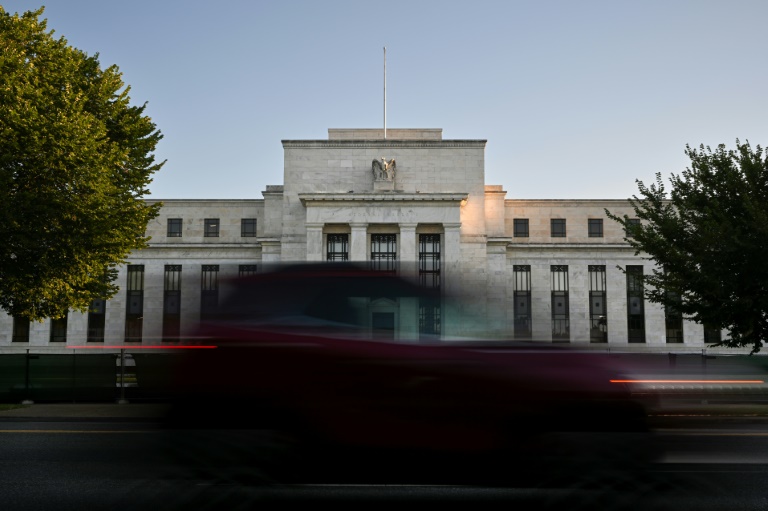
Global stocks slid on Monday as investors braced for more large interest rate hikes from the Federal Reserve.

The prospect of higher yields on debt was a boon for the dollar, however, which gained on its main rivals.

“We’re seeing mild risk aversion in the markets at the start of the week, perhaps some apprehension ahead of what could be a big few days for the US,” said market analyst Craig Erlam at OANDA.

Last week closed out with news that the US firms created a net 263,000 jobs in September.

While that was down from August it was more than expected, indicating that the US economy is not yet slowing considerably and inflationary pressures likely remain.

That sent stocks sharply lower as it means the Fed is unlikely to relent on interest rate hikes that are meant to tame inflation.

Stocks took a beating in August and September as monetary policymakers made clear they would keep raising interest rates in order to bring down inflation, even at the cost of a recession.

Last week, however, they briefly rallied on hope that the US jobs data would show the economy is already slowing, meaning the Fed could relent on interest rate hikes.

Some investors “may still be hoping that this week’s inflation data will swing the central bank but given previous comments, that doesn’t appear realistic unless we see a significant miss to the downside,” added Erlam.

Adding to the stress is the upcoming corporate earnings season, which many fear will show that companies are feeling the pain of tightening monetary policies.

Elsewhere on Monday, the Moscow stock exchange plunged nearly 12 percent following a weekend explosion that partially destroyed the bridge connecting Crimea to Russia.

Meanwhile, the pound won little support from Britain ramping up efforts to calm markets after a heavily criticised budget.

In what was seen as co-ordinated action, the government brought forward the release date of key economic forecasts and the Bank of England boosted liquidity.

“With the pound remaining weak and (UK) government borrowing costs inching up again towards worrying levels, the UK government and the Bank of England have launched a two-pronged attempt to calm markets,” noted Susannah Streeter, senior investment and markets analyst at Hargreaves Lansdown.

Oil prices meanwhile fell after the biggest weekly gain since March that followed a decision by OPEC and allied producers led by Russia to slash crude output by two million barrels per day.

The drop Monday came also on demand concerns caused by China’s Covid flare-ups and more weak data out of Beijing owing to lockdowns.

– Key figures around 1530 GMT –

New York – Dow: DOWN 0.3 percent at 29,202.02 points

EURO STOXX 50: DOWN 0.6 percent at 3,356.88

London – FTSE 100: DOWN 0.5 percent at 6,959.31 (close) 

Frankfurt – DAX: FLAT at 12,272.94 (close)

Paris – CAC 40: DOWN 0.5 percent at 5,840.55 (close)

Hong Kong – Hang Seng Index: DOWN 3.0 percent at 17,216.66 (close) 

Shanghai – Composite: DOWN 1.7 percent at 2,974.15 (close)

Tokyo – Nikkei 225: Closed for a holiday

Pound/dollar: DOWN at $1.1034 from $1.1082 on Friday

Euro/dollar: DOWN at $0.9689 from $0.9743

Euro/pound: DOWN at 87.79 pence from 87.97 pence

Dollar/yen: UP at 145.77 yen from 145.38 yen

West Texas Intermediate: DOWN 0.5 percent at $92.20 per barrel

Brent North Sea crude: DOWN 0.6 percent at $97.29 per barrel

burs-rl/pvh

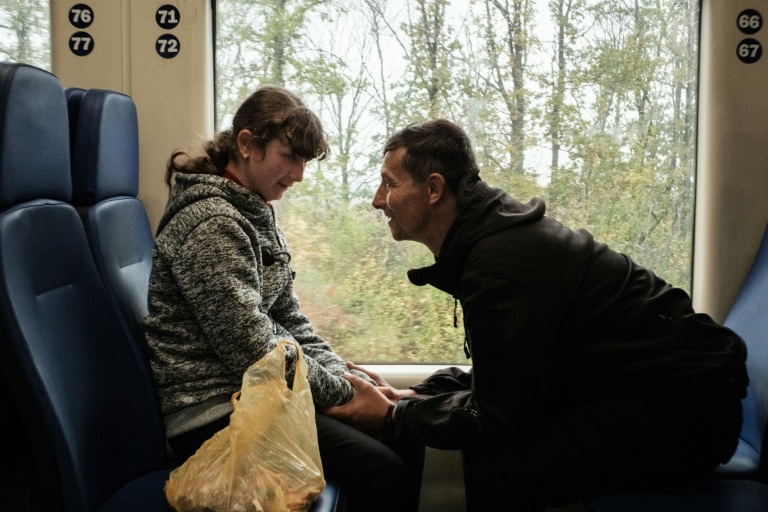
Defiant Ukraine reopens eastern rail link despite missiles

As Russia launched a huge wave of missile strikes against Ukrainian cities Monday, defiant rail workers in the east of the country managed to restore a severed rail link.

Angered by a truck bombing that damaged a bridge carrying Russia’s main road and rail link to the occupied Ukrainian region of Crimea, Moscow has stepped up strikes on civilian targets.

But, despite the savage bombardment, the passenger rail service between recently-occupied Izyum and Ukraine’s second city Kharkiv restarted after Russia’s February 24 invasion forced a seven-month closure.

“The trains will be running twice a day, every day,” said Izyum railway manager Andrei Gadyatskiy, standing in the rain in front of the boarded up windows of his partially burned station.

Any transport away from Ukraine’s eastern frontline will serve, for some, as a lifeline to the most basic necessities. 

“It will allow them to go to Kharkiv, to use their bank cards,” Gadyatskiy said.

Raisa Starovoytova came to the station on Monday because she could barely believe rumours that the train had returned. 

“I came to find out about the train because I will need to get back to Kharkiv,” she told AFP, relieved to confirm that she would be able to leave later in the week.

The 65-year-old retired teacher had returned to Izyum after the Russian retreat, to see what had happened to her home.

“They took everything they could… mattresses, bedding… I came to take the bedding at least, but it wasn’t there,” she said.

– Former airport shuttle –

There is no electricity to power the electric locomotives that once served the eastern network, and Russian missile attacks still regularly hit the marshalling yards in Kharkiv.

But a Ukrainian DPKr-3 diesel that once shuttled air travellers between the capital Kyiv and Boryspil international airport has been pressed into service, 600 kilometres (360 miles) east of its home.

In the early stages of the war, Izyum came under intense Russian shelling and the invading army occupied the city from early April until its liberation last month by Ukrainian forces.

After the Russian retreat, the discovery of a mass burial site and the corpses of torture victims made Izyum a byword for the alleged atrocities committed under Russian occupation.

Now the town once again has a link to the regional capital, Kharkiv, by the rail line, along with stops in former frontline towns like Savyntsi, Tsyganska and Balakliya along the way.

Mariya Tymofiyenko had not been to Balakliya since the start of the war.

“I’m 73 years old and I still have to ride a bicycle because the buses are not running. It’s too far to walk,” she told AFP, on board the train as it wound its way through low wooded hills under leaden grey skies.

She hopes that Balakliya, where she has relatives, will prove a respite from the ruined town left behind by the Russian occupation of Izyum.

– ‘Tortured, beaten’ –

“I have no hope. If it’s like Izyum, I don’t know — here they broke into my flat, my garage. They stole everything. They ate all my preserves. They took all the tools,” she told AFP, blinking back tears.

“So many people died under the rubble. Apartments were destroyed, the schools. It was terrifying,” she said, wrapped up well against the first damp, chilly days of autumn.

“So many people were tortured, taken away, beaten. One man, my neighbour from one street over, was hanged,” she continued. 

“Yesterday, my granddaughter called me and said, ‘Grandma, I checked on the internet and the train to Balakliya will start again tomorrow.’ And I said, ‘OK, OK I will take it’.”

Close Bitnami banner
Bitnami