World

'All options' on table in US response to OPEC+ cuts: W.House

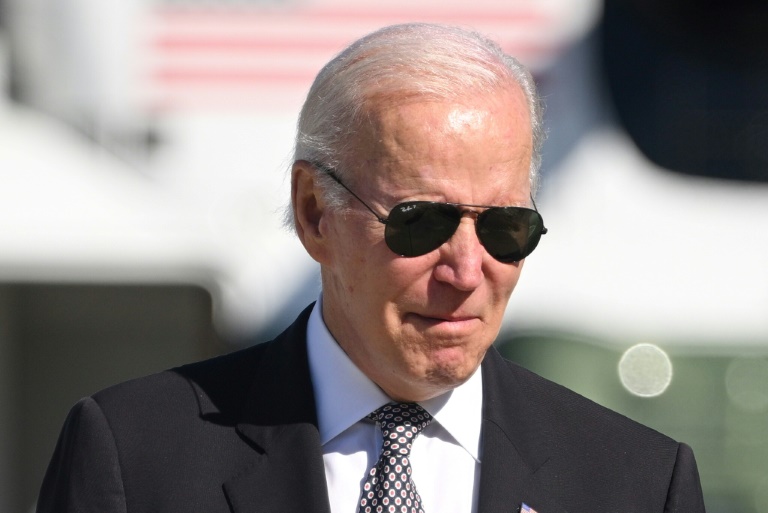
The White House on Thursday said “all options” are being considered after the OPEC+ group’s decision to cut oil production, despite US arguments that this will raise fuel costs and endanger world economies.

President Joe Biden’s administration is angry at ally Saudi Arabia for overseeing Wednesday’s move by the OPEC cartel and an additional group of 10 exporters led by Russia to cut production by two million barrels a day in a bid to boost oil prices.

The decision came as Biden leads international efforts to isolate major energy producer Russia over its invasion of Ukraine, while also working to tamp down US consumer prices ahead of midterm elections next month.

“Disappointment. We’re looking at what alternatives we may have” to counter the expected price hikes, Biden told reporters.

Biden said there were “a lot of alternatives.”

These could include further releases from the US Strategic Petroleum Reserve, potentially increased US domestic drilling, and more drastic measures, including limits on exports.

Officials remain guarded on what the next move will be but Biden’s chief economic advisor, Brian Deese, told reporters aboard Air Force One that “we need to look at… what tools are necessary.”

Asked whether this could include a ban or limit on exports of US production, Deese said “the president has directed that we have all options on the table — and that will continue to be the case. And so that’s how we’re approaching this question.”

Deese also declined to rule out an idea being debated in Congress for a law stripping sovereign immunity in antitrust suits, something which would potentially allow the US government to take the oil cartel members to court.

“We will be assessing and consulting closely with Congress around a range of issues,” he said.

Deese said the OPEC+ decision is “unwarranted” at a time when the global economy is in such weak condition and that “the lack of supply continues to be a significant challenge” for consumers.

But he said the production cuts may not have as much effect on markets as feared because members of the cartel have already been struggling to meet their output quotas, meaning the headline figure of two million barrels fewer per day does not meet reality.

“We’re going to have to see the actual impact of this,” Deese said. “Certainly the impact on production will be significantly lower than that.”

Iran protests: What happened on Zahedan's 'Bloody Friday'?

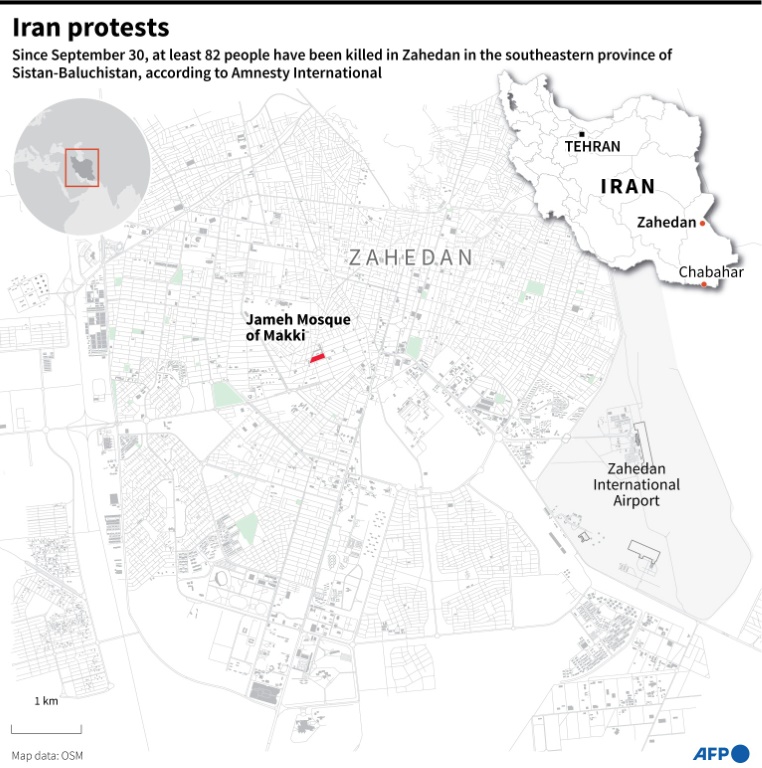
Iranian security forces have massacred over 80 people in the southeastern city of Zahedan in Sistan-Baluchestan province, in a crackdown on protests that erupted as Iran is convulsed by nationwide demonstrations, rights activists charge.

President Ebrahim Raisi has ordered an investigation into the unrest that started on September 30 after Friday prayers, which officials have characterised as attacks by “extremists” on police stations.

Activists however say the horrifying images of bloodied corpses with bullet wounds are emblematic of Tehran’s repressive polices towards a poor ethnic minority region.

– Where did the killings take place?

Zahedan is the main city of Sistan-Baluchestan, Iran’s poorest region, on the border with Pakistan. Zahedan is one of Iran’s few Sunni-majority cities and the region is populated by the Baluch ethnic minority who adhere to Sunni Islam rather than the Shiism predominant in Iran.

Activists have long complained the region has been the victim of discrimination by Iran’s Shiite clerical leadership, with disproportionate numbers of Baluch killed in clashes every year and also hanged in executions.

The region has been the scene of attacks on the Iranian security forces that Tehran has blamed on Sunni extremist groups, while the border area is also seen as a hub for drug smuggling by armed gangs.

Amnesty International said that in 2021 at least 19 percent of all executions were of members of the Baluchi minority, who it said make up five percent of Iran’s population.

“Killing Baluch does not cost much for the Iranian government,” said Abdollah Aref, director of the UK-based Baluch Activists Campaign (BAC).

-What sparked the protests?

The unrest erupted two weeks into nationwide protests in Iran over the death of Mahsa Amini, who had been arrested by the notorious morality police.

However the trigger for the protests were accusations that a regional police chief had raped a 15-year-old-girl in custody in the port city of Chabahar, also in Sistan-Baluchestan. It is not clear why she was detained.

The accusation had been made public last month by the Friday prayer leader in the town of Rask south of Zahedan, prompting protests that then spread to the main city of the region.

-What was the chain of events?

According to Aref, a protest was planned after Friday prayers in Zahedan on September 30. Demonstrators then headed to the police station to protest the rape and also shouted slogans against supreme leader Ayatollah Ali Khamenei. 

Amnesty said “a minority” of protesters threw stones at the police station. Security forces responded by firing “live ammunition, metal pellets and teargas”, including from the roof of the police station.

The protests then spread across the city, targeting other police stations, said Aref. “The police sought to send a message,” he added.

Internet monitor Netblocks reported access disruptions in Zahedan.

-How many people were killed?

According to Amnesty, 82 people have been killed, with 66 losing their lives on September 30 alone, including three children. 

The protest “was bloodily suppressed by security forces. It has since been named Zahedan’s ‘Bloody Friday’,” said Norway-based group Iran Human Rights (IHR).

Influential Sunni cleric Molavi Abdol Hamid charged that “a group of officers… opened fire Friday evening on a crowd that gathered around a mosque, killing and wounding multiple young people”.

But state media has put the death toll from the events at 20, including six members of the security forces.

Aref said the death toll was accentuated by a shortage of blood and bandages, meaning many of the wounded died from their injuries.

He added: “Many did not go to hospital for fear of being arrested. They preferred home treatment but then lost a lot of blood.”

Amnesty said that, according to its evidence, “the majority of victims were shot in the head, heart, neck and torso, revealing a clear intent to kill or seriously harm.”

Iranian Foreign Minister Hossein Amir-Abdollahian on Wednesday blamed the violence in Zahedan and elsewhere in Iran on “foreign interventionists, organised agents and terrorists”.

-What is the situation now?

Aref said the situation in Zahedan has calmed, although new protests were possible after weekly prayers this Friday.

But he added many people had been arrested in a clampdown on participants in the protests, although the precise figures were not clear.

Security forces used aerial drones and facial recognition technology to identify protesters and arrest them, he said.

Reports said that Taftan, the main border crossing east of Zahedan between Iran and Pakistan’s Balochistan province, had been closed in the wake of the unrest.

Meanwhile executions of Baluch have continued. Four of five people who were hanged at the weekend in the prison in the city of Mashhad for drug related crimes were Baluch, IHR said.

Out of 251 people executed in Iran this year, 67 were Baluch, it said.

IMF chief urges action as global recession risks rise

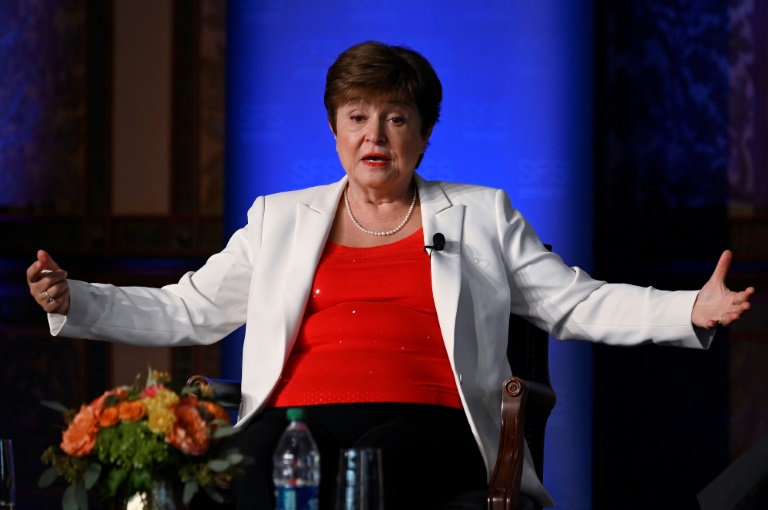
IMF chief Kristalina Georgieva urged global policymakers Thursday to take concerted action to avoid a “dangerous ‘new normal,'” as the risks of a worldwide recession are driven ever higher by repeated economic shocks.

In a speech ahead of the fund’s annual meetings next week, the IMF’s managing director said it was critical to “stabilize the global economy by addressing the most immediate challenges” — including rampant inflation.

Policymakers need to act together to “prevent this period of heightened fragility from becoming a dangerous ‘new normal,'” Georgieva said.

But she warned the process will be painful — and acknowledged that if central banks move too aggressively to tamp down price pressures, it could trigger a “prolonged” economic downturn.

Finance ministers and central bank governors from more than 180 nations will gather next week in Washington for the first fully in-person meeting of the International Monetary Fund and World Bank since 2019, prior to the Covid-19 pandemic.

The meetings come at a difficult time for the global economy, with the pandemic largely under control, but soaring prices and rising interest rates now threatening to reverberate around the globe and choke off nascent recoveries.

But the IMF chief said it is too soon for major central banks to pull back in the battle against inflation that has reached its highest in four decades.

Inflation remains “still stubborn, still persistent,” Georgieva told AFP in an interview.

“The risk of doing not enough is bigger than the risk of doing too much,” she said. “Clearly they have to do more. They have to stay the course.”

– ‘Shock, after shock’ –

Amid a “darkening global outlook … the risks of recession are rising,” Georgieva said in her speech, noting that a third of countries are expected to see at least two quarters of contraction.

And “even when growth is positive, it will feel like a recession” because of rising prices eroding incomes.

The crisis lender plans to once again downgrade its 2023 forecast for the world economy, in the report due to be published next week for the annual meeting.

The fund in July slashed its growth forecast for this year to 3.2 percent, and for next year to 2.9 percent — the third consecutive downgrade.

“In less than three years we lived through shock, after shock, after shock,” Georgieva said in her speech at Georgetown University.

Global supply snarls already were a challenge as demand surged following the pandemic slowdown, fueling inflation worldwide, and strains worsened in the wake of the Russian invasion of Ukraine — Georgieva called it a “senseless war” — sending food and fuel prices soaring, which has spread to rising costs for other items.

“Far from being transitory, inflation has become more persistent,” and acting before high prices become entrenched is a key challenge for policymakers, Georgieva said.

Failure to win the battle will “undermine the foundation for growth” as rising prices create a tax on the poor, she told AFP.

But she warned, “the cost of a policy misstep can be enormous.”

“Not tightening enough would cause inflation to become deanchored and entrenched,” but central banks moving “too much and too fast — and doing so in a synchronized manner across countries — could push many economies into prolonged recession,” she said in the speech.

“This is not easy, and it will not be without pain in the near term,” she cautioned.

– Debt distress –

Georgieva stressed the need for fiscal policies to help the most vulnerable segments of society, but warned that efforts must be targeted “with a laser-sharp focus on lower-income households,” to avoid acting against the current of monetary policy.

She cautioned against relying on price controls which are not affordable nor effective.

The pandemic forced many countries to take on more borrowing, and now many are already facing or at risk of debt distress amid rising interest rates. That “raises the risk of a widening debt crisis” which could further harm global growth.

To reduce the risk “large creditors such as China and private-sector creditors have a responsibility to act,” she said, calling for “faster and more predictable” action on debt restructuring.

Gunman murders at least 37 in Thai nursery attack

A former Thai police officer armed with a gun and a knife killed at least 37 people in northeast Thailand on Thursday, most of them children at a nursery, in one of the kingdom’s deadliest mass killings.

Following the attack, gunman Panya Khamrab went home and killed his wife and child before taking his own life, police said. 

Armed with a shotgun, pistol and knife, Panya opened fire on the childcare centre in northeastern Nong Bua Lam Phu province, at about 12:30 pm (0530 GMT).

National Police Chief Damrongsak Kittiprapat told a news conference the gunman had killed 37 people, including 23 children and his own family, and wounded 12 others.

Nanthicha Punchum, acting chief of the nursery, described harrowing scenes as the attacker barged into the building in rural Uthai Sawan district.

“There were some staff eating lunch outside the nursery and the attacker parked his car and shot four of them dead,” she told AFP.

“The shooter smashed down the door with his leg and then came inside and started slashing the children’s heads with a knife.”

Footage after the incident showed distraught parents weeping in a shelter outside the nursery, a yellow single-storey building set in a garden. 

The 34-year-old gunman was a former police sergeant suspended in January and sacked in June for drug use, Damrongsak told reporters.

“As far as I know he was due in court tomorrow for a drug-related trial,” he said.

He said the attacker was in a manic state but it was unknown whether it was drug-related.

“What happened today will be a lesson to prevent this happening again in the future,” he said.

Damrongsak said the pistol used had been purchased legally and was a privately owned weapon, not police property.

Witness Paweena Purichan, 31, said the attacker was well known in the area as a drug addict.

She told AFP she encountered Panya driving erratically as he fled the scene.

“The attacker rammed a motorbike into two people who were injured. I sped off to get away from him,” she said.

“There was blood everywhere.”

Video Paweena posted online showed a woman lying injured in a roadside bush after apparently being knocked off her motorbike by Panya.

Thai Prime Minister Prayut Chan-O-Cha ordered the national police chief to “fast-track an investigation” and said he would travel to the scene of the attack on Friday.

“This should not happen. This absolutely should not happen,” Prayut told reporters.

“I am extremely sorry for those who were injured and lost (their loved ones).”

A government spokesman said flags would fly at half-mast on Friday to honour those killed in the attack.

Thailand forms part of Southeast Asia’s so-called Golden Triangle, which has long been an infamous hotspot for the trafficking and abuse of drugs.

Surging supplies of methamphetamine have sent street prices crashing in Thailand to all-time lows, according to the United Nations Office on Drugs and Crime.

The White House said the United States is “horrified” by the shooting, while UN Secretary General Antonio Guterres said he was shocked and saddened and expressed his condolences to the families of the victims.

– Mass shootings rare –

The mass killing comes less than a month after an army officer shot dead two colleagues at a military training base in the capital Bangkok.

While Thailand has high rates of gun ownership, mass shootings are rare.

But in the past year, there have been at least two other cases of shooting murders by serving soldiers, according to local media.

In 2020, in one of the kingdom’s deadliest incidents in recent years, a soldier gunned down 29 people in a 17-hour rampage and wounded scores more before he was shot dead by commandos.

That mass shooting, linked to a debt dispute between gunman Sergeant-Major Jakrapanth Thomma and a senior officer, triggered public anger against the military.

The soldier was able to steal assault rifles from an army depot before embarking on his killing spree, posting live updates on social media as he did so.

Military top brass were at pains to portray the killer as a rogue soldier.

“I am shocked to hear of the horrific events in Thailand this morning. My thoughts are with all those affected and the first responders,” British Prime Minister Liz Truss tweeted.

Australian Prime Minister Anthony Albanese tweeted it was “impossible to comprehend the heartbreak of this horrific news”.

Floods to drag up to 9 million Pakistanis into poverty: World Bank

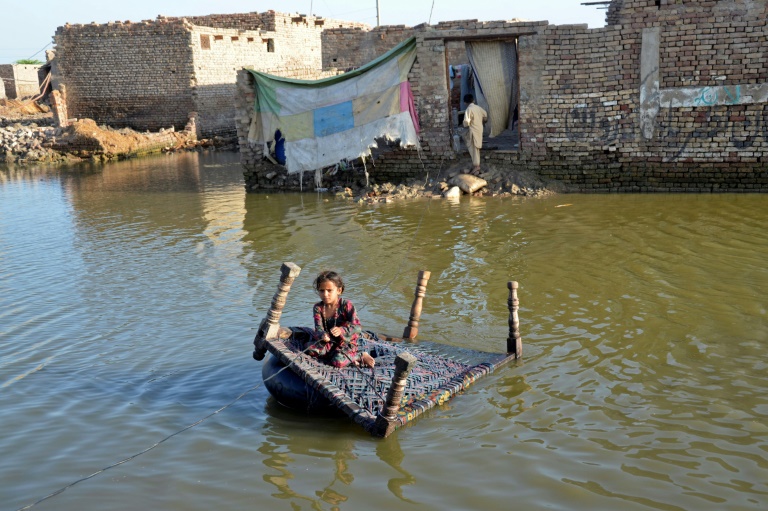
Between six and nine million Pakistanis are set to be dragged into poverty as a result of cataclysmic monsoon flooding linked to climate change, the World Bank said on Thursday.

Pakistan has been lashed by unprecedented monsoon rains this year which killed 1,700, devastated two million homes, and put a third of the nation underwater.

Eight million people remain displaced, living in ramshackle tent cities and scattered camps near the stagnant lakes which swallowed their belongings and livelihoods.

A World Bank report said Pakistan’s poverty rate is expected to rise between 2.5 and 4 percentage points as a direct consequence of the floods.

Loss of jobs, livestock, harvests, houses, and the closure of schools — as well as spread of disease and rising food costs — threaten to put between 5.8 and 9 million in poverty, it said.

“Reversing these negative socio-economic effects is likely to take considerable time,” it added.

In the nation of 220 million some 20 per cent are already living below the poverty line, according to Asian Development Bank data.

Before the deluges began Pakistan’s coffers were already in dire shape, with a cost-of-living crisis, a nose-diving rupee and dwindling foreign exchange reserves.

The World Bank said inflation in the country is set to stand at 23 per cent for the financial year 2023. 

Pakistan is responsible for less than one per cent of global greenhouse gasses, but places highly in rankings of nations vulnerable to extreme weather caused by climate change.

Credible research says severe weather events are becoming more frequent and more severe as a result of man-made emissions.

Islamabad has called for richer and more industrialised nations with larger carbon footprints to contribute to the aid effort as a form of climate justice.

“We have no space to give our economy a stimulus package, which would create jobs, and provide people with the sustainable incomes they need,” said climate change minister Sherry Rehman on Tuesday.

“We are still in a long, relentless struggle to save lives.”

Ukraine clocks Kherson wins, Zelensky urges more EU help

Ukraine said Thursday it had recaptured swathes of fresh territory from Russian troops as Kyiv urged Europe to help its forces expel Moscow’s army once and for all.

The proclaimed wins in the southern region of Kherson are the latest in a series of Russian defeats undermining the Kremlin’s claim to have annexed around 20 percent of Ukraine.

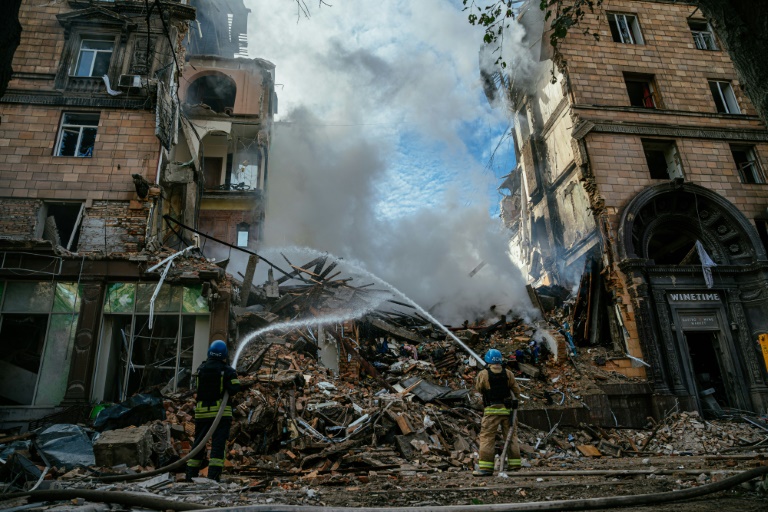
Russian missiles early on Thursday struck the central city of Zaporizhzhia, killing several civilians, as rescue workers clawed through rubble with their bare hands searching for survivors, AFP journalists saw.

“The Armed Forces of Ukraine have liberated more than 400 square kilometres of the Kherson region since the beginning of October,” southern army command spokeswoman Natalia Gumeniuk said in a briefing online.

She said that the recaptured territory was home to nearly 30 towns and villages that had been occupied by Russian forces for months.

Kherson, a region with an estimated pre-war population of around one million people, was captured early and easily by Moscow’s troops after their invasion launched February 24. 

Russian-installed officials have renewed a call for residents to remain calm, with deputy pro-Moscow leader Kirill Stremousov saying Kremlin forces were holding back the advance.

Addressing a meeting in Prague of European heads of state, President Volodymyr Zelensky called on Western capitals to supply his army with more weapons “to punish the aggressor”.

He said Ukraine must fend off Moscow’s invasion “so that Russian tanks do not advance on Warsaw or again on Prague”. 

– ‘Pure hatred’ –

The EU imposed its latest round of sanctions on Russia, expanding bans on trade and individuals over Moscow’s formal annexation last Friday of four Ukrainian regions.

On Thursday, seven Russian missiles struck downtown Zaporizhzhia just 40 kilometres (25 miles) from the artillery battles of the southern front. 

A woman, whose body was carefully removed from the rubble by rescuers, looked as though she had been asleep in bed when the building around her was destroyed.

“For the first time in my life, I feel pure hatred,” said Igor Osolodko, a 25-year-old musician, one of dozens of volunteer rescuers.

“It’s absurd, it’s unreal. We need to rely on our army and cope with this terror until it’s all over, until we win,” he said. 

Ukraine’s military has also said it is reclaiming territory in the eastern Lugansk and Donetsk regions, that have been partially controlled by Kremlin proxies since 2014.

Ukrainian forces have made gains on the west bank of the river Dnieper that cuts through Kherson, but the Russian military in a briefing said Thursday that its forces rebuffed “repeated attempts to break through our defences” in the area.

Further west, on Ukraine’s contact line with Russian forces from the Mykolaiv region — where Kyiv’s forces had been hunched in fox holes for months and pounded by Russian artillery — the mood was shifting along with frontlines.

– ‘End of the tunnel’ –

Bogdan, 29, from northwest Ukraine who re-enlisted in the military this year, has spent most of the summer holding the line in Mykolaiv some four kilometres from the Russians.

“We see their successes and it inspires us,” he said of Ukrainian wins elsewhere in the country.

“If some thought before that we weren’t moving fast enough, well now that’s not the case!”

“There is light at the end of the tunnel,” agreed commander Yaroslav, a sturdy 39-year-old man wearing a black cap.

The Ukrainian push deeper into Kherson is putting further strain on the Kremlin’s announcement last week that it had annexed the territory — alongside three others — and that its residents were would Russian “forever”.

The four territories — Donetsk, Kherson, Lugansk and Zaporizhzhia — create a land corridor between Russia and the Crimean peninsula, which was annexed by Moscow in 2014.

Together, the five regions make up around 20 percent of Ukraine.

Ukrainian Foreign Minister Dmytro Kuleba accused Russian forces of “deliberately striking civilians to sow fear”.

“Russian terror must be stopped — by force of weapons, sanctions and full isolation”, he said.

In Russia, opposition figure Vladimir Kara-Murza — jailed in April for denouncing the war — has been charged with high treason, his lawyer told the TASS news agency.

The UN nuclear agency chief was due in Kyiv to discuss creating a security zone around Ukraine’s Zaporizhzhia atomic plant — the largest in Europe — after Russian President Vladimir Putin ordered his government to impound it.

Revamp of World Bank and lenders needed to tackle global problems: Yellen

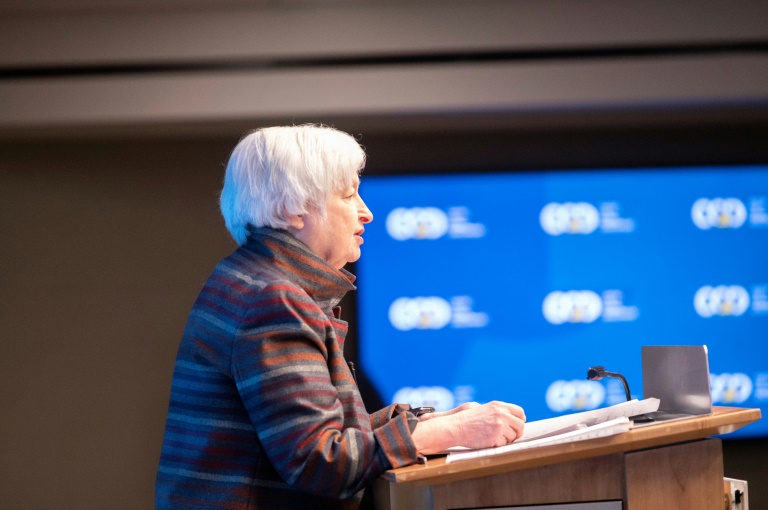
The World Bank and development lenders need to evolve to tackle the complex challenges that the world is facing, such as by going beyond country-based lending, US Treasury Secretary Janet Yellen said Thursday.

Her comments, delivered at the Center for Global Development think tank, follow warnings that global recession risks are growing on the back of shocks like the coronavirus pandemic and Russia’s invasion of Ukraine.

“Emerging markets and developing countries are often most acutely affected both by global shocks and by spillovers from the policies of advanced countries,” said Yellen.

While efforts to combat poverty have mostly been country-focused in the past, a different approach is needed in the face of problems such as climate change and pandemics, she said.

Yellen’s remarks come days before policymakers gather in Washington for the annual meetings of the International Monetary Fund and World Bank.

“I, along with leaders from a broad group of countries, will be calling on World Bank management at the annual meetings next week… to develop a World Bank evolution roadmap by December,” she said.

The meetings come at a tough time for the global economy, which has largely controlled the virus but faces surging inflation and rising interest rates that threaten to choke off nascent recoveries.

“We welcome the discussion on capital adequacy and Secretary Yellen’s leadership on the evolution of international financial institutions,” said a World Bank spokesman.

He noted the conversation comes as developing countries face a severe shortage of resources, risk of global recession, capital outflows and heavy debt service burdens.

While multilateral development banks have a strong record of financing national projects like infrastructure, there is not yet a “sufficiently robust toolkit” to quickly address cross-border challenges, said Yellen.

For example, there could be moves to lower costs of financing for investments where benefits are shared broadly by the world, like in clean energy projects, the Treasury official added.

Apart from the traditional country-based lending model, Yellen called for considering expanded options, such as for development banks to support both global and regional entities.

She noted that global organizations like Covax were key to speeding up the rollout of Covid-19 vaccines to developing countries.

Development banks should deploy more tools to mobilize greater private capital into their projects as well, Yellen added.

On Thursday, the Treasury also announced a new nearly $1 billion contribution to the Clean Technology Fund, a climate investment fund.

Yellen also urged for major bilateral creditors to “meaningfully participate in debt relief” to help lower- and middle-income countries, noting that China in particular has delayed providing debt treatments to borrowers in distress.

Apple wins 728-mn-euro cut to France antitrust fine

A French court on Thursday slashed more than 700 million euros from a record 1.1-billion-euro fine imposed on US tech giant Apple in 2020, sources close to the case told AFP.

France’s competition authority levied the fine — its biggest ever — after concluding that the firm squeezed independent sellers of Apple products as it tried to push buyers towards its own stores and preferred retailers.

But the Paris appeal court revised the decision and knocked 728 million from the fine, meaning Apple still faces having to pay 370 million euros.

Apple says the fine is unfair and told AFP the whole complaint should be quashed. 

“We consider that the decision should have been annulled in its entirety and plan to appeal to the French supreme court,” the firm told AFP in a statement. 

“The decision concerns practices that go back more than 10 years and that even the French competition authority has recognised as no longer being in force.”

The initial case was made up of three linked complaints — one was dismissed by the appeals court and two were upheld.

Sources close to the case, who did not want to be named because of the sensitivity of the issue, confirmed the amounts and the details of the decision.

The Paris appeals court told AFP the ruling would be made public on Friday.

Stocks mostly retreat, pound drops

Global equity markets mostly fell Thursday and the pound retreated once more against the dollar on lingering recession fears despite hopes that the US Federal Reserve will tame the pace of aggressive interest rate hikes.

Oil prices advanced, building on gains made before OPEC and other major producers led by Russia decided to slash output by two million barrels per day.

OANDA market analyst Craig Erlam said European markets erased early gains as “investors take a cautious approach” ahead of Friday’s release of a US jobs report that could influence the Fed’s next move.

Wall Street stocks mostly moved lower, with the Dow shedding 0.3 percent.

Stocks had snapped higher at the start of this week as disappointing US economic data fuelled hopes that the Federal Reserve may let up in its campaign of aggressive interest rate hikes to get soaring inflation under control.

“The narrative in recent days of weaker data being positive as it could be a precursor to slower tightening didn’t seem sustainable and it’s already proving to be the case,” added Erlam.

Instead, he said he believed the rally to be a response to the sharp drop in shares in the previous weeks as the Fed made clear it would keep raising rates until inflation is brought down, even if that triggers a recession.

Investors are now looking forward to the release Friday of US non-farm payroll jobs data for the latest glimpse at how the economy is handling rising interest rates.

Data showing tougher labour market conditions could trigger a new relief rally, while a resilient figure could send stocks lower as investors fret about further rate hikes.

Data out Thursday showed first time unemployment claims dropped to 219,000, but that was above expectations.  

“The key takeaway from the report is that initial claims — a leading indicator — have a lot more scope for deterioration before the Fed can be convinced that its rate hikes have induced a sufficient softening in the labor market to ease wage-based inflation pressures,” said Patrick O’Hare at Briefing.com.

– Oil prices steady –

Oil prices advanced further after a decision by OPEC+ nations to cut production by two million barrels per day, the biggest reduction in output since the Covid-19 pandemic.

Oil prices, which had slumped to pre-Ukraine war levels in recent weeks as global recession worries mount, had surged in the days ahead of the OPEC+ meeting.

The production cut should support crude prices, but as high oil prices have been stoking the inflation that is prompting central banks to raise interest rates, the move will further exacerbate the situation.

“The oil producing nations want to support the oil market, but a high oil price hurts most nations, so in a roundabout way, the move will probably add to global inflation,” said analyst David Madden at Equiti Capital.

The pound was down about 1.1 percent against the dollar after Fitch ratings agency lowered the outlook for British debt to negative from stable.

This comes after the government of new Prime Minister Liz Truss recently announced a budget packed with debt-fuelled tax cuts.

Ahead of the downgrade Wednesday, sterling had plunged more than two percent after Truss failed to reassure investors with a speech at her Conservative party conference.

The pound, however, has recovered since reaching a record-low close to parity against the dollar at the end of September.

– Key figures around 1530 GMT –

New York – Dow: DOWN 0.3 percent at 30,178.58 points

EURO STOXX 50: DOWN 0.4 percent at 3,433.45

London – FTSE 100: DOWN 0.8 percent at 6,997.27 (close) 

Frankfurt – DAX: DOWN 0.4 percent at 12,470.78 (close)

Paris – CAC 40: DOWN 0.8 percent at 5,936.42 (close)

Tokyo – Nikkei 225: UP 0.7 percent at 27,311.30 (close)

Hong Kong – Hang Seng Index: DOWN 0.4 percent at 18,012.15 (close)

Shanghai – Composite: Closed for a holiday

Pound/dollar: DOWN at $1.1184 from $1.1326 on Wednesday

Euro/dollar: DOWN at $0.9828 from $0.9889

Euro/pound: UP at 87.91 pence from 87.29 pence

Dollar/yen: UP at 144.77 yen from 144.59 yen

Brent North Sea crude: UP 0.8 percent at $94.08 per barrel

West Texas Intermediate: UP 0.7 percent at $88.33 per barrel

burs-rl/kjm

21 inmates dead in separate Ecuador prison clashes

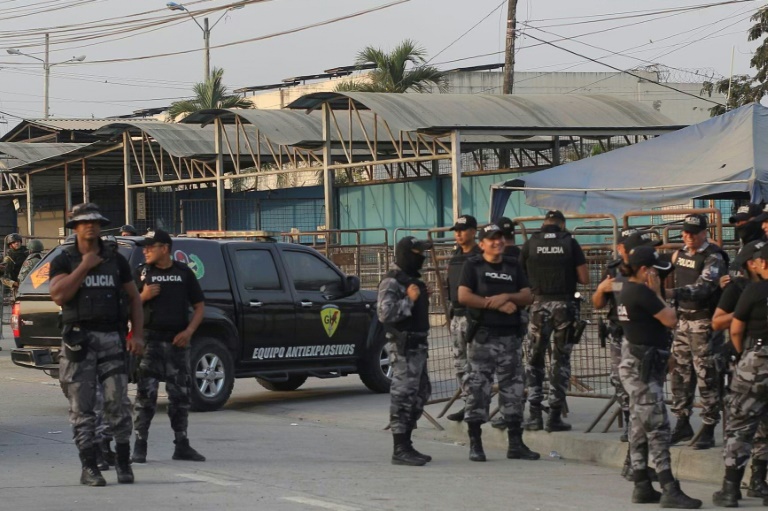
Three days of bloody clashes between inmates in Ecuador have left 21 dead and 66 people, including five police officers, injured in the latest bout of gang violence in the country’s notoriously brutal prisons, officials said Thursday.

At least five inmates died and 23 people were wounded in fresh fighting on Wednesday, the country’s prison authority said. The injured included five police members.

This came after clashes on Monday and Tuesday left 16 dead and 43 injured at another Ecuadoran prison in the city of Latacunga in central Ecuador, some 300 kilometers (186 miles) northeast of the port city of Guayaquil.

Some 900 police and soldiers were deployed to put down the revolt in Guayaquil, the SNAI prison authority said on Twitter, while the interior ministry said order had been “reclaimed.”

Violence in Ecuador’s prisons, where drug gangs with ties to Mexican cartels vie for power, is often carried out with knives and sometimes involves beheadings. 

Prison unrest has left nearly 400 inmates dead since February 2021.

In a single riot in September last year — one of the bloodiest in Latin American history —  122 inmates were killed at Guayas 1, the same section of the Guayaquil prison where Wednesday’s clashes occurred.

Police said Wednesday’s injured included five of their own who were attacked “with firearms while intervening to restore order.”

Some of the inmates were injured with “explosives,” which also caused structural damage to the facility, said the prison authority.

The clashes involved inmates from three of the 12 sections of Guayas 1, which houses nearly 7,000 prisoners as part of a larger complex that holds more than 13,000.

The Guayaquil prison is 20 percent overpopulated.

– ‘Torture centers’ –

The SNAI sent in tactical units to re-establish order after Monday’s riot at Latacunga prison, which houses 4,300 inmates and is one of the largest in the country.

On Tuesday, further clashes broke out.

Following Monday’s massacre, worried relatives waited outside the prison desperate for news on the fate of their loved ones.

“I’m looking for my brother Carlos Bravo. I got here at 6:00 am,” one tearful woman who did not give her name told AFP Tuesday.

After the violence, 135 Latacunga inmates were transferred to other facilities as a “security measure,” according to the SNAI.

In the past, such transfers have caused further problems as the gangsters land in rival territory.

A government committee noted in April that Ecuadoran prisons are akin to “torture centers.”

Bordered by Colombia and Peru, the world’s largest cocaine producers, Ecuador has gone from serving as a transit point for drug shipments to the United States and Europe to becoming a major trafficker itself.

The country seized a record 210 tons of drugs in 2021, the same year that its homicide rate almost doubled.

Overcrowding has been eased somewhat from 30 percent in 2021 through the use of pardons and parole for good behavior, but remains a major problem.

In a bid to improve prison living conditions, President Guillermo Lasso launched an inmate census in August.

In May this year, the UN High Commissioner for Human Rights expressed “deep alarm at recurring prison violence” in Ecuador, which it said underlined “the urgent need for comprehensive reform” of the justice and prison system.

The Inter-American Commission on Human Rights, for its part, has urged the Ecuadoran government to launch a “prompt, serious and impartial” investigation.

Close Bitnami banner
Bitnami