World

Suicide attack on Kabul classroom kills 20, mostly young women

A suicide bomber attacked an education centre in the Afghan capital on Friday where hundreds of students were preparing for university exams, killing at least 20 people, most of them young women.

The bombing happened in the Dasht-e-Barchi neighbourhood of western Kabul, a predominantly Shiite Muslim area home to the minority Hazara community, the target of some of Afghanistan’s most deadly attacks.

The bomber shot dead two security guards before entering the gender-segregated classroom, student Ali Irfani, who escaped the carnage, told AFP.

“Not many boys were hit because they were at the rear end of the classroom. The bomber entered from the front door where girls were sitting,” he said.

Akbar, another student witness, also told AFP that young women made up most of the casualties, with up to 600 people in the hall at the time.

No group has yet claimed responsibility for the blast at Kaaj Higher Educational Centre, which coaches students for university admission tests. 

However, the jihadist Islamic State group has claimed previous attacks in the area targeting girls, schools and mosques.

A resident who ferried victims to hospitals said he saw body parts scattered across the floor of the hall.

“Many students were hit by shrapnel in their head, neck and eyes,” said Asadullah Jahangir. 

Kabul police spokesman Khalid Zadran said 20 people were killed and 27 others wounded.

The United Nations Assistance Mission in Afghanistan (UNAMA) told AFP that at least 24 people were killed and 36 others wounded in the attack, adding the numbers were expected to rise.

A shopkeeper from the neighbourhood said there was a loud explosion and then crowds of students rushed out of the centre.

“It was chaos as many students, boys and girls, tried to escape from the building. It was a horrific scene. Everyone was so scared,” he told AFP, requesting anonymity.

Italian NGO Emergency, which operates a hospital in Kabul, said it had received 22 patients, including 20 women, two of whom had died. 

“The victims are all between 18 and 25 years old, and most of them were in the classroom to take an exam,” it said in a statement.

– ‘Shamefaced’ –

The Taliban’s return to power in Afghanistan last year brought an end to a two-decade war and a significant reduction in violence, but security has begun to deteriorate in recent months.

In April, two deadly bomb blasts on the same day at separate education centres in Dasht-e-Barchi killed six people and wounded at least 20 others.

Friday’s attack is a “shamefaced reminder of the ineptitude and utter failure of the Taliban, as de facto authorities, to protect the people of Afghanistan”, Samira Hamidi of rights group Amnesty International said in a statement.

The United Nations’ special rapporteur on Afghanistan, Richard Bennett, condemned the attack.

“Onslaught on education for Hazaras & Shiites must end. Stop attacks on Afghanistan’s future, stop international crimes,” he said on Twitter.

Afghanistan’s Shiite Hazaras have faced persecution for decades, targeted by the Taliban during their insurgency against the former US-backed government and by IS — both of which consider Shiites heretics. 

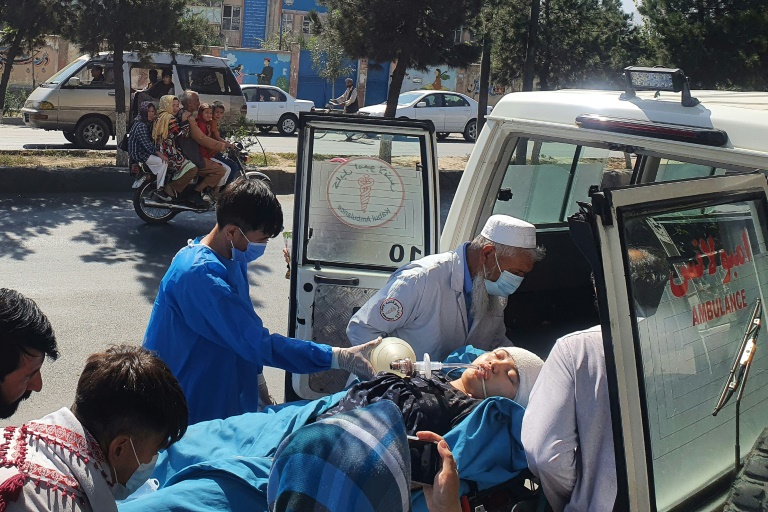
Families on Friday rushed to hospitals where ambulances arrived with victims, and lists of those confirmed dead or wounded were posted on the walls.

“We didn’t find her here,” a distressed woman looking for her sister at one of the hospitals told AFP. “She was 19 years old.”

“We are calling her but she’s not responding.”

Last year, before the Taliban returned to power, at least 85 people — mainly girl students — were killed and about 300 wounded when three bombs exploded near their school in the area.

No group claimed responsibility, but a year earlier IS claimed a suicide attack on an educational centre in the same neighbourhood that killed 24, including students.

In May 2020, the group was blamed for a gun attack on a maternity ward of a hospital in Dasht-e-Barchi that killed 25 people, including new mothers.

Education is a flashpoint issue in Afghanistan, with the Taliban blocking many girls from returning to secondary education. Islamic State also stands against the education of women and girls.
Foreigners arrested as Iran protests over Amini death enter third week

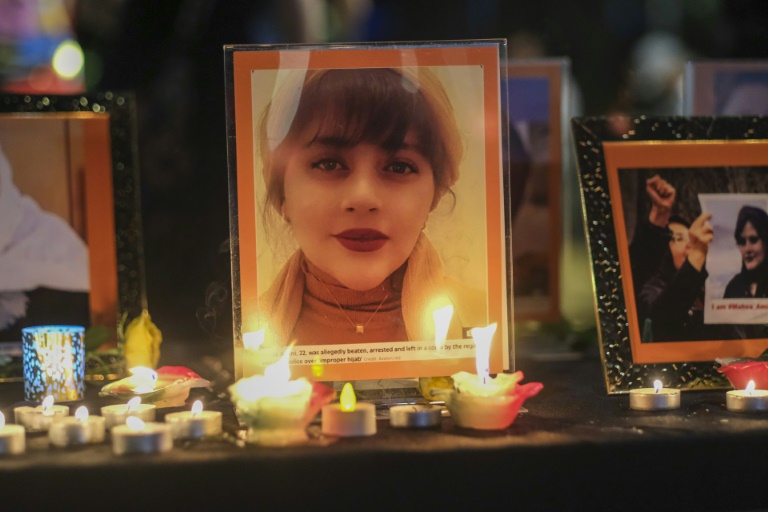
Iran said Friday that nine foreigners were arrested over deadly street protests sparked by the death of Kurdish woman Mahsa Amini, as demonstrations across the country entered a third week amid gunfire.

Dozens have been killed in a crackdown on the protests that erupted when Amini, 22, died in custody three days after her arrest by the notorious morality police in Tehran for allegedly breaching the Islamic republic’s strict dress code for women.

On Friday, Iranian security forces opened fire on angry protesters, foreign-based opposition media reported.

“Death to the dictator,” bare-headed women chanted in the northwestern city of Ardabil, said Iran International, a Persian-language television station based in London.

Iran’s intelligence ministry said “nine foreign nationals from Germany, Poland, Italy, France, the Netherlands, Sweden, etc. were arrested at or behind the scene of riots”, along with 256 members of outlawed opposition groups.

In the southwestern city of Ahvaz, security forces fired tear gas to disperse scores of people who streamed onto the streets jeering and shouting anti-government slogans, in another video shared by the channel.

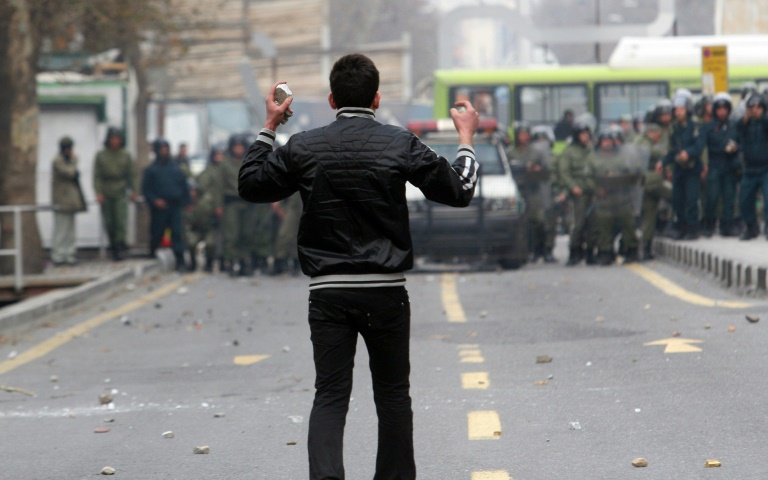
In Zahedan, near Iran’s southeastern border with Pakistan, men braved gunfire as they stoned a police station, other footage shared by the channel showed.

Stretcher parties were seen carrying away men bloodied by apparent bullet wounds in the footage, which AFP was unable to immediately verify.

State media said police in Zahedan had returned fire when they came under attack by gunmen, while Ahmad Taheri, the Sistan-Baluchestan provincial police chief, said three police stations were attacked.

“A number of police members as well as passers-by have been injured in the exchange of fire,” the state broadcaster said.

– Confront ‘mercilessly’ –

Women have defiantly burned their headscarves and cut their hair in the protests over Amini’s death, announced September 16, that are the biggest seen in Iran since demonstrations in November 2019 over fuel price rises.

A leading Iranian human rights lawyer, Nasrin Sotoudeh, told US news magazine Time that she expected the protests to go on regardless of the intensity of the authorities’ crackdown.

“What the people want is regime change, and no return to the past,” said Sotoudeh, who is on medical furlough from a 38-year jail sentence for her advocacy work.

“And what we can see from the current protests and strikes that are now being initiated is a very real possibility of regime change.”

Amnesty International said Iran was intentionally using lethal force against the protesters, adding that without international action “beyond statements of condemnation” more people risk being killed.

Amnesty said it had obtained a leaked official document issued to the commanders of armed forces in all provinces on September 21 instructing them to “severely confront” protesters.

Another leaked document showed that on September 23, the commander of the armed forces in Mazandaran province, where some of the deadliest clashes have taken place, ordered security forces to “confront mercilessly, going as far as causing deaths, any unrest by rioters and anti-revolutionaries”.

The NGO said it had confirmed 52 deaths in the protests but the toll was likely higher.

Another rights group, Oslo-based Iran Human Rights, said 83 people were confirmed to have been killed, while Iran’s Fars news agency has put the death toll at “around 60”.

– Outside forces –

Amnesty’s warning comes as Iran presses ahead with an intensifying crackdown that has seen the arrest of many journalists, activists and other prominent figures.

Former Iranian international footballer Hossein Maahini was arrested Friday after supporting the protests on his social media accounts, state media said.

Iranian football fans, meanwhile, asked FIFA to ban their national team from this year’s World Cup in Qatar over the crackdown.

Security forces also arrested singer Shervin Hajipour, whose song “Baraye” (“For”) made up of tweets about the protests went viral on Instagram, the rights group Article 19 said.

His song, which racked up millions of views, has now been removed from his Instagram account.

The crackdown has drawn widespread international condemnation.

Demonstrations of solidarity with Iranian women have been held worldwide, and rallies are planned in 77 cities on Saturday.

Iran has blamed outside forces for the protests, and on Wednesday it launched cross-border missile and drone strikes that killed 14 people in northern Iraq’s Kurdistan region, accusing rebel groups based there of fuelling the unrest.

Iran’s Revolutionary Guards pledged to carry out more attacks until the groups are disarmed.

The United States said one of its citizens had been killed in the Iranian strikes.

burs/pjm/hc

Stocks waver, pound wobbles on mixed data

Stock markets advanced and the pound seesawed on Friday as investors tracked fresh growth and inflation data at the end of another turbulent week.

The pound jumped on revised figures showing the UK economy had avoided recession — but it swiftly fell back on expectations of an eventual downturn owing to sky-high inflation, but then moved higher again.

“Sterling has been all over the place this week,” said Fawad Razaqzada, analyst at City Index and Forex.com. “For traders, the pound is a confusing arena to be in right now.”

Britain’s borrowing costs soared and the pound hit a record dollar-low earlier this week days after the government announced a controversial tax-cutting budget. 

London stocks ended the day with a small gain.

In the eurozone, consumer prices rocketed a record 10 percent in September on soaring energy prices caused by Russia’s war on Ukraine, separate official data showed.  

Nevertheless Paris and Frankfurt stocks ended the day with gains of over one percent.

In the United States, data showed the Federal Reserve’s preferred yardstick for inflation — the personal consumption expenditures price index — was higher than expected.

“The key takeaway from the report is that the inflation the Fed says it can control (i.e. core inflation) did not move in a friendly direction in August,” said Patrick O’Hare, analyst at Briefing.com.

“Therefore, market participants can continue to expect the Fed not to be their friend with monetary policy,” he said.

Fed officials have again reiterated their intention to ramp up rates until they have tamed inflation, even if that means plunging the world’s top economy into recession.

Wall Street stocks opened lower and wobbled in early trades, but moved higher by late morning.

In Asia on Friday, Shanghai dropped as data showed China’s manufacturing and services sectors struggled again in September from Covid lockdowns in parts of the country that have battered the world’s number-two economy.

There was also little reaction to news that Beijing would allow some cities to reduce mortgage rates for first-home purchases as it tries to support the property market.

Market sentiment was being eroded also by rising fears about developments in the Ukraine war, as Russia  annexed four occupied regions of its neighbour Friday, with President Vladimir Putin threatening to use nuclear weapons to defend the territories.

– Key figures around 1530 GMT –

New York – Dow: UP 0.3 percent at 29,318.18 points

EURO STOXX 50: UP 1.2 percent at 3,318.20

London – FTSE 100: UP 0.2 percent at 6,893.81 (close)  

Frankfurt – DAX: UP 1.2 percent at 12,114.36 (close)

Paris – CAC 40: UP 1.5 percent at 5,762.34 (close)

Tokyo – Nikkei 225: DOWN 1.8 percent at 25,937.21 (close)

Hong Kong – Hang Seng Index: UP 0.3 percent at 17,222.83 (close)

Shanghai – Composite: DOWN 0.6 percent at 3,024.39 (close)

Pound/dollar: UP at $1.1143 from $1.1116 on Thursday

Euro/dollar: DOWN at $0.9797 from $0.9818

Euro/pound: DOWN at 87.97 pence from 88.28 pence

Dollar/yen: UP at 144.69 yen from 144.42 yen

Brent North Sea crude: DOWN 0.4 percent at $88.15 per barrel

West Texas Intermediate: DOWN 0.6 percent at $80.72 per barrel

burs-rl/pvh

Clashes as Iran protests over Mahsa Amini death enter third week

Iranian security forces opened fire on angry protesters as street violence sparked by the death of Kurdish woman Mahsa Amini entered a third week on Friday, foreign-based opposition media reported.

Dozens have been killed in a crackdown on the protests that erupted when Amini, 22, died in custody three days after her arrest by the notorious morality police in Tehran for allegedly breaching the Islamic republic’s strict dress code for women.

“Death to the dictator,” bare-headed women chanted in the northwestern city of Ardabil, said Iran International, a Persian-language television station based in London.

In the southwestern city of Ahvaz, security forces fired tear gas to disperse scores of people who streamed onto the streets jeering and shouting anti-government slogans, in another video shared by the channel.

In Zahedan, near Iran’s southeastern border with Pakistan, men braved gunfire as they stoned a police station, other footage shared by the channel showed.

Stretcher parties were seen carrying away men bloodied by apparent bullet wounds in the footage, which AFP was unable to immediately verify.

State media said police in Zahedan had returned fire when they came attack by gunmen.

“A number of police members as well as passers-by have been injured in the exchange of fire,” the state broadcaster said.

– Confront ‘mercilessly’ –

Women have defiantly burned their headscarves and cut their hair in the protests over Amini’s death, announced September 16, that are the biggest seen in Iran since protests in November 2019 over fuel price rises.

Leading human rights lawyer, Nasrin Sotoudeh, told US news magazine Time that she expected the protests to go on regardless of the intensity of the authorities’ crackdown.

“What the people want is regime change, and no return to the past,” said Sotoudeh, who is on medical furlough from a 38-year jail sentence for her advocacy work.

“And what we can see from the current protests and strikes that are now being initiated is a very real possibility of regime change.”

Amnesty International said Iran was intentionally using lethal force against the protesters, adding that without international action “beyond statements of condemnation” more people risk being killed.

“The Iranian authorities have mobilised their well-honed machinery of repression to ruthlessly crack down on nationwide protests in an attempt to thwart any challenge to their power,” it said.

Amnesty said it had obtained a leaked official document issued to the commanders of armed forces in all provinces on September 21 instructing them to “severely confront” protesters.

Another leaked document showed that on September 23, the commander of the armed forces in Mazandaran province, where some of the deadliest clashes have taken place, ordered security forces to “confront mercilessly, going as far as causing deaths, any unrest by rioters and anti-revolutionaries”.

The NGO said it had confirmed 52 deaths in the protests but the toll was likely higher.

Another rights group, Oslo-based Iran Human Rights, said 83 people were confirmed to have been killed, while Iran’s Fars news agency has put the toll at “around 60” dead.

– Outside forces –

Amnesty’s warning comes as Iran presses ahead with an intensifying crackdown that has seen the arrest of many journalists, activists and other prominent figures.

Former Iranian international footballer Hossein Maahini was arrested Friday after supporting the protests on his social media accounts, state media said.

In a letter on Friday, Iranian football fans asked FIFA to ban their national team from this year’s World Cup in Qatar over the crackdown.

Security forces also arrested singer Shervin Hajipour, whose song “Baraye” (“For”) made up of tweets about the protests went viral on Instagram, the rights group Article 19 said.

His song, which racked up millions of views, has now been removed from his Instagram account.

Iran also arrested woman protester Donya Rad, who drew praise online after being shown eating out in Tehran without a headscarf, her sister Dina tweeted.

The crackdown has drawn widespread international condemnation.

Demonstrations of solidarity with Iranian women have been held worldwide, and rallies are planned in 77 cities on Saturday.

Iran has blamed outside forces for the protests, and on Wednesday it launched cross-border missile and drone strikes that killed 14 people in Iraq’s Kurdistan region, accusing rebel groups based there of fuelling the unrest.

Iran’s Revolutionary Guards pledged to carry out more attacks until the groups are disarmed.

The United States said one of its citizens had been killed in the Iranian strikes.

burs/dv/kir/pjm

Strong US dollar an unstoppable force endangering other currencies

The dazzling rise of the US dollar, which has hit one record after another, is raising fears of a currency crash of a severity not seen since the 1997 Asian financial crisis reverberated around the world. 

The Federal Reserve’s rapid, steep interest rate increases and the relative health of the US economy has caused investors to flood into the dollar, driving the greenback up and sending the British pound, Indian rupee, Egyptian pound and South Korean won and others to uncharted depths.

“The moves are definitely getting extreme,” said Brad Bechtel of Jefferies, warning that the exchange rates could fall further creating a “dire situation.”

Most other major central banks also are forcefully tightening monetary policy to bring down inflation, but so far the moves have not helped stabilized the currency market, nor has Japan’s direct intervention to support the yen last week. 

Many fear that the same will be the case with the Bank of England’s plan announced Wednesday to conduct emergency purchases of government bonds to support the pound. 

“We have our doubts that the BoE’s plan will be the silver bullet to kill all of the angst that has been pressuring the pound … considering its plan doesn’t have permanency,” said Patrick O’Hare of Briefing.com.

Others, especially emerging market countries, are even worse off. The Pakistani rupee has lost 29 percent of its value against the US dollar in the past year, and the Egyptian pound has weakened by 20 percent.

Those countries, and others like Sri Lanka and Bangladesh which “benefitted from cheap and plentiful liquidity,” when interest rates were low during the pandemic, “are all suffering from tighter global liquidity,” said Win Thin, head of currency strategy at BBH Investor Services. 

“Those countries with the weakest fundamentals are likely to be tested first but others may join them,” he warned.

Those countries rely on imported oil and grain which have seen prices soar, widening their trade deficits and fueling inflation, massive blows to their currencies. 

The appreciation of the US currency has exacerbated the problem, since many commodities are denominated in dollars. 

Already in a fragile position, Pakistan was hit with historic flooding in August, which prompted the government to discuss a restructuring of its debt.

“There are severe pressures on the financial system now. And it’s only a matter of time until there’s a larger crisis somewhere in the world,” warns Adam Button of ForexLive. 

– Bad memories –

US Treasury Secretary Janet Yellen earlier this week said she has not yet seen signs of “disorderly” financial market developments amid the interest rate hikes.

For countries like Taiwan, Thailand or South Korea, which also dependent on energy imports, China’s zero-Covid policy has caused their exports to this key trading partner to plummet. 

Larger economies like China and Japan have contributed in recent weeks to the turbulence on the foreign exchange market. The Japanese yen plunged its lowest level in 24 years, while the Chinese yuan hit its weakest in 14 years.

Fear of destabilization brings back memories of the 1997 Asian financial crisis, which was triggered by the devaluation of the Thai baht. 

Malaysia, the Philippines and Indonesia followed, which panicked foreign investors and led to massive outflows of capital, pushing several countries into a severe recession and South Korea to the brink of default. 

At the time, the collapse of the baht was in part linked to its fixed parity with the dollar, which forced the Thai government to support its currency, depleting its foreign exchange reserves, which was unsustainable in the face of market forces.

Argentina eventually was forced to abandon its peg to the dollar and defaulted in late 2001 — the largest sovereign default in history.

Erik Nielsen of Wells Fargo said that is a key difference between 2022 and 1997. 

“Now there’s not a lot of fixed exchange rates,” he said. “I’m frankly more worried about developed markets right now.”

Lebanon, one of the few to still peg its currency to the greenback, on Thursday announced a drastic devaluation, taking the country’s pound to 15,000 to the dollar from the previous fixed value of 1,507. 

In the United States, by contrast, where inflation has soared to a 40-year high “the Fed sees strong dollar as a blessing,” said Christopher Vecchio of DailyFX, noting that it helps “insulate the economy from more significant price pressures.”‘

A strong currency means the country pays less for its imported products. 

EU to cut power use, levy energy companies

EU ministers on Friday agreed cuts to peak-hour power consumption and windfall levies on energy companies in an urgent effort to bring down sky-high energy prices.

The decision, announced by the Czech Republic in its role holding the EU presidency, aims to mitigate energy costs sent soaring by Russia’s war in Ukraine and as the northern hemisphere winter looms. 

European households and businesses are already staggering under surging energy bills, fuelling record inflation that in the eurozone has hit 10 percent.

Extra drama has been injected with several unexplained leaks this week of Russia-Germany undersea gas pipelines, Nord Stream 1 and 2, that were widely seen as “sabotage”.

The EU ministers’ agreement came a day after Germany — the bloc’s export powerhouse that had long been dependent on Russian gas — announced a 200-billion-euro (about $200 billion) energy aid package to shield its consumers.

Other EU countries have deployed smaller-scale national measures with the same aim, but several demanded European-level concertation, in part to clamp down on energy-buying competition between EU peers.

– Push for gas price cap –

The two measures adopted were proposed by the European Commission.

The EU executive believes it can raise 140 billion euros from the levies on non-gas electricity producers and on energy majors that are raking in outsized profits from the global energy demand.

Its plan to cut power usage foresees a reduction of “at least five percent” during peak hours, according to a commission document seen by AFP.

Missing from the announced measures, however, was an idea espoused by 15 EU countries — among them France, Spain, Italy, Greece, Malta and Poland — for a price cap on imported gas.

The energy crisis, which had been brewing even before the war in Ukraine, took on greater magnitude when Russia severely curtailed natural gas supplies to Europe in retaliation for Western sanctions over its invasion.

Energy prices in the EU are calculated on the basis of the most expensive source, in this case gas, which has gone up around fivefold over the past year.

Several EU ministers went into the meeting wanting a gas price cap to be discussed.

“There is big disappointment that in the proposal that is on the table there is nothing about gas prices,” Polish Climate Minister Anna Moskwa said. 

“This maximum price for gas would be supported by the majority of European countries” and “cannot be ignored,” she said.

But Germany resisted, fearing that a price cap would simply see liquified natural gas (LNG) shipments avoid Europe and sent to more lucrative markets, worsening the supply crunch for the EU.

The European Commission shares those concerns, although EU energy commissioner Kadri Simson said there needed to be a way to target just Russian gas — which arrives in the EU by pipeline, not in LNG form.

“We have to remove the incentives that are there for Russia to manipulate these volumes, and the answer is clear: We have to offer a price cap for all Russian gas.”

She and other participants, including Irish Climate Minister Eamon Ryan, said that, for a gas price cap to be effective other major buyers such as Japan and South Korea needed to cooperate with the EU.

– German opposition –

German Economy Minister Robert Habeck said that, while Berlin was open to the idea of a price cap on Russian gas “as a sanction”, the broader application being called for was “treacherous”.

He insisted that “we need to bring down consumption” as a priority, and “we must not allow too little gas to reach Europe”.

While the measures agreed Friday were steps in the right direction, the Bruegel think tank in Brussels had warned in an analysis they were “not sufficient”.

“A more comprehensive plan needs to ensure that all countries bring forward every available supply-side flexibility, make real efforts to reduce gas and electricity demand, keep their energy markets open and pool demand to get a better deal from external gas suppliers,” it said.

Further EU measures were likely to be discussed at an informal summit in Prague next week, and another EU energy ministers’ meeting on October 11 and 12.

“We need to continue our work. We are in an energy war with Russia,” said Czech Energy Minister Jozef Sikela. 

'Internal crisis' in Burkina Faso army, gunfire near presidency

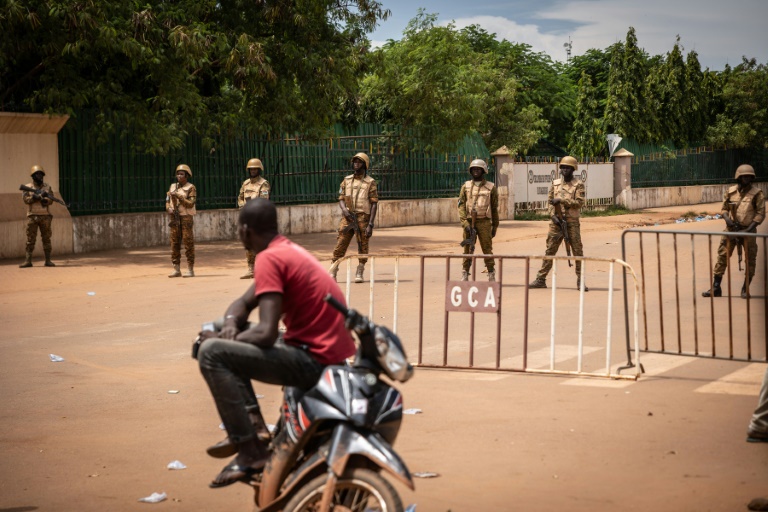
The Burkina Faso government admitted an “internal crisis” within the army was behind troop deployments Friday in key areas of the capital, saying negotiations were now underway after shots rang out before dawn.

Gunfire was heard around the presidential palace and headquarters of the military junta, which itself seized power in a coup last January, witnesses told AFP.

The transitional government said the developing situation was linked to an “internal crisis in the army”, after AFP journalists saw troops block several main roads in the capital Ouagadougou.

Government spokesman Lionel Bilgo told AFP “talks are continuing to try to reach a settlement without trouble”.

“I heard heavy detonations around 4:30 am (0430 GMT) and now the roads around my home have been sealed off by military vehicles,” said a resident who lives close to the presidential palace.

During the morning more shots had rung out an AFP video journalist said in the Ouaga 2000 neighbourhood that houses both the presidential and military junta headquarters.

Bilgo said the “crisis” was based on army pay claims, and that junta leader Lieutenant-Colonel Paul-Henri Sandaogo Damiba was taking part in discussions with the men.

A government source had earlier confirmed that Damiba was “in a safe place” without giving more details.

The state television was cut for several hours, broadcasting a blank screen for several hours saying: “no video signal”.

A second government source said, “The negotiations are continuing… the soldiers are maintaining pressure through their presence at strategic points they occupied this morning” in the capital.

Soldiers were seen at the city’s main crossroads, especially in Ouaga 2000 but also outside the state television centre, an AFP journalist said. 

In Brussels, the EU voiced “concern” at events in the Burkina capital.

“A military movement was observed from 04:30 this morning. The situation still remains particularly confused,” said spokeswoman Nabila Massrali.

– Rein in jihadists –

Violence has long wracked the landlocked west African country where Damiba took power in a January coup, ousting elected leader Roch Marc Christian Kabore.

Damiba has pledged to restore civilian rule within two years and to defeat the armed factions.

As in bordering countries, insurgents affiliated with Al-Qaeda and the Islamic State group have stoked the unrest.

Thousands have died and about two million have been displaced by the fighting since 2015 when the insurgency spread into Burkina Faso, which has since become the epicentre of the violence across the Sahel.

Damiba earlier this month sacked his defence minister and assumed the role himself.

The mini-shuffle, the first since the appointment of a transitional government in March, saw only one new minister introduced — Colonel-Major Silas Keita was named minister delegate in charge of national defence and promoted to brigadier general. 

More than 40 percent of Burkina Faso, a former French colony, is outside government control.

Attacks have increased since mid-March, despite the junta’s vow to make security its top priority.

– Bloody September –

September has been particularly bloody.

On Monday, suspected jihadists attacked a convoy carrying supplies to the town of Djibo in the north of the country. The government said 11 soldiers died and around 50 civilians were missing.

On September 5 an improvised explosive device struck a supply convoy in the north killing 35 civilians dead and wounding 37.

The following day, at least nine people, seven civilians and two soldiers, were killed in two separate attacks by suspected jihadists.

In June, 86 civilians died in a massacre at Seytenga, near the border with Niger.

Much of the impoverished Sahel region is battling the insurgency.

Starting in northern Mali in 2012, the insurgents attacked neighbouring Burkina Faso and Niger in 2015.

The violence has in recent years begun to spill over into coastal states Ivory Coast, Togo and Benin.

“The deteriorating security situation in Burkina Faso and Mali has made the north of the coastal countries the new front line against armed groups operating in the Sahel,” the Konrad Adenauer Foundation, a German think tank, said in a report in April.

No regrets, says Catalan ex-minister on referendum anniversary

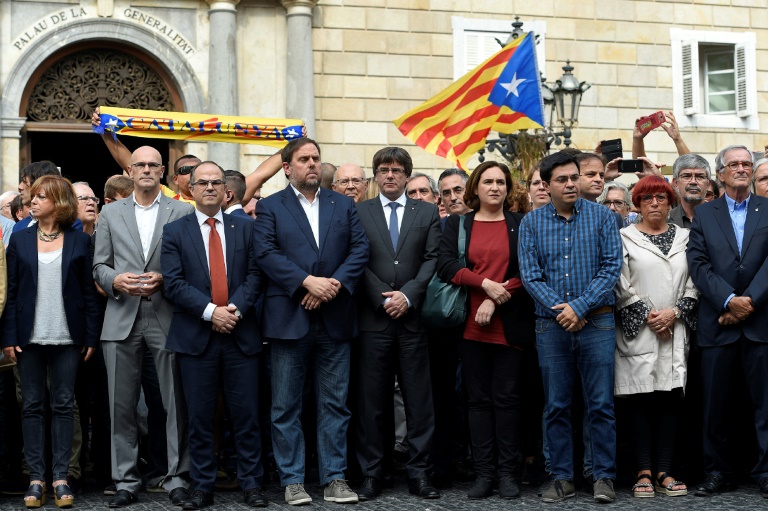
Five years after the failed secession push in Catalonia which landed him in jail, Oriol Junqueras remains convinced that defying Spain with a banned independence referendum was the right move. 

But the former deputy head of the region says the separatist camp needs to rally more support if its dream of an independent Catalan state is to one day become a reality.

“We did what we had to do,” the professor-turned-politician said during an interview with AFP when asked about the failed secession drive that came to a head in October 2017.

“I am deeply proud of all that we have done, of our commitment, of having been able to convene, organise and hold a referendum on self-determination,” the 53-year-old added.

Despite being banned by the Spanish courts, the October 1, 2017 referendum organised by Catalonia’s separatist government went ahead but descended into chaos as police moved in to stop it, sparking confrontations marred by violence.

Based on the results of this vote — which were never independently corroborated — the Catalan parliament declared independence on October 27.

Spanish authorities responded by sacking the Catalan government and pressed charges against the region’s leaders who either fled abroad or were jailed like Junqueras.

– Declining support –

Today the separatist movement is deeply divided over the path forward and Catalonia’s ruling pro-independence coalition is on the point of collapse.

While Junqueras’s ERC party favours dialogue with Madrid, its junior coalition partners, the JxC of former Catalan president Carles Puigdemont has taken a more confrontational approach.

Despite passions running high over independence, the region itself also remains divided, with only 41 percent in favour of separation while 52 percent want to remain in Spain, the latest survey suggested.

In an October 2017 poll support for independence in the wealthy northeastern region of Spain stood at 49 percent.

“What we must do today, is be democratically stronger” in the face of the “repressive” Spanish state, said Junqueras, a lifelong supporter of independence and father-of-two who also served as Catalonia’s economy minister.

The “main mistake” of the separatist camp in 2017 was that it did not “talk more with people, convince more people” to back the cause, he added.

Socialist Prime Minister Pedro Sanchez’s government last year pardoned Junqueras and eight other Catalan separatist leaders who were serving lengthy jail terms for their roles in the ill-fated independence bid.

Junqueras was in 2019 sentenced to 13 years behind bars, the longest term among the nine pardoned leaders. He spent over three years in prison before his pardon.

As Catalonia’s former vice president Junqueras was convicted of sedition and misuse of public funds after the unauthorised 2017 referendum which led to Spain’s worst political crisis in decades.

– ‘Made us stronger’ –

Puigdemont, who was the head of Catalonia’s government at the time of the referendum, evaded arrest by fleeing to Belgium after Catalonia’s short-lived declaration of independence.

“I was convinced that my obligation was to be as close as possible to my citizens, at the same time I understand perfectly that other people opted for exile,” Junqueras said.

“The fact that we have been in jail has only made us stronger in every way,” he added.

“It has also opened many doors in the international community that were more difficult to open previously, so in this sense the time in prison has also been a very profitable investment.”

He cited as an example an August finding from the UN’s Human Rights Committee which concluded Spain had violated the political rights of Catalan politicians including Junqueras.

The committee found that Spain violated their rights when they were suspended from office before having been convicted.

Suicide attack on Kabul classroom kills 19, mostly young women

A suicide bomber attacked an education centre in the Afghan capital on Friday where hundreds of students were preparing for university exams, killing at least 19 people, most of them young women.

The bombing happened in the Dasht-e-Barchi neighbourhood of western Kabul, a predominantly Shiite Muslim area home to the minority Hazara community, the target of some of Afghanistan’s most deadly attacks.

The bomber shot dead two security guards before entering the gender-segregated classroom, student Ali Irfani, who escaped the carnage, told AFP.

“Not many boys were hit because they were at the rear end of the classroom. The bomber entered from the front door where girls were sitting,” he said.

Akbar, another student witness, also told AFP that young women made up most of the casualties, with up to 600 people in the hall at the time.

No group has yet claimed responsibility for the blast at Kaaj Higher Educational Centre, which coaches students for university admission tests. 

However, the jihadist Islamic State group has claimed previous attacks in the area targeting girls, schools, mosques and a maternity hospital.

A resident who ferried victims to hospitals said he saw body parts scattered across the floor of the hall.

“Many students were hit by shrapnel in their head, neck and eyes,” said Asadullah Jahangir. 

Kabul police spokesman Khalid Zadran said 19 people were killed and 27 others wounded. 

A shopkeeper from the neighbourhood said there was a loud explosion and then crowds of students rushed out of the centre.

“It was chaos as many students, boys and girls, tried to escape from the building. It was a horrific scene. Everyone was so scared,” he told AFP, requesting anonymity.

Italian NGO Emergency, which operates a hospital in Kabul, said it had received 22 patients at the facility, including 20 women, two of whom had died. 

“The victims are all between 18 and 25 years old, and most of them were in the classroom to take an exam,” it said in a statement.

– ‘Shamefaced’ –

The Taliban’s return to power in Afghanistan last year brought an end to a two-decade war and a significant reduction in violence, but security has begun to deteriorate in recent months.

In April, two deadly bomb blasts on the same day at separate education centres in Dasht-e-Barchi killed six people and wounded at least 20 others.

Friday’s attack is a “shamefaced reminder of the ineptitude and utter failure of the Taliban, as de facto authorities, to protect the people of Afghanistan”, Samira Hamidi of rights group Amnesty International said in a statement.

The United Nations’ special rapporteur on Afghanistan, Richard Bennett, condemned the attack.

“Onslaught on education for Hazaras & Shiites must end. Stop attacks on Afghanistan’s future, stop international crimes,” he said on Twitter.

Afghanistan’s Shiite Hazaras have faced persecution for decades, targeted by the Taliban during their insurgency against the former US-backed government and by IS — both of which consider Shiites heretics. 

Families on Friday rushed to hospitals where ambulances arrived with victims, and lists of those confirmed dead or wounded were posted on the walls.

“We didn’t find her here,” a distressed woman looking for her sister at one of the hospitals told AFP. “She was 19 years old.”

“We are calling her but she’s not responding.”

Last year, before the Taliban returned to power, at least 85 people — mainly girl students — were killed and about 300 wounded when three bombs exploded near their school in the area.

No group claimed responsibility, but a year earlier IS claimed a suicide attack on an educational centre in the same neighbourhood that killed 24, including students.

In May 2020, the group was blamed for a gun attack on a maternity ward of a hospital in Dasht-e-Barchi that killed 25 people, including new mothers.

Education is a flashpoint issue in Afghanistan, with the Taliban blocking many girls from returning to secondary education. Islamic State also stands against the education of women and girls.
abh-qb-ash-jd/dhc

Iran committed 'crimes against humanity' in 2019 crackdown: lawyers

Iran’s government and security forces committed “crimes against humanity” in their suppression of huge nationwide protests in 2019, an international panel of lawyers probing the crackdown concluded on Friday.

The Iran Atrocities (Aban) Tribunal, which was convened by various human rights groups, heard evidence from over 250 witnesses as it investigated whether the Iranian regime broke international law in its response to the demonstrations. 

The protests, of a magnitude rarely seen in Iran following the 1979 Islamic Revolution and being repeated across the country in recent weeks, erupted nationwide in November 2019 after a sudden hike in fuel prices.

Activists say the authorities managed to impose control only after a ruthless crackdown that, according to Amnesty International, left at least 304 people dead in a deliberate policy to shoot at demonstrators.

The London tribunal said expert evidence suggested that the actual number killed was likely far larger and possibly as high as 1,515.

“The panel unanimously finds… beyond a reasonable doubt that the Iranian government and the security forces designed and implemented a plan to commit crimes against humanity,” the tribunal’s six legal experts said in their judgment summary.

It found various branches of the regime — from the interior ministry to the feared Basij militia — conducted murder, imprisonment, enforced disappearances, torture and sexual violence to quell the protests and conceal its crimes.

– ‘Case to answer’ –

Five of the six serving as jurists also concluded that protestors and bystanders were “discriminately targeted for their collective involvement in the protests or their perceived association” with them.

They cited 161 people as perpetrators of the alleged crimes against humanity, including supreme leader Ayatollah Ali Khamenei, former president Hassan Rouhani, and nearly a dozen other senior regime figures.

“We’ve named some of those who are responsible in the sense of there being a case to answer,” Wayne Jordash, a criminal lawyer who chaired the tribunal panel, told AFP after the judgment was read aloud at an event in London.

He said the report has particular resonance now as protesters once again face violent repression as they demonstrate across Iran over the death in police custody of Mahsa Amini on September 16.

“The current protests look like the Aban 2019 protests, and the government’s response looks pretty much the same,” Jordash added.

“I would be very surprised if the government isn’t again engaged in a range of crimes against humanity and gross human rights violations.”

– ‘Suffered’ –

The Aban tribunal — named after the Iranian month when the events took place — was founded by NGOs including the London-based Justice for Iran, which campaigns against impunity for crimes in Iran, and the Oslo-based Iran Human Rights (IHR).

It heard evidence in two public sessions held in London last November and online in February, analysing videos, written and expert testimony, and well as witnesses’ verbal accounts.

Some of those witnesses and relatives of those killed or detained during the protests attended the London judgment reading and held aloft photographs of their loved ones as it concluded.

“Today, it makes me very happy — it needed to be done a lot sooner,” said Mohammad Amin, 42, an Iranian exile living in Britain since last year who witnessed the crackdown in Baluchestan, southeast Iran.

“A lot of people in my area, in my city… were injured and killed and really the people in my area suffered the most,” he told AFP, speaking through a translator.

“I saw the IRGC (Islamic Revolutionary Guard Corps) and the security forces shoot up protesters… they were just killing people.”

The Iranian government could not immediately be reached for comment on the tribunal’s conclusions.

Close Bitnami banner
Bitnami