World

Suicide blast kills 19 at education centre in Afghan capital

A suicide bomb attack at a learning centre in the Afghan capital on Friday killed 19 people as students prepared for university entrance exams, police said.

The blast happened in the Dasht-e-Barchi neighbourhood of western Kabul, a predominantly Shiite Muslim area home to the minority Hazara community, the targets of some of Afghanistan’s most deadly attacks.

“Students were preparing for an exam when a suicide bomber struck at this educational centre. Unfortunately, 19 people have been martyred and 27 others wounded,” Kabul police spokesman Khalid Zadran said.

Kaaj Higher Educational Center coaches students, mainly adult men and women, to prepare for university entrance exams.

Families rushed to area hospitals, where ambulances were arriving with victims and lists of those confirmed dead and wounded were posted to the walls. 

“We didn’t find her here,” a distressed woman looking for her sister at one of the hospitals told AFP. “She was 19 years old.”

“We are calling her but she’s not responding.”

At at least one hospital, the Taliban forced families of victims to leave the site, fearing that there could be a follow-up attack on the crowd.  

Videos posted online and photos published by local media showed bloodied victims being carried away from the scene.

“Security teams have reached the site, the nature of the attack and the details of the casualties will be released later,” Abdul Nafy Takor, the interior ministry’s spokesman, earlier tweeted.

“Attacking civilian targets proves the enemy’s inhuman cruelty and lack of moral standards.”

The Taliban’s return to power in Afghanistan last year brought an end to the two-decade war and a significant reduction in violence, but security has begun to deteriorate in recent months.

Afghanistan’s Shiite Hazaras have faced persecution for decades, with the Taliban accused of abuses against the group when they first ruled from 1996 to 2001.

Such accusations picked up again after they swept back to power.

Hazaras are also the frequent target of attacks by the Taliban’s enemy, the Islamic State armed group. Both consider them heretics.

Many attacks have devastated the Dasht-e-Barchi neighbourhood, with many targeting women, children and schools. 

Last year, before the Taliban returned to power, at least 85 people — mainly girl students — were killed and about 300 wounded when three bombs exploded near their school in the area.

No group claimed responsibility, but a year earlier IS claimed a suicide attack on an educational centre in the same neighbourhood that killed 24, including students.

In May 2020, the group was blamed for a bloody gun attack on a maternity ward of a hospital in Dasht-e-Barchi that killed 25 people, including new mothers.

And in April this year, two deadly bomb blasts at separate education centres in the area killed six people and wounded at least 20 others.

Education is a flashpoint issue in Afghanistan, with the Taliban blocking many girls from returning to secondary education, while the Islamic State also stands against the education of women and girls.
Bolsonaro, Lula in attack mode in last Brazil presidential debate

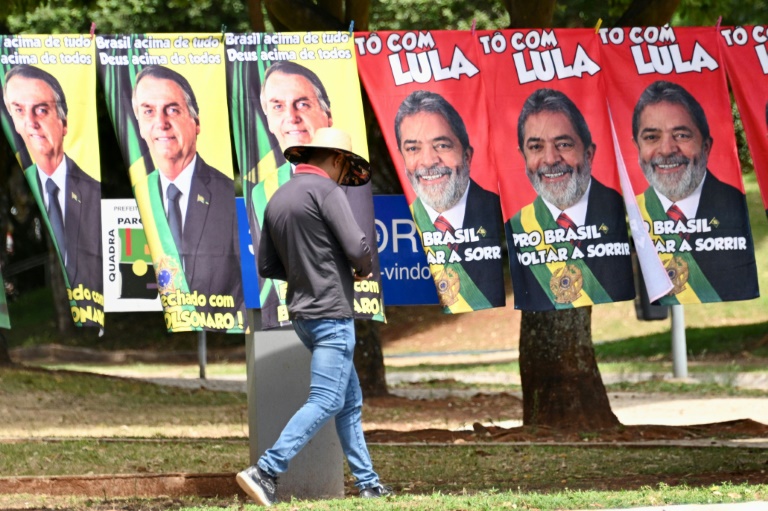
Far-right incumbent Jair Bolsonaro and leftist front-runner Luiz Inacio Lula da Silva traded heated attacks Thursday in a final debate three days from Brazil’s presidential election, accusing each other of corruption, nepotism and lying.

Trailing in the polls ahead of Sunday’s polarizing vote, Bolsonaro wasted no time going for the jugular, calling Lula a “liar, ex-inmate and traitor.”

Seeking to deliver a knockout punch and win the election in the first round, Lula, the charismatic but tarnished ex-president who led Brazil from 2003 to 2010, responded in kind.

“It’s ugly for the president of the republic to blatantly lie all the time… That’s why the people are going to send you packing,” the ex-metalworker said in his trademark gravelly voice.

He told Bolsonaro to “look in the mirror” if he wanted to see corruption, citing graft allegations against the president’s senator son Flavio and ex-education minister, accused of demanding kickbacks for influential evangelical churches.

The moderator, journalist William Bonner, reprimanded both candidates for failing to respect the ground rules, and had his work cut out for him in an unruly, heated debate that also featured five other candidates trailing far behind in the polls.

AFP fact-checkers identified numerous falsehoods in the candidates’ statements.

For example, Bolsonaro tried to fend off accusations he dragged his feet on purchasing Covid-19 vaccines, saying: “No country in the world purchased vaccines in 2020.”

In reality, millions of doses were administered around the world that year.

Lula meanwhile insisted he was “found innocent” of all corruption charges.

But his convictions were annulled on procedural grounds — he was never found not guilty.

Earlier Thursday, a poll by the Datafolha institute showed Lula maintaining a 14-point lead over Bolsonaro, 48 percent to 34 percent.

Excluding voters who said they planned to cast blank or spoiled ballots, Lula’s support reached 50 percent.

That put him on the cusp of the score needed to win outright and avoid a runoff on October 30: 50 percent of valid votes, plus one.

Bolsonaro, who is fond of saying the only reliable polls are “on the street” — where the 67-year-old incumbent regularly rallies his die-hard supporters en masse — is counting on his evangelical and business-centric base to pull through.

Lula — who presided over an economic boom, leaving office with an unprecedented approval rating of 87 percent — is meanwhile appealing to poor, minority and anti-Bolsonaro voters.

The 76-year-old is seeking a remarkable political comeback just four years after being jailed on controversial corruption convictions stemming from a massive scandal centered on state-run oil giant Petrobras.

Freed pending appeal in 2019 after 18 months behind bars, Lula regained his eligibility to run for office when the Supreme Court annulled his convictions last year, finding the lead judge in the case was biased.

– ‘Can change the picture’ –

The late-night debate on TV Globo, the most-watched broadcaster in Brazil, was the last chance for candidates to sway undecided voters.

Bolsonaro’s camp had said he would come out swinging, attacking Lula on the corruption issue and pressing home his conservative values on issues of religion and abortion.

“This is the debate that can change the picture,” a Bolsonaro campaign member told AFP on condition of anonymity.

After the first debate, a month ago, Lula was criticized for seemingly evading the corruption question. He opted not to take part in another debate, last Saturday.

Lula has urged Brazilians loyal to any of the minority candidates to rather cast a “tactical” vote for him, and against Bolsonaro.

The incumbent president got a celebrity boost Thursday for his re-election bid from football superstar Neymar, who posted a video on TikTok of himself dancing to a pro-Bolsonaro campaign song.

Grinning, the Paris Saint-Germain and Brazil striker, arguably Brazil’s most famous celebrity, flashed the number 22 with his fingers — Bolsonaro’s candidate number —  as he rocked out to the electronic dance jingle.

Datafolha will bring out another, final poll on Saturday, the eve of the first round.

Bolsonaro has repeatedly hinted he would challenge a Lula victory, saying last weekend: “We are the majority. We will win in the first round.”

Rich nations to face climate pressure at pre-COP27 talks in DR Congo

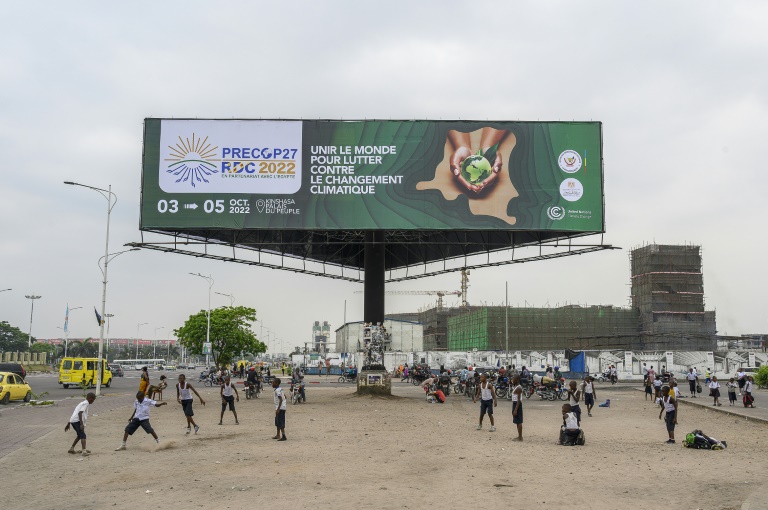
Environment ministers from some 50 countries gather in DR Congo on Monday for the pre-COP27 climate talks, with rich countries expected to come under pressure to contribute more to fight global warming.

The informal talks in the central African country’s capital Kinshasa come ahead of the COP27 climate summit in Egypt, from November 6-18.

Ministers and other delegates are expected to discuss points that could lead to impediments at the main summit.

But no formal announcements are expected at the pre-COP27 in the Democratic Republic of Congo, the country’s climate negotiator Tosi Mpanu Mpanu told AFP.

A Western diplomat, who requested anonymity, said that since the COP and pre-COP are both being held in Africa “the emphasis will certainly be on support from industrialised countries to countries in the south”.  

The theme was also present during the 2021 COP26 climate talks in Glasgow, which ended with a pledge to keep global warming at 1.5 degrees centigrade compared to pre-industrial levels.

Poorer countries had pushed for a mechanism that would account for damages caused by climate change. But wealthier nations — the largest polluters — rejected the call and the participants agreed instead to open a “dialogue” on financing damages. 

Egypt — which holds the presidency of the 27th meeting of the Conference of the Parties (COP) — has said it wants to make the latest summit about implementation.  

The pre-COP27 summit in Kinshasa ends on Wednesday. 

– Forest protection –

The DRC is expected to drive home the message that it is a country that can provide solutions for climate change during the talks.

Roughly the size of Western Europe, the DRC has 160 million hectares (395 million acres) of rainforest that acts as a carbon sink. 

It also has huge reserves of minerals such as cobalt and lithium, which are deemed critical for the transition to renewable energy because of their use in battery production.

Kinshasa is asking for more funding to protect its rainforests, which are currently threatened by slash-and-burn agriculture as well as logging for charcoal production. 

“The more resources we have at our disposal, the more climate action we can put in place,” said Congolese negotiator Mpanu Mpanu. 

Ahead of the pre-COP27 summit, the government organised a scientific conference at the Yangambi Biosphere Reserve in the forested northeast. It ended with scientists urging the international community to “support all initiatives” to protect the rainforest. 

However, the demand comes after the government put 30 oil and gas blocks up for auction in July — ignoring warnings from green activists that drilling could harm rainforests and peat lands and release vast amounts of heat-trapping gas.

Around 30 billion tonnes of carbon are stored across the Congo Basin, researchers estimated in a study for Nature in 2016. The figure is roughly equivalent to three years’ of global emissions.

The DRC, one of the poorest countries in the world, argues that drilling for oil and gas could help diversify its economy and benefit the Congolese people. 

China dips into pork reserves as rising prices fan inflation fear

China released more pork reserves Friday, state media said, after prices of the staple meat soared by almost a third, triggering inflation concerns.

Beijing’s top economic planner has already dipped into the state reserves three times this month and has ordered suppliers to slaughter more pigs in a bid to rein in costs.

But prices have continued to rise and a possible spike in demand over the week-long national day holiday in early October, has forced officials to respond. 

“China will release more pork from government reserves to the market on Friday to maintain supply and price stability,” official People’s Daily reported.

Pork is the most commonly consumed meat in China, with the average person in the country eating more than 25 kilogrammes per year, according to OECD data.

“From September 19-23, the weekly average retail price of lean meat in 36 large and medium-sized cities increased by 30 percent compared with the same period last year,” the National Development and Reform Commission said in a statement Tuesday.

Pork prices in the country have continued to rise since mid-March, despite government intervention, hitting 31.17 yuan ($4.40) a kilo last week.

China’s consumer inflation reached a two-year high of 2.7 percent in July — largely because of surging pork costs — before cooling slightly to 2.5 percent in August as Covid-related restrictions dampened overall demand, official data showed.

The Chinese government keeps massive stores of frozen pork in warehouses, occasionally releasing reserves to stabilise prices, especially during periods of peak demand including Lunar New Year.

Beijing’s central economic planner pledged more investment in the central pork reserves and to “further increase the distribution if necessary”.

“The domestic production capacity of live pigs is generally reasonable and sufficient, and the number of breeding sows, newborn piglets, and fattening pigs are all on the rise,” it added.

The world’s second-largest economy has mostly been spared the impact of a global surge in food prices caused by Russia’s war in Ukraine.

But pork prices were hit hard after the country’s herds were devastated by African swine fever in recent years, causing consumer inflation to spike.

In 2019, authorities said they would free up land to restore production to pre-swine fever levels, and officials have since released supplies from stockpiles to rein in costs.

Makeshift wifi spot reconnects shattered Ukraine city

Starved of news and contact with the outside world during six months of occupation by Russian forces, residents of recently liberated Izyum are grateful for a makeshift wifi spot in the shattered Ukrainian city.

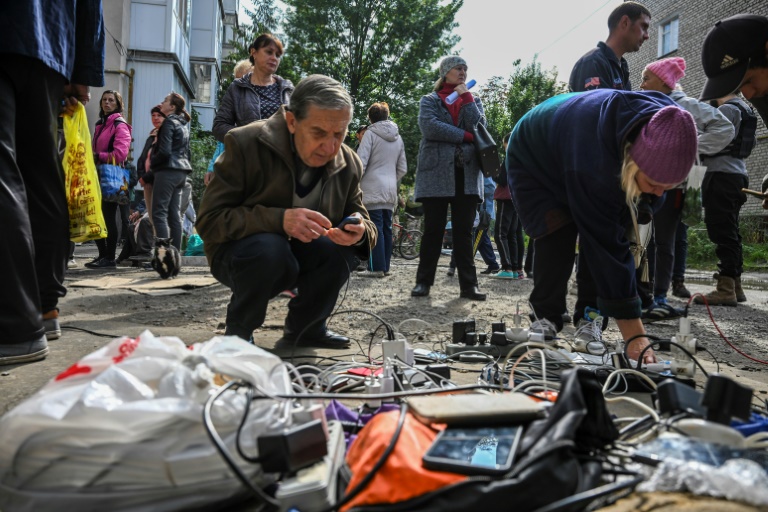
Outside an apartment block dozens of people queue before a sign that reads “15 minutes of wifi”, where an aid worker takes each phone and enters the password.

Izyum, a predominantly Russian-speaking city of about 50,000 people before the war, had been fully occupied since April until it was recaptured earlier this month during Kyiv’s lightning counter-offensive.

Soon after the liberation, investigation teams found what they said were 447 bodies buried during the occupation.

Residents told AFP Thursday that with electricity and mobile infrastructure networks badly damaged during the fighting, and still not restored, lack of information has kept them in the dark about what was happening.

But thanks to a power generator provided by the army, they can now reconnect to the internet — at least for a brief window each day.

“From 8:00 am to 7:00 pm, some three to four thousand per day can connect,” Seraphim, a soldier, told AFP.

“If too many people get connected at the same time the internet goes down, hence the 15-minute limit,” explained resident Olga German.

“After zero minutes a day, 15 is quite a lot. Now we can check the news online, and compare sources, and keep in touch with our families,” the 34-year-old English teacher said.

The eight-storey block is one of the few buildings in the devastated town to have escaped relatively unscathed, although many windows are broken, with the sound of sawing and hammers emanating from many floors. 

A TV screen on a stand beside the queue showed a Ukrainian channel broadcasting news about the war, while people huddled on the ground charging their telephones from extension cables connected to the generator. 

Residents ate borshch beetroot soup cooked on a nearby campfire, as children chopped firewood.

Around the corner a half-torn poster hung from a billboard: “Russia for ever”, it said.

– Information vacuum –

German said the six-month period of occupation felt like “purgatory”.

“We were living in an information vacuum, we couldn’t get in touch with our relatives, and we could feel that the information we got from the Russians was not objective.

“So we lived only on gossip, and the stories got twisted”. 

Nadezda Oleksandrivna, a 64-year-old dog-trainer waiting her turn in the queue, said being deprived of news and contact with friends felt “like having a bag on my head”.

It could have a serious impact on mental health, she added. 

Oleksandrivna said she stayed in Izyum during the occupation because she did not want to abandon her two dogs.  

Before the war she was an avid internet-user, keeping up with relatives, bloggers, politics and international news.

Now, she said she gets around the 15-minute wifi limit by returning to the back of the line when her time is up. 

For a group of teenagers scrolling their phones in the corner, the wifi spot is an opportunity to catch up with friends on Viber and Telegram.

“Everyone started messaging me, including friends I have in Germany and the Czech Republic, they were really worried about me,” said 16-year-old resident Anton.  

“When I first got connection back I didn’t know what to do, I noticed that my TikTok really changed.

“Now it’s only about the war,” he said. 

Kremlin set to annex four Ukraine territories at ceremony

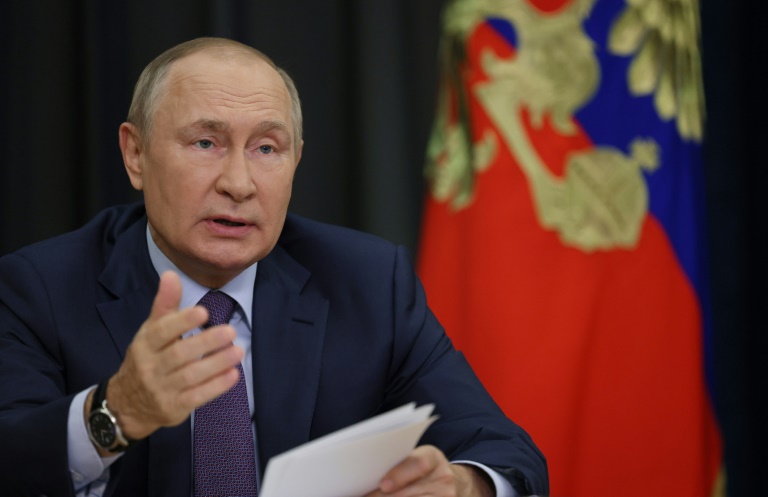
Russia is expected to annex four occupied regions of Ukraine at a lavish Kremlin ceremony on Friday that follows a threat by President Vladimir Putin to use nuclear weapons in their defence.

Kremlin spokesman Dmitry Peskov told reporters that the annexations would be formalised at the ceremony and Putin would deliver a “major” speech.

It comes after foreign leaders critical of Russia voiced their opposition to the plan, with US President Joe Biden saying the United States would “never, never, never” recognise Russian sovereignty over the territories.

The Kremlin’s atomic threats have not deterred a sweeping Ukrainian counter-offensive, which has been pushing back Russian troops in the east.

Kyiv’s forces are on the doorstep of the Donetsk region town of Lyman, which Moscow’s forces pummelled for weeks before capturing it this summer.

Putin has blamed the war in Ukraine on the West and said simmering conflicts in the former Soviet Union were the result of its collapse.

The rhetoric built on his now famous phrase that the fall of the USSR was a tragedy, and he has recently suggested Moscow should again extend its influence over the former Soviet region.

The four regions’ Kremlin-installed leaders who pleaded to Putin for annexation this week assembled in the Russian capital ahead of the ceremony.

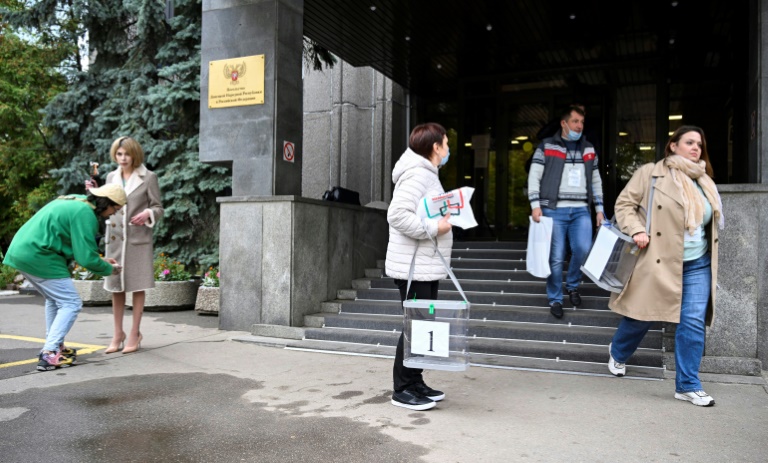
Their almost simultaneous requests came after they claimed residents had unanimously backed the move in hastily organised referendums that were dismissed by Kyiv and the West as illegal, fraudulent and void.

– 20 percent of Ukraine –

Ukraine said the only appropriate response from the West was to hit Russia with more sanctions and to supply Ukrainian forces with more weapons to keep reclaiming territory.

UN Secretary-General Antonio Guterres condemned the annexation plans as “a dangerous escalation” that “has no place in the modern world.”

The UN Security Council will vote Friday on a resolution condemning the referendums, according to France, the council’s current president, but it has no chance of passing due to Moscow’s veto power.

Ukraine’s President Volodymyr Zelensky called an “urgent” meeting of his national security council for Friday, his spokesman said, after the Kremlin announced the timing of the annexation ceremony.

The four territories — Kherson and Zaporizhzhia in the south and Donetsk and Lugansk in the east — create a crucial land corridor between Russia and the Crimean peninsula, annexed by Moscow in 2014.

Together, all five make up around 20 percent of Ukraine, whose forces in recent weeks have been clawing back ground.

Ukrainian troops have been progressing in the eastern Kharkiv region and recapturing territory in Donetsk. Military observers say Kyiv’s forces are close to capturing Lyman. 

Moscow’s forces are striking back along the entire front line and officials in Kyiv said Thursday that Russian bombardment had killed three people in the Dnipropetrovsk region, five in Donetsk and wounded seven in the Kharkiv region.

Along with threats to use nuclear weapons, Putin announced a mobilisation of hundreds of thousands of Russians to bolster Moscow’s army in Ukraine, sparking demonstrations and an exodus of men abroad.

Putin on Thursday called for mistakes with the draft to be “corrected”, as discontent grows over the often-chaotic conscription push. 

burs/gw/lcm/mca

Japan plans more stimulus to tackle inflation, low yen

Japan is preparing another round of economic stimulus measures, the government said Friday, as rising prices and the plummeting yen squeeze the world’s third-largest economy.

Prime Minister Fumio Kishida told ministers to draft the relief package by the end of October so it can be passed by parliament this year, government spokesman Hirokazu Matsuno told reporters.

He did not give a figure for the measures, but said they would include “efforts to deal with rising prices and to encourage wage increases”.

Ministers have also been told to seek “ways to recover and strengthen regional economies’ abilities to do business by taking advantage of the yen’s depreciation”, Matsuno added.

The yen has hit 24-year lows in recent weeks, prompting an intervention by the government last week.

The slumping currency inflates profits for Japanese exporters but also ramps up the price of imported goods for consumers already facing higher prices, including for energy, partly because of the war in Ukraine.

Matsuno said increased electricity bills had become “a significant burden” for both households and business.

Over the past two years, Japan has injected hundreds of billions of dollars into the economy as part of stimulus measures to support its recovery from the Covid-19 pandemic.

Japan already has one of the highest debt-to-GDP ratios in the world.

Kishida said on Thursday that his government would take “bold” measures to tackle inflation and the falling yen, as “the rapid rise of energy and food prices is directly hitting households”.

On Friday, one dollar bought 144.60 yen, compared with around 115 in March.

The currency’s plunge has mainly been caused by the Bank of Japan’s refusal to move away from its long-standing ultra-loose monetary policies, in contrast to tightening by central banks in the United States and elsewhere.

Hurricane Ian wreaks havoc on Florida, regains steam in Atlantic

Hurricane Ian unleashed “historic” devastation in Florida, leaving a yet unknown number of dead in its wake, officials said Thursday, as the storm restrengthened in the Atlantic on a path toward the Carolinas.

The storm, one of the most powerful ever to hit the United States, left hundreds of people in need of rescue, Florida Governor Ron DeSantis said, while warning it was still too early to get a clear picture of the death toll.

“We absolutely expect to have mortality from this hurricane,” he said at a press conference Thursday evening.

President Joe Biden, after a briefing at FEMA emergency management headquarters in Washington, said “this could be the deadliest hurricane in Florida history.”

The numbers “are still unclear, but we’re hearing reports of what may be substantial loss of life,” he added.

DeSantis said concrete information about casualty numbers could be expected “in the coming days.” 

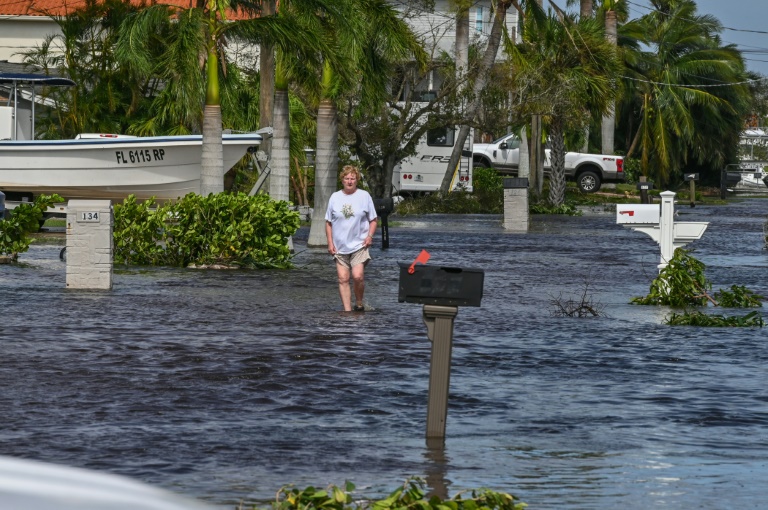
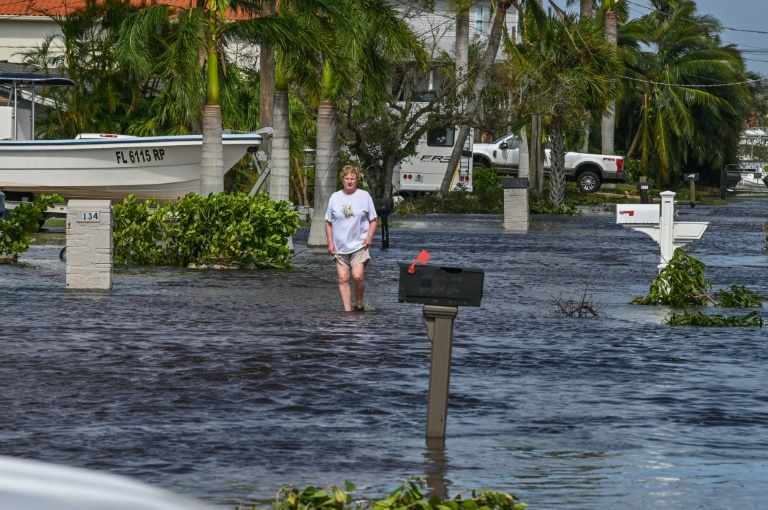
Fort Myers, where Ian made landfall as a powerful Category 4 hurricane on Wednesday, took much of the brunt of the storm, as streets became rivers and seawater poured into houses.

Dozens of boats moored in the marina were sunk while others were tossed on to downtown streets.

Trees were toppled by the howling winds of up to 150 miles per hour (240 kilometers per hour).

After weakening as it worked its way across Florida, Ian regained its Category 1 status in the Atlantic and was expected to make a turn towards the Carolinas where it would again cause “life-threatening flooding, storm surge and strong winds,” the National Hurricane Center said Thursday night.

– ‘Horrifying’ –

Earlier in the day, DeSantis described the destruction in the southwest part of his state as a “500-year flood event.”

“We’ve never seen storm surge of this magnitude,” he said.

Tom Johnson, 54, of Fort Myers had a front row seat to the destruction from his apartment on the second floor of a two-story harbourside building.

“I was scared because I’ve never been through that,” Johnson told AFP. “It was just the most horrifying sounds with debris flying everywhere, doors flying off.”

His home was undamaged but one of his neighbors, Janelle Thil, 42, was not so lucky and had to ask other residents for help after her ground floor apartment began to flood.

“They got my dogs and then I jumped out of the window and swam,” Thil said.

When Thil returned to her apartment after the storm passed, she said she opened the door and “had to wait about five minutes for all the floodwaters to come out.”

“I loved my home,” she said. “But I’m alive and that’s what matters.”

According to DeSantis, the area was also dealing with a water main break, which officials were “working to troubleshoot.”

A US Coast Guard official said helicopter crews were plucking people from the rooftops of homes inundated by floodwaters.

Eighteen migrants were missing from a boat that sank during the hurricane on Wednesday, though nine others had been rescued, the Coast Guard said. Among them were four Cubans who swam to shore in the Florida Keys.

– Ian regaining strength –

Ian was downgraded to a tropical storm overnight but the NHC said it regained Category 1 hurricane strength on Thursday afternoon and issued a hurricane warning for the entire coast of South Carolina as well as portions of Georgia and North Carolina.

“Ian could strengthen a little more before landfall” on Friday, the NHC said, adding that it will likely “rapidly weaken over the southeastern United States late Friday into Saturday.”

Biden has declared a “major disaster” in Florida, a move that frees up federal funding for storm relief.

“We’re continuing to take swift action to help the families of Florida,” he tweeted. “I want the people of Florida to know that we will be here at every step of the way.”

Much of Florida’s southwest coast was plunged into darkness after the storm wiped out power.

Tracking website poweroutage.us said 2.3 million homes and businesses remained without electricity in the so-called Sunshine State late Thursday.

Two barrier islands near Fort Myers, Pine Island and Sanibel Island, popular with vacationers, were essentially cut off when the storm damaged causeways to the mainland.

Sanibel Island got “hit with really biblical storm surge,” DeSantis said, and rescuers were using boats and helicopters to evacuate residents who rode out the storm.

Mandatory evacuation orders had been issued in many areas of Florida ahead of Ian, with several dozen shelters set up.

Airports stopped all commercial flights, and cruise ship companies delayed or canceled voyages.

Before pummeling Florida, Ian plunged all of Cuba into darkness Tuesday after downing the island’s power network.

At least two people died in Pinar del Rio province, state media in the country of more than 11 million reported.

Human activity has caused life-threatening climate change, resulting in more severe weather events across the globe.

Hurricane Ian wreaks havoc on Florida, regains steam in Atlantic

Hurricane Ian unleashed “historic” devastation in Florida, leaving a yet unknown number of dead in its wake, officials said Thursday, as the storm restrengthened in the Atlantic on a path toward the Carolinas.

The storm, one of the most powerful ever to hit the United States, left hundreds of people in need of rescue, Florida Governor Ron DeSantis said, while warning it was still too early to get a clear picture of the death toll.

“We absolutely expect to have mortality from this hurricane,” he said at a press conference Thursday evening.

President Joe Biden, after a briefing at FEMA emergency management headquarters in Washington, said “this could be the deadliest hurricane in Florida history.”

The numbers “are still unclear, but we’re hearing reports of what may be substantial loss of life,” he added.

DeSantis said concrete information about casualty numbers could be expected “in the coming days.” 

Fort Myers, where Ian made landfall as a powerful Category 4 hurricane on Wednesday, took much of the brunt of the storm, as streets became rivers and seawater poured into houses.

Dozens of boats moored in the marina were sunk while others were tossed on to downtown streets.

Trees were toppled by the howling winds of up to 150 miles per hour (240 kilometers per hour).

After weakening as it worked its way across Florida, Ian regained its Category 1 status in the Atlantic and was expected to make a turn towards the Carolinas where it would again cause “life-threatening flooding, storm surge and strong winds,” the National Hurricane Center said Thursday night.

– ‘Horrifying’ –

Earlier in the day, DeSantis described the destruction in the southwest part of his state as a “500-year flood event.”

“We’ve never seen storm surge of this magnitude,” he said.

Tom Johnson, 54, of Fort Myers had a front row seat to the destruction from his apartment on the second floor of a two-story harbourside building.

“I was scared because I’ve never been through that,” Johnson told AFP. “It was just the most horrifying sounds with debris flying everywhere, doors flying off.”

His home was undamaged but one of his neighbors, Janelle Thil, 42, was not so lucky and had to ask other residents for help after her ground floor apartment began to flood.

“They got my dogs and then I jumped out of the window and swam,” Thil said.

When Thil returned to her apartment after the storm passed, she said she opened the door and “had to wait about five minutes for all the floodwaters to come out.”

“I loved my home,” she said. “But I’m alive and that’s what matters.”

According to DeSantis, the area was also dealing with a water main break, which officials were “working to troubleshoot.”

A US Coast Guard official said helicopter crews were plucking people from the rooftops of homes inundated by floodwaters.

Eighteen migrants were missing from a boat that sank during the hurricane on Wednesday, though nine others had been rescued, the Coast Guard said. Among them were four Cubans who swam to shore in the Florida Keys.

– Ian regaining strength –

Ian was downgraded to a tropical storm overnight but the NHC said it regained Category 1 hurricane strength on Thursday afternoon and issued a hurricane warning for the entire coast of South Carolina as well as portions of Georgia and North Carolina.

“Ian could strengthen a little more before landfall” on Friday, the NHC said, adding that it will likely “rapidly weaken over the southeastern United States late Friday into Saturday.”

Biden has declared a “major disaster” in Florida, a move that frees up federal funding for storm relief.

“We’re continuing to take swift action to help the families of Florida,” he tweeted. “I want the people of Florida to know that we will be here at every step of the way.”

Much of Florida’s southwest coast was plunged into darkness after the storm wiped out power.

Tracking website poweroutage.us said 2.3 million homes and businesses remained without electricity in the so-called Sunshine State late Thursday.

Two barrier islands near Fort Myers, Pine Island and Sanibel Island, popular with vacationers, were essentially cut off when the storm damaged causeways to the mainland.

Sanibel Island got “hit with really biblical storm surge,” DeSantis said, and rescuers were using boats and helicopters to evacuate residents who rode out the storm.

Mandatory evacuation orders had been issued in many areas of Florida ahead of Ian, with several dozen shelters set up.

Airports stopped all commercial flights, and cruise ship companies delayed or canceled voyages.

Before pummeling Florida, Ian plunged all of Cuba into darkness Tuesday after downing the island’s power network.

At least two people died in Pinar del Rio province, state media in the country of more than 11 million reported.

Human activity has caused life-threatening climate change, resulting in more severe weather events across the globe.

Asian markets drop again but sterling holds up after recovery

Asian markets sank Friday after another devastating day on US and European trading floors, with inflation continuing to soar and central bankers getting increasingly hawkish in their attempts to bring prices under control.

Sterling, however, managed to hold gains after clawing back more of the huge losses suffered at the start of the week owing to a tax-cutting mini-budget that analysts warned could cause even more pain to the already fragile UK economy.

The pound’s bounce — from a record low of $1.0350 Monday to above $1.11 Friday — came after the Bank of England pledged $71 billion of support to shattered financial markets, fearing that several pension funds could go under.

Britain’s beleaguered currency was given an extra boost by news Thursday that the budget watchdog will provide costings of new Finance Minister Kwasi Kwarteng’s fiscal plan on  October 7, two weeks earlier than initially announced.

“This has helped alleviate some fears within markets given the initial optics of an uncosted large fiscal package,” said National Australia Bank’s Tapas Strickland.

Markets remain concerned about the UK economy and the impact that borrowing tens of billions of dollars will have on interest rates, with observers warning that the Bank of England could announce a 1.5 percentage point hike at its next meeting in November.

Sean Callow, at Westpac Banking Corp, said the pound’s gains this week were “a reminder that currencies are driven by a myriad of factors — it’s clearly not due to any improvement in the outlook for the UK”.

The bank’s cash injection meant it had to put on hold its plan to tighten monetary policy as part of a global effort to fight decades-high inflation.

– Russia worries –

And in a sign of the long road ahead for finance chiefs — and the dour outlook for stocks — data out of several countries including Germany and Belgium this week showed that prices are still rising about 10 percent year-on-year.

In the United States, Federal Reserve officials again reiterated their intention to ramp up rates until they have tamed inflation, even if that means plunging the world’s top economy into recession.

And the case for a fourth successive 0.75 percentage point lift was strengthened by news that first-time unemployment benefit claims fell below 200,000 for the first time since May.

All three main indexes on Wall Street finished deep in the red, with the S&P 500 ending at its lowest level since November 2020.

And Asia picked up the baton.

Hong Kong and Shanghai dropped as data showed China’s manufacturing and services sectors struggled again in September from Covid lockdowns in parts of the country that have battered the world’s number-two economy.

There was also little reaction to news that Beijing would allow some cities to reduce mortgage rates for first-home purchases as it tries to support the property market.

Tokyo, Sydney, Seoul, Singapore, Taipei, Wellington, Manila and Jakarta were also off.

“Risky assets don’t stand a chance of a meaningful rally if the economy continues to show resilience while inflation continues to be significantly above the Fed’s Funds rate,” said OANDA’s Edward Moya.

Market sentiment was also being eroded by rising fears about developments in the Ukraine war, as Russia prepares to annex four occupied regions of its neighbour Friday, with President Vladimir Putin threatening to use nuclear weapons to defend the territories.

– Key figures around 0300 GMT –

Tokyo – Nikkei 225: DOWN 1.7 percent at 25,979.75 (break)

Hong Kong – Hang Seng Index: DOWN 0.2 percent at 17,132.81

Shanghai – Composite: DOWN 0.4 percent at 3,029.26

Pound/dollar: DOWN at $1.1113 from $1.1116 on Thursday

Euro/dollar: DOWN at $0.9807 from $0.9818

Euro/pound: DOWN at 88.27 pence from 88.28 pence

Dollar/yen: UP at 144.70 yen from 144.42 yen

West Texas Intermediate: DOWN 0.1 percent at $81.14 per barrel

Brent North Sea crude: DOWN 0.3 percent at $88.23 per barrel

New York – Dow: DOWN 1.5 percent at 29,225.61 (close)

London – FTSE 100: DOWN 1.8 percent at 6,881.59 (close) 

Close Bitnami banner
Bitnami