World

Bolsonaro: Brazil's polarizing far-right president

Four years after storming in to shake up a Brazil disgusted with politics, far-right President Jair Bolsonaro finds it increasingly hard to cast himself as an outsider, but remains as vitriolic and polarizing as ever.

Seeking re-election for a new four-year term Sunday, the 67-year-old incumbent is trailing in the polls to his leftist nemesis, ex-president Luiz Inacio Lula da Silva (2003-2010).

Known for a brash, divisive style that earned him the nickname “Tropical Trump,” Bolsonaro, an ex-army captain turned congressman, surged to national prominence in 2018 by playing to voters disgusted with Brazil’s economic implosion and the massive “Car Wash” corruption scandal that stained a laundry list of bigwigs in the worlds of business and politics, particularly Lula’s Workers’ Party.

When Bolsonaro survived a knife attack during a campaign rally that September — perpetrated by an assailant who was later declared mentally unfit to stand trial — it only fueled followers’ belief in their “Messias,” or “Messiah” — Bolsonaro’s middle name.

But the aura of invincibility around the president has faded as he enters the twilight of his term with the economy sputtering and his popularity flagging.

– Tough talker –

Tapping widespread outrage, Bolsonaro won the presidency in a landslide in 2018, with broad support from the business sector, voters fed up with corruption, and the powerful “Bibles, bullets and beef” coalition — Evangelical Christians, security hardliners and the agribusiness industry.

Supporters love his gloves-off style, anti-establishment message and everyman touch on social media, where his movement thrives.

But he infuriates critics with his divisive vitriol and disdain for political correctness, often drawing accusations of racism, sexism and homophobia.

And his support has badly eroded among the political center and business sector as his administration has floundered through various crises.

Bolsonaro insistently downplayed Covid-19, defied expert advice on fighting it and mocked face masks, social distancing and vaccines, warning the latter could “turn you into an alligator” — even as the death toll in Brazil surged to become one of the highest in the world, second only to the United States at more than 685,000.

Bolsonaro faces international outcry over the destruction of the Amazon rainforest, which has surged on his watch, fueled by cattle ranches encroaching on the jungle.

He also faces scores of impeachment requests and a series of corruption scandals involving his inner circle.

He is betting on big new welfare benefits launched in July to boost his support from low-income voters — but faces accusations of economic populism and fueling already soaring inflation.

– ‘Prison, death or victory’ –

Born in 1955 to a Catholic family with Italian roots, Bolsonaro served as an army paratrooper before starting his political career in 1988 as a Rio de Janeiro city councilor.

Two years later, he was elected to the lower house of Congress, where he served until becoming president.

He has ignited one explosive controversy after another with his remarks.

In 2011, he told Playboy magazine he would rather his sons be killed in an accident than come out as gay.

In 2014, he made headlines by saying a left-wing lawmaker was “not worth raping” because she was “too ugly.”

In August 2020, he threatened a journalist who asked him about allegations his wife, Michelle, received money from a political operative targeted in a corruption investigation.

“I so want to pound your mouth with punches,” Bolsonaro told the reporter from leading newspaper O Globo.

The president is openly nostalgic for Brazil’s 1964-1985 military dictatorship, whose “mistake,” he said in 2016, “was to torture and not kill” leftist dissidents.

Bolsonaro has cultivated a close relationship with the army top brass, selecting General Walter Souza Braga Netto, his onetime defense minister and chief of staff, as his running mate.

Many Brazilians fear Bolsonaro could try to fight the election result if he loses, following in the footsteps of his political role model, ex-US president Donald Trump.

He has hinted he will not leave the presidency without a fight, saying his reelection bid can only have three outcomes: “prison, death or victory.”

Bolsonaro has four sons — three of them politicians — and, in what he called a moment of “weakness,” a daughter.

Germany says mass fish deaths in Oder river a 'man-made disaster'

Germany said Friday that mass fish deaths in the Oder river were a “man-made environmental disaster”, blaming toxic algae growth sparked by the introduction of salt into the waters.

Presenting a report into the disaster that saw at least 300 tonnes of dead fish pulled from the river in Germany and Poland this summer, the German environment ministry said the most likely cause was “a sudden increase in salinity”.

The “introduced salt” led to “massive proliferation of a brackish water algae that is toxic to fish”, it said.

However, “due to a lack of available information, the experts had to leave open what caused the unnaturally high salt content”, it added.

German Environment Minister Steffi Lemke said it was clear that “human activity” was to blame.

Polish authorities had on Thursday released a separate report that also blamed toxic algae for the fish deaths.

But the Polish report said the disaster had most likely been caused by poor water quality as a result of high temperatures and very low water levels over the summer.

Poland and Germany have long been at odds over the disaster.

Berlin initially accused Warsaw of failing to communicate the problem, while Poland slammed Germany for spreading “fake news” about the discovery of herbicides and pesticides in the water.

A report in Germany’s Der Spiegel magazine on Friday accused Polish authorities of failing to cooperate with their German counterparts to investigate the fish deaths.

Polish authorities became “more and more reserved, in some cases almost secretive”, Lilian Busse, the head of the investigation, was cited as saying.

The Spiegel report said Greenpeace investigations had shown high salt levels at a copper mine in the city of Glogow may have contributed to the disaster.

“It is obvious to me that the Polish government wants to cover up the causes of the fish kill in the Oder,” Ralph Lenkert, environmental policy spokesman for the far-left Die Linke party, told the magazine.

'Democracy on the ballot' as Brazil holds divisive vote

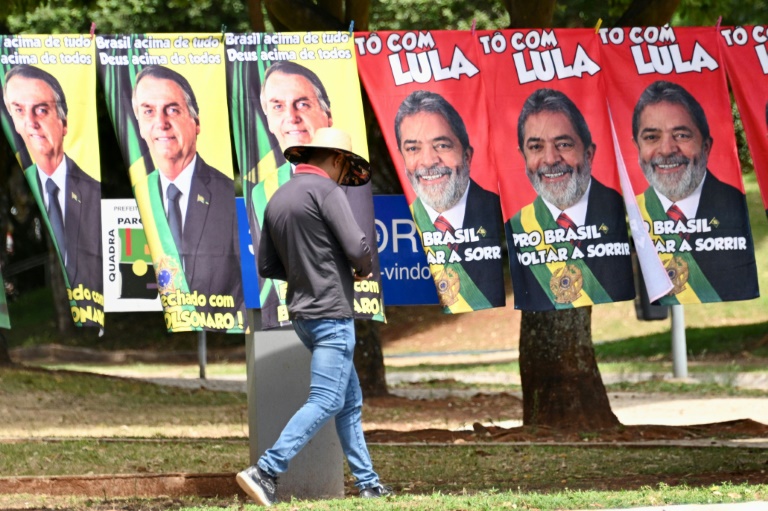
After a polarizing campaign, Brazil votes for its next president Sunday in a combative heavyweight bout threatening to test its young democracy: far-right incumbent Jair Bolsonaro versus leftist former leader Luiz Inacio Lula da Silva.

Lula, the charismatic but tarnished ex-metalworker who led Brazil through an economic boom from 2003 to 2010, leads in the polls, seeking to stage a stunning comeback four years after being jailed on controversial corruption convictions — since annulled by the Supreme Court.

Bolsonaro, the pugnacious ex-army captain whose popularity has suffered from the carnage of Covid-19 and a sputtering economy, is gunning for a come-from-behind win and has strongly hinted he would not accept a loss.

He has repeatedly alleged, without evidence, that Brazil’s electronic voting system is plagued by fraud.

Lula enters the home stretch leading Bolsonaro 50 percent to 36 percent, according to the latest poll from the Datafolha institute, released Thursday.

The figures, which exclude voters planning to cast blank or spoiled ballots, put Lula on the cusp of winning outright and avoiding a runoff on October 30.

Lula is pulling out all the stops for a first-round victory, crisscrossing the country and summoning the star power and sex appeal of celebrity supporters like pop superstar Anitta and singer-songwriter Caetano Veloso to convince wavering Brazilians to cast a “tactical vote” for him.

“What’s at stake is democracy versus fascism,” the gravelly voiced 76-year-old told a cheering crowd decked out in the red of his Workers’ Party (PT) at a rally last month.

It is a line heard often these days in the sprawling country of 214 million people, deeply divided after four years of Bolsonaro’s social media polemics, anti-establishment attacks, disregard for deforestation in the Amazon and no-holds-barred battle on behalf of his “Bible, bullets and beef” coalition — Evangelical Christians, security hardliners and the powerful agribusiness sector.

Leading mass marches and motorcycle rallies by supporters draped in the green and yellow of the flag, Bolsonaro has tapped the popularity of his telegenic, devoutly Christian first lady, Michelle, and got a high-voltage endorsement of his own Thursday from football superstar Neymar. 

With Bolsonaro, 67, having vowed his re-election bid can only have three outcomes — “prison, death or victory” — the election could be turbulent for Latin America’s biggest country, which emerged from two decades of military dictatorship in 1985.

“The stakes are huge… Democracy is on the ballot,” said political analyst Michael Shifter of the Inter-American Dialogue think tank, calling Bolsonaro “the most anti-democratic president” since the military regime.

Some degree of unrest and violence “is probably likely,” he told AFP.

– ‘Million-dollar question’ –

The “million-dollar question” is exactly what shape this unrest would take, said Guilherme Casaroes, a political scientist at the Getulio Vargas Foundation.

Bolsonaro, who is openly nostalgic for the dictatorship, has given the military a big role in his government and enthusiastically courted its support.

But defense experts say an all-out military coup is unlikely.

A Bolsonaro court challenge or bid to delay the runoff election are stronger possibilities, analysts say.

More troubling is what Casaroes calls the “Capitol riot scenario”: a Brazilian version of the turmoil unleashed by supporters of former US president Donald Trump — Bolsonaro’s political role model — when he refused to accept electoral defeat.

Gun ownership has boomed under Bolsonaro’s firearm-friendly policies: since he took office on January 1, 2019, the number of registered gun owners has more than quintupled to 673,000.

That, combined with die-hard support for Bolsonaro among some sectors of the military and police, is making observers nervous in Brazil and beyond.

The White House warned against violence Tuesday, saying the United States will be watching “closely.”

Brazil’s 156 million voters will also be electing the lower house of Congress, one-third of the Senate and governors and state legislators in all 27 states.

Polls open at 8:00 am and close at 5:00 pm (1100-2000 GMT), with results expected some two hours later.

Japan's digital minister says he's ready for a fight

Japan’s media-savvy digital minister said Friday he’s ready to take an iron-fisted approach to speed up the nation’s slow embrace of online services at government offices and workplaces.

Taro Kono — a political heavyweight who has been minister of defence, foreign affairs and Covid vaccines — has already declared war on fax machines, floppy disks and other obsolete technologies that are still common in the world’s third-largest economy.

“I have no plan to be a coordinator. If there are people who have a problem with it, I will beat them up,” he quipped in an online interview with a small group of journalists.

“The pandemic forced everyone to acknowledge that Japan’s digitalisation has been slow,” added Kono.

“It has become crystal clear, compared with other countries, how difficult it is to do business and to conduct daily affairs.”

Japan is often internationally considered a byword for high-tech, but fax machines are still routinely used by businesses and households along with email and texting apps.

Floppy disks and CD-ROMs are less visible to consumers, but some official documents are legally required to be stored in these outdated formats.

“Throughout Covid, we have seen so many countries move their government procedures onto digital platforms,” Kono said. 

“At the same time, we are not there yet.”

He blamed a culture that does not necessarily encourage people to suggest change in the workplace, which he said results in people pretending not to notice problems.

“People are so quick to make changes if something is not convenient at home. But once you step out of your house, everything becomes someone else’s problem,” Kono said. 

“We must build a society where people take actions and suggest improvements to better society.

Kono, who has also sought to phase out the personal ink signature stamps known as hanko, said he was optimistic society would embrace the convenience of digitalisation. 

“If people feel their lives are getting better, more convenient, easier, I think that means the digital agency is successful,” he said.

“How do you measure that? If you see people have more smiles on their face.” 

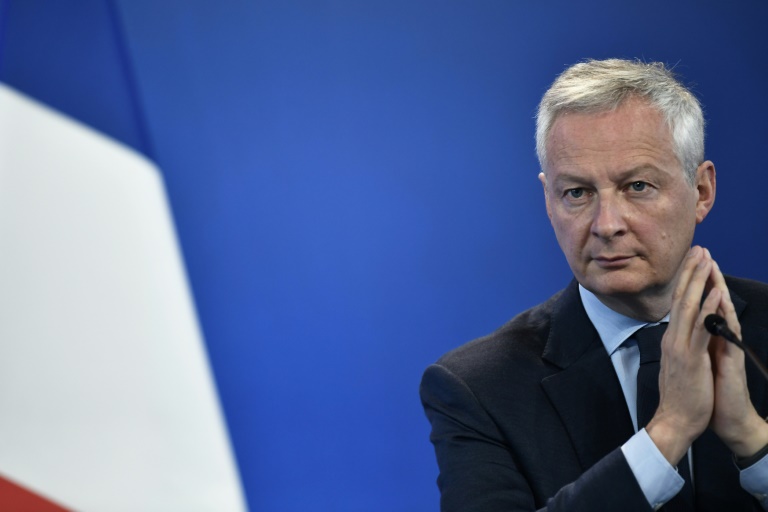
French economy minister 'worried' by British 'disaster'

France’s economy minister said Friday that he was worried by the financial turbulence in Britain, criticising Prime Minister Liz Truss’s economic policies for causing a “disaster” of high borrowing rates for her country.

“I’m not worried about the situation in the eurozone,” Bruno Le Maire told Europe 1 radio when asked about the risk of the crisis spreading. “On the other hand, I am worried about the British situation.”

“What does it show? It shows firstly that there are costs for financial and economic policies,” he said.

Truss’s “mini-budget” announced last Friday included major tax cuts that would need to be financed by extra borrowing, spooking investors who immediately questioned the credibility of the policies and Britain’s financial standing. 

“When you take on major costs like that, with spectacular announcements, as some opposition parties want to do in France, it perturbs the markets. It perturbs financial balances,” Le Maire said.

“And it leads to a real disaster with interest rates which are 4.5 percent or even higher in Great Britain. We have interest rates which are reasonable, which are quite close to Germany’s because there is consistency in our economic and financial policymaking,” he said.

“The second thing is that leaving Europe comes with a considerable cost because Europe is a protection,” he added, referring to Britain’s exit from the European Union.

The pound fell to an all-time low against the dollar and the yield on 10-year British government bonds — which sets the cost of borrowing for the government — briefly rose to above 4.5 percent on Wednesday.

That led the Bank of England to intervene with a £65 billion ($71 billion) emergency bond-buying programme to stabilise the market.

Le Maire has been under pressure this week to explain his own budget choices, with the government planning to borrow a record 270 billion euros ($260 billion) next year and a run a deficit of 5.0 percent of GDP.

Some analysts see the deficit as likely to be higher because of Le Maire’s optimistic growth forecast for the economy and assumptions about savings from a controversial pensions reform that has not been passed by parliament.

French-British relations have been rocky for years, particularly under former prime minister Boris Johnson, with a host of issues souring ties from Brexit and fishing rights to migrants.

French ministers had been reluctant to comment on Truss since she came to power despite deep concerns about her Brexit policies and her statement while campaigning that she did not know if French President Emmanuel Macron was a “friend or foe.”

Hurricane Ian heads to Carolinas after regaining strength in Atlantic

Forecasters expect Hurricane Ian to cause life-threatening storm surges in the Carolinas on Friday after unleashing devastation in Florida, where it left a yet unknown number of dead in its wake.

After weakening across Florida, Ian regained its Category 1 status in the Atlantic Ocean and was headed toward the Carolinas, the US National Hurricane Center said Friday.

“Flooding rains (are) likely across the Carolinas and southwestern Virginia,” the NHC added.

The storm, one of the most powerful ever to hit the United States, left hundreds of people in need of rescue in Florida, Governor Ron DeSantis said, warning it was too early to get a clear picture of the death toll.

“We absolutely expect to have mortality from this hurricane,” he said Thursday.

DeSantis said concrete information about casualty numbers could be expected “in the coming days.” 

President Joe Biden, after a briefing at the Federal Emergency Management Agency (FEMA) headquarters, said “this could be the deadliest hurricane in Florida history.”

The numbers “are still unclear, but we’re hearing reports of what may be substantial loss of life,” he said Thursday.

Biden later declared an emergency in South Carolina, ordering federal assistance in response efforts, according to a White House statement.

The NHC has issued a hurricane warning for the entire coast of South Carolina as well as portions of Georgia and North Carolina.

Ian would likely make landfall on Friday, the NHC said, and then “rapidly weaken over the southeastern United States late Friday into Saturday.”

– ‘Horrifying’ –

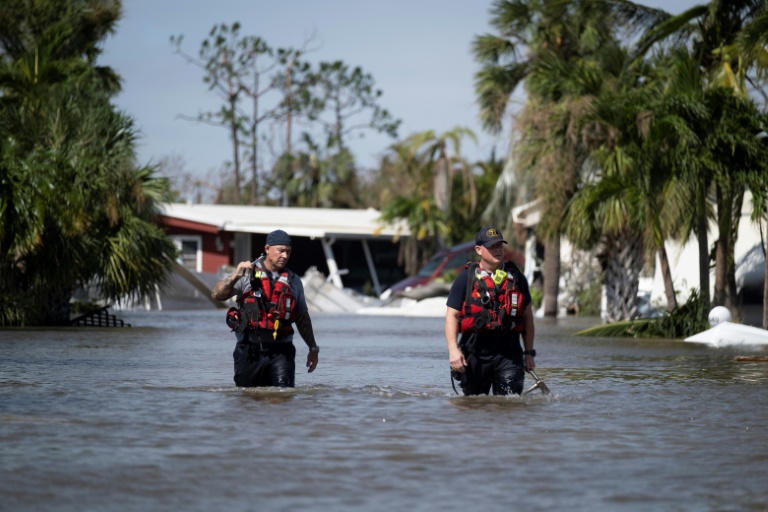
Fort Myers, where Ian came ashore as a powerful Category 4 hurricane on Wednesday, took much of the brunt, as streets became rivers and seawater poured into houses.

Dozens of boats moored in the marina were sunk while others were tossed onto downtown streets.

DeSantis described the destruction in the southwest part of his state as a “500-year flood event.”

“We’ve never seen storm surge of this magnitude,” he said.

Tom Johnson of Fort Myers had a front row seat to the destruction from his apartment on the second floor of a two-story harbourside building.

“I was scared because I’ve never been through that,” the 54-year-old told AFP. “It was just the most horrifying sounds with debris flying everywhere, doors flying off.”

His home was undamaged but one of his neighbors, Janelle Thil, was not so lucky and had to ask other residents for help after her ground floor apartment began to flood.

“They got my dogs and then I jumped out of the window and swam,” the 42-year-old said.

When Thil returned to her apartment after the storm passed, she said she opened the door and “had to wait about five minutes for all the floodwaters to come out.”

“I loved my home,” she said. “But I’m alive and that’s what matters.”

A US Coast Guard official said Thursday that helicopter crews were plucking people from the rooftops of homes inundated by floodwaters.

Eighteen migrants were missing from a boat that sank during the hurricane on Wednesday, though nine others had been rescued, the Coast Guard said. Among them were four Cubans who swam to shore in the Florida Keys.

– ‘Major disaster’ –

Much of Florida’s southwest coast was plunged into darkness after the storm wiped out power.

Tracking website PowerOutage.us said 2.1 million homes and businesses remained without electricity in the Sunshine State on Friday.

Two barrier islands near Fort Myers, Pine Island and Sanibel Island, popular with vacationers, were essentially cut off when the storm damaged causeways to the mainland.

Sanibel got “hit with really biblical storm surge,” DeSantis said, and rescuers were using boats and helicopters to evacuate residents who rode out the storm.

Biden has declared a “major disaster” in Florida, a move that frees up federal funding for storm relief.

“I want the people of Florida to know that we will be here at every step of the way,” he tweeted.

– Cuba power out –

Before pummeling Florida, Ian plunged all of Cuba into darkness after downing the island’s power network.

Electricity was gradually returning Thursday, but many homes remain without power.

Laura Mujica joined dozens of Cuban women gathered in the capital Havana on Thursday to demand electricity be restored in the city.

“We took to the street, because we haven’t had electricity for several days and we are tired of it. 

“We women decided to take to the streets to empower ourselves and protest so that the electricity will be fixed,” said the 20-year-old.

At least two people died in Pinar del Rio province, state media in the country of more than 11 million reported.

Human-induced climate change is resulting in more severe weather events across the globe, scientists say.

Hurricane Ian heads to Carolinas after regaining strength in Atlantic

Forecasters expect Hurricane Ian to cause life-threatening storm surges in the Carolinas on Friday after unleashing devastation in Florida, where it left a yet unknown number of dead in its wake.

After weakening across Florida, Ian regained its Category 1 status in the Atlantic Ocean and was headed toward the Carolinas, the US National Hurricane Center said Friday.

“Flooding rains (are) likely across the Carolinas and southwestern Virginia,” the NHC added.

The storm, one of the most powerful ever to hit the United States, left hundreds of people in need of rescue in Florida, Governor Ron DeSantis said, warning it was too early to get a clear picture of the death toll.

“We absolutely expect to have mortality from this hurricane,” he said Thursday.

DeSantis said concrete information about casualty numbers could be expected “in the coming days.” 

President Joe Biden, after a briefing at the Federal Emergency Management Agency (FEMA) headquarters, said “this could be the deadliest hurricane in Florida history.”

The numbers “are still unclear, but we’re hearing reports of what may be substantial loss of life,” he said Thursday.

Biden later declared an emergency in South Carolina, ordering federal assistance in response efforts, according to a White House statement.

The NHC has issued a hurricane warning for the entire coast of South Carolina as well as portions of Georgia and North Carolina.

Ian would likely make landfall on Friday, the NHC said, and then “rapidly weaken over the southeastern United States late Friday into Saturday.”

– ‘Horrifying’ –

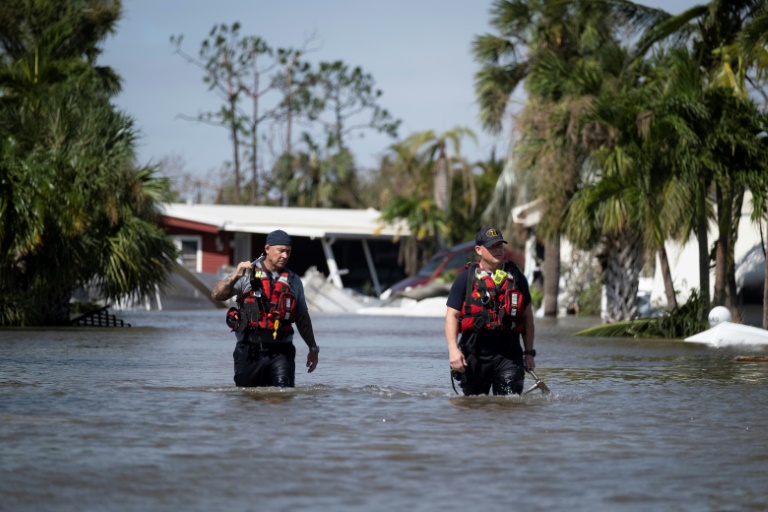
Fort Myers, where Ian came ashore as a powerful Category 4 hurricane on Wednesday, took much of the brunt, as streets became rivers and seawater poured into houses.

Dozens of boats moored in the marina were sunk while others were tossed onto downtown streets.

DeSantis described the destruction in the southwest part of his state as a “500-year flood event.”

“We’ve never seen storm surge of this magnitude,” he said.

Tom Johnson of Fort Myers had a front row seat to the destruction from his apartment on the second floor of a two-story harbourside building.

“I was scared because I’ve never been through that,” the 54-year-old told AFP. “It was just the most horrifying sounds with debris flying everywhere, doors flying off.”

His home was undamaged but one of his neighbors, Janelle Thil, was not so lucky and had to ask other residents for help after her ground floor apartment began to flood.

“They got my dogs and then I jumped out of the window and swam,” the 42-year-old said.

When Thil returned to her apartment after the storm passed, she said she opened the door and “had to wait about five minutes for all the floodwaters to come out.”

“I loved my home,” she said. “But I’m alive and that’s what matters.”

A US Coast Guard official said Thursday that helicopter crews were plucking people from the rooftops of homes inundated by floodwaters.

Eighteen migrants were missing from a boat that sank during the hurricane on Wednesday, though nine others had been rescued, the Coast Guard said. Among them were four Cubans who swam to shore in the Florida Keys.

– ‘Major disaster’ –

Much of Florida’s southwest coast was plunged into darkness after the storm wiped out power.

Tracking website PowerOutage.us said 2.1 million homes and businesses remained without electricity in the Sunshine State on Friday.

Two barrier islands near Fort Myers, Pine Island and Sanibel Island, popular with vacationers, were essentially cut off when the storm damaged causeways to the mainland.

Sanibel got “hit with really biblical storm surge,” DeSantis said, and rescuers were using boats and helicopters to evacuate residents who rode out the storm.

Biden has declared a “major disaster” in Florida, a move that frees up federal funding for storm relief.

“I want the people of Florida to know that we will be here at every step of the way,” he tweeted.

– Cuba power out –

Before pummeling Florida, Ian plunged all of Cuba into darkness after downing the island’s power network.

Electricity was gradually returning Thursday, but many homes remain without power.

Laura Mujica joined dozens of Cuban women gathered in the capital Havana on Thursday to demand electricity be restored in the city.

“We took to the street, because we haven’t had electricity for several days and we are tired of it. 

“We women decided to take to the streets to empower ourselves and protest so that the electricity will be fixed,” said the 20-year-old.

At least two people died in Pinar del Rio province, state media in the country of more than 11 million reported.

Human-induced climate change is resulting in more severe weather events across the globe, scientists say.

Markets mixed after sell-off, sterling edges up after recovery

Markets in Asia and Europe were mixed Friday after another tough day on US trading floors, with inflation continuing to soar and central bankers getting increasingly hawkish in their attempts to bring prices under control.

Sterling, however, managed to extend gains after clawing back more of the huge losses suffered at the start of the week owing to a tax-cutting mini-budget that analysts warned could cause even more pain to the already fragile UK economy.

The pound’s bounce — from a record low of $1.0350 Monday to briefly go above $1.12 Friday — came after the Bank of England pledged $71 billion of support to shattered financial markets, fearing that several pension funds could go under.

Britain’s beleaguered currency was given an extra boost by news Thursday that the budget watchdog will provide costings of new Finance Minister Kwasi Kwarteng’s fiscal plan on October 7, two weeks earlier than initially announced.

“This has helped alleviate some fears within markets given the initial optics of an uncosted large fiscal package,” said National Australia Bank’s Tapas Strickland.

Markets remain concerned about the UK economy and the impact that borrowing tens of billions of dollars will have on interest rates, with observers warning that the Bank of England could announce a 1.5 percentage point hike at its next meeting in November.

Sean Callow, at Westpac Banking Corp, said the pound’s gains this week were “a reminder that currencies are driven by a myriad of factors — it’s clearly not due to any improvement in the outlook for the UK”.

The bank’s cash injection meant it had to put on hold its plan to tighten monetary policy as part of a global effort to fight decades-high inflation.

But David Forrester, at Credit Agricole CIB, warned: “The pound is not out of the woods yet.

“While the BoE has restored some credibility to the currency, the government’s finances are another part that needs to be fixed for the pound’s rally to last.”

Still, there was some good news for new British Prime Minister Liz Truss, as official figures showed Britain’s economy grew in the second quarter, instead of shrinking as previously estimated.

– Russia worries –

In a sign of the long road ahead for finance chiefs — and the dour outlook for stocks — data out of several countries including Germany and Belgium this week showed that prices are still rising about 10 percent year-on-year.

In the United States, Federal Reserve officials again reiterated their intention to ramp up rates until they have tamed inflation, even if that means plunging the world’s top economy into recession.

And the case for a fourth successive 0.75 percentage point lift was strengthened by news that first-time unemployment benefit claims fell below 200,000 for the first time since May.

All three main indexes on Wall Street finished deep in the red, with the S&P 500 ending at its lowest level since November 2020.

On Friday, Shanghai dropped as data showed China’s manufacturing and services sectors struggled again in September from Covid lockdowns in parts of the country that have battered the world’s number-two economy.

There was also little reaction to news that Beijing would allow some cities to reduce mortgage rates for first-home purchases as it tries to support the property market.

Tokyo, Shanghai, Sydney, Seoul, Taipei, Wellington and Manila were also off.

However, Hong Kong, Mumbai, Jakarta and Bangkok rose, while London, Paris and Frankfurt also rebounded from Thursday’s losses.

“Risky assets don’t stand a chance of a meaningful rally if the economy continues to show resilience while inflation continues to be significantly above the Fed’s Funds rate,” said OANDA’s Edward Moya.

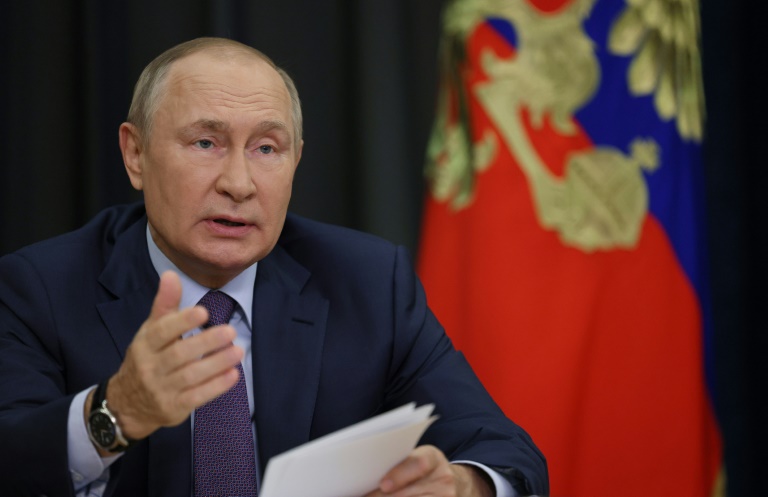
Market sentiment was also being eroded by rising fears about developments in the Ukraine war, as Russia prepares to annex four occupied regions of its neighbour Friday, with President Vladimir Putin threatening to use nuclear weapons to defend the territories.

– Key figures around 0810 GMT –

Tokyo – Nikkei 225: DOWN 1.8 percent at 25,937.21 (close)

Hong Kong – Hang Seng Index: UP 0.3 percent at 17,222.83 (close)

Shanghai – Composite: DOWN 0.6 percent at 3,024.39 (close)

London – FTSE 100: UP 0.5 percent at 6,917.32

Pound/dollar: UP at $1.1160 from $1.1116 on Thursday

Euro/dollar: UP at $0.9827 from $0.9818

Euro/pound: DOWN at 88.06 pence from 88.28 pence

Dollar/yen: DOWN at 144.40 yen from 144.42 yen

West Texas Intermediate: UP 1.0 percent at $82.06 per barrel

Brent North Sea crude: UP 0.9 percent at $89.32 per barrel

New York – Dow: DOWN 1.5 percent at 29,225.61 (close)

Markets mixed after sell-off, sterling edges up after recovery

Markets in Asia and Europe were mixed Friday after another tough day on US trading floors, with inflation continuing to soar and central bankers getting increasingly hawkish in their attempts to bring prices under control.

Sterling, however, managed to extend gains after clawing back more of the huge losses suffered at the start of the week owing to a tax-cutting mini-budget that analysts warned could cause even more pain to the already fragile UK economy.

The pound’s bounce — from a record low of $1.0350 Monday to briefly go above $1.12 Friday — came after the Bank of England pledged $71 billion of support to shattered financial markets, fearing that several pension funds could go under.

Britain’s beleaguered currency was given an extra boost by news Thursday that the budget watchdog will provide costings of new Finance Minister Kwasi Kwarteng’s fiscal plan on October 7, two weeks earlier than initially announced.

“This has helped alleviate some fears within markets given the initial optics of an uncosted large fiscal package,” said National Australia Bank’s Tapas Strickland.

Markets remain concerned about the UK economy and the impact that borrowing tens of billions of dollars will have on interest rates, with observers warning that the Bank of England could announce a 1.5 percentage point hike at its next meeting in November.

Sean Callow, at Westpac Banking Corp, said the pound’s gains this week were “a reminder that currencies are driven by a myriad of factors — it’s clearly not due to any improvement in the outlook for the UK”.

The bank’s cash injection meant it had to put on hold its plan to tighten monetary policy as part of a global effort to fight decades-high inflation.

But David Forrester, at Credit Agricole CIB, warned: “The pound is not out of the woods yet.

“While the BoE has restored some credibility to the currency, the government’s finances are another part that needs to be fixed for the pound’s rally to last.”

Still, there was some good news for new British Prime Minister Liz Truss, as official figures showed Britain’s economy grew in the second quarter, instead of shrinking as previously estimated.

– Russia worries –

In a sign of the long road ahead for finance chiefs — and the dour outlook for stocks — data out of several countries including Germany and Belgium this week showed that prices are still rising about 10 percent year-on-year.

In the United States, Federal Reserve officials again reiterated their intention to ramp up rates until they have tamed inflation, even if that means plunging the world’s top economy into recession.

And the case for a fourth successive 0.75 percentage point lift was strengthened by news that first-time unemployment benefit claims fell below 200,000 for the first time since May.

All three main indexes on Wall Street finished deep in the red, with the S&P 500 ending at its lowest level since November 2020.

On Friday, Shanghai dropped as data showed China’s manufacturing and services sectors struggled again in September from Covid lockdowns in parts of the country that have battered the world’s number-two economy.

There was also little reaction to news that Beijing would allow some cities to reduce mortgage rates for first-home purchases as it tries to support the property market.

Tokyo, Shanghai, Sydney, Seoul, Taipei, Wellington and Manila were also off.

However, Hong Kong, Mumbai, Jakarta and Bangkok rose, while London, Paris and Frankfurt also rebounded from Thursday’s losses.

“Risky assets don’t stand a chance of a meaningful rally if the economy continues to show resilience while inflation continues to be significantly above the Fed’s Funds rate,” said OANDA’s Edward Moya.

Market sentiment was also being eroded by rising fears about developments in the Ukraine war, as Russia prepares to annex four occupied regions of its neighbour Friday, with President Vladimir Putin threatening to use nuclear weapons to defend the territories.

– Key figures around 0810 GMT –

Tokyo – Nikkei 225: DOWN 1.8 percent at 25,937.21 (close)

Hong Kong – Hang Seng Index: UP 0.3 percent at 17,222.83 (close)

Shanghai – Composite: DOWN 0.6 percent at 3,024.39 (close)

London – FTSE 100: UP 0.5 percent at 6,917.32

Pound/dollar: UP at $1.1160 from $1.1116 on Thursday

Euro/dollar: UP at $0.9827 from $0.9818

Euro/pound: DOWN at 88.06 pence from 88.28 pence

Dollar/yen: DOWN at 144.40 yen from 144.42 yen

West Texas Intermediate: UP 1.0 percent at $82.06 per barrel

Brent North Sea crude: UP 0.9 percent at $89.32 per barrel

New York – Dow: DOWN 1.5 percent at 29,225.61 (close)

Kabul suicide blast kills 19, mostly girls, at education centre

A suicide bomb attack on a classroom of hundreds of people preparing for exams in the Afghan capital on Friday killed at least 19 people, with most of the casualties girls, police and a witness said. 

The blast ripped through Kaaj Higher Educational Center, which coaches mainly adult men and women ahead of university entrance tests. 

“We were around 600 in the class. But most of the casualties are among the girls,” Akbar, a student who was wounded in the attack, told AFP from a nearby hospital. 

The attack happened in the Dasht-e-Barchi neighbourhood of western Kabul, a predominantly Shiite Muslim area home to the minority Hazara community, the target of some of Afghanistan’s most deadly attacks.

“Students were preparing for an exam when a suicide bomber struck at this educational centre. Unfortunately, 19 people have been martyred and 27 others wounded,” Kabul police spokesman Khalid Zadran said.

Families rushed to area hospitals, where ambulances were arriving with victims and lists of those confirmed dead and wounded were posted on the walls. 

“We didn’t find her here,” a distressed woman looking for her sister at one of the hospitals told AFP. “She was 19 years old.”

“We are calling her but she’s not responding.”

At at least one hospital, the Taliban forced families of victims to leave the site, fearing that there could be a follow-up attack on the crowd.  

Videos posted online and photos published by local media showed bloodied victims being carried away from the scene.

“Security teams have reached the site, the nature of the attack and the details of the casualties will be released later,” Abdul Nafy Takor, the interior ministry’s spokesman, earlier tweeted.

“Attacking civilian targets proves the enemy’s inhuman cruelty and lack of moral standards.”

– Frequently attacked neighbourhood –

The Taliban’s return to power in Afghanistan last year brought an end to the two-decade war and a significant reduction in violence, but security has begun to deteriorate in recent months.

Afghanistan’s Shiite Hazaras have faced persecution for decades, with the Taliban accused of abuses against the group when they first ruled from 1996 to 2001.

Such accusations picked up again after they swept back to power.

Hazaras are also the frequent target of attacks by the Taliban’s enemy, the Islamic State armed group. Both consider them heretics.

Many attacks have devastated the Dasht-e-Barchi neighbourhood, with several targeting women, children and schools. 

Last year, before the Taliban returned to power, at least 85 people — mainly girl students — were killed and about 300 wounded when three bombs exploded near their school in the area.

No group claimed responsibility, but a year earlier IS claimed a suicide attack on an educational centre in the same neighbourhood that killed 24, including students.

In May 2020, the group was blamed for a bloody gun attack on a maternity ward of a hospital in Dasht-e-Barchi that killed 25 people, including new mothers.

And in April this year, two deadly bomb blasts at separate education centres in the area killed six people and wounded at least 20 others.

Education is a flashpoint issue in Afghanistan, with the Taliban blocking many girls from returning to secondary education, while the Islamic State also stands against the education of women and girls.

Close Bitnami banner
Bitnami