World

Stocks and oil drop as dollar gains on recession, Ukraine fears

Equities and crude prices fell while the dollar held at multi-year highs Wednesday as recession fears mount and traders grow increasingly concerned about tensions between Russia and the West.

Investors are keeping a close eye on London, after new finance minister Kwasi Kwarteng’s tax-cutting last week sent shock waves through markets, pushing the pound to a record low and leading to dire warnings for Britain’s economy.

While Asia saw small gains Tuesday, New York and Europe ended mostly in the red again, with Wall Street jolted by data showing a surprise improvement in US consumer confidence — likely because of a dip in petrol prices — and a jump in home sales.

The figures pointed to resilience in the world’s top economy despite three successive bumper Federal Reserve rate hikes — and expectations for another in November — as it tries to tame four-decade-high inflation.

Several Fed officials have lined up this week to reassert their determination to keep hiking until prices are brought under control, even at the cost of a recession.

Observers are now betting that borrowing costs will top out at around 4.75 percent next year, and some policymakers have suggested they could remain elevated for some time.

The prospect of such tight monetary policy has battered equities, as US 10-year Treasury yields — a gauge of future rates — hit four percent for the first time since 2010.

The Dow and S&P 500 ended down Tuesday, though the Nasdaq enjoyed a slight uptick. 

Asia resumed its downtrend Wednesday, with Hong Kong down more than three percent, while Seoul, Taipei and Manila sank more than two percent. Tokyo, Shanghai and Singapore were off more than one percent.

There were also losses in Sydney, Wellington, Bangkok and Mumbai, while London, Paris and Frankfurt were also sharply lower.

– Russia nuclear warning –

The dollar remains the go-to unit as the Fed leads the way in central bank tightening.

“The fact we have such a strong increase in US yields is attracting flows into the US dollar,” said Nannette Hechler-Fayd’herbe, of Credit Suisse Group AG.

“As long as monetary and fiscal policy worldwide are really not coming to strengthen their own currencies, we should be anticipating a very strong dollar.”

The greenback rose against sterling, with the British currency battered by concerns that Kwarteng’s spending plan would ramp up borrowing just as the Bank of England was trying to hike rates to fight inflation, causing consternation among many observers.

The dollar was also approaching 145 yen, having sunk from a high close to 146 yen after the Japanese government intervened last week to support its currency. 

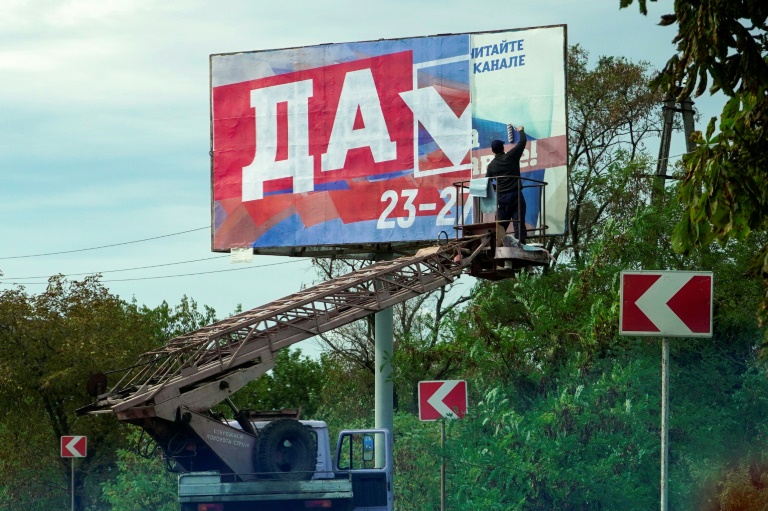
Sentiment was also rattled by worries about developments in Ukraine, after Kremlin-installed authorities in four regions under Russian control claimed victory in annexation votes, with Moscow warning it could use nuclear weapons to defend the territories.

Ukraine and its allies have denounced the so-called referendums as a sham, saying the West would never recognise the results.

In response, Kyiv on Wednesday called for the West to “significantly” increase its military aid to Ukraine.  

But former Russian leader Dmitry Medvedev — an ally of President Vladimir Putin and now deputy chairman of the country’s security council — issued a stark warning that Moscow was ready to act decisively.

“I want to remind you — the deaf who hear only themselves: Russia has the right to use nuclear weapons if necessary,” he said on social media.

On crude markets, both main contracts were down more than two percent on recession worries and as Bloomberg quoted sources saying that US inventories increased more than four million barrels last week.

The drop comes despite a report that Moscow is calling on OPEC and other major groups to slash output by a million barrels a day when they meet next week.

“With Brent trading only a little above $80 and WTI below, you have to wonder how much more OPEC+ will tolerate, and the size of (any) output cut they may be considering next week in light of the new economic outlook and price,” said OANDA’s Craig Erlam.

– Key figures at around 0810 GMT –

Tokyo – Nikkei 225: DOWN 1.5 percent at 26,173.98 (close)

Hong Kong – Hang Seng Index: DOWN 3.4 percent at 17,250.88 (close)

Shanghai – Composite: DOWN 1.6 percent at 3,045.07 (close)

London – FTSE 100: DOWN 2.0 percent at 6,845.82

Pound/dollar: DOWN at $1.0680 from $1.0730 on Tuesday

Euro/dollar: DOWN at $0.9562 from $0.9595

Euro/pound: UP at 89.50 pence from 89.39 pence 

Dollar/yen: DOWN at 144.60 yen from 144.81 yen

West Texas Intermediate: DOWN 2.2 percent at $76.76 per barrel

Brent North Sea crude: DOWN 2.1 percent at $84.50 per barrel

New York – Dow: DOWN 0.4 percent at 29,134.99 (close)

US will operate 'undaunted, unafraid' in Taiwan Strait: Harris

Washington will operate “undaunted and unafraid” throughout Asia, including the Taiwan Strait, US Vice President Kamala Harris said Wednesday as she addressed American troops in Japan.

Speaking after attending Tuesday’s funeral for assassinated former Japanese leader Shinzo Abe, Harris accused China of “disturbing behaviour” in the East China Sea and South China Sea and “provocations across the Taiwan Strait”.

“The United States believes that peace and stability in the Taiwan Strait is an essential feature of a free and open Indo-Pacific,” she said, using Washington’s term for the Asia-Pacific region.

“We will continue to fly, sail and operate, undaunted and unafraid, wherever and whenever international law allows,” she added.

Beijing claims both democratic Taiwan and the narrow body of water separating the island from mainland China — one of the world’s busiest shipping channels.

The United States has long used “freedom of navigation” passages through the Taiwan Strait to push back against Chinese claims, and Western allies have increasingly joined these operations.

Harris restated Washington’s longstanding opposition to any unilateral attempt by Beijing to take control of Taiwan and pledged ongoing US support for the island’s self-defence.

In recent months, US President Joe Biden has said American troops would come to Taiwan’s aid in the event of a Chinese invasion, despite Washington’s official policy of “strategic ambiguity” on the matter.

The White House has said there is no change to that policy and Harris did not address Biden’s comments in her remarks to troops on the USS Howard at the Yokosuka Naval Base outside Tokyo.

She also slammed Russia for “attempting to annex the territory of another sovereign nation” in a reference to votes organised by Moscow in occupied areas of Ukraine.

And she accused North Korea of threatening regional stability with fresh missile launches.

Washington “does not seek conflict with China”, Harris said, but “we anticipate continued aggressive behaviour from Beijing as it attempts to unilaterally undermine the status quo”.

Harris leaves Japan later Wednesday for South Korea, where she will visit the Demilitarized Zone.

Iranian woman died of 'blow to the head': family in Iraq

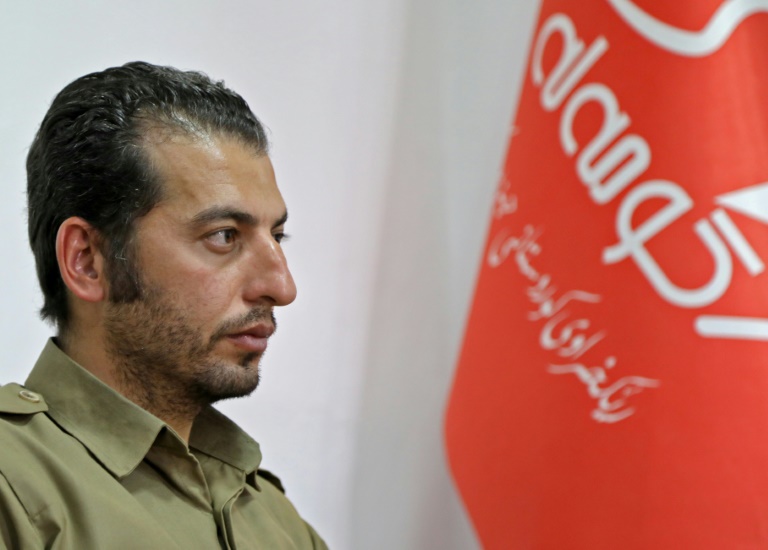
Iranian Kurdish woman Mahsa Amini was visiting Tehran with her family when she encountered the notorious morality police and died after a “violent blow to the head”, her cousin living in Iraq said.

“Jhina’s death has opened the doors of popular anger,” said Erfan Salih Mortezaee, 34, using Amini’s Kurdish first name and referring to the ongoing wave of protests that her death has sparked.

In a phone call after the young woman’s death was announced, Amini’s mother told him what happened when her 22-year-old daughter was detained, Mortezaee said.

AFP spoke with Mortezaee in Iraq’s autonomous Kurdistan region — bordering Amini’s native Kurdistan province in Iran — where he has been living for a year.

There he joined Iranian Kurdish nationalist group Komala, which has conducted a long-running cross-border insurgency against the Tehran authorities, seeking autonomy for Kurdish-populated areas of northwestern Iran.

Mortezaee said that, before starting university, Amini had gone to Tehran with her parents and 17-year-old brother to visit relatives.

On September 13, Amini, her brother and female relatives went out in the capital.

On leaving the Haghani underground station, “the morality police stopped them, arresting Jhina and her relatives,” Mortezaee said.

Wearing military fatigues and speaking at a Komala base in the Sulaimaniyah area of northern Iraq, Mortezaee said Amini’s brother tried to tell the police that they were “in Tehran for the first time” and “did not know the (local) traditions”.

But his appeals fell on deaf ears.

– Beatings –

“The police officer told him, ‘We are going to take her in, instil the rules in her and teach her how to wear the hijab and how to dress’,” Mortezaee said.

Amini was “dressed normally. Like all women in Iran, she was wearing the hijab,” her cousin added.

In Iran, women — regardless of their faith — are required to cover their hair, and the morality police bans them from wearing coats above the knee, tight trousers, bright colours or torn jeans.

The code has been widely skirted for decades, particularly in major cities, but there have been periodic crackdowns.

“The police officers hit Jhina, they hit her in front of her brother,” Mortezaee said.

“They slapped her, they hit her hands and legs with a baton,” said Mortezaee, adding that they also sprayed her brother in the face with pepper spray.

Jhina and her relatives were forced into the morality police van and taken to a station on Vezarat Street. 

The beatings continued during the ride, Mortezaee said.

“When they hit her in the head with the baton, she lost consciousness,” he said. “One of the officers said: ‘She’s putting on an act’.”

After they arrived, it was at least another hour and a half before she was taken to a Tehran hospital, despite pleas from her relatives, Mortezaee said.

After three days in a coma, she was pronounced dead.

– ‘Better life’ –

Amini’s mother said doctors at the hospital told the family that her daughter “had received a violent blow to the head”, Mortezaee said.

Iranian authorities have denied all involvement in Amini’s death, which has sparked 12 consecutive nights of protests and a security crackdown.

“What is happening in Kurdistan and everywhere else in Iran is popular anger against the Islamic republic’s regime, against the dictatorship,” Mortezaee said.

At least 76 people have been killed in the demonstrations, according to the Oslo-based group Iran Human Rights (IHR), while Iran’s semi-official Fars news agency has put the toll at “around 60”.

Authorities said Monday they had made more than 1,200 arrests.

The protests come at a particularly sensitive time for Iran’s leadership, when the country’s economy remains mired in a crisis largely caused by US sanctions over its nuclear programme.

The country has seen protests in recent years, including deadly demonstrations in November 2019 over fuel price rises.

But this time “women are taking the lead and are actively taking part in the protests”, Mortezaee said.

“Women are participating in the demonstrations courageously and are taking to the streets, day and night,” he said.

“We the youth know that if this regime falls, a better life awaits us.”

China's offshore yuan hits record low against dollar

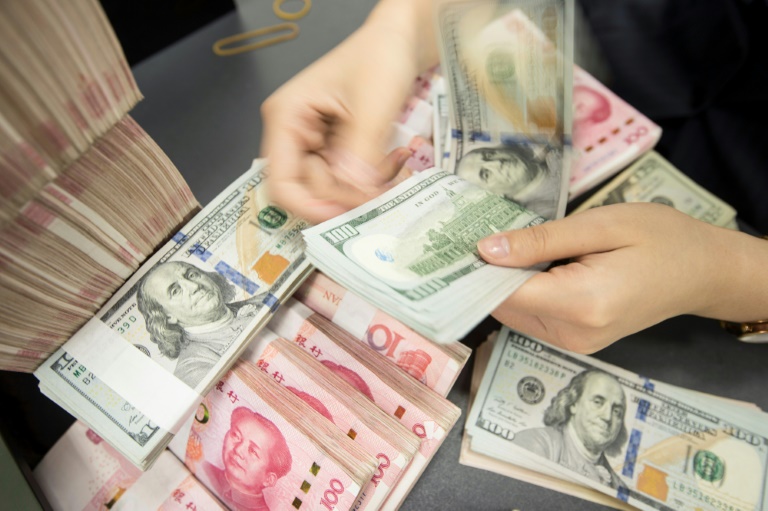
China’s yuan hit a record low against the surging US dollar in offshore trading Wednesday, despite recent efforts by the country’s central bank to shore up the currency.

The offshore yuan — which is circulated outside mainland China and is more freely traded than currency in the domestic market — fell to 7.2386 against the dollar on Wednesday, according to Bloomberg. 

That is its weakest level since clearing banks in Hong Kong were given the go-ahead to open renminbi accounts freely in 2010.

The US Federal Reserve’s increasingly hawkish tone and expectations of further interest rate hikes to fight soaring inflation have seen investors pile into the dollar, sending it to record or multi-decade peaks against other major currencies.

The onshore yuan, which is not freely convertible and limited to a two percent range on either side of a central parity rate set each day, also extended its slump to a 14-year low of 7.2297 per dollar Wednesday.

The depreciation comes despite recent efforts by the Chinese central bank to protect the currency’s value without directly intervening, including a decision to raise the foreign exchange risk reserve ratio.

The move, announced by the People’s Bank of China on Monday, effectively makes it more expensive for financial institutions to sell yuan and buy dollars.

The Chinese economy has been hammered in recent months by Covid-related curbs, extreme weather, and a property market slump.

The sharp slowdown in economic growth had led officials to announce a series of easing measures in recent months to provide support, but putting pressure on the yuan as the US Federal Reserve continues to tighten policy.

But the yuan’s depreciation could mean “the central bank will have to at least pay more attention than in the past” to balancing domestic stimulus and its foreign exchange policies, Tianfeng Securities analysts wrote in a note Tuesday. 

Body of missing US ski mountaineer found in Nepal

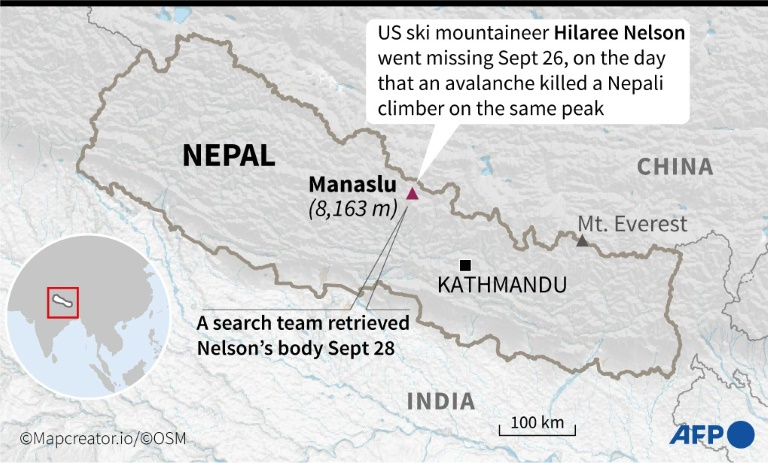
A search team retrieved the body of top US ski mountaineer Hilaree Nelson from the Himalayas on Wednesday, two days after she disappeared on the slopes of Nepal’s Manaslu peak.

Nelson slipped and went missing while skiing down the world’s eighth-highest mountain, after a successful summit with her partner Jim Morrison on Monday. 

Morrison led the search operations and had left Wednesday morning on a helicopter to resume efforts to locate her. 

“The search team that left this morning on a helicopter spotted her body and is bringing her back,” Jiban Ghimire of Shangri-La Nepal Trek, which organised the expedition, told AFP.

Ghimire said that the body was brought to the peak’s base camp and will later be flown to Kathmandu. 

Nelson, 49, is described by her sponsor, The North Face, as “the most prolific ski mountaineer of her generation”.

A decade ago, she became the first woman to summit both the highest mountain in the world, Everest, and the adjacent Lhotse peak within the span of 24 hours.

In 2018, she returned to Lhotse and made the first ski descent of the mountain, which earned her the National Geographic Adventurer of the Year award.

In an Instagram post last week, Nelson said her latest climb had been deeply challenging because of “incessant rain” and dangerous conditions.

“I haven’t felt as sure-footed on Manaslu as I have on past adventure into the thin atmosphere of the high Himalaya,” Nelson wrote in a post on Thursday.

“These past weeks have tested my resilience in new ways.”

-‘Let’s pray for Hilaree’ –

Mountaineers and well-wishers had earlier shared messages of support on social media, hoping for Nelson’s safe return.

“Let’s pray for Hilaree,” fellow The North Face athlete Fernanda Maciel, currently at the Manaslu base camp, wrote on Instagram on Tuesday.

Constant rain and snow have been a challenge for the 404 paying climbers attempting to reach the summit of Manaslu this year.

On the same day as Nelson’s accident, an avalanche hit between Camps 3 and 4 on the 8,163-metre (26,781-foot) mountain, killing Nepali climber Anup Rai and injuring a dozen others who were later rescued.

The deaths of Nelson and Rai are the first confirmed casualties of the autumn climbing season in Nepal.

Nepal is home to eight of the world’s 14 highest peaks and foreign climbers who flock to its mountains are a major source of revenue for the country.

The industry was almost completely shut down due to the coronavirus pandemic in 2020, but the country reopened its peaks to mountaineers last year.

Body of missing US ski mountaineer found in Nepal

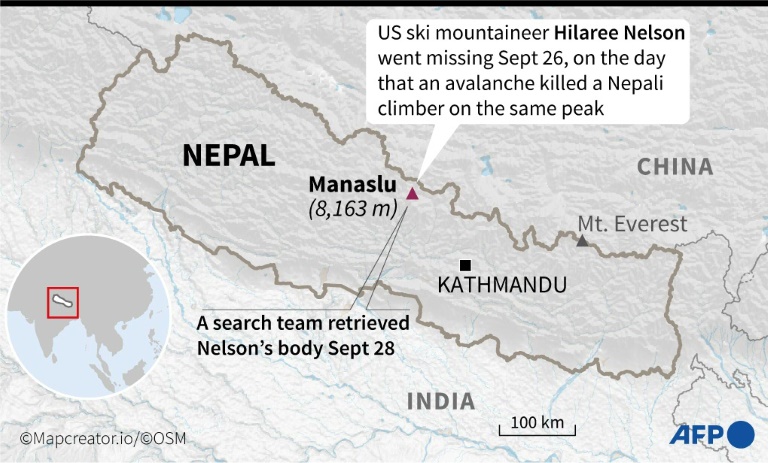
A search team retrieved the body of top US ski mountaineer Hilaree Nelson from the Himalayas on Wednesday, two days after she disappeared on the slopes of Nepal’s Manaslu peak.

Nelson slipped and went missing while skiing down the world’s eighth-highest mountain, after a successful summit with her partner Jim Morrison on Monday. 

Morrison led the search operations and had left Wednesday morning on a helicopter to resume efforts to locate her. 

“The search team that left this morning on a helicopter spotted her body and is bringing her back,” Jiban Ghimire of Shangri-La Nepal Trek, which organised the expedition, told AFP.

Ghimire said that the body was brought to the peak’s base camp and will later be flown to Kathmandu. 

Nelson, 49, is described by her sponsor, The North Face, as “the most prolific ski mountaineer of her generation”.

A decade ago, she became the first woman to summit both the highest mountain in the world, Everest, and the adjacent Lhotse peak within the span of 24 hours.

In 2018, she returned to Lhotse and made the first ski descent of the mountain, which earned her the National Geographic Adventurer of the Year award.

In an Instagram post last week, Nelson said her latest climb had been deeply challenging because of “incessant rain” and dangerous conditions.

“I haven’t felt as sure-footed on Manaslu as I have on past adventure into the thin atmosphere of the high Himalaya,” Nelson wrote in a post on Thursday.

“These past weeks have tested my resilience in new ways.”

-‘Let’s pray for Hilaree’ –

Mountaineers and well-wishers had earlier shared messages of support on social media, hoping for Nelson’s safe return.

“Let’s pray for Hilaree,” fellow The North Face athlete Fernanda Maciel, currently at the Manaslu base camp, wrote on Instagram on Tuesday.

Constant rain and snow have been a challenge for the 404 paying climbers attempting to reach the summit of Manaslu this year.

On the same day as Nelson’s accident, an avalanche hit between Camps 3 and 4 on the 8,163-metre (26,781-foot) mountain, killing Nepali climber Anup Rai and injuring a dozen others who were later rescued.

The deaths of Nelson and Rai are the first confirmed casualties of the autumn climbing season in Nepal.

Nepal is home to eight of the world’s 14 highest peaks and foreign climbers who flock to its mountains are a major source of revenue for the country.

The industry was almost completely shut down due to the coronavirus pandemic in 2020, but the country reopened its peaks to mountaineers last year.

In Brazil election run-up, even samba is political

In Pedra do Sal, the birthplace of samba in Rio de Janeiro, supporters chant “Ole, Ola, Lula” as they sway rhythmically, brandishing flags, T-shirts and caps bearing the likeness of Brazilian presidential candidate Luiz Inacio Lula da Silva.

In a nod to the symbolism of samba’s Afro-Brazilian character in a country of divisive identity politics, the leftist ex-president chose the Portela samba school for one of his final rallies before Sunday’s first round of presidential elections.

“Samba is a way to resist oppression, it is the voice of the people. And Lula represents the people,” says Karen Gama, a 24-year-old black Brazilian who attended the rally last week with stickers of Lula’s Workers Party stuck to her chest and rear.

She was among thousands dressed in red — the color of Lula’s Workers Party — who turned out to listen to the former steelworker who is seeking a third term as president, already having served from 2003 to 2010. 

His main rival is far-right incumbent Jair Bolsonaro, whose government is closely allied to conservative and evangelical movements often hostile to samba and its association with Afro-Brazilian culture and religions.

– Pragmatic – 

“By coming here, he (Lula) returns to his popular base,” says Joao Diamante, who grew up in a Rio favela. 

Diamante, a chef, said he was able to study gastronomy thanks to the university scholarships put in place under the Lula presidency for young people from low-income backgrounds. 

“We came here to cheer on the only president who valued us, black people and minorities. We were extremely attacked during the Bolsonaro mandate,” says Douglas Williams, a 30-year-old nurse with an LGBTQ flag wrapped around his head.

Samba has not always been associated with left-wing ideas, says Wagner Pralon Mancuso, a professor of political science at the University of Sao Paulo. 

“There are well-known samba schools that exalted Brazil during the military dictatorship (1964-1985),” he says.

More recently, several Rio samba schools supported Marcelo Crivella, a pastor of the evangelical right, in his successful 2016 campaign for the mayorship of the city. 

Samba “schools are pragmatic because they depend on public funds,” explains Marco Teixeira, a political scientist at the Getulio Vargas Foundation.

And Veiga de Almeida Guilherme Guaral, an academic who studied the links between politics and samba, says that “today, schools remember that the governments of Lula supported cultural events.”

– ‘Form of resistance’ –

Earlier this month, the band Samba Independente dos Bons Costumes, believing themselves in friendly territory, were booed off the stage when they played a pro-Lula song at a Rio concert.

“Art is an essential political tool in our democracy, and samba is political in essence,” the group said in a response on Instagram.

“In other words, much more than a musical genre, samba is an instrument of socio-political change.” 

Claudio Cruz, the owner of a samba bar in central Rio, agrees. 

“Samba has always been a form of resistance to inequality, so it is more than normal that the world of samba supports Lula today,” says Cruz, who has installed a 10-meter (33-foot) helium-filled figurine of Lula on the sidewalk outside his bar.

Pakistan FM warns of consequences to Taliban isolation

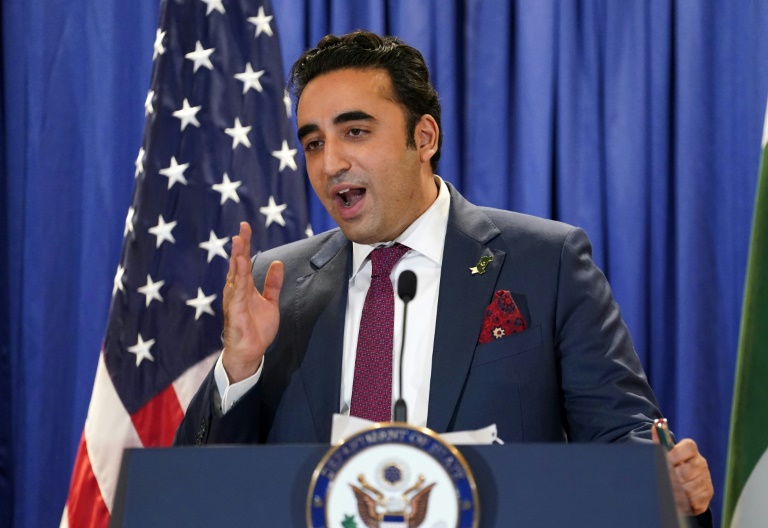
Pakistan’s foreign minister wants the world to engage the Taliban, warning of dangerous consequences if Afghanistan’s rulers are again isolated.

In an interview with AFP on a visit to Washington, Bilawal Bhutto Zardari cautioned against creating “parallel governance” after the United States, distrustful of the Taliban, put Afghanistan’s frozen assets in a professional fund in Switzerland.

“We’ve learned from the past that when we wash our hands and turn our backs, we end up creating unintended consequences and more problems for ourselves,” Bhutto Zardari said Tuesday.

“I believe that our concerns of an economic collapse, of an exodus of refugees, of a threat of new recruits for organizations such as ISIS-K and others, outweigh concerns that there may be about their financial institutions.”

The Taliban returned to power last year after the United States ended a two-decade war. Relations had soured with Pakistan, whose powerful military and intelligence apparatus was accused in Washington of quietly nurturing the Islamist militants despite providing logistical access to US forces.

In contrast to some previous Pakistani officials, the foreign minister — whose mother, former prime minister Benazir Bhutto, was assassinated in 2007 — offered no warm words for the Taliban.

But he said the militants needed “political space” on concerns such as women’s rights, which have been sharply curtailed.

“Throughout history, theocratic, autocratic regimes haven’t exactly tended to expand rights at times of economic strife,” he said.

“In fact, they tend to hold on to cultural issues and other issues to engage their population.”

The United States came away unpersuaded from a series of talks with the Taliban and in August said the militants had violated promises by welcoming Al-Qaeda leader Ayman al-Zawahiri, who was found at a house in Kabul and killed in a US strike.

– ‘Great power rivalries’ –


Bhutto Zardari, the Oxford-educated 34-year-old scion of a preeminent political dynasty, took office five months ago amid political turbulence in Pakistan after a no-confidence vote in former prime minister Imran Khan.

The strife comes as Pakistan is ravaged by floods that have submerged one-third of the country, displacing millions.

At a meeting Monday, US Secretary of State Antony Blinken promised long-term support. In a message less welcome by Pakistan, the top US diplomat also called on Islamabad to ask China to restructure debt accumulated as Beijing builds billions of dollars of infrastructure in a quest for Indian Ocean port access.

Asked about Blinken’s remarks, Bhutto Zardari said he has had “very productive conversations” with China and said he hoped that assistance after the historic floods “does not fall prey to great power rivalries and geostrategic issues.”

With Beijing seen by many Pakistanis as an uncritical ally, successive governments in Islamabad have rebuffed US calls to weigh in on the mass incarceration of Uyghurs and other mostly Muslim people, a campaign Washington calls genocide.

“I’m sure that the United States would like for us to comment more on China’s internal affairs,” Bhutto Zardari said.

“But maybe if we start by addressing disputes that are recognized by bodies such as the United Nations as disputes of an international nature, that would be more productive.”

He was referring to Kashmir, the Himalayan territory divided between India and Pakistan and the trigger for two of their three full-fledged wars.

Indian Prime Minister Narendra Modi, a Hindu nationalist, in 2019 stripped Muslim-majority Jammu and Kashmir of its historic autonomy and opened the way for other Indian citizens to live there.

Bhutto Zardari recalled that when his Pakistan People’s Party was in power in 2010, it moved to open  trade with India, then led by prime minister Manmohan Singh.

“We were willing to take the political risk, stick our necks on the line, and touch the third rail of Pakistani politics — but because we knew that there was a rational, reasonable player on the other end who would perhaps be willing to reciprocate,” Bhutto Zardari said.

“Unfortunately, that space does not exist today. It’s a very different India.”

Typhoon Noru tears across Vietnam

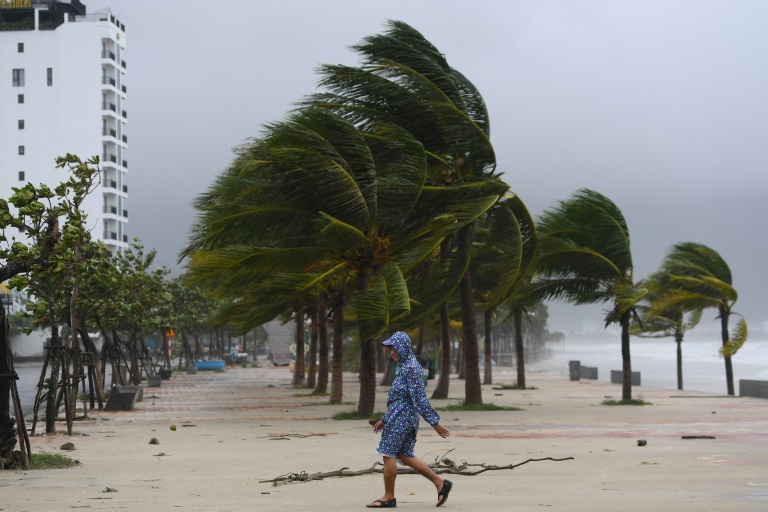
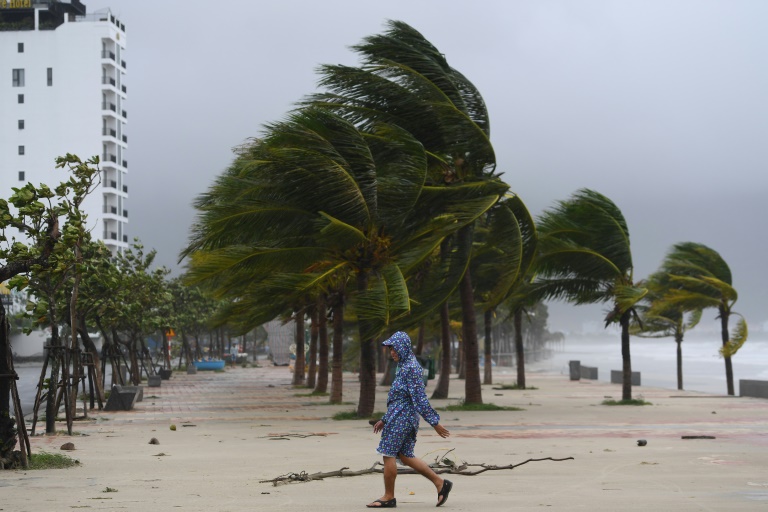
Typhoon Noru tore roofs from homes and caused power outages across central Vietnam Wednesday, with hundreds of thousands of people taking refuge after the storm claimed at least 10 lives in the Philippines.

In Danang, Vietnam’s third-largest city, high-rise buildings shook as the typhoon made landfall in the early hours of Wednesday, bringing winds of up to around 120 kilometres (75 miles) per hour, according to the national forecaster.

More than 300,000 people in Vietnam hunkered down in shelters overnight, after forecasters predicted the storm would be one of the biggest to ever hit the country.

Wind speeds were lower than initially feared, but forecasters said heavy rain would continue into the day and warned of landslides and serious flooding.

The defence ministry has mobilised around 40,000 soldiers and 200,000 militia members, equipped with armoured vehicles and boats in preparation for rescue and relief operations, state media said.

In the popular tourist city of Hoi An, the Hoai River was close to bursting its banks, while the ground was littered with metal roof sheeting and fallen trees which had damaged cars and blocked roads.

“The typhoon was terrible last night. I could not sleep as the wind was so strong and loud,” resident Nguyen Thi Hien told AFP.

Around 300 houses in the coastal province of Quang Tri had their roofs blown off late Tuesday as the wind began picking up speed.

“I heard the sound of fallen trees and signboards outside. I was scared. But we were prepared so luckily the losses were not that bad.”

Residents rushed to clean up the debris early Wednesday, with some shops already open and tourists walking the streets.

Almost half of Vietnam’s airports have been closed since midday Tuesday, with schools and offices across several central provinces also shut, while Danang banned the public from going out on the streets.

The central section of the highway linking Hanoi in the north with commercial hub Ho Chi Minh City in the south was closed.

– Deaths in Philippines –

The Vietnam impact came after Noru slammed into the Philippines earlier this week as a super typhoon with winds of up to 195 kph, leaving 10 dead and eight missing, the civil defence office said.

Noru was forecast to continue moving inland Wednesday, passing over Laos before hitting Thailand’s northeastern Ubon Ratchathani province on Thursday and gradually weakening into a tropical depression.

The Thai authorities warned of heavy rain, and possible flash flooding, and said people living in high-risk areas should prepare to evacuate their homes.

Vietnam is frequently lashed by heavy storms in the rainy season between June and November, with central coastal provinces the worst affected, but scientists have warned they are becoming more powerful as the world gets warmer because of climate change.

Typhoon Noru tears across Vietnam

Typhoon Noru tore roofs from homes and caused power outages across central Vietnam Wednesday, with hundreds of thousands of people taking refuge after the storm claimed at least 10 lives in the Philippines.

In Danang, Vietnam’s third-largest city, high-rise buildings shook as the typhoon made landfall in the early hours of Wednesday, bringing winds of up to around 120 kilometres (75 miles) per hour, according to the national forecaster.

More than 300,000 people in Vietnam hunkered down in shelters overnight, after forecasters predicted the storm would be one of the biggest to ever hit the country.

Wind speeds were lower than initially feared, but forecasters said heavy rain would continue into the day and warned of landslides and serious flooding.

The defence ministry has mobilised around 40,000 soldiers and 200,000 militia members, equipped with armoured vehicles and boats in preparation for rescue and relief operations, state media said.

In the popular tourist city of Hoi An, the Hoai River was close to bursting its banks, while the ground was littered with metal roof sheeting and fallen trees which had damaged cars and blocked roads.

“The typhoon was terrible last night. I could not sleep as the wind was so strong and loud,” resident Nguyen Thi Hien told AFP.

Around 300 houses in the coastal province of Quang Tri had their roofs blown off late Tuesday as the wind began picking up speed.

“I heard the sound of fallen trees and signboards outside. I was scared. But we were prepared so luckily the losses were not that bad.”

Residents rushed to clean up the debris early Wednesday, with some shops already open and tourists walking the streets.

Almost half of Vietnam’s airports have been closed since midday Tuesday, with schools and offices across several central provinces also shut, while Danang banned the public from going out on the streets.

The central section of the highway linking Hanoi in the north with commercial hub Ho Chi Minh City in the south was closed.

– Deaths in Philippines –

The Vietnam impact came after Noru slammed into the Philippines earlier this week as a super typhoon with winds of up to 195 kph, leaving 10 dead and eight missing, the civil defence office said.

Noru was forecast to continue moving inland Wednesday, passing over Laos before hitting Thailand’s northeastern Ubon Ratchathani province on Thursday and gradually weakening into a tropical depression.

The Thai authorities warned of heavy rain, and possible flash flooding, and said people living in high-risk areas should prepare to evacuate their homes.

Vietnam is frequently lashed by heavy storms in the rainy season between June and November, with central coastal provinces the worst affected, but scientists have warned they are becoming more powerful as the world gets warmer because of climate change.

Close Bitnami banner
Bitnami