World

Pound hits record low versus dollar, markets hit by recession fears

The pound hit a record low against the dollar Monday on surging fears about the UK economy after the government unveiled a huge tax-cutting budget.

The selloff came as equity markets across Asia and Europe fell again owing to a growing expectation that central bank interest rate hikes to fight runaway inflation would lead to deep and painful recessions. Oil also suffered more hefty selling.

Officials in several countries including the United States, Britain, Switzerland and Sweden announced more increases in the cost of borrowing.

The moves sent equity markets deep into the red again after officials reiterated their focus on fighting inflation, even if that means causing a recession.

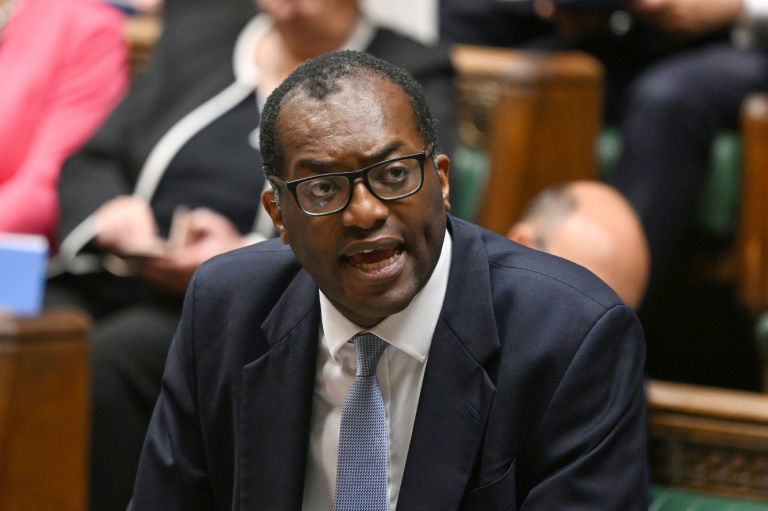
But the biggest casualty of the week was the pound, which fell below $1.10 for the first time since 1985 as new finance minister Kwasi Kwarteng announced his controversial mini-budget.

It then extended the losses Monday to briefly touch an all-time low of $1.0350 in Asian trade after he said he intended to unveil further reductions, despite his budget causing ructions on London’s markets.

It also fell to a two-year low against the euro, though the single currency remains under pressure against the dollar, sitting at 2002 levels.

Now, observers are warning that the pound could fall even further.

“The pound’s crash is showing markets have a lack of confidence in the UK and that its financial strength is under siege,” said Jessica Amir, of Saxo Capital Markets. 

“The pound is a whisker away from parity and the situation is going to only worsen from here.”

Kwarteng, who was appointed by Liz Truss after she became prime minister earlier this month, said he planned to slash taxes to kickstart the British economy and provide cash to cushion families from rocketing energy costs.

But investors were spooked by the huge amount of borrowing likely needed for the multi-billion-pound package, which critics said would benefit the rich far more than the poorest during a cost-of-living crisis.

Sterling’s drop has led to speculation the Bank of England will have to step in with an emergency interest rate hike to give the currency a much-needed shot in the arm.

– ‘Macau casinos soar’ –

“Whether or not the UK government announcement of the biggest tax reduction since 1972… will in time yield a significant growth dividend is not something markets are yet willing to contemplate,” said National Australia Bank’s Ray Attrill.

“Instead, they were consumed by worries over the scale of near-term UK government financing needs, at a time when the current account deficit is running at more than eight percent of GDP.”

He added: “Chatter about a possible UK sovereign rating downgrade has already begun.”

And former US treasury secretary Lawrence Summers was scathing of Britain’s recent monetary policy decisions.

“It makes me very sorry to say, but I think the UK is behaving a bit like an emerging market turning itself into a submerging market,” he told Bloomberg Television’s Wall Street Week last week.

“Between Brexit, how far the Bank of England got behind the curve and now these fiscal policies, I think Britain will be remembered for having (pursued) the worst macroeconomic policies of any major country in a long time.”

The collapse in sterling came as markets across the world are sent into a spin by recession worries caused by a sharp tightening of monetary policy by central banks fighting decades-high inflation. 

New York’s three main indexes ended well down, with the Dow at a two-year low, and Asia followed suit.

Tokyo shed more than two percent as traders there returned from a long weekend break, while Seoul was off more than three percent, with Sydney, Shanghai, Mumbai, Singapore, Taipei and Jakarta also tanking.

Hong Kong was also down having reversed early gains that came after the city said it would relax strict hotel quarantine measures for international travellers.

Still, Macau casino stocks rallied as the city said it would accept Chinese tour groups again from November, having been blocked during the pandemic.

London edged up tentatively after Friday’s hammering, while Paris and Frankfurt were also higher.

Oil prices ticked lower, extending the big losses suffered Friday as expectations that a recession is looming hammer demand expectations.

The surging greenback added to the sell-off in crude, which is priced in dollars and therefore ore expensive for buyers using other currencies. 

Both main contracts are sitting at their lowest levels since January, having wiped out all the gains seen in the wake of Russia’s invasion of Ukraine.

Black Gold Investors’ Gary Ross described the strong dollar as “a wrecking ball for commodities”.

– Key figures at around 0810 GMT –

Pound/dollar: DOWN at $1.0700 from $1.0852 on Friday

Euro/pound: UP at 90.40 pence from 89.28 pence 

Euro/dollar: DOWN at $ 0.9673 from 0.9695

Dollar/yen: UP at 143.96 yen from 143.31 yen

London – FTSE 100: UP 0.3 percent at 7,039.64

Tokyo – Nikkei 225: DOWN 2.7 percent at 26,431.55 (close)

Hong Kong – Hang Seng Index: DOWN 0.4 percent at 17,855.14 (close)

Shanghai – Composite: DOWN 1.2 percent at 3,051.23 (close)

West Texas Intermediate: DOWN 0.2 percent at $78.58 per barrel

Brent North Sea crude: DOWN 0.4 percent at $85.84 per barrel

New York – Dow: DOWN 1.6 percent at 29,590.41 (close)

'I'm no cannon fodder': Russians flee to Georgia

Nikita spent two days in traffic before he made it to Georgia, one of the thousands of Russian men seeking to evade the Ukraine war draft.

The latest wave of Russian exiles since the war began in February has seen military-aged men pour into the Caucasus country — by cars in a column stretching for some 20 kilometres, by bicycles and some walking kilometres by foot to the border crossing. 

“I have no choice but to flee Russia,” Nikita told AFP standing outside the Georgian side of the Kazbegi border crossing in a narrow rocky ravine. 

“Why on earth would I need to go to that crazy war?” the 23-year-old added “I am no cannon fodder. I am not a murderer,” he said as a vulture circled overhead, high in the clear sky. 

Like the majority of men who talked to AFP, he declined to give his last name fearing retribution.

Denis, 38, said: “Our president wants to drag all of us in the fratricidal war, which he declared on totally illegitimate grounds.”

“I want to escape,” he said with a sad smile. “To me, this is not a nice Georgia holiday, this is an emigration.”

Alexander Sudakov, a 32-year-old production manager, said “The mobilisation was the final straw” to him after twenty years of living under President Vladimir Putin’s increasingly authoritarian rule.

“Ukrainians are our brothers, I don’t understand, how could I go there to kill them, or to be killed.”

He said Georgia was the top choice for those fleeing the draft because Russians can enter and stay up to a year without a visa.

He said he would mull seeking asylum in a European Union country once his wife and baby son, whom he left behind in his native Saint Petersburg, join him.

The influx of Russian immigrants has sparked mixed feelings in a country where  painful memories of Russia’s 2008 invasion are still fresh.

The five-day war left Georgia partitioned, with Russian troops stationed in its two separatist regions which the Kremlin recognised as independent after the EU brokered a ceasefire.

– ‘Wild corruption’ –

Nearly 50,000 Russians have fled to Georgia over the first four months of the war, the tiny Black Sea nation’s statistics office said in June.

Some 40,000 more fled over the same period to Armenia, another top destination that also has no visa requirement for Russians.

On Saturday, Russian authorities acknowledged for the first time that there was a significant outflow of travellers from the country.

The local interior ministry in a Russian region that borders Georgia said there was a congestion of around 2,300 cars waiting to reach the border.

The ministry urged people “to refrain from travelling” in the direction of Georgia, saying the movement towards the checkpoint was “difficult” and that additional traffic officers had been deployed.

But Nikita said “wild corruption” was to blame for the traffic jam.

He said police periodically closed traffic and artificially created congestion “to extort money from desperate people.”

“It takes currently up to three days to drive 20 kilometres to the Georgian border, but if you pay the police a bribe, then it’s a matter of just several hours, they would escort you to the border,” he said, adding that he knew cases where people paid hundreds of dollars. 

Alexander said he paid police $1,200 and it still took him some 30 hours to reach the Georgian border.

– ‘I’ll live until March’ –

Nikita said the wave of Russian emigration seen so far was just a beginning of a mass exodus.

“Millions will follow, nobody wants to go to this war — even those Russians who are poisoned by government propaganda and like the idea of Russia again becoming the dominatrix on the post-Soviet space.”

Igor, 32, is one of such people.

“I am a patriot, I support Putin and the special military operation in Ukraine,” the 32-year-old IT specialist said.

“But personally, I can’t go to the war because I am the sole breadwinner in the family and I’ve got that bloody mortgage.”

He said he plans to work remotely for a Russian IT company from Georgia, but will be forced to return to Russia when his passport expires in six months.

“I’ll be alive for another six months, until March, that’s all I know for sure.”

Tokyo stocks end 2.7% lower on slowdown fears

Tokyo stocks closed lower Monday with investors disheartened by global selloffs linked to growing fears over an economic slowdown.

The benchmark Nikkei 225 index plunged 2.66 percent, or 722.28 points, to end at 26,431.55, while the broader Topix index lost 2.71 percent, or 51.84 points, to 1,864.28.

The dollar fetched 143.89 yen, against 143.31 yen on Friday in New York.

Recession fears spread on Friday after central banks ramped up interest rates to combat decades-high inflation, causing stock markets to tumble and the pound to crash against the dollar.

The Federal Reserve’s decision Wednesday to again lift borrowing costs by 75 basis points was followed by a warning that more big rises were in the pipeline and that rates would likely come down only in 2024.

There were similar moves by central banks in other countries, including Britain, Sweden, Norway, Switzerland, the Philippines and Indonesia — all pointing to a dark outlook for markets.

“Last week’s monetary policy meetings around the world highlighted the prospect that rate hikes will continue, which is having a negative impact on Japanese stocks, too,” Makoto Sengoku, senior equity market analyst at Tokai Tokyo Securities, told AFP.

“Stock prices also keep going down, leaving more and more investors feeling uncertain,” he added.

Among major shares in Tokyo, SoftBank Group nosedived 5.18 percent to 5,066 yen, Sony Group plummeted 3.85 percent to 9,682 yen and Toyota plunged 3.20 percent to 1,963 yen. 

Uniqlo operator Fast Retailing ended down 0.83 percent at 80,600 yen. 

Six people killed in Philippine typhoon

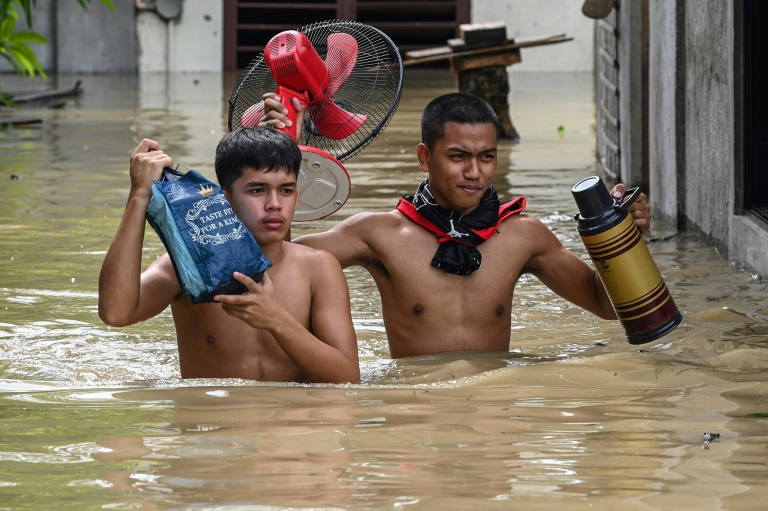
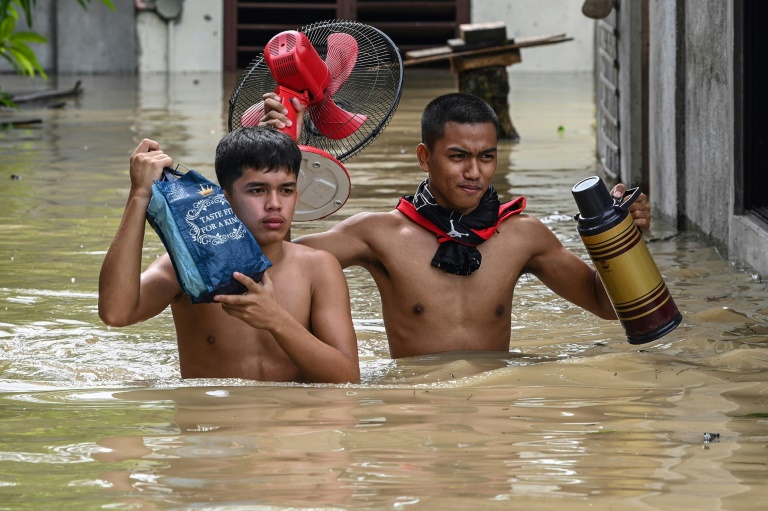
The strongest typhoon to hit the Philippines this year left at least six people dead, authorities said Monday, after heavy rain and fierce winds battered the country’s most populous island.

Typhoon Noru toppled trees, knocked out power and flooded low-lying communities as it swept across Luzon on Sunday and Monday.

There have so far been no reports of widespread severe damage from the storm, which hit the country as a super typhoon. 

“We were ready for all of this,” President Ferdinand Marcos Jr told a briefing with disaster agencies.

“You might think that we overdid it. There is no such thing as overkill when it comes to disasters.”

Five rescuers were killed after they were sent to help flooded residents in San Miguel municipality in Bulacan province, near the capital Manila.

“They were deployed by the provincial government to a flooded area,” said Lieutenant-Colonel Romualdo Andres, chief of police in San Miguel.

Andres said the rescuers were wading through floodwaters when a wall beside them collapsed, sending them into the fast current.

An elderly man died after he was hit by a landslide in Burdeos municipality on the Polillo islands, part of Quezon province, where the storm made landfall, said Garner Jimenez from the local civil defence office.

The Philippines is regularly ravaged by storms, with scientists warning they are becoming more powerful as the world gets warmer because of climate change.

Noru smashed into the archipelago nation on Sunday after an unprecedented “explosive intensification” in wind speeds, the state weather forecaster said earlier.

It made landfall about 100 kilometres (62 miles) northeast of the densely populated capital Manila, before weakening to a typhoon as it crossed a mountain range, coconut plantations and rice fields.

Nearly 75,000 people were evacuated from their homes before the storm hit, as the meteorology agency warned heavy rain could cause “serious flooding” in vulnerable areas, trigger landslides and destroy crops.

But on Monday there was no sign of the widespread devastation many had feared, as the storm moved over the South China Sea towards Vietnam.

Aerial footage taken during Marcos’s inspection flight over central Luzon showed rivers that were swollen or had burst their banks, and patches of farmland under water.

– ‘The wind was whistling’ – 

Burdeos municipality on the Polillo islands bore the brunt of Noru.

Ferocious winds ripped off some roofs and brought down large trees while heavy rain flooded riverside houses, said Ervin Calleja, a 49-year-old teacher.

“It was really worrisome,” Calleja told AFP by phone. 

“The wind was whistling and it had heavy rains. That’s the more dangerous part.”

Flimsy houses along the coast were damaged and some crops were wiped out.

“Here at the town centre all banana trees were flattened, 100 percent,” said Liezel Calusin, a member of the civil defence team in Polillo municipality. 

“We still have no electricity, but the phones are working.”

In Banaba village near Manila, Terrence Reyes fled his riverside home with his family and neighbours as floodwaters rose during the storm. 

They returned home Monday to find their belongings sodden and caked in mud.

“We just have to throw them away and start over again,” Reyes, 25, said. 

“It happens each time there is a storm here.”

The Philippines — ranked among the most vulnerable nations to the impacts of climate change — is hit by an average of 20 storms every year.

Six people killed in Philippine typhoon

The strongest typhoon to hit the Philippines this year left at least six people dead, authorities said Monday, after heavy rain and fierce winds battered the country’s most populous island.

Typhoon Noru toppled trees, knocked out power and flooded low-lying communities as it swept across Luzon on Sunday and Monday.

There have so far been no reports of widespread severe damage from the storm, which hit the country as a super typhoon. 

“We were ready for all of this,” President Ferdinand Marcos Jr told a briefing with disaster agencies.

“You might think that we overdid it. There is no such thing as overkill when it comes to disasters.”

Five rescuers were killed after they were sent to help flooded residents in San Miguel municipality in Bulacan province, near the capital Manila.

“They were deployed by the provincial government to a flooded area,” said Lieutenant-Colonel Romualdo Andres, chief of police in San Miguel.

Andres said the rescuers were wading through floodwaters when a wall beside them collapsed, sending them into the fast current.

An elderly man died after he was hit by a landslide in Burdeos municipality on the Polillo islands, part of Quezon province, where the storm made landfall, said Garner Jimenez from the local civil defence office.

The Philippines is regularly ravaged by storms, with scientists warning they are becoming more powerful as the world gets warmer because of climate change.

Noru smashed into the archipelago nation on Sunday after an unprecedented “explosive intensification” in wind speeds, the state weather forecaster said earlier.

It made landfall about 100 kilometres (62 miles) northeast of the densely populated capital Manila, before weakening to a typhoon as it crossed a mountain range, coconut plantations and rice fields.

Nearly 75,000 people were evacuated from their homes before the storm hit, as the meteorology agency warned heavy rain could cause “serious flooding” in vulnerable areas, trigger landslides and destroy crops.

But on Monday there was no sign of the widespread devastation many had feared, as the storm moved over the South China Sea towards Vietnam.

Aerial footage taken during Marcos’s inspection flight over central Luzon showed rivers that were swollen or had burst their banks, and patches of farmland under water.

– ‘The wind was whistling’ – 

Burdeos municipality on the Polillo islands bore the brunt of Noru.

Ferocious winds ripped off some roofs and brought down large trees while heavy rain flooded riverside houses, said Ervin Calleja, a 49-year-old teacher.

“It was really worrisome,” Calleja told AFP by phone. 

“The wind was whistling and it had heavy rains. That’s the more dangerous part.”

Flimsy houses along the coast were damaged and some crops were wiped out.

“Here at the town centre all banana trees were flattened, 100 percent,” said Liezel Calusin, a member of the civil defence team in Polillo municipality. 

“We still have no electricity, but the phones are working.”

In Banaba village near Manila, Terrence Reyes fled his riverside home with his family and neighbours as floodwaters rose during the storm. 

They returned home Monday to find their belongings sodden and caked in mud.

“We just have to throw them away and start over again,” Reyes, 25, said. 

“It happens each time there is a storm here.”

The Philippines — ranked among the most vulnerable nations to the impacts of climate change — is hit by an average of 20 storms every year.

Death toll from Venezuela floods rises to eight

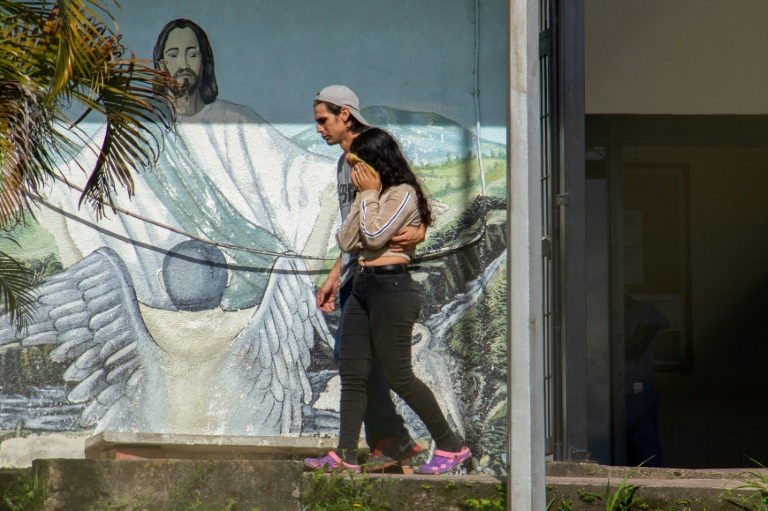
The death toll from floods that swept away a group of people at a religious retreat in western Venezuela has risen to eight, authorities said on Sunday, as the search for two more missing people continued.

Around 40 members of a Methodist church had gathered in Tachira state on Friday when heavy rains caused flooding, state governor Freddy Bernal tweeted.

Some of the worshippers were bathing in the river when the rains came down, suddenly raising the water level and washing them away, Bernal said.

Four of the dead were between the ages of 12 and 17, according to a police report seen by AFP, with the rest aged between 19 to 25.

“The search for two more people is ongoing,” Bernal wrote.

The flooding took place in a region of the Andes Mountains bordering Colombia that is popular with tourists.

Authorities were searching 12 kilometers (seven miles) downstream from where they estimated the 10 people had been swept away by the current, according to police chief Yesnardo Canal.

The incident took place in the city of Lobatera, about 31 kilometers (19 miles) from Tachira’s capital of San Cristobal, authorities said.

Resident Martin Carrillo said his daughter and his son-in-law were swept away by the current.

“They were on a spiritual retreat, they decided to go swimming in the river and the flood came and swept them away,” he told AFP as he waited with several family members for the bodies to be delivered.

This year, Venezuela has recorded above-average rainfall, which has caused damage in several regions, officials said.

Government spokespeople have linked the heavy rain to the La Nina weather phenomenon, which is caused by a thermal anomaly in the equatorial surface waters of the Pacific Ocean.

In Caracas, the country’s capital, rains accompanied by strong gusts of wind, electrical discharges and hail were recorded on Sunday.

Hong Kong cardinal among activists on trial over protest fund

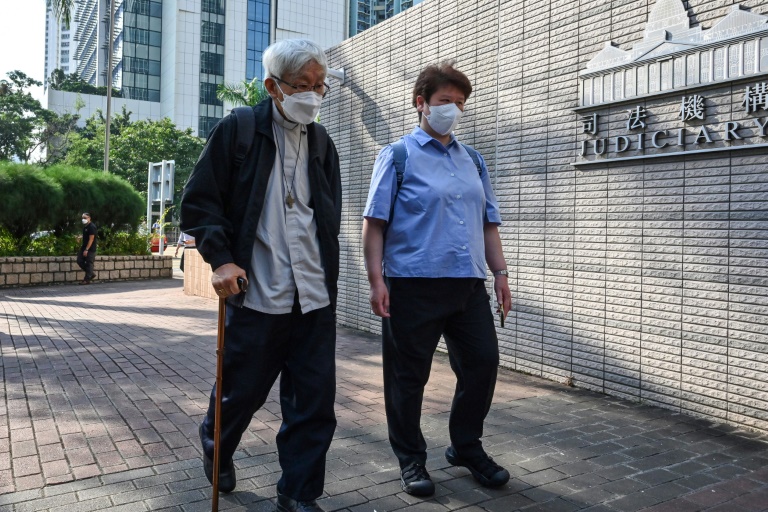
A 90-year-old Hong Kong cardinal went on trial alongside five fellow democracy supporters on Monday over their role in running a fund to help defend people arrested in anti-government protests.

Cardinal Joseph Zen, one of Asia’s highest-ranking Catholic clerics, was originally detained earlier this year under a national security law that Beijing imposed on Hong Kong to quell dissent.

His arrest for “colluding with foreign forces” shocked the city’s Catholic community and renewed criticism of the Vatican’s warming ties with Beijing, including from fellow senior clerics.

Police have not yet charged Zen with a national security offence, which can carry a sentence of up to life in jail.

Instead, he and his fellow defendants, including activist and singer Denise Ho and veteran human rights barrister Margaret Ng, are being prosecuted for the less serious offence of failing to properly register their defence fund as a society.

If convicted they face a fine of up to HK$10,000 ($1,274) but no jail time. All have pleaded not guilty.

Zen, a retired former Bishop of Hong Kong, arrived for court on Monday morning with the help of a walking stick.

The Vatican has been muted on his arrest, previously saying it was concerned and “following the development of the situation very closely”.

Pope Francis declined to comment on Zen’s prosecution when asked about it earlier this month but said he was determined to continue pursuing a dialogue with Beijing.

The trial comes at a sensitive time for the Vatican, which is working to renew its controversial agreement with Beijing later this year over the appointment of bishops in China.

Shanghai-born Zen was critical, calling the deal a “sellout” of China’s underground Catholics who have faced persecution for remaining loyal to Rome and refusing to recognise the Communist Party-sanctioned Catholic Patriotic Association.

– ‘We abandoned him’ –

One of the most senior Catholic clerics to criticise the Vatican’s response to Zen’s arrest is German Cardinal Gerhard Mueller.

“We abandoned him,” Mueller told the Italian newspaper Il Messaggero earlier this month, saying he was disappointed that a recent consistory — a gathering of cardinals in Rome — did not speak in support of Zen.

“This cardinal will be sacrificed on the altar of reason, to defend and implement the diplomatic agreement with Beijing,” he added. 

Zen’s group acted as trustees of a now-defunct fund that helped pay legal and medical costs for those arrested during huge and sometimes violent democracy protests three years ago.

The “612 Humanitarian Relief Fund” is charged with not properly registering under the Societies Ordinance, a colonial-era law from 1911. 

The fund disbanded after national security police demanded it hand over operational details, including information about its donors and beneficiaries.

In an illustration of the democracy movement’s widespread support, prosecutors on Monday revealed the fund had raised as much as HK$270 million ($34 million) from 103,000 donations by the time it closed.

The prosecution said “part of the fund was used for political activities and non-charity events”, including donations to protest groups and activists overseas. 

The defence argued the fund’s political views were irrelevant to the charge of whether it had registered correctly. 

China responded to the 2019 protests with a sweeping crackdown on dissent. 

A majority of the city’s most prominent democracy activists are now in jail or have fled overseas, while dozens of civil society groups have shuttered.

Some groups have been prosecuted for funding and registration irregularities, even though several had functioned without incident for years. 

Hong Kong’s government says prosecutors are simply following the law. 

Critics contend a form of “lawfare” has been used to silence critical groups and bog them down in expensive legal fights.

The court is not sitting on consecutive days and the trial is expected to conclude in early November. 

The initial national security investigation was triggered when one of the defendants, cultural studies scholar Hui Po-keung, was intercepted at Hong Kong’s airport on May 10 as he tried to leave to take up an academic post in Europe.

Ukrainian heavy industry ground down by Russia's war

Usually the engine-room of the Ukrainian economy, heavy industry has fallen victim to Russia’s invasion, with output ground down under the pressure of the war. 

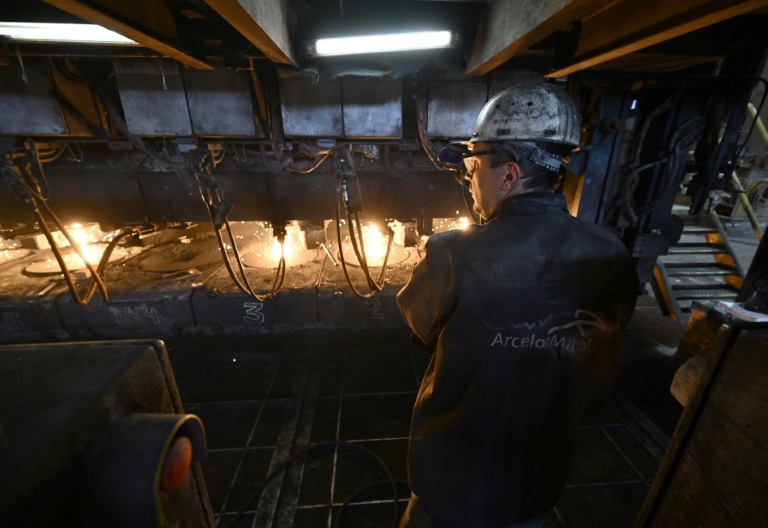
In the gigantic ArcelorMittal steelworks and iron mine complex in Kryvyi Rih, three of the four blast furnaces have been shut down, while the mine lies dormant. 

The last working blast furnace, a cathedral of metal surrounded by colossal pipes, was running on low gear when AFP visited.

Much of the site which sprawls over 70 square kilometres — two-thirds the size of the city of Paris — and normally employs 22,000 people was running below normal operations. 

A handful of workers took turns tending a small river of glowing metal, while square steel beams clank along a treadmill in a cavernous hangar nearby. 

The complex in the southern city close to the frontline is considered a national jewel by Ukrainians. 

Bought in 2005 by ArcelorMittal for nearly $5 billion, its products are sold internationally — including for the Burj Khalifa skyscraper in Dubai, the tallest in the world. 

But after the invasion began in February, work halted for a month when Russian troops approached Kryvyi Rih. 

Production eventually restarted, but at a reduced tempo. 

By the end of August, output was “between 15 and 20 percent” of the corresponding period in 2021, according to Artem Filipiev, the site’s deputy director.

– Logistical headaches –

“We keep the site running, that’s our mission,” Filipiev told AFP.  

Some 2,000 of the site’s employees are currently fighting in the Ukrainian army, and 17 have been killed, so keeping the plant functional is “not just about profit…(but) social responsibility”, he said. 

Among the myriad logistical headaches the war has caused for Ukraine’s industrial sector are how to maintain supplies, keep customers, and deliver products.

Moscow now controls the major Black Sea ports of Mariupol and Berdiansk in southeast Ukraine. 

Ports in the southwest like Odesa and Chernomorsk remain in Ukrainian hands, although Russia — under strong international pressure — has only allowed their use for grain exports.

“The ports are closed, the metallurgical industries of Mariupol were among our main consumers of iron ore, clients in Zaporizhzhia have also slowed down their activity, our iron mines are at a standstill,” said Sergiy Milutin, deputy mayor of Kryvyi Rih.  

ArcelorMittal — which exports 85 percent of its products — says it now uses rail and river transport for deliveries, mainly via Poland and the Baltic Sea, as well as Romania. 

But the costs have “multiplied by two or three” for steel producers, Marina Bozkurt, an analyst with Rystad, told AFP. 

– ‘De-economisation’ –

The months-long shelling by Russia of Ukrainian troops entrenched in the Azovstal steelworks in Mariupol showed the resilience of such Soviet-era infrastructure — but ultimately the facility was left destroyed. 

By September, over 420 Ukrainian industries and companies had been damaged or destroyed by the war, comprising an estimated loss of $30 billion, according to the Kyiv School of Economics.

Mining and manufacturing processing industries made up 17 percent of Ukraine’s GDP in 2021, and the sector “is part of the economic security” of the country, said Dmytro Goryunov, an economist with the Centre for Economic Strategy. 

The importance of heavy industry for the economy explains why Russia pounds it, according to Anatoly Kovaliov, rector of the Odessa National University of Economics. 

“After three days of failed ‘blitzkrieg’, of absolute fiasco, the Russians understood that they would not take our country easily, so they decided to destroy it”, Kovaliov told AFP. 

The Kremlin has an aim of “de-economisation”, he said. 

Ukrainian GDP collapsed by 37 percent in the second quarter of 2022 compared to the same period last year, according to Goryunov.

According to Kovaliov, the country needs a good five to eight years of reconstruction once it wins the war, which he believes is a certainty.

“We will need a Marshall Plan,” he said, referring to the US-devised giant economic rescue scheme to rebuild Europe after World War II. 

Porsche, luxury carmaker with storied history

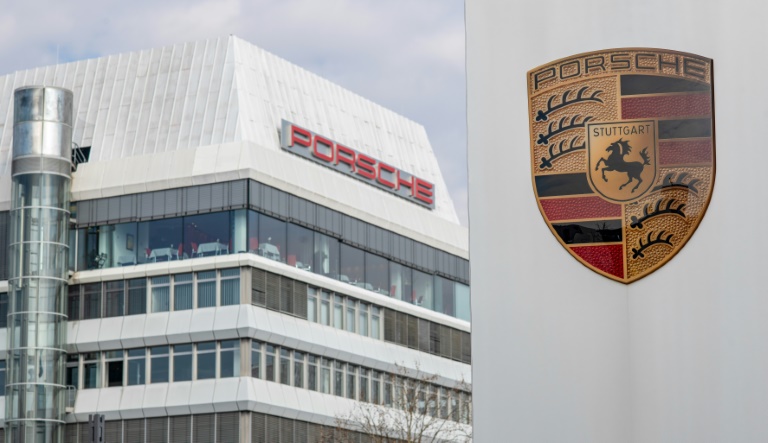
Germany luxury carmaker Porsche is gunning for a blockbuster IPO on the Frankfurt Stock Exchange this week. Here are five facts about the automobile giant: 

– Dial 911 –

Porsche made waves at the Frankfurt international motor show in 1963 when it unveiled a new car with a six-cylinder engine designed to succeed its 356 model. 

The manufacturer originally intended to call it the 901 — but Peugeot had already laid claim to all the three-digit numbers with a zero in the middle, prompting Porsche to settle for 911. 

The number is now strongly linked to the brand — to call the company, 911 is on every phone number after the local dial code. The company’s capital amounts to 911 million shares, and its shares will be traded under the code P911.

– Electric car pioneer –

Volkswagen, the parent company of Porsche, has launched a well-publicised drive to dump combustion engines — but in fact, it produced its first electric vehicles over a century ago. 

At the Porsche museum in Zuffenhausen, southern Germany, a kind of old stage coach described as the first Porsche in history is on display.

Built in 1898 by the company’s founder Ferdinand Porsche, the “Egger-Lohner C.2 Phaeton” ran on electric power. 

Two years later, Porsche unveiled a new model the “Lohner-Porsche”, a petrol-electric hybrid. 

– On screen – 

Porsches have made regular appearances on the silver screen over the years. One of the best-known instances is the 1971 movie “Le Mans”, starring Steve McQueen as Michael Delaney, an American driving a Porsche 917 against a German rival in a Ferrari at the famous 24-hour race in France. 

In the 1995 cop film “Bad Boys”, Will Smith’s character drives a 911 Turbo, as he and a fellow detective investigate the theft of a massive haul of heroin from a police vault. 

One of Hollywood star Tom Cruise’s earliest hits, 1983 teen comedy “Risky Business”, features a Porsche 928. Cruise’s character is forbidden from driving the car while his parents are away — but he does just that, and it ends up sinking into a lake. 

In “Scarface”, Al Pacino — playing a Cuban immigrant who becomes a powerful drug lord in Miami — also drives a Porsche 928. 

– And in motorsports – 

Porsche is one of the world’s biggest race car manufacturers. After enjoying moderate success with early models on long-distance races in the 1950s and 60s, the 917 drove the manufacturer to a coveted first victory at the Le Mans 24 Hour Race in 1970, an event it has triumphed in repeatedly since.

The iconic 911 has done particularly well in rallies, including the Monte Carlo rally. 

The manufacturer has also raced in Formula One. They had a team from 1957-62, although they only raced in two complete seasons 1961/62, with their only victory Dan Gurney’s in the 1962 French Grand Prix.

They returned to the circuit in 1983 providing the engines for the McLaren team and enjoyed great success — McLaren won two successive constructors championships in 1984 and 1985.

However, its negotiations with Red Bull for a partnership that would have allowed them to return to F1 failed earlier this month. 

– Porsche and Piech – 

The Porsche-Piech family are the main shareholders of the Volkswagen group, and have roots in Germany’s auto industry stretching back decades.

An Austrian-born engineer, Ferdinand Porsche was founder of the luxury car brand that bears his name. In addition, he created the Volkswagen Beetle and designed the iconic, open-top Mercedes-Benz SSK sports car. 

During World War II, he contributed to the German war effort by helping produce weapons systems, and was a member of the Nazi party. He died in 1951. 

Ferdinand Piech was the grandson of Ferdinand Porsche. Chief executive of VW from 1993 to 2002, he helped to transform the group into a global auto giant in the face of fierce competition, particularly from rivals in Asia. 

He reorganised the group and cleaned up its books at the cost of tens of thousands of jobs, and was a notoriously tough manager nicknamed “the emperor” and “the patriarch” by German media. 

He died in 2019. 

Porsche to race onto German stock exchange with mega IPO

Luxury sports carmaker Porsche will this week race onto the Frankfurt stock exchange in what is set to be one of Europe’s biggest listings in years, seeking to defy recent market turbulence.

While the listing comes at a difficult time for global markets — roiled by the war in Ukraine and surging inflation — the maker of the 9-11 sports car expects to leverage its brand power. 

“Some potential clients may not yet be able to afford a Porsche, but they can buy the shares,” said Lutz Meschke, deputy chairman of the company’s board.

Parent company Volkswagen hopes Thursday’s flotation will raise up to 9.4 billion euros ($9.2 billion) and are targeting a valuation of up to 75 billion euros for Porsche.

Some of the cash will be ploughed into Volkswagen’s high-speed drive towards electric vehicles, which has brought the legacy carmaker into more direct competition with US rival Tesla.

In terms of value of shares issued, Porsche’s is set to be the biggest stock market debut in Germany since Deutsche Telekom’s in 1996, and the largest in Europe since the 2011 flotation of Switzerland-based commodities giant Glencore.

Analysts are looking to the carmaker’s market entry for some cheer in a morose economic backdrop.

“The Porsche AG IPO may offer a catalyst in an industry sorely lacking positive surprises,” Berenberg said in a note.

“Volkswagen’s luxury sports car business holds brand power and electrification momentum in the most desirable automotive segments.”

– Electric drive –

The IPO will see 114 million shares of “Porsche AG” listed, with a price range between 76.50 and 82.50 euros per share. 

VW’s targeted valuation is below some earlier estimates — but should still catapult it above rivals such as BMW, with a valuation of 49 billion euros, and Mercedes-Benz, with a 61-billion-euro price tag. 

The maker of the iconic 911 sports car has joined the electric drive of Volkswagen group, whose brands also include Audi and Skoda, in earnest. 

The electric “Taycan” has been the brand’s best-selling model since January, an electric version of the “Macan” is due in 2024, as well as the launch of a new SUV in the middle of the decade.

The electric strategy — launched by former VW chief Herbert Diess — includes building battery factories across Europe and the US.

The IPO will see preferential shares sold to investors, which have no voting rights, while Volkswagen will also sell 25 percent of the carmaker to Porsche SE. 

The eponymous company is a listed holding controlled by the Porsche-Piech family, who in turn are the main shareholders in Volkswagen.

This means that Porsche SE will have a blocking minority that will allow it to steer the future of the company.

– Major investor interest –

While there is much anticipation ahead of the Porsche IPO, concerns surrounding governance have been brewing at Volkswagen.

The dual role of recently appointed group CEO Oliver Blume  — who has maintained his position as Porsche chief, as well as taking on the top job at Volkswagen group — has in particular raised eyebrows. 

Nevertheless, the listing has generated interested among major investors, including Qatar and Abu Dhabi’s public investment funds, Norway’s sovereign wealth fund and US asset management firm T. Rowe Price. 

They will together hold about 3.6 billion euros in preferential shares, with Qatar making the biggest investment.

Volkswagen hopes that listing a minority stake in Porsche will push up its own stock market value, which is currently about 90 billion euros — just a fraction of Tesla’s, at just under $900 billion.

Close Bitnami banner
Bitnami