World

German bakeries fight for survival as costs spiral

Faced with exploding energy and ingredient costs, German baker Tobias Exner has installed new energy-efficient ovens, shortened his opening hours and even considered baking at lower temperatures.

But “it just doesn’t taste the same without a good crust”, he said, adding that in any case such efforts could do little to counter the existential crisis he and other bakers are facing.

“If the conditions don’t change, then sooner or later a large share of bakeries in Germany will simply no longer exist,” Exner told AFP.

Bakeries in Germany have been among the businesses hardest hit by the economic fallout from Russia’s invasion of Ukraine.

The war has sent energy prices spiralling across Europe, but especially in Germany, which was previously heavily dependent on Russian gas.

“Bakeries all have ovens. Seventy percent of artisanal bakeries have gas ovens and gas prices are going through the roof,” said Friedemann Berg, managing director of the German Bakers’ Federation.

And two of the main ingredients used by bakers — flour and oil — are among those that have been affected by blockades at Ukrainian ports. 

Exner’s business is relatively large with 220 staff and 36 branches in Berlin and the surrounding area, leaving it better placed than many to survive the crisis — but even he is struggling.

Wheat is now 2.5 times more expensive than before the crisis, he said, while the cost of a litre of oil has risen from around 82 cents to more than three euros ($2.91).

– Dough in the dark –

Energy bills for the business, meanwhile, have almost quadrupled compared with 2020. 

“You can see that the calculations no longer work,” Exner said to the hum of machines at the company’s main production site in the town of Beelitz.

But Exner is reluctant to pass the cost increases on to his customers, who he simply believes “would not pay those kinds of prices”.

In central Berlin, the mood on the ground appears to confirm his fears.

“Even more? No way. It’s getting extortionate,” said unemployed Gloria Thomas, 56, when asked whether she would be prepared to pay more for her favourite loaf.

Many bakeries in Germany have already gone under as a result of recent cost increases, with others staging protests to demand urgent help from the government.

And there is more at stake than just bread rolls, according to Exner.

“These businesses are often the most important institution in the village — they are at once grocery store, social centre, post office, etc.”

In early September, around 800 German bakeries served customers in the dark for a day to draw attention to their plight.

– Insolvency blunder –

Germany’s centre-left government has announced relief measures worth almost 100 billion euros to tackle inflation, but small businesses have so far been largely excluded from the help.

Worse still, they were left feeling insulted by controversial comments by Economy Minister Robert Habeck earlier this month.

Asked on a TV panel show whether he thought Germany was heading for a wave of insolvencies, Habeck replied: “I can imagine that certain industries will simply stop producing for a while.”

The comments provoked anger from bakers in particular, who accused Habeck of having no understanding of their industry.

“Habeck is probably not a stupid person, but the question is, is he qualified for the job he has right now? And I would say no,” said Exner.

The Bakers’ Confederation is calling for “quick and unbureaucratic” financial aid.

Bakeries can shave off costs here and there but they “can only do so much”, according to Berg.

If government help does not arrive soon “the future looks bleak,” he said.

“It could be that many businesses have to give up their operations or simply file for bankruptcy.”


Super Typhoon Noru barrels towards Philippines

A super typhoon barrelled towards the Philippines Sunday and was on track to slam into the heavily populated main island of Luzon, forcing the evacuations of coastal towns, authorities said.

Super Typhoon Noru was packing maximum sustained wind speeds of 195 kilometres (121 miles) an hour after an unprecedented “explosive intensification”, the state weather forecaster said. 

The storm, the strongest to hit the Philippines this year, is expected to continue strengthening as it makes landfall around 80 kilometres northeast of the sprawling capital Manila in the afternoon or evening local time.

“We ask residents living in danger zones to adhere to calls for evacuation whenever necessary,” Philippine National Police chief General Rodolfo Azurin said.

The Philippines is regularly ravaged by storms, with scientists warning they are becoming more powerful as the world gets warmer because of climate change.

Weather forecaster Robb Gile said Noru’s rapid intensification as it neared land was “unprecedented”. The agency said it increased by 90 kilometres per hour in 24 hours. 

“Typhoons are like engines — you need a fuel and an exhaust to function,” said Gile.

“In the case of Karding, it has a good fuel because it has plenty of warm waters along its track and then there is a good exhaust in the upper level of the atmosphere — so it’s a good recipe for explosive intensification,” he said, using the local name for the storm.

– Calm before the storm –

Noru comes nine months after another super typhoon devastated swathes of the country, killing more than 400 people and leaving hundreds of thousands homeless.

Residents in several municipalities in Quezon province, where this latest storm could make a direct hit, were being evacuated from their homes, said Mel Avenilla from the provincial disaster office.

In the neighbouring province of Aurora, residents of Dingalan municipality were being forced to seek shelter. 

“People living near the coast have been told to evacuate. We live away from the coast so we’re staying put so far. We’re more worried about the water from the mountains,” said Rhea Tan, 54, a restaurant manager in Dingalan.

Tan said residents were securing the roofs of their houses and boats were being taken to higher ground while the weather was still calm.

“We’re even more anxious if the weather is very calm, because that’s the usual indicator of a strong typhoon before it hits land,” Tan added.

Noru could have wind speeds of up to 205 kilometres per hour when it makes landfall, the weather bureau said. 

It is expected to weaken to a typhoon as it sweeps across central Luzon, before entering the South China Sea on Monday, heading towards Vietnam.

The weather bureau warned of dangerous storm surges, widespread flooding and landslides as the storm dumps heavy rain.

It could damage farmlands in the heavily agricultural region, as well as inundate villages. 

Classes in some areas have been cancelled for Monday.  

The Philippines — ranked among the most vulnerable nations to the impacts of climate change — is hit by an average of 20 storms every year.

Super Typhoon Noru barrels towards Philippines

A super typhoon barrelled towards the Philippines Sunday and was on track to slam into the heavily populated main island of Luzon, forcing the evacuations of coastal towns, authorities said.

Super Typhoon Noru was packing maximum sustained wind speeds of 195 kilometres (121 miles) an hour after an unprecedented “explosive intensification”, the state weather forecaster said. 

The storm, the strongest to hit the Philippines this year, is expected to continue strengthening as it makes landfall around 80 kilometres northeast of the sprawling capital Manila in the afternoon or evening local time.

“We ask residents living in danger zones to adhere to calls for evacuation whenever necessary,” Philippine National Police chief General Rodolfo Azurin said.

The Philippines is regularly ravaged by storms, with scientists warning they are becoming more powerful as the world gets warmer because of climate change.

Weather forecaster Robb Gile said Noru’s rapid intensification as it neared land was “unprecedented”. The agency said it increased by 90 kilometres per hour in 24 hours. 

“Typhoons are like engines — you need a fuel and an exhaust to function,” said Gile.

“In the case of Karding, it has a good fuel because it has plenty of warm waters along its track and then there is a good exhaust in the upper level of the atmosphere — so it’s a good recipe for explosive intensification,” he said, using the local name for the storm.

– Calm before the storm –

Noru comes nine months after another super typhoon devastated swathes of the country, killing more than 400 people and leaving hundreds of thousands homeless.

Residents in several municipalities in Quezon province, where this latest storm could make a direct hit, were being evacuated from their homes, said Mel Avenilla from the provincial disaster office.

In the neighbouring province of Aurora, residents of Dingalan municipality were being forced to seek shelter. 

“People living near the coast have been told to evacuate. We live away from the coast so we’re staying put so far. We’re more worried about the water from the mountains,” said Rhea Tan, 54, a restaurant manager in Dingalan.

Tan said residents were securing the roofs of their houses and boats were being taken to higher ground while the weather was still calm.

“We’re even more anxious if the weather is very calm, because that’s the usual indicator of a strong typhoon before it hits land,” Tan added.

Noru could have wind speeds of up to 205 kilometres per hour when it makes landfall, the weather bureau said. 

It is expected to weaken to a typhoon as it sweeps across central Luzon, before entering the South China Sea on Monday, heading towards Vietnam.

The weather bureau warned of dangerous storm surges, widespread flooding and landslides as the storm dumps heavy rain.

It could damage farmlands in the heavily agricultural region, as well as inundate villages. 

Classes in some areas have been cancelled for Monday.  

The Philippines — ranked among the most vulnerable nations to the impacts of climate change — is hit by an average of 20 storms every year.

Cypriot carob growers harvest their 'black gold'

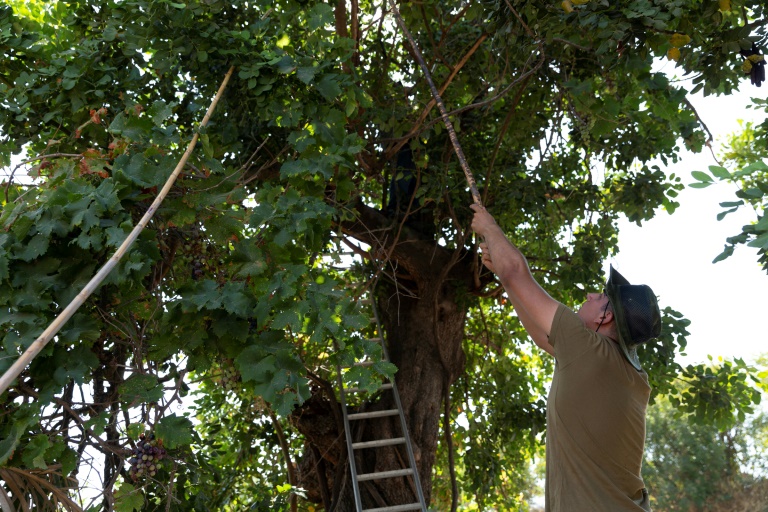
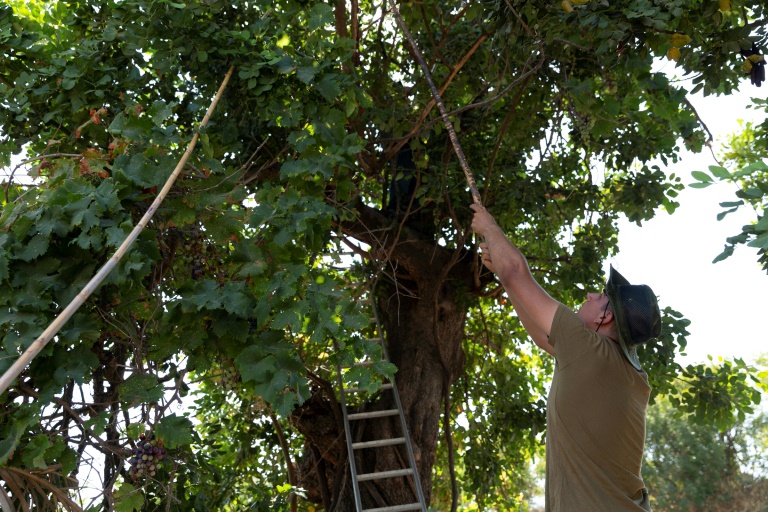
Christos Charalambous might be 79 but he is several metres up a carob tree, harvesting a fruit known as “black gold” on the island of Cyprus as his grandson works below.

For some, carob has long been relegated to the status of a less appealing substitute for chocolate.

But in Cyprus, its thick brown pods are also eaten raw or ground up to make sweet syrups, spreads, toffees, drinks and as a sweetener, while its seeds have industrial uses.

“It’s one of the fruits that you use up entirely,” Charalambous said from his field in Asgata.  

Branches rustle and sway as he and his grandson, Theophanis Christou, 20, hit the pods loose with long sticks, sending carob raining to the ground.

The pair have been working for about three weeks in the late summer heat, collecting about three tonnes of carob by early September.

Christou, a shipping and finance student, is keen to join in his grandfather’s labours.

It’s “hard to do”, Christou said, but it’s “work that can keep the family together”.

– ‘Extra income’ –

In the nearby coastal village Zygi, individual growers bring bulging sacks of pods into a carob mill.

Zygi “started as a carob village” and its name refers to the weigh scale used for the fruit, said community representative Christos Konstantinou.

In Zygi and elsewhere across the eastern Mediterranean island where the carob tree is native, disused or repurposed carob facilities are reminders of the industry’s heyday last century. 

“Carob has been known as the black gold of Cyprus because many farmers used to have carob… it was the main occupation of the villagers,” said Stavros Glafkou Charalambous, from the Cooperative Carob Marketing Federation.

The federation, which runs the Zygi mill and other facilities, said it works with around 1,500-2,000 small producers, most of them harvesting carob for “extra income”.

George Pattichis, 75, from Vavla, said he has been coming to the Zygi mill for more than half a century.

The former forester said some of his carob trees were planted by his grandfather.

“I am the last generation — my children have other jobs,” said Pattichis.

– ‘Increasing again’ –

In 2019, when the growers’ price was around 35 euro cents (now 34 US cents) per kilogram, carob represented less than 1.5 percent of the Republic of Cyprus’s crop production value, according to statistics provided by the agriculture ministry.

This year, carob farmers told AFP the price was nearing one euro per kilogram (2.2 pounds).

“I will sell to whoever offers me the best price,” said Anastasis Daniel, 65, in Choirokoitia village.

Bags of harvested carob were stacked by his house ready for the mill, though he said he would also keep some for animal feed.

Global demand for the seeds’ locust bean gum (LBG) — used as a food thickening agent — drives the carob price, said Marios Kyriacou from Cyprus’s Agricultural Research Institute.

Cypriot carob pod and seed exports were worth almost eight million euros last year, according to the official statistics. Egypt was the biggest taker of the pods fit for human consumption, and Italy of the seeds.

Cyprus had been ranked as the world’s third-biggest producer of carob in the 1960s, Agriculture Minister Costas Kadis told AFP.

Production then declined, he said, “but now it is increasing again”.

– ‘Drought-resistant’ –

Carob “is very important for Cyprus because it needs little insecticides, fertilisers and water — and this is important when we talk about climate change,” the minister said.

In late 2017, a University of Cyprus project planted almost 5,000 carob saplings and subsequently gave around 28,500 more to interested farmers, project scientist Chrysi Tomouzou told AFP.

Researcher Kyriacou said carob was “a very drought-resistant tree species” that has been used as a crop in Cyprus “for at least the past 3,000 years”.

“The carob pod is rich in sugars” and dietary fibres, Kyriacou said. It also contains a “rare type of sugar-alcohol” that is “recognised as an anti-diabetic agent”, he said, noting this was “of interest for further clinical research”.

Kyriacou and his team have been studying genetic and other variations in Cypriot carob.

They say their work could be crucial if Cyprus decides to ramp up production and processing.

But for now, both often remain a low-scale affair.

At a festival in Anogyra, where stalls sold everything from carob sweets to ice cream, Andreas Andreou from Polyxenis Carob Products said carob syrup was his family firm’s most popular product.

Despoula Georgiou, 61, demonstrated how to make pasteli — a kind of carob toffee that her village is known for.

It’s “only (made with) carob juice, no sugar at all”, she said.

“I’ve been doing it for 50 years,” she said. “I learned it from my mother and aunt.”

Cypriot carob growers harvest their 'black gold'

Christos Charalambous might be 79 but he is several metres up a carob tree, harvesting a fruit known as “black gold” on the island of Cyprus as his grandson works below.

For some, carob has long been relegated to the status of a less appealing substitute for chocolate.

But in Cyprus, its thick brown pods are also eaten raw or ground up to make sweet syrups, spreads, toffees, drinks and as a sweetener, while its seeds have industrial uses.

“It’s one of the fruits that you use up entirely,” Charalambous said from his field in Asgata.  

Branches rustle and sway as he and his grandson, Theophanis Christou, 20, hit the pods loose with long sticks, sending carob raining to the ground.

The pair have been working for about three weeks in the late summer heat, collecting about three tonnes of carob by early September.

Christou, a shipping and finance student, is keen to join in his grandfather’s labours.

It’s “hard to do”, Christou said, but it’s “work that can keep the family together”.

– ‘Extra income’ –

In the nearby coastal village Zygi, individual growers bring bulging sacks of pods into a carob mill.

Zygi “started as a carob village” and its name refers to the weigh scale used for the fruit, said community representative Christos Konstantinou.

In Zygi and elsewhere across the eastern Mediterranean island where the carob tree is native, disused or repurposed carob facilities are reminders of the industry’s heyday last century. 

“Carob has been known as the black gold of Cyprus because many farmers used to have carob… it was the main occupation of the villagers,” said Stavros Glafkou Charalambous, from the Cooperative Carob Marketing Federation.

The federation, which runs the Zygi mill and other facilities, said it works with around 1,500-2,000 small producers, most of them harvesting carob for “extra income”.

George Pattichis, 75, from Vavla, said he has been coming to the Zygi mill for more than half a century.

The former forester said some of his carob trees were planted by his grandfather.

“I am the last generation — my children have other jobs,” said Pattichis.

– ‘Increasing again’ –

In 2019, when the growers’ price was around 35 euro cents (now 34 US cents) per kilogram, carob represented less than 1.5 percent of the Republic of Cyprus’s crop production value, according to statistics provided by the agriculture ministry.

This year, carob farmers told AFP the price was nearing one euro per kilogram (2.2 pounds).

“I will sell to whoever offers me the best price,” said Anastasis Daniel, 65, in Choirokoitia village.

Bags of harvested carob were stacked by his house ready for the mill, though he said he would also keep some for animal feed.

Global demand for the seeds’ locust bean gum (LBG) — used as a food thickening agent — drives the carob price, said Marios Kyriacou from Cyprus’s Agricultural Research Institute.

Cypriot carob pod and seed exports were worth almost eight million euros last year, according to the official statistics. Egypt was the biggest taker of the pods fit for human consumption, and Italy of the seeds.

Cyprus had been ranked as the world’s third-biggest producer of carob in the 1960s, Agriculture Minister Costas Kadis told AFP.

Production then declined, he said, “but now it is increasing again”.

– ‘Drought-resistant’ –

Carob “is very important for Cyprus because it needs little insecticides, fertilisers and water — and this is important when we talk about climate change,” the minister said.

In late 2017, a University of Cyprus project planted almost 5,000 carob saplings and subsequently gave around 28,500 more to interested farmers, project scientist Chrysi Tomouzou told AFP.

Researcher Kyriacou said carob was “a very drought-resistant tree species” that has been used as a crop in Cyprus “for at least the past 3,000 years”.

“The carob pod is rich in sugars” and dietary fibres, Kyriacou said. It also contains a “rare type of sugar-alcohol” that is “recognised as an anti-diabetic agent”, he said, noting this was “of interest for further clinical research”.

Kyriacou and his team have been studying genetic and other variations in Cypriot carob.

They say their work could be crucial if Cyprus decides to ramp up production and processing.

But for now, both often remain a low-scale affair.

At a festival in Anogyra, where stalls sold everything from carob sweets to ice cream, Andreas Andreou from Polyxenis Carob Products said carob syrup was his family firm’s most popular product.

Despoula Georgiou, 61, demonstrated how to make pasteli — a kind of carob toffee that her village is known for.

It’s “only (made with) carob juice, no sugar at all”, she said.

“I’ve been doing it for 50 years,” she said. “I learned it from my mother and aunt.”

Ukraine is 'not Nazi', Holocaust survivors tell Putin

Roman Gerstein, an 83-year-old Ukrainian Holocaust survivor, has a blunt riposte for Kremlin justifications of its invasion: “There are no Nazis here.”

For supporters of Russian President Vladimir Putin, Ukraine’s alleged “genocide” of Russian speakers in the country’s eastern regions is comparable with the actions of Nazi Germany.

And that, they argue, requires “de-Nazification”. 

Gerstein is having none of that.

A slightly built man wearing an oversized suit, his eyes twinkling behind round glasses, he explained how he had to flee from real Nazis.

“In fact I am one of the few people to have been evacuated twice from Chernobyl,” he said with a laugh.

Gerstein spoke to AFP at the synagogue in Kryvyi Rig, central Ukraine.

The first time he fled was when Nazi Germans occupied his hometown of Chernobyl in 1941, he said; the second was 45 years later, in 1986, when the town was the site of the world’s worst nuclear accident.

Born in 1939, Gerstein was two years old when his father put his family on a boat to Kyiv to flee the Nazis — and from there they caught a train for Tajikistan.

When they finally returned to Chernobyl they discovered that the Jewish community no longer existed.

“Those who stayed behind now rest for good underground,” he said. “Seven hundred people: women, children, elderly.”

– ‘Rewriting history’ –

Lyubov Petukhova, who turns 100 in November, remembers fleeing with her family from the central Ukraine region of Vinnytsia to Uzbekistan. 

In her village of Botvyno all the Jews who remained were “tortured, murdered”, she told AFP in her apartment with a hard stare.

Gerstein and Petukhova are remnants of Ukraine’s once large Jewish community, which has endured a history of pogroms, Holocaust and communist-era purges.

The Jews were almost completely wiped out in Ukraine during the Holocaust, in which Nazis killed a total of six million European Jews.

A 2019 study by the Hebrew University of Jerusalem concluded that there were only between 48,000 and 140,000 Jews left across the whole country.

Another Holocaust survivor, 84-year-old Felix Mamut, recalled how before World War II his extended family included his great-grandmother, her 16 children, and a host of grandchildren and great-grandchildren.

But 72 of them were killed in Babyn Yar ravine, the site of a 1941 massacre where Nazis executed more than 30,000 Jews. 

Between 1941 and 1944, about 1.5 million Ukrainian Jews were massacred, often by shooting, by Nazis who, on the move, were sometimes assisted by local collaborators. 

But “we don’t know their number”, Anton Drobovych, director of the National Institute of Memory, told AFP. Collaboration “was never a mass phenomenon” in Ukraine, he said.

Conversely, two to three million Ukrainian soldiers fought and died with the Red Army during the war.

According to Drobovych then, Moscow calling Ukraine a “Nazi” country makes “no sense”. It is a “rewriting of history” aimed at “tarnishing the memory” of the victims and “justifying” Russia’s invasion. 

That is especially ironic since after World War II, the Jews of the Soviet Union — of which Ukraine was a part — still had to face “an official policy of anti-Semitism in the USSR”, he added.

– “Worse than Hitler” –

Felix Mamut, still agile despite his advanced years, well remembers the Soviet-era persecution.

While his engineer father enjoyed a relatively comfortable situation in Moscow, he later found himself threatened by anti-Jewish purges and so returned hastily to Ukraine, said Mamut. 

Gerstein recalls how his brothers and sister were barred from higher education “because of their name” despite excellent academic grades, while promotions at work were out of bounds for Jews.

Since Ukraine’s independence, the situation has greatly improved, he said. 

“During the Soviet era, discrimination was enormous, but that no longer exists,” said Gerstein.

“You only have to look at who our president is to understand it”, he added, referring to President Volodymyr Zelensky’s Jewish origins.

“There are no Nazis in Ukraine”, Lyubov Petukhova insists indignantly.

Gerstein, meanwhile, denounced Putin himself as a “Nazi”, a “robber”, and “worse than Hitler”.

Such descriptions of Putin are common now in Ukraine, seven months into the invasion.

With the discovery of mass graves in Bucha and Irpin, north of Kyiv, and more recently in Izyum in the northeast, Kryvyi Rig’s rabbi Liron Ederi even drew a parallel between Russian atrocities and the Holocaust.

“Except that it is no longer just Jews, but all Ukrainians who are being killed.” 

'You cannot survive': Inflation bites as Thai election looms

Sheltering from rain near Bangkok’s Grand Palace, scores of unemployed Thais queue alongside homeless people waiting for free meals as 14-year-high inflation sends living costs soaring — causing a headache for the government ahead of a looming general election.

The leadership came to power eight years ago under Prayut Chan-O-Cha, promising to provide stability after long-running protests started to hit the kingdom’s economy.

However, it struggled to live up to its pledges and the damage wrought by the pandemic on the travel industry has been compounded by a global inflationary crisis that has sent prices rising beyond many people’s reach.

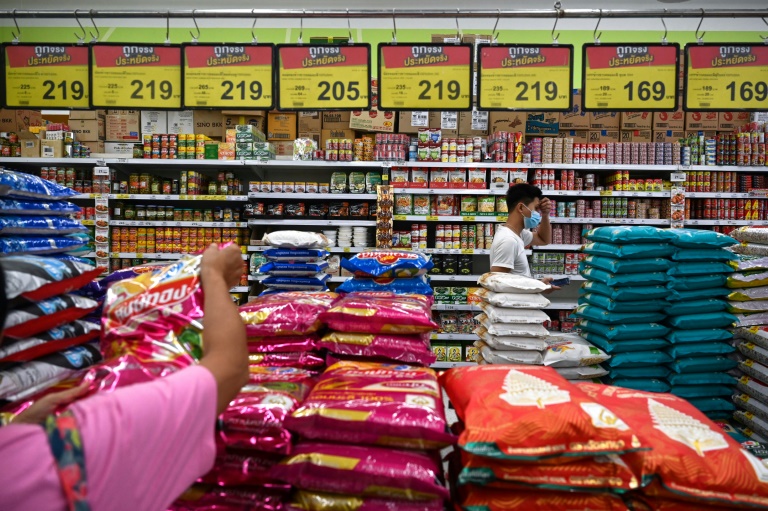
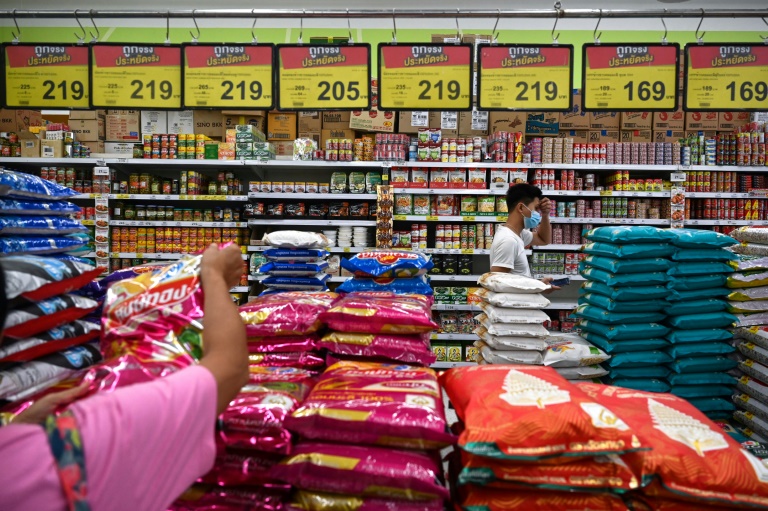
And in a move seen as symbolic of the severity of the situation but likely to cause more pain for consumers, the government recently raised the price of instant noodles for the first time in more than a decade after manufacturers agitated for a rise.

For those waiting in the rain, the impact is already painfully clear.

“A few years ago, I was able to afford buying my own food but now food is too expensive,” said Somchai, who only gave one name, and who is unemployed.

“I couldn’t bear the prices so I have to come out and find food donation like this,” said the 42-year-old after he had collected his meal.

A general election must be called by March, giving the coalition government led by the military-friendly Palang Pracharat Party (PPRP) little time to turn things around.

– Unkept promises –

Adding to PPRP’s woes, Prayut was suspended from office last month while the Constitutional Court decides whether he has reached his term limit as prime minister.

In a bid to ease the pain for struggling Thais, the government has approved a proposal to raise the daily minimum wage to between 328 and 354 baht ($8.83 and $9.53) after earlier agreeing to extend a fuel tax break.

But political analyst Napisa Waitoolkiat at Naresuan University told AFP the measures were taken “for winning votes” but doubted they would turn many voters around.

“The damage is beyond repair,” she said.

The economy looks set to be a major factor in the election, and Napisa said voters would not forget the PPRP’s vows to improve it.

“Yet, once they are in power, they cannot keep the promise,” she said.

And while the minimum wage hike goes some way, Thammasat University international business professor Pavida Pananond suggested more was needed.

“What we now need to look at is more targeted policy measures that would help alleviate the difficulty from rising living costs among Thai lower-income households,” she said.

Growth remains sluggish — just 2.5 percent in the second quarter, dragged by high inflation despite the return of foreign visitors after the pandemic shutdowns.

“You will see that even the GDP growth rate of Thailand is the slowest in the region,” Pavida said.

– ‘You cannot survive’ –

Pavida also warned that price rises, like those of instant noodles, could be a precursor to further hikes in foodstuff.

“For lower-income people, whose majority of income is spent on food or energy, they would be even more impacted by this,” she said.

Veerayuth Sae-ung, queueing to buy a noodle lunch in central Bangkok, said his “way of eating has changed a lot”.

“I used to come down here and buy lunch like this daily, but lately I just couldn’t afford to buy from stalls every day anymore,” the 34-year-old said.

Greg Lange, co-founder of Bangkok Community Help Foundation which distributes 500 meals a day, warned they were helping more and more people.

“Even in spite of the rain, there are some times that the line goes two or three blocks,” he said.

“I think it was already very hard for the elderly to make ends meet,” his co-founder Friso Poldervaart added.

Poldervaart said many of the elderly people they helped had lost touch with their families and were unable to survive on the government support of between 600 and 1,000 baht a month.

“You cannot survive on that. That’s just the way it is,” he said.

“So it was already hard, but of course with increasing prices it just gets harder for everyone to make ends meet.”

'You cannot survive': Inflation bites as Thai election looms

Sheltering from rain near Bangkok’s Grand Palace, scores of unemployed Thais queue alongside homeless people waiting for free meals as 14-year-high inflation sends living costs soaring — causing a headache for the government ahead of a looming general election.

The leadership came to power eight years ago under Prayut Chan-O-Cha, promising to provide stability after long-running protests started to hit the kingdom’s economy.

However, it struggled to live up to its pledges and the damage wrought by the pandemic on the travel industry has been compounded by a global inflationary crisis that has sent prices rising beyond many people’s reach.

And in a move seen as symbolic of the severity of the situation but likely to cause more pain for consumers, the government recently raised the price of instant noodles for the first time in more than a decade after manufacturers agitated for a rise.

For those waiting in the rain, the impact is already painfully clear.

“A few years ago, I was able to afford buying my own food but now food is too expensive,” said Somchai, who only gave one name, and who is unemployed.

“I couldn’t bear the prices so I have to come out and find food donation like this,” said the 42-year-old after he had collected his meal.

A general election must be called by March, giving the coalition government led by the military-friendly Palang Pracharat Party (PPRP) little time to turn things around.

– Unkept promises –

Adding to PPRP’s woes, Prayut was suspended from office last month while the Constitutional Court decides whether he has reached his term limit as prime minister.

In a bid to ease the pain for struggling Thais, the government has approved a proposal to raise the daily minimum wage to between 328 and 354 baht ($8.83 and $9.53) after earlier agreeing to extend a fuel tax break.

But political analyst Napisa Waitoolkiat at Naresuan University told AFP the measures were taken “for winning votes” but doubted they would turn many voters around.

“The damage is beyond repair,” she said.

The economy looks set to be a major factor in the election, and Napisa said voters would not forget the PPRP’s vows to improve it.

“Yet, once they are in power, they cannot keep the promise,” she said.

And while the minimum wage hike goes some way, Thammasat University international business professor Pavida Pananond suggested more was needed.

“What we now need to look at is more targeted policy measures that would help alleviate the difficulty from rising living costs among Thai lower-income households,” she said.

Growth remains sluggish — just 2.5 percent in the second quarter, dragged by high inflation despite the return of foreign visitors after the pandemic shutdowns.

“You will see that even the GDP growth rate of Thailand is the slowest in the region,” Pavida said.

– ‘You cannot survive’ –

Pavida also warned that price rises, like those of instant noodles, could be a precursor to further hikes in foodstuff.

“For lower-income people, whose majority of income is spent on food or energy, they would be even more impacted by this,” she said.

Veerayuth Sae-ung, queueing to buy a noodle lunch in central Bangkok, said his “way of eating has changed a lot”.

“I used to come down here and buy lunch like this daily, but lately I just couldn’t afford to buy from stalls every day anymore,” the 34-year-old said.

Greg Lange, co-founder of Bangkok Community Help Foundation which distributes 500 meals a day, warned they were helping more and more people.

“Even in spite of the rain, there are some times that the line goes two or three blocks,” he said.

“I think it was already very hard for the elderly to make ends meet,” his co-founder Friso Poldervaart added.

Poldervaart said many of the elderly people they helped had lost touch with their families and were unable to survive on the government support of between 600 and 1,000 baht a month.

“You cannot survive on that. That’s just the way it is,” he said.

“So it was already hard, but of course with increasing prices it just gets harder for everyone to make ends meet.”

Storm Fiona slams eastern Canada, knocking out power and ripping off roofs

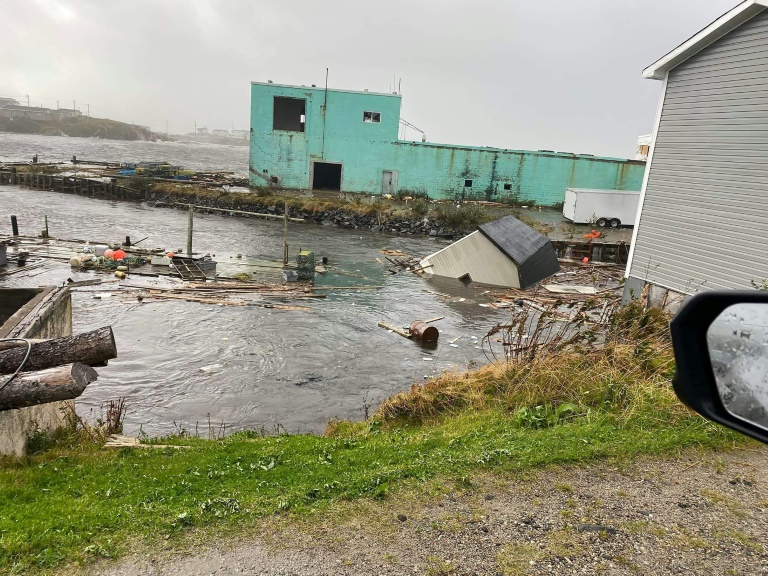
Powerful storm Fiona lashed into eastern Canada on Saturday, cutting power to thousands and washing houses into the sea as it pummeled the area with fierce winds and rains “like nothing we’ve ever seen,” police said.

Two women were swept into the ocean in Newfoundland, the Royal Canadian Mounted Police said. One was rescued, and investigators were looking into the second case.

Mayor Brian Button of Channel-Port aux Basques, on the southwestern tip of Newfoundland, said in a Facebook video Saturday night that at least 20 homes had been destroyed and the community looked like a “total warzone.”

“We’ve got destruction everywhere,” he said. 

A boil water order was in effect, Button said, and he encouraged residents in need to take shelter at a local elementary school. 

As of late afternoon, nearly 500,000 homes were left without power across the region as the storm hammered a wide area, felling countless trees and ripping roofs from buildings.

“The power lines are down everywhere,” Erica Fleck, assistant chief of Halifax Regional Fire and Emergency, told CBC. “It’s not safe to be on the roads.”

Although downgraded to a post-tropical cyclone, Fiona still packed hurricane-force winds of 80 miles (130 kilometers) per hour as it first barreled into Canada after earlier battering the Caribbean, according to meteorologists. 

By late Saturday, the storm’s maximum sustained winds had slowed to 68 mph, according to the Canadian Hurricane Centre (CHC), with the government reporting individual gusts seen at more than 100 mph in Newfoundland and Labrador, as well as Nova Scotia.

– Nova Scotia hard hit –

The storm first made landfall in Nova Scotia province around 3:00 am (0600 GMT), according to the CHC. 

By Saturday night, 294,000 households were still without electricity in the province, Nova Scotia Power reported, though repairs had started on some lines, with the utility’s president saying outages could last for days.

In New Brunswick, more than 25,000 were still without power while 82,000 customers were without electricity on Prince Edward Island. 

“Trees have come down on homes, trees have come down on cars, there’s buildings that have collapsed,” Fire Chief Lloyd MacIntosh in the Nova Scotia town of North Sydney told CBC. 

Police in Charlottetown, the capital of Prince Edward Island, posted images of tangles of downed power lines and roofs punctured by felled trees. 

“It’s incredible,” said Charlottetown mayor Philip Brown on Radio-Canada TV. “It’s stronger than Hurricane Juan in 2003.”

Nova Scotia Premier Tim Houston said in a statement that “it will take time for Nova Scotia to recover. I just ask everyone for their patience.”

Canadian Prime Minister Justin Trudeau, who canceled his trip to Japan for former prime minister Shinzo Abe’s funeral so that he can travel to the affected regions, told Canadians that the “government is standing ready to support provinces with any necessary resources.”

“We’re thinking first and foremost of the people who’ve had a terrifying past 12 hours,” Trudeau said during a press conference Saturday, adding that the country’s military would aid in the recovery effort.

Canada had issued severe weather warnings for swaths of its eastern coast, advising people to lay in supplies for at least 72 hours.

Rainfall of up to 7.5 inches (192 millimeters) was recorded in Nova Scotia, the CHC said, with waves of up to 40 feet (12 meters) hitting Nova Scotia and western Newfoundland. 

The CHC said conditions were improving in parts of Nova Scotia, New Brunswick, Prince Edward Island and areas of Quebec and Newfoundland late Saturday, but warned of ongoing “strong winds and large waves” in the eastern Gulf of the St. Lawrence region into the night. 

– Puerto Rico struggling –

Fiona had skirted Bermuda a day earlier, with residents battening down and authorities calling for people to remain inside as strong winds raked over the British territory. No fatalities or major damage were reported as the storm passed roughly 100 miles to the west of the island.

Fiona killed at least four people in Puerto Rico earlier this week, according to US media, while two deaths were reported in the Dominican Republic and one in the French overseas department of Guadeloupe. 

President Joe Biden declared a state of emergency in Puerto Rico, a US territory that is still struggling to recover from Hurricane Maria five years ago.

In the Dominican Republic, President Luis Abinader declared three eastern provinces to be disaster zones.

As the Caribbean licked its wounds, Cuba, Jamaica and Florida were bracing Saturday for the arrival of tropical storm Ian, which is expected to gain power in coming days to reach “at or near major hurricane strength,” the NHC said.

In anticipation of the storm, NASA called off the scheduled Tuesday launch of its historic uncrewed mission to the Moon, and Biden approved a state of emergency in Florida.  

burs/sw/bbk/caw/ssy

Ford's electric drive reinvents historic Michigan factory

Construction crews are back at Dearborn, remaking Ford’s century-old industrial complex once again, this time for a post-petroleum era that is finally beginning to feel possible.

The manufacturing operation’s prime mission in recent times has been to assemble the best-selling F-150, a gasoline-powered vehicle.

The truck plant churns out a new pickup truck every 53 seconds in a well-oiled process that will continue for the foreseeable future.  

But in September 2020, Ford broke ground on a smaller facility on neighboring land, tasking the new operation with building a battery electric cousin to the internal combustion engine (ICE) F-150. 

The F-150 Lightning is part of a growing fleet of battery electric vehicles (BEVs) hitting the roadways from established automakers and upstarts.

At the Detroit Auto Show last week, President Joe Biden proclaimed that “the great American Road Trip is going to be fully electrified.”

After racking up some 200,000 reservations for the Lightning, Ford has announced expansions to quadruple output over the next year.

Will there be a tipping point where the Lightning could overtake the ICE model? That is a question on the minds of officials at Ford and rival Detroit automakers that are investing billions of dollars in BEVs while still producing millions of ICE vehicles.

“The industry is changing so quickly, I don’t think anybody has a good prediction of where it’s going to be,” Ford’s Chris Skaggs told AFP.  

“But we are reacting and getting the right resources to build batteries and scaling so that we can meet demand whatever that is,” said Skaggs, a veteran Ford operations manager who is leading the BEV plant expansion.  

“I’ve been doing this for 29 years, and I thought I would be retired before we even got to this point.”

– Storied history –

The Lightning marks the latest reinvention of the Dearborn Rouge industrial complex south of Detroit near the Rouge River.

The Rouge factory was built between 1917 and 1928 and originally planned to comprise all the components in car production, including tire-making, vehicle assembly, steelmaking and engine building. 

Peak employment topped 100,000 in the 1930s, a decade that also saw visits by artist Diego Rivera for his famed murals of auto workers.

The complex was enlisted to build fighter jet engines for the Allies’ World War II before assembling such iconic Ford vehicles as the Thunderbird and the Mustang, which was launched in the 1960s and is now assembled at a different Michigan factory.

The Rouge site — long emblematic of the moving assembly line that changed manufacturing history — began to look like a white elephant as Ford streamlined later in the twentieth century and pollution rendered it a brownfield site.

But William Clay Ford Jr., the great-grandson of Henry Ford, refused to shutter it, authorizing a $2 billion upgrade soon after becoming chairman in 1999.

Dearborn Truck plant opened in 2004 following extensive environmental cleanup and the installation of a “living roof” to make heating and cooling more efficient.

– ‘Flex’ capacity –

The younger Ford, who identified Rouge as “our heritage,” faced pushback internally on the Dearborn investment, which coincided with a trying period financially.

But it would be difficult to find fault with the staying power of the F-150, which has been the best-selling vehicle in the United States for four decades.

Three shifts populate the 4,500-employee Dearborn truck assembly plant, working around the clock.

The vehicle assembly process starts when the aluminum coils are stamped into panels on-site. The panels are assembled at the body shop and then painted before making their way to the assembly line.

The truck then proceeds through hundreds of work stations where the engine and other components are installed, and is then put through testing including wheels and headlamp alignment, camera-based inspections and electronic computer once-overs before shipping to the customer.

Ford does not release daily output figures, but each vehicle is assembled in hours once it arrives at the factory, Skaggs said.

In contrast to the ICE truck factory, which clanks with activity, the BEV plant operates at a modest hum, a quality partly due to the company’s focus on ergonomics. 

The BEV assembly process is also organized around production lines, but there are fewer work stations in an operation that is still gearing up for bigger things. The Rouge Electric Vehicle Center currently employs about 500.

The expansion will double the size of the BEV factory and add more workers and work stations, taking output to 150,000 annually by next fall, Skaggs said.

But the added productivity will be “flex,” Skaggs said, meaning it could be used for either ICE or BEV depending on demand.

“If we don’t call it right, we can build more ICE units… or if BEV really takes off like we all expect it to, we can scale this up.”

Close Bitnami banner
Bitnami