World

Ford's electric drive reinvents historic Michigan factory

Construction crews are back at Dearborn, remaking Ford’s century-old industrial complex once again, this time for a post-petroleum era that is finally beginning to feel possible.

The manufacturing operation’s prime mission in recent times has been to assemble the best-selling F-150, a gasoline-powered vehicle.

The truck plant churns out a new pickup truck every 53 seconds in a well-oiled process that will continue for the foreseeable future.  

But in September 2020, Ford broke ground on a smaller facility on neighboring land, tasking the new operation with building a battery electric cousin to the internal combustion engine (ICE) F-150. 

The F-150 Lightning is part of a growing fleet of battery electric vehicles (BEVs) hitting the roadways from established automakers and upstarts.

At the Detroit Auto Show last week, President Joe Biden proclaimed that “the great American Road Trip is going to be fully electrified.”

After racking up some 200,000 reservations for the Lightning, Ford has announced expansions to quadruple output over the next year.

Will there be a tipping point where the Lightning could overtake the ICE model? That is a question on the minds of officials at Ford and rival Detroit automakers that are investing billions of dollars in BEVs while still producing millions of ICE vehicles.

“The industry is changing so quickly, I don’t think anybody has a good prediction of where it’s going to be,” Ford’s Chris Skaggs told AFP.  

“But we are reacting and getting the right resources to build batteries and scaling so that we can meet demand whatever that is,” said Skaggs, a veteran Ford operations manager who is leading the BEV plant expansion.  

“I’ve been doing this for 29 years, and I thought I would be retired before we even got to this point.”

– Storied history –

The Lightning marks the latest reinvention of the Dearborn Rouge industrial complex south of Detroit near the Rouge River.

The Rouge factory was built between 1917 and 1928 and originally planned to comprise all the components in car production, including tire-making, vehicle assembly, steelmaking and engine building. 

Peak employment topped 100,000 in the 1930s, a decade that also saw visits by artist Diego Rivera for his famed murals of auto workers.

The complex was enlisted to build fighter jet engines for the Allies’ World War II before assembling such iconic Ford vehicles as the Thunderbird and the Mustang, which was launched in the 1960s and is now assembled at a different Michigan factory.

The Rouge site — long emblematic of the moving assembly line that changed manufacturing history — began to look like a white elephant as Ford streamlined later in the twentieth century and pollution rendered it a brownfield site.

But William Clay Ford Jr., the great-grandson of Henry Ford, refused to shutter it, authorizing a $2 billion upgrade soon after becoming chairman in 1999.

Dearborn Truck plant opened in 2004 following extensive environmental cleanup and the installation of a “living roof” to make heating and cooling more efficient.

– ‘Flex’ capacity –

The younger Ford, who identified Rouge as “our heritage,” faced pushback internally on the Dearborn investment, which coincided with a trying period financially.

But it would be difficult to find fault with the staying power of the F-150, which has been the best-selling vehicle in the United States for four decades.

Three shifts populate the 4,500-employee Dearborn truck assembly plant, working around the clock.

The vehicle assembly process starts when the aluminum coils are stamped into panels on-site. The panels are assembled at the body shop and then painted before making their way to the assembly line.

The truck then proceeds through hundreds of work stations where the engine and other components are installed, and is then put through testing including wheels and headlamp alignment, camera-based inspections and electronic computer once-overs before shipping to the customer.

Ford does not release daily output figures, but each vehicle is assembled in hours once it arrives at the factory, Skaggs said.

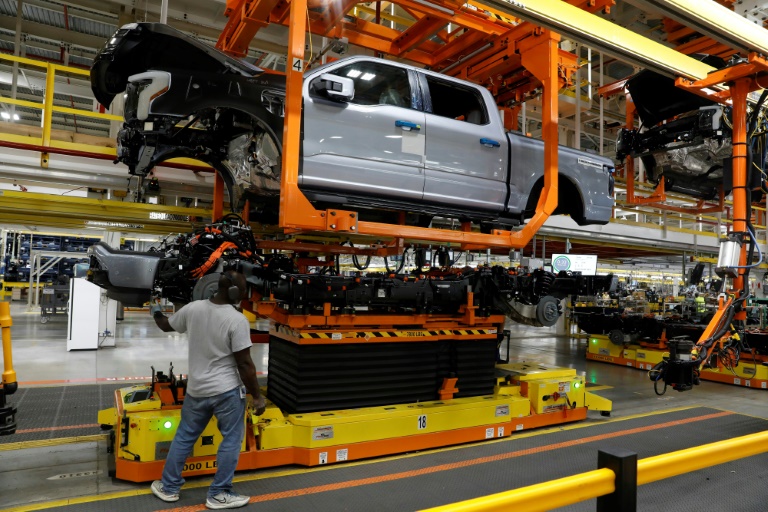
In contrast to the ICE truck factory, which clanks with activity, the BEV plant operates at a modest hum, a quality partly due to the company’s focus on ergonomics. 

The BEV assembly process is also organized around production lines, but there are fewer work stations in an operation that is still gearing up for bigger things. The Rouge Electric Vehicle Center currently employs about 500.

The expansion will double the size of the BEV factory and add more workers and work stations, taking output to 150,000 annually by next fall, Skaggs said.

But the added productivity will be “flex,” Skaggs said, meaning it could be used for either ICE or BEV depending on demand.

“If we don’t call it right, we can build more ICE units… or if BEV really takes off like we all expect it to, we can scale this up.”


Taiwan's pangolins suffer surge in feral dog attacks

In most of its habitats, the heavily trafficked pangolin’s biggest threat comes from humans. But in Taiwan, the scaly mammals brave a different danger: a surging feral dog population.

Veterinarian Tseng Shao-tung, 28, has seen firsthand what a dog can do to the gentle creatures during his shifts at a hospital in Hsinchu.

Last month he worked to save the life of a male juvenile pangolin who had been lying in the wild for days with half of its tail chewed off. 

“It has a big open wound on its tail and its body tissue has decayed,” Tseng said as he carefully turned the sedated pangolin to disinfect the gaping injury.

It was the fifth pangolin Tseng and his fellow veterinarians had saved this year, all from suspected dog attacks.

Chief veterinarian Chen Yi-ru said she had noticed a steady increase of pangolins with trauma injuries in the last five years — most of them with severed tails.

Pangolins are covered in hard, overlapping body scales and curl up into a ball when attacked. The tail is the animal’s most vulnerable part.

“That’s why when attacked, the tail is usually the first to be bitten,” Chen explained.

Wildlife researchers and officials said dog attacks, which account for more than half of all injuries since 2018, have become “the main threat to pangolins in Taiwan” in a report released last year.

– Most trafficked mammal –

Pangolins are described by conservationists as the world’s most trafficked mammal, with traditional Chinese medicine being the main driver. 

Although their scales are made of keratin — the substance that makes up our fingernails and hair — there is huge demand for them among Chinese consumers because of the unproven belief that they help lactation in breastfeeding mothers.

That demand has decimated pangolin populations across Asia and Africa despite a global ban and funded a lucrative international black market trade.

All eight species of pangolins on both continents are listed as endangered or critically endangered.

Taiwan has been a comparative conservation success story, transforming itself from a place where pangolins went from near-extinct to protected and thriving.

Chan Fang-tse, veterinarian and researcher at the official Taiwan Endemic Species Research Institute, said the 1950s to 1970s saw massive hunting. 

“Sixty thousand pangolins in Taiwan were killed for their scales and hides during that period,” he told AFP. 

A 1989 wildlife protection law ended the industry, while rising conservation awareness led the public to start embracing their scaly neighbours as something to be cherished, rather than a commodity.

The population of the Formosan or Taiwanese pangolin, a subspecies of the Chinese pangolin, has since bounced back with researchers estimating that there are now between 10,000 to 15,000 in the wild.

But the island’s growing feral dog population — itself a consequence of a 2017 government policy not to cull stray animals — is hitting pangolins hard, Chan warned. 

“Pangolins are most affected because they have a big overlap of roaming area and pangolins don’t move as fast as other animals,” Chan said.

– Picky eaters –

Pangolins are also vulnerable because of how few offspring they have.

The solitary Formosan pangolins mate once a year and only produce one offspring after 150 days of pregnancy. Captivity breeding programmes have had little success. 

“It may be more difficult to breed pangolins than pandas,” Chan said.

The rise in injured pangolins has created another challenge for animal doctors: finding enough ants and termites to feed the picky eaters who often reject substitute mixtures of larvae. 

Piling into a truck with three other vets, Tseng headed to a tree to retrieve an ant nest he had recently spotted.

“We have to be constantly on the lookout and go search for ants nests every couple of days now because we have more pangolins to feed,” Tseng said.

A pangolin can eat an ant nest the size of a football each day. 

The government has also called for residents to report nest locations to help feed the pangolins until they can be released back into the wild.

But the injured pangolin in Tseng’s care will likely have to be sent to a zoo or government facility for adoption after it recovers.

“It will have difficulty climbing up trees and won’t be able to roll itself into a ball shape,” Tseng said.

“It has lost the ability to protect itself in the wild.”

Taiwan's pangolins suffer surge in feral dog attacks

In most of its habitats, the heavily trafficked pangolin’s biggest threat comes from humans. But in Taiwan, the scaly mammals brave a different danger: a surging feral dog population.

Veterinarian Tseng Shao-tung, 28, has seen firsthand what a dog can do to the gentle creatures during his shifts at a hospital in Hsinchu.

Last month he worked to save the life of a male juvenile pangolin who had been lying in the wild for days with half of its tail chewed off. 

“It has a big open wound on its tail and its body tissue has decayed,” Tseng said as he carefully turned the sedated pangolin to disinfect the gaping injury.

It was the fifth pangolin Tseng and his fellow veterinarians had saved this year, all from suspected dog attacks.

Chief veterinarian Chen Yi-ru said she had noticed a steady increase of pangolins with trauma injuries in the last five years — most of them with severed tails.

Pangolins are covered in hard, overlapping body scales and curl up into a ball when attacked. The tail is the animal’s most vulnerable part.

“That’s why when attacked, the tail is usually the first to be bitten,” Chen explained.

Wildlife researchers and officials said dog attacks, which account for more than half of all injuries since 2018, have become “the main threat to pangolins in Taiwan” in a report released last year.

– Most trafficked mammal –

Pangolins are described by conservationists as the world’s most trafficked mammal, with traditional Chinese medicine being the main driver. 

Although their scales are made of keratin — the substance that makes up our fingernails and hair — there is huge demand for them among Chinese consumers because of the unproven belief that they help lactation in breastfeeding mothers.

That demand has decimated pangolin populations across Asia and Africa despite a global ban and funded a lucrative international black market trade.

All eight species of pangolins on both continents are listed as endangered or critically endangered.

Taiwan has been a comparative conservation success story, transforming itself from a place where pangolins went from near-extinct to protected and thriving.

Chan Fang-tse, veterinarian and researcher at the official Taiwan Endemic Species Research Institute, said the 1950s to 1970s saw massive hunting. 

“Sixty thousand pangolins in Taiwan were killed for their scales and hides during that period,” he told AFP. 

A 1989 wildlife protection law ended the industry, while rising conservation awareness led the public to start embracing their scaly neighbours as something to be cherished, rather than a commodity.

The population of the Formosan or Taiwanese pangolin, a subspecies of the Chinese pangolin, has since bounced back with researchers estimating that there are now between 10,000 to 15,000 in the wild.

But the island’s growing feral dog population — itself a consequence of a 2017 government policy not to cull stray animals — is hitting pangolins hard, Chan warned. 

“Pangolins are most affected because they have a big overlap of roaming area and pangolins don’t move as fast as other animals,” Chan said.

– Picky eaters –

Pangolins are also vulnerable because of how few offspring they have.

The solitary Formosan pangolins mate once a year and only produce one offspring after 150 days of pregnancy. Captivity breeding programmes have had little success. 

“It may be more difficult to breed pangolins than pandas,” Chan said.

The rise in injured pangolins has created another challenge for animal doctors: finding enough ants and termites to feed the picky eaters who often reject substitute mixtures of larvae. 

Piling into a truck with three other vets, Tseng headed to a tree to retrieve an ant nest he had recently spotted.

“We have to be constantly on the lookout and go search for ants nests every couple of days now because we have more pangolins to feed,” Tseng said.

A pangolin can eat an ant nest the size of a football each day. 

The government has also called for residents to report nest locations to help feed the pangolins until they can be released back into the wild.

But the injured pangolin in Tseng’s care will likely have to be sent to a zoo or government facility for adoption after it recovers.

“It will have difficulty climbing up trees and won’t be able to roll itself into a ball shape,” Tseng said.

“It has lost the ability to protect itself in the wild.”

North Korea fires ballistic missile, Seoul says

North Korea fired a ballistic missile Sunday, Seoul’s military said, just days after a US aircraft carrier arrived for joint drills with the South in a show of force against Pyongyang.

With talks long-stalled, nuclear-armed North Korea has doubled down on its banned weapons programmes, even revamping its laws earlier this month to declare itself an “irreversible” nuclear power.

The Sunday launch is the latest in a record-breaking blitz of weapons tests by Pyongyang so far this year, including firing an Intercontinental Ballistic Missile at full range for the first time since 2017.

South of the border, hawkish new President Yoon Suk-yeol, who vowed on the campaign trail to get tough with North Korean leader Kim Jong Un, has ramped up South Korea’s joint drills with key security ally the US.

Seoul’s military “detected one short range missile fired by North Korea at 6:53 today around Taechon in North Pyongan province towards the East Sea,” the Joint Chiefs of Staff (JCS) said. 

The missile flew around 600 kilometres (373 miles) at an altitude of around 60 kilometres, with maximum speed of around Mach 5, the JCS added in a statement.

“Our military maintains a full readiness posture and is closely cooperating with the US while strengthening surveillance and vigilance,” it said.

Japan’s coast guard issued a warning for ships after the launch, and Tokyo’s defence minister Yasukazu Hamada said the missile landed outside of Japan’s Exclusive Economic Zone.

“The repeated ballistic missile launches by North Korea are absolutely unforgivable and the remarkable improvement in its missile technology is something we cannot overlook,” Hamada said. 

– Kamala Harris visit –

South Korea’s President Yoon, who took office in May, has vowed to beef up joint military exercises with the United States after years of failed diplomacy with North Korea under his predecessor.

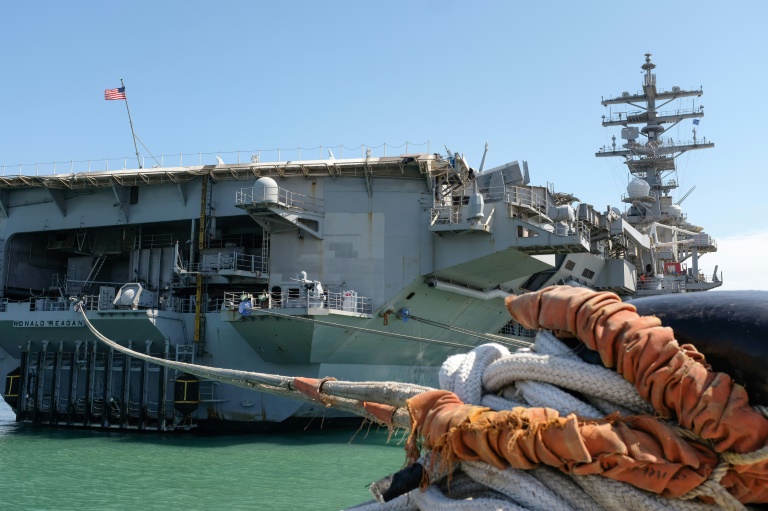
On Friday, the nuclear-powered USS Ronald Reagan and vessels from its strike group docked in the southern port city of Busan, part of a push by Seoul and Washington to have more US strategic assets operating in the region.

Yoon is also due to meet US Vice President Kamala Harris Thursday when she visits Seoul this week, following a trip by President Joe Biden in May, and US House Speaker Nancy Pelosi last month.

“The timing of this latest test is sandwiched between the arrival of USS Ronald Reagan this week and VP Harris’ visit to Seoul next week,” Soo Kim, an analyst at the RAND Corporation, told AFP. 

“It’s North Korea’s way of showing defiance of the alliance and injecting itself at an opportune time.”

The USS Reagan will take part in joint drills off South Korea’s east coast this month.

Washington is Seoul’s key security ally and stations about 28,500 troops in South Korea to protect it from the North.

The two countries have long carried out joint exercises, which they insist are purely defensive but North Korea sees them as rehearsals for an invasion.

“Pyongyang could be making a show of strength while a US aircraft carrier is visiting South Korea for defence exercises,” said Leif-Eric Easley, a professor at Ewha University in Seoul.

“But North Korea’s major tests are, most of all, part of a long-term campaign for advancing offensive military capabilities.”

– Nuclear test next? –

South Korean and US officials have been warning for months that Kim is preparing to conduct another nuclear test.

Seoul had also detected signs the North was preparing to fire a Submarine Launched Ballistic Missile (SLBM), the president’s office said Saturday, a weapon Pyongyang last tested in May.

The isolated regime has tested nuclear weapons six times since 2006. Its last and most powerful one in 2017 — which Pyongyang claimed was a hydrogen bomb — had an estimated yield of 250 kilotons.

“North Korea might be delaying its seventh nuclear test out of respect for China’s upcoming political conference that Xi Jinping is tightly scripting to extend his leadership,” Easley said. 

“But there are limits to Pyongyang’s self-restraint.”

Cubans to vote in referendum on same-sex marriage

Cubans on Sunday will vote in a landmark referendum on whether to legalize same-sex marriage and adoption, allow surrogate pregnancies and give greater rights to non-biological parents.

The new family code, promoted by the communist government, would represent a major shift in Cuba, where the culture of machismo is strong and where the LGBTQ community was ostracized by authorities in the 1960s and 1970s.

More than eight million Cubans over 16 are invited to vote “Yes” or “No” amid the country’s worst economic crisis in 30 years, and experts say the referendum could turn into an opportunity to voice opposition against the government.

If approved, the new family code would replace a law in effect since 1975 and define marriage as the union between two people, rather than that of a man and a woman.

It would also permit surrogate pregnancies, as long as no money changes hands, while boosting children’s rights and those of the elderly and people with disabilities.

“The family code sets out above all respect for human beings, respect for each (person) and everyone,” said President Miguel Diaz-Canel. 

Polling stations will be open from 7:00 am to 6:00 pm local time.

– ‘I’m Christian, I have other ideas’-

The official attitude toward homosexuality has changed significantly over the past 20 years, and the government has put much effort into the “Yes” campaign on television and social media.

“I couldn’t care less if two men marry or two women marry, I don’t have that prejudice,” 67-year-old retiree Reinaldo Orgalles told AFP. “I’m from another era, but I don’t have that prejudice.”

In 2019, the government sought to include same-sex marriage rights in the country’s new constitution but balked after criticism from the Catholic and Evangelical Churches.

The Conference of Bishops recently reiterated its opposition to some of the key provisions of the new code, such as allowing surrogate pregnancies.

“It is unethical… when a woman who has carried a baby in her womb for nine months must hand it over to others straight after birth,” the bishops said.

Zulika Corso, 65, a teacher in central Havana agrees.

“I’m Christian, I have other ideas, I don’t accept this,” she said.

– ‘More important subjects’ –

Between February and April, a vast public debate took place across Cuba, with more than 79,000 neighborhood meetings held to discuss the new family rights.

That resulted in more than half the original text being modified, according to official media.

Still, political scientist Rafael Hernandez calls it the “most important human rights legislation” in Cuba since the 1959 revolution.

The law would be one of the most progressive in Latin America, where same-sex marriage is only legal in eight other countries: Argentina, Brazil, Colombia, Ecuador, Costa Rica, Chile, Uruguay and some Mexican states.

But experts also say the sheer size of the code — it contains some 500 articles — could work against it.

Some Cubans, for example, have expressed support for same-sex marriage but oppose surrogate pregnancies.

“I still haven’t decided because there are some things I consider good and many others I don’t consider good,” said Airam Zulueta, a restaurant owner. 

Six decades after the revolution, Cuba is experiencing its worst economic crisis in 30 years, fueled by ramped-up US sanctions and a tourism collapse due to the coronavirus pandemic.

Many Cubans are struggling to access medicine, electricity, fuel and basic foodstuffs amid critical import shortages and staggering inflation.

The country erupted in historic anti-government protests last summer by citizens clamoring for food and greater freedoms. 

Hundreds were detained and jailed, but crackdown has not stopped repeated demonstrations in recent months in a country notoriously intolerant of dissent.

Many voters could use this occasion to express disapproval of the government, experts have said.

“There are many other subjects that are more important than the family code, like the fact there is no food, that many people are hungry,” concierge Julio Cesar Vazquez told AFP.

Dissidents and the banned opposition, short of other means to express themselves, have called on citizens to reject the new code or to abstain from voting.

The law needs more than 50 percent of the vote to be adopted.

Why are climate activists calling for reparations?

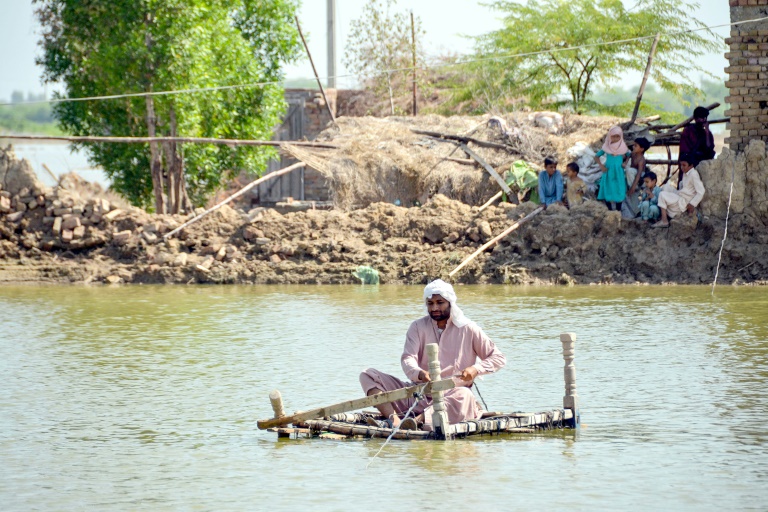
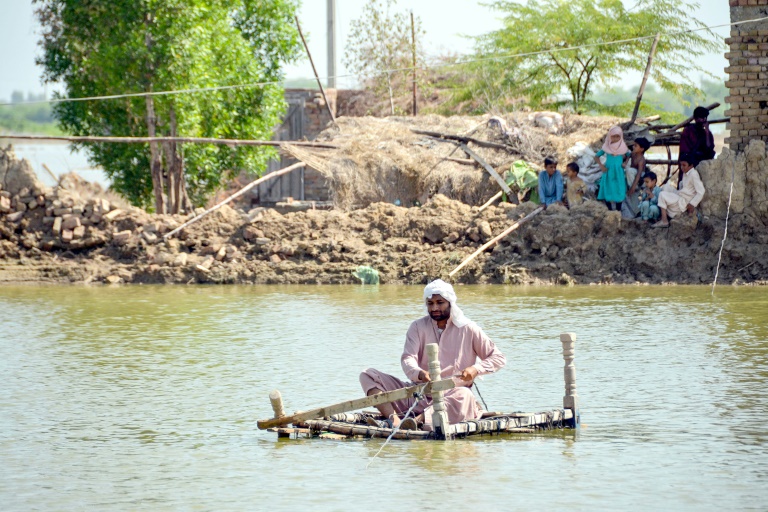
Pakistan’s catastrophic floods have led to renewed calls for rich polluting nations, which grew their economies through heavy use of fossil fuels, to compensate developing countries for the devastating impacts caused by the climate crisis.

The currently favored term for this concept is “loss and damage” payments,  but some campaigners want to go further and frame the issue as “climate reparations,” just as racial justice activists call for compensation for the descendants of enslaved people. 

Beyond the tougher vocabulary, green groups also call for debt cancellation for cash-strapped nations that spend huge portions of their budgets servicing external loans, rather than devoting the funds to increasing resilience to a rapidly changing planet. 

“There’s a historical precedent of not just the industrial revolution that led to increased emissions and carbon pollution, but also the history of colonialism and the history of extraction of resources, wealth and labor,” Belgium-based climate activist Meera Ghani told AFP.

“The climate crisis is a manifestation of interlocking systems of oppression, and it’s a form of colonialism,” said Ghani, a former climate negotiator for Pakistan. 

Such ideas stretch back decades and were first pushed by small island nations susceptible to rising sea levels —  but momentum is once more building on the back of this summer’s catastrophic inundations in Pakistan, driven by unprecedented monsoon rains. 

Nearly 1,600 were killed, several million displaced, and the cash-strapped government estimates losses in the region of $30 billion. 

– Beyond mitigation and adaptation –

Campaigners point to the fact that the most climate-vulnerable countries in the Global South are least responsible — Pakistan, for instance, produces less than one percent of global greenhouse emissions, as opposed to the G20 countries which account for 80 percent.

The international climate response currently involves a two-pronged approach: “mitigation” — which means reducing heat-trapping greenhouse gases — and “adaptation,” which means steps to alter systems and improve infrastructure for changes that are already locked in.

Calls for “loss and damage” payments go further than adaptation financing, and seek compensation for multiplying severe weather impacts that countries cannot withstand.

At present, however, even the more modest goal of adaptation financing is languishing. 

Advanced economies agreed to channel $100 billion to less developed countries by the year 2020 — a promise that was broken — even as much of the funding that was mobilized came in the form of loans.

“Our starting point is that the global North is largely responsible for the state of our planet today,” said Maira Hayat, an assistant professor of environment and peace studies at the University of Notre Dame in Indiana. 

“Why should countries that have contributed little by way of GHG emissions be asking them for aid –- loans are the predominant form –- with onerous repayment conditions?”

“If the language is upsetting for some, the next step should be to probe why that might be -– do they dispute the history? Or the present-day implications of accepting certain historical pasts?”

– Point scoring? –

Not all in the climate arena are convinced. 

“Beyond a certain rhetorical point-scoring that’s not going to go anywhere,” said Daanish Mustafa, professor in critical geography at King’s College London. 

While he mostly blames the Global North for the world’s current predicament, he says he is wary of pushing a narrative that may excuse the actions of the Pakistani leadership and policy choices they have taken that exacerbate this and other disasters.

The World Weather Attribution group of climate scientists found that climate change likely contributed to the floods. 

But the devastating impacts were also driven “by the proximity of human settlements, infrastructure (homes, buildings, bridges) and agricultural land to flood plains,” among other locally driven factors, they said.

Pakistan’s own emissions, while low at the global scale, are fast rising — with the benefits flowing to a tiny elite, said Mustafa, and the country should pursue an alternative, low-carbon development path rather than “aping the West” and damaging itself in the process. 

The case for “loss and damage” payments received a recent boost with UN chief Antonio Guterres calling for “meaningful action” on it at the next global climate summit, COP27 in Egypt in November.

But the issue is sensitive for rich countries — especially the United States, the largest emitter of GHGs historically — which fear it could pave the way for legal action and kept language regarding “liability and compensation” out of the landmark Paris agreement.

Why are climate activists calling for reparations?

Pakistan’s catastrophic floods have led to renewed calls for rich polluting nations, which grew their economies through heavy use of fossil fuels, to compensate developing countries for the devastating impacts caused by the climate crisis.

The currently favored term for this concept is “loss and damage” payments,  but some campaigners want to go further and frame the issue as “climate reparations,” just as racial justice activists call for compensation for the descendants of enslaved people. 

Beyond the tougher vocabulary, green groups also call for debt cancellation for cash-strapped nations that spend huge portions of their budgets servicing external loans, rather than devoting the funds to increasing resilience to a rapidly changing planet. 

“There’s a historical precedent of not just the industrial revolution that led to increased emissions and carbon pollution, but also the history of colonialism and the history of extraction of resources, wealth and labor,” Belgium-based climate activist Meera Ghani told AFP.

“The climate crisis is a manifestation of interlocking systems of oppression, and it’s a form of colonialism,” said Ghani, a former climate negotiator for Pakistan. 

Such ideas stretch back decades and were first pushed by small island nations susceptible to rising sea levels —  but momentum is once more building on the back of this summer’s catastrophic inundations in Pakistan, driven by unprecedented monsoon rains. 

Nearly 1,600 were killed, several million displaced, and the cash-strapped government estimates losses in the region of $30 billion. 

– Beyond mitigation and adaptation –

Campaigners point to the fact that the most climate-vulnerable countries in the Global South are least responsible — Pakistan, for instance, produces less than one percent of global greenhouse emissions, as opposed to the G20 countries which account for 80 percent.

The international climate response currently involves a two-pronged approach: “mitigation” — which means reducing heat-trapping greenhouse gases — and “adaptation,” which means steps to alter systems and improve infrastructure for changes that are already locked in.

Calls for “loss and damage” payments go further than adaptation financing, and seek compensation for multiplying severe weather impacts that countries cannot withstand.

At present, however, even the more modest goal of adaptation financing is languishing. 

Advanced economies agreed to channel $100 billion to less developed countries by the year 2020 — a promise that was broken — even as much of the funding that was mobilized came in the form of loans.

“Our starting point is that the global North is largely responsible for the state of our planet today,” said Maira Hayat, an assistant professor of environment and peace studies at the University of Notre Dame in Indiana. 

“Why should countries that have contributed little by way of GHG emissions be asking them for aid –- loans are the predominant form –- with onerous repayment conditions?”

“If the language is upsetting for some, the next step should be to probe why that might be -– do they dispute the history? Or the present-day implications of accepting certain historical pasts?”

– Point scoring? –

Not all in the climate arena are convinced. 

“Beyond a certain rhetorical point-scoring that’s not going to go anywhere,” said Daanish Mustafa, professor in critical geography at King’s College London. 

While he mostly blames the Global North for the world’s current predicament, he says he is wary of pushing a narrative that may excuse the actions of the Pakistani leadership and policy choices they have taken that exacerbate this and other disasters.

The World Weather Attribution group of climate scientists found that climate change likely contributed to the floods. 

But the devastating impacts were also driven “by the proximity of human settlements, infrastructure (homes, buildings, bridges) and agricultural land to flood plains,” among other locally driven factors, they said.

Pakistan’s own emissions, while low at the global scale, are fast rising — with the benefits flowing to a tiny elite, said Mustafa, and the country should pursue an alternative, low-carbon development path rather than “aping the West” and damaging itself in the process. 

The case for “loss and damage” payments received a recent boost with UN chief Antonio Guterres calling for “meaningful action” on it at the next global climate summit, COP27 in Egypt in November.

But the issue is sensitive for rich countries — especially the United States, the largest emitter of GHGs historically — which fear it could pave the way for legal action and kept language regarding “liability and compensation” out of the landmark Paris agreement.

EVs at Detroit Auto Show? Consumers have questions

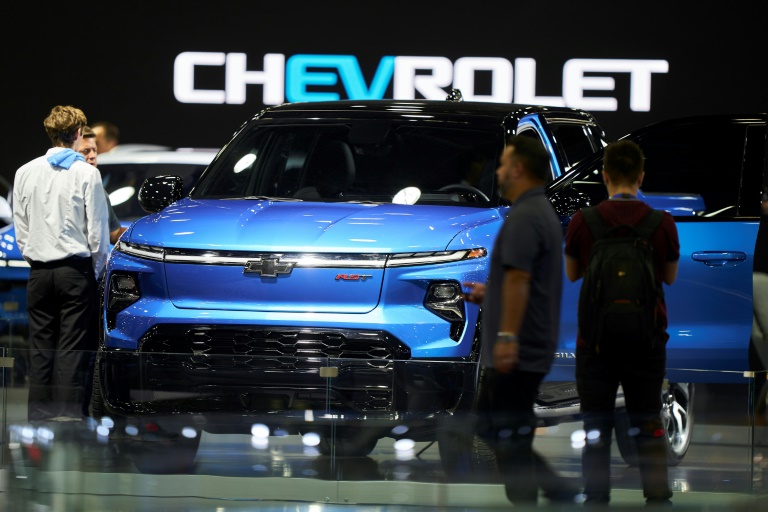
The emerging fleet of electric vehicles (EV) provoked fascination at the Detroit Auto Show, but many consumers were not yet ready to take the plunge to own one themselves.

Some, like Justin Tata, wanted a first-hand look at new EV offerings, saying “it’s embracing the change that’s coming because I think the internal combustion engine (ICE) is on the way out.” 

But Tata, who works in the packaging industry, still has questions about EV battery disposal. He came to the Detroit show, which concludes Sunday, to survey the state of play, but doesn’t foresee buying an EV for another five to 10 years.

Among other attendees, the less-EV enthused included Tim Stokes.

“I think eventually that’s going to be the only option,” said Stokes as he admired a new gasoline-powered Ford Mustang, adding that he wants to “prolong (driving ICE vehicles) as long as possible.”

Friends in the auto industry have advised waiting three or four years for the industry to “work out the kinks” with EVs, said Stokes, who works in telecommunications.

– Mainstream options –

Long considered a niche sideshow in the auto world, the prominence of EVs at this year’s Detroit gathering underscored their new mainstream status as big automakers respond to rising concerns about climate change and government policies promoting EVs.

Chevrolet’s showcase highlighted EV versions of three of the GM brand’s top-selling products: the Silverado pickup, and the Blazer and Equinox, both SUVs. Chevy expects to begin deliveries on the vehicles in 2023.

Ford too has targeted its EV campaign towards its most popular vehicles, unveiling a battery-powered version of its best-selling F-150 pickup truck and launching the Mustang Mach-E, a new SUV that has also attracted strong interest from consumers.

A 2022 Consumer Reports survey showed 14 percent of Americans saying they would “definitely” buy or lease an EV if they were searching for a vehicle, up from four percent in 2020.

While the vehicle launches have brought unprecedented attention to EVs, auto experts say that a meaningful transformation of the ICE-dominated US fleet is still years away. 

Price remains a big problem, with the average price of an EV nearly $67,000, according to Cox Automotive.

Experts also cite the lack of EV charging stations as a concern. President Biden signed into law a bill to provide $7.5 billion to build more stations, as his administration announced the first tranche of funding in parallel with a presidential address at the Detroit show.

– Can the industry deliver? –

Auto insiders also point to doubts about the availability of critical materials such as lithium and cobalt needed for batteries. 

These issues have come to the fore during the Covid-19 pandemic, when shortages of semiconductors and other supply chain woes forced automakers to restrict vehicle production and store tens of thousands of partially-built autos.

Ford said on Monday that it expects to have some 40,000-45,000 mostly built vehicles in inventory at the end of the third quarter due to needed parts. On Friday, the Wall Street Journal reported that the company had delayed some vehicle deliveries due to a shortage of badges with the company’s blue oval logo.

Don Lamos, who works for auto supplier, had placed an order on a Ford Lightning, but is backing off after Ford raised the price on that version to above the $80,000 cap that would allow car buyers to qualify for a $7,500 tax credit under new US legislation.

Lamos and his wife, Janice, were drawn to the Chevy offerings, including the Equinox, which starts at $30,000. 

“If they can hold that at $30,000, then awesome,” he said. “I don’t know if they’ll really be able to meet production next year, so we’ll see.”

Don Lamos cited cost savings as the main impetus, while Janice Lamos described climate change as a priority. The couple are sold on EVs, but pondering how much to spend now when battery technologies will likely improve in the future.

Many of the vehicles being released are touted for being able to travel 300 miles without being recharged, but the capacity is much lower if the vehicle is towing cargo.

“You know when you need gas you can go to the corner and there’s a station. I don’t think there’s enough (charging) stations for one of these,” Carlos Rubante said when asked about the Lightning.

Consumers at the show described climate change as a worry, but were not necessarily convinced that EVs were the solution. 

Besides battery disposal, another concern is the unwanted consequences of the mining boom in critical materials, such as the use of child labor in the Democratic Republic of Congo to produce cobalt, said Cristian Damboiu, who works for an auto supplier.

“When you’re considering all these things, maybe they aren’t as clean as they seem,” said Damboiu.

“I understand (EVs) have some advantages, so we’ll see how it plays out.”

Russia stiffens penalty for surrender, replaces top general

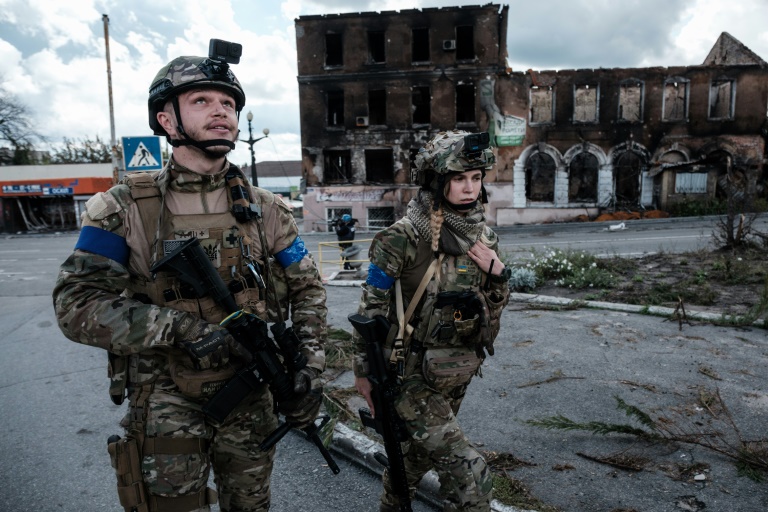
Russia on Saturday toughened penalties for soldiers voluntarily surrendering or refusing to fight, with up to 10 years imprisonment, and it replaced its top logistics general after a series of setbacks to its seven-month war in Ukraine.

Those developments come days after Russia instigated a partial mobilisation affecting up to 300,000 additional troops, at a time when Kyiv has taken back more and more territory in a stunning counter-offensive.

Seemingly in response to the new Russian penalties, Ukrainian President Volodymyr Zelensky directly addressed Russian citizens on Saturday, telling them that their president was knowingly “sending citizens to their death.”

Speaking in Russian, he called on Moscow’s forces to surrender, saying, “You will be treated in a civilized manner… No one will know the circumstances of your surrendering.”

His pointed remarks came as Kremlin-held regions of eastern and southern Ukraine voted for a second day on whether to become part of Russia, dramatically raising the stakes in the conflict. 

Integrating the four regions into Russia would mean that Moscow would consider any military move there as an attack on its own territory.

Zelensky has denounced the polls, on Friday calling them “crimes against international law and the law of Ukraine”.

Ukraine’s recent gains have laid bare flaws in Russia’s approach since it invaded on February 24, with some analysts seeing logistics as the weak link in Moscow’s army.

“Army General Dmitry Bulgakov has been relieved of the post of deputy minister of defence” and will be replaced by Colonel General Mikhail Mizintsev, aged 60, the defence ministry said.

Russia’s partial mobilisation, announced on Wednesday, will likely be one of Mizintsev’s first big logistical challenges, with the hundreds of thousands of reservists being called up needing equipment and training before deployment.

Military-age men have sought to leave, with flights full and neighbouring countries receiving an influx of Russians. Some 2,300 private vehicles were waiting at one crossing into Georgia, regional Russian authorities said.

“We were talking to our friends and many are thinking about leaving,” said Daria, 22, after fleeing Russia to Istanbul with many of her compatriots.

“Not everyone wanted to leave in February. The (mobilisation) decision of September 21 forced many to think about it again.”

More than 700 people were detained in protests on Saturday against the partial mobilisation, according to independent monitoring group OVD-Info. 

Now that President Vladimir Putin has signed the legislation, servicemen who desert, surrender “without authorisation”, refuse to fight or disobey orders can face up to 10 years imprisonment.

Looting will be punishable by 15 years imprisonment.

A separate law, also signed on Saturday, facilitates Russian citizenship for foreigners who enlist in the Russian army as the Kremlin seeks to bolster the ranks.

– Biden calls vote a ‘sham’ –

On Friday, US President Joe Biden dismissed as a “sham” the voting on whether Russia should annex four regions of Ukraine.

And in remarks at the UN General Assembly in New York, even Beijing, Moscow’s closest ally since the war began, called on Russia and Ukraine not to let the effects of the war “spill over”.

In his own address to the UN on Saturday, Russian Foreign Minister Sergei Lavrov bitterly criticized Western nations, saying the United States and its allies sought to “destroy” his country.

“The official Russophobia in the West is unprecedented. Now the scope is grotesque,” he said. 

He also defended the referendums, describing them as people claiming land “where their ancestors have been living for hundreds of years.”

The voting is being held in Russian-controlled areas of Donetsk and Lugansk in the east, and Kherson and Zaporizhzhia in the south.

Authorities there are going door-to-door to collect votes.

Polling stations then open Tuesday for residents to cast ballots on the final day of voting. Results are expected as early as late Tuesday.

“Ultimately, things are moving towards the restoration of the Soviet Union. The referendum is one step towards this,” Leonid, a 59-year-old military official, told AFP.

The snap referendums were announced just this week after the Ukrainian counter-offensive seized most of the northeast Kharkiv region — bringing hundreds of settlements back under Kyiv’s control after months of Russian occupation.

On Saturday, bad weather and stiff Russian resistance caused Ukraine’s counter-offensive to slow to a brutal slog in Kupiansk, in the eastern Kharkiv region. 

“For now, the rain is making it difficult to use heavy weapons everywhere. We can only use paved roads,” Ukrainian army sergeant Roman Malyna told AFP.

Irpin, close to the capital, was recaptured after weeks of fighting and residents have rallied to start rebuilding before winter sets in.

More than 100 apartment blocks in Irpin — dubbed a “hero city” by Zelensky for holding back Russian invaders — were badly damaged by shelling.

– Evidence of ‘war crimes’ –

Head of the residents’ association in his building, Mykhailo Kyrylenko looked proudly at the new roof taking shape.

“People don’t have much money, but they agreed” to donate funds to gradually restore shattered homes, he told AFP.

Putin this week warned that Moscow would use “all means” to protect its territory — which former Russian leader Dmitry Medvedev said on social media could include the use of “strategic nuclear weapons”.

UN investigators on Friday accused Russia of committing war crimes on a “massive scale” in Ukraine — listing bombings, executions, torture and horrific sexual violence.

In the eastern Kharkiv region, Ukrainian officials said they had exhumed 447 bodies from a site near the city of Izyum, which was recaptured from Russian forces.

The Kremlin has accused Kyiv of fabricating evidence of the alleged war crimes.

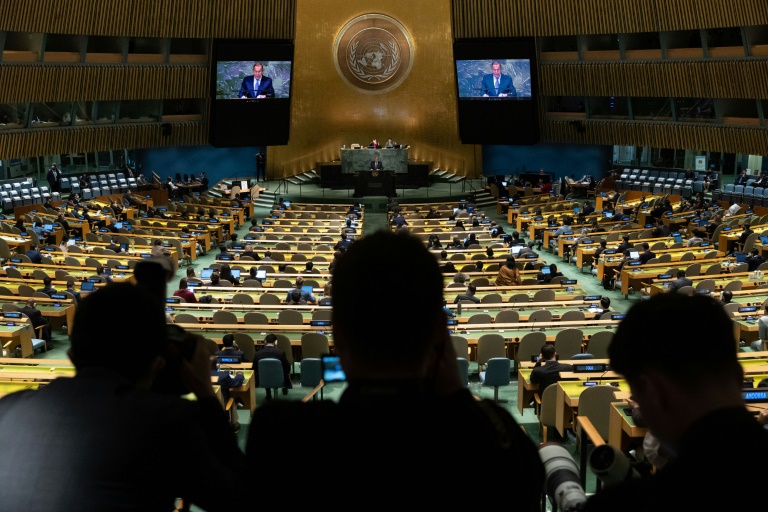
Russian FM, at UN, slams West for 'grotesque' Russophobia

Russian Foreign Minister Sergei Lavrov bitterly criticized Western nations Saturday over the Ukraine war, telling the United Nations that the United States and its allies are seeking to “destroy” his country.

“The official Russophobia in the West is unprecedented. Now the scope is grotesque,” Lavrov said in a fiery UN General Assembly speech. 

“They are not shying away from declaring the intent to inflict not only military defeat on our country but also to destroy and fracture Russia.”

After days of Western leaders denouncing Russia’s invasion of Ukraine, Lavrov used Russia’s turn at the General Assembly rostrum to hit back at pressure on Moscow led by Washington. 

The United States, he said, was “trying to turn the entire world into its own backyard.” 

“Declaring themselves victorious in the Cold War, Washington erected themselves almost into an envoy of God on Earth,” operating with impunity as the “self-proclaimed masters of the world,” he said.

He also defended referendums Friday and Saturday in Russian-occupied parts of Ukraine, describing them as people claiming land “where their ancestors have been living for hundreds of years.” 

“The West is now throwing a fit” on the referendums, Lavrov said.

US President Joe Biden and other Western leaders have vowed never to accept results from the “sham” referendums, seeing them as part of an effort to change borders by force.

In a lengthy press conference after his speech, Lavrov further mocked as “hysteria” the American and Western response to the polls in Kremlin-held regions of southern and eastern Ukraine, including Donetsk and Lugansk.

“Russia, of course, will respect the expression of the will of those people who for many long years have been suffering from the abuses of the neo-Nazis,” he said, repeating a Moscow accusation against some officials in Ukrainian President Volodymyr Zelensky’s government. 

Lavrov also slammed the European Union as “becoming an authoritarian, harsh, dictatorial entity.”

Russia faced broad condemnation at this week’s UN General Assembly, particularly after President Vladimir Putin issued a veiled threat to use nuclear force against any menace to Russia’s “territorial integrity.”

When asked to clarify Russia’s nuclear policy, particularly regarding Ukraine and the separatist regions, Lavrov was vague. 

“We have a doctrine for nuclear security which is an open document” laying out the cases in which use of the destructive weapons is acceptable, he said.

Close Bitnami banner
Bitnami