World

Indonesia hikes rates for second straight month to stem inflation

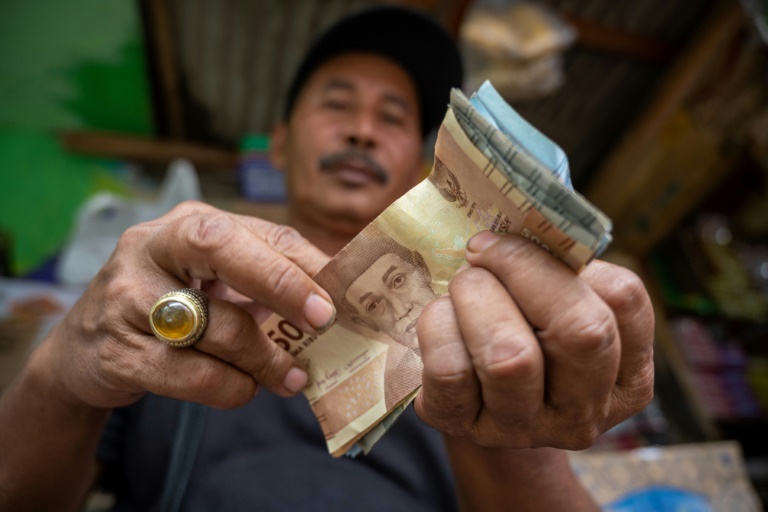
Indonesia’s central bank hiked its key interest rate for the second month in a row Thursday to combat rising inflation stoked by fuel prices and the war in Ukraine.

Bank Indonesia pushed the policy rate to 4.25 from 3.75 percent, and the jump was higher than expected by analysts.

Its two other main rates were also raised by 50 basis points.

The central bank hiked interest rates in August for the first time since 2018 to defend against accelerating inflation, with Russia’s invasion of Ukraine driving up global energy and food prices and pushing millions into poverty.

But a fuel price rise this month has put more pressure on the central bank to act.

The government raised heavily subsidised fuel prices by about 30 percent, a policy expected to further stoke inflation already at 4.69 percent.

Some analysts have forecast inflation reaching as high as seven percent by the end of the year.

Thurday’s rate hike was a “frontloaded, pre-emptive and forward-looking” move aimed at “lowering inflation expectation”, Bank Indonesia Governor Perry Warjiyo said.

It sought to bring down core inflation to within the central bank’s target of between 2 and 4 percent in the second half of next year, he said, predicting it could rise to nearly six percent this month.

President Joko Widodo came to power in 2014 on a pledge to boost annual growth to seven percent.

The commodities-driven economy has remained stuck around five percent, however, and has fallen below that after the onset of the coronavirus pandemic in early 2020.

The outlook for monetary policy is likely even more tightening as the government tries to get a greater handle on inflation, economists said.

“While a rate hike today was never in doubt, the size of the increase was,” said Gareth Leather, Asia economist from Capital Economics.

“With inflation set to jump sharply higher in September and remain well above target until late 2023, further tightening is likely.”

Japan government intervenes to bolster cratering yen

Japan’s finance ministry said Thursday it intervened in the currency market to bolster the yen, which has plummeted against the dollar in recent months on the widening policy gap between the US and Japanese central banks.

It was the first government intervention to prop up the currency since 1998 and came after the dollar surged to nearly 146 yen earlier in the day.

The yen has been weakening against the dollar for months, but sank further on Thursday after the US Federal Reserve again hiked rates to tame inflation, while the Bank of Japan left its ultra-loose monetary policy in place.

“There have been some rapid, one-sided developments on the back of speculative movement in the foreign exchange market,” Japan’s vice finance minister for international affairs Masato Kanda told reporters on Thursday evening.

“The government is worried about these excessive fluctuations and has just taken resolute action,” he added, confirming this referred to intervention.

His remarks saw the yen pare most of its losses, with the dollar retreating as low as 140.70 yen.

Inflation in Japan is rising, with the consumer price index in August at 2.8 percent, its highest level since 2014, but the central bank views the increases as temporary.

In its policy statement earlier Thursday, it said it would leave its current policy in place, “aiming to achieve the price stability target of two percent, as long as it is necessary”.

“It will continue expanding the monetary base until the year-on-year rate of increase in the observed CPI exceeds two percent and stays above the target in a stable manner.”

The bank said it sees Japan’s economy as on a recovery path, “with the impact of Covid-19 and supply-side constraints waning”, though it warned of uncertainty from commodity price increases linked to the war in Ukraine.

The yen’s rapid depreciation has caused concern in Japan, pushing up the cost of imported goods for consumers and businesses.

– ‘BoJ has no choice’ –

Earlier this month, the central bank reportedly conducted a “rate check”, an operation often seen as a precursor to a currency intervention.

The move came shortly after the yen came close to breaching the psychologically significant 145 barrier, and reports of the operation temporarily bolstered the Japanese unit.

It has plunged from around 115 in March, and the BoJ on Thursday repeated that “it is necessary to pay due attention to developments in financial and foreign exchange markets and their impact on Japan’s economic activity and prices”.

Governor Haruhiko Kuroda, whose term expires next year, told reporters before the intervention announcement that the bank would stick with its long-standing programme.

“We haven’t been and will not be targeting certain levels of foreign exchange,” he said.

“It is desirable that forex rates reflect economic and financial fundamentals, however the recent rapid depreciation of the yen is not that and is negative for the economy,” he added.

He noted though that the dollar has gained against most major currencies.

There is little expectation the BoJ will shift course, wrote Shigeto Nagai, head of Japan Economics at Oxford Economics, in a note.

“Although foreign investors might continue challenging the yen and (Japanese government bond) yields until the Fed’s rate tightening cycle peaks, we believe that the BoJ has no choice but to stick to the current… policy.”

Markets tumble again as Fed hikes rates, warns more to come

Asian and European markets sank Thursday and the dollar rallied after the Federal Reserve unveiled a third straight jumbo interest rate hike, said more were in the pipeline and warned the battle against inflation was straining the US economy.

While the three-quarter-point rise was widely expected, there was some surprise at the central bank’s forecast that borrowing costs would likely be held above four percent throughout next year.

Fed boss Jerome Powell reiterated his determination to focus on bringing down inflation — which is at a four-decade high — and accepted that the campaign would hit Americans hard.

“We have got to get inflation behind us,” Powell said after a two-day meeting of the Fed policy committee. “I wish there were a painless way to do that. There isn’t.”

He added that “the historical record cautions strongly against prematurely loosening policy” and the Fed would “keep at it until the job is done”.

All three main indexes on Wall Street tumbled Wednesday as traders contemplated an era of higher-for-longer rates, which could hit companies’ bottom lines.

Asia followed suit, with Hong Kong down at an 11-year low — while Tokyo, Shanghai, Seoul, Singapore, Mumbai, Taipei and Manila also down.

London, Paris and Frankfurt extended the losses in early trade.

However, the dollar continued its strong march higher, striking a fresh 24-year high of 145.90 yen, which prompted the government to embark on a rare intervention to protect its currency.

The US Fed has for months tried to walk a fine line between fighting soaring prices and trying to keep the economy from contracting, but officials accept the chances of success are narrow.

“With the new rate projections, the Fed is engineering a hard landing — a soft landing is almost out of the question,” said Seema Shah, of Principal Global Investors.

“Jerome Powell almost channelled his inner Paul Volcker… talking about the forceful and rapid steps the Fed has taken, and is likely to continue taking, as it attempts to stamp out painful inflation pressures and ward off an even worse scenario later down the line.”

Volcker used aggressive measures to quell runaway prices in the 1980s, when inflation was last as high as it is now.

Commentators are now betting on a fourth straight 75-basis-point rate hike at the next Fed meeting in November.

All three main indexes on Wall Street tumbled Wednesday as traders contemplated an era of higher-for-longer rates, which could hit companies’ bottom lines.

– ‘Bitter medicine’ –

“This meeting once again demonstrates that the Fed is willing to do what is necessary to bring inflation under control. It will slow demand by keeping rates higher for longer — even if this means growth and jobs are lost,” said Christian Scherrmann, of asset management firm DWS.

“The current view of the central bankers is still that this will cause a slowdown, but not a recession. We fully agree that bitter medicine to win back price stability is necessary. But we fear its side-effects will be harsher than the Fed is currently projecting.”

And Fidelity International’s Anna Stupnytska said a long-hoped-for change of direction from the Fed “now seems further away”, though added that a significant tightening of monetary financial conditions could see an earlier pause in the rate hikes.

The Swiss central bank followed up Thursday with a 0.75 percentage point hike and Norway lifted its rate to an 11-year high. Indonesia and the Philippines also tightened policy.

Investors are now preparing for a large move from the Bank of England later in the day.

Still, the Bank of Japan decided not to shift from its ultra-loose measures owing to its determination to kickstart the country’s torpid economy. The decision leaves it as the only major central bank with negative rates, a policy that has sent the yen plunging 20 percent this year.

However, the currency got a bounce after the finance ministry stepped into the currency markets, pushing the dollar back below 143 yen.

Other currencies were also under pressure, with the euro wallowing at a 20-year low and sterling touching a fresh 37-year nadir of $1.1221.

The greenback was also at multi-year highs on the South Korean won, Chinese yuan, Australian dollar and Canadian dollar, among others.

Oil prices edged up after a rollercoaster Wednesday.

Both contracts spiked in reaction to President Vladimir Putin’s announcement of a partial mobilisation of the Russian army and a veiled threat to use nuclear weapons against the West.

But they soon retreated as investors once again turned to the likely impact on demand from an expected recession across world economies.

– Key figures at around 0810 GMT –

Tokyo – Nikkei 225: DOWN 0.6 percent at 27,153,83 (close)

Hong Kong – Hang Seng Index: DOWN 1.6 percent at 18,147.95 (close)

Shanghai – Composite: DOWN 0.3 percent at 3,108.91 (close)

London – FTSE 100: DOWN 0.4 percent at 7,209.75

Dollar/yen: UP at 142.63 yen from 144.02 yen Wednesday

Pound/dollar: DOWN at $1.1275 from $1.1275

Euro/dollar: DOWN at $0.9840 from $0.9847

Euro/pound: UP at 87.25 pence from 87.31 pence 

West Texas Intermediate: UP 0.6 percent at $83.46 per barrel

Brent North Sea crude: UP 0.7 percent at $90.41 per barrel

New York – Dow: DOWN 1.7 percent at 30,183.78 (close)

Almost 200 pilot whales perish on Australian beach

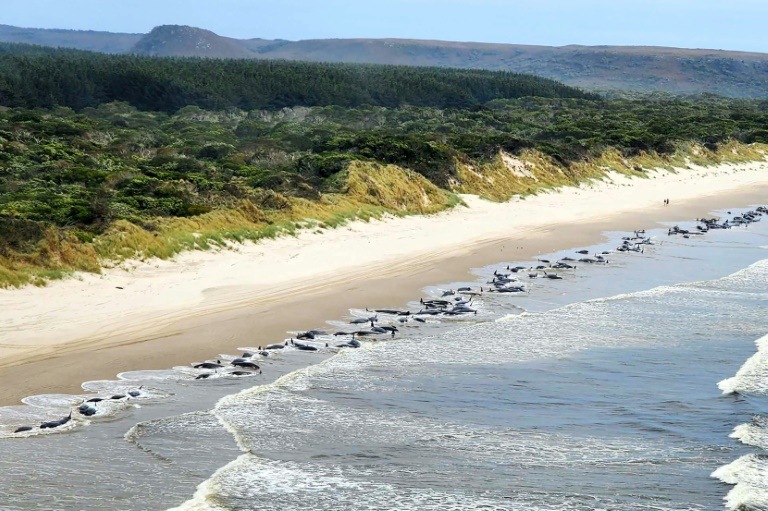
Almost 200 whales have perished at an exposed, surf-swept beach on the rugged west coast of Tasmania, where Australian rescuers were only able to save a few dozen survivors Thursday.

After an arduous, day-long effort in difficult conditions, state wildlife services said just 32 of the 226 beached long-finned pilot whales were strong enough to be rescued. 

“We’ve been refloating those whales that have been deemed suitable for release back to sea,” Sam Thalmann, a marine biologist, told AFP.

“Every whale that has been released has been tagged,” he said. “There may be a few that restrand unfortunately, but we expect that by far the majority will head out to sea.”

Locals had covered some of the mammals with blankets and doused them with buckets of seawater to keep them alive until more help arrived.

But many of the whales were too far gone.

By nightfall, scores of the glossy black whales were strewn along Ocean Beach, their carcasses pock-marking the waterline where the frigid southern ocean meets the sand.

“Unfortunately we do have a high mortality rate on this particular stranding,” said state wildlife operations manager Brendon Clark.

“The environmental conditions, the surf out there on the exposed west coast, Ocean Beach, is certainly taking its toll on the animals.”

Efforts will now turn to the considerable task of disposing of the whale bodies safely.

If left in shallow waters or on the beach, they could attract sharks and can carry disease. 

“There is a lot more work to be done with the carcass disposal,” said Thalmann, who added that “valuable biological samples” would need to be collected from the animals.

Those could help scientists understand how and why “the animals strand at this location”.

“There (are) certainly some local characteristics that lead to this spot being repeatedly a site for mass whale stranding.”

Two years ago, Macquarie Harbour was the scene of the country’s largest-ever mass stranding, involving almost 500 pilot whales.

More than 300 pilot whales died during that event, despite the efforts of dozens of volunteers who toiled for days in Tasmania’s freezing waters to free them.

Clark said the conditions of the latest stranding were tougher for the whales than two years ago, when the animals were in “much more sheltered waters”.

– Distress signals –

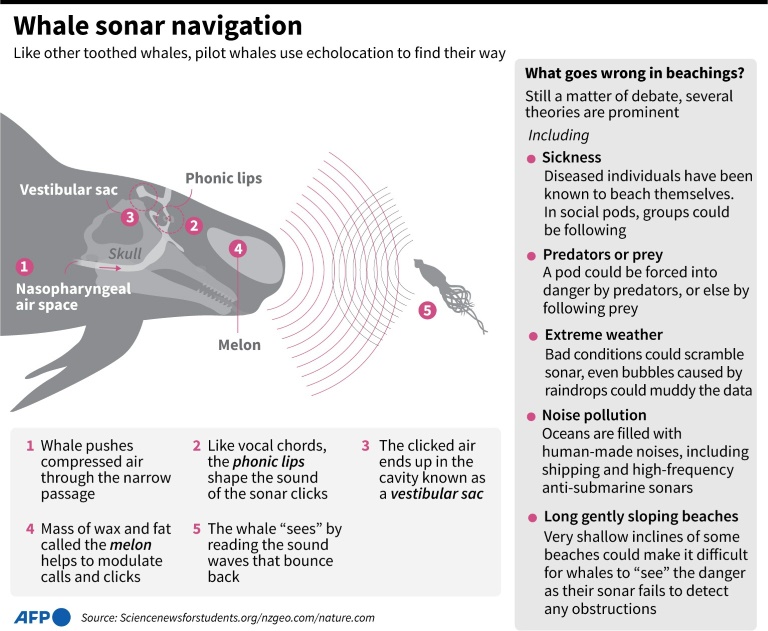
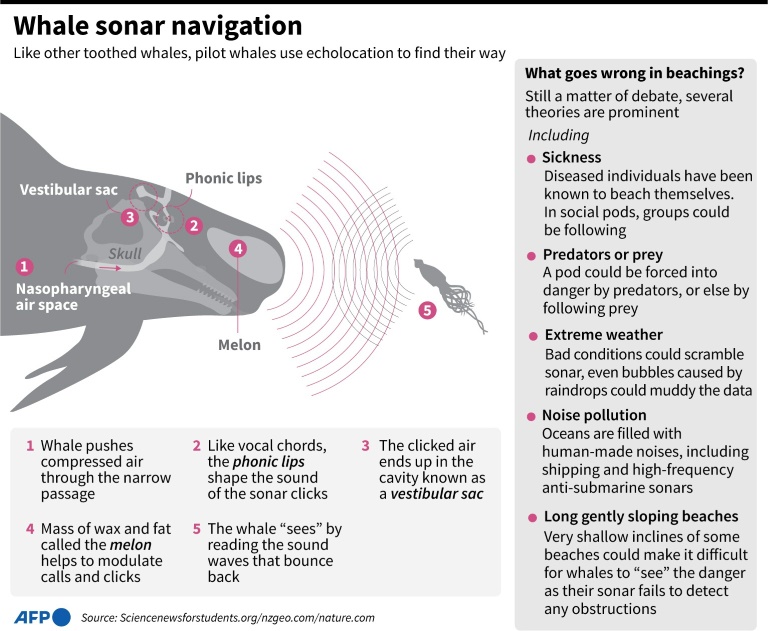
Scientists still do not fully understand why mass strandings occur.  

Some have suggested pods go off track after feeding too close to shore.

Pilot whales — which can grow to more than six metres (20 feet) long — are also highly sociable, so they may follow pod-mates who stray into danger.

That sometimes occurs when old, sick or injured animals swim ashore and other pod members follow, trying to respond to the trapped whale’s distress signals.

Others believe gently sloping beaches like those found in Tasmania confuse the whales’ sonar, making them think they are in open waters.

The latest stranding came days after a dozen young male sperm whales were reported dead in a separate mass stranding on King Island — between Tasmania and the Australian mainland.

State officials said that incident may have been a case of “misadventure”.

Strandings are also common in nearby New Zealand.

There, around 300 animals beach themselves annually, according to official figures, and it is not unusual for groups of between 20 and 50 pilot whales to run aground. 

But numbers can run into the hundreds when a “super pod” is involved — in 2017, there was a mass stranding of almost 700 pilot whales.

Almost 200 pilot whales perish on Australian beach

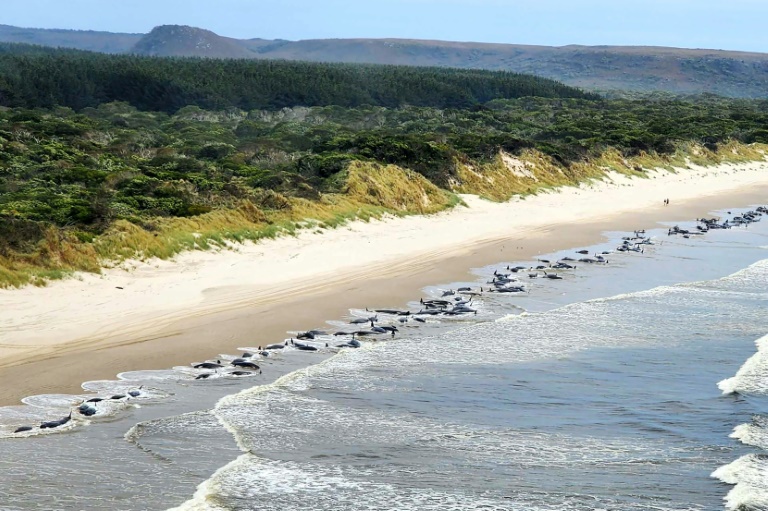
Almost 200 whales have perished at an exposed, surf-swept beach on the rugged west coast of Tasmania, where Australian rescuers were only able to save a few dozen survivors Thursday.

After an arduous, day-long effort in difficult conditions, state wildlife services said just 32 of the 226 beached long-finned pilot whales were strong enough to be rescued. 

“We’ve been refloating those whales that have been deemed suitable for release back to sea,” Sam Thalmann, a marine biologist, told AFP.

“Every whale that has been released has been tagged,” he said. “There may be a few that restrand unfortunately, but we expect that by far the majority will head out to sea.”

Locals had covered some of the mammals with blankets and doused them with buckets of seawater to keep them alive until more help arrived.

But many of the whales were too far gone.

By nightfall, scores of the glossy black whales were strewn along Ocean Beach, their carcasses pock-marking the waterline where the frigid southern ocean meets the sand.

“Unfortunately we do have a high mortality rate on this particular stranding,” said state wildlife operations manager Brendon Clark.

“The environmental conditions, the surf out there on the exposed west coast, Ocean Beach, is certainly taking its toll on the animals.”

Efforts will now turn to the considerable task of disposing of the whale bodies safely.

If left in shallow waters or on the beach, they could attract sharks and can carry disease. 

“There is a lot more work to be done with the carcass disposal,” said Thalmann, who added that “valuable biological samples” would need to be collected from the animals.

Those could help scientists understand how and why “the animals strand at this location”.

“There (are) certainly some local characteristics that lead to this spot being repeatedly a site for mass whale stranding.”

Two years ago, Macquarie Harbour was the scene of the country’s largest-ever mass stranding, involving almost 500 pilot whales.

More than 300 pilot whales died during that event, despite the efforts of dozens of volunteers who toiled for days in Tasmania’s freezing waters to free them.

Clark said the conditions of the latest stranding were tougher for the whales than two years ago, when the animals were in “much more sheltered waters”.

– Distress signals –

Scientists still do not fully understand why mass strandings occur.  

Some have suggested pods go off track after feeding too close to shore.

Pilot whales — which can grow to more than six metres (20 feet) long — are also highly sociable, so they may follow pod-mates who stray into danger.

That sometimes occurs when old, sick or injured animals swim ashore and other pod members follow, trying to respond to the trapped whale’s distress signals.

Others believe gently sloping beaches like those found in Tasmania confuse the whales’ sonar, making them think they are in open waters.

The latest stranding came days after a dozen young male sperm whales were reported dead in a separate mass stranding on King Island — between Tasmania and the Australian mainland.

State officials said that incident may have been a case of “misadventure”.

Strandings are also common in nearby New Zealand.

There, around 300 animals beach themselves annually, according to official figures, and it is not unusual for groups of between 20 and 50 pilot whales to run aground. 

But numbers can run into the hundreds when a “super pod” is involved — in 2017, there was a mass stranding of almost 700 pilot whales.

Whale strandings: Five questions answered

The death of about 200 pilot whales at a Tasmanian beach has renewed questions about what causes such mass strandings and whether they can be prevented.

With the help of Karen Stockin, a whale stranding expert at New Zealand’s Massey University, here are the answers to five key questions:

What causes mass strandings?

Scientists are still trying to work that out. They do know that there are multiple types of stranding events, with several explanations that can overlap. The causes can be natural, based on bathymetry — the shape of the ocean floor — or they can be species-specific. 

Pilot whales and several smaller dolphin species are known to regularly mass strand, especially in the southern hemisphere, according to Stockin. In some instances, a sick whale headed towards shore and a full group unwittingly followed them. 

Does it happen in certain areas?

There are a few global hotspots. In the southern hemisphere, Tasmania and New Zealand’s Golden Bay have seen several instances, and in the northern hemisphere, the United States bay of Cape Cod, Massachusetts, is another hotspot. 

In those areas, there are similarities between the topography of the beaches and environmental conditions. For example, Cape Cod and Golden Bay share a prominent narrow coastal land feature and shallow water with large tidal variations. Some people call such areas “whale traps” because of the speed at which the tide can recede.

Are strandings becoming more common?

Possibly. Strandings are natural phenomena and have been documented since the days of Aristotle. The health of the oceans has, however, deteriorated in recent decades.

Strandings could become more common as human use of the seas, shipping traffic and chemical pollution all increase. 

Epizootic diseases — outbreaks of sickness that affect a specific animal species — could also lead to more. But there is still much to understand about the phenomenon, Stockin said. 

Is climate change a factor?

Research on how climate change is affecting marine mammals is still in its infancy. Experts know that climate change can give rise to changes in prey and predator distribution. For some species, this may result in whales coming closer to shore. 

For example, recent research based on current climate prediction models suggests that by the year 2050, the distribution of sperm whales and blue whales in New Zealand could vary considerably.

Can strandings be prevented?

Not really. As strandings occur for a multitude of reasons, there is no one-size-fits-all solution. But Stockin said that by better understanding whether and how human-induced changes are causing more mass strandings, solutions could be found. 

Whale strandings: Five questions answered

The death of about 200 pilot whales at a Tasmanian beach has renewed questions about what causes such mass strandings and whether they can be prevented.

With the help of Karen Stockin, a whale stranding expert at New Zealand’s Massey University, here are the answers to five key questions:

What causes mass strandings?

Scientists are still trying to work that out. They do know that there are multiple types of stranding events, with several explanations that can overlap. The causes can be natural, based on bathymetry — the shape of the ocean floor — or they can be species-specific. 

Pilot whales and several smaller dolphin species are known to regularly mass strand, especially in the southern hemisphere, according to Stockin. In some instances, a sick whale headed towards shore and a full group unwittingly followed them. 

Does it happen in certain areas?

There are a few global hotspots. In the southern hemisphere, Tasmania and New Zealand’s Golden Bay have seen several instances, and in the northern hemisphere, the United States bay of Cape Cod, Massachusetts, is another hotspot. 

In those areas, there are similarities between the topography of the beaches and environmental conditions. For example, Cape Cod and Golden Bay share a prominent narrow coastal land feature and shallow water with large tidal variations. Some people call such areas “whale traps” because of the speed at which the tide can recede.

Are strandings becoming more common?

Possibly. Strandings are natural phenomena and have been documented since the days of Aristotle. The health of the oceans has, however, deteriorated in recent decades.

Strandings could become more common as human use of the seas, shipping traffic and chemical pollution all increase. 

Epizootic diseases — outbreaks of sickness that affect a specific animal species — could also lead to more. But there is still much to understand about the phenomenon, Stockin said. 

Is climate change a factor?

Research on how climate change is affecting marine mammals is still in its infancy. Experts know that climate change can give rise to changes in prey and predator distribution. For some species, this may result in whales coming closer to shore. 

For example, recent research based on current climate prediction models suggests that by the year 2050, the distribution of sperm whales and blue whales in New Zealand could vary considerably.

Can strandings be prevented?

Not really. As strandings occur for a multitude of reasons, there is no one-size-fits-all solution. But Stockin said that by better understanding whether and how human-induced changes are causing more mass strandings, solutions could be found. 

Protests mark Australia's 'day of mourning' for queen

Hundreds of activists rallied in Australia on Thursday to decry colonial Britain’s destructive impact on Indigenous peoples, as the country held a public holiday to mark the death of Queen Elizabeth II.

“Abolish the Monarchy” demonstrators gathered in cities including Sydney, Melbourne and Canberra, protesting the persecution of Indigenous people since the British landed in Australia more than two centuries ago.

In Sydney, scores of people came together near a statue of Queen Victoria in the city centre before marching through the streets.

“I think the monarchy needs to be aware that there’s unfinished business happening here in Australia,” said Gwenda Stanley, a 49-year-old activist of the Indigenous Gomeroi people.

“The monarch is nothing to mourn about, it is something if anything for our people to rejoice,” she said, calling for the return of Indigenous lands and restitution for “war crimes”.

“The monarchy needs to be abolished, it should have been many years ago,” said 24-year-old Indigenous activist Paul Silva.

“First Nations people within Australia are still fighting for their traditional lands,” he added.

“We demand that they return those lands to the traditional owners.”

At a national memorial service for the queen in Canberra, Australia’s Governor-General David Hurley, who represents the monarchy, said he recognised the concerns of the island continent’s first inhabitants.

“Considering the unifying role her majesty played, I acknowledge that her passing has prompted different reactions for some in our community,” Hurley said.

“I’m conscious and respect that the response of many First Nations Australians is shaped by our colonial history and broader reconciliation journey. That is a journey we as a nation must complete.”

Australia’s Prime Minister Anthony Albanese has promised a referendum in his first three-year term to give Indigenous peoples the right to be consulted by lawmakers on matters that affect them, a so-called Voice to Parliament.

Though an avowed republican, Albanese has made the Voice to Parliament his priority, rejecting questions about a push for an Australian republic as inappropriate during a period of mourning.

The arrival of British settlers in 1788 signalled the start of two centuries of discrimination and oppression of Indigenous Australians who have inhabited the land for an estimated 65,000 years.

The persecution of Indigenous peoples has been braided into Australia’s history, beginning with the decimation of the population after colonisation and continuing through policies such as the forced removal of children.

The inequalities facing Aboriginal and Torres Strait Islander people in Australia remain stark, with life expectancies years shorter than that of other Australians and a higher rate of deaths in custody.

Cambodia Khmer Rouge court upholds conviction in final ruling

Cambodia’s UN-backed Khmer Rouge war crimes court gave its final verdict Thursday, upholding the genocide conviction and life sentence imposed on the regime’s last surviving leader.

The tribunal was ruling on an appeal by Khieu Samphan, head of state for the murderous communist regime which wiped out a quarter of the Cambodian population in less than four years in the 1970s.

It is the last verdict that will be issued by the tribunal, which has cost more than $330 million and prosecuted only five Khmer Rouge leaders, two of whom died during proceedings.

“The Supreme Court chamber finds no merit in Khieu Samphan’s arguments regarding genocide and rejects them,” Chief Judge Kong Srim said in the lengthy ruling.

The court also upheld the 2018 convictions against the 91-year-old for multiple crimes against humanity — including murder, torture and enslavement  — on the basis of a “joint criminal enterprise”, even if he did not personally take part in all crimes.

It backed the earlier ruling that Khieu Samphan had “direct contemporaneous knowledge of the commission of crimes and shared the intent for their commission”.

But it reversed convictions on murder and persecution charges relating to two specific locations.

– ‘Heinous’ crimes –

The hybrid court, with both Cambodian and international judges, was set up to try the senior leaders of the genocidal ultra-Maoist regime, which wiped out some two million people through starvation, torture, forced labour and mass executions during its 1975-79 rule.

Regime chief Pol Pot, known as “Brother Number One”, never faced justice, dying in 1998 before the court was set up.

The genocide conviction relates to the persecution of ethnic-minority Vietnamese, seen by the Khmer Rouge as treacherous enemies within.

Judge Kong Srim said the charges related to “some of the most heinous events” during the Khmer Rouge’s blood-soaked rule.

The frail Khieu Samphan sat hunched in a wheelchair in the dock, listening intently to the lengthy ruling through headphones.

His argument that the Khmer Rouge was simply a political movement, aimed at improving the lives of Cambodians, was rejected by the court.

“By no stretch of the imagination could it be seriously stated that the CPK revolution was implemented in a benevolent or altruistic manner,” the ruling said, using an abbreviation for the Communist Party of Kampuchea, the Khmer Rouge’s official name.

Some 500 people packed into the courtroom to hear the verdict, including Khmer Rouge survivors, Buddhist monks, diplomats and government officials.

“I want justice for all victims because we suffered so much. The Pol Pot regime was so brutal,” survivor You Soeun, 67, told AFP.

– Historic work –

Alongside Khieu Samphan in the 2018 case, “Brother Number Two” Nuon Chea was also sentenced to life for genocide and other crimes, including forced marriages and rapes.

Nuon Chea died in 2019.

Both men were given life sentences by the court in 2014 for crimes against humanity in another case related to the violent forced evacuation of Phnom Penh in April 1975, when Khmer Rouge troops drove the population of the capital into rural labour camps.

The only other person convicted by the special court was Kaing Guek Eav, better known as Duch, head of the notorious S-21 torture interrogation centre where about 18,000 people were murdered.

Duch also died several years after being convicted.

While the tribunal, formally known as the Extraordinary Chambers in the Courts of Cambodia (ECCC), has secured few convictions, experts say it has done valuable work in promoting national reconciliation.

“The ECCC is internationally recognized as a model hybrid court for the prosecution of crimes and massacres, and has gradually become a model court that several countries consider creating in a similar fashion,” Cambodian Deputy Prime Minister Bin Chinn told reporters after the verdict.

'Shottas' vs 'Spartanos': Colombian town gripped by gang terror

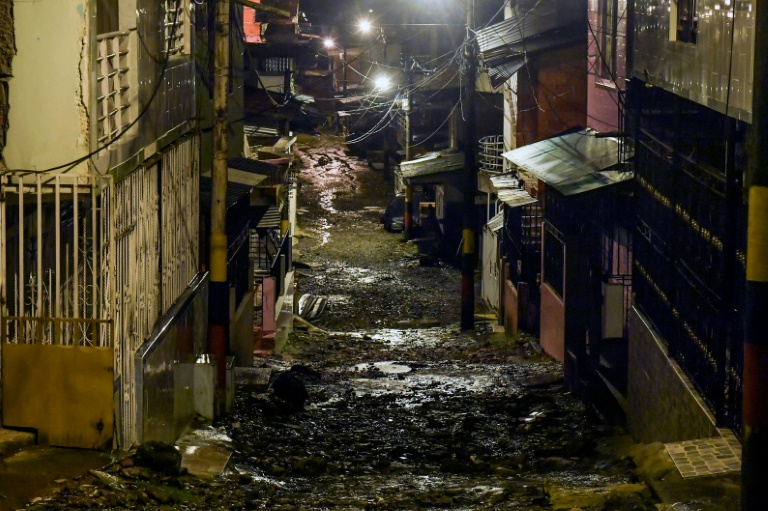
Long marred by poverty and neglect, the port city of Buenaventura on Colombia’s Pacific coast must now also contend with the daily terrors of a merciless and escalating war between rival drug gangs.

By mid-afternoon each day, shops lower their shutters, and the streets run empty as inhabitants scurry to safety before nightfall.

Those who can lock themselves behind iron gates. Others take what refuge they can in shacks on stilts or zinc huts perched in stagnant water and filth along the unlit, potholed streets.

“We are witnessing a new urban and territorial war” in Buenaventura, Juan Manuel Torres of Colombia’s Foundation for Peace and Reconciliation told AFP.

“The situation has become very violent and out of control,” he said, as the “Shottas” and “Spartanos” gangs vie for supremacy in the mainly Afro-Colombian community.

With a population of nearly 400,000, Buenaventura saw 576 killings in the five years from 2017 to 2021 — one of the highest homicide rates for a city in one of the world’s most violent countries.

Last year, the town recorded 50 “forced disappearances” in a vicious campaign of intimidation and extortion headed by the gangs.

When AFP visited, the fear was palpable as police patrolled cautiously, their guns drawn and pointed at the ramshackle buildings lining the plastic-strewn streets.

At night, a hearse arrived under escort to pick up a corpse riddled with bullets and left out in the open.

– Children ‘with no future’ –

In Buenaventura’s seedy John XXIII district, there are near daily reports of violence. 

It was here the gangs, armed with automatic weapons, clashed for several hours on August 30 in what the press dubbed a “night of terror.”

“The authority in the neighborhoods is the Shottas and Spartanos,” said Buenaventura bishop Ruben Dario Jaramillo. 

“They are stronger than the government; the residents have no choice but to submit,” he told AFP.

According to Torres, what is happening in Buenaventura is indicative of “a total failure of the state.”

This has allowed the gangs, he said, to “coopt the population, enlisting children with no future” in a city where 43 percent of the population is indigent and one in three people unemployed.

Neighborhood activist Wilmar Valencia Orozco said people are too afraid to leave their homes — even more so their immediate neighborhood.

The most dangerous parts are the “invisible borders” between areas controlled by one gang or the other.

“Young people with no history (with the gangs) are kidnapped and killed just because they live in a certain neighborhood,” said Orozco.

The Shottas and Spartanos came about in late 2020 after a predecessor cartel called “La Local” split in two.

Both have ties with armed groups who fight for control of illegal mining, drug crops and smuggling routes in the vast Colombian jungle.

“The backbone of their (the gangs’) business is drug trafficking. Then the micro-trafficking, the extortion… and now also the legal trade,” said Jaramillo, the priest. 

According to Torres, the gangs have recently taken over Buenaventura’s food trade: “eggs, cheese, fruit… no staple escapes their grasp,” he said.

A doctor, who asked not to be named for fear of reprisal, pointed to the many empty shops.

“Many traders had to close. If you don’t pay, they kill you,” he explained.

“In Buenaventura, the law is that of the gangs!” 

A shop owner said he had to increase prices as the gangsters extort ever more protection money.

A taxi driver said, “There are two taxes here, the official one and the street one. And the second one, we really feel it!” 

– ‘Cannot be everywhere’ –

Authorities say the Shottas and Spartanos have between 400 and 600 members each, up to 1,000 counting those in prison.

A main focus of their dispute is the waterways that crisscross the city and give access to Buenaventura Bay for easy movement of drugs, said military official Lieutenant-Colonel Samuel Aguilar.

Soldiers and police deployed in the city face an uphill battle.

“Both gangs have huge logistics and lots of little hands, ‘flies,'” said Aguilar of the children who do nuisance jobs for the gangsters and create distractions.

“We cannot be everywhere at once,” the official added.

Colombia’s first leftist president Gustavo Petro has expressed concern about the “serious situation of violence” in Buenaventura, which he blamed on decades of state neglect.

Petro visited the city this month as part of his “total peace” drive, which includes offering gang members an alternative to prison time if they hand themselves over.

Both gangs indicated they were willing to negotiate, the president announced afterward.

“It is a chance for them not to die or end up in prison,” said Torres of the prospects for surrender.

Added Orozco, the activist: “They are tired of killing each other and hiding. They just want to be able to enjoy their money.”

Close Bitnami banner
Bitnami