World

Switzerland signs contract for 36 US fighter jets

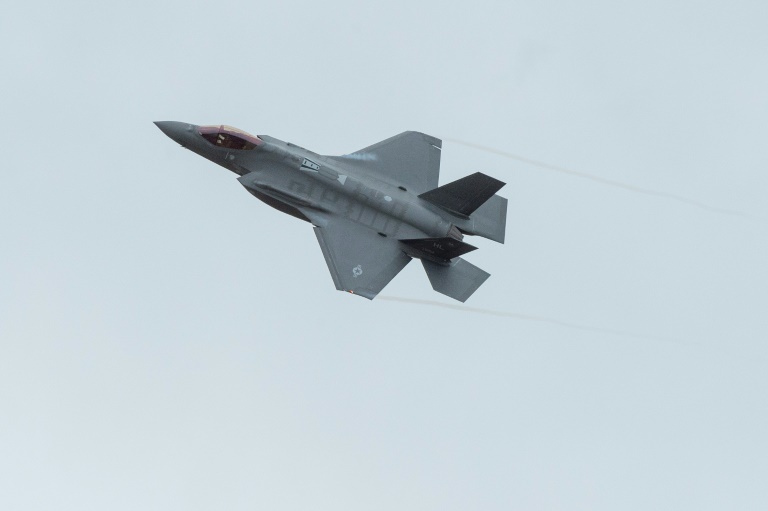
Switzerland signed a controversial contract on Monday to buy 36 US F-35 stealth fighter jets at a cost of more than six billion francs ($6.2 billion). 

“National Armaments Director Martin Sonderegger and the Swiss F-35A Program Manager Darko Savic signed the procurement contract on 19 September 2022 at armasuisse in Bern,” said armasuisse, the country’s arms procurement agency.

“With this, the procurement of 36 F-35A is contractually agreed,” it added.

The selection of the F-35 by the Swiss government in June 2021 sparked some controversy, particularly in light of the cost-overruns of the fighter programme in the United States.

But a Swiss parliamentary investigation did not call into question the selection of the fighter.

The Swiss government and parliament also short-circuited holding a referendum on the plane’s purchase despite enough signatures being collected to put the issue to voters, saying there was not enough time to do so before manufacturer Lockheed Martin’s offer expires.

But Swiss voters had already narrowly approved in September 2020 spending six billion Swiss francs to replace the country’s fleet of ageing F/A-18 Hornets and F-5 Tigers.

The F-35s will be delivered between 2027 and 2030.

Switzerland joins a growing number of European countries which have opted for the stealth multi-role combat aircraft, including Belgium, Britain, Denmark, Finland, Italy, Greece, Germany, the Netherlands, Norway, and Poland.

Kremlin dismisses mass burial discoveries as 'lies'

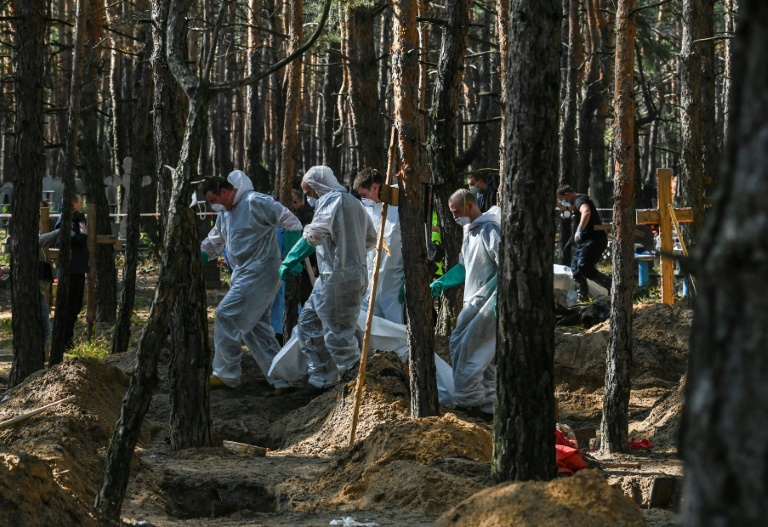
The Kremlin on Monday denied its forces were responsible for large-scale killings in east Ukraine and accused Kyiv of fabricating its discoveries of mass graves in recaptured territory.

In the latest incident spurring fears of an atomic emergency, Ukraine said that Russian rockets landed precariously close to a nuclear power station in southern Ukraine.

Ukraine recaptured Izyum and other towns in the east this month, crippling Kremlin supply routes and bringing fresh claims of Russian atrocities with the discovery of hundreds of graves — some containing multiple bodies.

“These are lies,” Kremlin spokesman Dmitry Peskov told reporters on Monday. Moscow, he said, “will stand up for the truth in this story.”

Fighting in the northeast has raged and AFP journalists heard artillery exchanges in frontline Kupiansk on Monday, as traumatised civilians headed out of the town now mainly in the hands of Ukrainian forces.

The streets were strewn with broken glass, spent cartridge casings and the discarded remains of ration packs issued by both forces. 

Most of the fire is outgoing, with Ukrainian tanks and artillery targeting Russian positions on the west side of the town, over a mess of broken bridges. A column of smoke rose in the distance. 

At the entrance to the town, cowering from the sounds of Ukrainian tank shells passing overhead towards Russian lines, civilians gathered to hitch rides or join buses to head out into safer Ukrainian territory. 

“There’s been no light, no electricity, for a week. No water,” said a 49-year-old former policeman who gave his name only as Ruslan.

– ‘Lost a lot of blood’ –

Russian-backed authorities in east Ukraine said a “punitive” strike by Kyiv’s forces had killed more than a dozen people and wounded more in the separatist stronghold of Donetsk.

The rebel head of the region claimed the strike was “deliberate” and said it would “not go unpunished.”

A court in the neighbouring rebel-region of Lugansk sentenced an employee of the Organization for Security and Cooperation in Europe to 13 years for leaking military secrets.

Ukrainian civilians in the recaptured northeast region of Kharkiv have recounted months of brutality under Russian occupation.

In Kupiansk, Mykhailo Chindey, told AFP he had been tortured on suspicion of supplying targeting coordinates to Ukrainian forces.

“One person was holding my hand and another one was beating my arm with a metal stick. They were beating me up two hours almost every day,” he told AFP. 

“I lost consciousness at some point. I lost a lot of blood. They hit my heels, back, legs and kidneys,” he said.

Ukraine’s nuclear energy agency, Energoatom, said Russia struck the Pivdennoukrainsk nuclear power plant overnight, with a “powerful explosion” just 300 metres (985 feet) from its reactors.

The strike damaged more than 100 windows at the station, but the reactors were not damaged, Energoatom said, publishing photos of glass shattered around blown-out frames.

It also released images of what it said was a two-metre-deep crater from where the missile landed. No staff were wounded, it said.

– ‘Russia endangers the whole world’ –

Attacks around nuclear facilities in Ukraine have spurred calls from Ukraine and its Western allies to de-militarise surrounding areas.

Europe’s largest atomic facility — the Zaporizhzhia nuclear plant in Russian-held territory in Ukraine — has become a hot spot for concerns after tit-for-tat claims of attacks.

The UN’s atomic agency deployed a monitoring team to the site in early September after new fighting.

Early in the February invasion, fighting erupted around Chernobyl in the north, where an explosion in 1986 left swathes of the surrounding territory contaminated.

“Russia endangers the whole world. We have to stop it before it’s too late,” President Volodymyr Zelensky said early Monday.

French President Emmanuel Macron this month urged Vladimir Putin to withdraw Russian heavy weapons from Zaporizhzhia. The Russian leader cautioned against potential “catastrophic” consequences of fighting there.

The Mykolaiv region in southern Ukraine, where the Pivdennoukrainsk plant is located, is close to the front line of of a Ukrainian counter-offensive in the south.

Kyiv’s forces have clawed back territory near Mykolaiv, nearing the strategically important hub of Kherson.

Russian forces have continued to shell Ukrainian-held towns near the front lines.

burs-jbr/jm

Markets struggle ahead of another Fed rate hike

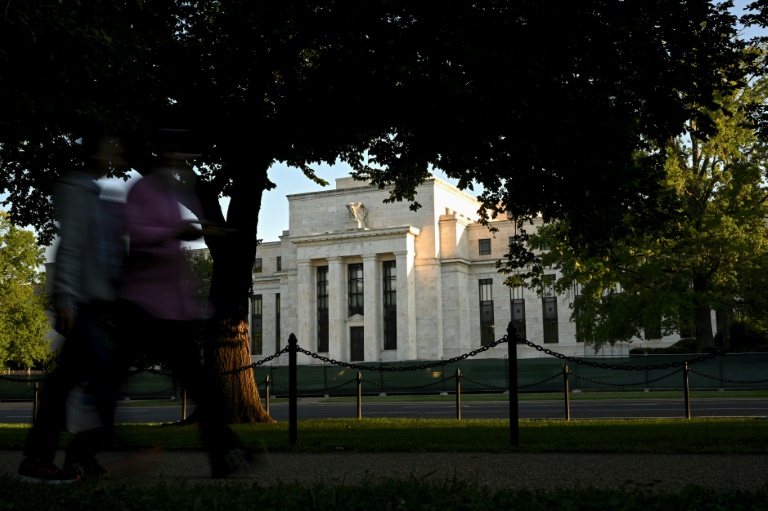
Stock markets dropped again Monday, extending last week’s rout as investors brace for another big rate hike by the US Federal Reserve that they fear could drag down the global economy.

Wall Street opened lower, with the Dow dropping 0.6 percent.

The Paris CAC 40 and Frankfurt DAX were down in afternoon trading while Asian indices mostly closed lower. London was closed for the funeral of Queen Elizabeth II. 

“Traders are worried that they are going to hear more hawkish stance from central banks this week” which would “cut economic activity further,” AvaTrade analyst Naeem Aslam told AFP.

The Fed will announce its latest monetary policy decision on Wednesday as it seeks to tame decades-high inflation.

With recent data showing US inflation rooted at four-decade highs, investors are increasingly pessimistic about the outlook for the global economy.

Central banks raise interest rates to cool inflation, but higher borrowing costs also slow down economic activity.

Disappointing US inflation figures last week unnerved traders and ramped up bets for a third successive 0.75-percentage-point rise, while some have predicted a whole percentage point move.

Policymakers, including Fed chairman Jerome Powell, have repeatedly said their ultimate aim is to bring inflation under control, even if that means sending the economy into recession.

“We’re expecting a sharp interest rate increase and therefore a clear signal against galloping inflation,” said Tim Emden, an independent market analyst.

Patrick O’Hare at Briefing.com said that a good question is why stock markets are still falling when they already took a wallop last week on the prospect of higher interest rates triggering an economic slump.

“The reason being is that the market doesn’t have a comforting sense where the end rate will be, how long the end rate will remain the end rate, and how low earnings estimates will go,” he said.

The Bank of England and its peer in Japan are also holding key meetings this week, with the pound and the yen feeling the pressure from a strong dollar.

– Yen under pressure –

Asian equity investors continued the selling on Monday.

Hong Kong closed down one percent, even after reports that the city’s government was considering ending mandatory hotel quarantine for incoming travellers.

Shanghai was also down despite news that megacity Chengdu was ending a two-week Covid-19 lockdown that saw 21 million people affected.

Tokyo was closed for a holiday.

The prospect of more big Fed rate hikes is also keeping the dollar at multi-decade highs against its major peers, with the yen feeling most of the pressure as the Bank of Japan refuses to tighten policy.

The Japanese unit last week hit a fresh 24-year low of 144.99 to the dollar, though it has bounced slightly after comments from BoJ officials that signalled they were ready to intervene to provide support.

Oil prices tumbled around three percent despite the news out of Chengdu as demand fears are fuelled by the growing fear of recession around the world.

“The market’s growth concerns, meanwhile, are being fed by the inverted yield curve and are manifesting themselves in the commodities market,” O’Hare said.

An inverted yield curve is the unusual situation where short-term interest rates are higher than long-term interest rates, and is often a signal of an impending recession.

– Key figures at around 1330 GMT –

New York – Dow: DOWN 0.6 percent at 30,722.56

EURO STOXX 50: DOWN 0.7 percent at 3,499.78

Frankfurt – DAX: DOWN 0.3 percent at 12,707.24

Paris – CAC 40: DOWN 1.0 percent at 6,015.85

London – FTSE 100: Closed for queen’s funeral

Hong Kong – Hang Seng Index: DOWN 1.0 percent at 18,565.97 (close)

Shanghai – Composite: DOWN 0.4 percent at 3,115.60 (close)

Tokyo – Nikkei 225: Closed for holiday

Pound/dollar: DOWN at $1.1369 from $1.1423 on Friday

Euro/pound: UP at 87.79 pence from 87.00 pence 

Euro/dollar: DOWN at $0.9983 from $1.0018

Dollar/yen: UP at 143.45 yen from 142.91 yen

West Texas Intermediate: DOWN 3.5 percent at $81.81 per barrel

Brent North Sea crude: DOWN 2.7 percent at $88.67 per barrel

Scholz to visit Saudi as Germany seeks energy supplies

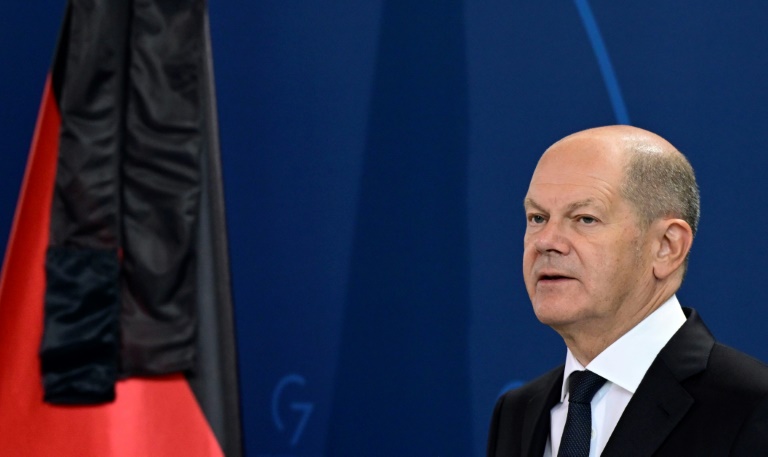
Chancellor Olaf Scholz will visit Saudi Arabia and meet Saudi Crown Prince Mohammed bin Salman as part of a Gulf trip, his spokesman said Monday, as Germany rushes to secure energy supplies.

Scholz, whose two-day trip next weekend will also take him to Qatar and the United Arab Emirates, becomes the latest Western leader to meet with the crown prince.

Bin Salman was until recently regarded as a pariah in the West due to his suspected role in the murder of Washington Post journalist Jamal Khashoggi in 2018. 

But he is being courted again as Europe and its allies urgently seek fresh sources of fossil fuels after Russia cut gas supplies amid soaring tensions over its invasion of Ukraine.

Scholz, accompanied by a business delegation, will visit Saudi Arabia on Saturday, where he will meet with the crown prince and — if his health permits it — King Salman, government spokesman Steffen Hebestreit said. 

He did not go into detail about the reasons for Scholz’s Gulf visit but said he would be “very surprised” if the topic of energy was not discussed. 

The spokesman also offered assurances that “the murder of Mr Khashoggi will certainly figure in discussions”.

It is the latest sign of bin Salman’s international rehabilitation — in July, French President Emmanuel Macron held talks with him in Paris, and US President Joe Biden visited the kingdom.

On Sunday, Scholz will head first to the UAE and meet with President Sheikh Mohamed bin Zayed Al-Nahyan. Economy Minister Robert Habeck said Scholz would sign contracts there related to liquified natural gas — seen as a key alternative to Russian energy supplies. 

In the afternoon, the chancellor will hold talks with Qatari Emir Sheikh Tamim bin Hamad Al-Thani. 

Habeck already visited Qatar and the UAE in March in an effort to find alternatives to Russian gas, which Germany has traditionally depended on heavily.

Russia’s decision to cut off supplies has triggered an energy crisis in Europe, with consumers and businesses facing soaring bills as winter approaches. 

Wedding, coronation, now funeral: emotive farewell to queen

Queen Elizabeth II was married and crowned in Westminster Abbey. In death, she entered and departed the thousand-year-old church to the same words of prayer: “May God grant to the living, grace; to the departed, rest.” 

The words are engraved on a stone slab next to the Great West Door through which Elizabeth’s coffin was borne for Monday’s Anglican funeral service, attended by leaders of all faiths from around the world.

They were the same words intoned by the dean of the abbey, David Hoyle — part of the final blessing concluding the hour-long service, before trumpeters sounded the Cavalry Last Post.

Then followed a two-minute silence in the abbey and throughout the new kingdom of the late monarch’s eldest son, now Charles III. 

The ceremony closed with the national anthem, “God Save the King”, symbolising the transition from one reign to another, and a lone piper playing the Scottish lament “Sleep, dearie, sleep”.

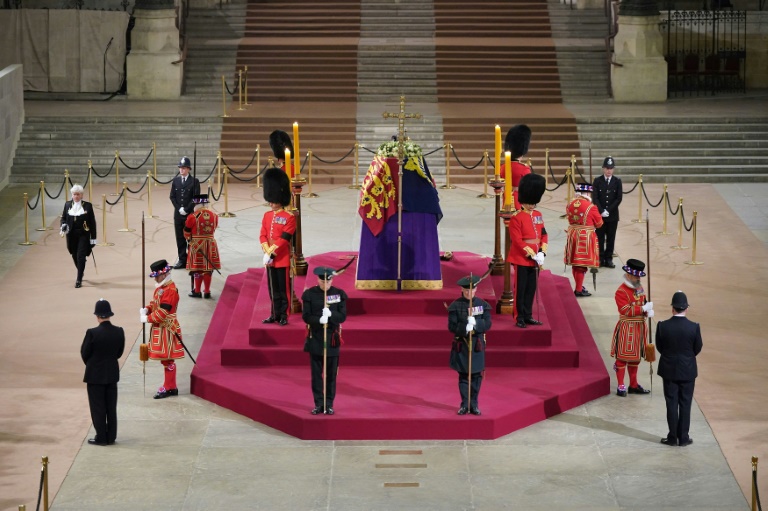
Eight minutes before arriving at the abbey, the coffin had departed on a gun carriage pulled by Royal Navy sailors from Westminster Hall, where hundreds of thousands of public mourners had filed past since Wednesday.

At one end of the medieval hall, it passed under a stained-glass window commissioned by parliament for the queen’s record-breaking Platinum Jubilee this year, and then past a fountain erected in 1977 for her Silver Jubilee.

The window features the royal coat of arms with the monarch’s motto “Dieu et mon droit” (God and my right) — symbolising, like the funeral service, the monarch’s divinely ordained role as guardian of the nation.

On the heavy lead-lined oak coffin lay a new wreath of flowers, with the message “In loving and devoted memory. Charles R” (for Rex, or king).

The coffin also bore the instruments of state — the Imperial State Crown, the Orb and the Sceptre. 

They were to be placed on the high altar of St George’s Chapel in Windsor Castle, where the queen was to be buried after a final military procession from the abbey to London’s Wellington Arch.

– ‘We will meet again’ –

The burial was to be a private affair for the royal family — in contrast to the grandeur and public nature of the televised abbey service, a last opportunity for the nation and world to bid adieu.

Leading up to the service, Westminster Abbey’s tenor bell tolled every minute for 96 minutes, signifying the age at which Britain’s longest-reigning sovereign died on September 8.

Through the Great West Door, eight pallbearers from the Grenadier Guards bore the coffin past the Tomb of the Unknown Warrior, an eternal tribute to Britain’s war dead.

They processed down the nave to the high altar, accompanied by a choir singing biblical verses starting with words from the New Testament book of John: “I am the resurrection and the life.”

In his sermon, Archbishop of Canterbury Justin Welby noted words the queen used in a broadcast when Britain went into lockdown at the start of the Covid pandemic, plunging millions into anxious isolation.

She in turn had drawn on a famous World War II song by much-loved singer Vera Lynn: “We will meet again.”

“Service in life, hope in death,” Welby intoned. “All who follow the queen’s example, and inspiration of trust and faith in God, can with her say: ‘We WILL meet again.'”

The service included New Testament readings by Commonwealth secretary-general Patricia Scotland and by Liz Truss — who was appointed by the queen as her 15th prime minister only two days before she passed away.

As the coffin was borne out, the abbey organist played a sonata allegro movement by Edward Elgar — part of a musical programme drawing heavily on English composers that was selected by the queen herself, along with the hymns and prayers.

When applause swept through the abbey from the crowds outside during the funeral of Diana, princess of Wales in 1997, it seemed revolutionary and a threat to the monarchy.

But this time, applause rang out following the national anthem after the funeral, symbolising appreciation for the same values displayed by Elizabeth throughout her long reign, from her coronation in the abbey in 1953 — stoicism and duty.

With Elizabeth II, 20th century is also laid to rest

The laying to rest of Queen Elizabeth II, whose 70-year reign witnessed the aftermath of World War II, the Cold War and dizzying technological change, marks a further step in a leave-taking with the 20th century.

The British monarch exercises little real power but Elizabeth was a titanic figure on the 20th-century stage, whose first prime minister was wartime leader Winston Churchill, met the first man in space Yuri Gagarin, and made landmark visits to newly independent nations as the British Empire fell apart.

Her death at the age of 96 was even more symbolic coming just over a week after the passing of former Soviet leader Mikhail Gorbachev, 91, another among increasingly few surviving icons of the last century, who let the USSR dissolve and eastern Europe escape Moscow’s grip.

Their disappearances comes as the world is still recovering from the Covid-19 pandemic, shaken by Russia’s invasion of Ukraine, which has revived fears of nuclear war, and waking up to how climate change could wreck the hopes of this and future generations.

“These were absolutely central figures whose like we will be hard-pressed to see again,” said Gilles Gressani, director of the French geopolitical journal Le Grand Continent.

“We are living in an interregnum — a space between two reigns, two eras,” he added.

“We often have this angst and anxiety; we know well that the world is changing because of the pandemic, the war in Ukraine, terrorism, economic crises and the climate crisis.”

– Losing the threads –

Queen Elizabeth II will be buried Monday alongside her father, King George VI, and other family members at Windsor Castle outside London, after a state funeral attended by world leaders in the heart of the British capital. 

Gradually, the world is losing the threads that still tied it to the 20th century, and just a few iconic figures remain alive.

The great cultural giants are also taking their leave — Jean-Luc Godard, one of the most influential filmmakers of the 20th century and the father of the French New Wave, died last week by assisted suicide. 

Nelson Mandela, who campaigned to end apartheid in South Africa and then became its first majority-rule president, died in 2013. Cuban revolutionary leader Fidel Castro, who led his country for half a century and was an icon of the Cold War, died in 2016.

Jimmy Carter, 97, is the sole former US president still alive to have ruled exclusively in the 20th century, during a convulsive single mandate that saw the overthrow of the shah in the Islamic revolution in Iran.

His successors Ronald Reagan and George H.W. Bush died in 2004 and 2018 respectively.

The current Dalai Lama, the spiritual leader of Tibetans based in exile in India since 1951, when a Tibetan uprising against Chinese rule failed, is 87 and still working.

And Iran’s supreme leader Ayatollah Ali Khamenei, 83, who in 1989 took over after the death of revolutionary leader Ayatollah Ruhollah Khomeini, remains in a post that is appointed for life.

– ‘End of World War II’ –

Some of the greatest bridges now retained with the 20th century are cultural. 

Rolling Stones lead singer Mick Jagger, 79, still performs with his group while Beatles icon Paul McCartney, 80, continues with an illustrious solo career that included a rapturously received set at the Glastonbury Festival this year.

The queen herself was a symbol of a shift to modernity, with her coronation in 1953 the first major event televised around the world, and her first televised Christmas message in 1957 blazing a trail for other world leaders.

But above all, the death of the queen represents a major rupture with the memory of World War II, a conflict that her father King George VI endured along with his daughters and other Londoners in bomb-scarred London.

“The queen participated directly in the victory of 1945. Being one of the victors of 1945 left a strong mark on the identity of the United Kingdom and the queen embodied that until her death,” said Thomas Gomart, director of the French Institute of International Relations (IFRI).  

“For me, the death of Elizabeth II, in a way, marks an end point for World War II,” he said.

Taliban say US national freed in exchange for key ally

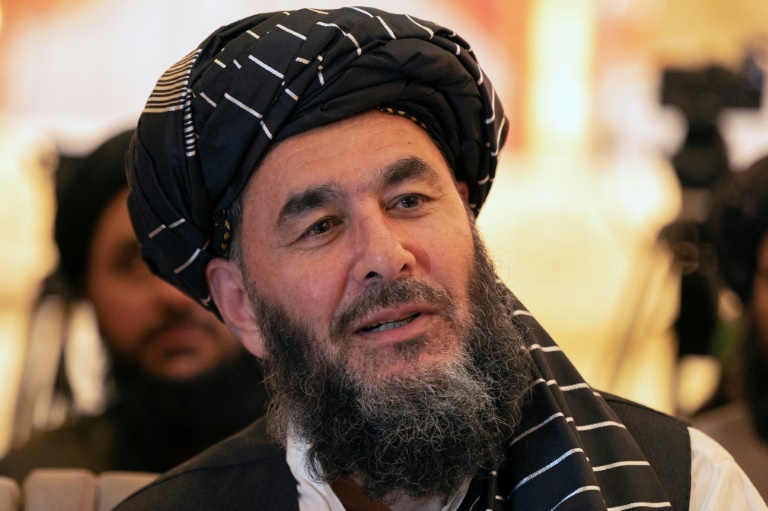
An American navy veteran detained in Afghanistan since 2020 was released by the Taliban on Monday in exchange for an ally who spent 17 years in a US jail for heroin smuggling, Afghanistan’s foreign minister said.

Mark Frerichs was working as a civil engineer on construction projects in Afghanistan when he was “taken hostage”, Washington previously said.

“After long negotiations, US citizen Mark Frerichs was handed over to an American delegation and that delegation handed over (Bashar Noorzai) to us today at Kabul airport,” Afghan Foreign Minister Amir Khan Muttaqi said at a press conference.

“We are happy that at Kabul International Airport, in the capital of Afghanistan, we witnessed the wonderful ceremony of one of our compatriots returning home.”

Noorzai was welcomed with a hero’s fanfare by the government of the newly-styled Islamic Emirate of Afghanistan (IEA). Photos show he was greeted by masked Taliban soldiers bearing floral garlands.

“If the IEA had not shown its strong determination, I would not have been here today,” Noorzai told reporters at the press conference.

“My release in exchange for an American will be a source of peace between Afghanistan and Americans.”

Noorzai is the second Afghan inmate released by the United States in recent months. In June, Assadullah Haroon was released after 15 years of detention in the United States’ notorious Guantanamo Bay prison.

Haroon was accused of links to Al-Qaeda but languished without charge for years at the US detention centre in Cuba, after his arrest in 2006 whilst working as a honey trader.

He was not released under the terms of a deal with the Taliban.

Afghan security analyst Hekmatullah Hekmat said Noorzai’s release was a “major achievement” for Kabul’s new rulers.

“The Taliban can tell their foot soldiers and Afghans that they are able to bring back their people held by opposition groups,” he told AFP.

Muttaqi said the homecoming of Noorzai marks the beginning of a “new chapter” in relations between Afghanistan and the United States.

– ‘Non-negotiable’ –

The Taliban seized power in Afghanistan a little over a year ago, as the United States and their NATO allies withdrew from the country after 20 years of military intervention. 

Since then, the nation has been further plunged into economic and humanitarian hardship, with billions in Afghan assets abroad frozen by Washington and international aid vastly reduced. 

No country has yet recognised the new government, with Washington repeatedly telling the Taliban that they will have to “earn” legitimacy.

The US State Department had previously described navy veteran Frerich’s release as one of the government’s “core, non-negotiable priorities”. 

“The Taliban must immediately release Mark before it can expect any consideration of its aspirations for legitimacy. This is not negotiable,” US President Joe Biden said in a statement in January.

Noorzai, a militia commander and Taliban associate, was sentenced to life imprisonment for heroin smuggling and had served 17 years.

He once fought with US-backed mujahideen forces against the Soviet occupation of Afghanistan and was a close associate of the Taliban’s late founder Mullah Omar.

At the time of his trial, US prosecutors said he ran a “worldwide narcotics network” and supported the Taliban’s first regime between 1996 and 2001.

While he held no official position, Noorzai had “provided strong support including weapons” for the Taliban in the 1990s, Taliban government spokesman Zabihullah Mujahid told AFP on Monday.

Markets struggle ahead of another Fed rate hike

Stock markets dropped again Monday, extending last week’s rout as investors brace for another big rate hike by the US Federal Reserve that they fear could drag down the global economy.

The Paris CAC 40 and Frankfurt DAX were down in early afternoon trading while Asian indices mostly closed lower. London was closed for the funeral of Queen Elizabeth II. 

“Traders are worried that they are going to hear more hawkish stance from central banks this week” which would “cut economic activity further,” AvaTrade analyst Naeem Aslam told AFP.

The Fed will announce its latest monetary policy decision on Wednesday as it seeks to tame decades-high inflation.

With recent data showing US inflation rooted at four-decade highs, investors are increasingly pessimistic about the outlook for the global economy.

Central banks raise interest rates to cool inflation, but higher borrowing costs also slow down economic activity.

Disappointing US inflation figures last week unnerved traders and ramped up bets for a third successive 0.75-percentage-point rise, while some have predicted a whole percentage point move.

Policymakers, including Fed chairman Jerome Powell, have repeatedly said their ultimate aim is to bring inflation under control, even if that means sending the economy into recession.

“We’re expecting a sharp interest rate increase and therefore a clear signal against galloping inflation,” said Tim Emden, an independent market analyst.

The Bank of England and its peer in Japan are also holding key meetings this week, with the pound and the yen feeling the pressure from a strong dollar.

– Yen under pressure –

Asian equity investors continued the selling on Monday.

Hong Kong closed down one percent, even after reports that the city’s government was considering ending mandatory hotel quarantine for incoming travellers.

Shanghai was also down despite news that megacity Chengdu was ending a two-week Covid-19 lockdown that saw 21 million people affected.

Tokyo was closed for a holiday.

The prospect of more big Fed rate hikes is also keeping the dollar at multi-decade highs against its major peers, with the yen feeling most of the pressure as the Bank of Japan refuses to tighten policy.

“Speculative selling of the yen is readily justified by the ongoing widening in US-Japan yield differentials,” said Ray Attrill, of National Australia Bank.

“Until or unless something happens to arrest or reverse this spread widening, the yen is susceptible to additional selling pressure.”

The Japanese unit last week hit a fresh 24-year low of 144.99 to the dollar, though it has bounced slightly after comments from BoJ officials that signalled they were ready to intervene to provide support.

Oil prices dipped despite the news out of Chengdu as demand fears are fuelled by the growing fear of recession around the world.

– Key figures at around 1100 GMT –

EURO STOXX 50: DOWN 1.1 percent at 3,462.97

Frankfurt – DAX: DOWN 0.7 percent at 12,654.03

Paris – CAC 40: DOWN 1.4 percent at 5,994.24

London – FTSE 100: Closed for queen’s funeral

Hong Kong – Hang Seng Index: DOWN 1.0 percent at 18,565.97 (close)

Shanghai – Composite: DOWN 0.4 percent at 3,115.60 (close)

Tokyo – Nikkei 225: Closed for holiday

New York – Dow: DOWN 0.5 percent at 30,822.42 (close)

Pound/dollar: DOWN at $1.1378 from $1.1423 on Friday

Euro/pound: UP at 87.81 pence from 87.00 pence 

Euro/dollar: DOWN at $0.9991 from $1.0018

Dollar/yen: UP at 143.45 yen from 142.91 yen

West Texas Intermediate: DOWN 1.8 percent at $83.61 per barrel

Brent North Sea crude: DOWN 0.6 percent at $89.91 per barrel

Britain and the world bid adieu to Queen Elizabeth II

Britain said farewell to Queen Elizabeth II on Monday at a state funeral attended by world leaders, before a historic last ceremonial journey through the streets of London packed with sorrowful mourners.

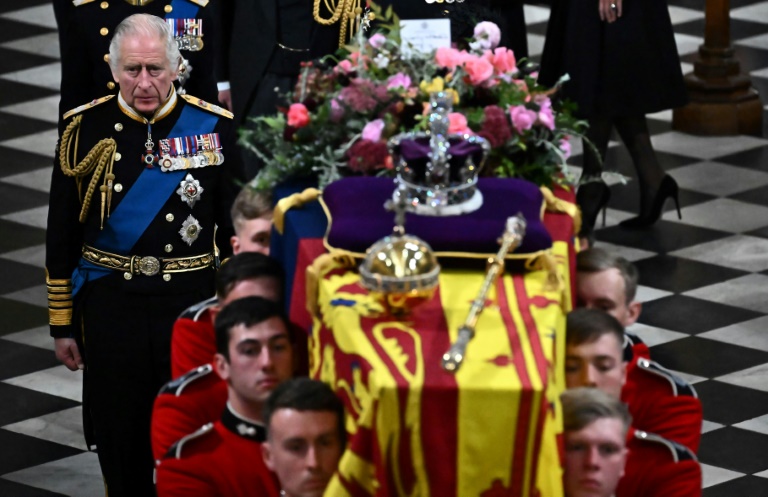
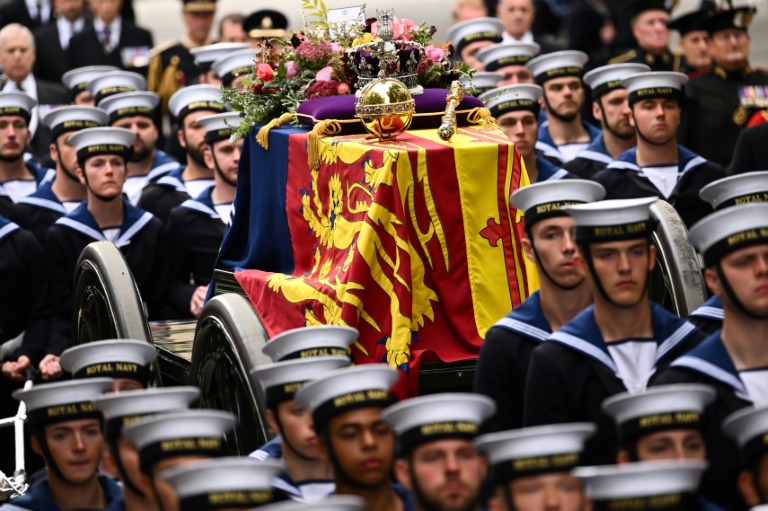
Huge crowds gathered in near silence to watch as the queen’s flag-draped coffin, topped with the Imperial State Crown, her orb and sceptre, was carried slowly to a gun carriage from parliament’s Westminster Hall where it had lain in state since Wednesday.

To the tune of pipes and drums, the gun carriage — used at every state funeral since Queen Victoria’s in 1901 — was then drawn by 142 junior enlisted sailors in the Royal Navy to Westminster Abbey.

The thousand-year-old church’s tenor bell tolled 96 times at one-minute intervals — one for every year of her life — stopping a minute before the service began at 11:00 am (1000 GMT).

In his funeral sermon, Archbishop of Canterbury Justin Welby praised the queen’s life of duty and service to the UK and Commonwealth.

“People of loving service are rare in any walk of life. Leaders of loving service are still rarer,” he told the 2,000 guests, who included US President Joe Biden and Japan’s reclusive Emperor Naruhito.

“But in all cases, those who serve will be loved and remembered,” the Anglican leader added, before the coffin was borne on another procession towards her final resting place in Windsor Castle, west of London.

The longest-serving monarch in British history died at Balmoral, her Scottish Highland retreat, on September 8 after a year of declining health. 

Her eldest son and successor, King Charles III, dressed in ceremonial military uniform, followed the solemn processions, alongside his three siblings.

– ‘She was my boss’ –

Charles’s eldest son Prince William accompanied them alongside William’s estranged brother, Prince Harry, and other senior royals.

William’s two eldest children, George and Charlotte, who are next in line to the throne, also walked behind the coffin inside the abbey.

Late Sunday, Charles, 73, and his wife, Queen Consort Camilla, said they had been “deeply touched” by the public’s flood of messages.

“As we all prepare to say our last farewell, I wanted simply to take this opportunity to say thank you,” he said.

Britain, a country much changed since the queen’s coronation in the same abbey in 1953, has dug deep into its centuries of tradition to honour the only monarch that most of its people have ever known.

“It’s once in a lifetime,” said student Naomi Thompson, 22, camped out in the crowds at London’s Hyde Park.

“It’s a moment of history… She’s everyone’s granny,” added engineer Alice Garret, 28. 

Others unable to be in London gathered in cinemas and churches around England, Scotland, Wales and Northern Ireland to watch the service and procession on big screens.

Auto engineer Jamie Page, a 41-year-old former soldier, stood on Whitehall to observe the funeral procession, wearing his military medals from service in the Iraq war.

“Sixteen years old, I swore an oath of allegiance to the queen. She’s been my boss. She means everything, she was like a gift from God,” he said.

– Two minutes of silence –

But on Charles, the oldest person yet to ascend the British throne, Page added: “Who knows, time will tell.”

The funeral lasted just under an hour, brought to an end by a bugler playing “The Last Post”, before two minutes of silence and the reworded national anthem, “God Save the King”. 

After an hour-long procession that was to go past Buckingham Palace, the coffin was to be taken west by road to Windsor Castle, where thousands had lined the route since early morning. 

Some 6,000 military personnel have been drafted in to take part in proceedings in what Britain’s highest-ranking military officer has called “our last duty for Her Majesty the Queen”.

The queen will be buried alongside her father king George VI, her mother queen Elizabeth and sister princess Margaret, reuniting in death the family who once called themselves “us four”. 

The coffin of her husband, Prince Philip, who died last year aged 99, will also be transferred to lie alongside her.  

Elizabeth’s funeral could not be more different from Philip’s at St George’s Chapel, Windsor, in April 2021.

Coronavirus restrictions limited mourners to just 30, led by the queen, a solitary figure in mourning black and a matching facemask. 

The contrast was profound on Monday, the abbey packed with dignitaries and some ordinary Britons who were honoured for their military or community service, especially during the Covid pandemic.

– Biden’s tribute –

“You were fortunate to have had her for 70 years; we all were,” Biden said on Sunday after signing a book of condolence. “The world is better for her.”

In the abbey pews was Liz Truss, whom the queen appointed as the 15th British prime minister of her reign just two days before her death, in her last major ceremonial duty.

All of Truss’s living predecessors were there plus her counterparts and representatives from the 14 Commonwealth countries outside Britain where Charles is also head of state.

Whether they remain constitutional monarchies or become republics is likely to be the defining feature of Charles’s reign.

The queen’s death has prompted deep reflection about the Britain she reigned over, the legacy of its past, its present state and what the future might hold, as well as the values of lifelong service and duty she came to represent during her 70-year reign.

Hundreds of thousands of people are estimated to have queued, sometimes for up to 25 hours and overnight, to file past the queen’s coffin as it lay in state.

Chrissy Heerey, a serving member of the Royal Air Force who joined the marathon queue twice, was the last person through the doors and described the experience as “amazing”.

“When they came to me and said, ‘right, you’re the last person’, I said, really?!” she told AFP, before heading off to join the crowds for the coffin’s procession through London.

– Big Ben tolls –

Throughout the procession after the funeral, Big Ben, the giant bell atop the Elizabeth Tower at one end of the Houses of Parliament, tolled and military guns fired at one-minute intervals.

At Windsor, the Sebastopol Bell — captured in Crimea in 1856 — and the Curfew Tower Bell also sounded.

A vast television audience was expected to watch the funeral worldwide and live online, in a sign of the enduring fascination with the woman once described as “the last global monarch”.

Those lining the streets of London — already jammed at sunrise on Monday — said they had to bear witness.

“I will talk about this moment to my children,” said Jack Davies, 14, camped out for the procession with his parents at Hyde Park Corner, where the coffin will be transferred from the gun carriage for the drive to Windsor.

“I’ll say: ‘I was there!'”

At Windsor, the queen’s crown, orb and sceptre will be removed and placed on the altar. 

The most senior officer of the royal household, the lord chamberlain, breaks his “wand of office” and places it on the coffin, symbolising the end of her reign.

The lead-lined oak casket, draped with the queen’s colours, will be lowered into the Royal Vault as a lone bagpiper plays a lament. 

A private interment ceremony will take place at the adjoining King George VI Memorial Chapel at 1830 GMT.

US created 'industry of litigation' Iran tells top UN court

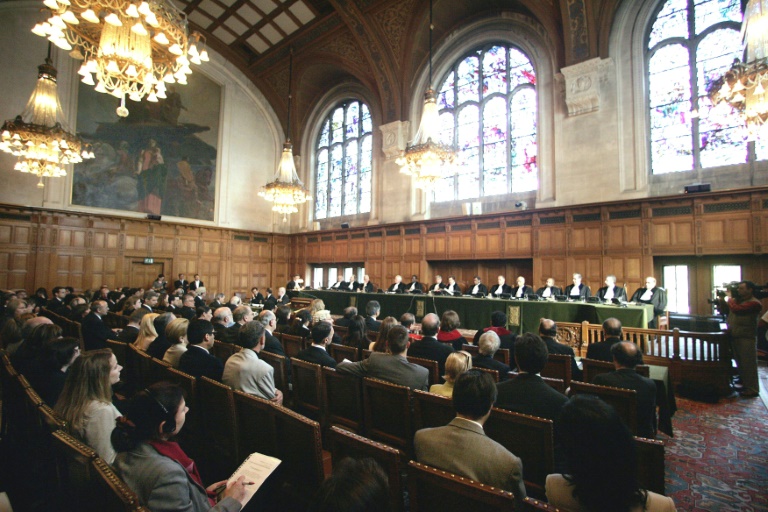
Iran accused the United States of creating an “industry of litigation” over terror claims against Tehran as it opened its bid at the UN’s top court Monday to unfreeze billions of dollars in assets frozen by Washington. 

The case before the International Court of Justice (ICJ) comes as hopes fade of reviving a landmark deal — from which former US president Donald Trump withdrew in 2018 — that sought to tame Iran’s nuclear ambitions.

Tehran took Washington to the Hague-based ICJ in 2016 after the US Supreme Court ordered some $2 billion in Iranian assets to be frozen, ordering the cash to go to survivors and relatives of attacks blamed on the Islamic republic.

These included the 1983 bombing of a US Marine barracks in Beirut which killed 299 people including 241 US soldiers, and the 1996 Khobar Towers bombing in Saudi Arabia which left 19 dead.

Iran’s representative Tavakol Habibzadeh told ICJ judges on Monday that the US ruling opened the way for “billions of dollars in compensation and punitive damages through default judgements.”

“By doing so the United States have created an industry of litigation against Iran and Iranian companies,” said Habibzadeh, who heads Iran’s Centre for Legal Affairs.

Another lawyer for Iran, Vaughan Lowe, said Iran “denies that it is responsible for the injuries to those victims.”

“United States legislation doesn’t bother with proof or with attribution, or with responsibility,” he said. “”Never mind proving that Iran is guilty in any particular case… Sentence first, verdict afterwards.” 

Iran says the freezing of the funds breached the 1955 Treaty of Amity with the United States, an agreement signed before Iran’s 1979 Islamic Revolution severed relations between the countries.

Tehran argues the US seizure of Iranian financial assets and those of Iranian companies is illegal, adding that resolving the case is crucial at a time when Iran is facing economic difficulties after sanctions and runaway inflation. 

– ‘Unclean hands’ –

In turn Washington has unsuccessfully tried to get the lawsuit thrown out, alleging that Iran’s “unclean hands” — a reference to Tehran’s alleged backing of terrorist groups — should disqualify its bid to recover the $2 billion of assets. 

US representatives are set to respond at the ICJ on Wednesday.

The US announced in October 2018 that it was pulling out of the Treaty of Amity after the ICJ in a separate case ordered Washington to lift nuclear-related sanctions on humanitarian goods for Iran.

The ICJ is the top court of the United Nations and was set up after World War II to resolve disputes between member states. Its rulings are binding and cannot be appealed, but it has no means of enforcing them.

Monday’s hearing comes as hopes fade of reviving the 2015 nuclear deal between Tehran and the West which gives Iran sanctions relief in return for restricting its nuclear programme.

Trump pulled out of what he called the “terrible” deal in 2018 and began reimposing sanctions, prompting Tehran to roll back its commitments made under the pact.

Talks have been ongoing in Vienna since April last year, aimed at restoring the agreement by lifting sanctions on Tehran once again and pushing Iran to fully honour its obligations.

But Western powers have raised doubts over Iran’s replies to their latest overtures.

Iranian President Ebrahim Raisi meanwhile on Monday demanded US “guarantees” it will not withdraw again from the nuclear deal, ahead of his debut visit to the United Nations.

Close Bitnami banner
Bitnami