World

27 people killed in China quarantine bus crash

Twenty-seven people died en route to a Covid-19 quarantine facility when their bus crashed in southwest China on Sunday, local authorities said, in the country’s deadliest road accident this year. 

The crash took place on a highway in rural Guizhou province when the vehicle carrying 47 people “flipped onto its side”, Sandu county police said in a statement on social media.

Twenty people were being treated for injuries and emergency responders were dispatched to the scene in remote Qiannan prefecture, police said.

The Guizhou government confirmed later Sunday that the vehicle had been “transporting people linked to the epidemic to quarantine” from the provincial capital of Guiyang, and that the accident occurred around 2:40 am (1840 GMT).

“At present, on-site rescue work is basically completed, the treatment of the injured and aftercare of the deceased are being carried out in an orderly manner, and the cause of the accident is under investigation,” the local government said in a social media statement. 

It was not clear whether the passengers were infected with Covid, close contacts, or living in the same building as virus patients.

Guizhou has seen more than 900 new infections in the past two days and Guiyang, home to six million people, was locked down earlier in September.

Photos shared widely on social media Sunday showed a gold-coloured passenger bus, its top is completely crumpled, being towed by a truck. 

Another viral photo appeared to show the bus driving at night, with the driver and passengers wearing hazmat suits, which are still commonly worn in China to protect against Covid. 

AFP could not verify the photos.

“This feeling can’t simply be represented by lighting a candle and saying RIP,” read one Weibo post with more than 15,000 likes.

– ‘Deep condolences’ –

Some people on social media used the accident to criticise China’s unrelenting zero-Covid policy, which has often seen entire housing compounds of thousands relocated to purpose-built quarantine facilities, sometimes hundreds of kilometres away.

“What proof do you have that you won’t be on that bus at night someday?” read one viral Weibo post with over 15,000 likes.

The top-rated reply read: “Who said we’re not on that bus late at night, we’re clearly all there.”

“We’re all on this terrifying, dark bus.”

Guizhou’s Communist Party chief and the provincial governor “rushed” to Qiannan prefecture to direct emergency response work, the local government said, adding the officials “expressed deep condolences to the victims”.

“It is necessary to draw a lesson from the accident, examine the quarantine and transportation of epidemic-linked personnel and hidden dangers in traffic safety… resolutely curb the occurrence of major accidents,” the statement said.

Guizhou officials also vowed to set up a working group to investigate the cause of the accident. 

During a two-month lockdown in the megacity of Shanghai this spring, some housing compound residents were forced to leave their homes and were bussed to crude quarantine facilities in neighbouring provinces in the middle of the night — despite testing negative for Covid.

Road accidents remain fairly common in China, where irregular enforcement and lax safety standards have resulted in a string of fatalities over the years.

Guizhou has also seen other transport accidents.

In June, a railway driver was killed when a high-speed train derailed in the province.

And in March, a Chinese passenger jet crash killed all 132 people on board, marking the deadliest aviation accident to take place in China for decades. 
UN condemns 'shameful' year-long ban on Afghan girls' education

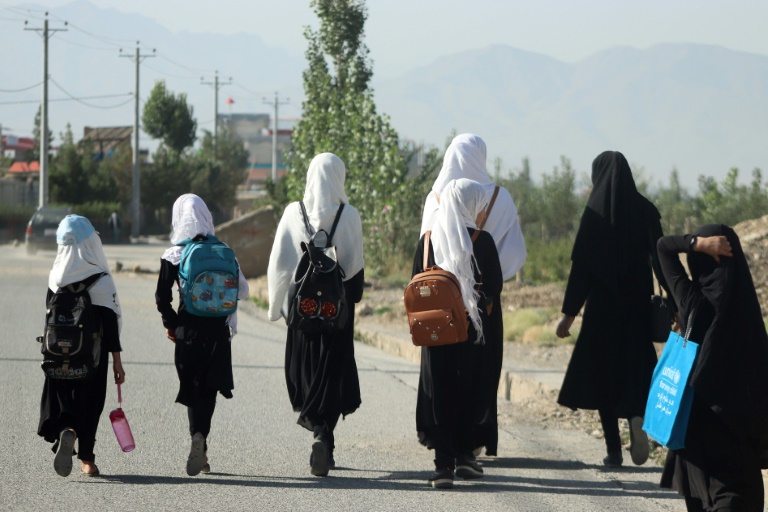
The United Nations urged the Taliban on Sunday to reopen high schools for girls across Afghanistan, condemning the ban that began exactly a year ago as “tragic and shameful”.

Weeks after the hardline Islamists seized power in August last year, they reopened high schools for boys on September 18 but banned secondary schoolgirls from attending classes.

Months later on March 23, the education ministry opened secondary schools for girls, but within hours the Taliban leadership ordered them shut again.

Since then, more than a million teenage girls have been deprived of education across the country, the United Nations Assistance Mission in Afghanistan (UNAMA) said.

“This is a tragic, shameful, and entirely avoidable anniversary,” Markus Potzel, the acting head of UNAMA, said in a statement.

“It is profoundly damaging to a generation of girls and to the future of Afghanistan itself,” he said, adding the ban had no parallel in the world.

UN chief Antonio Guterres urged the Taliban to revoke the ban.

“A year of lost knowledge and opportunity that they will never get back,” Guterres said on Twitter.

“Girls belong in school. The Taliban must let them back in.”

Several Taliban officials say the ban is only temporary, but they have also wheeled out a litany of excuses for the closures — from a lack of funds to time needed to remodel the syllabus along Islamic lines.

Earlier this month, the education minister, Noorullah Munir, was quoted by local media as saying it was a cultural issue, as many rural people did not want their teenage daughters to attend school.

– ‘Year of disappointment’-

Grade 12 student, Kawsar, who gave a fictitious name to protect her identity, said she was frustrated that her high school has been shut for a year now.

“It’s been a dark year, a year full of stress and disappointment,” she said.

“It’s our primary right to have an education. The society needs female doctors and teachers, only boys cannot meet all needs of the society.”

Many conservative Afghan clerics within the Taliban are sceptical of modern education.

Last month, the authorities said they were increasing compulsory religious classes in government universities, though no subjects from the current curriculum would be dropped.

Reacting to the education minister’s comments in local media, Kainat, a school teacher, said parents and families across Afghanistan were keen to educate their daughters.

“They want their girls to achieve what they aim, every family wants their kids, including girls, to serve the nation,” said Kainat, who also gave a fictitious name.

“It’s wrong to say that people in Afghanistan do not want their girls to be educated.”

After seizing power on August 15 last year during the chaotic withdrawal of foreign forces, the Taliban promised a softer version of their harsh Islamist regime in Afghanistan between 1996 and 2001.

But within days, they began imposing severe restrictions on girls and women to comply with their austere vision of Islam — effectively squeezing them out of public life.

Apart from closing high schools for girls, the Taliban have barred women from many government jobs and also ordered them to cover up in public, preferably with an all-encompassing burqa.

Some high schools for girls have remained open in provinces away from the central power bases of Kabul and Kandahar because of pressure from families and tribal leaders.

'Dangerous' Typhoon Nanmadol slams into Japan

Typhoon Nanmadol made landfall in southwestern Japan on Sunday night, as authorities urged millions of people to take shelter from the powerful storm’s high winds and torrential rain.

The storm officially made landfall around 7 pm local time (1000 GMT) as its eyewall arrived near Kagoshima city, the Japan Meteorological Agency (JMA) said.

It was packing gusts of up to 234 kilometres (146 miles) per hour and had already dumped up to 500 mm of rain in less than 24 hours on parts of southwestern Kyushu region.

At least 20,000 people were spending the night in shelters in Kyushu’s Kagoshima and Miyazaki prefectures, where the JMA has issued a rare “special warning” — an alert that is issued only when it forecasts conditions seen once in several decades.

National broadcaster NHK, which collates information from local authorities, said more than seven million people had been told to move to shelters or take refuge in sturdy buildings to ride out the storm.

The evacuation warnings are not mandatory, and authorities have at times struggled to convince people to move to shelters before extreme weather.

They sought to drive home their concerns about the weather system throughout the weekend.

“Please stay away from dangerous places, and please evacuate if you feel even the slightest hint of danger,” Prime Minister Fumio Kishida tweeted after convening a government meeting on the storm.

“It will be dangerous to evacuate at night. Please move to safety while it’s still light outside.”

The JMA has warned the region could face “unprecedented” danger from high winds, storm surges and torrential rain and called the storm “very dangerous.”

“Areas affected by the storm are seeing the sort of rain that has never been experienced before,” Hiro Kato, the head of the Weather Monitoring and Warning Centre, told reporters Sunday.

“Especially in areas under landslide warnings, it is extremely probable that some kinds of landslides are already happening.”

He urged “maximum caution even in areas where disasters do not usually happen.”

By Sunday evening, utility companies said nearly 200,000 homes across the region were without power.

Trains, flights and ferry runs were cancelled until the passage of the storm, and even some convenience stores — generally open all hours and considered a lifeline in disasters — were shutting their doors.

– ‘Highest caution possible’ –

“The southern part of the Kyushu region may see the sort of violent wind, high waves and high tides that have never been experienced before,” the JMA said Sunday, urging residents to exercise “the highest caution possible”.

On the ground, an official in Kagoshima’s Izumi city said conditions were deteriorating rapidly by Sunday afternoon.

“The wind has become extremely strong. Rain is falling hard too,” he told AFP. “It’s a total white-out outside. Visibility is almost zero.”

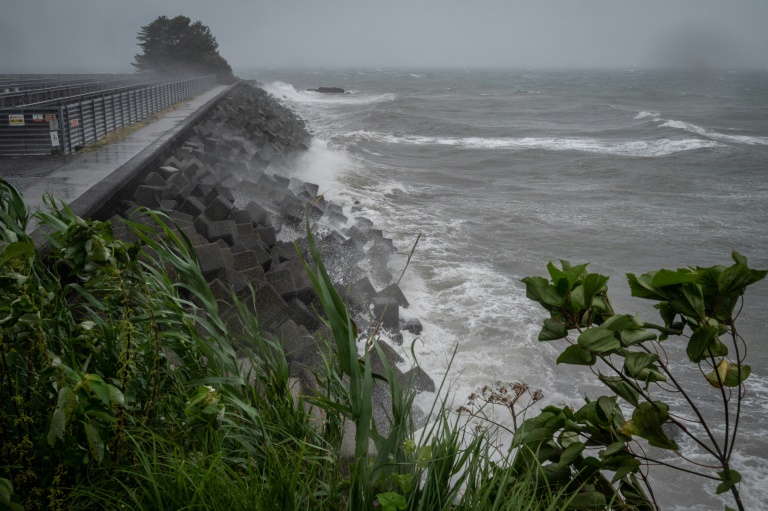
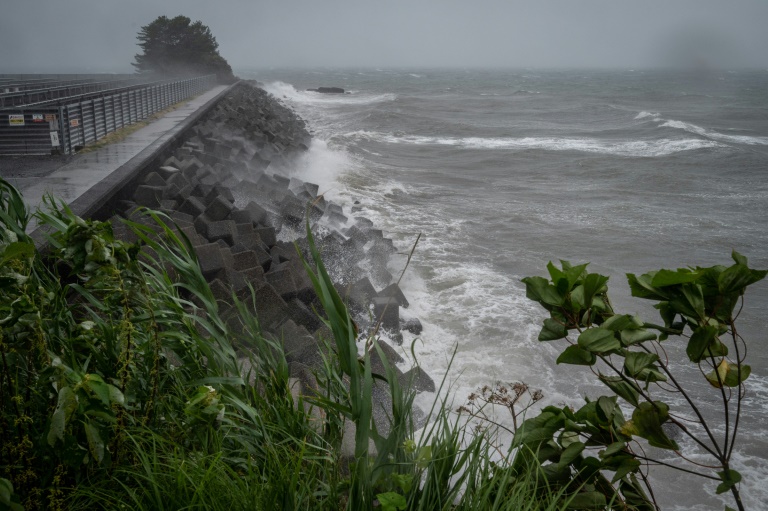
In Kyushu’s Minamata city, fishing boats tied up for safety bobbed on the waves, as spray from the sea and bands of rain sluiced the boardwalk.

The storm, which has weakened slightly as it approached land, is expected to turn northeast and sweep up across Japan’s main island through early Wednesday.

Japan is currently in typhoon season and faces around 20 such storms a year, routinely seeing heavy rains that cause landslides or flash floods.

In 2019, Typhoon Hagibis smashed into Japan as it hosted the Rugby World Cup, claiming the lives of more than 100 people. 

A year earlier, Typhoon Jebi shut down Kansai Airport in Osaka, killing 14 people.

And in 2018, floods and landslides killed more than 200 people in western Japan during the country’s annual rainy season.

Scientists say climate change is increasing the severity of storms and causing extreme weather such as heat waves, droughts and flash floods to become more frequent and intense.

'Dangerous' Typhoon Nanmadol slams into Japan

Typhoon Nanmadol made landfall in southwestern Japan on Sunday night, as authorities urged millions of people to take shelter from the powerful storm’s high winds and torrential rain.

The storm officially made landfall around 7 pm local time (1000 GMT) as its eyewall arrived near Kagoshima city, the Japan Meteorological Agency (JMA) said.

It was packing gusts of up to 234 kilometres (146 miles) per hour and had already dumped up to 500 mm of rain in less than 24 hours on parts of southwestern Kyushu region.

At least 20,000 people were spending the night in shelters in Kyushu’s Kagoshima and Miyazaki prefectures, where the JMA has issued a rare “special warning” — an alert that is issued only when it forecasts conditions seen once in several decades.

National broadcaster NHK, which collates information from local authorities, said more than seven million people had been told to move to shelters or take refuge in sturdy buildings to ride out the storm.

The evacuation warnings are not mandatory, and authorities have at times struggled to convince people to move to shelters before extreme weather.

They sought to drive home their concerns about the weather system throughout the weekend.

“Please stay away from dangerous places, and please evacuate if you feel even the slightest hint of danger,” Prime Minister Fumio Kishida tweeted after convening a government meeting on the storm.

“It will be dangerous to evacuate at night. Please move to safety while it’s still light outside.”

The JMA has warned the region could face “unprecedented” danger from high winds, storm surges and torrential rain and called the storm “very dangerous.”

“Areas affected by the storm are seeing the sort of rain that has never been experienced before,” Hiro Kato, the head of the Weather Monitoring and Warning Centre, told reporters Sunday.

“Especially in areas under landslide warnings, it is extremely probable that some kinds of landslides are already happening.”

He urged “maximum caution even in areas where disasters do not usually happen.”

By Sunday evening, utility companies said nearly 200,000 homes across the region were without power.

Trains, flights and ferry runs were cancelled until the passage of the storm, and even some convenience stores — generally open all hours and considered a lifeline in disasters — were shutting their doors.

– ‘Highest caution possible’ –

“The southern part of the Kyushu region may see the sort of violent wind, high waves and high tides that have never been experienced before,” the JMA said Sunday, urging residents to exercise “the highest caution possible”.

On the ground, an official in Kagoshima’s Izumi city said conditions were deteriorating rapidly by Sunday afternoon.

“The wind has become extremely strong. Rain is falling hard too,” he told AFP. “It’s a total white-out outside. Visibility is almost zero.”

In Kyushu’s Minamata city, fishing boats tied up for safety bobbed on the waves, as spray from the sea and bands of rain sluiced the boardwalk.

The storm, which has weakened slightly as it approached land, is expected to turn northeast and sweep up across Japan’s main island through early Wednesday.

Japan is currently in typhoon season and faces around 20 such storms a year, routinely seeing heavy rains that cause landslides or flash floods.

In 2019, Typhoon Hagibis smashed into Japan as it hosted the Rugby World Cup, claiming the lives of more than 100 people. 

A year earlier, Typhoon Jebi shut down Kansai Airport in Osaka, killing 14 people.

And in 2018, floods and landslides killed more than 200 people in western Japan during the country’s annual rainy season.

Scientists say climate change is increasing the severity of storms and causing extreme weather such as heat waves, droughts and flash floods to become more frequent and intense.

Argentine dancers crowned world champions of tango

Two Argentine pairs were crowned winners of the world tango championships in Buenos Aires, the city government said Saturday.

More than 20,000 people attended the music and dance shows during the competition, organizers said, with a final showdown on a stage in front of the historic Buenos Aires Obelisk in the heart of Argentina’s capital.

In the stage category, which featured spectacular acrobatic stunts, Constanza Vieyto and Ricardo Astrada from the city of Pergamino beat 19 other couples to emerge champions.

Forty pairs vied for the title in the traditional or “salon” category, dancing a tango that originated in Buenos Aires, with the crown going to Cynthia Palacios and Sebastian Bolivar from the city of Cipolletti.

The world championships, held from September 6 to 18, involved 560 couples from 30 countries, including the United States, France, Russia, Japan and the Philippines.

King to host world leaders as UK counts down to queen's funeral

US President Joe Biden was Sunday to pay his last respects in London to Queen Elizabeth II, as ordinary mourners waiting in marathon lines were warned that time was running out to view her coffin lying in state.

After witnessing the sombre scene in parliament’s Westminster Hall, Biden, Japan’s Emperor Naruhito and other world leaders were due to attend a reception with the late queen’s successor, King Charles III.

Biden, who flew in late Saturday, has said that Elizabeth “defined an era” after she reigned for a record-breaking 70 years leading up to her death on September 8, aged 96.

Australia’s anti-monarchy Prime Minister Anthony Albanese, who viewed the lying-in-state and met Charles on Saturday, told Sky News Australia that the queen was “a constant reassuring presence”.

There was also a private audience at Buckingham Palace for Prime Minister Jacinda Ardern of New Zealand, which like Australia and 12 other Commonwealth realms now counts Charles as its sovereign.

“You could see that it meant a huge amount (to Charles) to have seen the sheer scale and outpouring of people’s love and affection for her late Majesty,” she told BBC television Sunday.

Commonwealth leaders were among dozens of heads of state and government in attendance, as Britain stages its biggest-ever policing operation.

The first members of the public were already camping out in advance to catch a glimpse of Monday’s grand farewell at Westminster Abbey, which is expected to bring London to a standstill and be watched by billions of viewers worldwide.

– ‘The nation’s granny’ –

“We wanted to have a good spot to see the procession,” said Royal Navy veteran Bill Parry, 59, as he waited in camping chairs with two other former servicemen.

“It’s not much to ask to sleep outside considering everything the queen did for us: 70 years of duty,” he told AFP.

Britain will hold a minute’s silence at 8:00 pm (1900 GMT) on Sunday to reflect on the “life and legacy” of the queen ahead of her funeral. 

Eurostar said it would observe the moment on its cross-Channel trains.

Near the Scottish town of Falkirk, 96 lanterns were to be lowered into a “pool of reflection” at the foot of the Queen Elizabeth II Canal, before wreaths are placed in the water.

Those wanting to view the flag-draped casket have until 6:30 am (0530 GMT) on Monday to make it into the cavernous Westminster Hall opposite the abbey.

As the queue continued to snake for miles (kilometres) along the River Thames Sunday morning, the waiting time stood at more than 13 hours, and the line is likely to be closed by the evening.

“To avoid disappointment please do not set off to join the queue,” the government said.

IT worker Shaun Mayo, 27, was among those relieved to have made it to Westminster Hall after queueing for 14 hours to pay his respects.

“It was incredibly emotional. She was like the nation’s granny,” he said.

“We’ll all miss her.”

A man who was arrested after approaching the casket on Friday has been charged with a public-order offence, police said.

– Grandchildren’s vigil –

As mourners slowly filed by on Saturday evening, Prince William and his estranged younger brother Prince Harry led the queen’s eight grandchildren in a 12-minute vigil around the coffin.

Harry — who did two tours with the British Army in Afghanistan — wore the uniform of the Blues and Royals cavalry regiment in which he served.

The move appeared to be the latest olive branch offered by Charles towards Harry and his wife Meghan after they quit royal duties and moved to North America, later accusing the royal family of racism.

The king and his eldest son William, the new heir to the throne, had earlier surprised those standing in line along the Thames by staging an unscheduled walkabout to shake their hands and thank them for coming.

Queen Elizabeth’s state funeral, the first in Britain since the death of her first prime minister Winston Churchill in 1965, will take place Monday at Westminster Abbey in London at 11:00 am (1000 GMT).

Reflecting on the queen’s wishes for the hour-long ceremony, the former archbishop of York, John Sentamu, said she “did not want what you call long, boring services”.

“The hearts and people’s cockles will be warmed and at the same time, there will be a moment of saying this is a funeral service that is glorious in its setting,” he told BBC television.

– Russia says ‘immoral’ –

Leaders from Russia, Afghanistan, Myanmar, Syria and North Korea were not invited to join the 2,000 guests.

Moscow’s foreign ministry last week called the decision “deeply immoral”, and “blasphemous” to the queen’s memory. China will attend at the abbey, but was barred by parliamentary leaders from the lying-in-state.

After the funeral, the queen’s coffin will be driven to Windsor Castle, west of London, for a private burial when she will be laid to rest alongside her late husband Prince Philip, her parents and her sister.

Camilla gave her first public comments as the new queen consort, recalling her mother-in-law’s smile and “wonderful blue eyes”. 

“It must have been so difficult for her being a solitary woman” in a world dominated by men, Charles’s wife said in televised comments.

“There weren’t women prime ministers or presidents. She was the only one so I think she carved her own role.”

Strong quake strikes eastern Taiwan, tsunami threat lifted

A strong earthquake struck southeastern Taiwan, bringing at least one building down in a small town and tearing up roads as forecasters said the threat of a regional tsunami had passed.

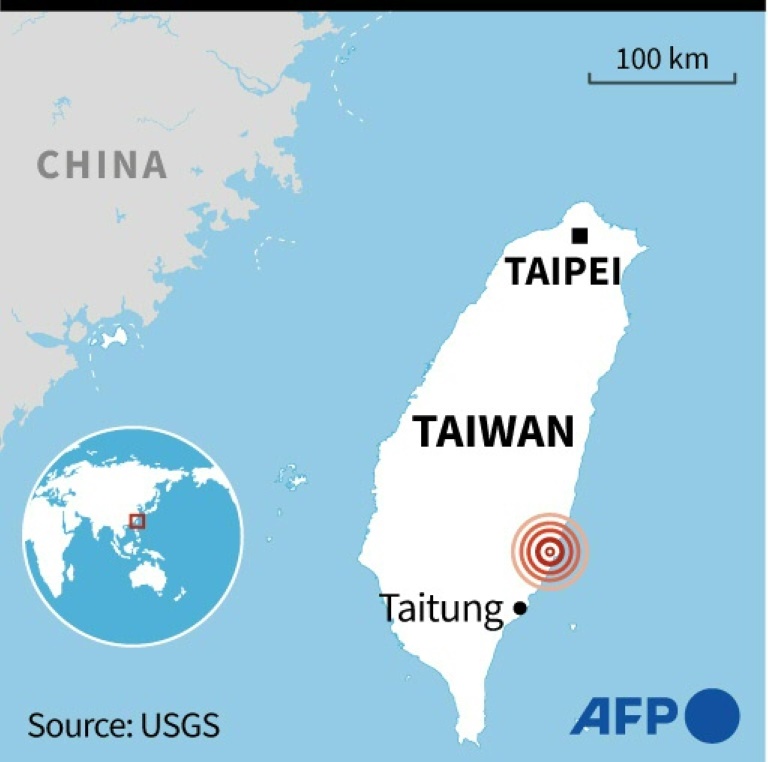
The quake hit at 2:44 pm (0644 GMT) about 50 kilometres (30 miles) north of the city of Taitung at a depth of 10 kilometres, the United States Geological Survey said.

Its initial strength was given as magnitude 7.2 but USGS later downgraded it to a 6.9-magnitude quake. Taiwan’s weather bureau recorded it as 6.8-magnitude. 

Japan’s Meteorological Agency and the Pacific Tsunami Warning Center issued tsunami advisories shortly after the quake, but both later sent updated bulletins saying there was no longer a threat of high waves.

In the Taiwanese town of Yuli, a building that hosted a 7/11 convenience store on the ground floor collapsed.

Video footage posted by Taiwan’s Central News Agency showed panicked residents running towards the building, which had caved in and sent up a thick cloud of dust.

Taiwan Railways Administration (TRA) said a train derailed in Dongli station in Hualien after it was hit by concrete from an overhead canopy that came loose during the quake.

Photographs released by CNA showed the train’s six carriages leaning at an angle in the station. 

TRA said the 20 onboard passengers were evacuated and no injuries were reported. 

Shaking was also felt in the capital Taipei and the southwestern city of Kaohsiung, with residents posting videos of chandeliers and paintings swaying on social media.

Taiwan’s President Tsai Ing-wen urged people to be vigilant for further aftershocks in the coming hours. 

“Water and electricity supplies in some areas are also affected by the earthquake,” she wrote on Facebook. “The related disaster relief work is in full swing.”

– Broken bridge, swimming pool waves –

Many expressed the kind of resilience that comes with living on an island that frequently experiences earthquakes.

In one video posted online, a man said he was trapped on a bridge where the road at either end had collapsed into a twisted mess of tarmac and concrete.

“This is troublesome,” he could be heard saying. “The whole bridge is broken”. 

In another Facebook post, Ou Chin Te shared footage from the swimming pool on the 60th floor of The One — a skyscraper in Kaohsiung and Taiwan’s fourth-highest building. 

The tremors had turned the pool into a wobbly mass of waves. 

“It’s shaking super big, I’m on 60th floor, it’s so scary,” a laughing man could be heard saying in the video.

A 6.6-magnitude quake hit the same region on Saturday and there have been multiple tremors since, with minimal damage in what is a mountainous and sparsely populated rural region. 

But Sunday’s quake was much stronger.

The China Earthquake Network Centre said tremors were felt in coastal areas including Fujian, Guangdong, Jiangsu and Shanghai.

Taiwan is regularly hit by earthquakes as the island lies near the junction of two tectonic plates.

The mountainous island sits on the “Ring of Fire”, an arc of intense seismic activity that stretches through Southeast Asia and across the Pacific basin.

Most of Taiwan’s population lives on the flat western coast and in the capital Taipei.

The scenic eastern coast is more remote and less populated but a major tourist draw.

There are few international tourists in Taiwan these days because the island maintains mandatory Covid quarantine for most arrivals.  

Taiwan is regularly hit by quakes and most cause minimal damage but the island also has a long history of deadly tremors. 

Hualien, a tourist hotspot, was struck by a 6.4-magnitude earthquake in 2018 that killed 17 people and injured nearly 300. 

In September 1999, a 7.6-magnitude quake killed around 2,400 people in the deadliest natural disaster in the island’s history.

Strong quake strikes eastern Taiwan, tsunami threat lifted

A strong earthquake struck southeastern Taiwan, bringing at least one building down in a small town and tearing up roads as forecasters said the threat of a regional tsunami had passed.

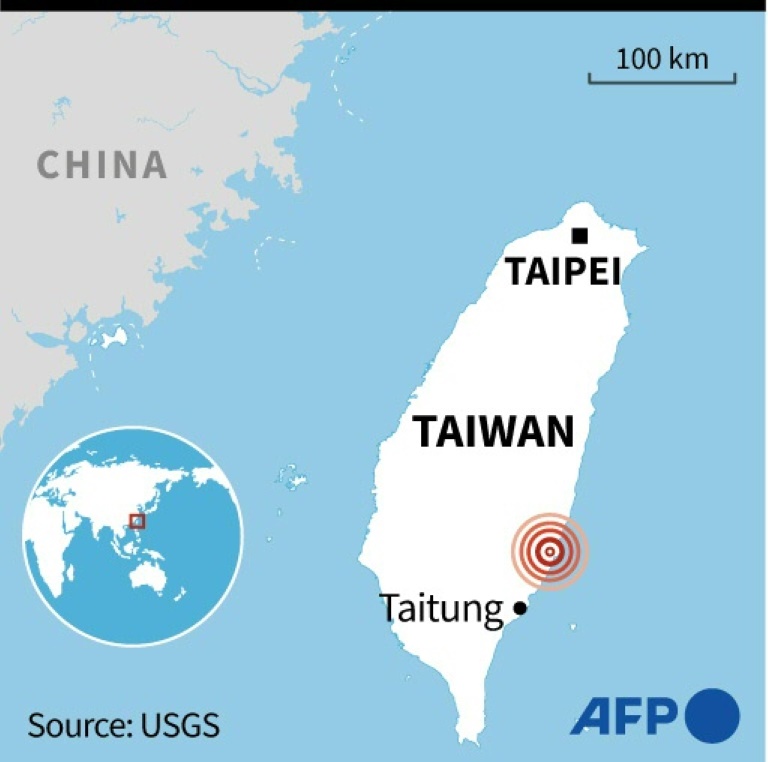
The quake hit at 2:44 pm (0644 GMT) about 50 kilometres (30 miles) north of the city of Taitung at a depth of 10 kilometres, the United States Geological Survey said.

Its initial strength was given as magnitude 7.2 but USGS later downgraded it to a 6.9-magnitude quake. Taiwan’s weather bureau recorded it as 6.8-magnitude. 

Japan’s Meteorological Agency and the Pacific Tsunami Warning Center issued tsunami advisories shortly after the quake, but both later sent updated bulletins saying there was no longer a threat of high waves.

In the Taiwanese town of Yuli, a building that hosted a 7/11 convenience store on the ground floor collapsed.

Video footage posted by Taiwan’s Central News Agency showed panicked residents running towards the building, which had caved in and sent up a thick cloud of dust.

Taiwan Railways Administration (TRA) said a train derailed in Dongli station in Hualien after it was hit by concrete from an overhead canopy that came loose during the quake.

Photographs released by CNA showed the train’s six carriages leaning at an angle in the station. 

TRA said the 20 onboard passengers were evacuated and no injuries were reported. 

Shaking was also felt in the capital Taipei and the southwestern city of Kaohsiung, with residents posting videos of chandeliers and paintings swaying on social media.

Taiwan’s President Tsai Ing-wen urged people to be vigilant for further aftershocks in the coming hours. 

“Water and electricity supplies in some areas are also affected by the earthquake,” she wrote on Facebook. “The related disaster relief work is in full swing.”

– Broken bridge, swimming pool waves –

Many expressed the kind of resilience that comes with living on an island that frequently experiences earthquakes.

In one video posted online, a man said he was trapped on a bridge where the road at either end had collapsed into a twisted mess of tarmac and concrete.

“This is troublesome,” he could be heard saying. “The whole bridge is broken”. 

In another Facebook post, Ou Chin Te shared footage from the swimming pool on the 60th floor of The One — a skyscraper in Kaohsiung and Taiwan’s fourth-highest building. 

The tremors had turned the pool into a wobbly mass of waves. 

“It’s shaking super big, I’m on 60th floor, it’s so scary,” a laughing man could be heard saying in the video.

A 6.6-magnitude quake hit the same region on Saturday and there have been multiple tremors since, with minimal damage in what is a mountainous and sparsely populated rural region. 

But Sunday’s quake was much stronger.

The China Earthquake Network Centre said tremors were felt in coastal areas including Fujian, Guangdong, Jiangsu and Shanghai.

Taiwan is regularly hit by earthquakes as the island lies near the junction of two tectonic plates.

The mountainous island sits on the “Ring of Fire”, an arc of intense seismic activity that stretches through Southeast Asia and across the Pacific basin.

Most of Taiwan’s population lives on the flat western coast and in the capital Taipei.

The scenic eastern coast is more remote and less populated but a major tourist draw.

There are few international tourists in Taiwan these days because the island maintains mandatory Covid quarantine for most arrivals.  

Taiwan is regularly hit by quakes and most cause minimal damage but the island also has a long history of deadly tremors. 

Hualien, a tourist hotspot, was struck by a 6.4-magnitude earthquake in 2018 that killed 17 people and injured nearly 300. 

In September 1999, a 7.6-magnitude quake killed around 2,400 people in the deadliest natural disaster in the island’s history.

27 people killed in China bus crash

A bus crash killed 27 people in southwest China on Sunday, police said, the country’s deadliest road accident so far this year. 

The accident took place on a highway in rural Guizhou province when the vehicle carrying a total of 47 people “flipped onto its side”, Sandu county police said in a statement published on social media.

The other 20 people were being treated for injuries and emergency responders were dispatched to the scene, police said, without providing any more details.

The accident happened in Qiannan prefecture — a poor, remote and mountainous part of Guizhou, home to several ethnic minorities.

Two social media posts by the China Road Network monitoring service, that have since been deleted, said the accident occurred at around 2:40 am (1840 GMT on Saturday), according to screenshots circulating on the Twitter-like Weibo.

Social media users angrily demanded why a passenger bus was travelling down a highway in the early hours of the morning, when many major roads in the province have been closed to regular traffic.

“This feeling can’t simply be represented by lighting a candle and saying RIP,” read one Weibo post with more than 15,000 likes.

One hundred toll stations are shuttered in Guizhou because of Covid-19 restrictions and long-distance passenger journeys across China are banned from running between 2:00 am and 5:00 am.

Guizhou is in the midst of a Covid outbreak that has seen more than 900 new infections in the past two days alone. 

Its provincial capital Guiyang, home to six million residents, was locked down earlier in September. 

The bus was travelling south in the direction of Guiyang to Libo county, according to the police statement.

Unverified photos circulating widely on social media Sunday showed a gold-coloured passenger bus, whose top is completely crumpled, being towed by a truck. 

Another viral photo appeared to show the bus driving at night before it crashed, with the driver and passengers wearing white hazmat suits, which are still commonly worn in China to protect against Covid-19. AFP could not verify the photos. 

Road accidents remain fairly common in China, where irregular enforcement and lax safety standards have resulted in a string of fatalities over the years.

Guizhou has also seen other transport acccidents.

In June, a railway driver was killed when a high-speed train derailed in Guizhou province.

And in March a Chinese passenger jet crash killed all 132 people on board, marking the deadliest aviation accident to take place in China for decades. 
With a tot and a toast, Antigua's loyalists remain true to Charles

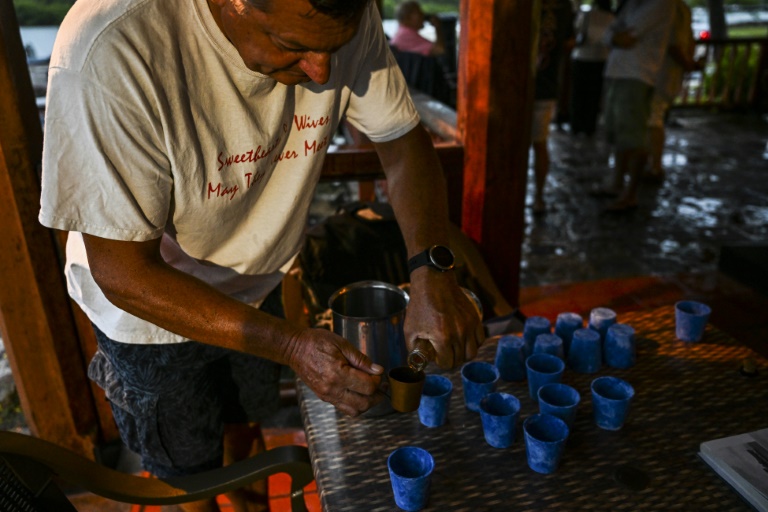
In the quickly fading light of a rainy Antiguan dusk, Mike Rose, chairman of the Royal Naval Tot Club, leads a circle of loyalists in raising their daily ration of rum and toasting King Charles III.

“To the King, God bless him,” the dozen or so people standing in a semicircle facing Rose say as they knock back the pungent grog — pleased that, for the first time since Queen Elizabeth II died earlier this month, they got the words right and toasted her son rather than her.

It’s an easy mistake to make — after all, they had toasted the queen in this way every night at 6:00 pm since 1991.

“We’ve never missed a tot,” 81-year-old Rose, originally from Britain, tells AFP as rain hammers down on the roof of the waterfront Galley Bar in the tiny Caribbean nation of Antigua and Barbuda.

They are carrying on a tradition that began in 1655, when the British Royal Navy began giving its sailors a daily half pint of rum. Yes — half a pint of rum, every morning.

It took nearly a century for the admirals to begin reassessing the wisdom of this idea. They ordered that the ration be watered down and split into two portions. 

Somehow problems with drunkenness among sailors persisted — perhaps because, as Rose points out, three parts water to one part rum is still one part rum.

In 1850 it was recommended that the daily ration be eliminated.

That advice was ignored, but the navy did at least begin reducing the ration, eventually landing at one-eighth of an imperial pint — a “tot,” or 71 milliliters (2.4 oz) per day.

– Black Tot Day –

It wasn’t until 1969 that the admirals finally conceded in a written answer to MPs that “the rum issue is no longer compatible with the high standards of efficiency required” in the navy.

Some sailors wore black armbands, or held mock funerals at sea as they drank their final tot on July 31, 1970 — “Black Tot Day.” 

Rose, who served as a chief petty officer in the Royal Navy and drew his daily ration for years, remembers it well. After Black Tot Day, he admits, he continued drinking it “unofficially.” 

He served in Antigua and Barbuda, formerly a British colony, and stayed when he retired, drinking his tot nightly.

“Other people eventually joined in,” he explains.

Now, the members believe, they are the only such club in the world to still have their daily grog — and they do have it daily, through hurricanes (they’ve been known to toast via VHF radio), Covid (Zoom toasts) and any other obstacles life in Antigua throws their way.

Members can only join while in Antigua and after passing a strict test, including a portion on naval history. Though only a handful made it through the weather to reach the bar on the night AFP visited, they now number around 500 people worldwide.

Their loyalty has been rewarded, with Prince William enjoying a lunch with them as a serving officer on HMS Iron Duke in 2008.

– Special blend –

The Royal Navy was Britain’s means of extending colonization around the world, and the 97,000 people of Antigua and Barbuda are largely descended from Africans who were enslaved and brought to the Caribbean by the British. 

The country gained independence in 1981, but retained the queen as head of state.

Now the tiny nation’s prime minister wants to hold a referendum on breaking that final link — though it may not come to pass for years, and Antiguans appear to be reserving judgment for the moment.

Rose is skeptical. “I’ll actually believe it when it happens,” he says. 

The Tot Club does include Antiguans — as well as Americans, Germans and even, the whisper goes around the Galley Bar, some French. 

Most of the members on the evening AFP visited appear to be English expatriates living and working on the island.

The only thing they ask of visitors is that they show loyalty — or, in the case of anyone who is not a British subject, respect — for the monarchy.

The death of Queen Elizabeth is “huge,” says Rose.

But their loyalty, of course, is to the crown, not the woman.

They will continue meeting nightly to toast Charles with their own blend of Antigua’s prized English Harbour Rum — a mix specially made for them. 

“I think, from what I’ve seen in the last few days, he’s going to be alright,” Rose says of the new monarch.

“He’s not going to be Elizabeth. But he’s going to be alright.”

Close Bitnami banner
Bitnami