World

Typhoon Muifa lashes eastern China, forcing 1.6 million from their homes

High winds and heavy rain lashed China’s densely populated east coast on Thursday, after Typhoon Muifa forced around 1.6 million people to leave their homes and grounded most flights at Shanghai’s main airports.

Muifa is the strongest tropical cyclone to hit Shanghai — home to more than 25 million people — since record-keeping began in 1949, state broadcaster CCTV said.

However, there were no immediate reports of any deaths or casualties.

At least 426,000 people were evacuated in Shanghai and another 1.2 million people were taken to temporary shelters in neighbouring Zhejiang province, CCTV added. 

Heavy rainfall led to traffic tailbacks and floods in several areas of the Yangtze river delta region, a major global manufacturing hub.

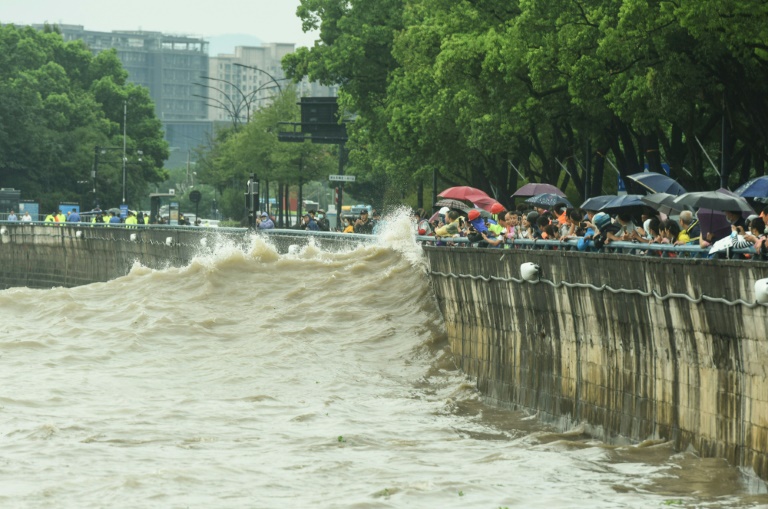
Giant waves were seen crashing onto the coastline in Hangzhou bay, to the south of Shanghai, and national radio reported a landslide in Ninghai County in Zhejiang province.

Packing winds of up to 125 kilometres (78 miles) per hour, the storm made landfall at 12:30 am Thursday (1630 GMT Wednesday) in Shanghai’s Fengxian district.

It had earlier led to the cancellation of all flights to China’s biggest financial hub.

Muifa previously hit the city of Zhoushan in Zhejiang on Wednesday, according to state news agency Xinhua.

Air travel slowly resumed in Shanghai as the storm moved north, but most flights from the city’s two main airports were cancelled Thursday morning, according to aviation data provider Flightradar24.

Operations at some of Asia’s largest container shipping ports in Shanghai and neighbouring Ningbo that were halted because of the typhoon were scheduled to resume later Thursday, according to statements from port officials. 

Officials ordered all fishing vessels in the Yellow Sea and Bohai Sea to anchor in ports as northeast China braced for the typhoon.

The storm entered east China’s Jiangsu province on Thursday morning and the wind speed weakened to about 90 kilometres (56 miles) per hour, the Central Meteorological Observatory said.

The storm came soon after Typhoon Hinnamnoor hit Shanghai and its neighbouring region last week, causing the suspension of Shanghai ferry services and school closures in parts of Zhejiang.

Muifa is the 12th typhoon to hit China this year, according to state media.

Tropical storms, which are expected to increase as the planet warms, were sharply up in 2021, a report by the US National Oceanic and Atmospheric Administration said earlier this month.

Syrian ex-prisoners haunted by horrors of 'salt rooms'

When a Syrian prison guard tossed him into a dimly-lit room, the inmate Abdo was surprised to find himself standing ankle-deep in what appeared to be salt.

On that day in the winter of 2017, the terrified young man had already been locked up for two years in war-torn Syria’s largest and most notorious prison, Sednaya. 

Having been largely deprived of salt all that time in his meagre prison rations, he brought a handful of the coarse white crystals to his mouth with relish.

Moments later came the second, grisly, surprise: as a barefoot Abdo was treading gingerly across the room, he stumbled on a corpse, emaciated and half-buried in the salt.

Abdo soon found another two bodies, partially dehydrated by the mineral.

He had been thrown into what Syrian inmates call “salt rooms” — primitive mortuaries designed to preserve bodies in the absence of refrigerated morgues.

The corpses were being treated in a way already known to the embalmers of ancient Egypt, to keep up with the industrial-scale prison killings under President Bashar al-Assad’s regime.

The salt rooms are described in detail for the first time in an upcoming report by the Association of Detainees and the Missing in Sednaya Prison, or ADMSP.

In additional research and interviews with former inmates, AFP found that at least two such salt rooms were created inside Sednaya.

Abdo, a man from Homs now aged 30 and living in eastern Lebanon, asked that his real name not be published for fear of reprisals against him and his family.

Speaking in his small rental flat in an unfinished building, he recounted the day he was thrown into the salt room, which served as his holding cell ahead of a military court hearing.

“My first thought was: may God have no mercy on them!” he said. “They have all this salt but don’t put any in our food!

“Then I stepped on something cold. It was someone’s leg.”

– ‘My heart died’ –

Up to 100,000 people have died in Syrian regime prisons since 2011, a fifth of the war’s entire death toll, according to Britain-based monitoring group the Syrian Observatory for Human Rights.

Abdo, fortunate to have survived, described the salt room on the first floor of the red building as a rectangle of roughly six by eight metres (20 by 26 feet), with a rudimentary toilet in a corner.

“I thought this would be my fate: I would be executed and killed,” he said, recalling how he curled up in a corner, crying and reciting verses from the Koran.

The guard eventually returned to escort him to the court, and Abdo lived to tell the tale.

On his way out of the room, he had noticed a pile of body bags near the door.

Like tens of thousands of others, he had been jailed on blanket terrorism charges. He was released in 2020 but says the experience scarred him for life.

“This was the hardest thing I ever experienced,” he said. “My heart died in Sednaya. If someone announced the death of my brother right now, I wouldn’t feel anything.”

Around 30,000 people are thought to have been held at Sednaya alone since the start of the conflict. Only 6,000 were released.

Most of the others are officially considered missing because death certificates rarely reach the families unless relatives pay an exorbitant bribe, in what has become a major racket.

AFP interviewed another former inmate, Moatassem Abdel Sater, who recounted a similar experience in 2014, in a different first-floor cell of around four by five metres, with no toilet.

Speaking at his new home in the Turkish town of Reyhanli, the 42-year-old recounted finding himself standing on thick layer of the kind of salt used to de-ice roads in winter.

“I looked to my right and there were four or five bodies,” he said.

“They looked a bit like me,” Moatassem said, describing how their skeletal limbs and scabies-covered skin matched his own emaciated body. “They looked like they had been mummified.”

He said he still wonders why he was taken to the makeshift mortuary, on the day of his release, May 27, 2014, but guessed that “it might have been just to scare us”.

– Black hole –

The ADMSP, after extensive research on the infamous prison, dates the opening of the first salt room to 2013, one of the deadliest years in the conflict.

“We found that there were at least two salt rooms used for the bodies of those who died under torture, from sickness or hunger,” the group’s co-founder Diab Serriya said during an interview in the Turkish city of Gaziantep.

It was not clear whether both rooms existed at the same time, nor whether they are still being used today.

Serriya explained that when a detainee died, his body would typically be left inside the cell with the inmates for two to five days before being taken to a salt room.

The corpses remained there until there were enough of them for a truckload.

The next stop was a military hospital where death certificates — often declaring a “heart attack” as the cause of death — were issued, before mass burials.

The salt rooms were meant to “preserve the bodies, contain the stench… and protect the guards and prison staff from bacteria and infections,” Serriya explained.

US-based professor of anatomy Joy Balta, who has published extensively on human body preservation techniques, explained how salt could be used as a simple and cheap alternative to cold rooms.

“Salt has the ability to dehydrate any living tissue … and can therefore be used to significantly slow down the decomposition process,” he told AFP.

A body can remain in salt without decomposing longer than in a purpose-built refrigerated chamber, “although it will alter the surface anatomy”, said Balta, who founded the Anatomy Learning Institute at Point Loma Nazarene University in San Diego.

The ancient Egyptians are known to have used the mummification process, which includes the immersion of the body in a salt solution called natron.

The tonnes of rock salt used in Sednaya are thought to have come from Sabkhat al-Jabul, Syria’s largest salt flats, in Aleppo province.

The report by ADMSP is the most thorough study yet of the structure of Sednaya, which has manufactured death on a terrifying scale for years.

It provides detailed schematics of the facility and of how duties were split between various army units and wardens.

“The regime wants Sednaya to be a black hole, no-one is allowed to know anything about it,” Serriya said. “Our report denies them that.”

– ‘Salt was a treasure’ –

The fighting in Syria’s brutal war has ebbed over the past three years, but Assad and the prison that has become a monument to his bloody rule are still there.

New layers to the horror of the war are still being uncovered as survivors abroad share their stories, and investigations into regime crimes by foreign courts fuel a drive for accountability.

“If a political transition ever occurs in Syria,” said Serriya, “we want Sednaya to be turned into a museum, like Auschwitz.”

Prisoners recall that, aside from torture and disease, their biggest torment was hunger.

Moatassem said his weight more than halved, from 98 kilograms when he was jailed in 2011 to 42 kilograms when he got out.

The ex-inmates also see as a sickening irony the fact that the salt they craved so badly formed an integral part of the horrific death machine that was decimating them.

The wheat, rice and potatoes they were sometimes fed were always cooked without salt, or sodium chloride, a lack of which can have serious health impacts on the human body.

Low sodium levels in the blood can cause nausea, dizziness and muscle cramps and, if sustained, coma and death.

Detainees used to soak olive pits in their water to salt it, and would even spend hours sifting through laundry detergent to pick out tiny crystals which they treated like a delicacy.

Former inmate Qais Murad recounted how, on a summer day in 2013, he was called out of his cell to see his parents, but on his way to the visitation area was shoved into a room.

Inside, he stepped on something like grit on the floor. Kneeling with his bowed head against the wall, he caught a glimpse of guards dumping around 10 bodies behind him.

When a cellmate returned from a visit later that day, his socks and pockets stuffed with salt, Murad understood what the substance was.

“From that day onwards, we always made sure to wear socks, and trousers with pockets, for visits in case we found salt,” Murad told AFP, also in Gaziantep.

He remembered how the excited cellmates ate boiled potatoes with their first pinch of salt in years that day, oblivious to its provenance.

“All we cared about was the salt,” Murad said. “Salt was a treasure.”

Sweden conservatives to form new government after narrow election win

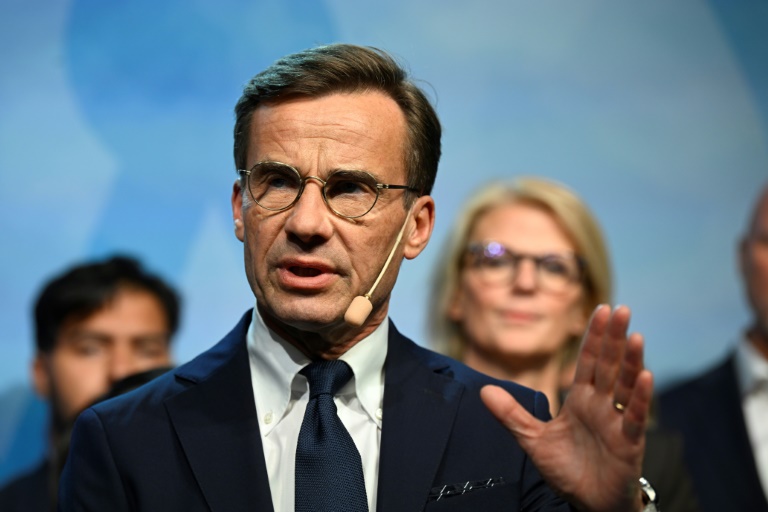
The leader of Sweden’s conservatives, Ulf Kristersson, was working to form a new government on Thursday after a narrow election win by a coalition of right and far-right parties.

“I now begin the work of forming a new and strong government,” Kristersson said on Wednesday as vote tallies were being finalised. “Now we will restore order in Sweden!”

With 176 seats — 73 of them going to the far-right Sweden Democrats — the four-party coalition will have a slim majority over the left, which won 173, according to a tally by the country’s elections authority that includes 99.9 percent of voting offices.

Sunday’s election was so close that it took until Wednesday for tens of thousands of votes from abroad and those cast in advance to be counted to validate the results. 

Acknowledging her camp’s defeat on Wednesday, Prime Minister Magdalena Andersson announced that she would resign.

Speaking at a press conference, Andersson, leader of the Social Democrats, noted that the right would enjoy a “narrow majority, but a majority nonetheless”.

“So tomorrow I will hand in my resignation as prime minister, and the responsibility for the continued process will go to the speaker,” Andersson said.

– ‘Making Sweden great again’ –

Never before has a Swedish government relied on the support of the anti-immigration and nationalist Sweden Democrats, who became the big winners of the vote.

With the vast majority of votes counted, the party emerged as Sweden’s second largest behind the Social Democrats, who have dominated Swedish politics since the 1930s.

However, the post of prime minister will in all likelihood go to Kristersson, the leader of the Moderate party, as Sweden Democrats leader Jimmie Akesson is unable to unite all four parties to head the government.

Kristersson, a former gymnast, led a major U-turn for his party when initiating exploratory talks in 2019 with the Sweden Democrats and then deepening their cooperation.

The Christian Democrats, and to a lesser extent the Liberals, later followed suit.

At the same time the thorny question remains of whether the far-right would be given cabinet posts, which Akesson said on Sunday was their “goal”.

In a post to Facebook on Wednesday, Akesson thanked “friends of Sweden” around the country, and noted that negotiating a new government was “a process that will take the time it needs”.

“Now the work begins of making Sweden great again,” the party leader said.

The head of Italy’s anti-immigrant League, Matteo Salvini, hailed the party’s success.

“Even in beautiful and democratic Sweden, the left is defeated and sent home,” Salvini said in a statement on Wednesday.

The Sweden Democrats rose up out of neo-Nazi groups and the “Keep Sweden Swedish” movement in the early 1990s, entering parliament in 2010 with 5.7 percent of votes.

– Difficult situation –

Long shunned as “pariahs” on the political scene, the party has registered strong growth in each subsequent election as it made efforts to clean up its image.

Its hardline stance on soaring gang shootings and integration set the tone in this year’s election.

The narrow majority means a right-wing government’s hold on power would be very fragile, with the four parties fiercely opposed on a number of issues, especially the Liberals and Sweden Democrats.

“This is a difficult parliamentary situation,” Gothenburg University political scientist Mikael Gilljam told AFP.

“And then you have parties that don’t like each other, the Sweden Democrats and the Liberals” in the same right-wing bloc, he added.

In such a situation, a few disgruntled MPs could end up flipping the balance of power, and support for the Sweden Democrats has been a divisive issue among parties and voters alike.

“It’s scary, it’s strange… We’re seeing an idiocracy winning more and more ground,” 39-year-old art curator Anna Senno told AFP in Stockholm shortly after Andersson’s announcement.

Behind the Sweden Democrats with 73 seats — 11 more than in the last elections in 2018 — the Moderates have 68 (-2), while the Christian Democrats have 19 (-3) and the Liberals 16 (-4). 

On the left, the Social Democrats climbed to 107 seats (+7) after getting 30.3 percent of the vote, ahead of the Left and Centre parties (24 seats each) and the Green Party (18).

Formally, the process of political changeover can only start after Andersson’s official resignation on Thursday. 

Then the speaker of the Riksdag, the Swedish parliament, can give Kristersson the task of forming a majority between the four parties, opening a period of negotiations.

The election of the new head of government cannot take place before September 27 at the earliest, when parliament re-opens.

S.Korea police arrest woman over dead children in suitcases in New Zealand

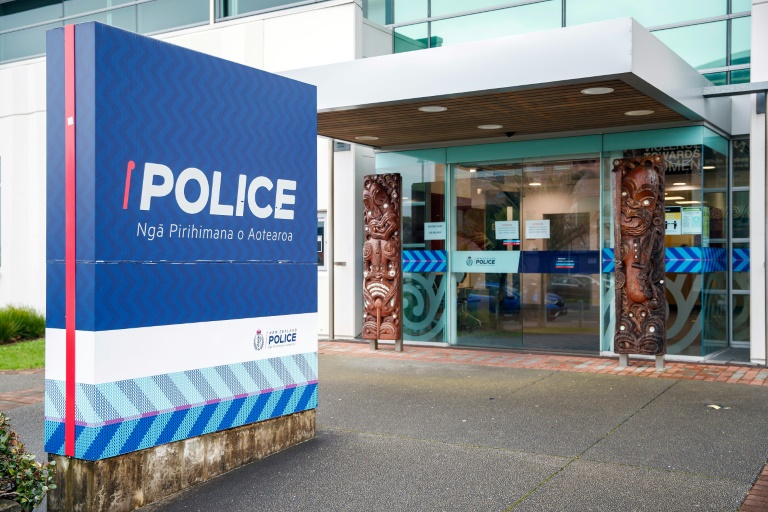
South Korean police on Thursday announced the arrest of a 42-year-old woman accused of murdering two children whose remains were found in suitcases in New Zealand.

The woman, who is believed to be the mother of the two dead young children, was arrested in South Korea on murder charges following a request from New Zealand, police in both countries said. 

She will now face extradition proceedings, they added.

“Police arrested the suspect at an apartment in Ulsan on Thursday following a stakeout with tips on her whereabouts and CCTV footage,” Seoul’s National Police Agency said in a statement.

“The suspect is accused by the New Zealand police of having murdered two of her children, aged seven and 10 then, in around 2018 in the Auckland area,” it said.

“She’s been found to have arrived in South Korea after the crime and has been in hiding ever since,” it added.

The Yonhap News Agency reported that the woman was a South Korean-born New Zealand citizen.

“Police plan to transfer the woman to the Seoul Central District Prosecutors Office in preparation for an extradition screening by the Seoul High Court,” Yonhap said.

The grisly discovery came after an unsuspecting family bought a trailer-load of items — including the suitcases — at an auction for abandoned goods near Auckland, New Zealand’s biggest city.

Detective Inspector Tofilau Fa’amanuia Vaaelua in Auckland said the case was “a very challenging investigation”. 

“To have someone in custody overseas within such a short period of time has all been down to the assistance of the Korean authorities and the coordination by our New Zealand Police Interpol staff,” the detective said.

Ford unveils newest Mustang, extending gasoline-powered life

Ford unveiled Wednesday its seventh-generation Mustang in a brash and boisterous launch event in downtown Detroit that pointed to the staying power of gasoline-powered vehicles. 

The big reveal had been teased for months by company officials and organized as a celebration of the 58-year-old model. The event, organized for Ford employees and Mustang mavens, featured pulsating music, slickly produced videos on wide screens and a light projection of the brand’s horse logo onto a city building that loomed in the background.

The 50-minute event culminated with the arrival of three sleek new sedans in different trims and, later, a fourth option, a racing vehicle called “Dark Horse” that was introduced dramatically by Ed Krenz, Ford’s chief functional engineer for performance.

“Its name is indicative of its design and its aspirations,” Krenz told a cheering crowd. “Its demeanor: absolutely sinister. Dark Horse is for the enthusiast who wants purebred force of nature.”

Ford, which has dived into EV investment as much as any company in recent years, had refrained ahead of Wednesday from saying whether the new Mustang would be electric or gasoline-powered.

But the company made no apologies for its choice to go with the internal combustion engine (ICE).

“Investing in another generation of Mustang is a big statement at a time when many of our competitors are exiting the business of internal combustion vehicles,” said Jim Farley, CEO of Ford Motor Company in a press release, adding that the company is “turbocharging” ICE growth even as it invests $50 billion in EV growth through 2026.

Mustang brand manager Jim Owens said some customers prefer the “visceral” feeling of an ICE vehicle, adding that the company has already released an EV version of the Mustang, the Mach-E sport utility vehicle.

“We know that there are customers out there in the sports car segment who still want the internal combustion engine,” he told AFP in an interview before launch.

“There are a lot of late millennials and early Gen Zers who are into the sports car segment, and we think we have some wonderful things in here that are going to draw them in,” he said.

– Rival muscle cars exit –

The latest Mustang — once the inspiration for a Serge Gainsbourg song and seen in some 3,000 movies — features a “fighter jet-inspired” interior and performance features that make it “the most exhilarating and fun-to-drive yet,” Ford said.

The newest Mustang nods to earlier versions in its lighting and grille design, while also employing the latest in digital technology. This includes a key fob that lets drivers who love the sound of an engine revving satisfy their fix with the press of a button.

By extending the Mustang’s run, Ford runs counter to some other brands such as Dodge, which in August said it was phasing out its gasoline-powered muscle car models, the Challenger and the Charger.

Ford’s vehicle launch event also harked back to the spectacle of past car shows, even though the industry has been moving away from that marketing model in favor of online launches. 

The Detroit Auto Show of yore was known for stunts such as the 1992 arrival of the Jeep Grand Cherokee, which announced itself by crashing through glass.

For Wednesday’s Mustang launch, Ford organized a “Stampede” of earlier Mustangs that caravaned from around the country to Hart Plaza in downtown Detroit, creating an impressive row of Mustangs that went on for blocks. 

Participants were encouraged to participate in a best-dressed contest of “attire inspired by their favorite period in Mustang history, from the 1960s through today,” with the first-place prize a two-year car lease for a new Mustang.

The event also appeared to be intended as a morale boost for “Motor City,” where the auto show has been revived for the first time since 2019 after pandemic cancellations. Presenters repeatedly acknowledged the contribution of local Ford employees, especially at the nearby Flat Rock Assembly Plant, where the Mustang is built.

Chinese moves on Taiwan rattle remote Japanese island

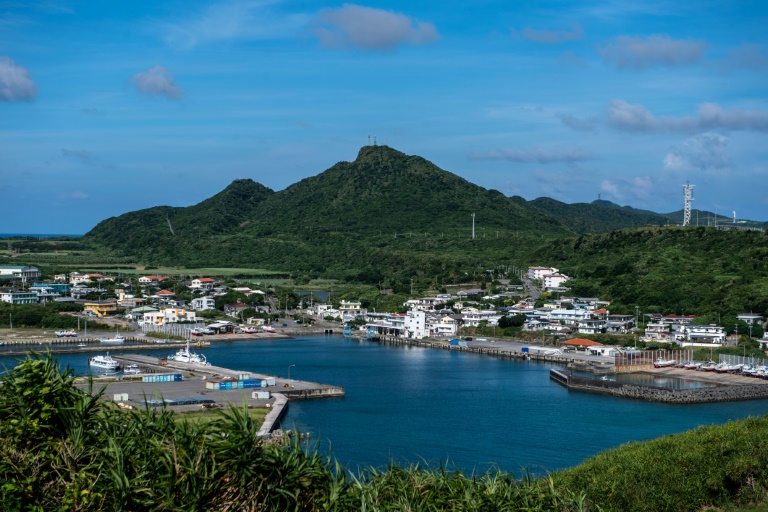
Life may seem tranquil on Japan’s remote Yonaguni island, where wild horses graze and tourists dive to spot hammerhead sharks, but China’s recent huge military exercises have rattled residents.

The western island is just 110 kilometres (70 miles) from Taiwan, and a Chinese missile fired during the drills last month landed not far from Yonaguni’s shores.

“Everyone is on edge,” Shigenori Takenishi, head of the island’s fishing association, told AFP.

“Even if we don’t talk about it, we still have the memory of the fear we felt, of the shock.”

He told fishing boats to stay in port during the drills that followed US House Speaker Nancy Pelosi’s visit to Taiwan in defiance of Beijing’s warnings.

The incident was the latest reminder of how growing Chinese assertiveness has affected Yonaguni, shifting debate about a contentious military presence on the island.

People used to say Yonaguni was defended by two guns, one for each policeman stationed there.

But since 2016, the island has hosted a base for Japan’s army, the Self-Defense Forces, which was established despite initial objections from residents.

The base for maritime and air surveillance is home to 170 soldiers, who with their families make up 15 percent of Yonaguni’s population of 1,700.

An “electronic warfare” unit is also due to be installed there by March 2024.

“When we see Chinese military activity today, we tell ourselves that we got our base just in time,” Yonaguni’s mayor Kenichi Itokazu told AFP.

“We’ve succeeded in sending a message to China.”

– ‘Can they really help us?’ –

That view was not always held so widely on the island.

Yonaguni is part of Okinawa prefecture, where resentment against military presence traditionally runs high.

A quarter of the region’s population perished in the World War II Battle of Okinawa in 1945, and it remained under US occupation until 1972.

Today, Okinawa hosts most of the US bases in Japan.

Yonaguni is closer to Taiwan, Seoul and even Beijing than the Japanese capital Tokyo.

Conscious of its vulnerability, officials have built up a military presence on the Nansei island chain, which extends 1,200 kilometres from Japan’s main islands to Yonaguni.

In addition to the security benefits, the government argued a base would bring economic windfalls to the 30-square-kilometre (11-square-mile) island.

Local officials once felt that Yonaguni’s economic future lay with Taiwan and other nearby commercial hubs, even campaigning to become a “special zone for inter-regional exchange”.

But the government rejected that and instead began in 2007 to pave the way for the base.

Support for the plan received a boost from a diplomatic crisis with Beijing in 2010, and by 2015, around 60 percent of Yonaguni’s residents backed the base in a referendum.

Since then, Chinese sabre-rattling and a string of maritime incidents have helped solidify support.

“Almost no one is against the base now,” said Shigeru Yonahara, 60, a resident who supported the base.

There are holdouts though, including some who fear the base will instead make Yonaguni a target, particularly if China seeks to forcibly bring Taiwan under its control.

“If there is a crisis, will they protect those living here? And can they really help us in the case of an invasion of Taiwan?” said Masakatsu Uehara, a 62-year-old fisherman.

– ‘It’s about deterrence’ –

Both backers and critics agree that the base has changed Yonaguni, including the radar facility’s lights that compete with the starry sky over the island.

A long-awaited incinerator that started operating last year was financed almost entirely by the defence ministry, and rent from the base helps pay for free lunches at the island’s schools.

Yonaguni has no high school and limited employment. It saw decades of decline after its thriving commercial links with Taiwan were severed following World War II.

Now, taxes paid by base residents account for a fifth of Yonaguni’s revenue.

But not everyone sees the changes as positive, including municipal council member Chiyoki Tasato, who has long opposed the base.

He resents the fact that Japanese army families can influence policy by voting in local elections, and argues the base’s economic impact makes it hard for residents to speak freely on the issue.

They “can’t say openly that they are against the base, because the economic situation isn’t good,” Tasato told AFP.

“We prefer to think about what we’re going to eat tomorrow.”

For mayor Itokazu though, there is no arguing with the economic boost the base provides.

And he said the security situation makes its presence a clear necessity.

“As the saying goes, ‘If you want peace, prepare yourself for war.’ It’s about deterrence.”

Asian stocks edge higher, with all eyes on Fed rate path

Asian stocks edged higher at the open on Thursday, tracking gains on Wall Street as markets adjusted following a rout this week on higher-than-expected US inflation data.

The data showed US yearly inflation slowing less than expected and monthly inflation rising, stoking fears that the US Federal Reserve would continue its aggressive tightening of monetary policy.

On Thursday, bourses in Tokyo, Hong Kong and Seoul opened cautiously up.

Analysts said markets were rebounding from the steep losses that followed the inflation data, and to price in an expected 75 basis-point interest rate hike by the Fed at a meeting next week.

The release of US producer price data also affected market sentiment, showing producer costs dropping for the second straight month, mainly driven by falling US fuel prices.

“Stock markets have stabilised a little after Tuesday’s rout which saw risk assets pummelled across the board,” said Craig Erlam, senior market analyst at OANDA.

Tokyo — the previous day’s biggest loser in Asia — rebounded slightly on Thursday but investors remained wary of the speed and degree of future US rate hikes.

“Investors remain deeply cautious about potentially excessive monetary tightening in the United States”, Okasan Online Securities said in a note.

On Wednesday, Wall Street stocks rose as investors prepared for next week’s Fed decision, with the Dow rising 0.1 percent and the S&P 500 gaining 0.3 percent.

Any US interest rate hike tends to strengthen the dollar, and Asian currencies remain at risk from the strong greenback.

On Thursday, the Australian dollar traded near a two-year low, with the yen at near 143 to the US dollar.

A day earlier, Japan’s central bank conducted a “rate check” operation on the yen, a move seen as a precursor to possible intervention, and which served to bring the currency back from the 145 level that is widely seen as a threshold by the market.

– ‘Front-running’ predictions –

Global consumer prices have soared for months, exacerbated by Russia’s invasion of Ukraine — which has hiked energy and food costs — and because of supply chain strains and Covid lockdowns in China.

Analysts say markets have been trying to “front-run” predictions of when inflation will peak.

“There appears to have been a tendency in recent months to front-run certain releases in the hope that it’s going to prove to be the ‘pivot’ moment when everything starts to look up, central banks can ease off the brake and risk assets will have bottomed,” said OANDA’s Erlam.

All eyes are now firmly on the Fed’s meeting next week, where another 75 basis-point rise is widely expected, after two consecutive increases of the same size.

Following the US inflation data, however, some analysts said it could rise by a full percentage point.

Aggressive interest rate tightening by central banks is slowing down major economies, as authorities attempt to stop them from overheating and tame sharp price rises.

On Wednesday, UK inflation slowed to 9.9 percent in August, but remained close to 40-year highs.

The Bank of England is expected to institute another rate hike next week.

“(The UK inflation figure is) not exactly cause for celebration, nor is it likely the peak, but you have to take your wins where you can these days,” said Erlam.

“The data also won’t in all likelihood change the outcome of the BoE meeting next week, with 75 basis points now heavily backed but 50 also possible.”

– Key figures at around 0230 GMT –

Tokyo – Nikkei 225: UP 0.4 percent at 27,918.46  

Hong Kong – Hang Seng Index: UP 0.3 percent at 18,896.92

Shanghai – Composite: DOWN 0.6 percent at 3,218.07

New York – Dow: UP 0.1 percent to 31,135.09 points (close)

London – FTSE 100: DOWN 1.5 percent at 7,277.30 (close) 

Euro/dollar: UP at $0.9976 from $0.9972 

Pound/dollar: UP at $1.1534 from $1.1532  

Euro/pound: UP at 86.50 pence from 86.46 pence 

Dollar/yen: UP at 143.28 yen from 142.20 yen 

Brent North Sea crude: DOWN 0.1 percent at $93.99 per barrel

West Texas Intermediate: UP 0.02 percent at $88.50 per barrel

Angola's Lourenco to be sworn in after disputed win

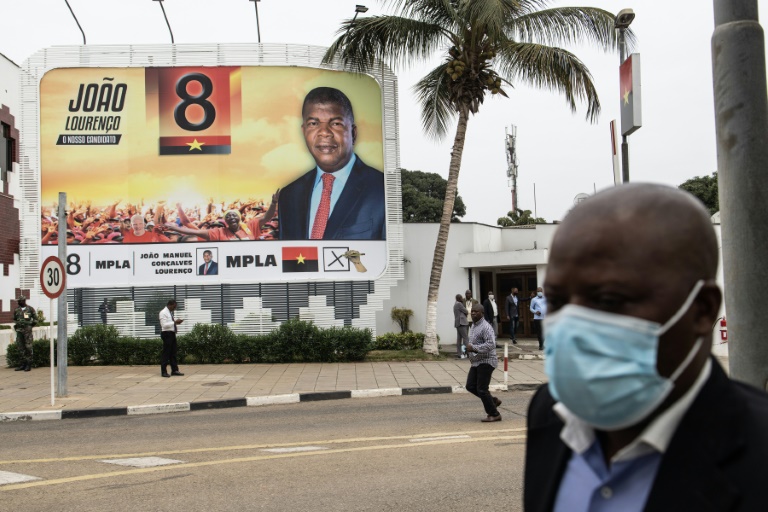
Angolan President Joao Lourenco is to be sworn in for a second term on Thursday amid tight security after a disputed electoral win last month.

The inauguration will be held on the historic palm tree-lined Praca da Republica square in the centre of the capital, Luanda.

Large numbers of police and military forces patrolled the streets ahead of the ceremony, AFP correspondents saw — a presence the main opposition party said aimed at stifling dissent.

“This setup aims to intimidate citizens who want to demonstrate against the election results on the day of the inauguration of a president without legitimacy,” the National Union for the Total Independence of Angola (UNITA) said in a statement.

Several heads of state and government, including Portuguese President Marcelo Rebelo de Sousa, are expected to be in attendance. 

Lourenco, 68, returned to power after the August 24 vote gave his Popular Movement for the Liberation of Angola (MPLA) a thin majority, winning just 51.17 percent of the votes.

The vote was to choose members of parliament, where the largest party automatically selects the president.

It was the MPLA’s poorest showing in the oil-rich African country it has controlled since independence from Portugal in 1975.

UNITA — a former rebel movement which fought a bitter 27-year civil war against the MPLA government — made significant gains, earning 43.95 percent of the vote, up from 26.67 percent in 2017.

Opposition parties and civic groups say the vote was marred by irregularities. 

UNITA disputed the results in court but its appeal was tossed out.

“Tomorrow I will stay at home. There are too many police forces around town,” Joao, a high school student who only gave his first name, said at a bus stop on the outskirts of Luanda.

– ‘President for all’ –

Under its charismatic leader Adalberto Costa Junior, 60, UNITA has proved popular in urban areas and among young voters clamouring for economic change. 

It did particularly well in the capital, where it won a majority for the first time. 

The MPLA instead lost its two-thirds parliamentary majority with its seats dropping to 124 from 150. 

Lourenco struck a conciliatory tone after the vote, pledging to promote “dialogue” and be the “president of all Angolans”.

But Costa Junior has said he will skip the inauguration and promised protests against the result of the vote, but has said his party will join the new parliament.

Foreign observers from other parts of Africa praised the peaceful conduct of the polls but raised concerns over press freedom and the accuracy of the electoral roll. 

The former general first came to power in 2017 when he took over from long-time ruler Jose Eduardo dos Santos, who bequeathed a country deep in recession and riddled by corruption and nepotism.

Lourenco swiftly turned on his predecessor, launching an anti-graft campaign targeting his family and friends, which critics say was a political stunt. 

He also embarked on an ambitious reform programme to lure foreign investors and diversify the economy. 

But that has so far failed to brighten the prospects of many of Angola’s 33 million people who are mired in poverty.

Dos Santos died in Spain in July. State funerals for the late strongman were held in August in the same square where Lourenco is to be sworn in.  

Putin, Xi meet for high-stakes talks in challenge to West

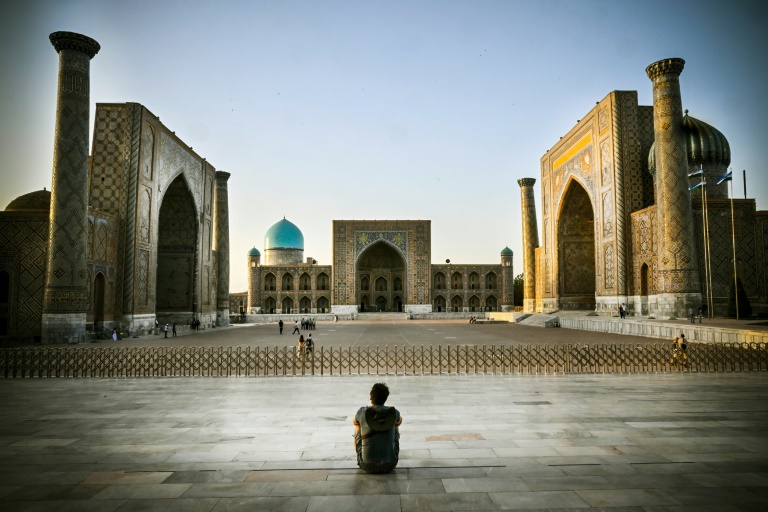
Russia’s Vladimir Putin and China’s Xi Jinping gather with other Asian leaders in the ancient Silk Road city of Samarkand from Thursday for a regional summit touted as a challenge to Western global influence.

Xi and Putin will be joined by the leaders of India, Pakistan, Turkey, Iran and several other countries for the meeting of the Shanghai Cooperation Organisation (SCO) in the Uzbek city on Thursday and Friday.

The main summit day will be Friday, but it is a meeting of the Russian and Chinese leaders on Thursday that will be the most closely watched.

For Putin, the summit is a chance to show that Russia cannot be isolated internationally, at a time when Moscow’s forces are facing major battlefield setbacks in Ukraine.

For Xi — on his first trip abroad since the early days of the coronavirus pandemic — it is an opportunity to shore up his credentials as a global statesman ahead of a pivotal congress of the ruling Communist Party in October.

And for both leaders, the summit will be a chance to thumb their noses at the West, especially the United States, which has led the charge in imposing sanctions on Russia over Ukraine and angered Beijing with recent shows of support for Taiwan.

“The SCO offers a real alternative to Western-centric organisations,” Kremlin foreign policy adviser Yuri Ushakov told reporters in Moscow this week.

“All members of the SCO stand for a just world order,” he said, describing the summit as taking place “against the background of large-scale geopolitical changes”.

– Tight security, empty streets –

Entry to Samarkand, a city of grand tiled mosques that was one of the hubs of Silk Road trade routes between China and Europe, was restricted in the days ahead of the summit, with its airport shut to commercial flights. 

The streets and even its famed markets stood largely empty as AFP journalists visited on Wednesday, and schools were to be closed for the two days of the summit.

Security was tight across the city, with a huge police presence on the streets and armoured vehicles parked downtown.

The SCO — made up of China, Russia, India, Pakistan and the ex-Soviet Central Asian nations of Kazakhstan, Uzbekistan, Kyrgyzstan and Tajikistan — was set up in 2001 as a political, economic and security organisation to rival Western institutions.

It is not a formal military alliance like NATO or a deeply integrated bloc like the European Union, but its members work together to tackle joint security issues, cooperate militarily and promote trade.

The summit’s main joint session will be on Friday but much of the focus will be on bilateral talks.

As well as Xi, Putin will meet Thursday with Iranian President Ebrahim Raisi and Pakistani Prime Minister Shehbaz Sharif, then on Friday with Indian premier Narendra Modi and Turkish leader Recep Tayyip Erdogan.

Iran is an SCO observer state and Erdogan has been a key broker in deals between Russia and Ukraine on issues like grain shipments.

– ‘No-limits’ friendship –

It was not clear who Xi might meet separately, though talks with Modi would be their first since 2019, after relations between China and India turned frosty over deadly fighting in 2020 on their disputed Himalayan border.

Xi arrived in Kazakhstan on Wednesday for the start of his Central Asian tour, holding talks with President Kassym-Jomart Tokayev.

Formerly Cold War allies with a tempestuous relationship, China and Russia have drawn closer in recent years as part of what they call a “no-limits” relationship acting as a counterweight to the global dominance of the United States.

Xi and Putin last met in Beijing in early February for the Winter Olympic Games, days before Putin launched the military offensive in Ukraine.

Beijing has not explicitly endorsed Moscow’s military action, but has steadily built economic and strategic ties with Russia over the six months of the conflict, with Xi assuring China’s support of Russian “sovereignty and security”.

Russia has in turn backed China over Taiwan, calling US House Speaker Nancy Pelosi’s visit to the island this summer a “clear provocation”.

There were more signs of ties being bolstered in recent weeks.

Beijing sent hundreds of troops to take part in joint military exercises in Russia’s Far East, and Moscow recently announced that China would be switching from US dollars to yuan and rubles to pay for deliveries of Russian natural gas.

Tears as British public pays respects to queen's coffin

Thousands queued overnight into Thursday to pay their last respects to Queen Elizabeth II, with many choking back tears after seeing her coffin lying in state in London.

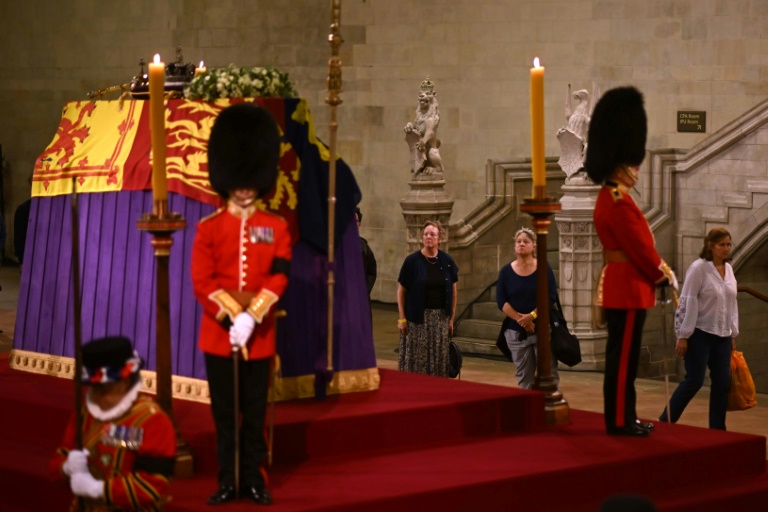
Britain’s longest-serving monarch, who died on September 8 aged 96 after 70 years on the throne, is at rest in the capital’s Westminster Hall ahead of Monday’s state funeral at Westminster Abbey.

After waiting in all weathers for more than 48 hours, the first public mourners were allowed into the vast mediaeval hall on Wednesday after the coffin left Buckingham Palace for the last time, in a ceremonial procession witnessed by tens of thousands.

Thursday marks the first full day of Queen Elizabeth II’s lying-in-state — a last chance to say a personal farewell to a much-loved sovereign admired around the world for her steadfast sense of duty.

The casket, draped in the Royal Standard flag and bearing the Imperial State Crown plus the Orb and Sceptre, was raised high on a platform, with tall, flickering candles at each corner.

The coffin was being guarded by soldiers in ceremonial uniform, in a constant vigil.

– ‘At peace’ –

In sombre scenes, many people stopped and bowed or curtsied towards the coffin. Others crossed themselves, or removed their hats.

Some prayed towards the casket or wiped away tears with tissues. Some brought their infants in pushchairs. Old soldiers stopped and gave one last salute to their former commander-in-chief.

Sue Harvey, 50, an accountant, was among those in tears after filing past the coffin.

“Inside it was really quiet, really calm, and incredibly emotional. A lot of people were in tears but there was a total silence. It was just so respectful,” she told AFP.

“I wanted to make sure I did see her no matter how long the queue was going to be, because I never met her when she was alive.”

Vickie Wicks, 36, a clinical paramedic specialist who took the day off work, was also in tears after leaving the hall.

“The guards were watching her one last time at the four corners of the coffin. It was beautiful,” she said. “She was at peace.”

Nina, a 40-year-old performer, wanted to say thank you for Elizabeth’s life of unswerving service to the nation.

“In this place, you can’t escape the magnitude of who she was. I got really emotional — and I was not the only one,” she said.

– ‘This is what we do’ –

The queue snaked back for nearly three miles (five kilometres) along the Thames river bank on Wednesday evening as mourners braved hours of waiting for their chance to see the late monarch.

Adam Armendariz, 35, a sales manager from London, joined the back of the line with his colleagues.

“She gave so much to us and the world,” he said. “I think it’s the minimum that we can do to queue for a few hours to see her rest.”

Jacob Lovewell, 29, who works in marketing, had only a large bottle of water with him.

“We British, this is what we do: queue,” he said. “It’s the end of an era and the beginning of a new one.

“I’ve never seen the queen, I’ve never met her, but this is an opportunity to say thank you and goodbye.”

– Solemn procession –

The coffin had been taken to Westminster Hall from Buckingham Palace earlier Wednesday.

To the strains of a military band playing funeral marches, King Charles III led the royal family in procession behind a horse-drawn gun carriage bearing the casket.

King Charles — Queen Elizabeth’s eldest son — his siblings, and his own sons, Princes William and Harry, walked at a carefully choreographed 75 steps a minute behind the gun carriage.

The sight of the new king’s two grief-stricken sons inevitably evoked memories of 1997, when William and Harry, then aged just 15 and 12, walked, heads bowed, behind the coffin of their mother, Diana, princess of Wales.

From the Elizabeth Tower at the Houses of Parliament, the Big Ben bell tolled out each minute as the casket passed in front of hushed crowds lining the route. 

The grand procession through the flag-lined heart of London represented the latest step in 11 days of national mourning that will culminate with the funeral.

– Visits to Sandringham, Manchester –

William and his wife Kate will travel to Sandringham, the royals’ private winter retreat in Norfolk, eastern England, on Thursday to view the floral tributes left by members of the public at the Norwich Gates.

Sandringham is where the royal family gathers for Christmas, with members walking to the local church on Christmas Day and interacting with well-wishers.

King Charles, 73, was created Prince of Wales by his mother in 1958 and bestowed the title on his eldest son on his first full day as monarch on Friday.

The historic title is given to the heir apparent to the throne.

It will be the first engagement conducted by just the new Prince and Princess of Wales.

Queen Elizabeth’s youngest son Prince Edward, 58, and his wife Sophie were to visit Manchester in northwest England to view the civic book of condolence at the city’s central library.

They were also to view the floral tributes in St. Ann’s Square and meet members of the public who are volunteering at the site.

The square became a sea of flowers in 2017 following the Manchester Arena bombing, which killed 22 innocent people.

Finally they were to light a candle in memory of Queen Elizabeth at Manchester Cathedral.

The late monarch’s funeral will see hundreds of world leaders and global royalty pack the historic Westminster Abbey in the heart of the British capital.

US President Joe Biden has confirmed he will attend, as will French President Emmanuel Macron and Japan’s Emperor Naruhito.

Close Bitnami banner
Bitnami