World

Swedish PM resigns after right, far-right poll win

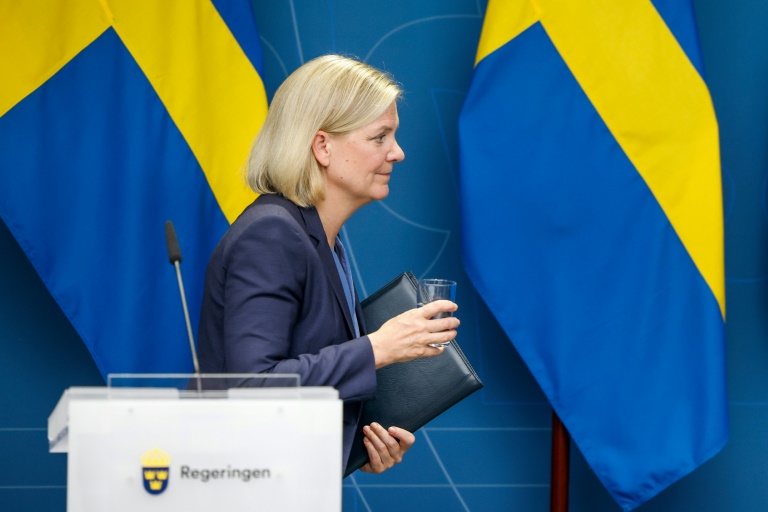
Swedish Prime Minister Magdalena Andersson on Wednesday announced that she would resign after an unprecedented right-wing and far-right bloc narrowly won Sunday’s election.

Out of the Swedish parliament’s 349 seats, the right-wing opposition was set to win 176, thanks in part to a surge by far-right Sweden Democrats (SD), with over 99 percent of districts counted.

Speaking at a press conference, Andersson, Social Democrats party leader, noted that it was a “narrow majority, but a majority nonetheless.

“So tomorrow I will hand in my resignation as prime minister, and the responsibility for the continued process will go to the speaker,” Andersson said.

Sunday’s elections were so close that tens of thousands of votes from abroad and those cast in advance had to be counted to validate the results.

– ‘Making Sweden great again’ –

Never before has a Swedish government relied on the support of the anti-immigration and nationalist SD, who became the big winners of the vote, by gaining more than three percentage points.

With 20.6 percent of votes counted so far the party emerged as Sweden’s second largest party behind the Social Democrats, which have dominated Swedish politics since the 1930s.

However, the post of Prime Minister will in all likelihood go to the leader of the Moderate Party, Ulf Kristersson, as SD leader Jimmie Akesson is unable to unite all four parties to head the government.

“I now begin the work of forming a new and strong government,” Kristersson said in a video posted to Facebook.

Kristersson, a former gymnast, led a major U-turn for his party when initiating exploratory talks in 2019 with the Sweden Democrats and then deepening their cooperation.

The Christian Democrats, and to a lesser extent the Liberals, later followed suit.

At the same time the thorny question remains of whether the far-right would be given cabinet posts, which Akesson said late Sunday was their “goal”.

In a post to Facebook on Wednesday, Akesson thanked “friends of Sweden”, around the country.

“Now the work begins of making Sweden great again,” the party leader said.

The Sweden Democrats rose up out of neo-Nazi groups and the “Keep Sweden Swedish” movement in the early 1990s, entering parliament in 2010 with 5.7 percent of votes.

– Difficult situation –

Long shunned as “pariahs” on the political scene, the party has registered strong growth in each subsequent election as it made efforts to clean up its image.

Its hardline stance on soaring gang shootings and integration set the tone in this year’s election.

The narrow majority also means a right-wing government’s hold on power would be very fragile, with the four parties fiercely opposed on a number of issues, especially the Liberals and Sweden Democrats.

“This is a difficult parliamentary situation”, Gothenburg University political scientist Mikael Gilljam told AFP.

“And then you have parties that don’t like each other, the Sweden Democrats and the Liberals” in the same right-wing bloc, he added.

In such a situation, a few disgruntled MPs could end up flipping the balance of power.

Behind the SD with 73 seats, 11 more than in the last elections in 2018, the Moderates have 68 seats (-2), while the Christian Democrats have 19 (-3) and the Liberals 16 (-4). 

On the left, the Social Democrats climbed to 107 seats (+7) thanks to the managing to get 30.4 percent of the vote, ahead of the Left and Centre party (24 seats each) and the Green Party (18).

Formally, the process of political changeover can only start after the announcement of Prime Minister Andersson’s resignation on Thursday. 

Then the speaker of the Riksdag, the Swedish Parliament, can give Ulf Kristersson the task of forming a majority between the four parties, opening a period of negotiations.

The election of the new head of government cannot take place before September 27 at the earliest, when parliament re-opens.

How the tide turned on data centres in Europe

Every time we make a call on Zoom, upload a document to the cloud or stream a video, our computers connect to vast warehouses filled with servers to store or access data.

Not so long ago, European countries were falling over each other to welcome the firms that run these warehouses, known as data centres or bit barns.

Wide-eyed politicians trumpeted investments and dreamt of creating global tech hubs.

But then the dream went sour.

The sheer amount of energy and water needed to power and cool these server farms shocked the public.

The industry sucked up 14 percent of Ireland’s power last year, London warned home builders that power shortages caused by bit barns could affect new projects, and Amsterdam said it simply had no more room for the warehouses.

Then things got worse.

The war in Ukraine helped spark an energy crisis across the continent, leaving consumers facing rocketing bills and countries contemplating energy shortages.

“Data centres will be a target,” critical blogger Dwayne Monroe told AFP, saying the focus would only grow if Europe cannot fix its energy crisis.

Grassroots campaigns and local opposition have already helped to halt projects this year by Amazon in France, Google in Luxembourg and Meta in the Netherlands.

The Irish government, while reaffirming support for the industry, put strict limits on new developments until 2028.

The data industry says it feels unfairly targeted, stressing its efforts to source green energy and arguing that outsourcing storage to bit barns has helped slash consumption.

– ‘Veil of shadow’ –

These arguments are playing out most spectacularly in Ireland.

Activists are campaigning on a broad range of topics and using local forums to push their case.

“They take up a huge amount of space but provide basically no employment,” says Madeleine Johansson, a Dublin councillor for the People Before Profit party, which is campaigning on the issue.

Johansson recently had a motion passed in her council area banning the centres, sparking an almighty row with the national government that is yet to be resolved.

Dylan Murphy of Not Here, Not Anywhere, one of several climate groups pushing the issue in Ireland, has filed a motion in his local council in Fingal calling for companies to reveal the kind of information they are holding.

“There’s a complete lack of transparency… about what data is actually being stored in these data centres,” he said, calling it a “veil of shadow”. 

The data industry says revealing that information would be impossible.

Michael McCarthy of Cloud Infrastructure Ireland, a lobby group, said activists had lost the argument on sustainability and were now throwing everything at the wall. 

“Data centres definitely are large energy users but they’re part of a cohort of larger energy users,” he said.

McCarthy and industry figures in other countries say the real problem is years of underinvestment in national energy infrastructure. 

He also pointed out that the industry in Europe had pledged to become carbon neutral by 2030.

And there are still countries hankering to get data firms to locate there — particularly Iceland and Norway.

– Questions over metaverse –

Against this backdrop, the tech industry continues to innovate new products that invariably require vast amounts of processing power and data storage.

Machine-learning tools, for example, are hugely energy hungry — Google said earlier this year they accounted for between 10 and 15 percent of its total energy usage.

The metaverse, an emerging concept for a 3D internet championed by Facebook owner Meta, would also be hugely energy intensive. 

Critical blogger Monroe reckons the metaverse will buckle under its own weight, partly because of its data requirements.  

“The construction of the metaverse would require Facebook to build out a distribution of data centres that would rival what Amazon, Microsoft and Google have done for their clouds,” he said.

Meta did not respond directly to questions about the metaverse but told AFP that it was “proud to build some of the most energy and water efficient data centres in the world”.

As far as the carbon footprint of such innovation goes, energy experts interviewed by AFP said it would be difficult to assess.

The metaverse, for example, could help to reduce emissions in other areas by reducing the need for travel.

An energy official who did not want to be named questioned whether data centres were the best target for criticism when cryptocurrencies were so wasteful.

While data centres used about one percent of global energy output in 2020, cryptocurrency mining used about half that amount, according to the International Energy Agency.

McCarthy said those who opposed data centres needed to reckon with just how embedded they had become in everyday life, particularly since the coronavirus pandemic.

“They facilitate how we can work and live online, that’s the reality of it,” he said.

10 killed in twin air strikes on Ethiopia's Tigray: hospital

Ten people were killed in a second day of air strikes on Ethiopia’s Tigray region Wednesday, hospital officials said, in attacks that came after authorities there expressed readiness for a ceasefire.

Twin drone attacks hit a neighbourhood in Tigray’s capital Mekele at around 7:30 am (0430 GMT), killing 10 and injuring more than a dozen others, two officials from the biggest hospital in the war-torn region said.

The air raids follow an announcement by Tigrayan authorities on Sunday that they were ready for talks led by the African Union (AU) to end almost two years of brutal warfare in northern Ethiopia.

On Wednesday, the Ethiopian government said it was “committed” to the AU-led peace process following calls by the international community for the warring sides to seize the opportunity for peace.

“Death toll raised to 10,” Kibrom Gebreselassie, a senior official at Ayder Referral Hospital in Mekele, told AFP via text message. In a later statement, he said 14 people were injured.

Fasika Amdeslasie, a surgeon at the same hospital, confirmed the death toll, adding that the first bombing injured two women followed by a second strike “on the people gathered to help and see the victims”.

“Among the victims, a father was dead and his son is taken to surgery,” he said on Twitter.

AFP was not able to independently verify the claims. Access to northern Ethiopia is severely restricted and Tigray has been under a communications blackout for more than a year.

– Renewed combat –

The reported attack followed another drone strike on Tuesday on Mekele University, which Tigrayan authorities said caused injuries and property damage.

Dimtsi Weyane, a TV network run by Tigrayan authorities, said its station was also hit on Tuesday, forcing it off air and “causing heavy human and material damage”.

“The regime in #Addis continues to defy any possibility for peaceful solution through show of force & air raids,” Kindeya Gebrehiwot, a spokesman for the Tigray People’s Liberation Front (TPLF), said on Twitter following Wednesday’s attacks.

Prime Minister Abiy Ahmed’s government has not commented on this week’s reported bombings, and AFP requests to officials were not answered.

Tigray has been bombed several times since fighting resumed in late August between government forces and their allies, and rebels led by the TPLF, which ruled Ethiopia for decades before Abiy took office in 2018.

The return to combat shattered a March truce and dashed hopes of peacefully resolving the war, which has killed untold numbers of civilians and triggered a humanitarian crisis in northern Ethiopia.

Both sides have accused the other of firing first, and fighting has spread from around southern Tigray to other fronts farther north and west, while also drawing in Eritrean troops who backed Ethiopian forces during the early phase of the war.

TPLF military boss Tadesse Worede on Tuesday said “Eritrean forces are in Sheraro”, a town in northwestern Tigray, where the rebels said they were resisting a major offensive by Ethiopian and Eritrean troops launched earlier this month.

– Diplomatic push –

Frantic diplomatic efforts are under way to end the war, with the new US envoy to the Horn of Africa, Mike Hammer, extending his visit to Ethiopia this month.

The offer by Tigrayan authorities to participate in AU-led talks removed an obstacle to negotiations with Abiy’s government, which had insisted the pan-Africa bloc based in Addis Ababa mediate any potential talks.

“The Ethiopian government is committed to the AU-led peace process and expressed hope that the EU would support efforts to end the conflict peacefully,” the foreign ministry quoted Deputy Prime Minister and Foreign Minister Demeke Mekonnen as saying Wednesday at a meeting with a visiting EU envoy.

It was the first official comment by the government after the Tigrayan authorities said they were ready to negotiate.

UN Secretary General Antonio Guterres, AU Commission chief Moussa Faki Mahamat, the East African bloc IGAD, and the European Union welcomed the offer by “the regional government of Tigray”.

Abiy’s government has declared the TPLF a terrorist group, and considers its claim to authority in Tigray illegitimate.

The UN human rights office has documented hundreds of civilian deaths from air strikes and drone attacks including on refugee camps, a hotel and a market.

It has warned that disproportionate attacks against non-military targets could amount to war crimes.

The government has accused the TPLF of staging civilian deaths from air strikes to manufacture outrage, and insists it only targets military sites.

Abiy, a Nobel Peace Prize laureate, sent troops into Tigray in November 2020 to topple the TPLF in response to what he said were attacks on federal army camps.

But the TPLF recaptured most of Tigray in a surprise comeback in June 2021.

It then expanded into the neighbouring regions of Afar and Amhara before the fighting reached a stalemate.

First public mourners view Queen Elizabeth II lying in state

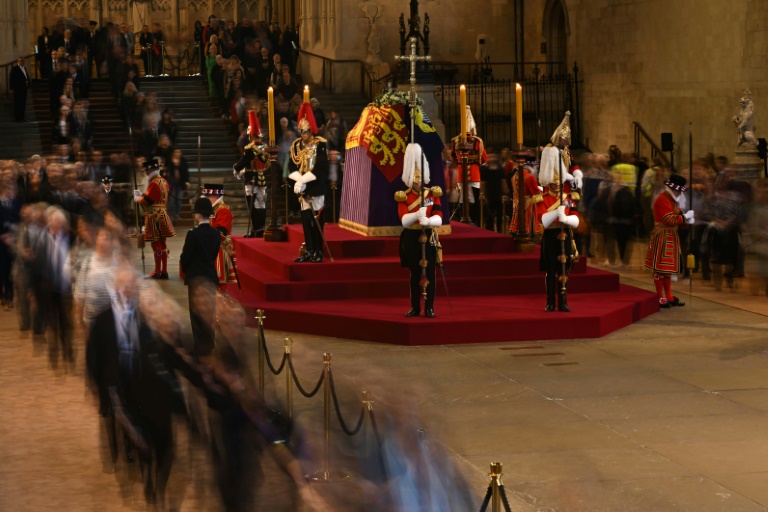
After a long and patient wait in the sun and the rain, the first members of the public, some in tears, gained access to Queen Elizabeth II’s lying-in-state Wednesday in the thousand-year-old Westminster Hall.

The hall in parliament was opened for the public — many of whom had braved downpours to camp out overnight — to pay their respects after the queen’s flag-shrouded coffin was brought from Buckingham Palace.

“Inside it was really quite calm and incredibly emotional. A lot of people were in tears, but there was total silence,” 50-year-old accountant Sue Harvey said after emerging from the cavernous hall.

“She is everything I have known. I wanted to make sure I did see her, no matter how long the queue was going to be,” she told AFP.

Prior to the start of the public part, the lying-in-state began with a short Anglican service before black-clad members of parliament including Prime Minister Liz Truss filed past the coffin, bowing their heads.

To the strains of a military band playing funeral marches, King Charles III had earlier led his family in procession behind a horse-drawn gun carriage bearing the coffin, before it was placed on a platform guarded by soldiers inside the most historic part of parliament.

The king, his siblings, and sons, princes William and Harry, walked at 75 steps a minute behind the gun carriage. Big Ben tolled out each minute as the casket — topped with the Imperial State Crown — passed in front of hushed crowds lining the route. 

“I remember when (the queen’s father) King George VI died, it was in winter, I was nine,” Ian Gammie, 79, said after watching the procession. 

“It’s like completing a journey: from watching the coronation of the queen in 1953 to paying tribute to her today,” he said. 

– Miles-long queue –

The grand procession through the flag-lined heart of London represented the latest step in 11 days of intricately choreographed national mourning that will culminate with the funeral on Monday of the UK’s longest-reigning monarch. 

The sight of the new king’s two grief-stricken sons inevitably evoked memories of 1997, when William and Harry, then aged just 15 and 12, walked, heads bowed, behind the coffin of their mother, princess Diana.

But it comes with the once-close brothers now estranged, after Harry’s move to the United States.

The public have been warned they will face an endurance test to see the queen’s coffin with lines that could tail back five miles (eight kilometres).

Hundreds of people were already queueing at around 8:20 am with those at the front having spent the night equipped with blankets, camping seats, tents and rain ponchos. 

Waiting in line earlier in the day, Brian Flatman, 85, said there was “no way” he would pass up the chance to pay his respects having missed the queen’s 1953 coronation. 

“I was 16, we got there before midnight, Hyde Park Corner, superb position, but very quickly I became suddenly ill and had to crawl all the way to South London,” he recalled. 

“This time there is no way I can miss that. I will dedicate a few seconds there (by the coffin) to her life of dedication. What an example.”

Strict rules and airport-style security measures have been put in place, with “far more” people expected than the 200,000 who filed past the coffin of the queen’s mother when she died in 2002, according to the government.

“It’s a massive challenge for the Metropolitan Police and for me personally, but we have been preparing for many, many years,” the newly appointed head of the London police force, Mark Rowley, told Sky News.

– UK tour – 

The body of the late 96-year-old queen, who died “peacefully” at her Balmoral estate in Scotland on Thursday, was flown to London aboard an RAF plane on Tuesday evening from the Scottish capital Edinburgh.

It was then driven to Buckingham Palace, past crowds of motorists who stopped their vehicles at the side of the road to catch a glimpse of the coffin, lit up in a specially built hearse.

The London procession mirrored a similar ceremony in Edinburgh on Monday when her coffin was driven through the hushed streets of the city to lie at rest at St Giles’ Cathedral.

There, some 33,000 people filed past the coffin overnight to Tuesday afternoon, the Scottish government said.

“Scotland has now bid our Queen of Scots a sad, but fond farewell. We will not see her like again,” said First Minister Nicola Sturgeon, who wants Scotland to separate from the United Kingdom.

After Scotland and England, Charles continued his tour of the four nations of the UK on Tuesday by visiting Northern Ireland for the first time as king. He visits Wales on Friday.

The 73-year-old new head of state has won wide praise in the British media for his dignified and often heartfelt reaction to his mother’s death, which has led to a rare moment of public unity in Britain.

He has seen his popularity recover since the death of his former wife Diana in a 1997 car crash — and his ratings have surged in recent days, according to a new survey on Tuesday. 

The mourning has also obscured — albeit briefly — the broader country’s sharp political divisions and a severe cost-of-living crisis that is expected to cause a major increase in poverty over the winter. 

– No invite for Putin –

Not everyone shares the public mood of sadness and remembrance sparked by the queen’s death, with royal fatigue increasingly evident on social media in the face of blanket media coverage.

British police have also faced criticism from civil liberties groups over their treatment of anti-monarchy protesters who have publicly challenged Charles’s accession to the throne.

Video footage and witnesses have drawn attention to police arresting or intimidating people who shouted slogans against the monarchy or held up placards reading “Not My King”.

The queen’s funeral will take place in Westminster Abbey, next to parliament, in front of 2,000 VIP guests, with the day declared a public holiday in Britain.

Hundreds of heads of state and government, as well as global royalty, are expected, but Russia, Belarus and Myanmar have not been invited to send representatives.

US President Joe Biden has confirmed he will attend, as will French President Emmanuel Macron and Japan’s Emperor Naruhito.

burs-jit/phz/gw

Biden tours Detroit Auto Show, highlighting electric vehicle push

A revived Detroit Auto Show kicked off in earnest Wednesday, with US car giants showcasing a mix of gasoline and electric vehicles (EV) ahead of an address by President Joe Biden.

Wednesday’s media day opened with presentations by General Motors and Stellantis brands ahead of the speech by Biden, who toured the showroom floor in his latest visit to Michigan, a critical presidential swing state.

The presidential visit has boosted the profile of the Detroit gathering, but Biden’s presence also forced a last-minute rejiggering of the schedule in the first Detroit show since 2019 following pandemic cancelations.

The gathering, shifted to fall from its old January time slot, is much smaller than in years past, with most foreign automakers and newer players like Tesla not presenting.

While gasoline-powered cars still dominate US roads, Detroit auto giants are unveiling more and more EVs as they pump billions of dollars in investment in a  bid to wrest control of a growing market from Tesla and newer upstarts amid concerns over climate change and petroleum dependency.

“People are on the precipice of a massive adoption of EVs,” Chevrolet Vice President Steve Majoros told AFP shortly before presenting the General Motors brand’s electric versions of top-selling trucks.

“More and more Americans are ready,” said Majoros, pointing to the boost to consumer confidence from the increased number of EV charging stations.

Chevy, which unveiled Wednesday a performance edition of its Tahoe gasoline-powered truck, plans this weekend to launch a new media blitz highlighting its electric vehicle offerings at different price points in ways that will lead to “mainstream EV adoption at scale,” Majoros told the gathering.

Stellantis brand Jeep released a 30-year commemorative edition of the popular Grand Cherokee SUV, as well as a new fifth-generation model that is the first Jeep plug-in hybrid.

– Corvette fan –

Midway through the morning, the Detroit convention center was cleared of journalists to secure the space for Biden, who was greeted by GM Chief Executive Mary Barra and other top GM officials before test-driving the Cadillac Lyriq, a luxury EV.

The US president said he liked the Lyriq, but took a particular shine to an Orange Corvette he had earlier examined, according to a White House pool press report.

“He said he’s driving it home,” Barra said of Biden’s reaction to the Corvette, a gasoline-powered vehicle. 

Biden, who also met with top brass from Stellantis and Ford, as well as labor and Michigan political leaders, is expected to tout major legislative victories in recent weeks on federal funding for semiconductor investment and climate change mitigation. 

A White House fact sheet highlighted a deluge of investment decisions by companies that have amounted to nearly $85 billion in investment on manufacturing of EVs, batteries, and chargers in the United States since Biden took office.

“The President’s economic plan has generated an American, EV manufacturing boom that is creating new economic opportunity and tens of thousands of good-paying and union jobs across the country,” the fact sheet said.

Biden has a long and generally warm relationship with Detroit giants after presiding as vice president over the bailouts following the 2008 financial crisis. 

As president, he has visited both GM and Ford.

Biden “has given a lot of kudos to the Detroit automakers,” said Jessica Caldwell, executive director of insights for the automotive research firm Edmunds.

“He’s been seen driving a lot of their products at the White House and all sorts of other places.”

– Sourcing rules –

But automakers have been griping about a provision in the just-passed Inflation Reduction Act that sets strict sourcing requirements for federal EV subsidies. 

The requirement is meant to prod automakers into using EV batteries produced in North America as well as critical materials sourced from North America or countries with which the United States has a free trade agreement.

Automakers are hoping officials in Washington may show flexibility in implementing the rule.

“There’s still a lot of guidance the government has to come forward with,” said Chevrolet’s Majoros. “We’re looking at future plans, we’re studying how things might adapt what we do from a sourcing perspective.”

Majoros said it is too soon to say whether the rule will prevent new subsidies for key vehicles, such as the Equinox, an SUV unveiled last Thursday with a starting price of $30,000, an affordable level in a pricey space.

The GM brand plans to begin modest production of the Equinox in 2023, but that 2024 would be a “big year” with higher output, Majoros said. Production will go still higher in 2025, but Chevy isn’t releasing specific targets.

Majoros said Chevrolet has capacity to “flex” output depending on demand, adding, “There’s a lot of questions about the rate at which industry will adapt.”

End of Covid pandemic in sight: WHO

The number of newly reported Covid-19 cases has dropped dramatically, the World Health Organization said Wednesday, urging the world to seize the opportunity to end the pandemic.

Newly reported cases of the disease, which has killed millions since being identified in late 2019, last week fell to the lowest level since March 2020, said WHO chief Tedros Adhanom Ghebreyesus. 

“We have never been in a better position to end the pandemic,” he told reporters. “We are not there yet, but the end is in sight.”

But the world needed to step up to “seize this opportunity”, he added.

“If we don’t take this opportunity now, we run the risk of more variants, more deaths, more disruption, and more uncertainty.”

According to WHO’s latest epidemiological report on Covid-19, the number of reported cases fell 28 percent to 3.1 million during the week ending September 11, following a 12-percent-drop a week earlier.

– ‘Underestimate’ –

But the agency has warned that the falling number of reported cases is deceptive, since many countries have cut back on testing and may not be detecting the less serious cases.

“The number of cases that are being reported to WHO we know are an underestimate,” Maria Van Kerkhove, the WHO technical lead on Covid, told reporters.

“We feel that far more cases are actually circulating than are being reported to us,” she said, cautioning that the virus “is circulating at a very intense level around the world at the present time”.

Since the start of the pandemic, WHO has tallied more than 605 million cases, and some 6.4 million deaths, although both those numbers are also believed to be serious undercounts.

A WHO study published in May based on excess mortality seen in various countries during the pandemic estimated that up to 17 million people may have died from Covid in 2020 and 2021.

Van Kerkhove noted that going forward there will likely be “future waves of infection, potentially at different time points throughout the world, caused by different sub-variants of Omicron or even different variants of concern”.

But, she added, “those future waves of infection do not need to translate into future waves of death”.

– ‘Seize this opportunity’ –

In a bid to help countries to do what is needed to rein in the virus, the WHO on Wednesday published six policy briefs.

Among the recommendations, the WHO is urging countries to invest in vaccinating 100 percent of the most at-risk groups, including health workers and the elderly, and to keep up testing and sequencing for the virus.

“These policy briefs are an urgent call for governments to take a hard look at their policies, and strengthen them for Covid-19 and future pathogens with pandemic potential,” Tedros said.

“We can end this pandemic together, but only if all countries, manufacturers, communities and individuals step up and seize this opportunity.”

WHO emergencies director Michael Ryan agreed.

“Even as the pandemic wanes, and as the number of cases may drop, we are going to have to maintain high levels of vigilance,” he told reporters.

“We still have a highly mutable, evolving virus that has shown us time and time again over two and a half years how it can adapt, how it can change.” 

Trial opens against Argentine ex-policeman accused of torture

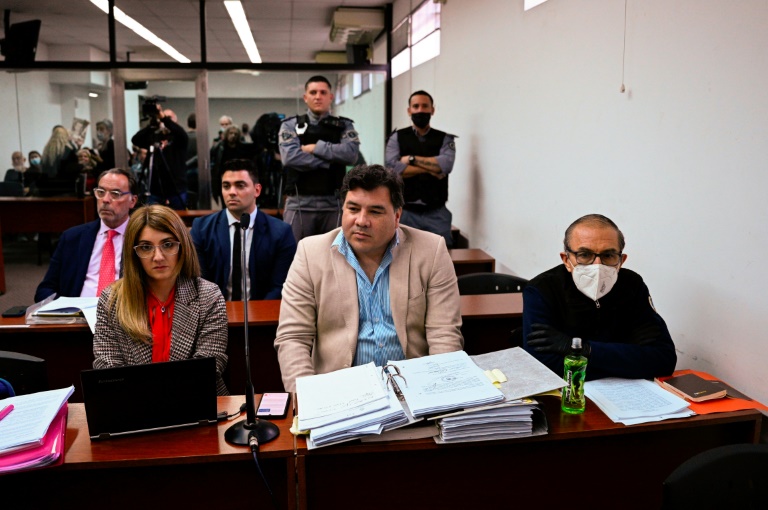
Argentine former police officer Mario Sandoval went on trial Wednesday for the alleged torture and disappearance of a young activist 46 years ago, during the South American country’s last dictatorship.

Sandoval, who was extradited in 2019 after a long exile in France, is suspected of taking part in the kidnapping, torture and disappearance of hundreds of people during the 1976-83 military dictatorship.

This particular case centers on such crimes apparently committed against then-24-year-old architecture student and leftwing activist Hernan Abriata in 1976.

Sandoval, 69, is a former Buenos Aires police inspector who was accused by survivors from the notorious Navy Mechanics School (ESMA), which served as the country’s largest detention and torture facility where 5,000 people were sent before they disappeared.

“It is a very long search for justice, 46 years,” lawyer Sol Hourcade told AFP. “The family identified those responsible for the kidnapping. We hope for a conviction.”

The family hopes Sandoval is sentenced to the maximum 25 years in jail.

Sandoval fled to France in 1985, two years after the military junta fell, and built a new life there as a defense and security consultant.

He even taught at the Institute of Higher Latin American Studies in Paris.

He gained French nationality in 1997 but that did not save him from extradition as he was not French at the time of the alleged crimes.

Sandoval arrived at the court handcuffed and with his face partially hidden by a medical mask.

The first part of the process was dedicated to the reading out of the charges against Sandoval, who denies the accusations and had petitioned France’s Council of State in a bid to prevent his extradition.

US indicts Iranians who hacked power company, women's shelter

The US Department of Justice announced an indictment Wednesday against three Iranian hackers who used ransomware to extort a battered women’s shelter and a power company.

Authorities said the trio launched ransomware attacks at “hundreds” of victims, including inside Britain, Australia, Iran, Russia and the United States, saying they extorted money “largely” for their own accounts, and not for the Iranian government.

But a separate US Treasury announcement of sanctions said the three were part of a larger hacking group tied to Iran’s powerful Islamic Revolutionary Guard Corps (IRGC), and the US State Department has offered a $10 million reward for information on them.

The indictment identified the three as Mansour Ahmadi, Ahmad Khatibi Aghda, and Amir Hossein Nikaeen Ravari.

It said that between October 2020 and August 2022, the men used known vulnerabilities in computer systems to attack multiple targets in the United States, stealing their data and demanding up to hundreds of thousands of dollars to have it returned.

Those included local governments, a shelter for victims of domestic violence, a children’s hospital in Boston, accounting firms and electricity generating companies.

The victims were not methodically chosen but were “targets of opportunity” whose computer systems were vulnerable to hacking, officials said.

“The indictment does not allege that these actors undertook these actions on behalf of the Government of Iran,” a senior Justice Department official told reporters.

The three “engaged in a pattern of hacking, cyber-theft, and extortion largely for personal gain,” FBI Director Chris Wray said in a separate statement.

But a concurrent announcement by the US Treasury said the three were part of a group of 10 Iranian hackers targeted with sanctions that was backed by the Revolutionary Guards.

“This IRGC-affiliated group is known to exploit software vulnerabilities in order to carry out their ransomware activities, as well as engage in unauthorized computer access, data exfiltration, and other malicious cyber activities,” the Treasury said.

Their actions align with those of known Iranian cyberattack operations which private cyber security groups have dubbed “APT35,” “Charming Kitten” and “Phosphorous,” Treasury added.

Timeline of Queen Elizabeth II's death

Here is a timeline of Queen Elizabeth II’s death, including her final days and the aftermath of her passing aged 96, after more than 70 years on the throne.

– September 6 –

The queen receives Boris Johnson at her Balmoral private retreat in the Scottish Highlands, to accept his resignation as prime minister.

Shortly afterwards, she receives Liz Truss, the new leader of Britain’s governing Conservative Party, and invites her to form a government as prime minister.

– September 7 –

Her final public statement, as queen of Canada, is a message of condolence for victims of the Saskatchewan stabbings.

“I mourn with all Canadians at this tragic time,” it ends.

The queen pulls out of an online meeting of the Privy Council formal body of advisers, during which Truss would have taken an oath and her new cabinet ministers formally sworn in.

“After a full day yesterday, Her Majesty has this afternoon accepted doctors’ advice to rest,” Buckingham Palace says.

– September 8 –

Prince Charles flies to Balmoral, arriving at 10:30 am (0930 GMT).

Buckingham Palace issues a statement at 12:30 pm saying that doctors were concerned for her health and recommended she remain under medical supervision.

“The queen remains comfortable and at Balmoral,” it says.

Truss is informed of her death at 4:30 pm.

Her death is announced publicly at 6:30 pm.

“The Queen died peacefully at Balmoral this afternoon,” the statement says.

Her daughter Princess Anne was with her during her last 24 hours.

Upon her death, her eldest son immediately becomes King Charles III.

– September 9 –

King Charles III and his wife Camilla, the Queen Consort, travel from Balmoral to Buckingham Palace in London where they greet mourners outside the gates.

The king meets Truss then pays tribute to his mother in a televised broadcast.

He renews her promise of lifelong service and pledges to uphold Britain’s constitutional principles.

He makes his eldest son Prince William the Prince of Wales.

A prayer service at London’s St. Paul’s Cathedral is attended by senior politicians. The ceremony sees the first official singing of “God Save The King” since 1952.

– September 10 –

King Charles III is formally proclaimed as the new monarch in a ceremony in London.

Twenty-one gun salutes are fired around the country.

In a rare show of unity, the king’s sons, princes William and Harry, and their respective wives Catherine and Meghan, view the floral tributes outside Windsor Castle.

– September 11 –

Queen Elizabeth II’s coffin is driven from Balmoral to the Palace of Holyroodhouse in Edinburgh, the monarch’s official residence in Scotland. Anne accompanies the cortege.

– September 12 –

King Charles III addresses both houses of parliament in Westminster Hall in London.

The king and queen consort fly to Edinburgh.

A procession takes Queen Elizabeth II’s coffin to St Giles’ Cathedral. Her four children march behind the hearse.

Members of the royal family attend a service celebrating her life.

King Charles III addresses the Scottish Parliament.

The first of 33,000 mourners file past the coffin in the cathedral.

For around 10 minutes, Queen Elizabeth II’s children mount the guard around her casket.

– September 13 –

The king and queen consort fly to Belfast.

The king meets Northern Irish lawmakers and delivers a speech. He shakes hands with Irish President Michael D. Higgins at a service at St. Anne’s Cathedral — the first foreign head of state to meet the new king.

Charles III returns to London.

Queen Elizabeth II’s coffin, accompanied by Anne, is flown from Edinburgh to London on a military transport plane. It is then driven to Buckingham Palace.

– September 14 –

The coffin is taken on a gun carriage from Buckingham Palace to Westminster Hall to lie in state. Tens, if not hundreds of thousands of people, are expected to pay their last respects by filing past her coffin.

Wall Street attempts recovery from previous day's rout

Wall Street stocks made modest gains Wednesday following the previous day’s rout on stronger-than-expected US inflation data that sparked fears of a prolonged campaign of Federal Reserve interest rate hikes.

The US inflation data still pulled European and Asian equities sharply lower, London the heaviest faller in Europe after news that UK inflation had slowed last month but remained close to a 40-year high.

The dollar edged down in choppy trade, as oil prices climbed.

US consumer price inflation (CPI) slowed slightly in August to 8.3 percent on an annual measure, but this trumped market expectations of about eight percent. Prices actually rose on a monthly comparison. 

– ‘Caught up’ –

European markets are “caught up in the negative sentiment that has taken hold across global markets,” said Victoria Scholar, head of investment at Interactive Investor.

“Hotter-than-expected US inflation figures prompted heavy selling on Wall Street” on Tuesday, she added, when the blue-chip Dow index tumbled almost four percent.

Global consumer prices have soared for months, exacerbated by Russia’s invasion of Ukraine — which has hiked energy and food costs — as well as owing to supply chain strains and Covid lockdowns in China.

The Fed has already instituted two consecutive 75-basis-point hikes, and a third such move is widely expected at its meeting next week.

After the latest US inflation data, some investors are even predicting the next Fed hike could be a full percentage point.

Aggressive rate tightening by central banks worldwide is denting economic activity as consumers and businesses face higher loan repayments.

Investors “still appear to be in a state of shock, trying to process how high the Fed will go with its policy rate and how low the economy and earnings growth will go as a result of the restrictive policy,” said market analyst Patrick O’Hare at Briefing.com.

In the UK, inflation slowed to 9.9 percent in August but remained almost in double digits.

The news boosted the pound on hopes of another interest rate hike next week from the Bank of England.

“There has been a fresh bout of anxiety on financial markets amid worries that inflation is still proving to be a formidable opponent to take down,” said Hargreaves Lansdown analyst Susannah Streeter.

In Asia, Tokyo led the region’s losses with the Nikkei plunging 2.8 percent.

Hong Kong stocks closed down more than two percent, with Chinese conglomerate Fosun hit hard by media reports that the group was under regulatory scrutiny.

But after slipping into the red early in the session, Wall Street stocks pushed modestly higher during morning trading on Wednesday.

A dip in US wholesale prices helped boost sentiment. 

The drop “suggests that inflation pressures are moderating albeit not as quickly as one would like,” said market analyst Michael Hewson at CMC Markets.

– Key figures at around 1330 GMT –

New York – Dow: UP 0.2 percent at 31,163.58 points

EURO STOXX 50: DOWN 0.5 percent at 3,567.56

London – FTSE 100: DOWN 1.5 percent at 7,277.30 (close) 

Frankfurt – DAX: DOWN 1.2 percent at 13,028.00 (close)

Paris – CAC 40: DOWN 0.4 percent at 6,222.41 (close)

Tokyo – Nikkei 225: DOWN 2.8 percent at 28,818.62 (close) 

Hong Kong – Hang Seng Index: DOWN 2.5 percent at 18,847.10 (close)

Shanghai – Composite: DOWN 0.8 percent at 3,237.54 (close)

Euro/dollar: UP at $0.9993 from $0.9970 late Tuesday

Pound/dollar: UP at $1.1564 from $1.1493 

Euro/pound: DOWN at 86.39 pence from 86.75 pence 

Dollar/yen: DOWN at 142.77 yen from 144.58 yen 

Brent North Sea crude: UP 2.1 percent at $95.10 per barrel

West Texas Intermediate: UP 2.4 percent at $89.42 per barrel

burs-rl/jj

Close Bitnami banner
Bitnami