World

Wall Street attempts recovery from previous day's rout

Wall Street stocks made modest gains Wednesday following the previous day’s rout on stronger-than-expected US inflation data that sparked fears of a prolonged campaign of Federal Reserve interest rate hikes.

The US inflation data still pulled European and Asian equities sharply lower, London the heaviest faller in Europe after news that UK inflation had slowed last month but remained close to a 40-year high.

The dollar edged down in choppy trade, as oil prices climbed.

US consumer price inflation (CPI) slowed slightly in August to 8.3 percent on an annual measure, but this trumped market expectations of about eight percent. Prices actually rose on a monthly comparison. 

– ‘Caught up’ –

European markets are “caught up in the negative sentiment that has taken hold across global markets,” said Victoria Scholar, head of investment at Interactive Investor.

“Hotter-than-expected US inflation figures prompted heavy selling on Wall Street” on Tuesday, she added, when the blue-chip Dow index tumbled almost four percent.

Global consumer prices have soared for months, exacerbated by Russia’s invasion of Ukraine — which has hiked energy and food costs — as well as owing to supply chain strains and Covid lockdowns in China.

The Fed has already instituted two consecutive 75-basis-point hikes, and a third such move is widely expected at its meeting next week.

After the latest US inflation data, some investors are even predicting the next Fed hike could be a full percentage point.

Aggressive rate tightening by central banks worldwide is denting economic activity as consumers and businesses face higher loan repayments.

Investors “still appear to be in a state of shock, trying to process how high the Fed will go with its policy rate and how low the economy and earnings growth will go as a result of the restrictive policy,” said market analyst Patrick O’Hare at Briefing.com.

In the UK, inflation slowed to 9.9 percent in August but remained almost in double digits.

The news boosted the pound on hopes of another interest rate hike next week from the Bank of England.

“There has been a fresh bout of anxiety on financial markets amid worries that inflation is still proving to be a formidable opponent to take down,” said Hargreaves Lansdown analyst Susannah Streeter.

In Asia, Tokyo led the region’s losses with the Nikkei plunging 2.8 percent.

Hong Kong stocks closed down more than two percent, with Chinese conglomerate Fosun hit hard by media reports that the group was under regulatory scrutiny.

But after slipping into the red early in the session, Wall Street stocks pushed modestly higher during morning trading on Wednesday.

A dip in US wholesale prices helped boost sentiment. 

The drop “suggests that inflation pressures are moderating albeit not as quickly as one would like,” said market analyst Michael Hewson at CMC Markets.

– Key figures at around 1330 GMT –

New York – Dow: UP 0.2 percent at 31,163.58 points

EURO STOXX 50: DOWN 0.5 percent at 3,567.56

London – FTSE 100: DOWN 1.5 percent at 7,277.30 (close) 

Frankfurt – DAX: DOWN 1.2 percent at 13,028.00 (close)

Paris – CAC 40: DOWN 0.4 percent at 6,222.41 (close)

Tokyo – Nikkei 225: DOWN 2.8 percent at 28,818.62 (close) 

Hong Kong – Hang Seng Index: DOWN 2.5 percent at 18,847.10 (close)

Shanghai – Composite: DOWN 0.8 percent at 3,237.54 (close)

Euro/dollar: UP at $0.9993 from $0.9970 late Tuesday

Pound/dollar: UP at $1.1564 from $1.1493 

Euro/pound: DOWN at 86.39 pence from 86.75 pence 

Dollar/yen: DOWN at 142.77 yen from 144.58 yen 

Brent North Sea crude: UP 2.1 percent at $95.10 per barrel

West Texas Intermediate: UP 2.4 percent at $89.42 per barrel

burs-rl/jj
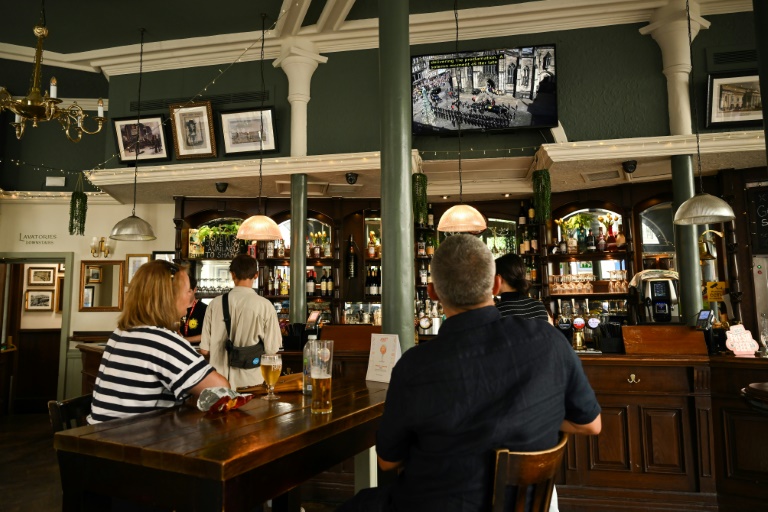
Shops shut for queen's funeral but pubs to raise glass

Many retailers will shut Monday for the state funeral of Queen Elizabeth II but thousands of pubs and bars will remain open for Britons to toast the late monarch.

The UK has declared a public holiday for the event due to be attended by world leaders and watched by millions across the globe on television and social media.

British schools and the London Stock Exchange will shut on the day, as is the case on every UK public holiday.

A number of hospital appointments have been postponed, while a day off work for millions of Britons is set to weigh on the UK economy, already headed for recession owing to sky-high inflation.

Britain’s biggest supermarkets led by Tesco and Sainsbury’s will close, as will major clothing store Primark.

Food-to-clothing retailer Marks and Spencer plans to open only a few shops that are situated close to the funeral and burial venues in and around London.

“Due to the millions of expected mourners travelling on the day, we will have a small number of stores open,” M&S said.

All UK branches of US fast-food giant McDonald’s will be closed until after the funeral ends.

Not everyone is happy at the closures, with disgruntled holidaymakers forcing Center Parcs to U-turn on its decision to remove guests from its UK venues for 24 hours.

Visitors had been told they would have to vacate the parks next Monday “as a mark of respect and to allow as many… colleagues as possible to be part of this historic moment”.

Following customer complaints, however, Center Parcs said guests still on holiday at its venues would be allowed to stay — but those not due to start their vacations until Monday would have to delay arrival by one day.

“We recognise that leaving the village for one night and returning is extremely inconvenient,” the company said in a message to customers seen by media.

“On reflection and having listened, we have made the decision to allow guests on longer duration breaks to remain… on Monday September 19.”

– Pubs ‘honour’ queen –

The UK’s biggest pub group said it plans to keep venues open and show the funeral on its televisions.

“The passing of Her Majesty Queen Elizabeth II is a momentous and sombre occasion,” Stonegate Group, which runs about 4,500 sites, said in a statement.

“Our managed pubs, bars and venues remain open and, where possible, will show the funeral… to honour her life and service,” added the owner of popular bar brands Walkabout and Slug & Lettuce.

Many other pubs plan to keep on serving, with Greene King opening all its venues in central London, allowing “communities to come together”.

Elsewhere, London’s Heathrow airport has flagged likely disruption to flights.

“We anticipate further changes to the Heathrow operation… when Her Majesty’s funeral is due to take place,” the hub said.

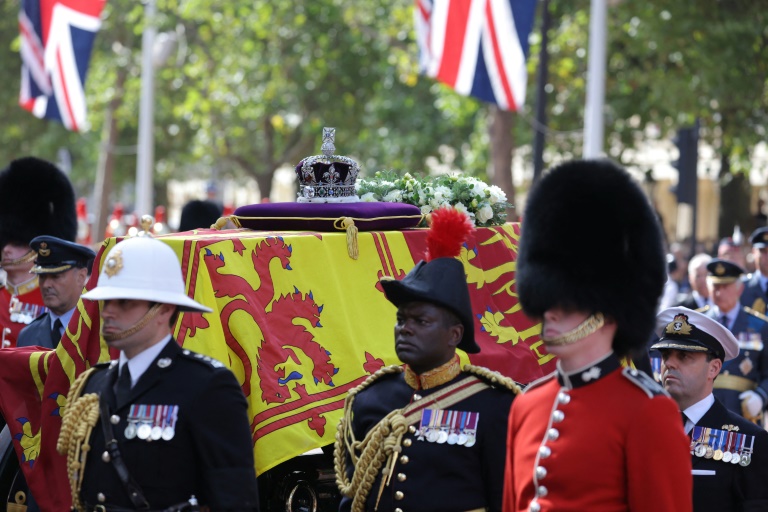
Air traffic above London was already restricted Wednesday for a procession of the queen’s coffin from Buckingham Palace to Westminster Hall, where the late monarch lies in state until her funeral in Westminster Abbey. 

The queen will be buried in Windsor, west of London.

Armenia accuses Baku of occupying fresh territory after clashes

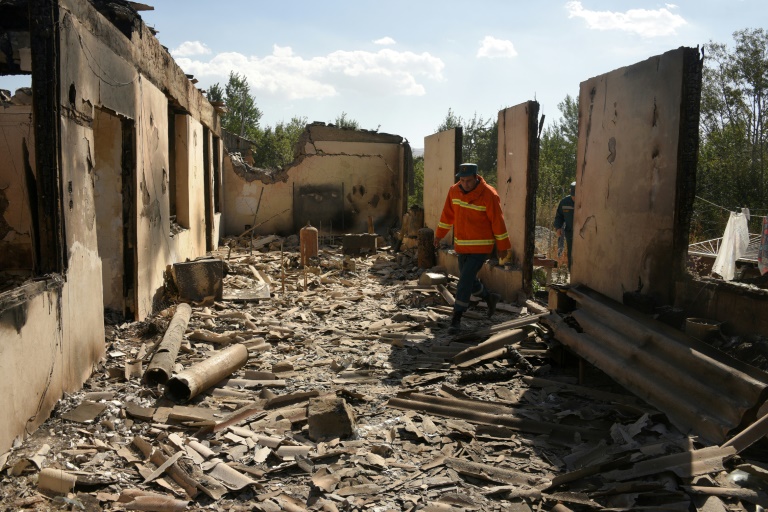
Armenia on Wednesday accused Azerbaijan of occupying a pocket of its land seized in fierce clashes between the warring neighbours that left more than 150 people dead, jeopardising fledgling peace talks.

The fighting that erupted on Tuesday came with Yerevan’s closest ally Moscow distracted by its nearly seven-month war in Ukraine.

The scale of hostilities significantly subsided on Wednesday, but Baku and Yerevan traded accusations of violating a fragile Russian-brokered truce which has rarely held.

Armenia said Azerbaijan’s shelling of its villages forced hundreds of civilians to flee their homes — a claim which Baku flatly denied.

Addressing lawmakers in Yerevan, Armenian Prime Minister Nikol Pashinyan said: “The enemy occupied 40 square kilometres (15 square miles) of Armenian land last May and has occupied 10 square kilometres more now.”

The neighbours fought two wars — in the 1990s and in 2020 — over the disputed Nagorno-Karabakh region, Azerbaijan’s Armenian-populated enclave.

Pashinyan said he cancelled his visit to the Uzbek city of Samarkand where he planned to attend a heads of state summit of the Shanghai Cooperation Organisation.

Azerbaijan’s commission on prisoners of war called for a ceasefire and said it was “ready to unilaterally hand over the bodies of 100 Armenian servicemen to Armenia.”

Yerevan confirmed Wednesday that 105 of its troops were killed in the recent clashes, while Baku reported the death of 50 its servicemen.

– Peace efforts ‘undone’ –

Russian President Vladimir Putin’s spokesman, Dmitry Peskov, said a delegation of the Collective Security Treaty Organisation — a Moscow-led grouping of ex-Soviet republics — was due in Yerevan later Wednesday.

On Tuesday, Armenia’s security council asked for military help from Moscow, which is obligated under the treaty to defend Armenia in the event of foreign invasion.

The Ukraine conflict changed the balance of force in the region as Russia — which deployed thousands of peacekeepers in the region after the 2020 war — is increasingly isolated.

The European Union has since led the Armenia-Azerbaijan normalisation process, which involves peace talks, border delimitation and the reopening of transport links.

Analyst Gela Vasadze of the Georgian Strategic Analysis Center said the latest escalation “has undone EU-led efforts to bring Baku and Yerevan closer to a peace deal.” 

“Brussels agreements are now practically nullified,” he said, adding that the clashes “have further radicalised public opinion in both countries.”

During EU-mediated talks in Brussels in May and April, Azerbaijan’s Ilham Aliyev and Armenia’s Nikol Pashinyan agreed to “advance discussions” on a future peace treaty.

Armenia’s rights ombudsperson, Kristina Grigoryan, said “at least 2,750 people were forced to flee their homes” as a result of Azerbaijani shelling.

– ‘Neither war, nor peace’ –

In the village of Sotk, resident Vardanush Vardanyan, 66, told AFP that “women and children were evacuated” after Azerbaijani forces shelled a nearby Armenian military base.

“I’ve stayed and watched houses burning as the shelling continued.”

In Yerevan, emotions ran high among relatives of wounded Armenian servicemen, as they gathered outside a military hospital late Tuesday.

“We must fight for our lands, for our homeland and for our country. Victory will be ours, if not today, then tomorrow. We are unbreakable,” one of the relatives, Sokrat Khachaturyan, 65, told AFP.

On Tuesday, Armenia appealed to world leaders for help over the latest fighting. 

The European Union, France, Russia, Iran, Turkey and the United States expressed concern over the escalation and called for an end to fighting.

The six weeks of fighting in autumn 2020 claimed the lives of more than 6,500 troops from both sides and ended with a Russian-brokered ceasefire.

Under the deal, Armenia ceded swathes of territory it had controlled for decades, and Moscow deployed about 2,000 Russian peacekeepers to oversee the fragile truce, which analyst Vasadze called “neither war, nor peace.”

Ethnic Armenian separatists in Nagorno-Karabakh broke away from Azerbaijan when the Soviet Union collapsed in 1991. The ensuing conflict claimed around 30,000 lives.

End of Covid pandemic in sight: WHO

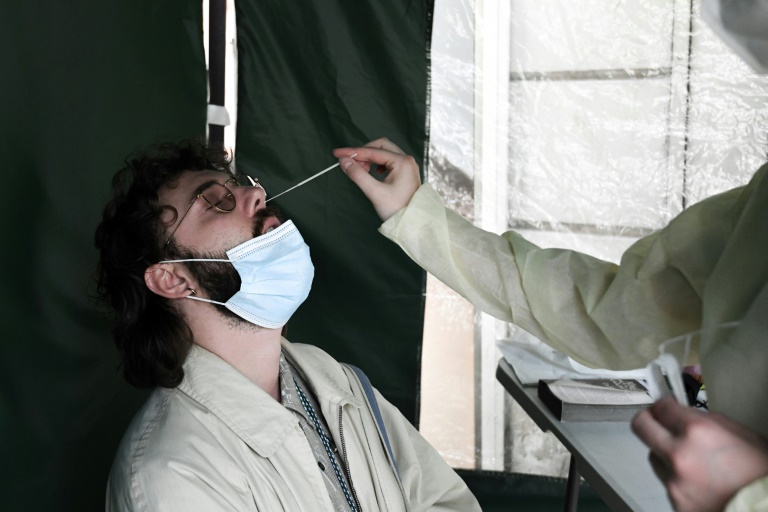
The number of newly reported Covid-19 cases has dropped dramatically, the World Health Organization said Wednesday, urging the world to seize the opportunity to end the pandemic.

Newly reported cases of the disease, which has killed millions since being identified in late 2019, last week fell to the lowest level since March 2020, said WHO chief Tedros Adhanom Ghebreyesus. 

“We have never been in a better position to end the pandemic,” he told reporters. “We are not there yet, but the end is in sight.”

But the world needed to step up to “seize this opportunity”, he added.

“If we don’t take this opportunity now, we run the risk of more variants, more deaths, more disruption, and more uncertainty.”

According to WHO’s latest epidemiological report on Covid-19, the number of reported cases fell 28 percent to 3.1 million during the week ending September 11, following a 12-percent-drop a week earlier.

– ‘Underestimate’ –

But the agency has warned that the falling number of reported cases is deceptive, since many countries have cut back on testing and may not be detecting the less serious cases.

“The number of cases that are being reported to WHO we know are an underestimate,” Maria Van Kerkhove, the WHO technical lead on Covid, told reporters.

“We feel that far more cases are actually circulating than are being reported to us,” she said, cautioning that the virus “is circulating at a very intense level around the world at the present time”.

Since the start of the pandemic, WHO has tallied more than 605 million cases, and some 6.4 million deaths, although both those numbers are also believed to be serious undercounts.

A WHO study published in May based on excess mortality seen in various countries during the pandemic estimated that up to 17 million people may have died from Covid in 2020 and 2021.

Van Kerkhove noted that going forward there will likely be “future waves of infection, potentially at different time points throughout the world, caused by different sub-variants of Omicron or even different variants of concern”.

But, she added, “those future waves of infection do not need to translate into future waves of death”.

– ‘Seize this opportunity’ –

In a bid to help countries to do what is needed to rein in the virus, the WHO on Wednesday published six policy briefs.

Among the recommendations, the WHO is urging countries to invest in vaccinating 100 percent of the most at-risk groups, including health workers and the elderly, and to keep up testing and sequencing for the virus.

“These policy briefs are an urgent call for governments to take a hard look at their policies, and strengthen them for Covid-19 and future pathogens with pandemic potential,” Tedros said.

“We can end this pandemic together, but only if all countries, manufacturers, communities and individuals step up and seize this opportunity.”

WHO emergencies director Michael Ryan agreed.

“Even as the pandemic wanes, and as the number of cases may drop, we are going to have to maintain high levels of vigilance,” he told reporters.

“We still have a highly mutable, evolving virus that has shown us time and time again over two and a half years how it can adapt, how it can change.” 

Smaller Detroit Auto Show kicks off ahead of Biden address

A revived Detroit Auto Show kicked off in earnest Wednesday with presentations by GM and Stellantis brands ahead of an address by President Joe Biden expected to highlight electric vehicle investments.

Chevrolet Vice President Steve Majoros spotlighted the General Motors brand’s electric versions of top-selling trucks.

These include the massive Silverado pickup truck — typically the nation’s second most popular vehicle after the Ford F-series — and the Equinox, unveiled last Thursday with a starting price of $30,000, an affordable level in a pricey space.

Chevy, which unveiled Wednesday a performance edition of its Tahoe gasoline-powered truck, plans this weekend to launch a new media blitz highlighting its electric vehicle offerings at different price points in ways that will lead to “mainstream EV adoption at scale,” Majoros told the gathering.

Stellantis brand Jeep released a 30-year commemorative edition of the popular Grand Cherokee SUV, as well as a new fifth-generation model that is the first Jeep plug-in hybrid.

The presentations opened the first Detroit car show since 2019 following pandemic cancelations. The gathering, shifted to fall from its old January time slot, is much smaller than in years past, with most foreign automakers and newer players like Tesla not presenting.

Biden is expected to tout major legislative victories in recent weeks on federal funding for semiconductor investment and climate change mitigation. 

A White House fact sheet highlighted a deluge of investment decisions by companies that have amounted to nearly $85 billion in  investment on manufacturing of EVs, batteries, and  chargers in the United States since Biden took office.

“The President’s economic plan has generated an American, EV manufacturing boom that is creating new economic opportunity and tens of thousands of good-paying and union jobs across the country,” the fact sheet said.

Automakers have been griping about a provision in the just-passed Inflation Reduction Act that sets strict sourcing requirements for federal EV subsidies. 

But Biden has a long and generally warm relationship with Detroit giants after presiding as vice president over the bailouts following the 2008 financial crisis. 

As president, he has visited both GM and Ford.

Biden “has given a lot of kudos to the Detroit automakers,” said Jessica Caldwell, executive director of insights for the automotive research firm Edmunds.

“He’s been seen driving a lot of their products at the White House and all sorts of other places.”

Queen Elizabeth II's funeral: What we know

The funeral service of Queen Elizabeth II at London’s Westminster Abbey on September 19 will be the culmination of decades of meticulous planning.

Here’s what we know so far about how the day will unfold.

– Return to the abbey –

The last time Westminster Abbey was used for a monarch’s funeral was for George II in 1760.

Since then, the preferred church has been St George’s Chapel at Windsor Castle, but Elizabeth opted for a larger venue.

On the morning of the funeral, the lying in state — begun at Westminster Hall in parliament on Wednesday — will continue until 6:30 am (0530 GMT).

The funeral will be conducted by the Dean of Westminster, David Hoyle, with Archbishop of Canterbury Justin Welby giving the sermon.

– Gun carriage –

At around 10:30 am a bearer party will transfer the coffin from the catafalque, a raised platform in Westminster Hall, to a gun carriage which will be waiting outside the north door of Westminster Hall.

The gun carriage will be pulled not by horses but by junior enlisted sailors — naval ratings — using ropes.

Members of the royal family will walk behind the coffin to the Great West Door of Westminster Abbey, where it will be carried up the west steps and through the nave to a platform in the choir. 

– Major security operation –

Westminster Abbey can hold up to 2,200 people. Those present will include family members, Britain’s Prime Minister Liz Truss, senior politicians, former premiers, more than 100 kings, queens and heads of state and other VIPs.

US President Joe Biden has confirmed he will attend, sparking a major security operation.

Biden will reportedly be allowed to travel to the funeral in his armoured presidential limousine, known as The Beast. 

Other leaders, such as French President Emmanuel Macron and Israeli President Isaac Herzog, are also expected to have their own transport. 

Others, however, will be transported to the abbey by shared bus. 

Invitations are expected to be sent to representatives of all countries with which Britain has diplomatic relations.

“Russia and Belarus have not been invited to Queen Elizabeth’s state funeral next Monday which will see more than 100 kings, queens, heads of state and other VIPs attend”, a government source said.

The source linked this to Russia’s invasion of Ukraine.

Military-run Myanmar and isolated North Korea have also not been invited, the source said on condition of anonymity.

There will be no attendance either by representatives from Syria, Venezuela or Taliban-run Afghanistan.

– Journey to Windsor –

After the funeral, the coffin will be drawn on the gun carriage from the abbey to Wellington Arch at London’s Hyde Park Corner from where it will continue to Windsor by hearse.

On arrival in Windsor, the hearse will make its way to St George’s Chapel via the Long Walk, a historic avenue, for a televised committal service.

The king and senior members of the royal family are expected to join the procession for the last stage of the journey from the Quadrangle in Windsor Castle.

St George’s is where Prince Harry and his wife Meghan married in May 2018. The funeral of the queen’s husband of 73 years, Prince Philip, was held there in April 2021. 

It is also regularly chosen for royal christenings.

– Final resting place – 

A private interment service held later will be attended only by close family members.

The queen’s final resting place will be the King George VI memorial chapel, which is an annex to the main chapel.

The queen’s mother and father — king George VI and queen Elizabeth the queen mother — were buried there as well as the ashes of her younger sister princess Margaret.

The coffin of Prince Philip will be moved from the royal vault to the memorial chapel.

EU plans 'comprehensive reform' of electricity market

The European Union presented plans on Wednesday to tap into the windfall profits of energy firms as part of measures to tame gas and electricity prices that have soared following Russia’s invasion of Ukraine.

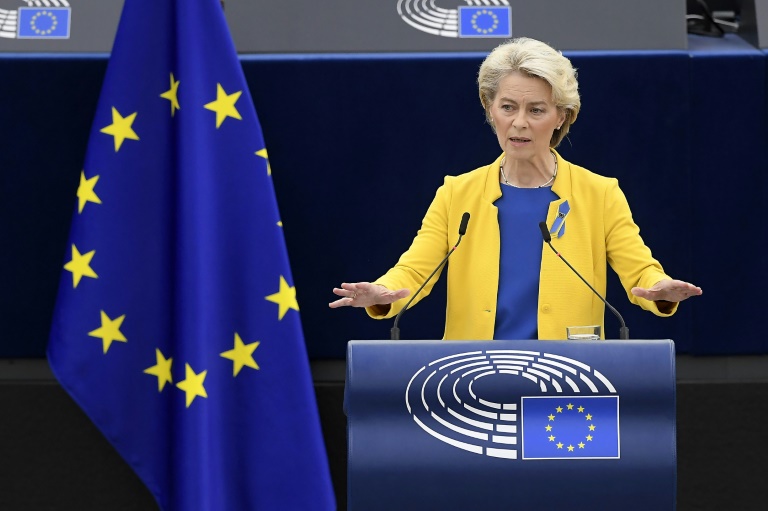
European Commission chief Ursula von der Leyen outlined a “deep and comprehensive” reform of the electricity market during her annual State of the European Union address in front of the bloc’s parliament in Strasbourg, France.

A cap on electricity producers’ profits would raise 140 billion euros ($140 billion) and “cushion” consumers from high prices, she said.

“These companies are making revenues they never accounted for, they never even dreamt of,” von der Leyen said, dressed in Ukraine’s blue and gold colours.

“In these times it is wrong to receive extraordinary record profits benefiting from war and on the back of consumers,” she said, adding that major oil, gas and coal companies would also “have to give a crisis contribution”.

The idea to tax profits by non-gas electricity providers is to divert the money to households and businesses to weather the situation.

Other steps laid out by von der Leyen include rationing energy, temporary state aid and decoupling the prices of gas and electricity.

She also announced the creation of a new bank designed to spur investment of up to three billion euros in hydrogen as a green alternative to fossil fuels.

The measures were in response to soaring energy costs as Europe painfully unhitches its decades-long dependency on Russian fossil fuels.

Sanctions on Russia and retaliation by Moscow by cutting off gas supplies have sent prices skyrocketing, leaving Europe to confront a difficult coming winter.

“Russia keeps on actively manipulating our energy market. They prefer to flare the gas than to deliver it,” von der Leyen said.

“This market is not functioning anymore.”

– Gas reserves –

EU countries have rushed to prepare for the winter, stocking up on gas while urging consumers and businesses to conserve energy in anticipation that Russia would cut off supplies.

The bloc’s gas reserves have hit 84 percent of capacity well ahead of an October deadline, von der Leyen said.

At the same time, she highlighted that the EU is pivoting to “reliable suppliers”, naming the United States, Norway and Algeria among them, and that in the longer term the EU wants greater reliance on renewable energies.

Countries have taken their own steps to cope with the crisis.

In a show of solidarity with Germany after Russia stopped deliveries to the country through the Nord Stream pipeline, French operator GRTgaz said Wednesday that new capacity for exports to France’s neighbour would be available from mid-October.

French Prime Minister Elisabeth Borne announced on Wednesday that her government would cap an expected increase in gas and electricity prices at 15 percent next year.

The new measures, however, are less far-reaching than caps introduced this year that limited domestic electricity price rises to four percent and fixed gas prices at October 2021 levels.

The Danish government unveiled its own 45-billion-kronor ($6-billion) plan to cap gas, electricity and heating bills to help households following a five-fold increase in energy prices.

– Kyiv trip –

Von der Leyen also announced plans for legislation to secure critical raw materials for the EU as it shifts towards greater use of electric vehicles and other more environmentally friendly technologies.

In her speech, she highlighted the stranglehold China has over resources such as lithium that are key to the energy transition.

“Today, China controls the global processing industry. Almost 90 percent of rare earths and 60 percent of lithium are processed in China,” she said in her address.

The proposed law would identify “strategic projects all along the supply chain” and “build up strategic reserves where supply is at risk”, she said.

As for Russia, the EU chief signalled that the bloc would maintain its sanctions pressure as long as Moscow waged its war in Ukraine.

“I want to make it very clear, the sanctions are here to stay. This is the time for us to show resolve, not appeasement,” she said.

Ukraine’s first lady Olena Zelenska attended the gathering in Strasbourg, receiving a standing ovation from lawmakers.

Von der Leyen told MEPs that she would travel to Kyiv to meet Ukrainian President Volodymyr Zelensky, her third trip to the Ukrainian capital since the war started, to discuss the continuation of European aid.

“For the first time in its history, this parliament is debating the state of our union while war is raging on European soil,” said von der Leyen.

All Shanghai passenger flights cancelled as typhoon hits

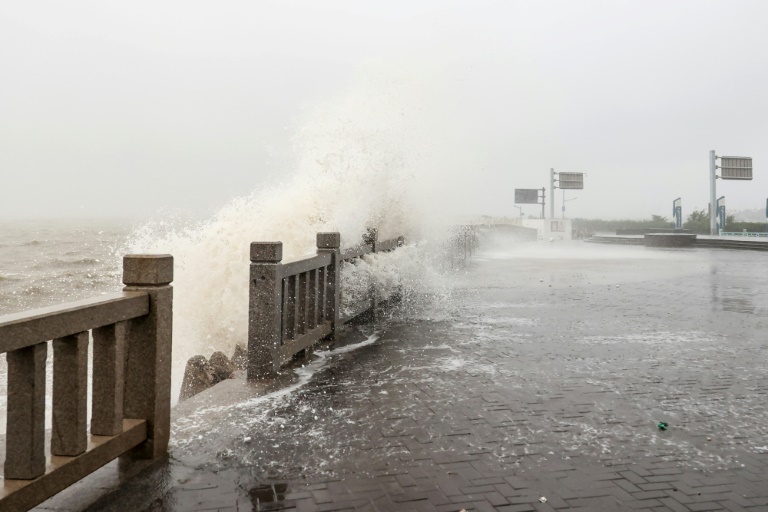
All passenger flights at Shanghai’s two international airports were cancelled Wednesday, the airport operator said, as Typhoon Muifa made landfall on China’s densely populated east coast.

The storm hit the city of Zhoushan in Zhejiang province at around 8:30 pm (1330 GMT), state news agency Xinhua said, bringing strong winds and threatening flooding along the coast around Shanghai — an area home to Asia’s largest commercial port.

The highest wind speed recorded on landfall was 42 metres per second, making it the strongest typhoon to make landfall in China this year, according to state broadcaster CCTV.

China’s Central Meteorological Administration issued its highest-level typhoon alert for the first time this year, saying Muifa would increase in intensity as it approaches the coast.

Gale force winds and heavy rains are forecast along China’s eastern seaboard until Thursday morning, the weather agency said. 

“Relevant areas should pay attention to the prevention of flash floods and geological disasters that may be caused by heavy rainfall,” it added.

The typhoon is expected to move from Zhoushan, home to the busiest port in the world in terms of cargo tonnage, through the coastal provinces of Jiangsu and Fujian carrying gusts of up to 172 kilometres (107 miles) per hour.

Shanghai Airport Group said in a social media statement that it “will announce flight adjustments at both airports to the public in a timely manner, in line with the typhoon’s impact”. 

The storm comes soon after Typhoon Hinnamnoor hit Shanghai and its neighbouring region last week, causing the suspension of Shanghai ferry services and school closures in parts of Zhejiang.

Zhejiang authorities ordered all fishing vessels to return to port by noon Wednesday, closed schools in three cities, suspended passenger ferry routes and shut tourist attractions as the province braced for Muifa’s landfall.

Temporary emergency shelters have been set up around Shanghai, CCTV reported, as well as an emergency evacuation zone spanning over 30 kilometres (18 miles) along the city’s coastal area. 

Muifa is the 12th typhoon to hit China this year, according to state media.

Its impact is expected to gradually decrease as it moves further north inland on Thursday, CCTV said.

Pope warns against using religion for political power

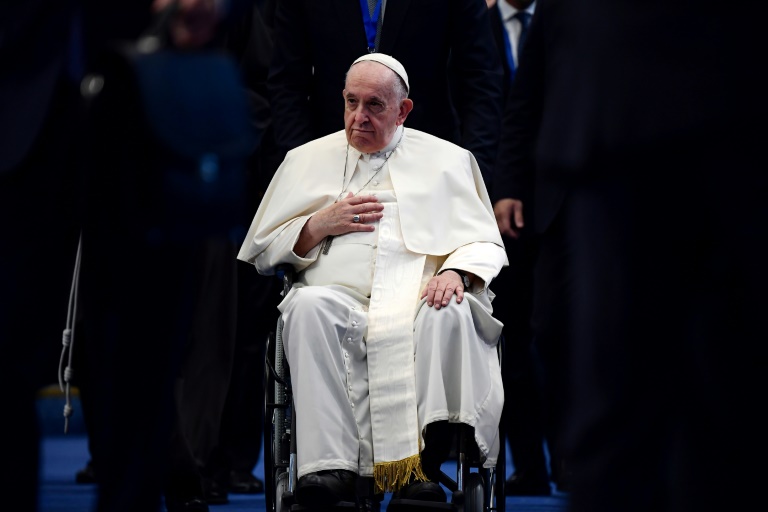
Pope Francis cautioned against leveraging religion for political power, addressing a religious summit in ex-Soviet Kazakhstan Wednesday, in what appeared to be criticism of pro-Kremlin Russian Orthodox leader Patriarch Kirill.

The Russian Orthodox Church meanwhile said it was ready for a new meeting between Patriarch Kirill and Pope Francis following weeks of diplomatic tensions sparked by the Ukraine war.

Pope Francis warned on Wednesday that faith should not be manipulated to defend conflict or buttress power.

“May we never justify violence. May we never allow the sacred to be exploited by the profane.

“The sacred must never be a prop for power, nor power a prop for the sacred,” he said, to applause from the crowd.

Over the summer, the pope went to so far as to warn Kirill not to become “Putin’s altar boy”, which irritated Moscow’s patriarch.

While the pope has previously called for peace in Ukraine, denouncing a “cruel and senseless war”, Kirill has defended Putin’s operation and arguing that Russia is fighting “evil forces” there.

The meeting the pope addressed on Wednesday was attended by around 100 delegations from 50 countries — but Patriarch Kirill was a notable absentee.

The pope did however speak with Kirill’s “foreign minister,” Metropolitan Anthony of Volokolamsk, for around 15 minutes.

– ‘Manipulations’ –

Anthony said a meeting between the two pontiffs was “a possibility,” provided it was “well prepared.”

“We need to see when, where (this would happen) and the most important thing is that we want something concrete to come out of the meeting, such as the joint call that we had in Havana,” he told journalists, referring to a historic 2016 meeting between Francis and Kirill in Cuba — the first since the schism in the Christian church in 1054.

Anthony said the pope himself thought a meeting was “needed” and regretted that a meeting planned in June in Jerusalem had been scrapped. 

“We were ready for this meeting, but it was cancelled by the Holy See,” after an announcement by Pope Francis in an interview to Italian daily Corriere della Sera in May.

Anthony stressed the need for the two religious leaders to “move forward”.

A message from Kirill, published on the Orthodox Church’s website and sent to participants of the meeting, said that “we have witnessed distortions of historical facts and unprecedented manipulations of mass consciousness.

“More than ever before, people find it difficult to navigate the flow of information, resist ideological indoctrination, and maintain a sober mind and peace of mind” Kirill said. 

Russia paints itself as a target of anti-Russian campaigns that it says “the collective West” is conducting to try to shore up waning influence.

But Kirill’s pro-war stance caused upheavals in the religious world, prompting the Moscow-backed branch of Ukraine’s Orthodox Church to sever ties with Russia.

It also put a damper on Kirill’s relationship with the Vatican: in March, the pope had already said that “the Church must not use the language of politics”.

– ‘A beautiful sign’ –

The pope gave a mass on Wednesday afternoon in front of a quiet crowd of 3,000 people, who he greeted from his “Popemobile”. 

“It can be sometimes challenging to be Catholic here, and that visit renews my belief,” 27-year-old Sagynysh Mukhametkaliyeva told AFP.

The population of Kazakhstan is 70% Muslim, 25% Orthodox and less than 1% Catholic.

Jeremy Convert, a 25-year-old French citizen said he was “touched” to “see worshippers from many different faiths, muslims, orthodox people, atheists” in the crowd.

“It’s a beautiful sign for Kazakhstan because the country has been working hard on finding unity,” he added.

The 85-year-old Argentinian pope, who is forced by knee pain to use a wheelchair, arrived on Tuesday in Nur-Sultan for his 38th trip abroad since becoming pontiff in 2013.

He is the second pope to visit Kazakhstan after John Paul II’s trip in September 2001.

Lufthansa back in private hands as Germany sells rescue stake

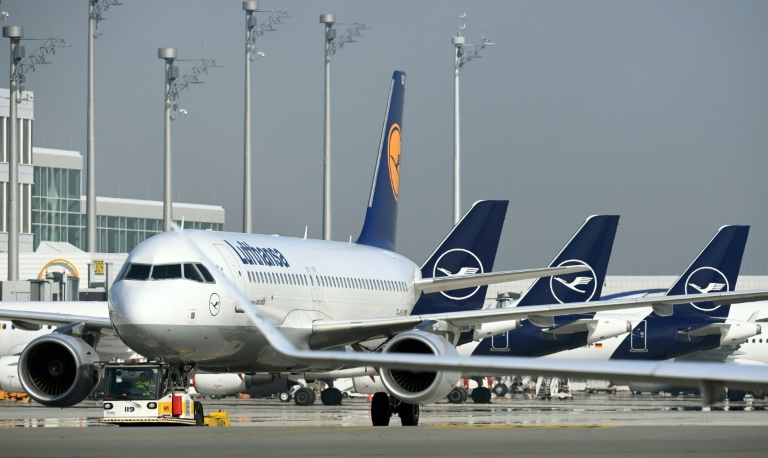
Lufthansa said Wednesday the German state had sold the stake it took in the airline as part of a rescue package at the peak of the Covid pandemic, and booked a healthy profit in the process.

In the spring of 2020, borders were shutting worldwide, forcing airlines everywhere to ground planes and put staff put on forced leave.

To save Lufthansa from bankruptcy, the German government took a 20-percent stake in the group under a nine-billion-euro (dollar) state aid package.

Under the deal, the government agreed to sell the stake by October 2023.

But with the airline’s finances stabilising as travel resumed, Berlin was able to start selling its holdings as early as November last year.

Lufthansa said the remaining 6.2 percent of the share capital was sold on Tuesday.

“This brings the stabilisation of Lufthansa to a successful conclusion,” said Carsten Spohr, its CEO.

“The stabilisation of Lufthansa was successful, and is also paying off financially for the German government and thus for the taxpayer,” he added.

The state paid 306 million euros for the stake and sold it for 1.07 billion euros — a profit of 760 million.

“With this gratifying balance, the WSF’s (Economic Stabilisation Fund’s) participation comes to an end and the company is once again in private hands,” said Jutta Doenges, who ran the fund.

Among investors who snapped up the shares was German billionaire Klaus-Michael Kuehne, who owns the logistics giant Kuehne + Nagel.

With the purchase, he raised his stake to 17.5 percent from 15 percent previously, his office said in a statement. 

Lufthansa in August reported its first net profit since the pandemic, booking 259 million euros in earnings for the second quarter as it benefited from pent-up demand for travel.

The group — which includes Eurowings, Austrian, Swiss and Brussels Airlines — made huge net losses of 6.7 billion euros in 2020 and 2.2 billion euros in 2021 as the pandemic shut down large parts of the airline industry.

Close Bitnami banner
Bitnami